
Structural Hollow Sections: Which Steel Tube Is Best for Frames and Supports?
A frame that twists under load is usually blamed on the design. More often, the wrong tube section, wall thickness or finish was supplied.
Short answer: A structural hollow section is a square, rectangular or circular steel tube used as a load-bearing member; square and rectangular SHS and RHS suit frames, columns and supports, and the section is chosen by shape, wall thickness, steel grade and coating.
That answer settles the vocabulary, not the purchase. Between the enquiry and the delivered bundle sit four decisions that decide whether the frame behaves the way the engineer intended: which profile shape suits the loading, which product standard the tube is certified against, whether the section arrives black or galvanized, and how wall thickness and connection details are specified so a fabricator can build without reworking the drawing. Each decision is cheap on paper and expensive on site, because a hollow section cannot be thickened once the coil has been formed and welded into a mother tube. This guide follows the same order a buyer meets them — profile, standard, coating, sizing, and inspection — and shows where the cost and the risk actually sit.
What Is a Structural Hollow Section and Why Does It Carry Load So Well?
A tube looks like a simple object, yet the closed profile is exactly what makes it stiff in every direction at once.
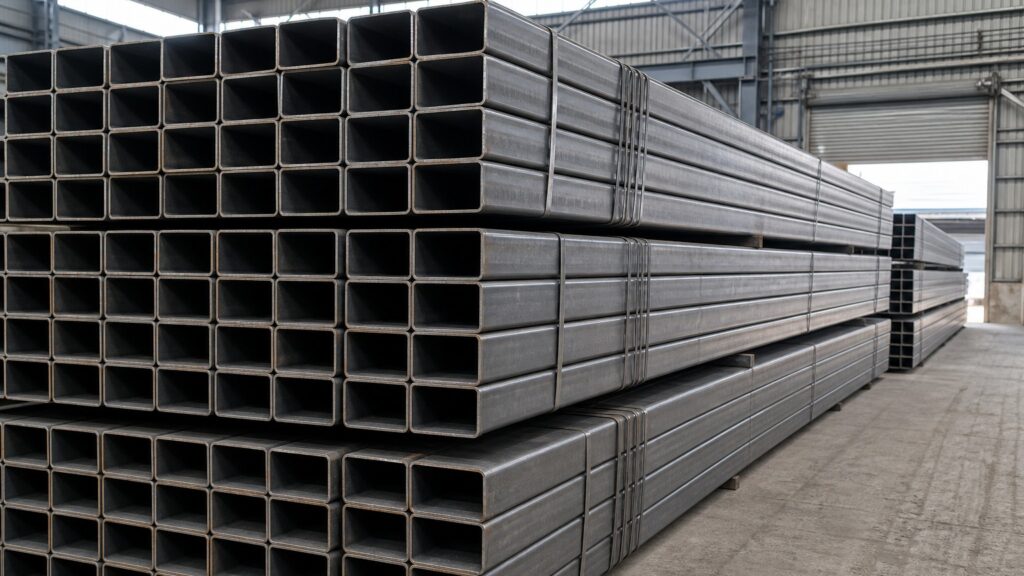
A structural hollow section is a closed steel profile — CHS, SHS or RHS — with a uniform wall around the perimeter, which gives equal strength on both axes, high torsional stiffness and a low weight per metre for the load carried.
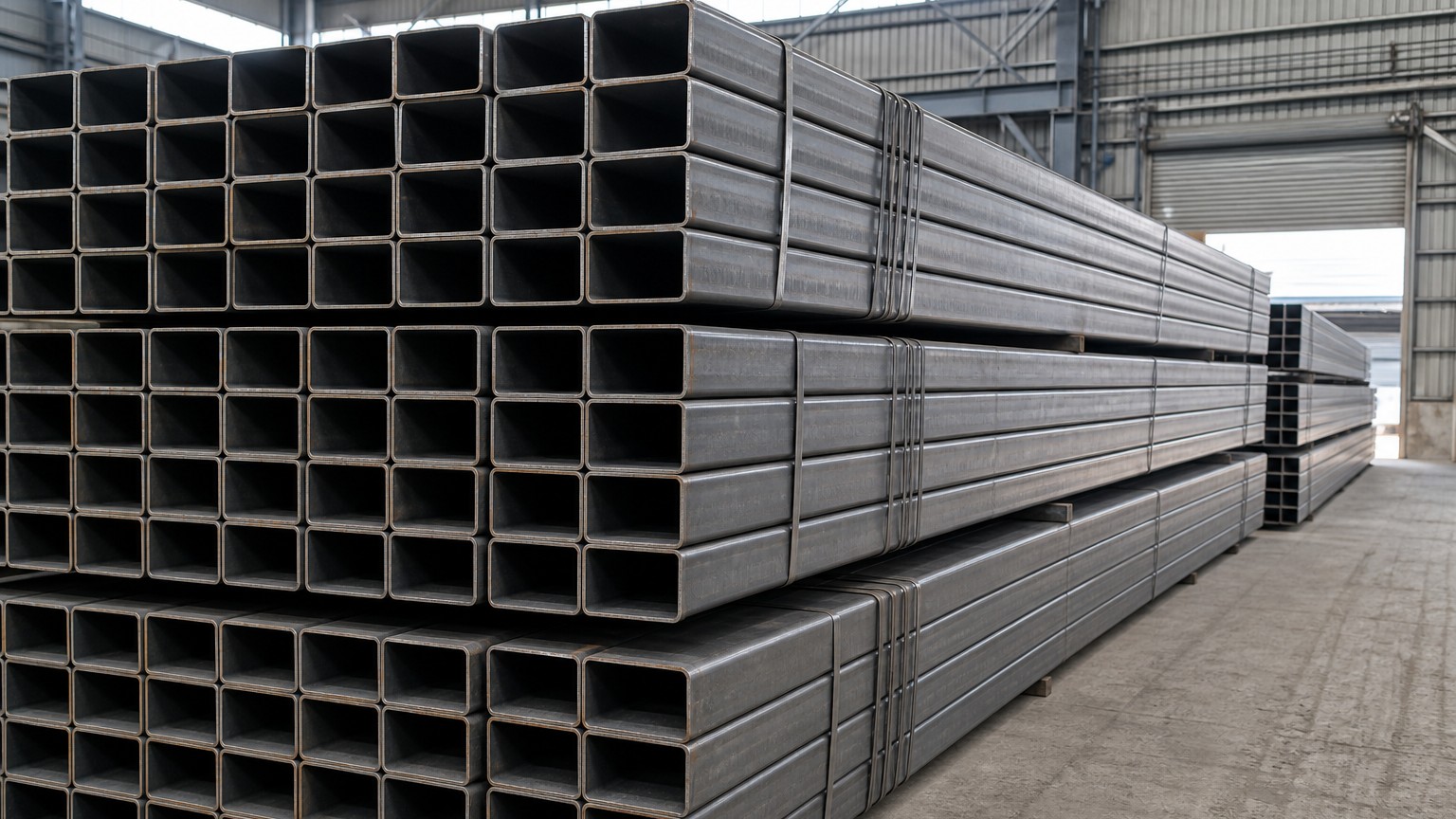
A hollow section is a closed profile, and closure is the whole point. An open section such as an I-beam concentrates material in two flanges placed as far as possible from the neutral axis, which is efficient when the direction of bending is known and constant. A tube spreads the same material around a continuous perimeter instead, so the second moment of area is similar in both principal directions, while the polar moment that resists torsion is far larger. That single geometric fact explains why tubular members are chosen for columns that may buckle in an unknown direction, for bracing that carries wind alternately in tension and compression, and for exposed architectural frames where a slender member must look deliberate from every angle. The same fact also explains the weight advantage. Because a closed section puts stiffness on the outside of the profile, a hollow section often matches the bending performance of a heavier open section while presenting a smaller painted area and fewer edges to protect. Closed profiles also cut the number of exposed corners that need protection, which matters on a coated frame: a tube presents two faces and two rounded corners rather than a run of flange tips and web junctions where zinc drains unevenly and paint films run thin.
The trade-off is on the inside. A closed section cannot be inspected from within, it cannot be painted from within, and it traps moisture if it is not detailed correctly. Internal surfaces rely on the section being sealed, on molten zinc reaching the bore during hot-dip galvanizing, or on drainage and ventilation holes placed so that condensation leaves as readily as air enters. Those holes belong in the fabrication drawing, not in a site instruction, because drilling a closed section after galvanizing exposes bare steel exactly where water will collect.
Why the closed profile resists torsion so efficiently
Torsion is carried by shear flow around the perimeter, and a closed cell provides a continuous path for that flow, while an open section can only resist twisting through the warping stiffness of its flanges. The practical consequence appears in frames that must resist wind or seismic action: a tubular brace or column can transfer the same torsional demand through a much lighter member, and the connection detail can remain compact because the load enters the tube from several directions at once rather than through one dominant flange.
Where a hollow section is the wrong answer
Tubular members are not automatically the economical choice. Where a beam spans in one direction only and the load path is fixed, a wide flange section usually places material more efficiently and costs less per metre. Hollow sections also demand more fabrication discipline, because a bolted connection on a closed profile needs through-bolts, welded plates or flow-drilled details, and a poor weld on a tubular joint is harder to inspect than a weld on an open section. Matching the section to the loading is therefore the first commercial decision, not the last.
Which Hollow Section Shape Fits Which Frame and Support Duty?
Choosing a profile is mostly a question of which direction the load arrives from, and how the member will be joined.
Square hollow sections suit columns, posts and two-way frames; rectangular hollow sections suit beams, lintels and supports where the depth must exceed the width; circular hollow sections suit bracing, poles and exposed members where wind loading and appearance matter most.

The three families sold as hollow structural sections are described in detail in the reference material on hollow structural sections, and the naming convention matters when you buy. In North America the profile is called HSS, with the size given as outside dimensions and the wall thickness quoted separately. In Europe and in markets that follow EN 10219 and EN 10210, the same products are called CHS, SHS and RHS, and the size is stated as a shape code followed by the dimensions — a 100×50 mm rectangular section with a 2.0 mm wall would be written as RHS 100×50×2.0. Importers who mix the two conventions on one bill of materials create the most common ordering error in this product family, because a nominal pipe size, an HSS size and an RHS size can describe three different tubes with the same shorthand. The practical safeguard is to write the shape code, the outside dimensions and the wall thickness on every line of the enquiry, and to state the tolerance basis alongside them, because a mill that receives only a nominal size will supply what it produces rather than what the drawing needs. Where a project mixes both systems, converting each line into a single convention before the enquiry leaves no room for a substituted profile.
Shape also changes fabrication cost. Square and rectangular sections present flat faces, which makes welded plates, bolted brackets and simple mitre joints straightforward, and they are preferred wherever a frame must be assembled quickly on site. Circular sections weld neatly at any angle, shed water and wind better, and are usually the most efficient for pure compression and torsion, but a bolted connection on a round tube needs a curved seat or a welded flange, which adds work. For most industrial frames, supports and racking, the rectangular section wins on balance: the deeper dimension can be oriented to carry the bending moment, while the flat faces keep the connection simple. The choice also interacts with detailing. A rectangular section can be rotated through ninety degrees without changing the member, so the stiff axis can be aimed at the dominant moment after the joint has been drawn, while a square section is indifferent to orientation and therefore offers no directional reserve. On long frames the wider, flatter face of a rectangular tube is also easier to splice with a bolted plate than a curved surface, which is why rectangular sections dominate industrial racking, mezzanine supports and machine frames.
Square, rectangular or circular in one line each
Square is the generalist: equal stiffness in both axes, ideal for columns and two-way frames. Rectangular is the specialist: put the long side where the bending occurs and save weight everywhere else. Circular is the aerodynamic and torsional choice: best wind behaviour, clean appearance, and the highest torsional stiffness per kilogram, at the price of more complex connections.
Why the corner radius is not a cosmetic detail
Rectangular and square tubes are formed with rounded corners, typically with an outside radius of roughly twice the wall thickness. That radius reduces the flat width available on each face, which matters when a bolted bracket is drawn to the full nominal face, and it determines how tightly a section can fit inside another for a telescopic joint. Specifying flat-width and radius limits in the enquiry is the cheapest way to avoid brackets that cannot be bolted and sleeves that will not slide.
What Do ASTM A500, A501 and EN 10219 Require From a Structural Steel Tube?
A tube that satisfies a standard is not automatically a tube that suits your project. The standard decides which product you are allowed to defend.
ASTM A500 covers cold-formed welded and seamless carbon steel structural tubing in rounds and shapes; ASTM A501 covers the hot-formed equivalent; EN 10219 covers cold-formed welded structural hollow sections, including grades such as S235JRH.
The first thing a standard fixes is the production route, because the route determines residual stress, dimensional tolerance and what a fabricator may do with the member. The ASTM A500/A500M specification describes cold-formed welded and seamless carbon steel structural tubing in round, square, rectangular or special shapes for welded, riveted or bolted construction of bridges and buildings, produced in welded and seamless forms with a periphery of 88 inches (2235 mm) or less and a wall thickness of 1.000 inch (25.4 mm) or less. The companion ASTM A501/A501M specification covers the hot-formed family, including black and hot-dipped galvanized square, round, rectangular or special shape tubing in grades A, B and C, with square and rectangular flats from 1 to 16 inches and round diameters up to 48 inches. The difference between the two is not a quality hierarchy but a manufacturing reality: cold forming produces tighter dimensional control and a work-hardened wall, while hot forming leaves a product with lower residual stress that behaves differently when it is cut, welded or bent. A note in A500 also flags the case that catches buyers out — dynamically loaded welded elements may need Charpy impact requirements, which A500 does not impose, so a project with low-temperature toughness criteria must be ordered against a standard that does.
The second thing a standard fixes is the grade range and the mechanical basis behind it. A500 grades A, B and C differ chiefly in minimum yield strength, and the same designation appears in both the welded and seamless product forms, which is why a quotation that names only the grade is incomplete: the product form must be named as well. In the European system the grade designation carries the yield strength directly, so S235JRH indicates a minimum yield strength of 235 MPa in a hollow section for room-temperature service. Buyers who translate one system into the other by matching yield strength alone will still miss the tolerance, the impact-testing regime and the marking requirements, all of which differ. The practical consequence for an importer is that the standard and the edition belong in the purchase order, together with any supplementary requirement, because the mill certificate must be issued against exactly what was ordered. Where the project also depends on corrosion performance, the section may be ordered in a galvanized condition, and the full galvanized structural hollow sections range is normally quoted with the standard, grade, coating mass and tolerance stated together rather than as a single line item.
Why the edition of the standard matters as much as the standard
Standards are revised, and a revision can change a tensile requirement, a tolerance table or a test frequency. A quotation that cites A500 without an edition is not a commitment, and a certificate issued to an older edition cannot be used to demonstrate compliance with a specification written against the current one. Putting the edition in the enquiry costs nothing and removes the most common documentary dispute in structural tube supply.
Reading a mill certificate without being misled
A certificate should identify the standard and edition, the grade, the product form, the heat number, the chemical analysis and the mechanical results for the tests that standard requires. What it should not do is substitute a generic statement of conformity for measured values. Where a project depends on impact toughness or on a specific coating mass, that result must appear as a number on the document, because a certificate is evidence only of what it actually records.
Does Galvanizing Change How You Specify a Structural Hollow Section?
Coating is often treated as a finish applied at the end. For a closed section, it is a design decision that has to be taken early.
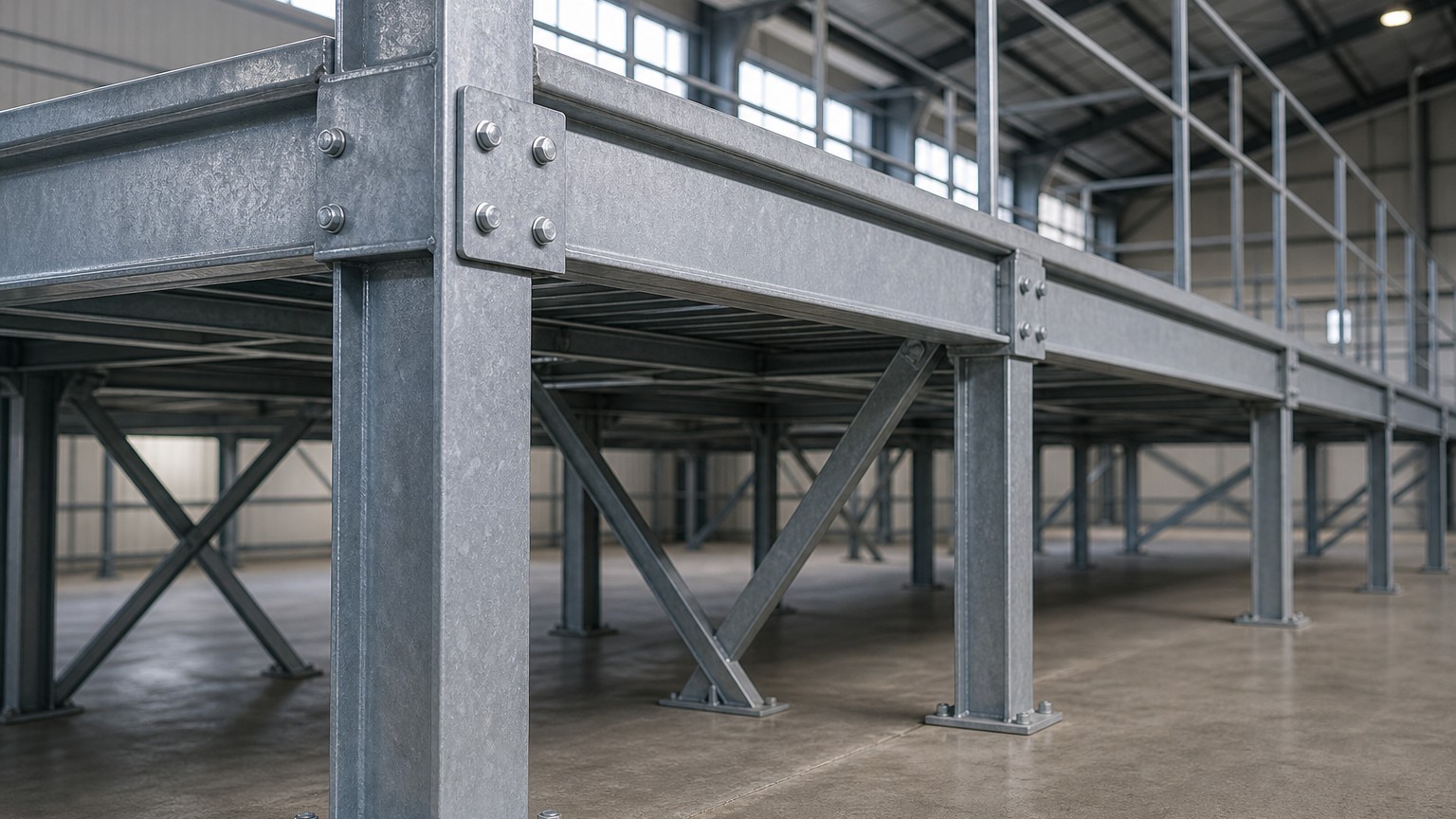
Galvanizing protects a structural hollow section with a zinc coating that corrodes sacrificially; the two usual routes are in-line zinc coating of the coil before forming, and hot-dip galvanizing of the finished member, which also coats the bore through drainage and vent holes.
Those two routes produce different products and different costs. In-line coating, sometimes described as pre-galvanized tube, applies the zinc to the flat coil on a continuous line before the strip is formed and welded, which leaves the weld and the sheared ends without a coating and limits the coating to what the line can apply evenly. Hot-dip galvanizing after fabrication immerses the finished section in molten zinc, so the coating forms a metallurgically bonded alloy layer on every surface the zinc can reach, including the inside of the tube, provided the fabricator has cut the correct drainage and vent holes. The coating mass is specified rather than assumed, as the industry reference material on tube products from the Steel Tube Institute sets out for hollow structural sections, and the commonly requested levels correspond to the Z180 and Z275 designations used for coated steel. The choice between them follows the exposure. An indoor frame that will be painted can do well with an in-line coated tube, while an outdoor support, a coastal installation or a member that will be buried or continually wetted calls for hot-dip galvanizing after fabrication, because the coating needs to be continuous and thick enough to survive the design life. The corrosivity of the environment, the expected service life and the maintenance interval belong in the same conversation as the section size, and the practical differences between the coating routes are set out in the comparison of how hot-dipped and electro-galvanized finishes behave in service.
Why galvanizing is a fabrication decision, not a purchase decision
A tube bought galvanized and then welded, drilled or cut on site loses its protection at every disturbance, and the repair is rarely as durable as the original coating. Deciding the coating route before the steel is cut means the drainage holes, the vent holes and the fabrication sequence can all be planned so that the zinc reaches every surface once, which is far cheaper than touching up a member that has already been erected.
Two details that decide whether a galvanized bore performs
A sealed section is not a protected section — condensed moisture inside an unvented tube creates a corrosion cell with nowhere to drain. Every enclosed length therefore needs a vent at the high point and a drain at the low point, positioned so the zinc can flow in and out during dipping, and every weld should be continuous rather than intermittent, because a gap between two closed surfaces allows a crevice that no coating can reach.
How Do You Size and Detail Hollow Sections for Real Structures?
Sizing a frame is not a search for the thickest wall available. It is a search for the lightest section that still passes the checks.
Size a structural hollow section by choosing the depth that limits deflection and bending stress, then the wall that prevents local buckling and carries shear; width-to-thickness limits, connection details, fire and corrosion allowances then set the final figure.
Depth is the first variable because it governs bending stiffness, and it is also the cheapest, since increasing the outside dimension of a tube adds stiffness while adding comparatively little weight. Wall thickness comes second, because it carries shear and controls local buckling, but it also raises weight, welding cost and the risk of a heavier member than the connection was designed for. That order of priorities is why a designer will often move from RHS 100×50×2.0 to a deeper section rather than to a thicker wall, and why the section properties published for each profile — area, second moment of area and radius of gyration — matter more than a rule of thumb. A worked case makes the point: a rectangular section with a long side of 100 mm and a 2.0 mm wall is a common choice for light supports, racking and frames, and its properties change disproportionately when the wall goes to 3.0 mm, because the added material sits close to the neutral axis and contributes less stiffness per kilogram than a deeper profile would. Buyers who specify a weight rather than a section frequently receive a tube that is heavier yet not stiffer. A deeper profile also keeps the connection compact, because the load enters the member over a longer lever arm instead of through a locally reinforced wall.
Detailing decides whether the sized section survives fabrication. Tubular joints concentrate stress where the wall is thinnest, so a load-bearing connection should be welded to a plate or a stiffener rather than directly to an unstiffened wall, and the weld procedure should be qualified for the grade and wall in use. Where a bolted connection is required, through-bolts or welded end plates avoid the crushing that a bolt bearing on a hollow wall can cause. Fire protection, coating thickness and the possibility of internal condensation all consume part of the section’s capacity or add weight, and each of those allowances should be added before the section is frozen. For a worked example of how a size, wall and coating are stated together in a real enquiry, this listing for a galvanized steel tube in 100×50 mm shows a rectangular section specified with its wall and coating mass rather than by weight alone.
Why deflection, not stress, usually sets the size
In most building frames the serviceability limit arrives before the strength limit, so the governing check is how far the member moves under working load rather than how much load it can carry before yielding. That is why a section can be perfectly adequate on a stress calculation and still be rejected on a deflection calculation, and why a deeper profile usually solves the problem more cheaply than a thicker wall.
Where a filled section changes the calculation
A hollow section filled with concrete combines the compressive capacity of the concrete with the confinement provided by the steel tube, which raises fire resistance and local buckling capacity. The trade-off is weight, and the need to design the connection around a member that can no longer be drilled or cut freely. Filling is therefore a decision taken at the drawing stage, not a remedy applied later.
What Should Importers Check Before the First Structural Tube Shipment?
The risk in structural tube supply is rarely a catastrophic defect. It is a quiet difference between the order and the bundle.
Before a first shipment, check the mill certificate against the ordered standard and edition, measure the outside dimensions and wall thickness on a sample, verify marking and traceability, confirm the coating mass where galvanized, and agree the packing and inspection rights in writing.
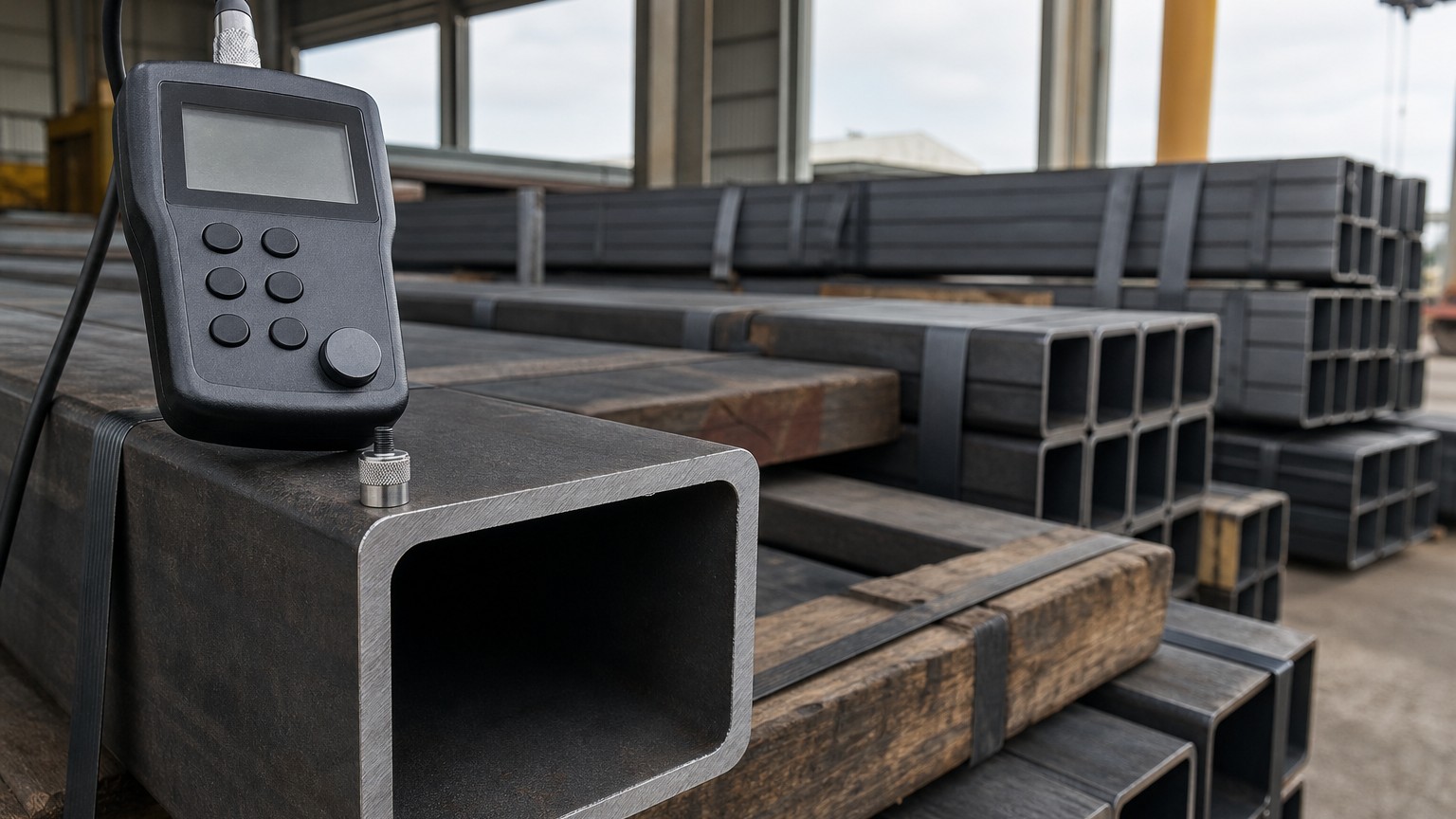
The first check is dimensional, because wall thickness is where the largest and least visible gaps appear. A supplier who saves material by running slightly under the nominal wall produces a bundle that looks correct, weighs slightly less and loses capacity out of proportion to the saving. The second check is documentary: the certificate should name the standard, the edition, the grade, the product form and the heat, and the markings on the tubes should correspond to the heats named on the certificate, because traceability that exists only on paper is not traceability. The third check is the coating, where the measured coating mass on a sample is the only way to confirm that a galvanized section was produced to the specified level rather than to a lighter default. Beyond the technical checks, three commercial habits reduce risk. Agree the inspection regime before the order is placed, so that a third-party inspector has the right of access and the criteria to apply. State the packing method, since a bundle of tubular sections is vulnerable to handling damage and to white rust when it is stacked without ventilation in a sea container. And keep the tolerance basis explicit — whether the dimensions are outside or inside, and whether the thickness is nominal or minimum — because a dispute about a fraction of a millimetre is best settled by the purchase order rather than by an argument after arrival. The full structural steel tube range supplied for frames and supports is quoted with the standard, grade, dimensions, coating and tolerance basis stated on the offer, and any specification you send to our export team is answered against those same items so the comparison stays like for like.
The three documents to request with the quotation
Ask for the mill certificate issued to the ordered standard and edition, the dimensional inspection record for the sampled tubes, and the coating mass result where the product is galvanized. A quotation that cannot state how those three records will be produced is describing an intention rather than a supply.
Why the first shipment deserves the most attention
Subsequent orders inherit the precedent set by the first one. If the first container is checked against the specification, sampled for wall thickness and closed out with matching documentation, every later shipment is measured against that standard and the relationship stays technical rather than negotiable. Where the wall or the coating varies later, the earlier records are what allow the difference to be proved.
Conclusion: Choose the profile for the load, buy to a named standard and edition, protect the closed section deliberately, and measure the wall before the bundle leaves the mill.