
Stainless Steel Plate Weight Calculation: What Is the Formula (with Chart)?
Getting stainless steel plate weight wrong blows the freight budget, overloads the container and delays the crane booking. Guessing is expensive; one formula and one density value fix it.
Stainless steel plate weight is length in metres × width in metres × thickness in millimetres × density in g/cm³. At 7.93 g/cm³ for 304, that is 7.93 kg per square metre per millimetre — about 137 kg for one 6 mm plate of 1200 × 2400 mm.
This guide follows the calculation in the order a buyer, estimator or inspector actually needs it: the base formula and why the units cancel, the density values that separate 304 from 316 and 430, a worked order line, a per-sheet chart for the mill sizes quoted most often, the conversion into price and container quantities, and the mistakes that quietly corrupt an otherwise correct figure. Every number below can be reproduced on a pocket calculator, and the density values come from published standard references rather than a supplier’s sales sheet.
What Is the Formula for Stainless Steel Plate Weight?
Only three inputs matter: length, width and thickness. Density becomes a fixed constant once the grade is known.
Weight (kg) = length (m) × width (m) × thickness (mm) × density (g/cm³). Because 1 g/cm³ equals 1000 kg/m³ and thickness is entered in millimetres, the two unit factors cancel exactly, so the density number doubles as the unit weight in kg per square metre per millimetre.
The formula is nothing more than a volume calculation wearing industrial clothes. A rectangular plate is a box whose volume is length × width × thickness, and mass is volume multiplied by density. Entering length and width in metres and thickness in millimetres already converts the third dimension into metres through a factor of 1/1000, and expressing density in grams per cubic centimetre instead of kilograms per cubic metre introduces precisely the same factor in the opposite direction. That cancellation is why the tidy formula works with mixed units and why no conversion table is required: 7.93 is simultaneously the density of 304 in g/cm³ and the weight in kilograms of a one square metre, one millimetre thick sheet of the same grade. The relationship is strictly linear in thickness, so a 3 mm plate weighs exactly twice a 1.5 mm plate of the same outline, and a 12 mm plate weighs four times a 3 mm plate. Linearity is what makes fast mental arithmetic possible on a factory floor or in a tender meeting. Weight per unit area is the other useful fraction. Divide weight by area and the answer becomes kilograms per square metre, which is the figure a buyer needs when plate is priced by area, when a cladding sheet is compared against a substitute material, or when a structural engineer checks a floor or roof loading against the steel specified. For 304, that figure is simply 7.93 kg/m² for every millimetre of thickness. Rounded values are acceptable for early estimating, but the exact density declared on the mill certificate is what belongs in a final shipping weight.
Working in inches instead of millimetres
If the drawing is imperial, use density in pounds per cubic inch: 7.93 g/cm³ converts to 0.2865 lb/in³, and 7.98 g/cm³ converts to 0.2883 lb/in³. Weight in pounds is then length × width × thickness in inches multiplied by that density. A quarter-inch plate measuring 48 × 96 inches weighs 0.25 × 48 × 96 × 0.2865, or about 330 lb. The metric and imperial routes agree once the units are converted carefully, and running both is the quickest way to catch a decimal slip before an enquiry is confirmed. For the reference values behind the arithmetic, the ASTM A240/A240M specification defines the chromium and chromium-nickel stainless steel plate, sheet and strip grades supplied for pressure vessel and general applications, while the background material on stainless steel explains why chromium-bearing alloys sit at a different density from plain carbon steel. When the outline and thickness are already fixed, the plate itself is ordered from a stainless steel plate range such as our stainless steel plate stock, where thickness, finish and mill size are quoted together.
Why Does Stainless Steel Density Change the Plate Weight?
Stainless steel is not one material. Nickel, molybdenum and chromium content shift the density, and 0.1 g/cm³ becomes tonnes on a large order.
Common published values are 7.93 g/cm³ for 304 and 304L, 7.98 g/cm³ for 316 and 316L, 7.80 g/cm³ for 201, 7.70 g/cm³ for 430 and about 7.80 g/cm³ for duplex 2205. Using another grade’s density is the most common source of small but repeatable weight errors.
| Grade | Density (g/cm³) | kg per m² per mm | Weight of one 1500 × 3000 × 3 mm plate |
|---|---|---|---|
| 201 | 7.80 | 7.80 | 105.30 kg |
| 304 / 304L | 7.93 | 7.93 | 107.06 kg |
| 316 / 316L | 7.98 | 7.98 | 107.73 kg |
| 430 | 7.70 | 7.70 | 103.95 kg |
| 2205 duplex | 7.80 | 7.80 | 105.30 kg |
Density varies because stainless steel is an alloy rather than a single element. The austenitic 300-series grades carry substantial nickel, and nickel is denser than iron, so 304 sits above 7.9 g/cm³ and 316 rises slightly higher still once molybdenum is added for pitting resistance. The ferritic 430 grade carries almost no nickel and more iron by proportion, which pulls its density down to about 7.70 g/cm³. Duplex grades are engineered around a roughly equal mix of austenite and ferrite and land between the two families. The commercial effect of these differences is small per plate and large per order. A 1500 × 3000 × 3 mm plate is 107.06 kg in 304 and 107.73 kg in 316L, a difference of less than one percent. Scale that to a 200 sheet order and the gap reaches roughly 130 kg, which is enough to push a container from compliant to overloaded and enough to change a freight quotation that was built on a declared tonnage. The practical rule is to fix the density at the moment the grade is fixed, before the chart is read, because every downstream figure — order weight, packing weight, price per sheet, container count — is derived from it. When a plate is supplied against a project specification, the mill certificate states the heat chemistry, and the density used for the shipping documents should follow that chemistry rather than a generic table. Reference density data for the stainless family is published by worldstainless, the international stainless steel development association, and regional guidance including grade selection and properties is collected by the British Stainless Steel Association. Both are worth checking when a project calls for a grade that sits outside the four common ones.
A density error that looks harmless in a quote
Weight errors are rarely arithmetic errors; they are grade errors. A quotation prepared on 7.85 g/cm³, the familiar carbon steel figure, understates a 304 plate by roughly one percent and a 316L plate by about 1.6 percent. Nobody notices per sheet. On a 25 tonne shipment the shortfall approaches 400 kg, and a buyer who has already booked freight against the lower figure absorbs the difference. Recalculating one line with the correct density takes less than a minute and removes that exposure entirely.

How Do You Calculate the Weight of a 304 Stainless Steel Plate Step by Step?
Take one order line: 304 stainless steel plate, 6 mm thick, 1200 × 2400 mm, 40 sheets. Four steps turn it into a shipping weight.
Convert the outline to metres (1.2 × 2.4 = 2.88 m²), multiply by thickness and density for 137.03 kg per sheet, multiply by the sheet count for 5,481 kg, then add packing and pallet weight before the container is planned.
The four steps are deliberately separated because each one can be checked independently. Step one is unit conversion: 1200 mm becomes 1.2 m and 2400 mm becomes 2.4 m, giving an area of 2.88 m². Step two combines area, thickness and density in a single multiplication: 2.88 × 6 × 7.93 = 137.03 kg, and that figure is the theoretical weight of one 6 mm sheet in 304. Step three multiplies by the order quantity, so 40 sheets come to 5,481.2 kg, conventionally written as 5,481 kg or 5.48 tonnes. Step four adds what the calculation deliberately omits: protective film, edge protection, steel strapping, timber pallets and, for some destinations, moisture barrier wrapping. A working allowance of one to two percent converts the theoretical figure into a realistic shipping weight, and the supplier’s actual packing specification should replace the allowance as soon as it is available. The same four steps run in reverse when an offer arrives. Divide the quoted total weight by the sheet count to recover the implied per-sheet weight, then divide again by area and thickness to recover the implied density. If the implied density does not match the grade that was quoted, the offer covers a different grade, a different thickness, or a nominal figure that has been rounded somewhere it should not have been. That single reverse check resolves most weight disputes before a purchase order is signed, and it costs nothing more than a calculator. Where the plate carries a specific finish and mill size, as with 304 stainless steel plate in 6 mm 2B finish, the dimension and density inputs above match the data a supplier publishes for that item, which makes cross-checking straightforward.
Adding packing weight without guessing it
Packing weight is the least predictable term in the calculation, yet it is the one that decides whether a container can be loaded as planned. A reasonable sequence is to calculate theoretical weight first, then add the supplier’s declared packing allowance, then compare the total against the container payload. Steel long before volume is the binding constraint on plate shipments, so a payload comparison made before the booking prevents a reload at the port.
What Do Common Stainless Steel Plate Sizes Weigh?
Most buyers need an answer rather than an algebra lesson. The table below gives 304 plate weight per sheet for the three mill sizes quoted most often.
For 304 stainless steel at 7.93 g/cm³, a 1219 × 2438 × 2 mm plate weighs 47.13 kg, a 1500 × 3000 × 3 mm plate weighs 107.06 kg, and a 1500 × 6000 × 8 mm plate weighs 570.96 kg.
| Thickness | 1219 × 2438 mm | 1500 × 3000 mm | 1500 × 6000 mm |
|---|---|---|---|
| 1.5 mm | 35.35 kg | 53.53 kg | 107.06 kg |
| 2.0 mm | 47.13 kg | 71.37 kg | 142.74 kg |
| 3.0 mm | 70.70 kg | 107.06 kg | 214.11 kg |
| 4.0 mm | 94.27 kg | 142.74 kg | 285.48 kg |
| 5.0 mm | 117.84 kg | 178.43 kg | 356.85 kg |
| 6.0 mm | 141.40 kg | 214.11 kg | 428.22 kg |
| 8.0 mm | 188.54 kg | 285.48 kg | 570.96 kg |
| 10.0 mm | 235.67 kg | 356.85 kg | 713.70 kg |
| 12.0 mm | 282.81 kg | 428.22 kg | 856.44 kg |
Reading the chart correctly is mostly about recognising that only two variables are in play. The first is area, which is why the 1500 × 3000 column is exactly one and a half times the 1219 × 2438 column at every thickness, and why the 1500 × 6000 column is double the 1500 × 3000 column. The second is thickness, which scales the weight in direct proportion. Combining the two explains why a 1500 × 6000 × 8 mm plate at 570.96 kg weighs roughly twelve times a 1219 × 2438 × 2 mm plate at 47.13 kg. Handling practicalities start to matter past about 300 kg per plate. A 1500 × 6000 × 8 mm plate needs mechanical lifting, and bundles of them need a crane or a heavy forklift rather than a light pallet truck, which changes the loading plan at the supplier’s yard and the unloading plan at the destination. The chart itself uses nominal thickness, and that distinction deserves attention. Rolled plate is supplied to a permitted thickness tolerance, and the tolerance band widens as the plate gets thicker, so a nominal 6 mm plate may legitimately run slightly heavy or light along its length. Theoretical weight therefore represents the nominal case, and the mill certificate states what was actually produced. Where finish and thickness are interdependent, particularly at the light end of the range, matching the chart against a defined thickness standard keeps the numbers aligned — the gauge boundaries and mill limits are set out in this guide to stainless steel sheet thickness selection. For estimating purposes the chart is more than accurate enough; for shipping declarations, replace the nominal thickness with the measured value.
How Do You Turn Plate Weight into Price, Freight and Container Load?
Weight is not the goal; it is the multiplier. Suppliers quote per tonne, forwarders bill per tonne, and cranes are limited per lift.
Multiply weight by the quoted price per tonne to check an invoice, divide the container payload by per-sheet weight to count how many sheets fit, and keep every lift below the crane or forklift rating marked on the bundle.
Three commercial calculations follow directly from the weight figure, and each one catches a different class of problem. The first is price verification. Stainless plate is normally quoted per tonne, so the invoiced amount should equal the theoretical or certified weight multiplied by the agreed rate. When a supplier quotes per sheet instead, convert to a per-tonne equivalent before comparing offers, because a per-sheet price obscures the fact that a thinner plate delivers less steel for the same handling and freight cost. The second is container planning, where weight and not volume decides the loading. A twenty-foot container is exhausted by steel long before its cubic capacity is full, so dividing the payload limit by the per-sheet weight gives the maximum sheet count, and the per-plate weight tells the loader whether a bundle can be moved with the equipment available on site. A worked figure makes this concrete: at 137.03 kg per 6 mm sheet of 1200 × 2400 mm, a 25 tonne payload allows about 182 sheets before packing is considered, and the packing allowance of one to two percent should be applied first so the count is not optimistic. The third is freight and insurance, both of which are rated on declared weight, and both of which are sensitive to a density figure taken from the wrong grade. The same logic applies across product lines, which is why quantity estimation for coils, tube and plate uses one consistent method rather than a separate rule per product — the approach described in this worked example of how coil weight is calculated is the same volume-times-density method, adapted to a coiled geometry. Keeping one method across the order means the tonnage on the packing list, the commercial invoice and the bill of lading can all be traced back to the same arithmetic.
Where the weight number shows up on documents
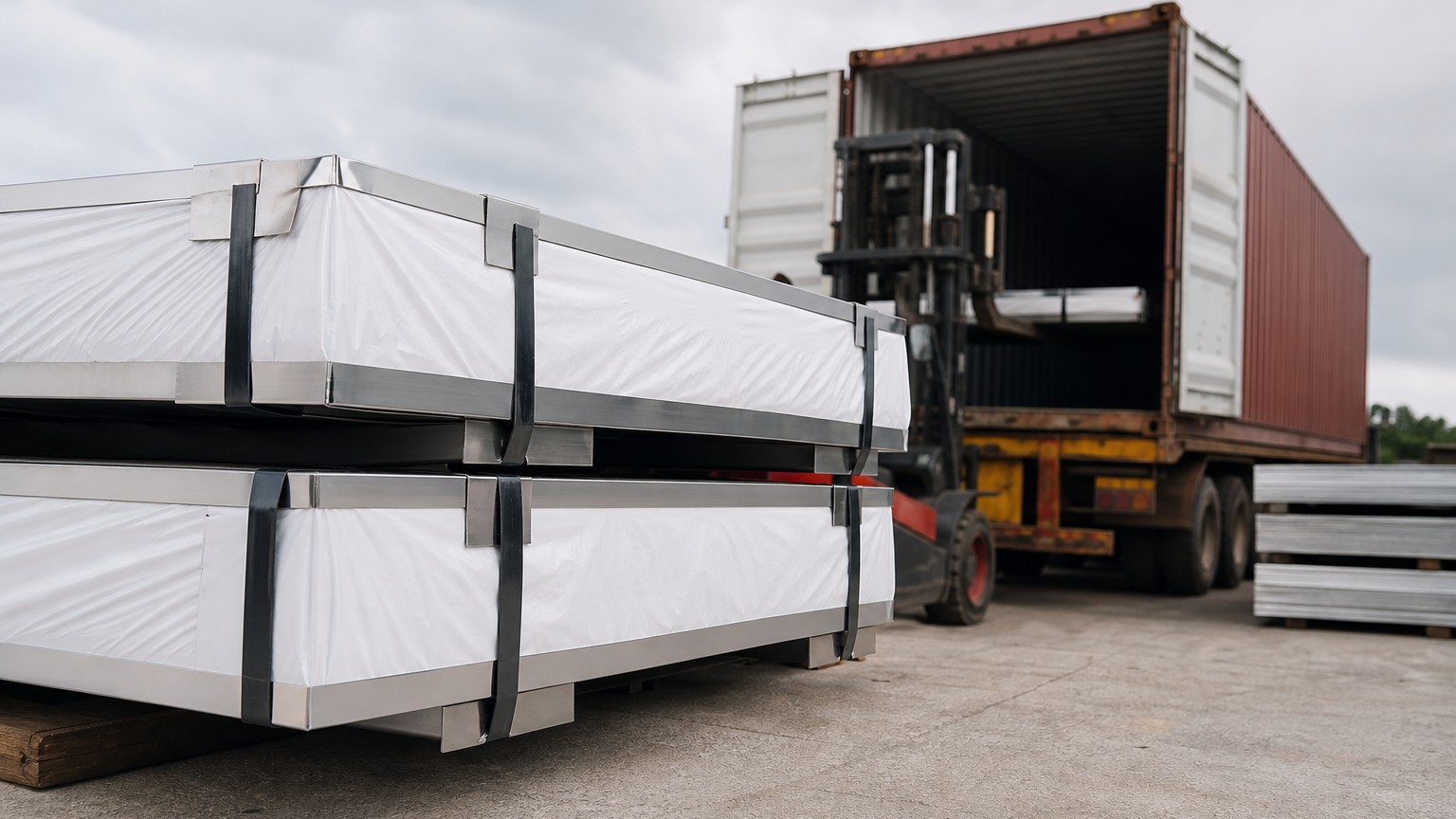
Net weight, gross weight and tare weight are three different declarations, and plate shipments fail inspection when they are confused. Net weight is the steel alone. Gross weight adds packing, pallets and edge protection. Tare weight is the container or truck itself. The theoretical calculation produces net weight, the packing allowance produces gross weight, and only the gross figure is compared against the payload limit. Declaring theoretical weight as gross weight on the bill of lading is a common and avoidable error.
What Mistakes Make Stainless Steel Plate Weight Estimates Wrong?
Six errors appear again and again in buyer spreadsheets, and every one of them can be caught before an order leaves the mill.
The usual offenders: applying 7.85 g/cm³ carbon steel density to a stainless grade, mixing inches with millimetres, ignoring mill thickness tolerance, forgetting packing and pallets, treating metric tonnes and short tons as equal, and using the sheet count from an old quotation.
The first two mistakes are unit and grade errors, and they are the most expensive because they scale across the entire order. A 1.6 percent density error on 25 tonnes is roughly 400 kg, and a millimetre-inch confusion is not a small error at all — it usually means a thickness that is 25 times too large or too small, which is caught immediately by anyone who reads the result. The third mistake is subtler: nominal thickness is a specification, not a measurement, and the tolerance band around it widens as the plate gets thicker. On a large tonnage order the difference between nominal and actual thickness can exceed the entire packing allowance, which is why the mill certificate rather than the sales sheet belongs in the final shipping weight. The fourth mistake is forgetting everything that is not steel. Pallets, strapping, edge protectors, interleaved paper, protective film and moisture barrier wrapping all add weight, and on a light-gauge order they can account for a larger share of gross weight than on a heavy plate order. The fifth mistake is unit-system drift at the commercial stage. A metric tonne is 1000 kg, a short ton is 907.2 kg and a long ton is 1016 kg, and quotations that switch between them without saying so produce invoices that look close but are not. The sixth mistake is stale quantity data. Buyers frequently recalculate weight from a new density while leaving an old sheet count in the formula, so the final tonnage is internally inconsistent. Working definition of a sound estimate: nominal thickness from the specification, density from the grade, area from the actual mill size, sheet count confirmed against the current take-off, packing from the supplier’s declared specification, and the whole figure reconciled once against the mill certificate after production.
A five-minute reconciliation routine
Before a plate order is confirmed, three checks remove nearly all weight risk. Recalculate one line by hand and compare it against the spreadsheet. Convert the total into both tonnes and short tons and confirm which unit the quotation uses. Then compare the gross weight against the container payload and the heaviest single lift against the handling equipment available at both ends of the route. If all three pass, the tonnage will hold from quotation through to the weighbridge.
For the sizes and grades most often ordered for tanks, vessels, cladding and general fabrication, the supplier’s published dimensions and the mill certificate together give everything the calculation needs. When the take-off is ready, send us your plate specification list — grade, thickness, mill size and quantity — and we will return per-sheet weights, bundle weights and the container count alongside the quotation, so the weight on your enquiry matches the weight on the bill of lading.
Conclusion: Stainless steel plate weight is one multiplication once the density is right. Use 7.93 g/cm³ for 304, 7.98 for 316, and the chart above for instant answers.