
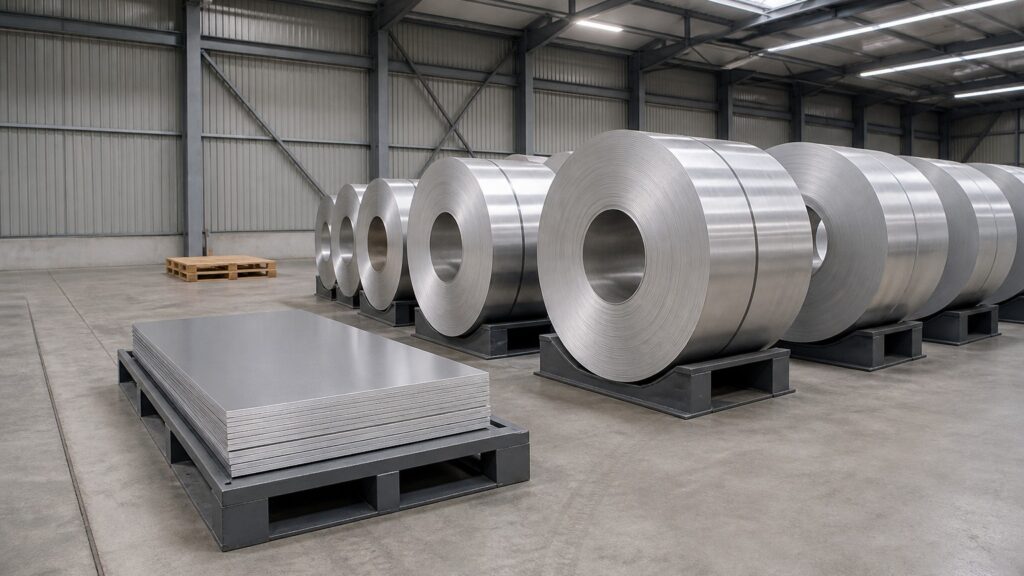
Aluminum Coil vs Sheet: How Do You Decide for Production?
A wrong call between coil and sheet shows up as scrap on your line. Choose the format first, and everything else — price, lead time, tooling — falls into place.
Short answer: Buy coil when your process runs continuously and can uncoil, because it costs less per tonne and arrives as one continuous length; buy cut sheet when your parts are flat, small-batch or hand-fed — where the extra cutting cost is cheaper than the handling coil demands.
Everything below follows one logic: match the delivered format to what your line already does well. We will look at how each format is produced, how the geometry of your parts forces the decision, where the numbers favour coil, where sheet wins, and which checks to run before you commit to a purchase order.
What Actually Separates Aluminum Coil from Aluminum Sheet?
Coil and sheet are the same metal delivered in two different geometries — and that geometry, not the alloy, drives most of the cost.
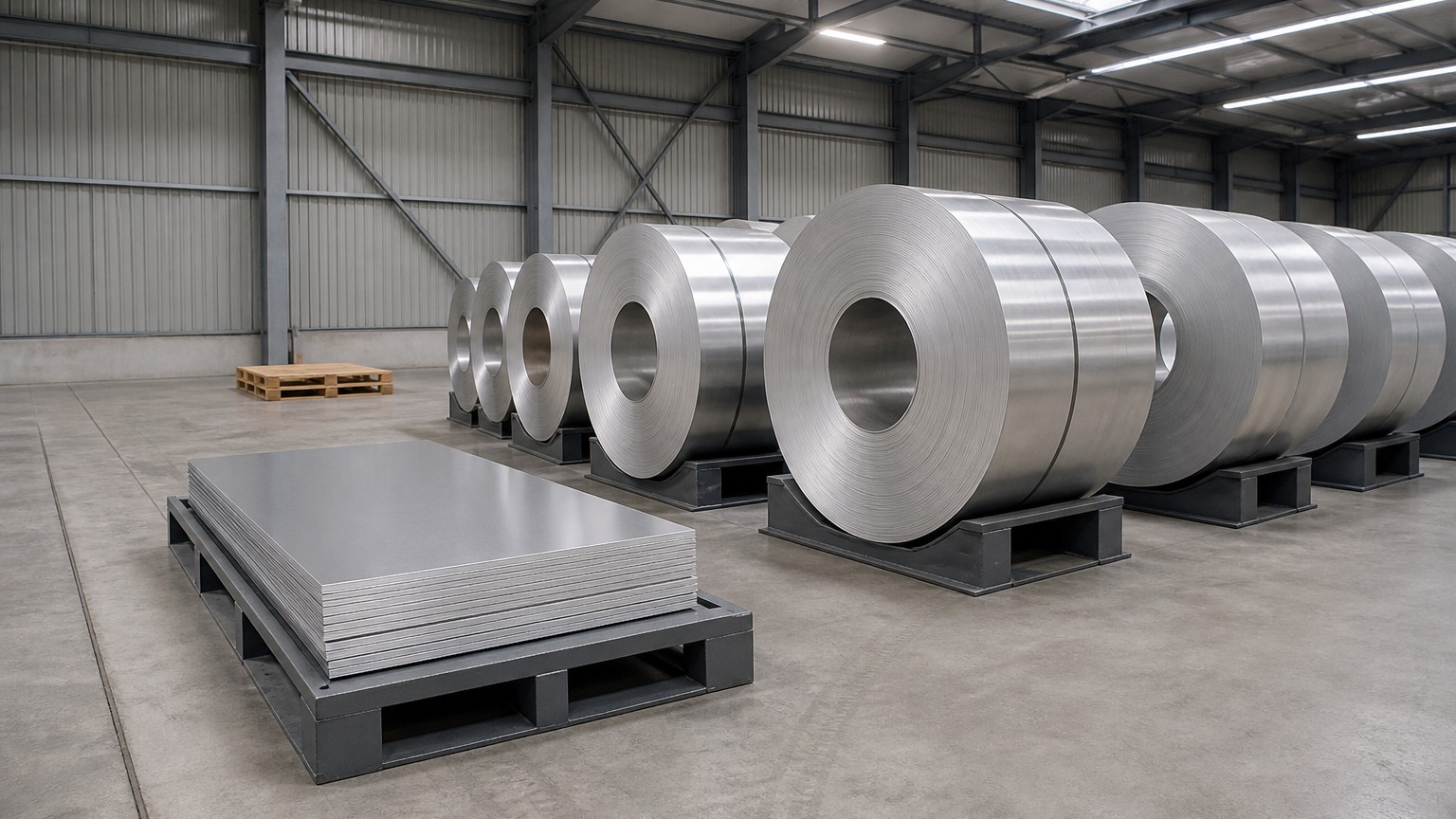
Short answer: Coil is a continuous length of strip wound into a roll; sheet is that same strip cut into flat lengths. Thickness and alloy can be identical — only the delivered form changes.
Dive deeper: Start with how the metal leaves the mill. Aluminium strip is cast as a slab or by continuous strip casting, then reduced by rolling — hot rolling above the recrystallisation temperature, cold rolling afterwards for thinner gauges, better surface and tighter tolerances. At the end of that line the product is a long ribbon of metal, and the natural way to ship a ribbon is to wind it. A coil is therefore the mill’s default output, which is why coil carries the lowest conversion cost and the widest availability of any format. Cut sheet is a second, deliberate operation: the coil is uncoiled, levelled, measured and sheared into flat lengths, then stacked and packed. Every step after uncoiling costs money and creates a condition that has to be controlled, so sheet is always coil plus processing. Terminology matters when you write the enquiry. In the widely used Aluminum Association convention, foil is material below 0.006 in (0.15 mm), sheet covers roughly 0.006 in to 0.249 in (0.15–6.35 mm), and plate starts at 0.25 in (6.35 mm) and above. ASTM B209/B209M, EN 485, ISO 6361 and GB/T 3880 all cover aluminium sheet, strip and plate, but each sets its own thickness tolerances, flatness limits and mechanical property requirements — so “0.5 mm sheet” means different things in different documents unless you name the standard you are buying to. Watch the input word too: buyers often say “sheet” when they mean any flat product, and quotations may say “coil” even when the material will finally be delivered as cut lengths. One further point belongs in this section because it removes a common misunderstanding. Aluminium does not rust the way carbon steel does. It forms a thin, self-healing oxide layer that protects the surface instead of flaking off, so the transport risks that actually matter are water staining, edge damage and handling marks rather than red corrosion — and those risks depend entirely on the delivered format, which is the subject of the next four sections.
How Is Each Format Produced, and Why Does That Change Your Cost?
One format leaves the mill as a roll; the other leaves a service centre as a stack of flat lengths.
Short answer: Coil comes straight off the rolling line, so you pay for rolling once. Sheet is coil that has been uncoiled, levelled, cut to length, stacked and packed, and each of those steps adds cost and a tolerance to control.
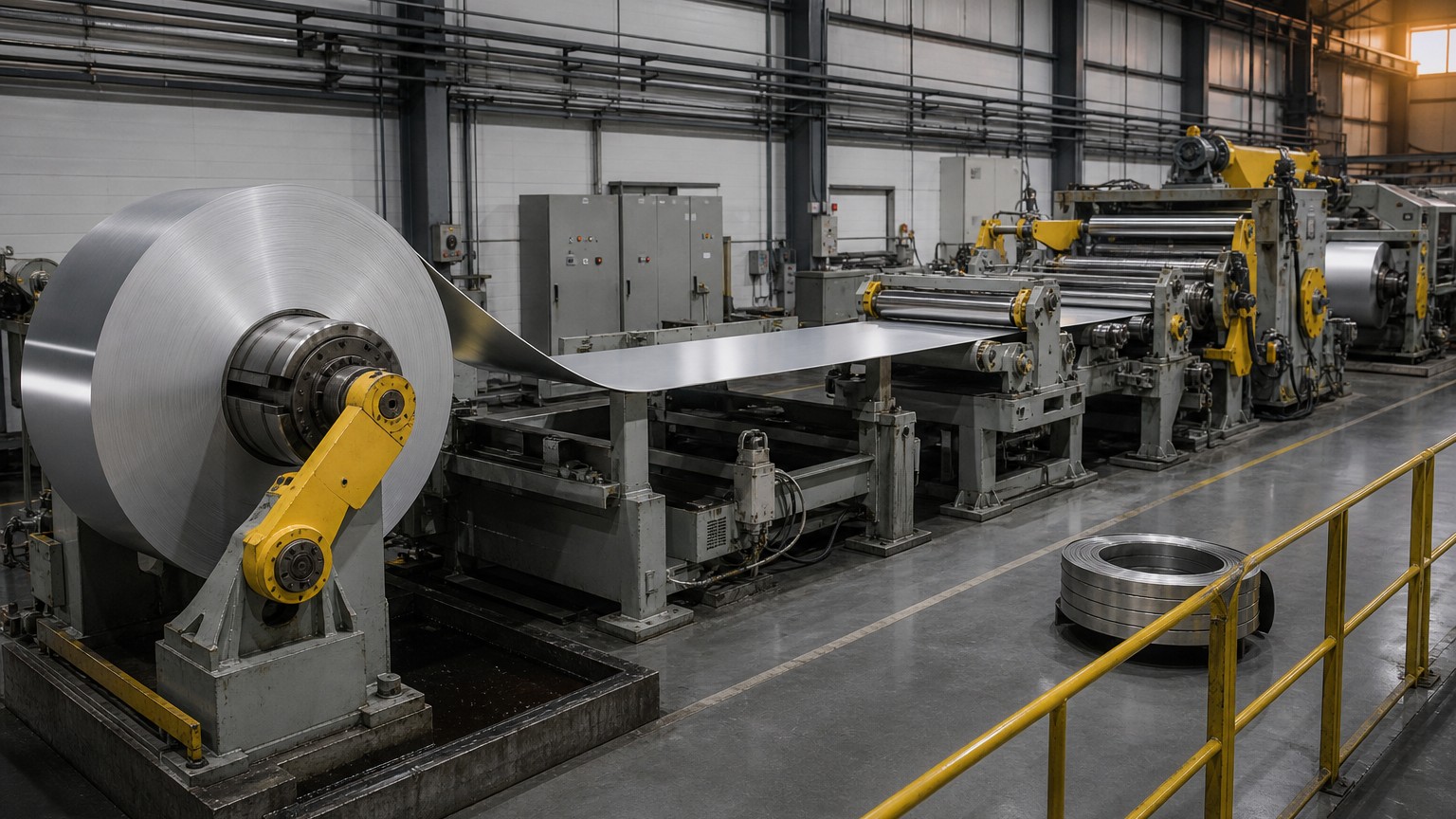
Dive deeper: A cut-to-length line is a chain of operations, and every link is a place where cost is added and quality can be lost. The coil is loaded onto a decoiler with a coil car, the leading wrap is opened, and the strip is threaded through a flattener or tension leveller that removes coil set — the residual curvature the metal remembers from being wound. A loop pit or accumulator keeps the strip moving while the shear stops to cut, then the shear squares the ends and cuts to the ordered length, and a stacker builds a flat pile that is banded onto a pallet or into a wooden crate. Slitting works the same way but cuts along the length instead of across it, which adds an edge that is either a clean slit edge or a burr, depending on tool sharpness and setup. The wider engineering context for these rolling and forming operations is well described in the Wikipedia article on rolling in metalworking. Two commercial consequences follow. First, a mill or a large service centre will normally quote coil against a minimum tonnage, because setting up and rolling a coil is efficient but setting up for a small run is not; cut-to-length suppliers do not have that minimum, which is exactly why importers with modest volumes find sheet the practical entry point. Second, the more processing you buy, the more you should specify. Sheet should be ordered with length and width tolerance, squareness, flatness and burr limits, because a sheared blank that is 1 mm out on a diagonal will not fit a welding fixture. Coil should be ordered with inner and outer diameter, coil weight, eye orientation and edge condition, because those are the numbers your decoiler and your crane have to live with. Neither format is intrinsically better engineered; they are simply purchased against different sets of variables.
Which Part Geometry Pushes You to Coil or Sheet?
Part geometry, not price, decides the answer: a line that cannot uncoil will never use coil, however cheap it looks.
Short answer: Long blanks, continuous runs and high annual volume favour coil; short, irregular or hand-fed parts favour sheet. If your longest blank is shorter than a coil circumference, coil still costs less per part.
Dive deeper: Work outwards from the blank. If your longest part exceeds the flat width the supplier can cut — commonly around 1,000 to 1,500 mm for aluminium service centres — sheet is out immediately, because flat sheet cannot exceed the width of the line that produced it, whereas a coil allows you to uncoil continuously along the length of the strip. If, on the other hand, every blank is a small rectangle, a small circle or a hand-fed strip, then the only thing coil gives you is a large roll sitting beside a machine that was never designed to hold one. Scrap is the tiebreaker. Coil forces you to choose a width once, and any part that does not tile neatly into that width loses the leftover margin to trim. A cut-to-length or blanking supplier can nest parts across the full strip width and re-use the trim where the geometry allows, which sometimes makes cut sheet cheaper per good part even though it is more expensive per tonne. Volume is the second tiebreaker: tooling payback on an automated uncoiler, straightener and feeder only makes sense over a large number of parts. The third tiebreaker is surface and flatness. Parts that will be anodised, painted, etched or used as a visible panel are judged on surface, and every extra handling step between coil and finished blank is another chance for a handling mark — so a buyer who needs a flawless decorative face may deliberately order a short cut-to-length run rather than unwind and process a large coil in-house. Alloy and temper selection follows the same logic: the 1 xxx and 3 xxx families are used for forming and general fabrication, 5 xxx for higher strength and marine-facing work and 6 xxx when heat treatment is available on your line. Where the sheet/plate boundary falls in practice, and which thickness class to order, is covered in our notes on aluminum sheet versus plate thickness classes. Designations and tempers, and the definitions those designations rest on, are published by the Aluminum Association.
What Does Cut-to-Length Really Cost You?
Cut-to-length looks economical because you buy only the metal you need — until you count everything that comes before the stack.
Short answer: Cut-to-length trades a lower minimum order against a higher price per tonne, more packaging, more scrap and slower replenishment. Coil demands a handling investment but delivers the lowest metal cost per kilogram.
Dive deeper: Price per tonne is only the visible layer. Above it sit the costs that decide which format is genuinely cheaper for your plant. The first is the metal price itself: because coil is closer to the mill’s output, it is normally the cheapest form of the same specification, and the gap widens with thickness, because thinner and wider strip is where shearing and levelling losses bite hardest. The second is packaging and freight. A stack of cut sheet has to be crated, banded, edged and protected against moisture, and because a sheet stack cannot be wound tight, more air travels with every shipment than a coil of equivalent weight — you pay for the volume. The third is yield. Every cut length produces offcut, and offcut on a fixed length cannot be re-used unless you happen to make a part that fits it, whereas a coil can keep feeding until the last usable metre. The fourth cost is time. A cut-to-length supplier must first buy coil, then schedule the line, so replenishment is a two-stage process; a coil order is a one-stage process and can therefore shorten the critical path when you are recovering from an unexpected surge. Against that, coil brings its own fixed costs: an uncoiler, a straightener-feeder or a levelling head, coil storage space with the load rating to hold several tonnes on saddles, and staff who know how to load and thread a coil safely. Below a certain annual tonnage those fixed costs never pay back, and cut sheet wins by default. Above it, the arithmetic reverses quickly, because the price advantage of coil is earned on every kilogram you process. The honest way to decide is to build a simple three-year comparison: price per tonne for each format, expected yield per part, packaging and freight per container, and the one-off cost of any equipment you would need. The result is usually obvious by the time the third year is on the page. Buyers who want the full dimensional and packaging baseline for coil products can review our aluminum coil and sheet range before building that model.
How Do Handling, Storage and Packaging Differ?
Coil and sheet fail in storage for different reasons, and handling decides whether the metal is usable when it reaches the line.
Short answer: Coil needs cranes, coil cars or a decoiler and must rest on saddles; sheet moves by forklift in crates but exposes far more surface to edge damage, flatness loss and water staining.
Dive deeper: A coil is a heavy, unstable cylinder, and everything about handling it follows from that. It is lifted by crane with a C-hook, by coil grabs, or by forklift with a coil ram, and it must be stored on timber or steel saddles so that the wrap does not deform under its own weight. Orientation matters more than most buyers expect: eye-to-wall storage keeps the coil axis horizontal and is easier to feed into a decoiler, while eye-to-sky storage saves floor space but requires a rotating cradle or a coil turner before the material can be processed. Coil identity also has to be protected, because a coil is sold by weight and a dented edge or a telescoped wrap is a permanent loss. In practice that means edge protectors, circumferential and radial strapping, eye protection, and sometimes VCI paper or desiccant inside the wrap for long sea voyages. Cut sheet fails differently because its weak point is the flat face and the cut edge. A stack of sheet is easy to move — a standard forklift and a wooden pallet are enough, which is precisely why sheet suits sites without crane capacity — but it offers a large area for condensation, so a crate that breathes during a humid voyage will show water staining between sheets long before a coil would show anything. Edges are exposed on all four sides, and a single burr can mark the next sheet in the stack. Stacking height also has a limit: load too many sheets and the ones at the bottom lose flatness, which then shows up as poor fit-up at the press or welding table. Then there is the question of what your team can safely handle today. Sheet in modest formats can be lifted and positioned by hand, whereas every coil movement needs equipment and a trained operator — a practical constraint that is often the real reason a small fabricator orders sheet. A typical formed, coiled product such as 1050 aluminum coil in 0.5 mm is ordered exactly to remove those process losses, since it can be fed directly into a forming line. Where buyers instead need flat material, the 1050A and 1070 grades we stock are commonly chosen for their forming behaviour.
How Do You Verify the Format You Receive?
Every format claim is verified at goods-in, because the packing list describes what should have arrived rather than what did.
Short answer: Measure thickness and width at several points, check coil inner and outer diameter and weight against the packing list, confirm flatness, camber and edge condition on sheet, and match the certificate heat number to the stencil on the material.
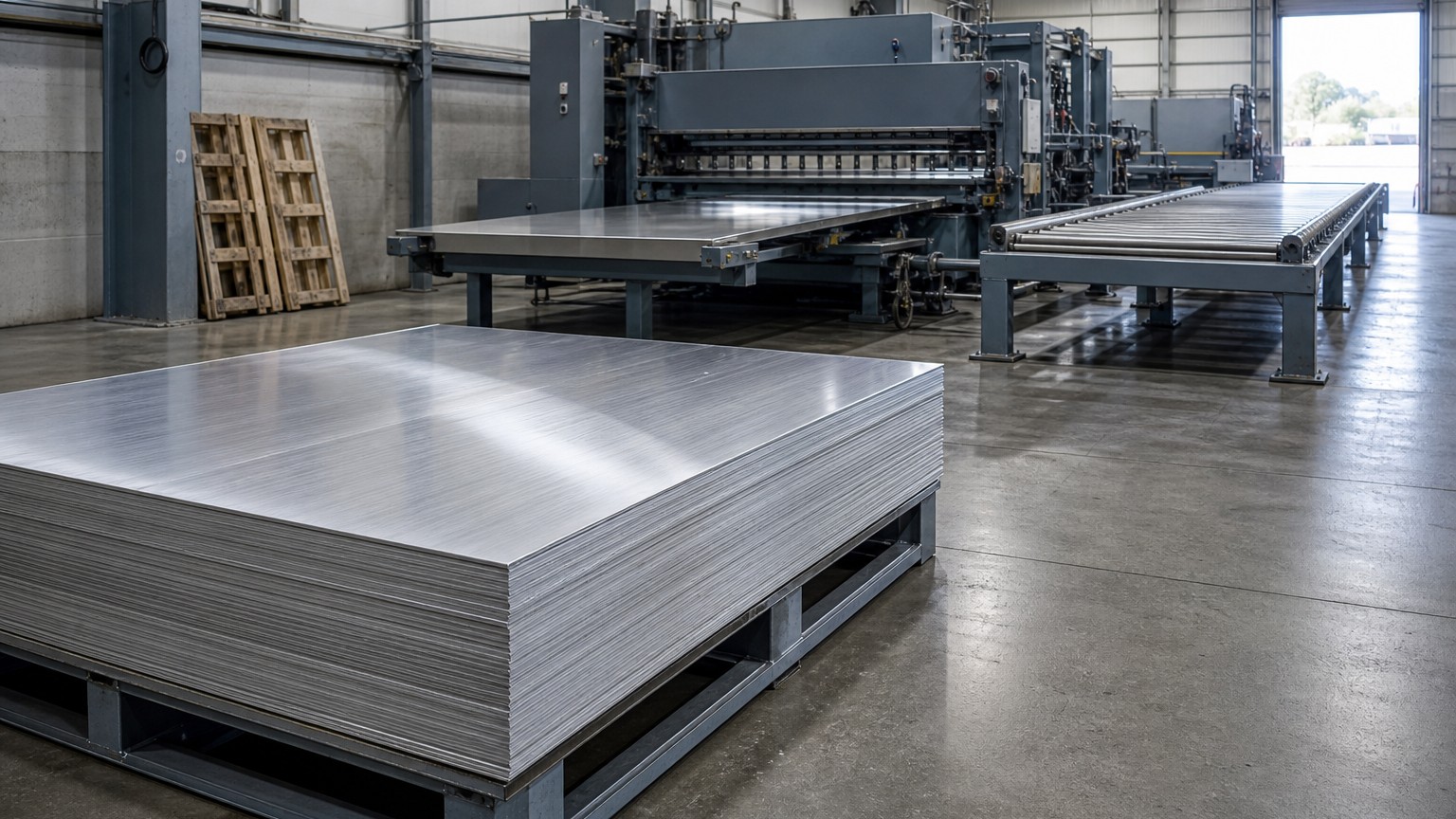
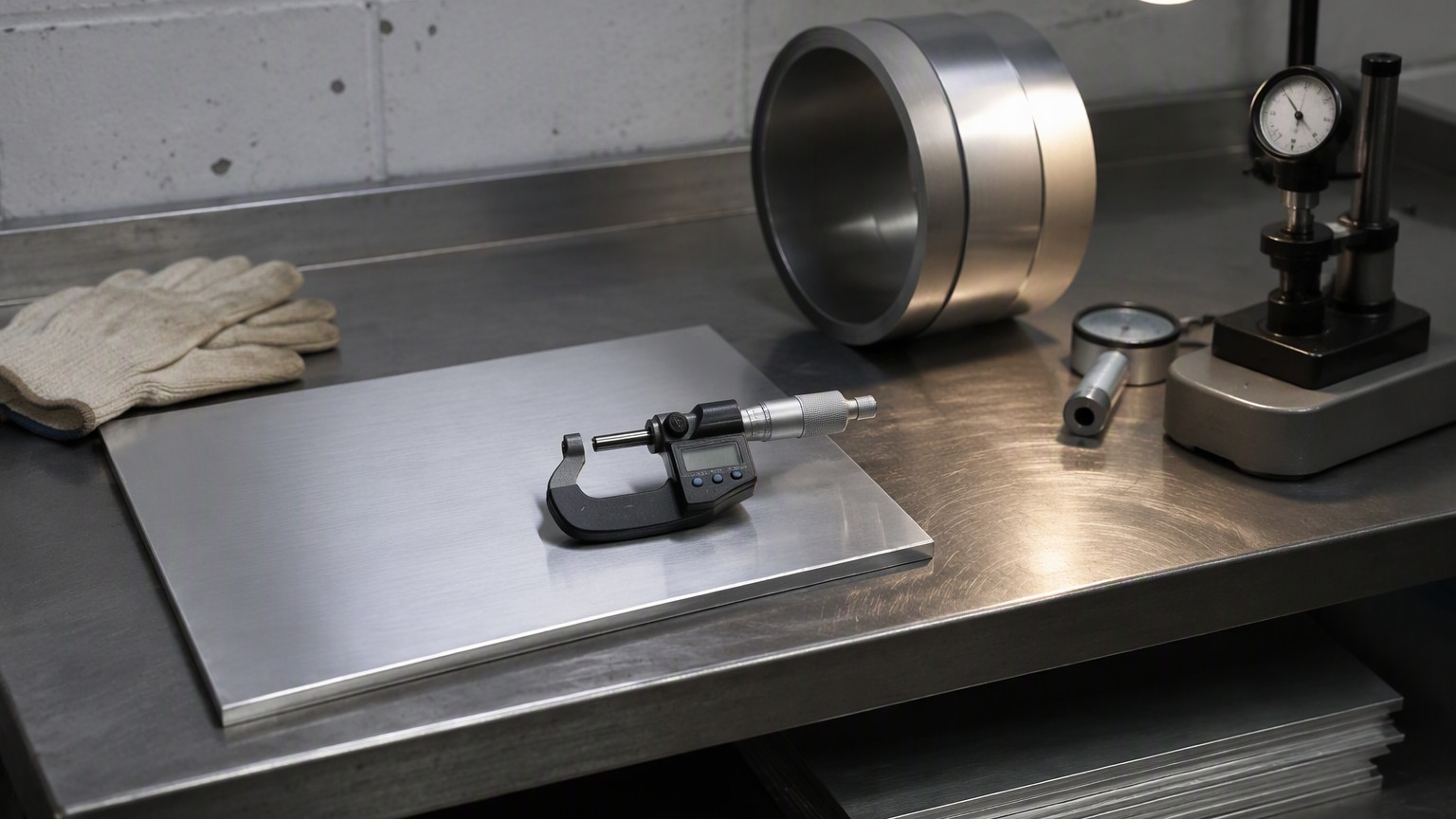
Dive deeper: Build the inspection around what each format can lose. For a coil, the first check is identity: the stencil on the wrap — alloy, temper, dimensions, heat number and coil number — must match the mill certificate, and the weight must match the packing list, because a short coil is a silent shortfall on what you paid for. Then check the geometry that your equipment depends on: inner diameter against the decoiler mandrel, outer diameter and coil weight against the crane or the coil car, and eye orientation against the way you store it. Finally look at condition: edge dents from strapping or handling, a telescoped wrap where the layers have slid sideways, and any sign of water marking inside the wrap. For cut sheet, focus on flatness and edge. Flatness is checked by laying the sheet on a straight reference or a surface plate and looking for a visible gap, camber by measuring the deviation of one edge from a straight line along the length. Measure thickness with a calibrated gauge at multiple points, recording the minimum as well as the average, because a stack that averages within tolerance while dipping below the minimum somewhere will fail your customer, not your supplier. Confirm length, width, squareness and burr condition on the sheared sides, and count the sheets against the packing list rather than trusting the crate label. Two documents make all of this usable: the material test certificate, which should state the standard the material was produced to, the heat number and the mechanical results, and the packing list that ties those numbers to specific coils or stacks. Keep both with your receiving record, photograph any defect before the packaging is discarded, and raise the claim while the material is still in its original form. If you would like the format, tolerances and inspection points written into a quotation for your own line, send us your blank size and monthly volume and we will price coil and cut sheet on the same basis so the comparison is real.
Conclusion: Match the delivered format to your line, your blank geometry and your storage, then verify it at goods-in — that is the whole decision.