
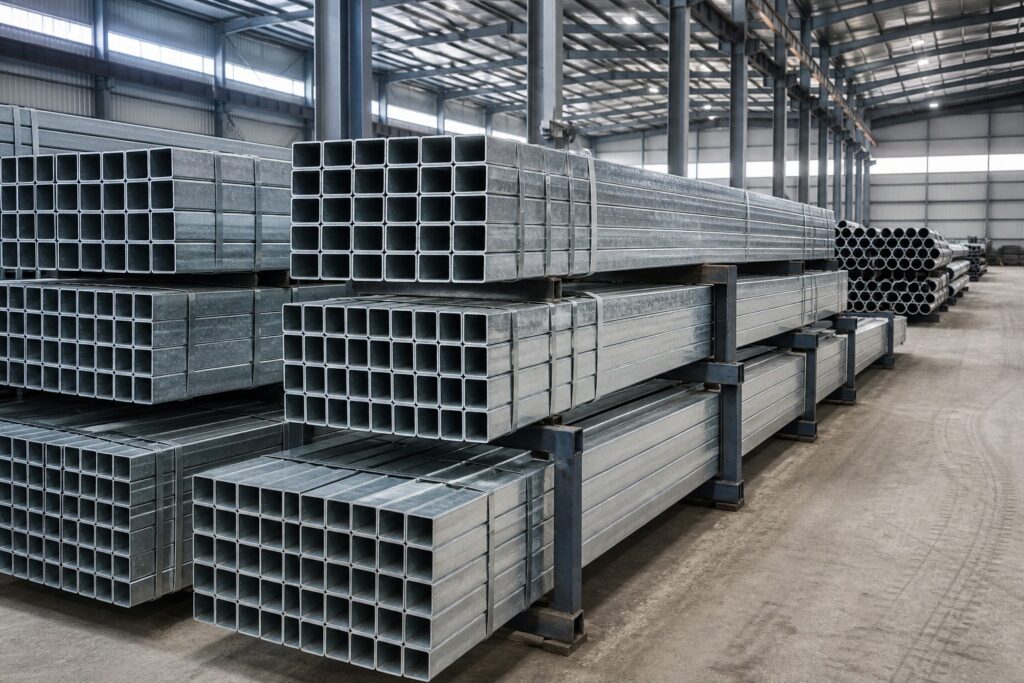
Galvanized Steel Tube: Types, Benefits and Common Uses
Few steel products carry as much quiet responsibility as the galvanized steel tube. Walk past any fence line, greenhouse frame, solar mounting row or highway gantry and you are looking at tubes that were dipped in molten zinc years ago — and are still standing with almost no maintenance. That combination of structural strength, corrosion protection and reasonable cost is exactly why galvanized tube shows up in everything from residential railings to industrial racking.
This guide explains what galvanized steel tube actually is, the main types you will meet in the market, how the zinc coating is applied, the benefits that drive most purchasing decisions, and the everyday applications where it outperforms plain steel or stainless alternatives. If you are comparing suppliers or writing a specification, the closing sections give you a practical buying checklist — and our galvanized steel tube range page shows the sizes, wall thicknesses and standards we regularly supply.
What Is Galvanized Steel Tube?
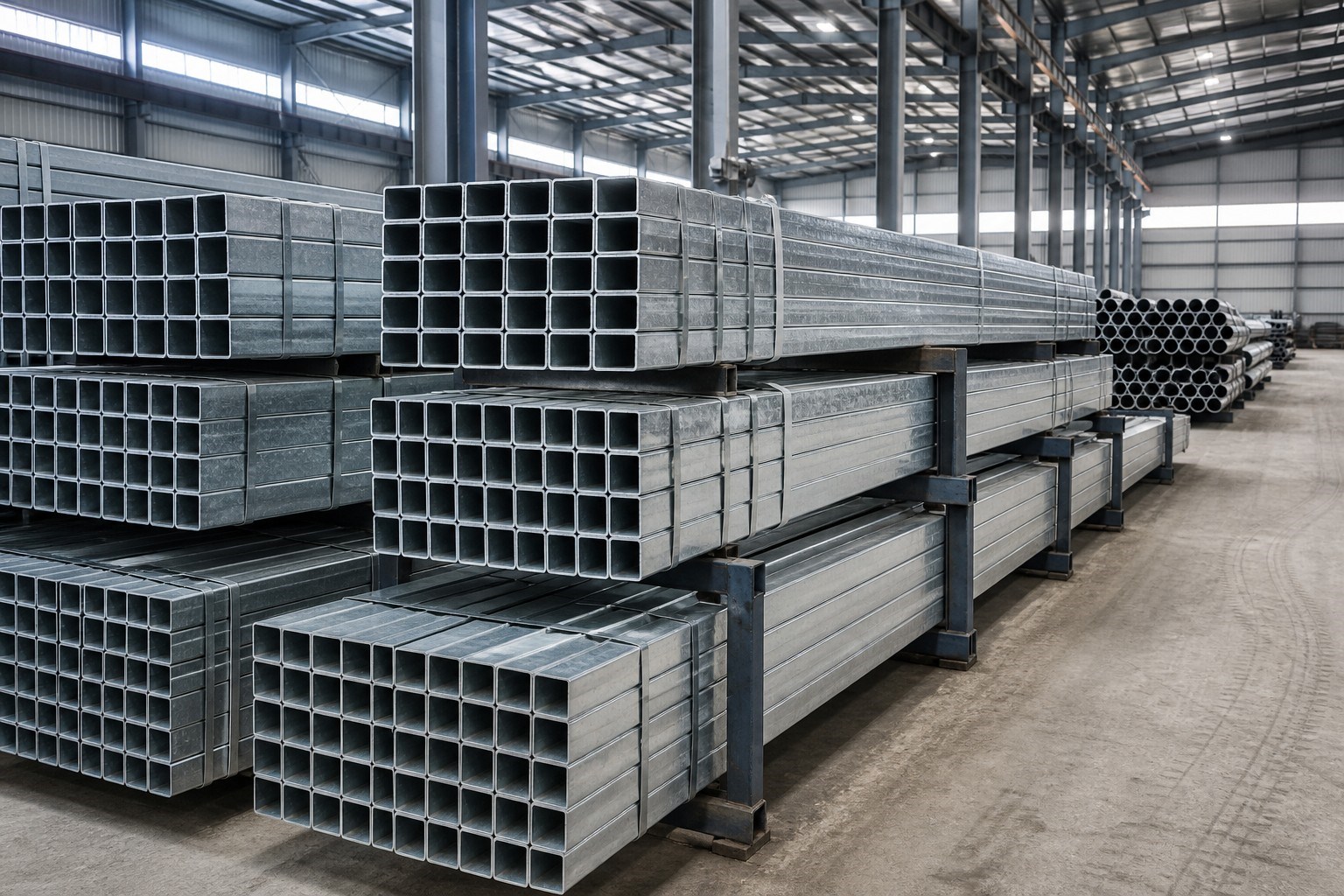
A galvanized steel tube is a hollow steel section — square, rectangular or round — that has been coated with a layer of zinc to protect the underlying steel from corrosion. The base tube is normally a low-carbon steel grade chosen for weldability and formability, and the zinc layer is applied after the tube has been formed and welded. The process is called galvanization, and it protects steel in two ways at once: the zinc film acts as a physical barrier that keeps moisture and oxygen away from the steel surface, and because zinc is more electrochemically active than steel, it also corrodes preferentially at any scratch or cut edge, defending the bare steel underneath through sacrificial action.
That dual protection is why galvanized tube behaves so differently from plain “black” steel tube in outdoor service. A scratch on painted steel quickly becomes a rust spot that spreads; a scratch on a galvanized surface stays small because the surrounding zinc keeps sacrificing itself to protect the exposed steel. For tubes exposed to weather — fences, handrails, structural frames — this one property is worth more than any paint system that needs periodic recoating.
Types of Galvanized Steel Tube
Galvanized tube is usually classified in two ways: by cross-section profile and by how the zinc coating was applied. Understanding both helps you describe exactly what you need to a supplier.
By Profile: Square, Rectangular and Round
Square and rectangular tubes (often called hollow structural sections, or HSS) are cold-formed from steel strip and closed by high-frequency electric resistance welding, then galvanized. Their flat faces make them ideal for frames, posts, gates and racks where components must bolt or weld together cleanly. Round tubes follow the same principle in circular form; a round profile has no edges, distributes stress evenly and is often preferred for handrails, scaffolding and applications involving rotation or internal pressure. The round type is frequently specified to pipe-style standards, which we cover below.
By Process: Hot-Dip Galvanizing vs Pre-Galvanized Strip
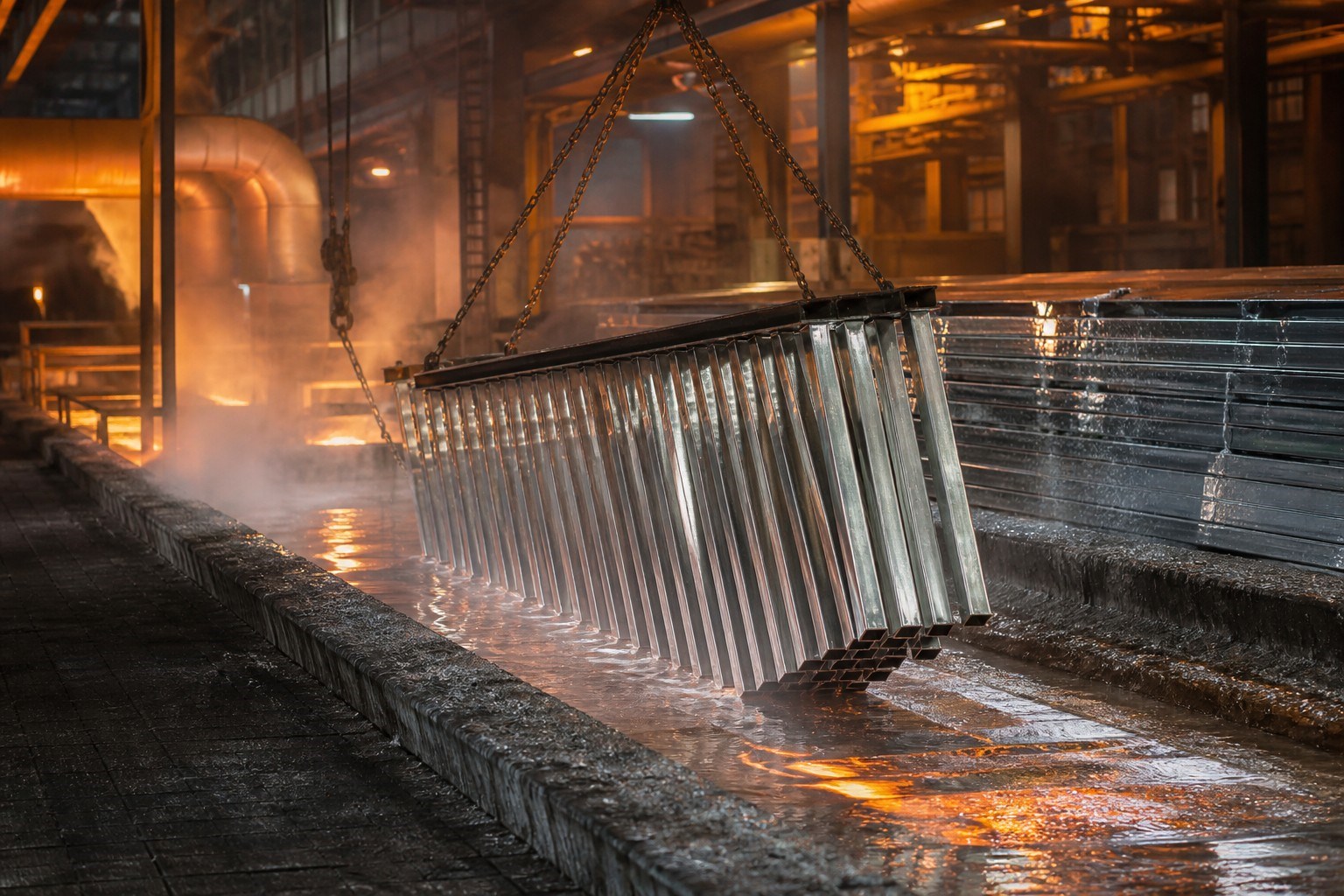
The most durable route is hot-dip galvanizing after fabrication: the finished, welded tube is cleaned, fluxed and immersed in a bath of molten zinc at around 450°C, producing a thick metallurgical zinc-iron alloy coating that covers the weld zone and the cut ends as well as the outside surface. The alternative is pre-galvanized strip, where the flat steel coil is galvanized before forming and welding. This gives a smooth, uniform but thinner coating, and it leaves the weld line and cut ends without full zinc coverage unless they are treated separately. For demanding outdoor and structural service, after-fabrication hot-dip galvanizing is the type most specifiers rely on.
| Feature | Hot-dip galvanized (after forming) | Pre-galvanized strip |
|---|---|---|
| When zinc is applied | After tube forming and welding | On the flat coil, before forming |
| Typical coating thickness | Thicker (commonly 45–85 µm and above) | Thinner, typically 10–25 µm |
| Weld line and cut ends | Fully coated | Exposed unless treated |
| Best suited for | Structural, outdoor, long-life service | Indoor or lightly exposed applications |
| Typical reference standards | ISO 1461, ASTM A123 | ASTM A653, EN 10346 |
How Galvanized Steel Tube Is Made
Production starts with steel strip of a specified grade and thickness, which is slit to width and progressively roll-formed into the required profile. The open seam is then closed by high-frequency electric resistance welding, the weld flash is removed, and the continuous tube is cut to length, straightened and end-faced. The relationship between welded and seamless routes — and when each makes sense — is covered in detail in our earlier guide on seamless vs welded pipe.
Galvanizing the finished tube follows a strict sequence: degreasing to remove oils, pickling in acid to strip mill scale, rinsing, fluxing to keep the cleaned surface active, and finally immersion in the molten zinc bath. In the bath the zinc alloys with the steel surface to form layered iron-zinc compounds, topped by a pure zinc layer — this is what gives galvanized tube its characteristic crystalline “spangle” appearance. The coating thickness and quality requirements for fabricated articles are defined internationally by ISO 1461, and in North America by ASTM A123/A123M, which set minimum average coating thicknesses according to the steel section thickness. Round galvanized tube and pipe ordered to pipe specifications is usually governed by ASTM A53/A53M, which covers black and hot-dipped galvanized welded and seamless pipe.
Key Benefits of Galvanized Steel Tube
Why choose galvanized tube instead of bare steel with paint, or stainless steel? The answer sits in four practical benefits:
- Long service life outdoors. A correctly specified hot-dip coating, typically in the 45–85 µm range on structural sections, gives decades of protection in atmospheric exposure. The American Galvanizers Association publishes extensive corrosion-performance data showing that galvanized coatings last far longer than paint systems in the same environment, and the zinc continues protecting exposed edges even after mechanical damage.
- Low lifetime cost. Galvanized tube costs more than black steel tube but far less than stainless steel tube. Because it needs no painting and almost no maintenance, its life-cycle cost in outdoor service is usually the lowest of the three — the initial premium over black steel is repaid the first time you skip a repainting cycle.
- Full coverage, including cut ends. Because the whole tube is immersed, the zinc covers edges, corners, threads and internal surfaces of hollow sections — areas a paint brush cannot reliably reach. This is a decisive advantage for fabricated frames where cut ends are exposed.
- Impact and abrasion resistance. The zinc-iron alloy layers of a hot-dip coating are harder than pure zinc or paint, so the tube shrugs off the knocks and scrapes of transport, installation and daily site use.
One practical limit worth knowing: hot-dip galvanized steel is generally recommended for continuous service temperatures up to about 200°C. Above that the zinc layer can begin to peel from the intermetallic layer, so for hot process piping you would step up to a different material — the trade-offs are examined in our carbon steel vs stainless steel pipe guide.
Common Uses of Galvanized Steel Tube
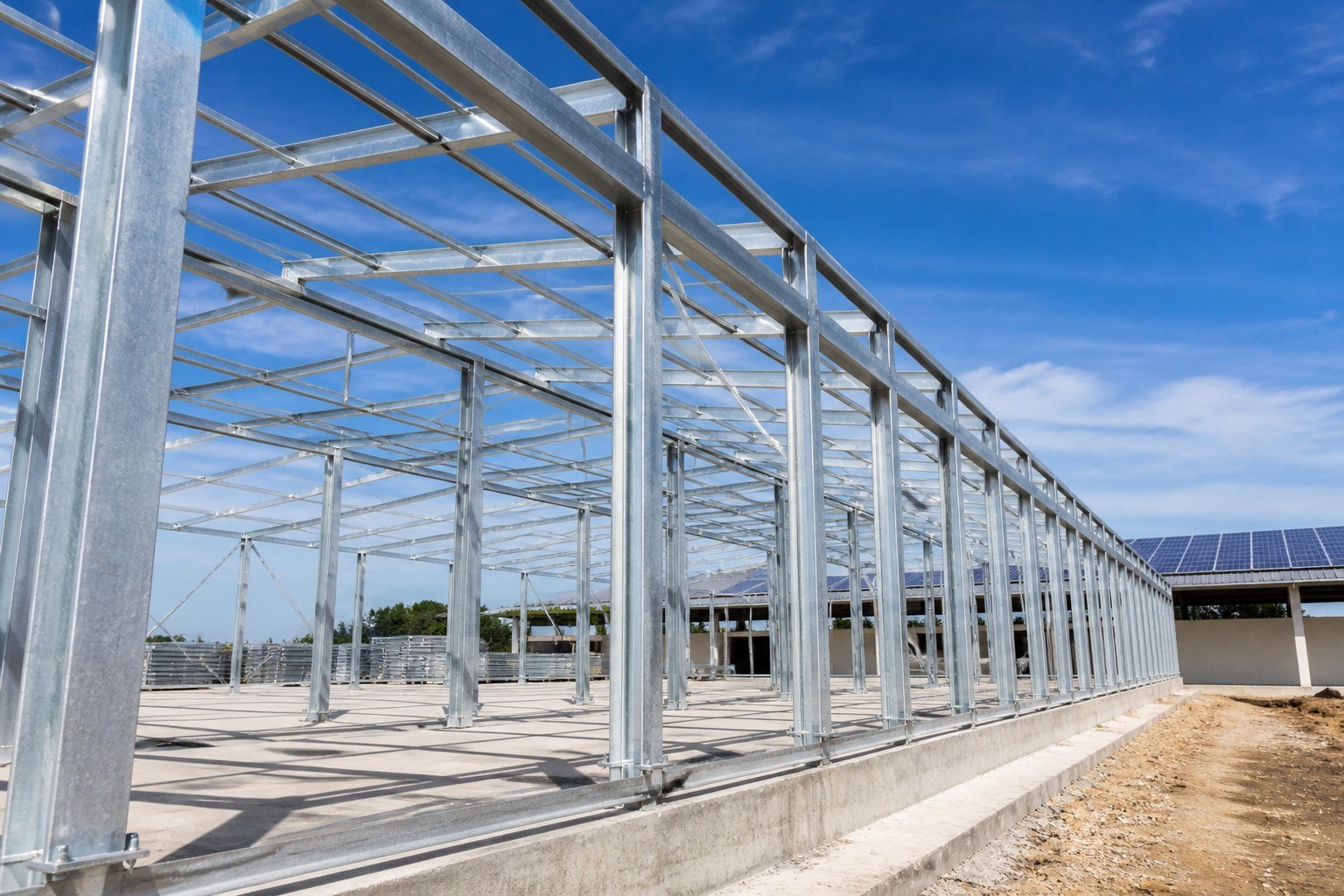
Walk through a typical industrial estate or construction site and you can compile the application list yourself:
- Construction and structure: portal frames, mezzanine floors, bracing, roof trusses and temporary works where square and rectangular tubes carry load in two directions and bolt together easily.
- Fencing, gates and security: boundary fences, gate frames, crash barriers and vehicle protection posts — the classic outdoor job where rust resistance decides the product.
- Handrails and balustrades: stair rails, balcony balustrades and walkway guardrails, usually round or square tube with welded or mechanical joints.
- Agriculture and horticulture: greenhouse frames, animal enclosures, crop supports and irrigation structures exposed to humidity, fertilizers and cleaning chemicals.
- Solar and renewable energy: ground-mount solar racking and support structures, where galvanized tube provides the long, maintenance-free life that a 20-year installation warranty demands.
- Transport and infrastructure: highway sign gantries, lighting columns, street furniture and crash-protection systems that must survive decades of outdoor exposure.
- General engineering and racking: warehouse racking frames, work benches, machine guards and trolleys that take knocks and need to stay rust-free indoors or in semi-covered yards.
Where the round profile is used for conveying water, gas or air at low pressure, the tube is commonly supplied to pipe standards such as ASTM A53 (hot-dipped galvanized pipe) or BS/EN 10255, and the installation follows normal threaded or welded galvanized piping practice.
Galvanized Steel Tube vs Black Steel and Stainless Steel Tube
The selection question usually comes down to environment and budget. Black (uncoated) steel tube is the cheapest but rusts quickly outdoors; it belongs indoors or in protected service, or where it will be painted and maintained. Galvanized tube steps in when the part will face weather, moisture or chemicals but the budget cannot justify stainless steel. Stainless steel tube (304, 316) wins where corrosion loads are severe — marine air, chlorides, process chemicals — or where appearance and cleanability matter enough to pay several times more per tonne. In practice, most structural outdoor applications between those extremes land on galvanized steel tube, which is exactly why it dominates fencing, racking and solar markets worldwide.
How to Choose Galvanized Steel Tube: A Buying Checklist
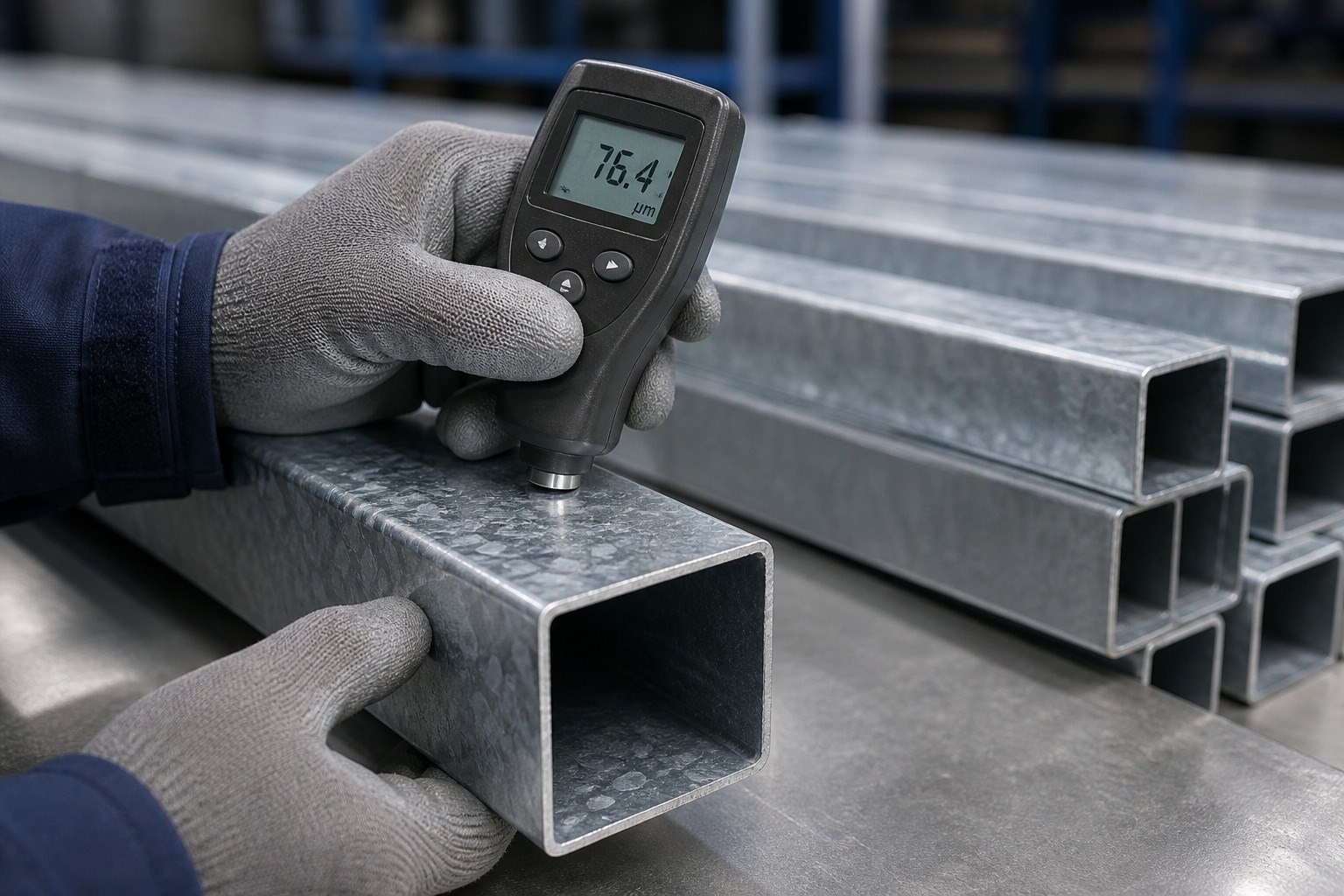
When you move from concept to purchase, work through this checklist so the tube you receive matches the job:
- Define the profile and size. Square, rectangular or round? State the outside dimensions and wall thickness in millimetres or inches — for example, 40 × 40 × 2.0 mm square tube, or 2 inch round tube with a 2.5 mm wall — and the length you need.
- Confirm the base steel grade. Common choices include Q195/Q235/Q345 (Chinese designation), S235JR (EN), Gr.B (ASTM A53) or STK400/STK500 (JIS). Match the grade to the load the tube must carry.
- Specify the galvanizing route and coating weight. For outdoor structural use, specify after-fabrication hot-dip galvanizing and a coating weight such as Z180 or Z275 (grams of zinc per square metre), and ask how the coating thickness is verified against ISO 1461 or ASTM A123.
- Name the governing standard. Depending on your market this will be GB/T 3091, EN 10219, EN 10255, BS 1387, ASTM A53 or JIS G 3444. Naming the standard removes ambiguity about dimensions, tolerances and testing.
- Check cut ends and weld quality. Confirm that cut ends are zinc-protected (or will be painted with zinc-rich paint after cutting) and that the weld seam passes the required dimensional and pressure checks for your application.
- Ask for test documentation. For contract quantities, request mill test certificates covering chemistry and mechanical properties, and coating thickness reports for the zinc layer.
If you need standard stocked sizes delivered quickly, or a custom section rolled to your specification, our galvanized steel products hub lists the tube, sheet and coil options we supply, with the size ranges and coating weights available on each.
Frequently Asked Questions
How long does galvanized steel tube last outdoors?
In typical atmospheric environments a correctly applied hot-dip coating of 45–85 µm commonly provides 30–50 years or more of protection before significant zinc depletion, depending on local conditions such as humidity, rainfall and industrial pollution. In severe marine or industrial atmospheres, service life is shorter, which is why specifiers in those areas choose thicker coatings or stainless steel.
Can galvanized steel tube be welded?
Yes, but welding burns away the zinc coating around the joint and produces zinc fumes, so welding must be done with adequate ventilation and the weld area should be repaired afterwards with a zinc-rich paint or by re-galvanizing to restore corrosion protection. For bolted or clamped connections, simply cut carefully and protect the exposed cut end.
Is galvanized tube suitable for water supply pipes?
Round galvanized tube and pipe has been used for decades in cold-water service and remains common in many markets, though local plumbing codes increasingly favor other materials for potable water. For structural, agricultural and low-pressure conveying duties it remains an excellent, cost-effective choice.
Get a Quote for Your Galvanized Steel Tube Order
Whether you need a few bundles for a fencing project or container quantities of square, rectangular or round tube for a structural contract, send us your profile, dimensions, wall thickness, coating weight and destination port. Our team will confirm the governing standard, check mill availability and reply with a quotation and lead time. See the 40x40mm galvanized steel tube product page for wall thickness, Z180 coating and export packaging details. Start the conversation on our contact page — we respond to all inquiries within 24 hours.