
Corrugated vs Trapezoidal Roofing Sheet: Which Profile Should You Specify?
Specify the wrong profile and every fixing point becomes a potential leak, while span and steel weight quietly rise. One geometric decision drives all of it.
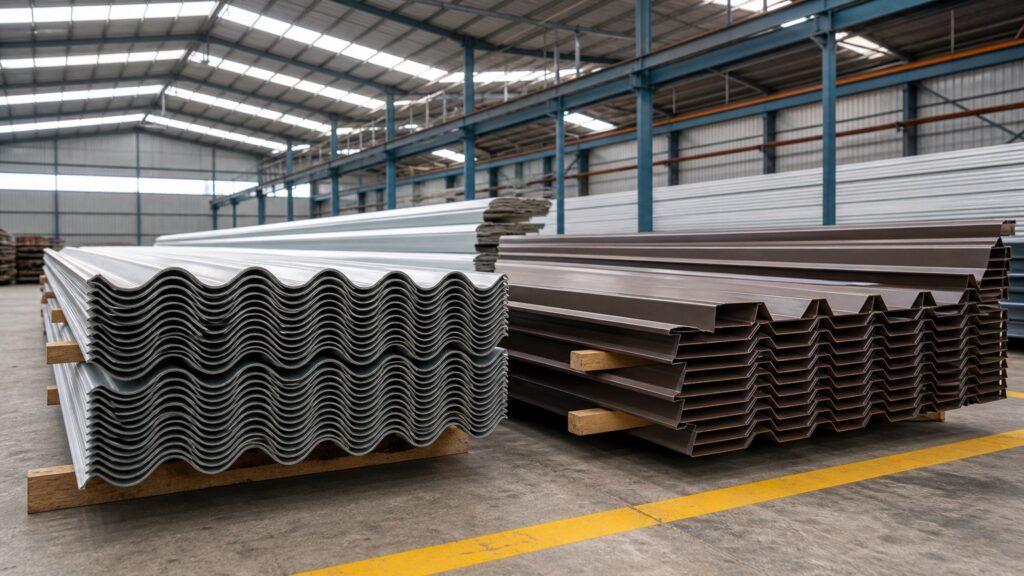
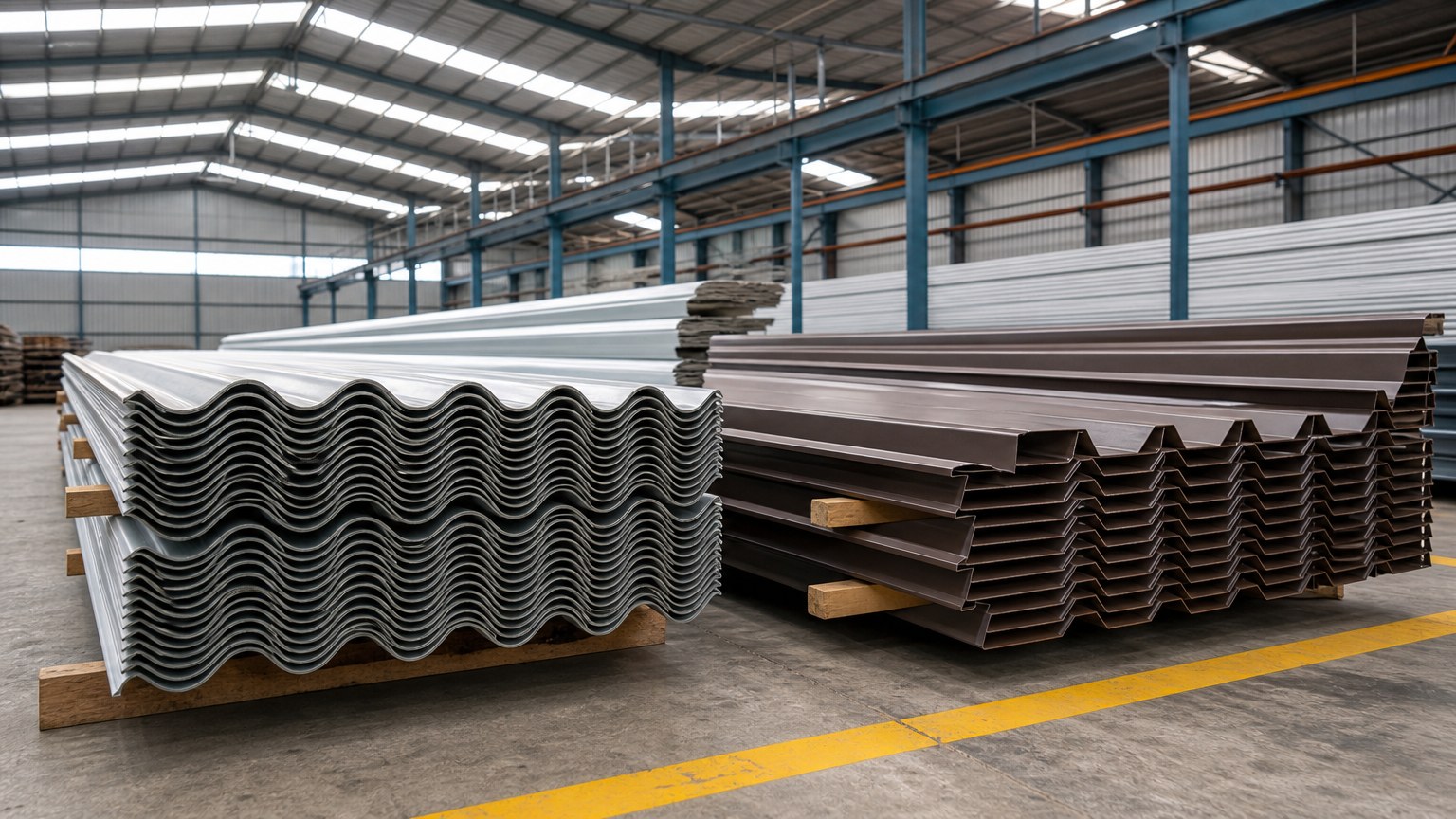
Corrugated roofing sheet uses a rounded, evenly waved section; trapezoidal roofing sheet uses flat pans separated by steep angular ribs. Corrugated suits short spans, tight curves and traditional roofs, while trapezoidal spans further, drains faster, takes longer fixings and dominates industrial cladding.
Transition: both profiles come off the same roll forming line, from the same coated coil, often at the same price per tonne. What changes is geometry, and geometry decides span, drainage, fixing method, installation speed and how the roof behaves after ten years of weather. This guide works through the decision in the order a buyer or engineer actually faces it: what separates the two sections, how they behave under load, how each handles rain and wind, where the labour cost really sits, which applications each suits, and the specification mistakes that send the wrong profile to site.
What Is the Real Difference Between Corrugated and Trapezoidal Roofing Sheet?
Both profiles are roll formed from the same pre-painted steel, so the base material rarely decides anything. The section shape does.
Corrugated sheet has a sinusoidal wave with similar crests and troughs. Trapezoidal sheet has wide flat pans joined by trapezoid-shaped ribs, usually deeper, often with a stiffening groove rolled into each pan. Same base metal, different geometry, very different behaviour.
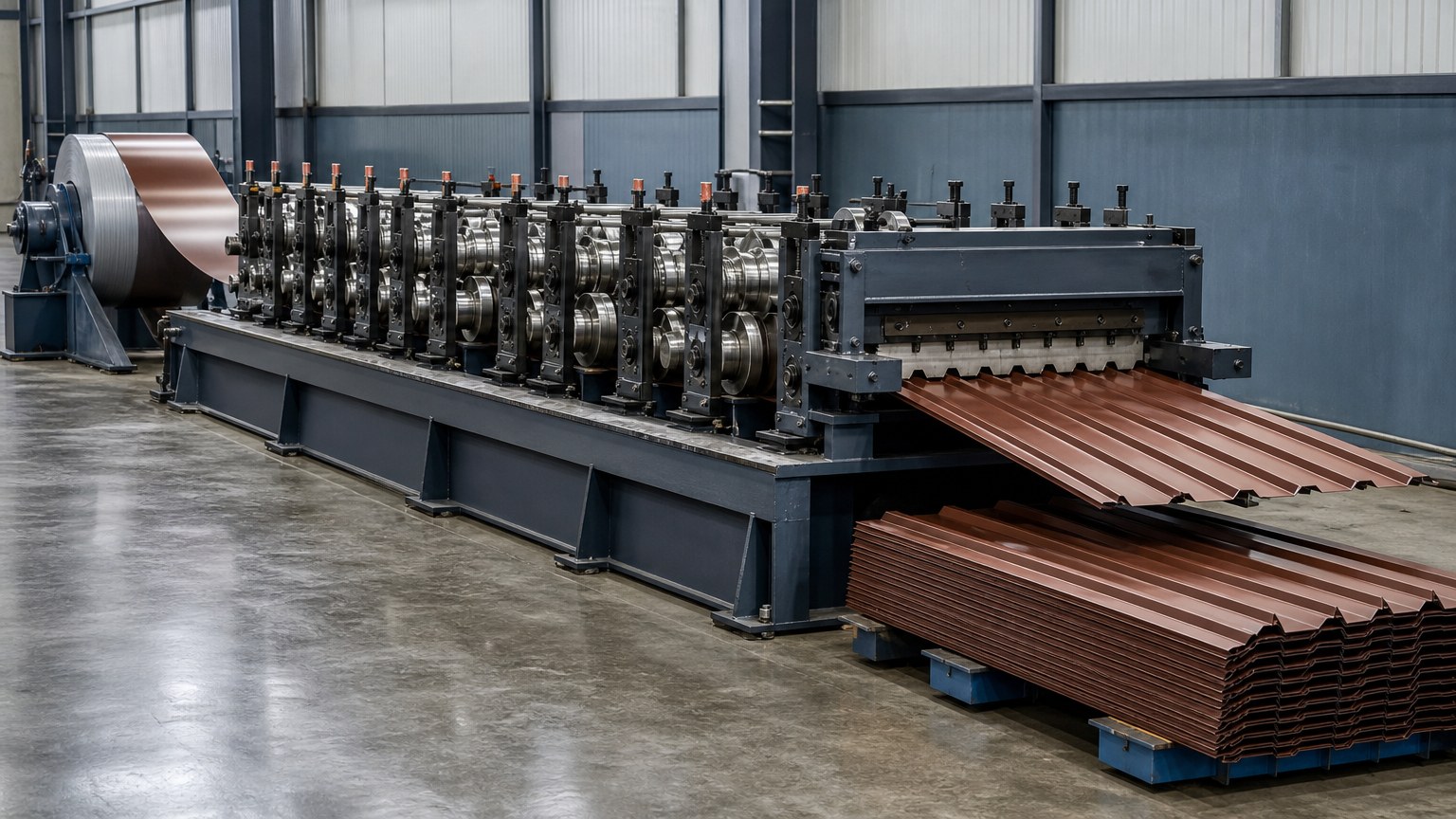
Both profiles begin life as the same product: a coil of continuously hot-dip coated, coil-coated steel strip whose zinc or aluminium-zinc layer and paint film were applied before any forming took place. The strip then travels through a roll forming line, where a sequence of paired rolls bends it a little further at each stand until the finished section emerges and is cut to length. Corrugated tooling is the older and simpler version of that sequence, because successive rolls press a rounded wave into the strip and the deformation is gentle and roughly symmetrical, so the section can be produced on a relatively short line from a modest number of stands. Trapezoidal tooling does something different. It concentrates the bend into narrow shoulders on either side of a wide flat pan, forming a deeper rib across a longer sequence of stands, which is why a trapezoidal line costs more to build, why its roll set is committed to one specific geometry, and why changing profile on it is a heavier decision than on a corrugated line. The continuous bending process behind both profiles is also the reason a mill can quote a specific pitch, depth and coverage width at all: the geometry is fixed by the tooling rather than adjusted per order. That single constraint explains why profile availability differs between suppliers, and why an unusual pitch or depth is usually quoted with a longer lead time and a higher minimum order quantity.
Why the section geometry decides everything downstream
Geometry then determines almost every commercial and structural property of the sheet. Corrugated profiles are typically shallow and broadly sinusoidal, with crests and troughs of similar width and a large number of small channels across the sheet width. Trapezoidal profiles carry fewer, wider and deeper ribs separated by flat pans, often with a stiffening groove to stop the flat area from oil-canning under load. Because a deeper rib moves material further from the neutral axis, trapezoidal sections develop a considerably higher section modulus at the same steel thickness, and that single fact explains most of the rest: longer spans, wider purlin spacing, fewer side laps and better walkability during installation. Corrugated sections compensate with a greater number of bends, which still adds stiffness, but over a much shallower depth, so the two families are not interchangeable at equal gauge. The practical consequence for a buyer is that profile names are local and imprecise. A supplier in one market may use the word corrugated for any profiled sheet, including a trapezoidal one, so the only reliable specification is dimensional: state pitch, depth, overall coverage width and the number of ribs across the sheet. Our corrugated and trapezoidal roofing sheet in color coated steel is quoted exactly that way, because the roll set and the coil width have to be matched before an order can be accepted.
What profile names hide when you compare two offers
Trade naming is the quietest source of error in this whole category, because the same word is used for different geometries in different markets. In several regions the word corrugated covers any profiled sheet, including deep trapezoidal and standing-seam products, while in others it means only the rounded wave, and the same ambiguity applies to terms such as box profile, ribbed sheet and tile profile. Two suppliers can therefore answer a request for corrugated roofing sheet honestly and quote sections that cannot be laid next to each other. The remedy is to compare offers on four dimensional numbers rather than on a name: overall width, effective coverage width, rib or corrugation pitch, and rib depth. Effective coverage width matters most commercially, because it is the width actually covered after the side lap has been deducted, and it decides how many sheets a given roof consumes. A sheet described as one metre wide with a generous lap allowance is not the same product as one metre of covered roof. Steel thickness with its tolerance class, coating mass and coating system then complete the comparison, so both quotations are read on the same basis. Buyers who request those values in writing usually find that apparently similar offers diverge in ways that change the installed cost substantially.
How Do Corrugated and Trapezoidal Profiles Compare in Load Capacity and Span?
The same 0.4 mm coated steel carries a very different load depending on how the section is folded.
Trapezoidal profiles span further because deeper ribs and stiffening grooves raise the section modulus. Corrugated profiles are shallower and structurally less efficient, so they need closer purlin spacing or thicker base metal to carry the same load.
Load capacity in profiled roofing is not a material property at all; it is a section property. Two sheets of identical coated steel, one corrugated and one trapezoidal, will deflect very differently over the same span simply because their ribs place metal at different distances from the neutral axis. A deeper rib raises both the second moment of area and the section modulus, so the sheet resists bending with less material and reaches a longer permissible span before deflection and stress limits are reached. It also stiffens the section locally against buckling, which is the failure mode that governs thin gauges, because a flat or shallow element under compression can wrinkle long before the steel itself yields. Wind uplift and snow then apply the same load case in opposite directions: uplift pulls the sheet off the purlin and stresses the fixings, while snow pushes the pan down between supports and stresses the section. Snow load is therefore governed largely by rib depth, and uplift resistance by rib depth together with the fixing pattern. The table below compares the two families on the properties a buyer can control at the specification stage; permissible spans themselves must be read from the profile manufacturer’s load tables, because they depend on pitch, depth, thickness, coating and the governing load case in combination.
| Comparison | Corrugated profile | Trapezoidal profile |
|---|---|---|
| Section shape | Rounded, evenly waved crests and troughs | Wide flat pans joined by steep angular ribs |
| Rib depth for the same coverage width | Shallow | Deeper, usually with a pan stiffening groove |
| Span at equal steel thickness | Shorter; needs closer purlin spacing | Longer; allows wider purlin spacing |
| Load efficiency | Lower section modulus for the same gauge | Higher section modulus for the same gauge |
| Walkability during installation | Limited to the line of the purlins | Better, because wide pans distribute foot load |
| Typical first choice | Short spans, curved and heritage roofs, walling | Long-span industrial and commercial roofs |
How section depth changes the load path
A deeper rib performs two jobs at once. It moves material away from the neutral axis, which raises the bending resistance of the section, and it creates a continuous stiffened edge along both sides of the pan, which resists local buckling where a thin gauge would otherwise crumple. Corrugated sections rely more heavily on the number of bends and on the continuity of the wave, so their stiffness is distributed across many small folds rather than concentrated in a few deep ones. In service this shows up as a difference in how the sheet behaves between supports. A corrugated sheet at a marginal span will visibly deflect under foot or wind load and can develop a rippling, trampolining effect that damages the paint film at the fixing points long before it fails structurally. A trapezoidal sheet over the same span keeps its shape and transfers load to the purlins through a stiffer rib, which is one reason large industrial roofs are almost always built on trapezoidal profiles. There is also a maintenance dimension that rarely appears in a quotation. A roof that moves slightly at every fixing point works its fasteners loose over the years, and re-tightening thousands of screws is a real cost of ownership. Deeper sections reduce that movement, and with it the slow loosening that eventually shows up as a leak in wind-driven rain rather than as a visible structural failure.
What that means for purlin spacing and steel weight
Purlin spacing is where profile choice becomes a structural decision rather than a cladding preference. Because a trapezoidal section carries more load per metre of sheet, the purlins underneath can be spaced further apart, and that reduces the number of purlin runs, the number of cleats and bolts, the tonnage of secondary steel and the crane time needed to place it. A corrugated sheet carrying the same load needs closer purlins, and the extra purlin tonnage frequently costs more than the saving on the sheet itself. Resistance to uplift enters here as well: a deeper, more heavily fixed rib grips the purlin through a stiffer connection, so the fastening pattern can be simpler for a given wind load. Buyers who compare only the per-tonne sheet price and ignore purlin spacing are comparing roughly half of the real structural cost. Working through both sides of that trade-off before ordering is the difference between a competitive roof and an expensive one, and it costs nothing but a conversation with the profile supplier. The underlying behaviour of the section is described in the reference entry on how corrugated and profiled steel sheet behaves, and if the question is really about the coating rather than the shape, our note on how the two pre-painted substrates compare covers the metallurgical side in detail.
Which Profile Handles Rain, Wind and Fixing Better in Service?
Rain does not fail a roof; it finds the one detail the profile cannot drain quickly enough.
Trapezoidal pans drain faster and shed water over longer roof runs. Corrugated channels are shallower and slower, so they suit steeper pitches and shorter runs. Trapezoidal profiles also accept through-crest and concealed fixings more readily, which cuts leak paths in wind-driven rain.
Water management in a profiled roof depends on three things: how much water each channel can carry, how quickly it reaches the eaves, and how many penetrations the fastening system creates. Trapezoidal profiles win on the first two because their pans are wider and deeper, giving a greater drainage cross-section per metre of roof width, and because fewer sheets are needed per square metre, there are fewer side laps for water to cross on its way down the slope. Corrugated profiles have many shallow channels, which work well on a steep pitch where flow is fast and the run is short, and less well on a shallow pitch or a long run where water can back up at an end lap during a heavy storm. Volume is not the only question: velocity matters too, because fast-moving water carries debris that can lodge in a shallow corrugation and dam the channel further down the slope. The practical rule is to treat pitch and profile as a pair rather than as two independent choices. As pitch falls, drainage cross-section and lap integrity have to rise, which is exactly the direction trapezoidal profiles move. A long, low-pitch, wide roof is therefore the case where profile geometry earns its cost most clearly, while a short, steep, narrow roof is the case where a corrugated profile costs least and performs perfectly well.
End laps, side laps and capillary action
Laps are the weakest part of any profiled roof and the place where profile geometry is least forgiving. A side lap works only when the rib of one sheet nests into the rib of the next and the overlap covers at least one full corrugation or rib, because the seal depends on the geometry holding the sheets apart and pressing the sealant in the right place. End laps add a second failure mode: water travelling down the pan can be drawn upwards into the lap by capillary action if the sheets touch with no sealant between them, which is why end laps are normally sealed and why the minimum pitch for a lapped roof is set by the profile and the run length together. Trapezoidal pans make this easier to control because the flat surface gives the sealant a defined footprint and the fixings a predictable line, and because a stiffening groove interrupts the flat area so water cannot spread sideways across the pan. Corrugated sections rely on the wave itself for the same function, and the small radius at each crest leaves less contact area for a sealant bead. On a long run in an exposed location, that difference is often what separates a roof that stays dry from one that needs maintenance every season.
Wind uplift, fixing method and corrosion at cut edges
Wind uplift is the load case that decides how the sheet is fixed, and here the profiles diverge again. Corrugated sheets are classically fixed through the crest with hooked bolts or self-drilling screws fitted with sealing washers, accepting a relatively high number of small penetrations. Trapezoidal sheets can be fixed the same way, but they also support concealed fixing, where a clip engages the rib and the screw is hidden under the next sheet, leaving far fewer exposed penetrations and a cleaner appearance. Fewer penetrations means fewer potential leaks and less reliance on washer quality, which matters in wind-driven rain. Corrosion behaves differently from leakage and deserves separate attention. On hot-dip coated steel the sacrificial zinc or aluminium-zinc layer protects the steel even at a sheared edge, which is why the galvanizing process and the coating it produces are specified by coating mass rather than by appearance alone. Where a sheet is cut on site, the exposed edge has no paint film, and the rate at which it corrodes depends on the coating system underneath and on the environment. Industry guidance published by the American Iron and Steel Institute treats the coating specification and cut-edge exposure as one design decision, and it is worth reading before choosing a coating for a coastal or polluted site. A better coating on the base steel does not stiffen the profile, and a deeper rib does not protect a sheared edge; the two decisions have to be made separately and both belong in the inquiry.
How Do the Two Profiles Change Installation Labour and Cost?
Two quotations for the same roof area can differ by more than the sheet price, and labour is usually the reason.
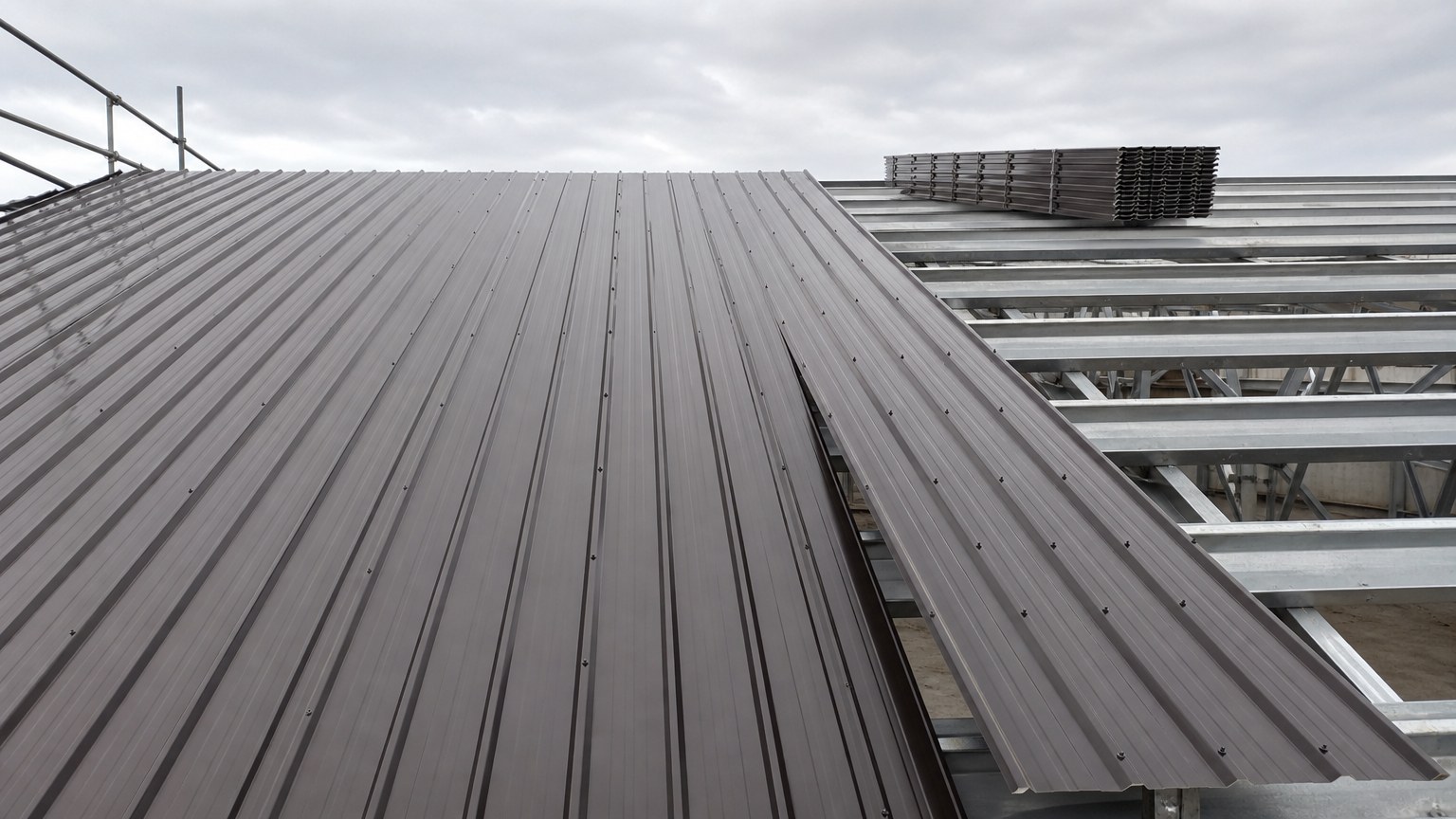
Trapezoidal sheets are wider in effective coverage, so fewer sheets, fewer side laps and fewer fixings are required per square metre. Corrugated sheets need more overlaps and more fasteners, lifting installation hours and the risk of workmanship defects, even when the sheet itself is cheaper.
Installation cost in profiled roofing is driven by repetition: every sheet that has to be lifted, positioned, aligned, lapped and fastened costs roughly the same hour of labour regardless of what it is made from. Reducing the number of sheets per square metre therefore reduces cost almost linearly, which is why effective coverage width is one of the most commercially important numbers on a profile drawing. A wider sheet with a deeper rib means fewer crane or hoist movements, fewer alignment operations, fewer side laps to seal and fewer fasteners to place. It also means fewer opportunities for the crew to leave a lap under-sealed or a fixing over-driven, so the wider sheet tends to produce both a cheaper and a more reliable roof. On large roofs those effects compound, because access equipment, walkways and safety lines are all priced per unit of roof area as well, and a longer installation also carries more weather risk. The direction of the saving is consistent even though the exact figure depends on the building, the crew and the access, so the useful comparison is not price per tonne of sheet but cost per square metre installed, with labour, sealant, fixings and access included. Two quotations that look similar on the sheet line can differ by a third once those items are priced, and the difference almost always follows the profile’s coverage width.
Where the labour actually goes
Most of the labour on a profiled roof is not the fastening; it is handling and alignment. A long sheet must be lifted to the roof without buckling, laid in the right position, pulled into line with the previous sheet so the side lap nests, and then fastened in a sequence that does not trap a sheet out of alignment at the far end. Wider trapezoidal sheets reduce all of these operations per square metre, and their flat pans give the crew somewhere to stand, which improves access and reduces the awkward reaches that cause misaligned fixings. Corrugated sheets, being narrower and rounder, demand more repositioning and give less stable footing, so an experienced crew will often add a walkway or a crawl board — another cost that never appears on the sheet quotation. Pre-painted sheet adds one more discipline to the same work: every operation risks the paint film, and the coil coating that produces pre-painted steel is only as durable as the handling it receives. Dragging sheets over each other, walking on them in the wrong place or over-tightening a screw damages the coating locally, and local coating damage is where rust begins. A profile that reduces handling therefore protects the finish as well as the schedule, which is why the two benefits tend to arrive together.
The hidden cost: purlins, laps and waste
Three costs sit outside the sheet price and are frequently left out of a comparison. The first is secondary steel: a shallower corrugated profile needs closer purlin spacing, so the tonnage of purlins, cleats and bolts rises even though the cladding looks cheaper. The second is consumables and laps: more sheets per square metre means more side laps to seal, more fixings, more sealing washers and more sealant. The third is waste. Profiled sheets are cut to length on site, and offcuts from a narrower sheet with a fixed pitch usually cannot be used elsewhere on the roof, whereas a wide trapezoidal sheet cut for a hip or a penetration often leaves a usable piece. When these three items are added to the invoice, the profile with the lower sheet price is often not the cheaper roof, which is why a full cost comparison should be made before the order rather than after the first delivery. Our full steel product range is supplied in both sheet and coil form for exactly this reason: a buyer who intends to run the profile on their own roll forming line needs coil, while a buyer installing the roof directly needs cut sheets, and both orders are quoted on the same coating and thickness data.
When Should You Specify Corrugated and When Trapezoidal Roofing Sheet?
The right answer is usually decided by span, pitch and appearance, in that order.
Specify trapezoidal roofing sheet for long spans, wide purlin spacing, industrial and commercial buildings and solar-ready roofs. Specify corrugated sheet for short spans, steeper or curved roofs, heritage and residential work, and wherever a traditional appearance is required.
Because both profiles are equally easy to supply, the decision should follow the building rather than the supplier’s stock list. A buyer who starts from the span and the purlin layout will nearly always arrive at a profile that also suits the drainage and the appearance, while a buyer who starts from the cheapest sheet per square metre often ends up paying the difference in secondary steel, laps and maintenance. The sequence matters because the constraints are not interchangeable: span and load are fixed early by the structural design, roof geometry and pitch are fixed by the building form, the environment decides the coating system, and only then do appearance and budget come into play. Reversing that order is what produces roofs that need a permanent walkway to be maintained, or a pitch that cannot drain the run length it has been given. The two subsections below set out the conditions that point clearly one way or the other, and most real buildings satisfy several conditions at once, so the answer is normally a balance rather than a rule. Where the balance is genuinely close, the deciding factor is almost always the span, because span drives purlin spacing and secondary steel, which are the largest cost items the cladding choice can influence.
Choose trapezoidal when span, purlin spacing or wind load dominates
Trapezoidal profiles are the default for large industrial and commercial roofs because they resolve three constraints at once. Their deeper ribs allow wider purlin spacing, which reduces secondary steel and crane time. Their wider pans give greater drainage cross-section, which suits the long roof runs typical of warehouses and factories. Their flat surfaces accept walkways, roof lights, penetrations and mounting rails for solar panels more readily than a rounded wave, and they support concealed fixing where appearance matters. If the building has a low pitch, a long run or an exposed location, trapezoidal geometry is usually the lower-risk answer, because it addresses the drainage and uplift cases with the same rib that carries the load. The profile also buys tolerance for thinner material: where the specified steel is light for economy, the section is doing more of the structural work, and a deeper trapezoidal rib is the efficient way to recover the stiffness that a thinner gauge gives away. That is why a sheet such as trapezoidal roofing sheet in 0.4 mm RAL 8017 is normally supplied in a deeper rib than the corrugated gauge it replaces. Buyers who intend to add roof-mounted equipment later should also make that decision now, because the purlin grid and the rib spacing that suit a bare roof may not suit one carrying rails and panels.
Choose corrugated when the roof geometry or appearance says so
Corrugated profiles remain the right answer in several situations that trapezoidal sections handle poorly. Curved roofs, barrel-vault canopies and architectural features are far easier to form from a fine, uniformly waved section, because the sheet bends smoothly along the run without the deep ribs concentrating stress at the shoulders. Short-span roofs over small buildings, rural sheds, agricultural shelters and site offices do not generate enough load to justify a deep profile, and the shallower section is cheaper and lighter to handle and to lift into place by hand. Wall cladding in a traditional style, rural and heritage settings, and any project where the client expects the familiar corrugated appearance all point the same way. In these cases the limiting factor is rarely the structural capacity of the profile; it is whether the pitch and the run length allow the shallower channels to drain properly, which is the one check that should never be skipped when a corrugated profile is chosen for appearance reasons. If the pitch is marginal, the more sensible answer is usually to steepen the roof or shorten the run, rather than to accept a roof that will pond water at every end lap and need attention within a few seasons.
What Mistakes Lead to the Wrong Roofing Profile Being Delivered?
Most wrong-profile deliveries are order errors rather than mill errors, and they look correct on paper until the sheets reach the roof.
The usual causes are using the word corrugated loosely, quoting only steel thickness without profile dimensions, mixing profiles from two suppliers so side laps no longer nest, and specifying a coating system the environment will defeat within a few years.
Each of these mistakes has a short and rather unglamorous fix, and the fix is always a line of text in the inquiry. Write the profile dimensions and the interpretation problem disappears. Write the coating class and the corrosion argument never starts. Write the lap requirement and the sheets arrive compatible. The reason these errors persist is that roof sheets are usually bought from a short inquiry, by email, in trade language, and trade language means different things in different markets. A mill cannot reasonably be blamed for supplying what the words allowed, and the buyer discovers the problem after the sheets have been cut and lifted, when return is no longer practical. There is also a commercial asymmetry that makes such errors expensive: the buyer absorbs the cost of handling, rework and delay, while the supplier can point to a document that permitted exactly what was delivered. Closing the gaps in the inquiry therefore moves the cost of ambiguity back to the point where it is cheapest to resolve, which is before the order is placed. The subsections below cover the errors that account for most wrong-profile deliveries, and none of them requires technical expertise to avoid — only a specification written in dimensions rather than in trade words.
Trade words are not specifications
In many markets, corrugated is used as a generic term for any profiled sheet, including trapezoidal and standing-seam products, so an inquiry that says only extra-long corrugated sheet may legitimately be answered with a profile the buyer did not intend. The reliable alternative is dimensional: pitch, rib depth, overall coverage width, number of ribs across the sheet, and the steel thickness with its tolerance class. Adding the intended use is also useful, because it lets the supplier catch an impossible combination before it becomes an order — a deep profile requested for a tightly curved roof, or a shallow one requested for a long low-pitch run, are both cases where a supplier holding the drawings can raise the problem while it is still free to solve. Two other details belong in the same paragraph: the coating system with its coating mass, and the fixing method, because a concealed-fix design cannot be executed on a profile without the correct rib. Buyers who write these five or six lines consistently find that their second order from a mill needs almost no discussion at all, and that the first order stops generating claims. It takes about two minutes and it removes the most expensive class of error in profiled roofing.
Side laps only nest with matched profiles
The second recurring error is mixing profiles from two suppliers on the same roof. Even when both sheets are described as the same pitch and depth, small differences in rib angle, shoulder radius and coverage width mean the side lap will not nest properly, and a lap that does not nest cannot be sealed reliably however much sealant is applied. The failure appears months later as a wet streak or a rust line at the lap, and by then the two orders are indistinguishable on site. Where a roof has to be extended or repaired, the safe approach is to order the matching profile from the original supplier, or to accept an engineered overlap detail rather than hoping the geometries are close enough. The same logic applies to accessories: ridge caps, eaves flashings, barge boards and end closures are made to match a specific profile and not a generic one, and an accessory that does not follow the rib leaves an open path for water and wind. Ordering the sheet, the flashings and the fixings as one package from one supplier is the cheapest way to guarantee that every component on the roof was designed for the same geometry, rather than assuming that similar-looking parts will fit and discovering the difference at the ridge.
Thickness is not stiffness, and cheaper is rarely cheaper
A thinner sheet of the same profile is always cheaper per square metre and almost always more expensive per square metre installed. Reducing steel thickness reduces the section modulus of the profile, so the permissible span falls and purlin spacing has to tighten, which adds secondary steel, fixings and labour to the same roof. It also increases the risk of handling damage during installation, because a thinner sheet buckles more easily when lifted and distorts more readily under foot, and damaged cladding has to be replaced at full installed cost. The same logic applies to coating thickness. Thinning the zinc or aluminium-zinc coating to save a small amount per tonne moves the first maintenance event from years away to months away in an aggressive environment, and repainting or replacing a roof costs many times the original saving. The workable sequence is to select the profile for the span and the purlin layout, select the coating for the environment, and only then look for the most economical combination of the two that still satisfies both requirements. Buyers who reverse that order — choosing a price first and justifying the engineering afterwards — tend to revisit the same roof within a few seasons, and they usually pay for it twice.
Conclusion
Trapezoidal profiles span further and install faster over long runs; corrugated profiles suit short spans, curves and traditional roofs. Specify pitch, depth, coverage and coating for the right delivery.
For a quotation on corrugated or trapezoidal roofing sheet in pre-painted galvanized or galvalume steel, send us your material specification and quantity and we will confirm the profile, coating system and delivery terms that can be supplied.