
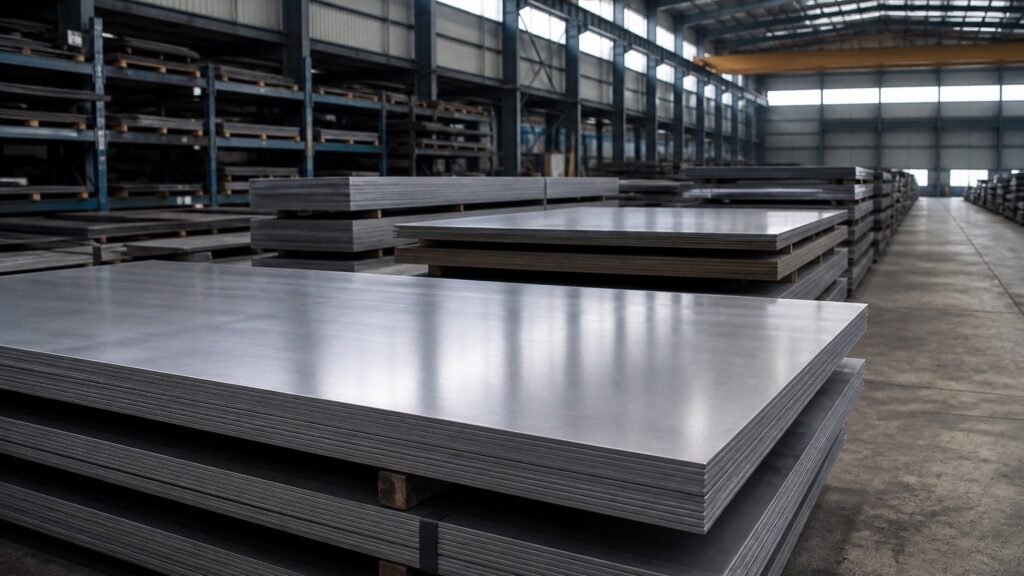
2B vs No.4 Finish Stainless Steel Sheet: Visual and Price Differences?
Wrong finish on a stainless order means rejected deliveries, rework and frozen cash. This guide shows how 2B and No.4 really differ before you specify either one.
2B is a smooth, cold-rolled, bright-annealed finish with a soft grey sheen and no visible grain. No.4 is a brushed satin finish with visible unidirectional grain lines. Choose 2B for tanks, forming and general fabrication; choose No.4 where fingerprints, scratches and long-term appearance matter.
Surface finish is one of those decisions that looks cosmetic on a quotation sheet and then becomes a commercial problem on the shop floor, or a quality claim six months after installation. Buyers who treat “2B or No.4” as a free choice usually discover that the two finishes behave differently under forming, welding, cleaning and inspection, and that the price gap between them is neither constant nor arbitrary. This guide walks through what each finish actually is, how the two look and measure side by side, where the extra cost of a brushed surface comes from, which applications genuinely need which finish, and how to specify and inspect the surface you receive so that the delivery matches the drawing. By the end you should be able to defend your finish choice to your own engineering team and to your supplier.
What Exactly Is a 2B Finish on Stainless Steel Sheet?
2B is the default mill finish for cold-rolled stainless sheet, and most of the world’s flat product ships with it.
A 2B finish is produced by cold rolling, annealing and then a light temper pass on polished rolls. The result is a smooth, reflective grey-white surface with no directional grain and very low roughness, which is why it is the standard finish for fabrication.
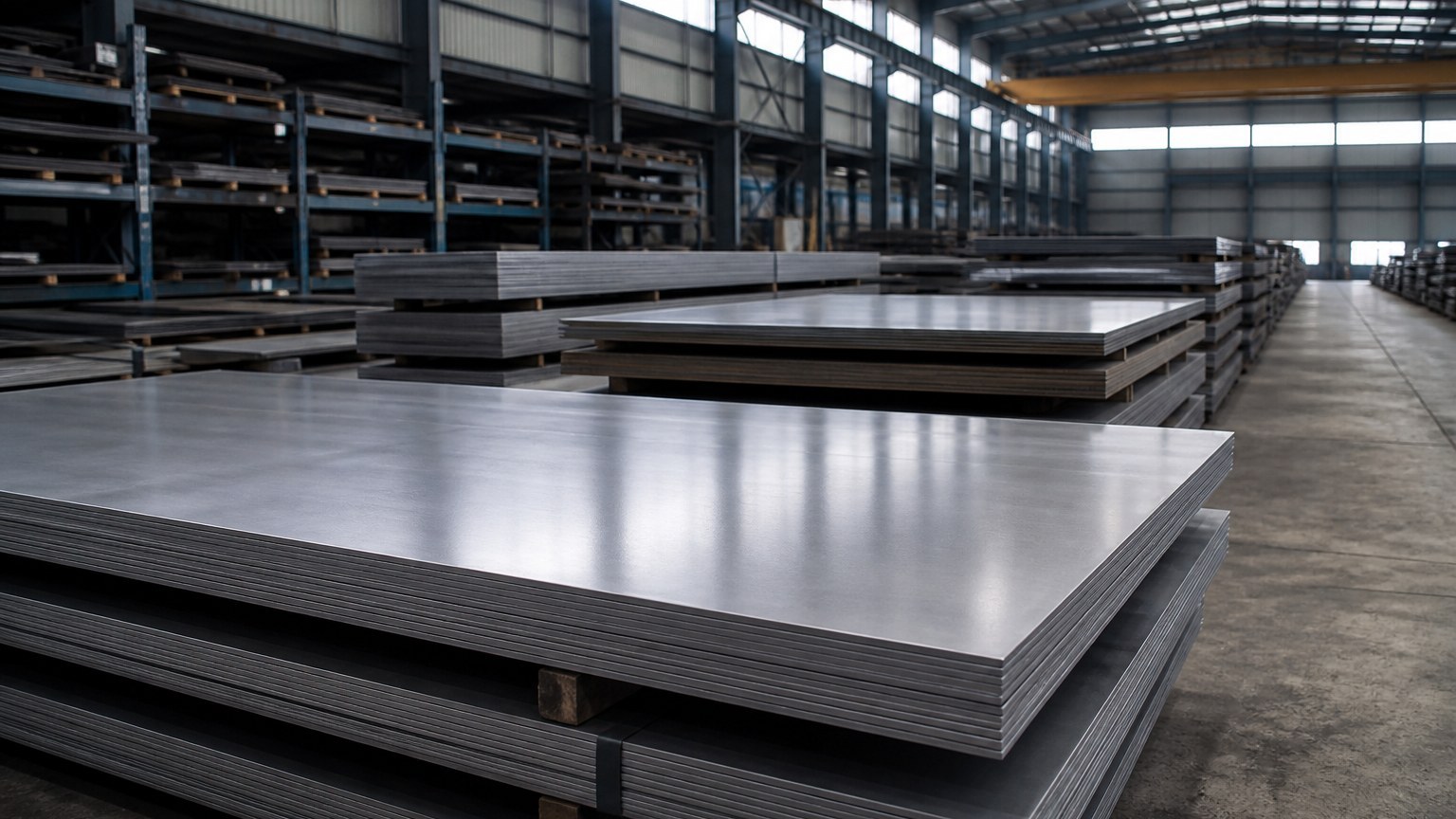
Dive deeper: the rolling route that produces a 2B surface. A 2B finish is not applied like a coating; it is the outcome of the entire hot and cold rolling sequence. Stainless slab is hot rolled into coil, then annealed and pickled to give the rough, dull No.1 surface used for heavy plate and industrial work. To reach 2B, the coil is cold rolled in a series of passes that reduce thickness, harden the metal and progressively close the surface, after which it is annealed again to soften it and to relieve the internal stresses introduced by cold work. The final step is a light temper or skin-pass rolling on polished work rolls, typically taking off only a few percent of thickness. That last pass is what gives 2B its smooth, slightly reflective grey-white appearance and its flatness, and it is also why 2B is described as the mill’s default cold-rolled finish rather than a decorative one. Because the surface is generated by polished rolls rather than by an abrasive belt or brush, there is no grain direction; the sheet reads as uniform whichever way you look at it. Two consequences matter commercially. First, 2B is produced in enormous volume, so it is the most economical finish available and is stocked in the widest range of thicknesses and widths. Second, its uniformity makes it the reference surface against which other finishes are judged: bright annealed (BA) is smoother and more mirror-like, No.1 is rougher and hot rolled, and No.4 is deliberately textured. Stainless steel itself is defined by its chromium content, which forms a self-healing passive film that protects the material; the background to that mechanism is set out in the Wikipedia article on stainless steel.
What Makes a No.4 Finish Different from a 2B Surface?
A No.4 finish starts from the same base metal, but its final operation is mechanical rather than metallurgical.
No.4 is a brushed, unidirectional satin finish. Abrasive belts or brushes cut fine parallel grooves into the sheet, which makes the surface matte, hides fingerprints well, and makes the sheet appear lighter when viewed along the grain and darker across it.
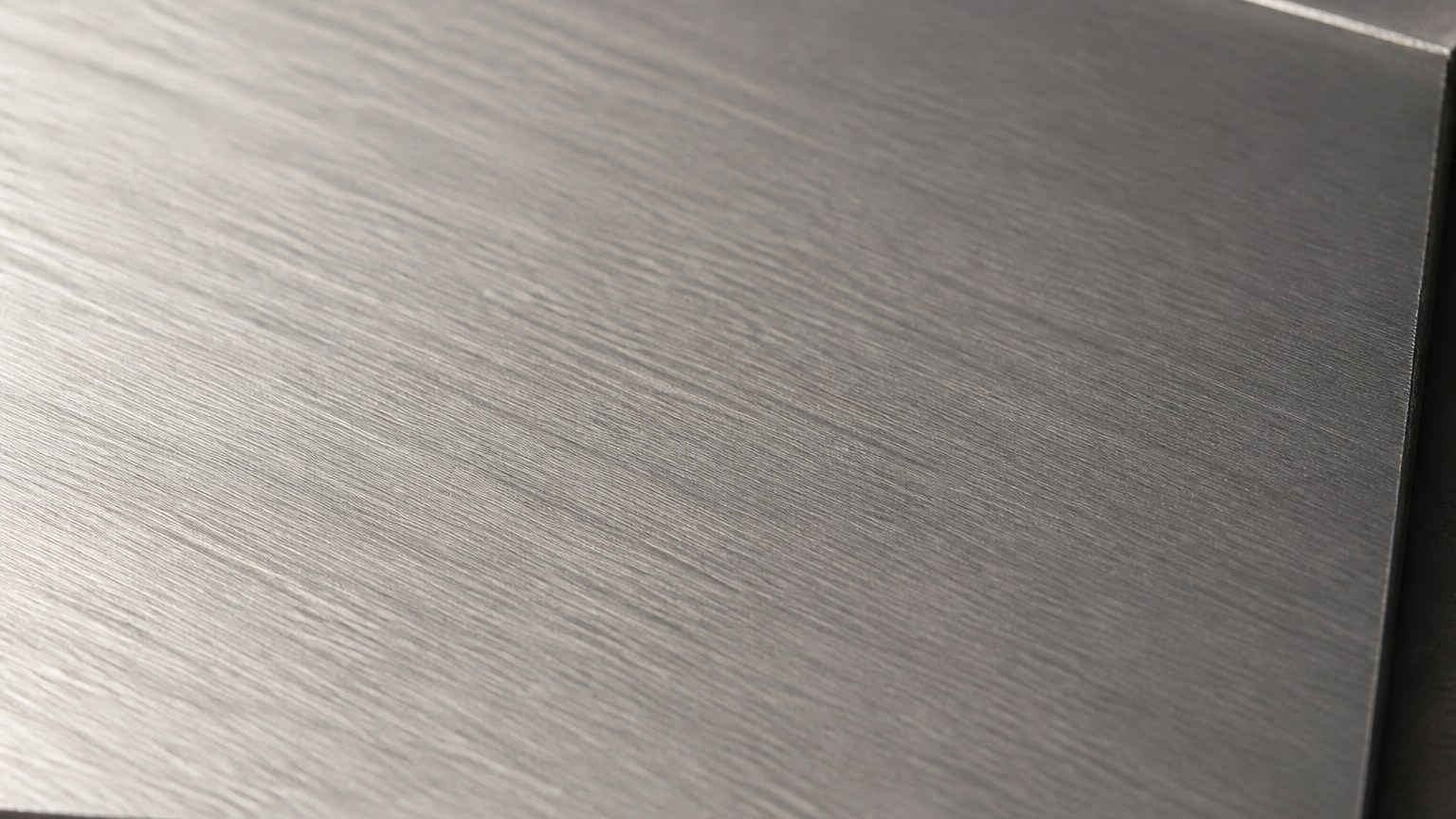
Dive deeper: how brushing creates grain, and what it does to the surface. A No.4 finish begins with the same cold-rolled sheet that carries 2B, but the last pass is abrasive. The sheet is fed under belts or brushes, commonly in the 120–180 grit range, that cut fine, parallel grooves across the whole surface. Because the abrasive travels in one direction, the result is directional by nature: reflectivity changes with viewing angle, and that behaviour is what designers mean when they ask for a satin or brushed look. The same operation has physical consequences. Brushing removes the smooth skin produced by cold rolling, so roughness increases and the exposed surface area rises; published guidance places the intensity of a brushed finish in the region of 0.5–1.5 µm Ra, which is a useful benchmark when you write a roughness requirement into a purchase order. A rougher surface also behaves differently in service. On stainless steel the grooves can trap chloride ions that break down the chromium oxide passive layer, so for the same grade a brushed sheet is generally less corrosion resistant than a smooth one in aggressive environments. Handling is the other half of the story. Brushed finishes hide fingerprints and light handling marks far better than 2B, which is exactly why they dominate public-facing architecture, appliance fronts and medical equipment. They are, however, harder to repair: a scratch or a weld repair has to be re-blended along the grain, otherwise the repaired area reads as a visible patch under glancing light. The mechanism behind the satin effect and its roughness measurement are described in the Wikipedia article on brushed metal.
How Do 2B and No.4 Compare Visually and Measurably?
Side by side, the two finishes are immediately distinguishable, and a written comparison helps you settle internal debates.
2B looks smooth, uniform and slightly reflective. No.4 looks matte and satin with visible grain. Measurably, 2B is much smoother; No.4 is specified by roughness, typically around 0.5–1.5 µm Ra, and cannot be judged fairly under a single fixed light.
| Aspect | 2B finish | No.4 finish |
|---|---|---|
| Production route | Cold rolled, annealed, light temper pass on polished rolls | Cold-rolled base, then abrasive belt or brush with directional grain |
| Appearance | Smooth, reflective, soft grey-white sheen, no grain | Matte satin with visible unidirectional grain lines |
| Surface roughness | Very low and uniform | Higher; commonly specified around 0.5–1.5 µm Ra |
| Fingerprints and light scratches | Show readily, especially under glancing light | Largely masked by the grain |
| Forming and welding | Excellent for deep forming; easy to clean | Usable but grain direction must be respected; welds need re-blending |
| Typical applications | Tanks, vessels, ducting, appliances, general fabrication | Kitchen counters, architectural panels, lifts, medical equipment |
| Relative cost | Lowest-cost flat finish | Higher, driven by extra processing and handling |
Dive deeper: why a single photograph or a single light source is never enough. Buyers frequently approve a finish from one photograph or from a sample viewed under one lamp, then reject the delivered coil. The reason is that 2B and No.4 respond differently to light, and the difference grows as the viewing angle becomes shallower. A 2B surface is essentially a smooth reflector: it returns light almost evenly, so its appearance changes modestly as you walk around it. A No.4 surface is a set of fine parallel grooves: from one direction the grooves reflect light back at you and the sheet looks bright, and from ninety degrees away the same sheet looks distinctly darker. That angle dependence is a feature, not a defect, but it means the conditions under which a sample is approved must be written into the specification. In practice the reliable approach is to judge samples outdoors or under a broad diffused source, then again under the harsh glancing light typical of a handrail, a door panel or a wall cladding joint. Two further checks repay the effort. First, flatness: 2B sheet is checked on a surface table because waviness distorts the finish reading. Second, uniformity along the coil: brushed surfaces can vary slightly at the head and tail of a coil, where abrasive belts cut differently, so a sample from one end of a coil does not automatically represent the other. For projects where appearance is contractual, agree a retained approved sample, state the roughness value and the light conditions, and keep both in the purchase order. Our own surface finish options for ASTM A240 plate, including 2B and No.4, are listed on the 2B vs No.4 stainless finish product page alongside No.1 and mirror.
Why Does a No.4 Finish Cost More Than 2B?
The price gap between the two finishes is real, but it comes from process and yield rather than from the metal itself.
No.4 costs more because brushed finishes need an extra processing pass, run at lower line speed, generate more scrap and rework, and often ship with a protective film and heavier handling controls.
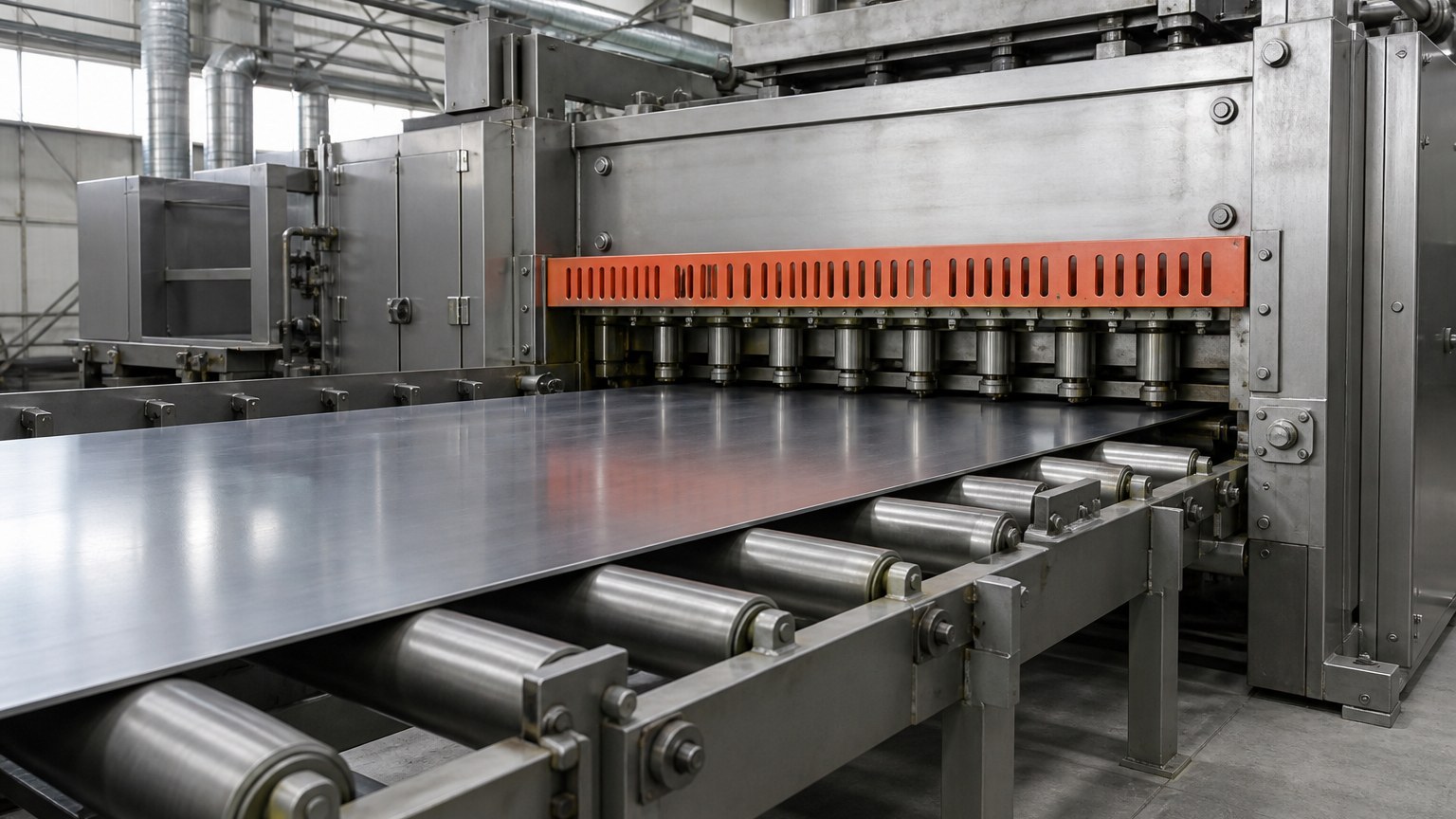
Dive deeper: where the money actually goes, and why a number cannot be quoted from a table. The alloy, thickness and size of a stainless sheet are the same whether it ends up as 2B or No.4, so the base metal cost is identical. Everything above that is conversion and risk. The first driver is an additional production step: a dedicated brushing or polishing line, additional rolls or belts, and the labour to run it. The second is throughput, because brushing runs far more slowly than a temper pass on a cold-rolling mill. The third is yield: abrasive processing produces visible defects that cannot be hidden, so any mark, scratch or edge damage that would have been acceptable on 2B becomes scrap or a re-worked piece, and a re-worked sheet rarely returns to first-quality appearance. The fourth is protection and logistics. Brushed surfaces are usually shipped with a removable protective film, wrapped with interleaving, and handled with gloves, because a single careless contact with a steel sling or a forklift leaves a mark that a customer will see before they see anything else. Film and careful packing add cost, and they add weight and care at the port as well. Finally, cosmetic-grade brushed material is often ordered to a stricter flatness and appearance requirement than structural 2B, which narrows the acceptable portion of a coil. The practical consequence for buyers is that finish pricing has to be quoted per project: the metal price moves with nickel and molybdenum markets, and the conversion premium moves with quantity, gauge and the appearance standard you write down. General requirements for flat-rolled stainless plate, sheet and strip, including the surface-condition framework, are indexed in the ASTM steel standards library. When you need a real number rather than an estimate, the fastest route is to send grade, size, finish and quantity, and compare the offers on a like-for-like basis — for example a 316L stainless steel plate in 3 mm 2B finish quoted against the same size in No.4.
Which Stainless Sheet Finish Should You Specify?
The choice normally falls out of service environment and visibility, not out of preference.
Specify 2B where the surface is functional, hidden or must be cleaned easily, and where cost and availability matter. Specify No.4 where the surface is seen, touched or specified by an architect or a client, and where fingerprints would be an issue.
Dive deeper: matching finish to application so you do not over- or under-specify. Start with visibility. Anything the end user will look at daily — a kitchen worktop, a lift car, a reception panel, a display frame, a medical trolley — is a candidate for No.4, because the grain hides the fingerprints and light scuffs that would make a 2B panel look tired within weeks. Anything that will be covered, insulated, painted, buried or enclosed can stay at 2B and save money without any functional loss. Next, look at the process the sheet will go through. If the part will be deep drawn, press formed or severely bent, a smooth 2B surface forms more predictably, while No.4 material has a grain direction to respect and can show stretch marks after forming. If the part will be welded and then ground or dressed, remember that a brushed panel has to be re-blended along its grain, which is difficult in a fabrication shop and usually impossible on site, so heavily welded assemblies are often better specified in 2B and then finished or passivated uniformly. Environment comes third. Chlorides, including coastal air, road salt, swimming-pool atmospheres and certain cleaning chemicals, attack any stainless surface, and a rougher brushed finish gives them more places to start. Where chloride exposure is real, moving up in grade usually does more for service life than changing finish: the molybdenum-bearing grades resist pitting substantially better than the 304 family, as explained in our guide to 304 vs 316 stainless steel plate. Grade and finish should be decided together, not one after the other. If the part will be welded and left unpainted in a chemical environment, the low-carbon grades matter as well, because lower carbon keeps the weld heat-affected zone from losing corrosion resistance — the reasons are covered in our article on why low-carbon grades hold up at weld seams. Finally, check whether a downstream customer has already fixed the finish in a drawing or a sample panel; if so, reverse-engineer the roughness figure from that sample and write it into the order rather than describing it in words.
How Do You Inspect and Protect the Finish You Receive?
Finish complaints are almost always inspection or handling failures rather than mill failures.
Inspect on arrival under diffused and glancing light, check roughness if it was specified, verify flatness on a table, and confirm the protective film and packing before signing off. Then store and handle the sheets so the finish survives to installation.
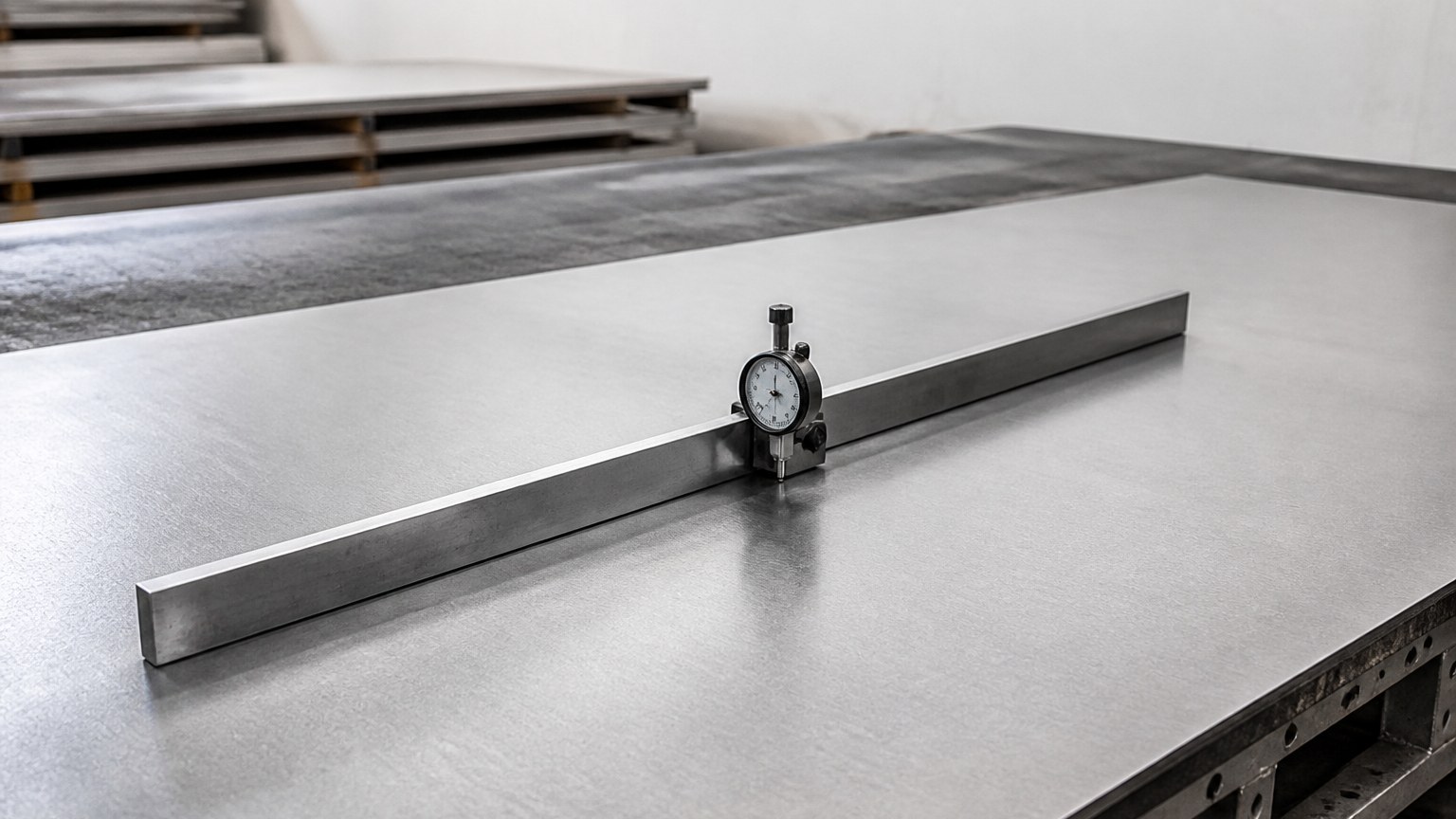
Dive deeper: an incoming inspection routine that actually catches problems. Inspection should begin before unloading, because the most common finish claim concerns transit damage rather than the mill surface. Look at the packing first: interleaving between sheets, edge protection, corner guards and a clean, dry container floor. Then unpack in a clean area and inspect in daylight or under a broad diffused source, checking each sheet along its length, not just at the centre; the ends of a coil or the outer sheet of a bundle carry the highest risk. For 2B, the faults to look for are roll marks, cross-bow and oil staining, all of which show up strongly under glancing light. For No.4, the faults are grain inconsistency, patches where the brush direction changes, and handling marks that stand out because the grain has been interrupted. If the order carried a roughness figure, verify it with a portable surface roughness gauge on a clean, dry area away from edges; if it did not carry a figure, the approved sample becomes the reference, and the sheet should be compared against it under the same light. Flatness is checked separately on a surface table or with a straightedge, because waviness makes any finish look worse than it is. Storage matters as much as inspection. Sheets should be stored indoors, dry, on timber or plastic dunnage rather than directly on concrete, with the protective film left on until the final stage; film that has been left in direct sun or for months can leave adhesive residue or cause staining, so remove it as late as practical and never leave a partly peeled sheet exposed to weather. On site, use suction lifters or clean slings, wear gloves, and keep grinding dust from carbon steel away from stainless surfaces. The British Stainless Steel Association publishes practical guidance on finishes and their treatment, which is a useful reference when writing handling instructions into a contract. When you are ready to compare offers with the finish clearly specified, send your specification to our sales team and we will quote grade, size, finish and packing as one package.
Conclusion
2B is smooth, low-cost and formable; No.4 is brushed, fingerprint-hiding and dearer. Decide by visibility, forming, welding and chloride exposure, then write the finish into the order.