
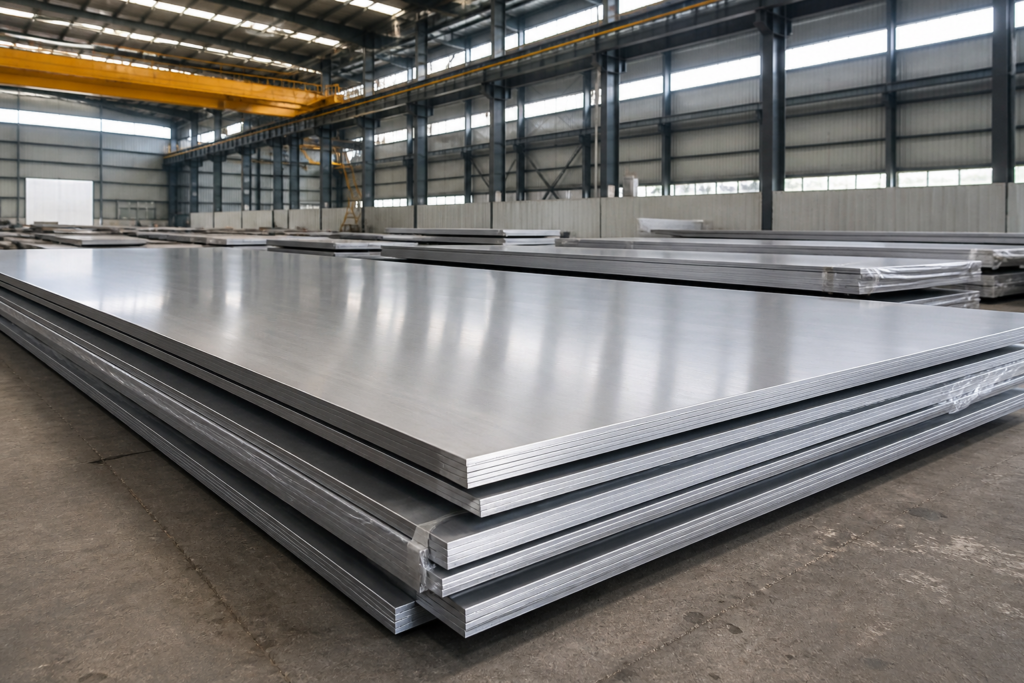
316L Stainless Steel Plate: Properties, Uses and Price Factors
When a project demands strong corrosion resistance and heavy welding, 316L stainless steel plate is often the specification that comes back from the engineering team. It is the low-carbon version of 316 stainless steel, and that single difference makes it the preferred grade for welded chemical, pharmaceutical, and marine equipment. This guide covers what 316L plate actually is, why buyers choose it, what drives its price, and how to source it without overpaying.
What Is a 316L Stainless Steel Plate?
316L is an austenitic stainless steel containing approximately 16–18% chromium, 10–14% nickel, and 2–3% molybdenum, with a maximum carbon content of 0.03% (the “L” stands for low carbon). The molybdenum content is what separates the 316 family from 304: it provides markedly better resistance to chlorides, saltwater, and industrial chemicals, especially against pitting and crevice corrosion.
The low carbon level is the defining feature of the L grade. Standard 316 can lose corrosion resistance near weld seams because carbon combines with chromium at welding temperatures, forming chromium carbide and depleting the surrounding metal. By keeping carbon at or below 0.03%, 316L minimizes this “sensitization” and keeps the heat-affected zone corrosion-resistant without requiring post-weld heat treatment.
Key Properties of 316L Stainless Steel Plate
- Superior chloride resistance: The molybdenum addition protects against pitting and crevice corrosion in seawater, coastal air, and de-icing salt environments.
- Excellent weldability: The low carbon content allows heavy welding sections without intergranular corrosion, making it the standard choice for fabricated tanks and vessels.
- Broad chemical compatibility: Resists many acids, alkaline solutions, and aggressive industrial media where 304 would fail.
- Good fabricability: Can be cut, formed, rolled, and machined with conventional equipment, with a slightly higher work-hardening rate than 304.
- Wide temperature range: Retains useful mechanical properties from cryogenic temperatures up to roughly 800°C in continuous service.
Common Applications of 316L Stainless Steel Plate
Because of its corrosion performance and weldability, 316L plate is specified across demanding industries:
- Chemical and petrochemical processing: storage tanks, reactors, heat exchangers, and piping systems handling corrosive media
- Pharmaceutical and biotechnology: clean-room equipment, storage vessels, and process lines requiring high purity and easy sanitization
- Marine and coastal construction: boat fittings, coastal architecture, offshore platform components, and seawater-handling equipment
- Food and beverage: processing tanks, brewing equipment, and hygienic piping where cleaning agents are aggressive
- Medical devices: surgical instruments and implants where biocompatibility and corrosion resistance matter
316L vs 316 vs 304: Quick Comparison
| Property | 304 | 316 | 316L |
|---|---|---|---|
| Maximum carbon | ~0.08% | ~0.08% | ≤0.03% |
| Molybdenum | None | ~2–3% | ~2–3% |
| Chloride resistance | Moderate | High | High |
| Weld corrosion risk | Low–moderate | Moderate (needs PWHT in thick sections) | Minimal |
| Typical use | General fabrication | Marine & chemical | Heavy welded fabrications |
| Relative cost | Lowest | Higher than 304 | Comparable to 316 |
In practice, most buyers now order 316L instead of 316 because it offers the same corrosion performance with better weld behavior, at essentially the same price.
Price Factors for 316L Stainless Steel Plate
316L plate prices move with a few well-understood factors:
- Nickel prices: Nickel is the largest cost component of austenitic stainless steel, and 316L contains more nickel than 304. Global nickel market movements are the single biggest driver of price changes.
- Molybdenum surcharge: Ferro-molybdenum is expensive, and its market price flows directly into 316L mill pricing.
- Plate thickness and size: Heavier plates and non-standard dimensions cost more per ton due to rolling and processing yield.
- Surface finish: No.1 (hot rolled, annealed) is the most economical; 2B, No.4, and mirror finishes add processing cost.
- Quantity and specification: Larger orders with stable specifications and container-load quantities earn better mill pricing; small mixed orders pay a premium.
Because nickel and molybdenum fluctuate weekly, the best strategy is to work with a supplier that quotes based on current raw-material indexes and confirms pricing validity for a defined window, rather than posting fixed list prices.
Where to Buy 316L Stainless Steel Plate
When sourcing 316L plates, verify that the supplier can provide mill test certificates, guaranteed chemical composition per ASTM A240, and consistent thickness tolerances. Shaanxi Shuncheng Tian Steel supplies 316L stainless steel plates in No.1 and 2B finishes across standard and custom sizes, with strict quality control on every batch. Contact our team with your dimensions and quantity for a current quotation.
FAQ
Is 316L better than 316?
For welded fabrications, yes. 316L avoids sensitization at weld seams and has the same corrosion performance as 316, making it the preferred choice for most projects.
Does 316L cost much more than 304?
Yes, typically 20–30% more per ton, driven by higher nickel and molybdenum content. The premium is justified where chloride or chemical exposure would damage 304.
Can 316L plate be used in seawater?
316L resists seawater corrosion far better than 304 and is commonly used in coastal and marine applications. For permanent full-immersion service, specialist grades such as super-austenitic or duplex stainless steels are sometimes specified instead.
Need a quote for 316L stainless steel plate? Contact Shuncheng Steel with your required sizes, thickness, and finish — we respond with current pricing and lead times.