
Steel Tube Weight Chart: How Do You Read Square and Rectangular Profiles?
Quote from a half-understood chart and margins vanish: a missed wall-thickness column turns a 40-tonne order into 44 tonnes, and nobody absorbs that extra freight but you.
A steel tube weight chart gives theoretical mass per metre for each outside dimension and wall thickness at a steel density of 7.85 g/cm³. Square, rectangular and round sections each use a different shape formula, all of them stated below in millimetres.
The numbers themselves are simple. What is not simple is knowing which assumptions sit behind them, when to trust the chart and when to go back to the formula, and how a per-metre figure becomes a container plan. The sections below work through the chart family by family, from the calculation itself to the point where you compare two suppliers’ quotations on the same basis.
What Does a Steel Tube Weight Chart Actually Tell You?
Weight tables look like neutral data, yet every column carries an assumption that changes your cost before the quotation is even issued.
It gives the theoretical mass of one metre of tube, derived from the nominal outside dimension and nominal wall thickness at a steel density of 7.85 g/cm³. It is not a measured weight and it is not a guaranteed weight.
Theoretical weight is geometry, not measurement
Every figure in a steel tube weight chart is a geometric calculation. Take the cross-sectional area of the steel wall, multiply it by the density of steel, and you have the mass of one metre. Nothing else is inside that number. The coating is not in it. The end finish is not in it. Threads, bevels, cut allowances, end caps and packing material are not in it. Understanding this is what separates a buyer who uses the chart correctly from one who discovers the difference at the port.
Three assumptions deserve to be checked before you trust any table:
- Nominal wall, not actual wall. Product standards allow a wall-thickness tolerance, so the steel actually in a consignment is rarely exactly the nominal figure. Theoretical weight and invoiced weight therefore drift apart by a few per cent, and the direction of that drift is set by the mill, not by the chart.
- Coating excluded. Almost every published table is a bare-steel figure. A galvanized tube carries zinc on both the outside and the inside surface, and that zinc has mass.
- Density assumed for carbon steel. The 7.85 g/cm³ assumption holds well for carbon and low-alloy steel tube. Austenitic stainless steel runs closer to 7.9–8.0 g/cm³, which is why stainless suppliers publish separate tables rather than reusing the carbon steel ones.
Units and naming cause more errors than arithmetic
Two unit systems circulate in parallel. European and most Asian mills quote kilograms per metre; North American buyers often expect pounds per foot, and the conversion is 1 kg/m = 0.672 lb/ft. A tube published as 7.25 kg/m is therefore about 4.87 lb/ft, and quoting the wrong column is a mistake that survives three rounds of email because both numbers look plausible.
Naming causes the same kind of confusion. In North America a square or rectangular tube is normally called a hollow structural section, while under EN 10219 it is an SHS or RHS. Round tube is sometimes called pipe, although pipe is dimensioned and classed differently. Before comparing two charts, confirm that both are describing the same product family and the same dimension basis.
How Is the Weight of a Square Steel Tube Calculated?
A square tube is four flat walls of equal width, so the whole calculation collapses into one short formula you can run without a calculator app.
Mass per metre = 0.0314 × t × (a − t), where a is the side and t the wall thickness in millimetres. A 40 × 40 mm square tube with a 2.0 mm wall therefore weighs approximately 2.39 kg/m.
Worked example: 80 × 80 × 3.0 mm square tube
Take a section that appears constantly in fencing, solar mounting and light structural work. The side a is 80 mm and the wall t is 3.0 mm. Subtracting the wall from the side gives 77 mm, and multiplying 0.0314 by 3.0 by 77 produces 7.25 kg/m. That single figure then drives everything downstream: a 6 m length weighs about 43.5 kg, which is one person-portable but not comfortable, and a 50-piece bundle lands at roughly 2.18 tonnes.
The formula works because the four walls are identical and the corners contribute almost nothing: their material is already counted twice in the naive “4 × a × t” approach, and the − t term puts it right. That single correction is why hand estimates made without it come out systematically heavy, usually by roughly 4–11% on small sections and less on large ones.
| Square size (mm) | Wall 2.0 mm | Wall 3.0 mm | Wall 4.0 mm |
|---|---|---|---|
| 20 × 20 | 1.13 | – | – |
| 25 × 25 | 1.44 | – | – |
| 30 × 30 | 1.76 | – | – |
| 40 × 40 | 2.39 | 3.49 | – |
| 50 × 50 | 3.01 | 4.43 | – |
| 60 × 60 | 3.64 | 5.37 | – |
| 80 × 80 | 4.90 | 7.25 | 9.55 |
| 100 × 100 | 6.15 | 9.14 | 12.06 |
All values are kilograms per metre, calculated on nominal dimensions at 7.85 g/cm³. The structural standard behind most square and rectangular tube orders in North America is ASTM A500/A500M, which covers cold-formed welded and seamless carbon steel structural tubing in rounds, squares, rectangles and special shapes, with a specified wall thickness of 1.000 in. (25.4 mm) or less. The same square sections are also supplied hot-dip galvanized, and the dimensions, wall ranges and coating classes available are set out on our galvanized steel tube page.
Round tube as a cross-check
Many orders mix square sections with round ones, and the round formula is different enough to catch people out: 0.02466 × t × (OD − t). A 60.3 mm round tube with a 2.9 mm wall comes to about 4.10 kg/m, while a 114.3 mm tube at 3.6 mm wall reaches roughly 9.83 kg/m. Note that the round formula uses the outside diameter directly, not a nominal size name. That distinction matters because in the imperial system the nominal size is not the real diameter at all — an NPS 2 pipe measures 60.3 mm outside, a relationship explained in the reference on nominal pipe size. Feed the nominal number into the formula and the answer will be wrong; feed the outside diameter and it will be right.
What Do Rectangular Tube Weight Tables Look Like in Practice?
Rectangular profiles add a second dimension, and that is where manual estimates go wrong — buyers routinely forget to subtract the wall twice.
Mass per metre = 0.0157 × t × (a + b − 2t). A 100 × 50 mm rectangle with a 3.0 mm wall works out at about 6.78 kg/m, roughly 26% heavier than a 60 × 60 mm square with the same wall.
Why the − 2t term appears
The centreline perimeter of a rectangular section is not the sum of the outside dimensions. Each corner overlaps once, and there are four corners; the net correction is two wall thicknesses. Skipping it inflates the answer by the full wall thickness on both sides, which on a 100 × 50 × 3.0 mm profile is 6 mm of phantom perimeter — about 4% of extra weight that never existed. On high-volume orders that phantom becomes real money.
| Rectangular size (mm) | 2.0 mm wall | 3.0 mm wall | 4.0 mm wall |
|---|---|---|---|
| 40 × 20 | 1.76 | 2.54 | – |
| 60 × 40 | 3.01 | 4.43 | 5.78 |
| 80 × 40 | 3.64 | 5.37 | 7.03 |
| 100 × 50 | 4.58 | 6.78 | 8.92 |
| 120 × 60 | 5.53 | 8.20 | 10.80 |
| 150 × 100 | 7.72 | 11.49 | 15.20 |
Two practical notes on reading such a table. First, the rectangular family is usually listed by plan dimensions in millimetres, with the larger dimension written first, so 100 × 50 and 50 × 100 describe the same section. Second, the table describes nominal geometry; the outside dimensions of a formed tube are measured across the flats, and the corner radius is part of the section’s standard geometry rather than a defect. The Steel Tube Institute publishes section-property and dimension resources for hollow structural sections that are useful when you need to move from a weight figure to a design check.
If the difference between a square and a rectangular section of similar weight is still unclear, the practical comparison of how galvanized tube sizes are written sets out both families side by side and shows which dimension the weight is actually calculated from.
How Do You Estimate the Weight of a Whole Order or Bundle?
Per-metre figures only become useful when you multiply them by length and piece count — the step where container plans are made or broken.
Multiply mass per metre by piece length, then by the number of pieces. Fifty lengths of 80 × 80 × 3.0 mm tube at 7.25 kg/m and 6 m each weigh 2,175 kg, or about 2.18 tonnes.
From one bundle to a full container
The arithmetic is trivial; the judgement is not. Three variables decide whether your calculated tonnage matches what actually sails. The first is length: a running order in 6 m lengths and the same order in 12 m lengths contain identical steel but different piece counts, strap weights and loading efficiency, and a 12 m bundle can be heavier than the crane rating on a small vessel while the same tonnage in 6 m lengths is not. The second is packing: bundles are strapped, and the strapping, edge protection and dunnage add a small but non-zero amount to the shipped mass without appearing in any weight chart. The third is tolerance. Because the standards permit wall variation, a mill running consistently to the high side of tolerance can ship measurably more steel than the theoretical figure predicts, and a mill running low ships less.
Work the same calculation for a mixed order and the value of doing it properly becomes obvious. Take 40 pieces of 100 × 50 × 3.0 mm rectangular tube at 6.78 kg/m. At 12 m per piece each one weighs about 81.4 kg, so the order is roughly 3.26 tonnes. Add one 50-piece bundle of 80 × 80 × 3.0 mm at 2.18 tonnes and the shipment is about 5.44 tonnes of steel before packing. That number tells you immediately that this is an LCL shipment rather than a container-filling order, that forklift and crane capacity on site are satisfied, and that the freight quotation you receive should be built on roughly 5.5 tonnes rather than on a guess.
Two shortcuts stop working at this point. Guessing a bundle weight from a single piece fails because bundle sizes vary by mill. Estimating from the drawing rather than the standard fails because drawings rarely state nominal wall and tolerance together. The reliable approach is to take the chart figure for the exact outside dimension and wall, keep the tolerance question separate, and record the piece count and length explicitly. If you would rather have the figures confirmed against a real section, the mill listing for galvanized steel tube in 80 × 80 mm with a 3.0 mm wall shows a worked specification you can check a calculation against.
Does Galvanizing Change the Number on a Steel Tube Weight Chart?
Yes, and because most charts ignore the coating, the gap tends to surface only when the container is weighed.
Zinc adds mass in proportion to coated surface area. On an 80 × 80 mm square tube, a Z275 coating contributes roughly 0.15–0.2 kg per metre, about 2% on top of the bare-steel figure.
Coating weight is surface area, not wall thickness
The coating addition is independent of how heavy the section is. It scales with the area that zinc reaches: the outside surface plus, on a tube formed from pre-galvanized strip, the inside surface as well. For an 80 × 80 mm tube the outside perimeter is 320 mm, so one metre of tube exposes about 0.32 m² of external surface; the internal perimeter is slightly smaller because the wall is subtracted at each side, leaving roughly 0.62 m² of coated area per metre of tube in total. Apply a coating class of about 275 g/m² and the addition is a little under 0.2 kg/m — small per metre, but 2% of a 100-tonne contract, which is precisely the kind of difference that decides whether a tender is won or lost.
The direction of the error is always upward: a chart built on bare steel understates a galvanized consignment. Coating classes also differ from each other by a factor of two or more, so a heavier coating class such as Z275 adds noticeably more than a light class, while a hot-dip coating applied after fabrication can be thicker still. When you compare two galvanized tube quotations, confirm whether the weight basis includes the coating; if one supplier quotes theoretical bare weight and the other quotes coated weight, the two prices are not comparable even if the numbers look close.
Cross-section family changes the effect through geometry rather than chemistry. A round tube has a smaller perimeter for the same wall thickness than a square tube of similar mass, so the same coating class adds proportionally less — one reason round sections remain popular where a specified coating mass per unit area has to be met without inflating the shipped tonnage. The trade-off between profiles is covered in the comparison of square vs round steel tube, which pairs the weight difference with the structural and finishing behaviour of each family.
How Do You Use a Weight Chart When Comparing Supplier Quotations?
Quotations arrive in different units for a reason; the supplier who quotes per metre is quietly hoping you will not convert it back to tonnes.
Convert every offer to one unit, normally price per tonne of theoretical weight, then add freight, coating and tolerance exposure. Only then does a cheap-looking quote show its real position.
Build the comparison on theoretical tonnes
Three conversions settle most comparisons. Price per metre becomes price per tonne by dividing by the chart weight in kg/m and multiplying by 1,000. Price per piece becomes price per tonne by dividing by the piece weight. Price per kilogram needs no conversion, but it should be checked against the theoretical weight so that a quotation based on a systematically low weight is exposed rather than rewarded. Run all three against the same chart and the ranking rarely survives unchanged.
Then add the items that quotations leave out. Coating: is the quoted price for bare or galvanized tube, and if galvanized, at which coating class? Tolerance: does the supplier invoice on theoretical weight or on actual weighbridge weight, and who carries the difference if the mill runs high? Documentation: is a mill test certificate included with the shipment? Length and packing: are 6 m and 12 m lengths priced identically, and does the price include bundle strapping suitable for sea freight? Each of these changes the landed cost of a tonne by more than most buyers assume.
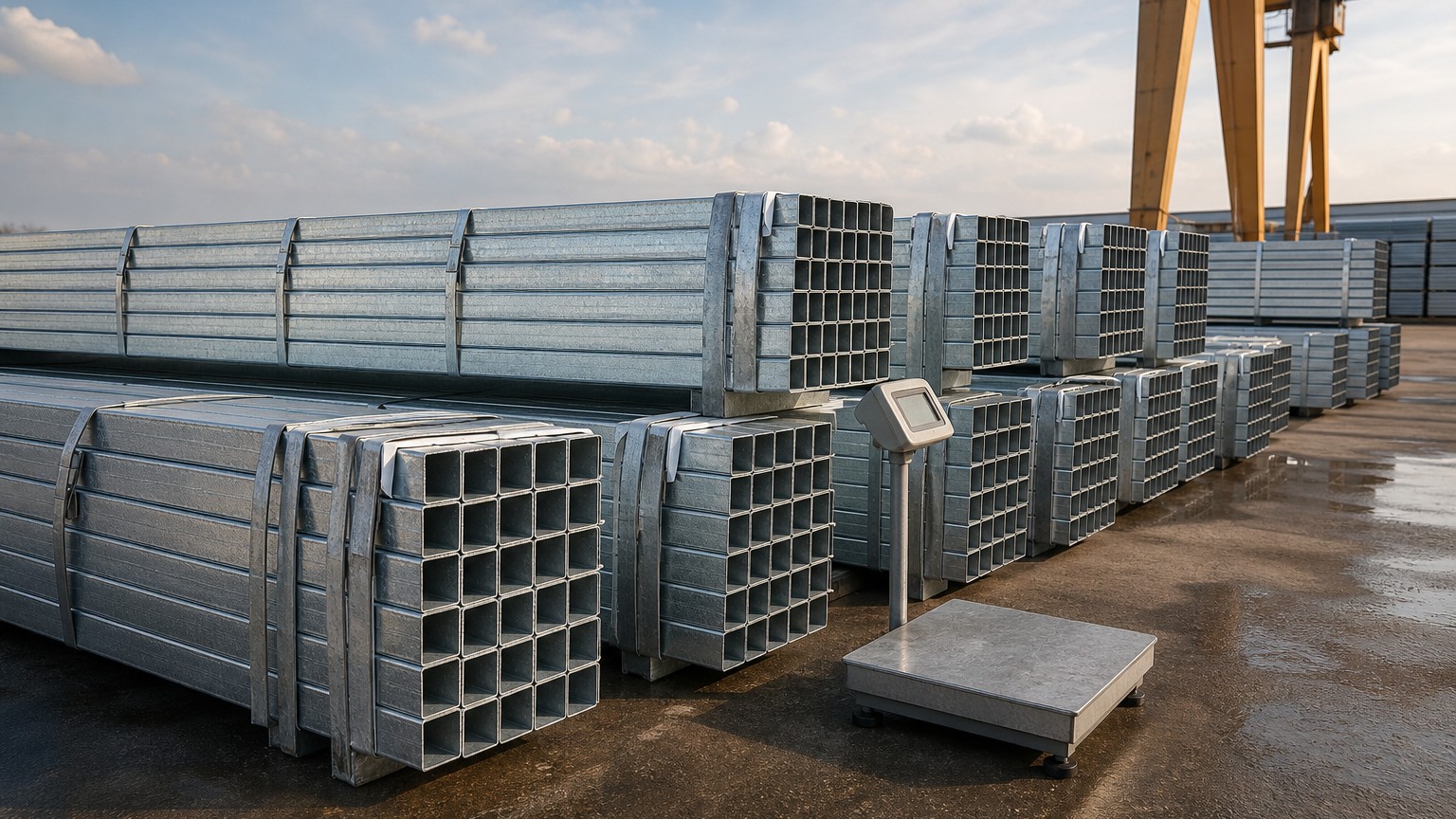
A final discipline worth adopting: build a one-page comparison sheet for each order, with the chart weight, piece count, length, theoretical tonnage, coating, quoted unit price, converted price per tonne and freight in separate columns. When a supplier later disputes a weight claim, or when a container comes in heavier than planned, that sheet is the difference between a two-minute answer and a two-week argument. It is also the document that makes annual supplier reviews meaningful, because it exposes which mills consistently deliver the section you specified rather than the section that is cheapest to produce.
If you would rather hand the specification over and have the weight and tolerance consequences checked for you, send us your tube schedule and we will return a section-by-section weight breakdown with the coating class stated explicitly.
Conclusion: Read the chart as theoretical bare-steel mass per metre, apply the correct formula for each section family, add the coating, and convert every quotation to tonnes before comparing suppliers.