
Cold Rolled Steel Coil Grades: Which One Should You Specify?
One grade code decides whether 40 tonnes of coil presses cleanly or cracks at the first bend, and you only find out when the press stops.
Cold rolled coil grades describe the forming and surface quality guaranteed by a standard — DC01 under EN 10130, SPCC under JIS G3141, or CS Type B under ASTM A1008. The letters indicate a formability level, not a thickness and not a coating.
That short answer carries most of the commercial risk. Every mill publishes its own grade list, every region writes the code differently, and two coils of identical thickness can behave nothing alike in the same press. The sections below take the designations family by family: what they actually guarantee, how the three main systems map onto each other, which application each one suits, and how to verify a grade before it reaches your production line.
What Do Cold Rolled Steel Coil Grades Actually Describe?
Grade codes look like specification trivia until a shipment fails at the press, and then they become the whole conversation.
A cold rolled coil grade is a defined combination of chemical composition, mechanical properties and surface condition, tested to a published standard. It fixes formability, strength range and finish — the three variables every fabricator depends on.
The grade is a promise about behaviour, not about appearance
Two coils can leave a mill with the same 2.0 mm thickness, the same 1250 mm width and the same clean grey surface, and still fail differently. The coating-free cold rolled surface hides everything that matters mechanically. What separates them is the specification behind the code: the carbon and manganese limits, the range of yield and tensile strength permitted, the minimum elongation, and the r-value that predicts how well the steel resists thinning during a deep draw. A commercial-quality coil is allowed a relatively wide band; a deep-drawing or interstitial-free grade is held to a much tighter one. The purchasing consequence is direct: the cheaper code is not a discount on the same product, it is a different product with wider behaviour.
The three families of designation
Cold rolled sheet is named by three systems that dominate international trade. In Europe, EN 10130 designates the material with a DC prefix followed by a two-digit formability index. In Japan and much of Asia, JIS G3141 uses SPCC, SPCD and SPCE, where the final letter ranks drawability. In North America, ASTM A1008/A1008M covers cold-rolled carbon sheet in coils and cut lengths with designations such as CS Type B, DS, DDS, EDDS and the structural and high-strength low-alloy families. Chinese mills commonly supply the EN-style DC codes and JIS-style SPCC codes side by side on the same production line.
Why thickness is deliberately not part of the grade
Thickness, width and coil weight belong to the dimensional part of the specification, not to the grade. A DC01 coil can be 0.5 mm or 3.0 mm, and it remains DC01 in both cases; what changes is the dimensional tolerance table applied and the mill’s processing route. Buyers who merge the two fields in a purchase order create the most expensive ambiguity in cold rolled sourcing — a supplier reading “SPCC 2.0 mm” as grade plus dimension is correct, while a supplier reading it as one product name may quote from a different property band entirely. Our cold rolled steel coil range is organised by exactly this split: grade and standard on one side, dimension and surface on the other, so the two can be confirmed separately before the order is placed.
What Do DC01 and the EN 10130 Family Mean?
The DC codes are the most widely traded in Europe and Asia, and the two digits after the prefix carry the whole meaning.
EN 10130 designates cold rolled flat products with a D for drawing and a C for cold rolled, followed by a formability index. DC01 is commercial quality, and the index rises with drawability through DC03, DC04, DC05 and DC06.
What the index is really grading
The number is not a strength rating. It is a formability rating, and formability in cold rolled sheet is bought with chemistry. As the index climbs, the carbon and nitrogen content is driven down, the annealing cycle is extended, and at the top of the range the steel becomes interstitial-free, alloyed with titanium or niobium so that the free interstitial atoms which pin dislocations are removed. The visible result is a coil that stretches further before it tears, holds a tighter thickness in the drawn wall, and resists the orange-peel surface that appears when a commercial-quality sheet is pushed past its forming limit.
How EN 10130 relates to the rolling process
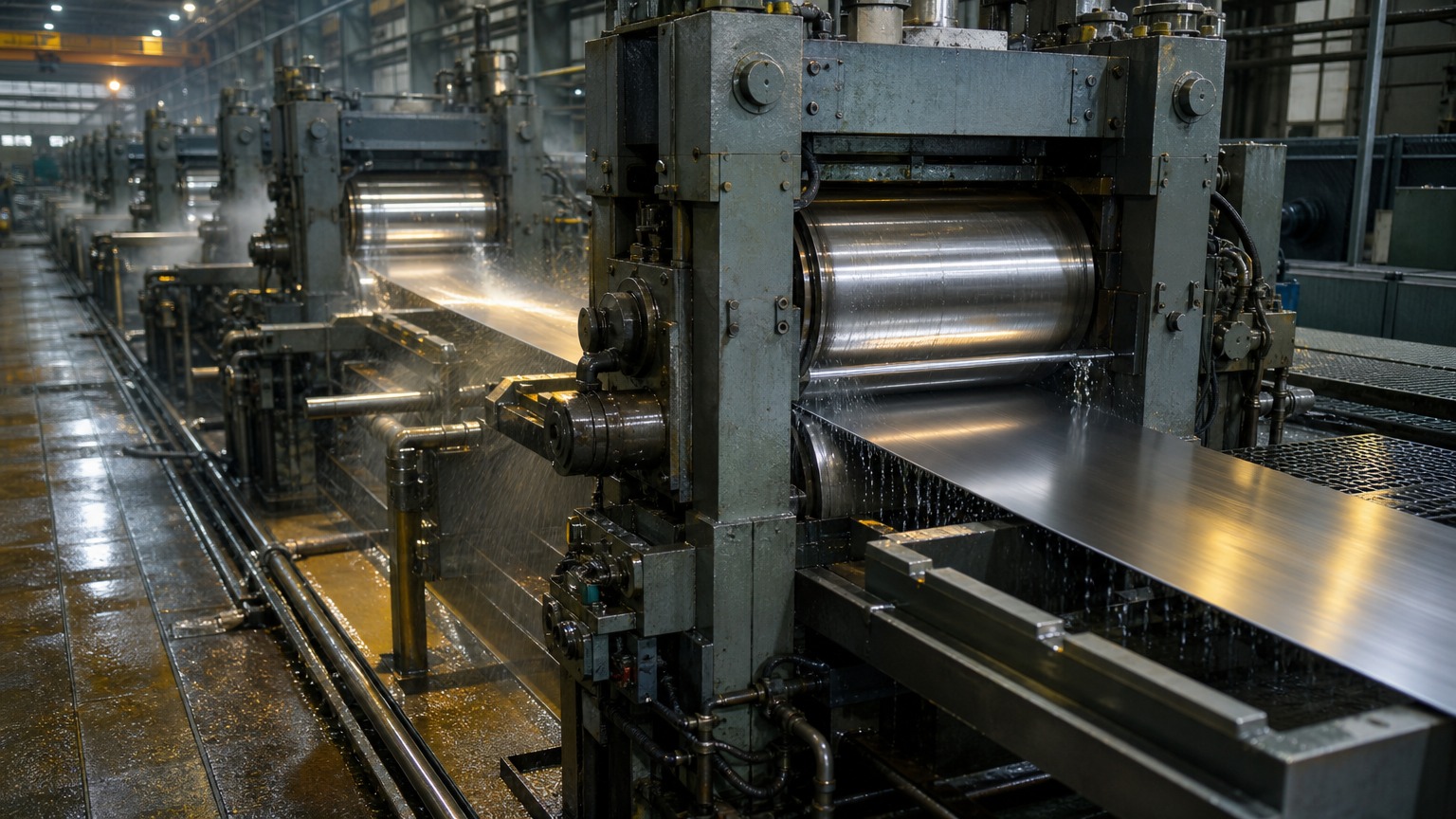
All of these grades start from the same place. A hot rolled coil is pickled to remove mill scale, then reduced in a tandem cold rolling mill at room temperature until the target thickness is reached, then cleaned and annealed to restore the ductility that cold working consumed. Skin passing follows, which sets the surface finish and flattens the yield-point elongation that would otherwise show as stretcher strain lines on formed parts. The grade determines how much reduction, how much annealing and how much temper the mill is prepared to invest — which is why DC06 costs more to make than DC01 before any commercial margin is added.
Where DC01 usually stops
DC01 forms simple bends, mild draws, lock seams and profiles where the radius is generous relative to the thickness. It is the grade behind the majority of general fabrication, shelving, ducts, panels and light structural profiles. Buyers run into trouble when a part is redesigned for a tighter radius or a deeper draw and the grade is left unchanged. The press tells you immediately, but the cost — tool damage, scrapped strip, a delayed container — is already incurred. If a drawing shows a draw ratio close to the limit of a commercial-quality sheet, moving one step up the index is cheaper than discovering it on the line.
What Is SPCC and Where Does JIS G3141 Fit?
SPCC is the code most often quoted by Asian suppliers, and it is not a synonym for a European grade even when the coil behaves similarly.
SPCC is defined in JIS G3141, the Japanese standard for cold-reduced carbon steel sheets and strip. SPCC is commercial quality, SPCD is drawing quality and SPCE is deep drawing quality, with further suffixes denoting the surface finish.
The naming means exactly what it says
The letters decode cleanly: Steel Plate Cold Commercial. Reading the code is therefore easier than reading a DC number, because the final letter states the intended forming duty instead of an index. That clarity is one reason SPCC and its neighbours spread far beyond Japan. Chinese and Korean mills write JIS designations on mill test certificates for export orders as a matter of routine, and buyers in markets with no domestic standard frequently specify SPCC as their default commercial-quality grade.
Where the standards genuinely diverge
Standard numbers are not interchangeable, and treating them as such is where claim risk begins. JIS standards are published by the Japanese Standards Association, and JIS G3141 defines its own chemical limits, its own tensile requirements and its own inspection regime; EN 10130 and ASTM A1008 each do the same. A supplier who promises “SPCC equivalent to DC01” is describing commercial practice, not a certified equivalence. The safe wording is the one used on a mill test certificate: the exact standard, the exact designation and the measured values. For a specific combination such as cold rolled steel coil SPCC 2.0 mm, the certificate wording is part of the product, and it should be confirmed before the order rather than after arrival.
Sub-codes that change what you receive
Two suffixes cause most of the avoidable disputes. The surface finish code distinguishes a standard matte finish from a bright finish, and a buyer who needs a paint-ready surface cannot accept whichever one the mill happened to run. The edge condition code distinguishes mill edge from trimmed edge, which decides whether the coil can be slit or blanked to a finished width without a secondary operation. Neither item appears in the grade name itself, so both must be written separately into the specification.
How Do DC01, SPCC and ASTM A1008 Grades Compare?
Buyers compare three standards on one spreadsheet and then discover the codes are not ranked on the same axis.
They are broadly comparable at the commercial-quality level, not identical. The table below shows the ordinary pairing used in international trade, ranked by formability rather than by strength.
| Formability level | EN 10130 | JIS G3141 | ASTM A1008/A1008M | Typical duty |
|---|---|---|---|---|
| Commercial quality | DC01 | SPCC | CS Type B | Bending, lock forming, simple profiles |
| Drawing quality | DC03 | SPCD | DS | Moderate draws, panels, enclosures |
| Deep drawing quality | DC04 | SPCE | DDS | Deep-drawn housings, appliance parts |
| Extra deep drawing | DC05 | SPCF | EDDS | Severe draws, complex automotive panels |
| Interstitial-free | DC06 | SPCG | IF / EDDS+ | Extreme draws, exposed automotive skin |
Read the table as a ranking, not an equation
The horizontal rows are declared equivalent in everyday procurement, and for most press work they behave as such. The vertical ranking is what matters when a part is marginal: climbing one row buys measurable drawability, and dropping one row to save cost buys a real risk of splitting. What the table deliberately does not claim is that DC01 and SPCC are the same steel. Their carbon ceilings, tensile ranges, elongation minima and sampling frequencies are set by different committees, and a certificate issued against one standard is not a certificate against another.
The consequences for quotation comparison
Once the ranking is clear, quotation comparison becomes mechanical. Convert every offer to the same standard and the same designation, then confirm that the dimension, surface finish, edge condition and temper rolling are stated separately. A quotation that names only a thickness is not comparable with one that names a full specification, however close the two unit prices appear to be. Ask also which test values the mill reports on the certificate; two suppliers quoting “SPCC” may be reporting different mechanical property sets, and the buyer who receives the fuller certificate has a better defence if a batch underperforms.
Which Cold Rolled Coil Grade Fits Which Application?
Application decides the grade far more reliably than price, because the forming operation sets the limit first.
Match the grade to the operation. Bends and profiles need commercial quality, drawn housings need drawing or deep drawing quality, and severely formed automotive or appliance panels need extra deep drawing or interstitial-free steel.
Commercial quality where the shop is honest about the operation
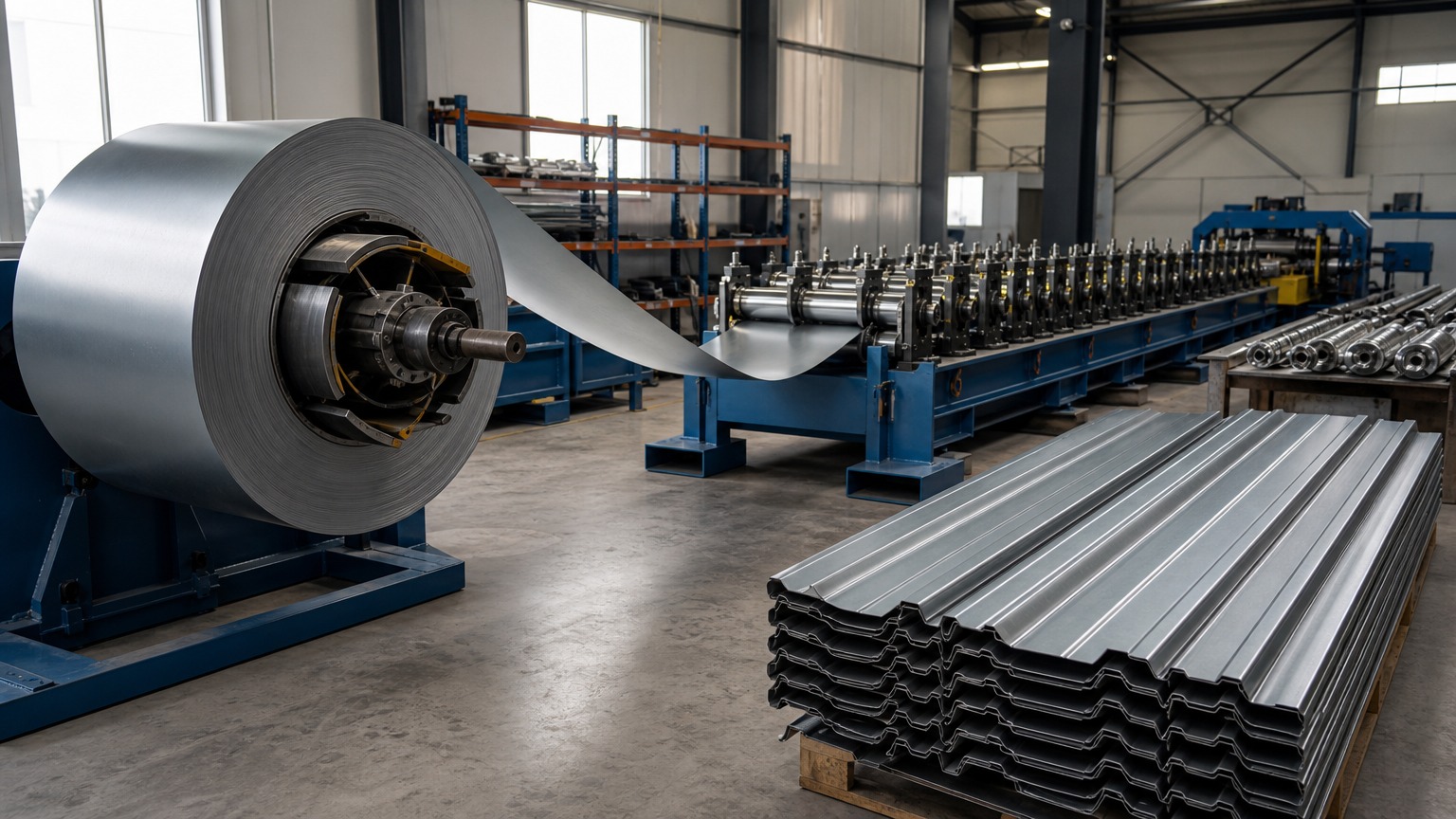
Roll-formed sections, cable trays, ducting, shelving, drums, furniture frames and general light fabrication are served well by DC01 or SPCC. These are operations dominated by bending and lock forming, where the material never approaches its forming limit and the priority is consistent thickness and a predictable surface. Cold-formed steel used in this way has been standard practice in construction and equipment manufacturing for a century, and the economics depend on the coil being the right commercial quality rather than the cheapest available.
Higher formability where the part shape is aggressive
Appliance housings, motor enclosures, sink bowls, filter bodies and automotive inner panels push far beyond simple bending. Here the grade determines whether the drawn wall thins acceptably and whether earing appears at the flange. Drawing quality, deep drawing quality and interstitial-free grades are specified where the draw ratio is high, the radius is tight relative to thickness, or the surface will be painted without filling. The cost difference between commercial and deep drawing quality is real, but the alternative — tool wear, scrap and rework — is rarely cheaper once volume is counted.
Where the next process decides
One further consideration overrides formability: what happens to the coil after forming. A part that will be coated, printed or organically coated usually needs a surface and an oiling regime chosen for that process, and the same is true where the coil follows the route described in how colour coated coil is specified before painting. Where the steel will be welded, the chemistry limits matter more than the drawability index. Where it will be exposed to weather, the cold rolled grade is the substrate rather than the answer, and coating becomes the design decision.
How Do You Verify a Cold Rolled Coil Grade Before Buying?
Certificates are easy to receive and hard to check, and the gap between the two is where most grade disputes live.
Verify three things: that the mill test certificate quotes the exact standard and designation ordered, that its chemical and mechanical values fall inside the permitted range, and that the physical coil matches the certificate — thickness, width and coil identification marks.
Read the certificate against the order, line by line
The certificate must name the standard number, the designation, the heat number, the dimensions and the measured values with the units stated. Compare the tensile and yield figures against the permitted ranges for the ordered designation rather than against a remembered number, and confirm the elongation basis, because elongation is quoted across different gauge lengths in different standards. Check that the surface finish and edge condition codes on the certificate match the ones on the purchase order; this single check catches more errors than any other, because finish and edge are the items most often left to the mill’s default.
Check the coil as well as the paperwork
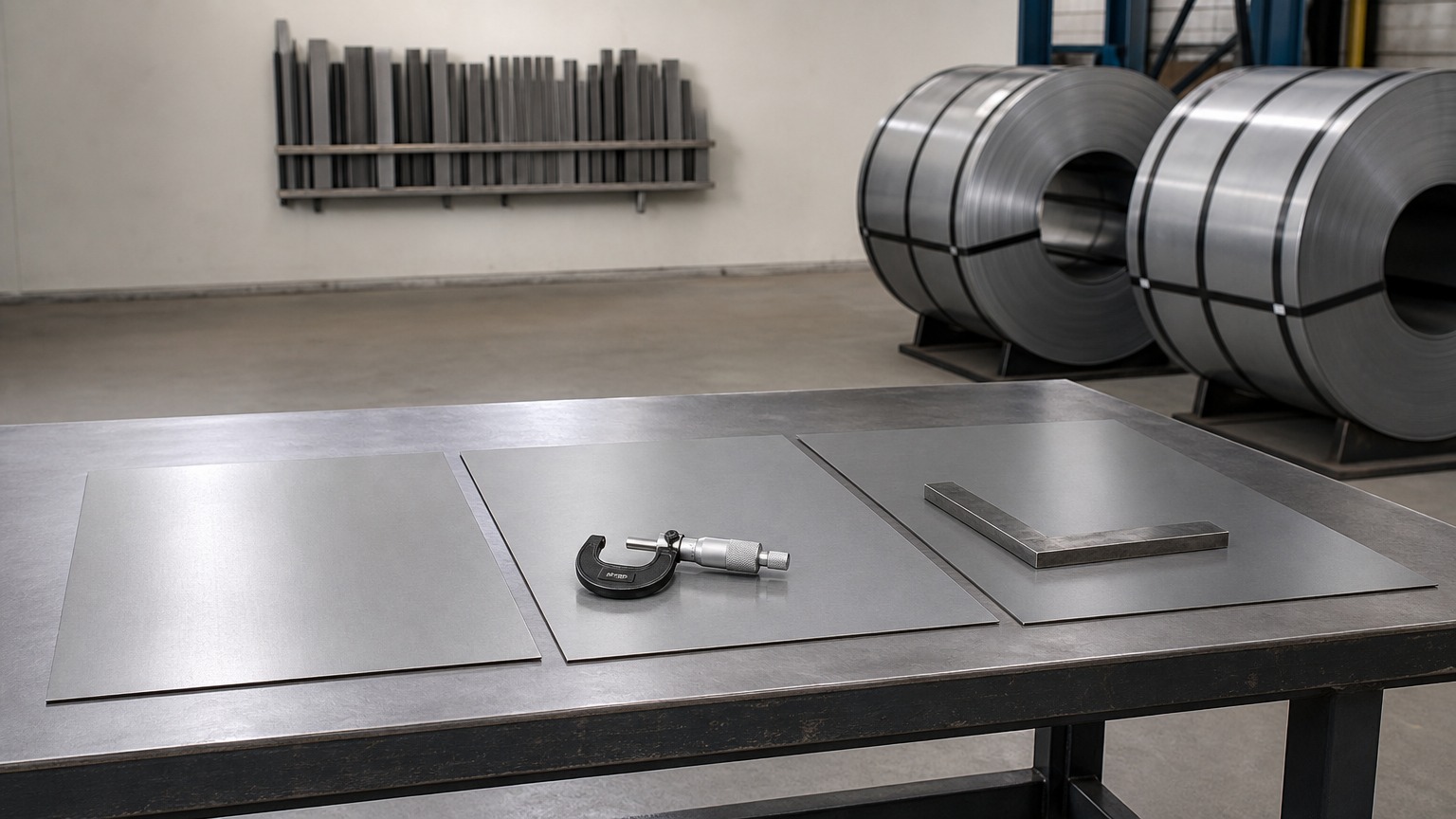
Physical confirmation is quick and worth doing on receipt. Measure thickness at several points along the strip width and through the coil, not only at the outside wrap, and check width and coil weight against the packing list. Confirm that the coil identification number and heat number are legible and match the certificate, since traceability is lost the moment the coil is separated from its paperwork. Note the oiling: cold rolled coil is normally supplied oiled and matte unless something else was specified, and an unintended film of oil changes how the strip behaves in a welding or coating line. A coil arriving dry when the order specified oiled — or the reverse — is a specification non-conformance, not a matter of taste.
Keep the record that resolves the argument
Filing the certificate, the packing list, a photograph of the coil markings and the incoming thickness readings takes a few minutes and settles the question if a batch later splits or measures out of tolerance. Suppliers respond to comparative evidence far more constructively than to a description of symptoms. If the specification is genuinely uncertain, send it to us before the order instead of after: as a cold rolled steel coil supplier, we confirm the designation, dimension, surface and edge condition in writing so the certificate can be checked against a documented order. Send your grade, thickness, width, coil weight and intended forming operation through the contact form, and we will return a specification summary with the standard and designation stated explicitly. Send us your coil specification and we will confirm it the same working day.
Conclusion: Grade codes rank formability, not strength. Match DC01, SPCC or a higher index to the forming operation, and verify certificate, finish and edge before use.