
Which Steel Should You Choose for Outdoor Marine and Coastal Projects?
Specify steel for a coastal site and eighteen months later the handrail weeps rust through its coating. Salt air decides that outcome long before price does.
For outdoor marine and coastal projects, choose 316 or 316L stainless steel where chlorides are constant, hot-dip galvanized steel where the structure stays dry and inspectable, and duplex or weathering grades only when the design and the atmosphere genuinely allow them.
Most coastal specifications are written from inland experience and corrected later, on site, at the cost of a recoating campaign. The sections below work through what chlorides actually do to steel, which grades answer that attack, where galvanized carbon steel is the honest choice rather than the cheap one, why weathering steel is so often misapplied near the sea, and how to write a surface clause that can still be checked when the material arrives.
Why Do Marine and Coastal Sites Attack Steel So Aggressively?
A coastal buyer pays for the same steel twice: once at the mill and again when the surface fails, because salt rewrites the rules of corrosion.
Coastal air carries chloride ions that break down passive films on steel, and it keeps surfaces wet for longer. Chlorides plus long wet time plus oxygen produce far faster pitting, crevice and galvanic corrosion than inland industrial atmospheres.
Chlorides defeat the protective film
Stainless steel resists corrosion because chromium in the alloy forms a thin passive oxide film that rebuilds itself when oxygen is available. Chloride ions are small and chemically aggressive, and in sufficient concentration they attack that film at individual points rather than uniformly across the surface. Once the film breaks locally, the pit that follows is self-sustaining: the chemistry inside it turns acidic and oxygen-starved while the surrounding surface stays passive, so the attack continues inward instead of spreading sideways. On carbon steel the mechanism is different but the result is similar in commercial terms, because chlorides accelerate the electrochemical reaction that produces rust and they also attack zinc coatings directly, consuming a galvanized layer faster at the coast than the same layer would last inland.
Wet time and geometry decide the failure point
Corrosion rate tracks wet time more closely than it tracks any other single variable. A coastal site keeps steel wet through salt-laden fog, wind-driven spray, night-time condensation and slow drying after rain, so the surface spends far more of the year in the condition that drives the reaction. Geometry then decides where the damage concentrates. Water sits under washers, inside lap joints, at the bottom of horizontal sections, behind stiffeners and in any crevice narrow enough to hold moisture but wide enough to let chloride in. Two components of identical grade can therefore have completely different service lives: the one that drains and dries outlasts the one that traps a film of salt water indefinitely.
What this means for a specification
Because chloride deposition and wet time drive the attack, a specification written for an inland industrial site is not transferable to a coastline. Distance from the shoreline, elevation above the water, prevailing wind direction, whether the surface is washed by rain, and whether it is shaded enough to stay damp all shift the answer. That is why the same project can correctly use 316L on an exposed seafront balustrade and a coated carbon steel section on a sheltered service walkway a hundred metres inland, and why a single atmospheric description copied across an entire bill of materials usually ends up either wasteful or inadequate.
Which Stainless Steel Grades Suit Outdoor Marine Steel Applications?
Grade substitution is the most expensive shortcut in coastal work, because two stainless steels that look identical on a mill certificate can behave completely differently at the waterline.
304 works for mild coastal shelter, 316 and 316L add molybdenum for chloride resistance, duplex 2205 suits high-chloride structural use, and 6Mo or super-duplex grades are reserved for severe service. Match grade to chloride exposure, not to budget alone.
Why molybdenum decides the grade
The difference between common austenitic grades comes down to alloying. Type 304 is the classic 18% chromium, 8% nickel austenitic grade, and it tolerates ordinary urban and inland industrial atmospheres well. Type 316 raises nickel slightly and adds roughly 2 to 3% molybdenum, and that molybdenum is what improves resistance to pitting and crevice corrosion in chloride-bearing environments. Type 316L is the low-carbon variant, with carbon held to a maximum of about 0.03% so that thick welded sections do not sensitise and lose corrosion resistance next to the weld. A useful shorthand is the pitting resistance equivalent number, calculated as PREN = %Cr + 3.3 × %Mo + 16 × %N. On that scale 304 typically sits near 18 to 19, 316 near 24 to 26, and duplex 2205 near 34 to 35. The number is not a service guarantee, but it ranks grades correctly when a project is choosing between them.
Where 304 still earns its place
304 is not a failed marine grade; it is simply a grade with a defined limit. It performs acceptably in sheltered coastal locations where surfaces are washed by rain, where chloride deposition is moderate, and where the component can be inspected and cleaned. It is a poor candidate for splash zones, for surfaces that stay damp, and for anything holding stagnant seawater. Projects that treat 304 as an interchangeable substitute for 316 save a modest amount on the mill invoice and take on a corrosion risk that appears after the warranty period has closed.
Localised corrosion is the real marine test
Uniform surface staining is rarely what ends a coastal component’s life. Pitting and crevice corrosion do the damage, and both are sensitive to stagnant water rather than to flow. Type 316 has useful resistance in flowing seawater but is widely understood to have limited resistance in stagnant or low-flow seawater, where oxygen cannot refresh the passive film and chlorides concentrate inside gaps. For structural work in constant chloride exposure, duplex grades are the usual engineering answer because they combine higher pitting resistance with roughly double the yield strength of austenitic grades, allowing thinner sections. Where the project needs a flat product rather than a profile, our outdoor marine steel plate range is supplied in 304, 316L and duplex grades so the grade decision can be made against the site rather than against the stock list. The chemistry behind these grades is summarised on the reference page for stainless steel, and the flat-product requirements themselves sit in ASTM A240/A240M.
When Is Galvanized or Coated Carbon Steel Enough for Coastal Work?
Not every coastal component justifies stainless steel, and over-specifying is as damaging to a project budget as under-specifying it.
Galvanized carbon steel is adequate in sheltered coastal positions where the coating stays intact and inspection is possible. In direct salt spray, on cut edges, in crevices and where recoating is impossible, higher coating mass, duplex systems or stainless steel are the safer choices.
Coating mass is the specification
For galvanized work, the protecting variable is the mass of zinc on the surface, not the word “galvanized”. A designation such as Z275 states the total zinc mass on both faces per square metre, and a heavier coating lasts longer in the same atmosphere because the zinc is consumed at a rate set by the environment. Chloride-bearing coastal atmospheres consume zinc faster than rural or indoor exposure, which is precisely why a coating weight chosen for an inland warehouse is the wrong basis for a coastal railing. Zinc also protects sacrificially: where the coating is cut, drilled or scratched, the surrounding zinc continues to protect the exposed steel, so a galvanized component tolerates site damage that an equal thickness of paint would not.
Where galvanized steel genuinely works
Galvanized or continuously coated carbon steel is a rational choice in sheltered positions above splash height, on components that dry out regularly, on assemblies that can be re-inspected and touched up during service, and where the structure’s design life is moderate. The conditions are explicit: the coating stays intact, water cannot pond on or inside the section, and the owner accepts periodic inspection. Hot-dip galvanizing of fabricated articles is standardised in ISO 1461:2022, and the corresponding requirements for zinc coatings on iron and steel products are set out in ASTM A123/A123M. Both documents matter to a buyer for the same reason: they fix not only the coating but the test method, so a coating mass quoted against one standard cannot be accepted under the rules of another.
When coatings stop being the right answer
Three situations push a coastal project away from coated carbon steel. The first is damage tolerance: cut edges, drilled holes, welded joints and field modifications are exactly where a zinc coating is thinnest or absent, and on an exposed seafront those points become corrosion initiation sites. The second is consumable life: every zinc coating has a finite budget of metal, and where replacement is impossible or expensive the specification should stop relying on a consumable layer. The third is geometry: hollow sections sealed at both ends, crevices that hold salt water, and components that cannot be drained put a coated section into a worse position than the coating-weight table assumes. Our comparison of how galvanized steel and Galvalume behave in the same atmosphere covers the aluminium-zinc alternative for projects that want a longer barrier life from a coated flat product.
Does Weathering Steel Belong on a Coastal Site?
Weathering steel is the most misapplied material in coastal design, and the mistake is almost always made by looking at architecture photographs rather than at chloride data.
Usually not. Weathering steel depends on repeated wet-and-dry cycling to build a protective patina, and chlorides interfere with that layer. In the immediate coastal zone it often keeps corroding instead of stabilising.
How weathering steel is supposed to work
Weathering steels such as the ASTM A242 and A588 families are low-alloy structural steels with small additions of copper, chromium, nickel and phosphorus. Exposed to the atmosphere, they form a dense, tightly adhering surface layer of corrosion product that slows further attack, which is why they are valued for bridges and architectural structures where the rusted appearance is acceptable and painting is undesirable. The mechanism depends on cycles: the surface wets, then dries, and the drying step is what consolidates and stabilises the patina. It also depends on drainage and detailing, because the layer cannot form where water stands or where the surface is permanently damp. The background on the grade family and its properties is described on the reference page for weathering steel.
Why the coast breaks the mechanism
Chloride deposition interferes with patina formation. Instead of consolidating into a protective layer, the surface keeps producing fresh, loosely adherent corrosion product, so the material behaves less like a protected alloy and more like unpainted carbon steel with a slightly slower reaction. Coastal installations also tend to sit in exactly the conditions weathering steel dislikes: constant humidity, salt aerosol, poor drying, and detailing that traps moisture behind stiffeners or under fixings. The visual result appears gradually — run-off staining, laminar flaking and section loss at edges — and by the time it is obvious, the structure is expensive to correct. That is why responsible practice treats the immediate coastal zone as somewhere weathering steel is generally discouraged unless a project can demonstrate specific service experience in the same exposure.
The honest rule for coastal projects
The rule that survives contact with real coastal projects is to treat weathering steel as an inland and well-drained material unless there is local evidence to the contrary. Where the design intent is an unpainted, low-maintenance exposed structure near salt water, the realistic options are a suitably alloyed stainless grade, duplex for structural work, or a properly specified coating system with an inspection and maintenance plan. Choosing weathering steel for its appearance and then discovering that the coast will not let it stabilise is the expensive version of that decision.
How Should You Specify and Verify Outdoor Marine Steel Before Ordering?
A marine specification is only as strong as the test it can be checked against, and most coastal disputes trace back to a surface clause nobody could measure.
State the grade and its standard, the product form and thickness, the finish, the chloride environment, and the documents you expect: mill test certificate, grade verification and coating mass or film thickness results. Then verify them on arrival.
The clause that survives inspection
A usable coastal clause names five things: the grade and the standard it is ordered against, the product form with dimensions and tolerances, the surface condition or finish, the environment it is intended for, and the evidence to be supplied. Each item converts a preference into something measurable. “Marine grade” is not a grade; “type 316L plate to ASTM A240, 3.0 mm nominal, 2B finish, for an exposed coastal structure, with mill test certificate and grade verification report” is one. Naming the environment matters because it gives the supplier a documented basis for the offer, and it gives the buyer a reference point if the delivered surface turns out to be inadequate for the site.
Documents worth naming
For stainless products, the mill test certificate identifies the heat and reports the chemical composition and mechanical properties, and it should be traceable to the material actually shipped rather than to a generic example. Grade verification by PMI is the practical way to confirm that the material in the container matches the certificate, and it can be requested as a condition of shipment. For coated products, the document should state coating mass or dry film thickness against a named test method, with both minimum average and minimum single readings where the standard allows both, because a good average can hide a thin patch. Physical appearance is not evidence: a duller surface does not prove a lower grade, and a brighter one does not prove a higher one.
Verification that costs nothing
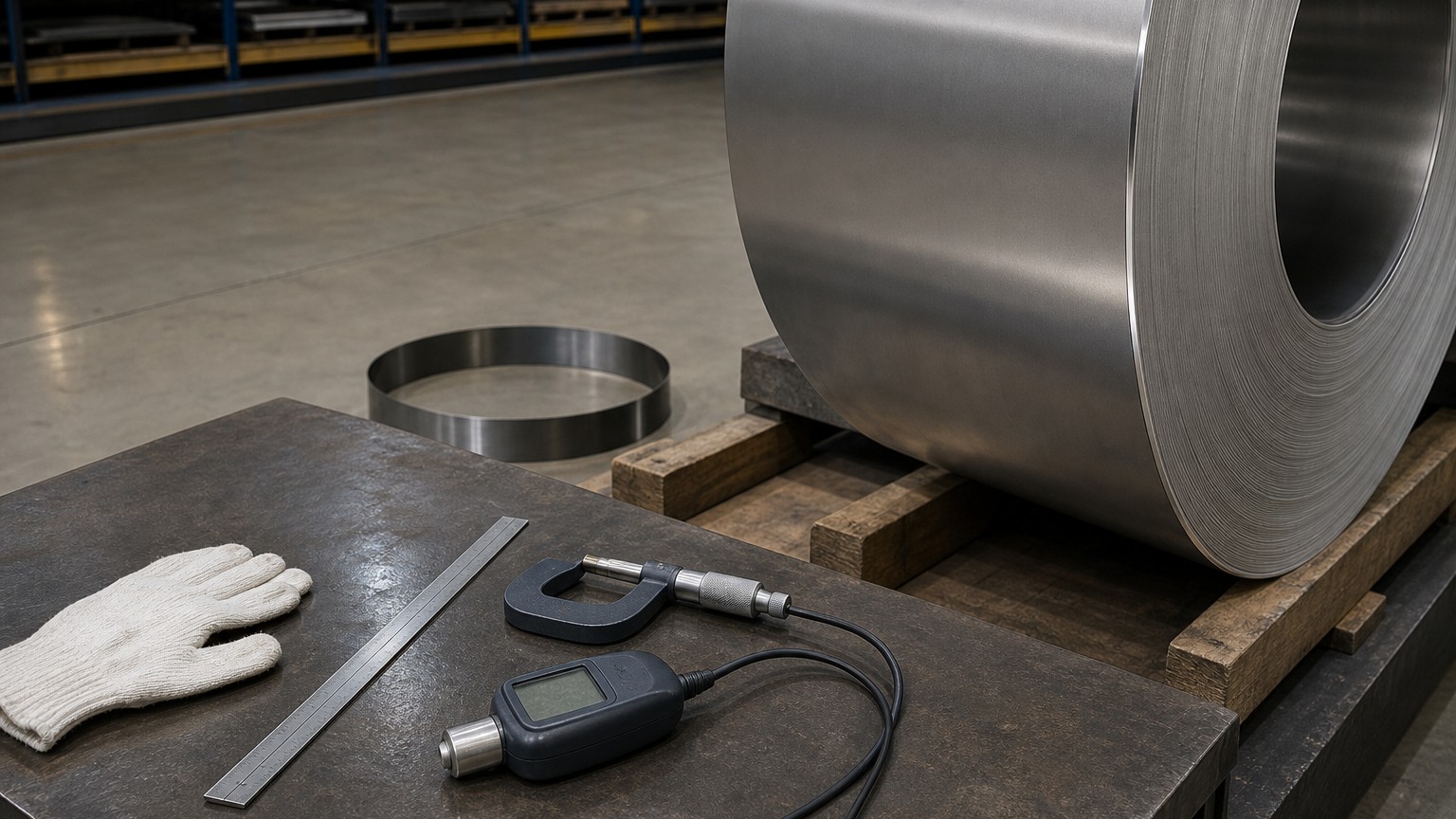
Most incoming checks need no laboratory. Compare the certificate against the purchase order, confirm the grade and dimensions, measure film or coating thickness with a gauge at several points including an edge and a weld, and note the surface condition in photographs before the material is moved. Storage is part of the specification as well: coastal steel should be stacked clear of the ground, ventilated so condensation can escape, and separated so that bundles do not trap moisture between contacting surfaces. For flat products, the finish itself affects how contamination and salt residue behave on the surface, and our notes on how stainless steel surface finishes are specified explain which finish suits an exposed coastal component. Where a project needs a light-gauge coil rather than plate, 304 stainless steel coil in 0.5 mm by 1219 mm is supplied with the grade and finish declared per order.
What Do Coastal Projects Most Often Get Wrong?
Six-figure remediation bills usually trace back to small specification omissions, not to a mill that shipped the wrong steel.
The recurring errors are grade substitution without disclosure, coatings specified by name rather than by mass, mixed metals bolted together without insulation, welded stainless left unpickled, and inspection that never measures the surface.
Grade substitution and mixed metals
The first error is quiet substitution: a 304 delivered where 316 was specified, or a 201 grade offered in place of 304, with the invoice still reading “stainless steel”. It is caught by grade verification, not by appearance. The second is galvanic corrosion between dissimilar metals. Stainless steel in direct contact with carbon steel or with a galvanized component, especially in a wet coastal joint, creates a small electrochemical cell in which the less noble metal corrodes much faster than it would alone. The fix is a design fix rather than a material upgrade: isolate the joint, avoid large-area couples in wet positions, and do not rely on a coating to separate two metals at a bolted connection.
Welds, contamination and storage
The third error is untreated welds on stainless work. Welding disrupts the passive film and can leave heat tint, scale and a chromium-depleted zone that resists corrosion far less than the parent metal. Cleaning and restoring the surface after welding is part of making the component marine-capable, and skipping it is a common reason a correct grade fails at exactly the joints. The fourth is contamination: carbon steel grinding dust, iron particles carried on tools and workshop floors, and handling with unclean equipment all deposit free iron on stainless surfaces, which then rusts and makes a sound grade look defective. The fifth is storage. Coastal steel that sits unventilated for weeks in a humid container starts its service life with salt and moisture already on the surface.
Planning the maintenance the coating needs
The last error is expecting a consumable surface to be permanent. Every galvanized and painted system has a finite life that depends on the environment, and if the specification assumes otherwise, maintenance is never budgeted. A realistic coastal specification states how the surface will be inspected, at what interval, and by what method — a visual walk-down, thickness readings at nominated points, or a scheduled wash-down to remove chloride accumulation. That plan should be written before the material is ordered, because it determines whether the coating mass and the grade in the bill of materials will still make sense in year five. If you would rather have the site conditions and the intended service life checked against what can actually be supplied, send us your project conditions and we will confirm the grade, finish and documentation before the order is placed.
Conclusion: Which Steel Belongs on Your Coastal Project?
Treat chlorides as the design driver: specify 316L or duplex where spray is constant, galvanized or coated carbon steel only where it stays dry, and verify the surface you receive.