
API 5CT Grades: How Do J55, K55, N80 and P110 Differ?
One grade chosen on strength alone can fail in sour service, and the well pays for it. API 5CT grades are a service hierarchy, not a strength ladder.
API 5CT grades group casing and tubing by minimum yield strength and by service: J55 and K55 for lower-strength casing, N80 for medium-strength wells, L80, C90, T95 and C110 for sour or restricted-yield service, and P110 and Q125 for high-strength, high-pressure wells.
Transition: the letters and numbers look like a code, but each designation is an engineering decision compressed into four characters. The sections below unpack what the specification actually controls, compare the grades side by side, isolate the four you will meet most often in an enquiry, explain what the type suffixes and product specification levels change, show why sour service reorders the whole selection, and close on the documentation that proves which grade was actually delivered.
What Does API 5CT Actually Specify?
One document governs this entire product family, and it controls far more than a strength number.
API Specification 5CT, matched internationally by ISO 11960, sets the technical delivery conditions for casing, tubing and pup joints — grades, product specification levels, dimensions, chemistry, heat treatment and testing. Threading and thread gauging are governed separately by API Spec 5B.
Where the specification draws its boundaries
The current international edition is ISO 11960:2020, a 267-page document maintained by ISO/TC 67/SC 5 that specifies technical delivery conditions for steel pipe used as casing, tubing and pup joints, together with coupling stock, coupling material and accessory material — so the scope does not stop at the pipe body. It lists the applicable product grades as H40, J55, K55, N80, L80, C90, R95, T95, P110, C110 and Q125, and it defines the connections covered: short round thread casing, long round thread casing, buttress thread casing, non-upset tubing, external upset tubing and integral-joint tubing, along with the couplings and thread protection that travel with them. Two boundaries matter commercially. The first is that threading itself is out of scope: the standard points to API Spec 5B for thread dimensions, thread gauges, gauging practice and thread inspection methods, which is why a joint can pass every pipe-body test and still be rejected at the gauging bench. The second is that the calculation of performance properties sits in a companion document rather than in 5CT, so the burst, collapse and tensile ratings printed in a quotation should be traceable to a stated method rather than taken on trust. The API edition moves on its own cycle, and the 10th edition is a useful reminder of why edition control matters: it eliminated grade M65 entirely, added polymer quenching for L80, updated the requirements for N80 Type 1, replaced the old supplementary requirement on test certificates with new mill test report expectations, and reworked the hardness requirements for L80, C90, T95 and C110 as a consequence of changes in NACE MR0175. For a buyer, the practical consequence is simple: confirm which edition and which product specification level a quotation is written against before comparing figures, because two offers for the same size, wall and grade designation are not necessarily the same product. Our range of seamless casing and tubing produced to API 5CT grades is quoted against a stated edition and PSL, and that statement belongs in the enquiry rather than in the purchase order.
What the standard does not promise
A grade designation certifies a material route and a set of tested properties; it does not certify that the pipe is right for a particular well. Nothing in 5CT knows the pore pressure, the fracture gradient, the produced fluid or the dogleg severity of the hole the pipe will occupy. Those inputs live in the casing design, and the design is what converts a general grade list into a specific order line. Reading the specification without the design document is the most common way a technically correct grade ends up in the wrong string.
How Do the Main API 5CT Grades Compare?
The grades form a strength ladder, but every rung assumes a different service condition.
The number in a 5CT grade is the specified minimum yield strength in ksi: J55 and K55 at 55 ksi (379 MPa), N80 and L80 at 80 ksi (552 MPa), C90 at 90 ksi, T95 at 95 ksi, P110 at 110 ksi (758 MPa) and Q125 at 125 ksi.
| Grade | Minimum yield basis | Typical service position | What the designation adds |
|---|---|---|---|
| H40 | 40 ksi (276 MPa) | Shallow, low-pressure conductor and surface strings | Lowest-strength grade in the family |
| J55 | 55 ksi (379 MPa) | General casing, disposal and lower-pressure wells | A plain strength grade, widely available |
| K55 | 55 ksi (379 MPa) | Same strength level as J55, common in casing duty | Its own grade designation, so it must be quoted and certified as K55 |
| N80 | 80 ksi (552 MPa) | Medium-strength casing and tubing in deeper wells | The conventional 80 ksi route now that M65 is deleted |
| L80 | 80 ksi (552 MPa) | Sour service with controlled hardness; 13Cr variant for CO2 | Restricted yield with a hardness ceiling |
| C90 | 90 ksi (621 MPa) | Sour service where more strength is genuinely needed | Restricted yield plus hardness control |
| R95 | 95 ksi (655 MPa) | Intermediate restricted-yield service | Restricted yield without the sour-service label |
| T95 | 95 ksi (655 MPa) | Sour service above C90 strength | Restricted yield with hardness control |
| P110 | 110 ksi (758 MPa) | High-pressure intermediate and production strings | A strength grade; sour suitability is a separate question |
| C110 | 110 ksi (758 MPa) | High-strength sour service | Restricted yield at the 110 ksi level |
| Q125 | 125 ksi (862 MPa) | The highest-strength casing in the family | Several types with distinct chemistries |
Reading the table the way a designer does
The letters carry as much information as the numbers, and the grouping in the standard is not alphabetical decoration. H, J and K grades occupy the lower-strength end and cover the strings where pressure and depth are modest and cost discipline matters most. N80 is the workhorse medium-strength grade, and it inherited much of the space that M65 vacated when the 10th edition deleted that grade. The L, C, R and T grades are the restricted-yield family: their specified maximum yield is capped relatively close to their minimum, and for the sour-service members the hardness is capped as well, because sulphide stress cracking is driven by hardness rather than by strength. That single sentence explains why a P110 string is not interchangeable with a C110 string and why the design engineer will not accept a substitution even when the minimum yield numbers look comparable. P110 and Q125 sit at the top of the range, and both are strength grades first; whether they are acceptable in a well with hydrogen sulphide present is a material-selection question answered elsewhere. The American Petroleum Institute’s own summary of the specification’s revisions illustrates how tightly the restricted-yield grades are coupled to sour-service requirements, since the hardness clauses for L80, C90, T95 and C110 were updated specifically in response to revisions in NACE MR0175. See the API Specification 5CT announcement for that change list. A second point follows from the table: the same grade designation can be ordered at different product specification levels, so the grade column fixes the material route while the PSL fixes how much evidence accompanies it. Anyone pricing a project from the grade column alone is comparing half of the specification. If you want to see how these grades sit inside the wider downhole product family, our guide to what the OCTG product family covers sets out the surrounding components and accessories.
Which Grade Fits Your Well: J55, K55, N80 or P110?
Four grades cover most enquiries, and the deciding factor is rarely the strength number itself.
Start from the load case, not the grade: J55 and K55 suit shallow to moderate wells with modest pressures, N80 covers most medium-depth casing and tubing, and P110 is chosen where collapse, burst or tension demand roughly 110 ksi minimum yield.
Choosing between J55 and K55
J55 and K55 share a strength level, so the decision between them is not a strength decision at all. It is driven by what the quotation, the design document and the mill certificate are allowed to say. Because K55 is written into the specification as its own grade, a string certified as K55 cannot be accepted as J55 without the substitution being formally agreed, and the reverse is equally true. In practice the choice is settled early, often by the operator’s standard casing programme or by what the mill routinely produces in the size and wall required. Where both are available, the more useful question is which grade the mill can evidence with the required documentation and delivery date, because an unplanned grade substitution late in a project costs far more than the difference between two 55 ksi quotes.
When N80 is the right answer, and when it is not
N80 is the grade that fits the largest number of ordinary wells: deep enough to need more than 55 ksi, not so demanding that a restricted-yield grade is mandatory. It is available across a wide size and wall range, which makes it easy to standardise on, and that standardisation has real value in procurement. It stops being the right answer in two situations. The first is sour service, where the hardness control that wet hydrogen sulphide demands may push the selection into L80, C90 or T95 even at the same nominal strength. The second is where the load case genuinely needs more than 80 ksi at a critical depth — a deep intermediate or production string in a high-pressure well — and here the design normally moves to P110 or C110 rather than adding wall thickness everywhere. A useful sanity check is to ask what governs the string: if collapse at the deepest point or burst near surface sets the wall, then raising grade may be cheaper than raising wall, and if tension at the top sets the wall, the reverse is usually true. Reaching for a heavier wall when the connection is the limiting element solves nothing. For a concrete example of how this lands in an order line, 9-5/8 inch N80 OCTG casing is a size and grade combination that appears in a great many intermediate and production strings, and the connection family specified with it usually decides whether that string qualifies for the load case in front of the designer.
Where P110 earns its place
P110 is specified when the arithmetic leaves no cheaper route: high collapse resistance in a deep hole, high burst near surface, or tensile capacity that a lower grade cannot carry at an acceptable wall. Because it has no hardness ceiling, its role is strength, and the split between casing and tubing duty follows the same logic described for well casing in the general literature — permanent strings are designed as pressure vessels, while removable strings are designed for flow and repeatability. P110 is common in both, but it should not be selected as a default upgrade. Every step up the strength ladder brings higher hardness, more sensitivity to handling damage, tighter welding and threading discipline, and usually longer lead time. If a well can be completed in N80 with a well-chosen wall and connection, that is normally the better commercial answer.
What Do the Type Suffixes and PSL Levels Change?
Two questions decide the price of a quotation before any tonnage is counted.
A type suffix describes the heat-treatment and chemistry route within a grade — N80 Type 1 against a quenched-and-tempered designation, or L80 against its 13Cr variant. The product specification level decides how much testing and non-destructive examination the order carries.
What a type suffix is telling you
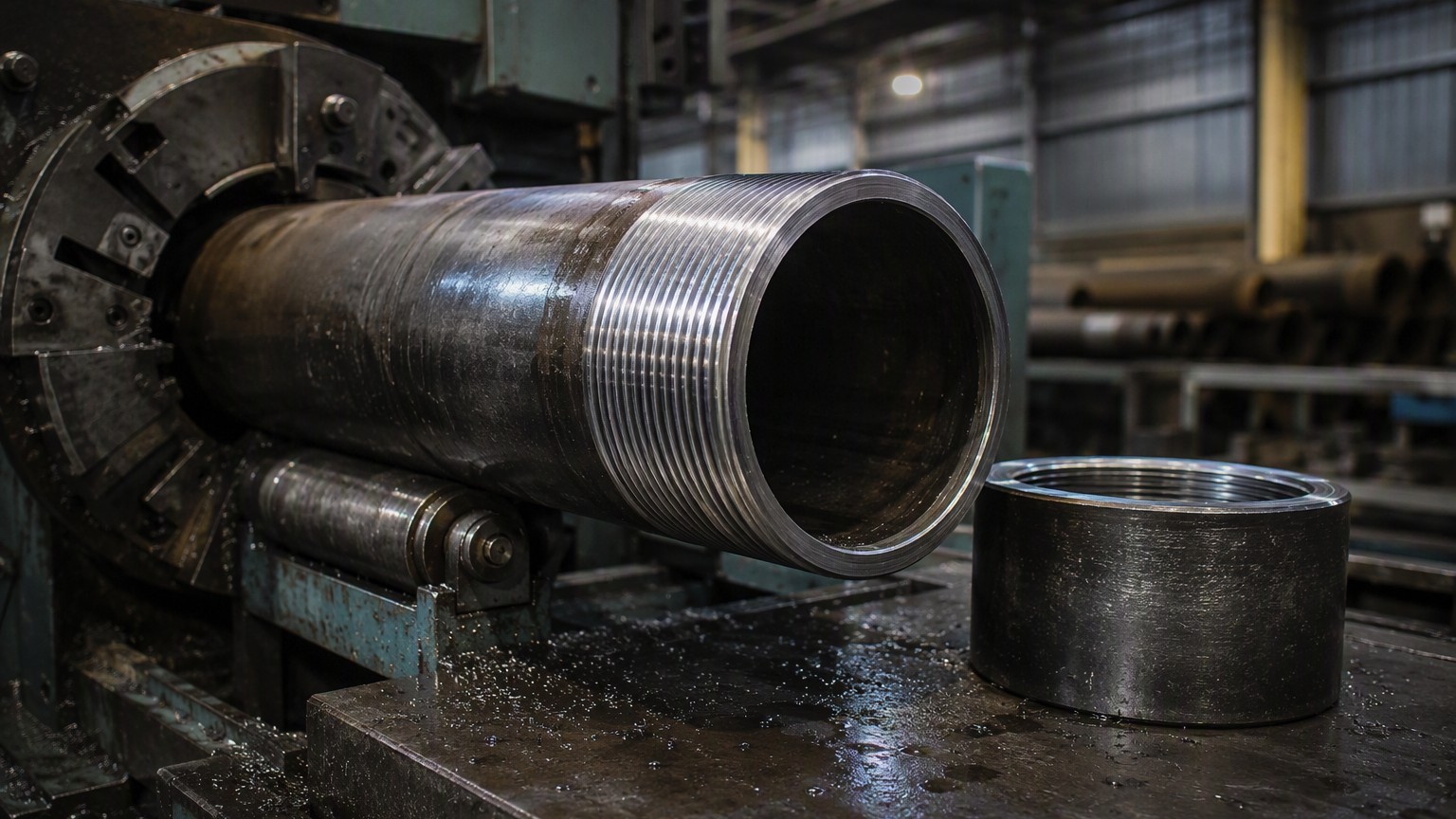
A suffix is not marketing; it selects a manufacturing route, and different routes deliver different combinations of toughness, hardness and corrosion resistance at the same strength level. N80 is the clearest example. The 10th edition of the specification revisited the requirements for N80 Type 1, which is the reminder that within a single grade name there can be more than one qualified route, each with its own chemistry limits and heat-treatment condition. L80 shows the same pattern from the corrosion side: the 13Cr variant exists to handle carbon dioxide in the produced fluid, and because a chromium-bearing surface behaves differently from a carbon steel surface, the specification also addresses internal surface preparation for that variant. When a quotation names a suffix, it is naming a route; when it omits the suffix, ask which one is being offered, because the answer changes the material that arrives.
PSL-1, PSL-2 and PSL-3 in practical terms
The product specification level is the second multiplier on price, and it is easier to understand as a testing regime than as a quality grade. PSL-1 is the baseline and covers the ordinary case: a disposal well, a shallow string or a service where the consequence of a defect is manageable. PSL-2 adds mandatory non-destructive examination, tighter chemistry control and impact-testing requirements, and it is the normal basis for pressure-critical or low-temperature service where toughness has to be demonstrated rather than assumed. PSL-3 goes further for the most demanding applications. Because the pipe body, the coupling and the thread protection are all within scope, the PSL applies across the joint rather than to the tube alone. This is the mechanism behind the warning that two quotations for identical size, wall and grade can differ substantially without either being dishonest: they may not describe the same level of examination, or the same edition of the standard, or the same type suffix. Asking for the PSL and the edition on every offer is the cheapest due-diligence step available, and it takes one line in the enquiry. Where an order does need evidence rather than assurance, the documents that carry it are the mill test reports, and how to read a mill test certificate explains what each field has to say before the paperwork can be treated as complete.
Why Does Sour Service Change the Grade You Need?
Sour service does not punish strength; it punishes hardness, and that reorders the grade list.
Wet hydrogen sulphide causes sulphide stress cracking, a hydrogen embrittlement mechanism that attacks susceptible steels most severely at or slightly below ambient temperature. NACE MR0175/ISO 15156 governs material selection for sour production, and hardness ceilings push buyers from P110 towards L80, C90, T95 or C110.
Why the failure mechanism changes the material choice
Sulphide stress cracking is a cathodic cracking mechanism, and the chemistry behind it explains why the solution is metallurgical rather than mechanical. Steels in contact with wet hydrogen sulphide react to form metal sulphides and atomic hydrogen; because sulphur acts as a hydrogen recombination poison, far less of that atomic hydrogen recombines into harmless gas at the surface, and correspondingly more diffuses into the metal. The consequence is embrittlement and cracking at stress levels well below the yield strength the pipe was purchased for, and the susceptibility is highest at or slightly below ambient temperature — which is precisely the condition a shut-in well sits in. The mechanism of sulphide stress cracking is described in the general literature, and it is the reason a material that performs perfectly in a pressure test can crack in service. Practical selection therefore follows NACE MR0175/ISO 15156 for oil and gas production environments, with refining environments governed by a parallel standard. The controlling variable in that framework is hardness, which is why the restricted-yield grades exist at all: their yield range is capped and their hardness is limited, so the material has a defined resistance to the mechanism rather than a hope of it. The 10th edition of API 5CT tracked those requirements directly by updating the hardness clauses for L80, C90, T95 and C110. A buyer who has historically used P110 throughout will find that a sour-service specification refuses it, not because P110 is a weak material but because its hardness is not controlled for that service.
What this means for a quotation
Three practical rules follow. First, declare the sour condition in the enquiry, including partial pressure information if it is available, because material selection cannot be revisited without cost once the pipe is threaded and shipped. Second, expect the grade to move down in strength and up in price for the same well: an L80 or C90 string at a lower yield than the P110 it replaces is usually a more expensive pipe, and that difference is the price of a defined hardness ceiling. Third, accept that the answer may be a chemistry change rather than a grade change, since a chromium-bearing variant exists precisely because some wells attack carbon steel regardless of hardness. Where the well is both deep and sour, the honest answer is normally a design conversation about wall, grade and connection together, not a single substitution.
How Do You Verify an API 5CT Grade Before Shipment?
Certificates settle disputes that measurements should have settled far earlier.
Verify three things: chemistry and mechanical properties, hardness and impact behaviour where the grade or the service requires them, and the connection. Match all three to mill test reports and keep the heat number traceable to each length.
The evidence chain that protects the buyer
Start with the material. Chemistry confirms that the steel is the grade it claims to be, and tensile testing confirms the minimum yield and tensile strength the designation promises; hardness testing is not a formality for the restricted-yield grades, because hardness is the property that governs sour-service acceptance. Where the product specification level or the service calls for it, impact testing at a specified temperature demonstrates toughness rather than assuming it, and the temperature at which the test was run belongs in the report. Then the dimensions: a wall thickness survey around the circumference and along sampled lengths quantifies the eccentricity inherent in the piercing route, and because burst and collapse calculations use minimum wall rather than average wall, that survey protects the design directly. Drift testing confirms the bore will pass the tools the completion requires. Finally the connection, which is where this product group separates itself most sharply from general pipe: thread form, taper, pitch diameter and standoff have to be gauged with the correct gauges, thread protectors must be fitted, and coupling make-up torque has to be controlled. A joint that passes every pipe-body test and fails gauging is still unusable. The role the two products play in the well — permanent pressure-containing strings against removable flow conduits — is set out in the reference material on production tubing, and it explains why the inspection burden falls so heavily on the pipe body of a seamless string.
Three habits that prevent most claims
First, require the heat number to be transferred to each length or bundle so that certificates can be matched to material rather than to a delivery note; a certificate that cannot be traced to a joint is decoration. Second, require the report to state the standard and edition, the grade, the type suffix, the product specification level, the wall thickness basis, the heat treatment condition and the connection type, and treat anything shorter as an incomplete document set. Third, where the order value justifies it, appoint a third-party inspector and witness the gauging, the wall thickness survey and the hydrostatic test at the works, because that is the moment when a re-test is still inexpensive. Before loading, confirm piece count and length against the packing list, photograph the thread protectors and coupling condition, and check that marking is legible on the material itself. If you want the grade, type suffix, PSL, wall basis, connection and certificate set agreed before production begins, send your well programme to our export team and we will confirm what is available against the service conditions you describe.
Conclusion: How Should You Specify an API 5CT Grade?
Specify the well first, then the grade: match strength to the load case, control hardness for sour service, and prove both with traceable mill test reports.