
Pipe Weight per Meter: How Do You Calculate It for Carbon and Stainless Steel?
A wrong pipe weight per meter figure becomes an overweight container, a failed lift plan or a disputed invoice. Most buyers trust a copied table instead of the formula.
Pipe weight per meter is calculated as wall thickness multiplied by outside diameter minus wall thickness, then multiplied by a density coefficient: 0.02466 for carbon steel, about 0.02491 for 304 stainless and 0.02507 for 316 stainless. The coefficient equals pi times steel density divided by 1,000.
Transition: the formula looks trivial, and the errors are not. Density, wall thickness and outside diameter each enter the calculation differently, and the number you carry into a quotation, a container plan and a structural check comes from a slightly different version of the same arithmetic. The six sections below move from the definition, through the carbon and stainless formulas, into logistics and structural use, verification at the mill, the errors that recur on import orders, and what to confirm before you release a purchase order.
What Is Pipe Weight per Meter, and Why Does It Decide Project Cost?
Pipe weight per meter is the mass of one metre of finished pipe, expressed in kilograms per metre. It is a nominal value, not a weighing result.
Pipe weight per meter is the calculated mass per unit length of a pipe, derived from its outside diameter, wall thickness and material density. It converts a size list into tonnes, freight volume, load capacity and price, so it appears on quotations, packing lists and lifting plans.
Why the same number appears in three different documents
A pipe buyer meets weight per meter three times on one order, and each meeting asks something different. The commercial department needs total tonnage, because steel pipe is normally quoted per tonne rather than per piece, so weight per meter multiplied by ordered length sets the invoice value. The logistics department needs total mass and volume together, because heavy cargo and bulky cargo fail different limits: a shipment can be inside the weight limit of a container and still be refused for stowage, or fit the container and exceed the road axle limit on the way to the port. The engineering department needs distributed load, because weight per meter is the figure a support spacing calculation, a pipe rack beam or a hydrostatic test assumption starts from.
Because three functions read the same figure, an error propagates three times. On a recent enquiry pattern that repeats constantly in this trade, a buyer quotes a stainless pipeline from a carbon steel weight table, understates the tonnage by one to two percent, and discovers the gap only after the purchase order is signed and the price per tonne has been fixed. The reverse happens too: a fabricator sizes supports from a heavier nominal wall than the mill actually supplies on the minus tolerance, and the verification weighing later looks like a shortfall that is not one.
Nominal weight is a calculation, not a certificate
The distinction matters for contracts. Nominal weight per meter is what geometry and density produce, and it is the number published in dimensional tables. Actual weight is what a scale reports, and it differs because real wall thickness sits somewhere inside the tolerance band the applicable standard permits, and because the mill’s density assumption is a nominal figure too. Good purchase orders therefore say which of the two governs the price, and which document proves it. Weight per meter is the Nominal Pipe Size world meets the mass world, and the terminology on both sides is worth fixing before the first quotation, not after the first dispute.
If you are specifying a line, our page on seamless steel pipe weight per meter sizes sets out the diameter and wall combinations actually produced on that route.
How Do You Calculate Pipe Weight per Meter for Carbon Steel?
For carbon steel the calculation needs only three inputs: outside diameter, wall thickness and the density coefficient 0.02466.
Multiply wall thickness in millimetres by outside diameter minus wall thickness, then multiply by 0.02466. For a 6 inch Schedule 40 carbon pipe, 7.11 mm wall on 168.3 mm outside diameter gives 28.26 kilograms per metre.
The formula, and where 0.02466 comes from
The expression is easier to trust once you see that it is a volume calculation in disguise. The cross-section of a pipe wall is an annulus, so its area equals pi divided by four, multiplied by outside diameter squared minus inside diameter squared. Rewritten as a product of sums and differences, that area becomes pi multiplied by the mean diameter and the wall thickness. Multiply by one metre of length to get volume, multiply by density to get mass, and keep the units consistent in millimetres and grams per cubic centimetre, and the whole thing collapses into a single coefficient: wall thickness times outside diameter minus wall thickness, times pi times density divided by one thousand.
For carbon steel a density of 7.85 grams per cubic centimetre is the conventional figure, and pi times 7.85 divided by one thousand is 0.02466. That is where the coefficient in every steel weight table comes from. Nothing about it is empirical or proprietary, which is why the same number appears in Chinese, European and American reference tables.
A worked example you can repeat
Take the same 6 inch Schedule 40 pipe the quotation will use. Wall thickness is 7.11 mm and outside diameter is 168.3 mm, so outside diameter minus wall is 161.19 mm. Multiply 7.11 by 161.19 to get 1,146.06, then multiply by 0.02466 to reach 28.26 kilograms per metre. Check that against any published schedule table and the figure matches, which is the fastest way to confirm you are reading the right wall column. The table below extends the same arithmetic across the sizes that dominate import orders, and adds the stainless columns that are covered in the next section.
| Nominal size | Outside diameter (mm) | Wall, Sch 40 (mm) | Carbon steel (kg/m) | 304 stainless (kg/m) | 316 stainless (kg/m) |
|---|---|---|---|---|---|
| 2 inch | 60.3 | 3.91 | 5.44 | 5.49 | 5.53 |
| 3 inch | 88.9 | 5.49 | 11.29 | 11.41 | 11.48 |
| 4 inch | 114.3 | 6.02 | 16.07 | 16.24 | 16.34 |
| 6 inch | 168.3 | 7.11 | 28.26 | 28.55 | 28.73 |
| 8 inch | 219.1 | 8.18 | 42.55 | 42.98 | 43.25 |
Why the nominal size in the first column is not the number you use
The trap in the table is the first column. A 6 inch pipe does not measure 6 inches anywhere: its outside diameter is 168.3 mm, or 6.625 inches, because the nominal figure historically described the inside bore of an older, heavier wall. Any calculation that substitutes the nominal size for the outside diameter returns a wrong weight, usually low, and the error grows with the wall. As pipe (fluid conveyance)) explains, the terminology in this product family relates to historical dimensions rather than to the pipe in your hand, which is exactly why the outside diameter column must be read from the standard dimensional table and not inferred from the description on the enquiry.
How Do You Calculate Pipe Weight per Meter for Stainless Steel Pipe?
Stainless steel changes only one input: density. The geometry stays identical, so the coefficient moves with the grade.
Use a grade-specific coefficient on the same geometry: about 0.02491 for 304 and 0.02507 for 316, because their densities are roughly 7.93 and 7.98 grams per cubic centimetre against 7.85 for carbon steel. A 6 inch Schedule 40 pipe weighs 28.55 kilograms per metre in 304 and 28.73 in 316.
Grade by grade, the coefficient moves with density
Because the coefficient is nothing more than pi times density divided by one thousand, the only question a stainless calculation asks is which density applies. The usual published values cluster in the range that stainless steel references put between 7.5 and 8.0 grams per cubic centimetre, depending on the alloy: austenitic grades such as 304, 304L, 316 and 316L sit close to the top of that band because of their nickel and molybdenum content, while ferritic grades such as 430 sit lower and duplex grades above 304. In practice four coefficients cover the great majority of enquiries: 0.02466 for carbon, 0.02491 for 304 and 304L, 0.02507 for 316 and 316L, and 0.0248 approximate for the higher-density duplex families.
The practical consequence is that stainless pipe is between one and two percent heavier per metre than carbon pipe of identical geometry. On a single 12 metre length that is a few hundred grams. Across a full container of 6 inch pipe it is several hundred kilograms, which is enough to change a stowage plan and enough to matter when the buyer is paying per tonne.
Where the weight difference stops being an accounting detail
Stainless buyers frequently price by weight and fabricate by length, and the two views diverge in a way worth planning for. A pipeline quoted in tonnes at a 304 coefficient has to be delivered as a length count and a bore, so the mill converts back to metres using the same coefficient; if the buyer’s own estimate used the carbon figure, the tonnage on the sales confirmation and the tonnage in the buyer’s budget will not agree even though both parties calculated honestly.
The second place the difference bites is where stainless is selected for a reason unrelated to strength but the structure still has to carry it: food, pharmaceutical and desalination plants often run 304 or 316 lines at larger diameters than the carbon equivalent, and the pipe rack or support spacing designed from the carbon estimate ends up marginally under-designed. Weight per meter for stainless pipe is therefore not a rounding exercise; it is a materials decision expressed as a number, and it should be carried through the support and lifting calculations rather than replaced by the carbon figure at the last step.
How Do You Use Pipe Weight per Meter in Logistics and Structural Design?
Weight per meter becomes a design input once pipe leaves the quotation. Freight, lifting, supports and hydrostatic test loads all derive from it.
Multiply weight per meter by ordered length to get total tonnage for freight and price, and use the same figure as distributed load for supports. At 28.26 kilograms per metre, a 12 metre length of 6 inch Schedule 40 pipe weighs about 339 kilograms.
From metres to tonnes to a container plan
Total tonnage is the easy step and the one most orders get right. The step that goes wrong is the one nobody checks, because a container is limited by weight and by volume, and pipe is an awkward shape for both. Pipe is shipped in bundles that leave substantial void space, so a full 20 foot container of pipe is often well inside its payload limit yet completely full, while a smaller-diameter order can hit the weight ceiling with space still visible. Two consequences follow for anyone planning an import: bundle count and bundle weight are the two figures the freight forwarder actually needs, and the weight per meter figure is what converts a length list into them.
Length also interacts with weight. Standard commercial lengths of 6 or 12 metres mean longer pipe carries more mass per bundle, so a mill that offers 12 metre lengths quoted on tonnage can look identical in price to one offering 6 metre lengths and be substantially different in handling cost at destination. Ask for the length range in writing on the enquiry return, because the weight per meter figure is silent about it.
Supports, spans and the hydrostatic test
In structural use the same number changes meaning: it becomes a distributed load. Support spacing for an above-ground line is decided by deflection, so a heavier product of the same diameter needs closer supports, and a stainless line in a plant designed from a carbon estimate is the case where the one to two percent described earlier finally shows up. Our weight per meter for square and rectangular tube chart shows how the same arithmetic is applied to hollow sections, where the geometry changes but the method does not.
Testing is the other moment weight per meter matters. A hydrostatic test fills the pipe with water, so the mass on the supports during the test is the pipe mass plus the mass of the internal volume of water, which for a large line can exceed the pipe’s own weight. A lifting plan or a temporary support scheme built from pipe weight alone is therefore incomplete, and the error appears at exactly the moment when the line is full and nobody wants to stop the test. Add the water, add insulation and coating masses if they are applied before the test, and check the result against the support capacity.
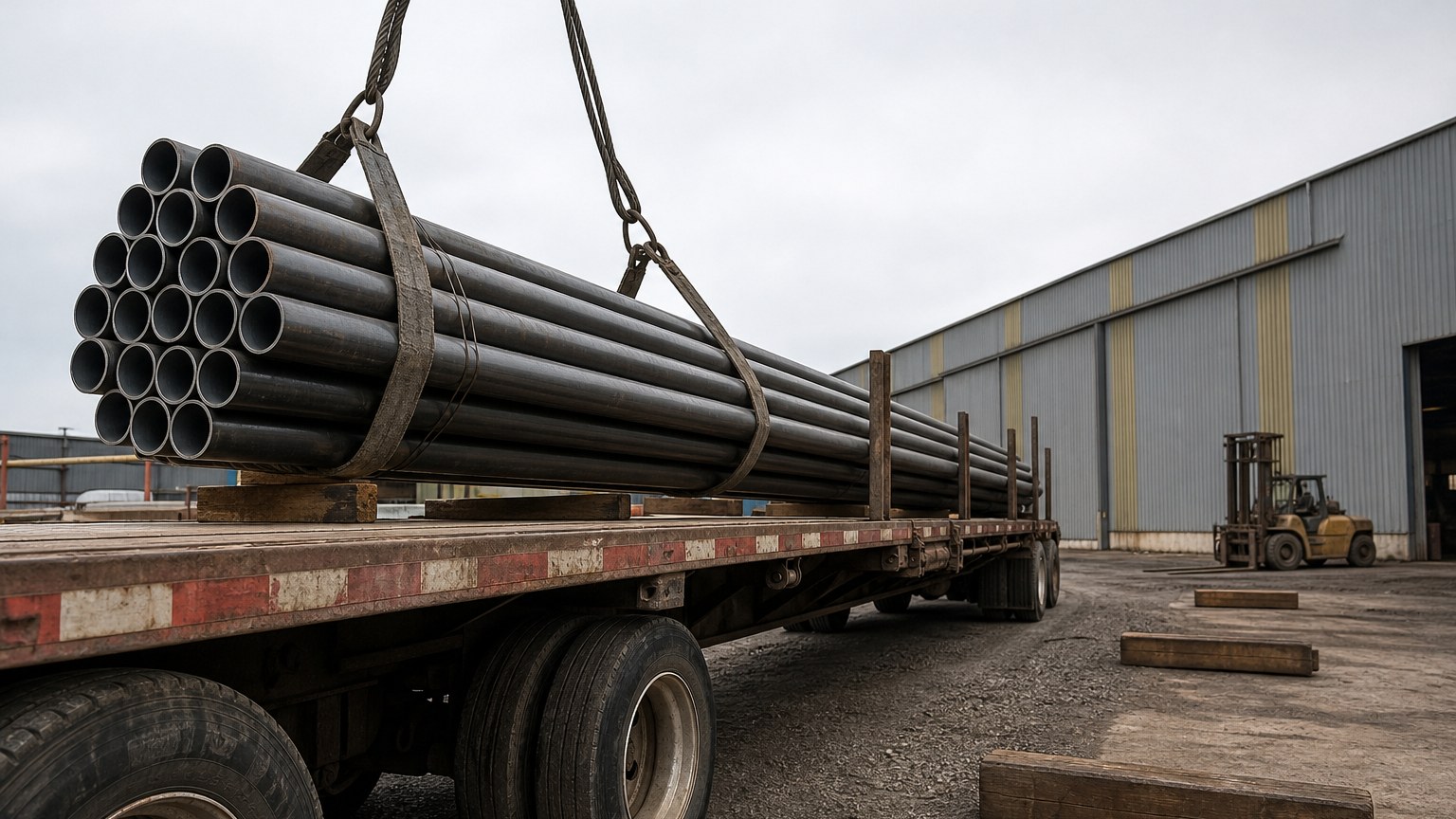
How Do You Verify a Mill’s Pipe Weight per Meter Claim?
A calculated weight is a claim until it is measured. Verification combines the mill test report, dimensional inspection and, where it matters, weighing.
Check three things: the outside diameter and wall thickness measured on the pipe, the standard’s wall tolerance, and the mass stated on the mill test report. Where a shipment is priced on tonnage, ask for the weighing record, because nominal and actual weight differ by the wall tolerance.
Dimensional check first, because everything else follows
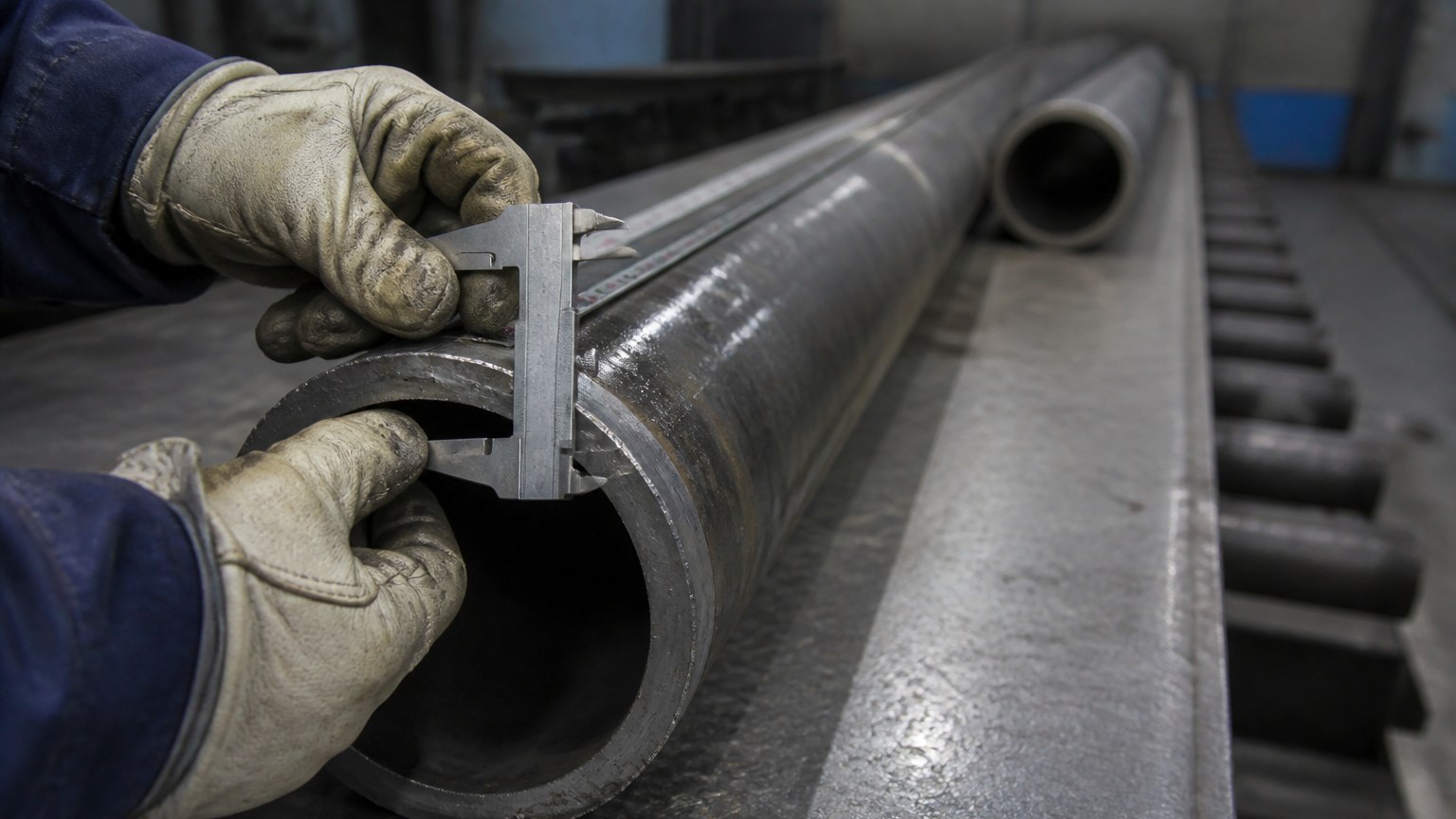
The fastest way to test a weight claim is to test the inputs. Measure outside diameter and wall thickness on a sample of pipes from the bundle, at several positions around the circumference, and compare the results with the dimensional table for the specified size and schedule. If the wall is inside the tolerance band the applicable standard allows, the nominal weight calculation will agree with the mill’s figure and the enquiry was answered consistently. If the wall sits at the bottom of the band, the actual tonnage of the shipment will be lighter than the nominal calculation, and the honest conversation about who carries that difference has to happen before the price is fixed rather than after the container is loaded.
The same discipline applies to the certificate. API Specification 5L is the reference most line pipe orders are placed against, and its editions carry revised requirements for testing and marking that change what a mill is obliged to record; a certificate written against an old edition is not evidence about a pipe made last month. Read the edition, the grade, the size and the mass line together, and match them to the packing list. Where a project is priced on tonnage and volumes are large, third-party inspection with an independently weighed sample is the only check that closes the loop.
The product this article was written around
The arithmetic above has been worked throughout on a Schedule 40 carbon line, the same family we supply as Q345B carbon steel pipe in 6 inch Sch 40, a size where the 28.26 kilograms per metre figure is quoted on almost every enquiry. When you ask a mill to confirm weight per meter, ask in the same breath for the drift or inside diameter and the length range, because those two values decide whether the pipe passes your completion or fabrication tools and whether your freight plan holds.
What Are the Most Common Errors in Pipe Weight Calculation?
Most disputes trace back to four repeated mistakes, and none of them involves arithmetic.
The recurring errors are using nominal size instead of outside diameter, mixing wall thickness between schedules, applying a carbon coefficient to stainless pipe, and quoting a nominal weight as if it were the weighed weight.
Four errors, in the order they cost money
The first is the nominal diameter substitution. A size list written as pipe sizes is a description, not a measurement, and the calculation needs the outside diameter from the dimensional table. The second is schedule drift: an enquiry that says 6 inch pipe and a quotation that answers 6 inch Schedule 40 can be looking at two different walls, and since wall thickness enters the formula twice, a schedule mismatch moves the weight more than most buyers expect. The third is the coefficient itself, which is a density decision rather than a steel decision: 304, 316 and duplex pipe all sit above the carbon figure, and using 0.02466 on a stainless order understates the tonnage. The fourth is contractual rather than mathematical, and it is the one that ends up in a claim: treating a calculated nominal weight as a weighed weight when the purchase order has not said which one governs. Related to it is the reverse mistake, ordering on nominal weight and then rejecting a shipment that is lighter than the calculation but inside the standard’s wall tolerance.
What to write on the enquiry so the error cannot happen
Four lines prevent all four errors. State the outside diameter and the wall thickness, or the size plus the schedule, so the geometry is unambiguous. State the material grade, so the density is fixed. State the length range and the quantity in metres or pieces, so tonnage can be computed rather than assumed. State whether the price and the acceptance criteria are based on theoretical weight or actual weight, and which document proves it. Your own reference point for the arithmetic is worth checking too: our rebar weight per meter table runs the same calculation for solid bar, where the same conceptual trap appears as a nominal size that is not a measured one.
When those four lines are on the enquiry, a quotation can be compared like for like, and the weight discussion stops being a negotiation at the end and becomes a specification detail at the start. If you have a size list in front of you and want the tonnage confirmed before you commit, send us your size list and we will return the weight per meter with the wall tolerance and the length range stated explicitly.
Conclusion: What Should You Do Before You Release the Order?
Calculate from outside diameter, wall thickness and the correct density coefficient, confirm the coefficient matches the grade, then verify the mill’s figure and agree whether nominal or actual weight governs.