
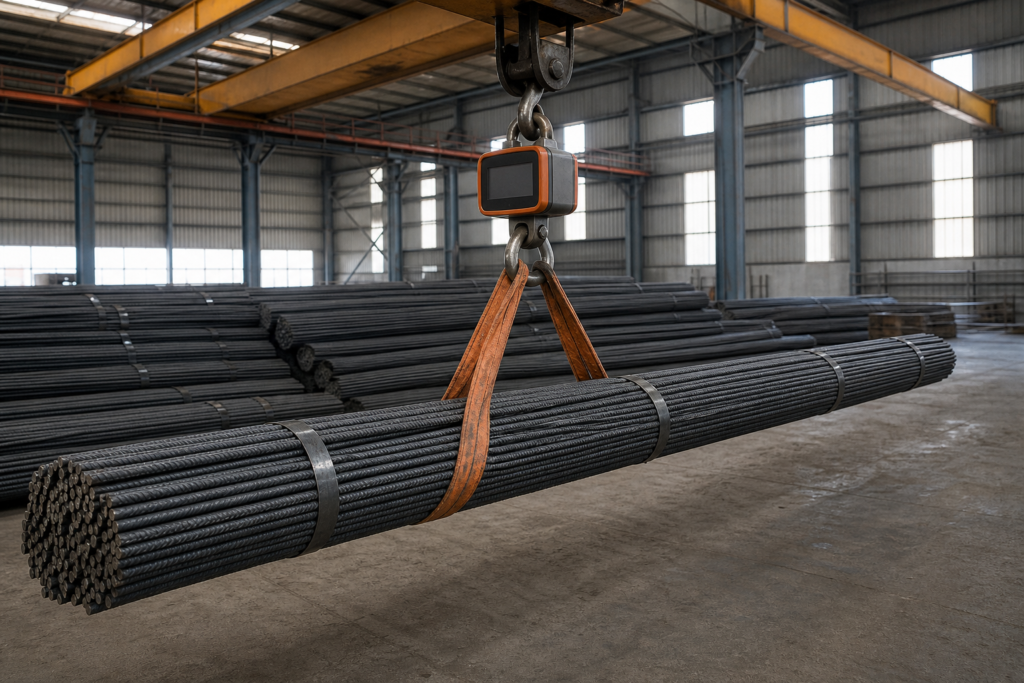
Rebar Weight per Meter: What Is the Formula and How Is the Weight Table Built?
Steel is quoted by the ton, yet every estimate starts from one figure: the weight per meter. Get it wrong and budgets drift. This guide makes it accurate.
Rebar weight per meter is calculated with the formula W = d²/162 (kg/m), where d is the nominal diameter in millimetres; equivalently W = 0.00617 × d². A 20 mm bar therefore weighs about 2.47 kg per meter.
That one number silently decides tonnage, freight cost, customs value, crane lifts and how many bars arrive in each bundle, so it is worth understanding properly rather than copying it from a supplier’s email. The pages below show where the constant 162 comes from, give the complete weight table for the diameters most often traded, explain why the delivered weight never exactly matches the calculation, and convert the figure into the estimates buyers actually make — tonnage, bar counts and bundle verification. Every figure applies to hot-rolled ribbed deformed steel bar, the reinforcement grade most construction projects order, and the same maths works for plain rounds used in stirrups and light ties.
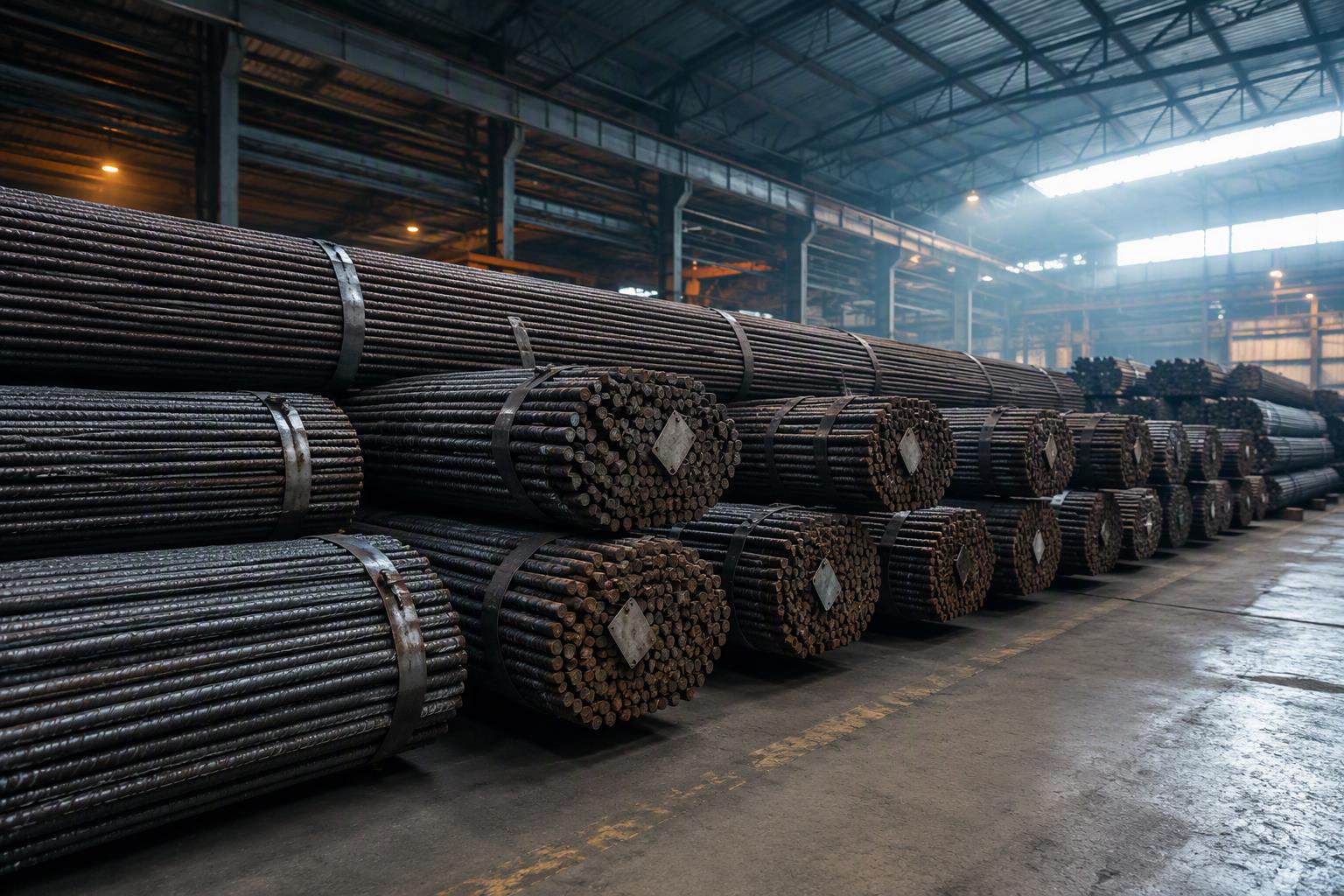
Where Does the Rebar Weight per Meter Formula Come From?
Knowing the formula by heart is not enough; trusting a number you cannot derive is how specification errors slip into purchase orders.
The formula comes from steel density: 7,850 kg/m³ applied to the bar’s nominal cross-section. For diameter d in millimetres, W = (π/4 × d²) × 7,850 ÷ 1,000,000, which simplifies to W ≈ d²/162 kg per meter.
Dive deeper: Rebar is a long cylinder, and the mass of any cylinder is its volume multiplied by the density of the material. Steel’s density is conventionally taken as 7,850 kg per cubic metre — the value used across structural steel handbooks and mill documentation. A round bar of nominal diameter d millimetres has a cross-sectional area of π × (d/2)², or πd²/4, expressed in square millimetres. One metre of that bar therefore contains (πd²/4) × 1,000 cubic millimetres of steel. Converting cubic millimetres to cubic metres divides by 10⁹, but because we already multiplied by 1,000 for the metre length, the net conversion is a division by 10⁶. Multiplying the resulting volume by 7,850 gives W = 0.00785 × πd²/4, which equals 0.006165 × d². The fraction 1/162 equals 0.0061728, close enough to 0.006165 that the industry shorthand d²/162 reproduces the same table values within rounding — a 16 mm bar gives 256/162 = 1.58 kg/m, and a 25 mm bar gives 625/162 = 3.86 kg/m, which is how the familiar catalogue numbers are born.
Why the ribs do not change the calculation
Deformed bars carry transverse ribs rolled into the surface, but the ribs add negligible mass relative to the bar body and are ignored in the theoretical weight. Standards such as GB/T 1499.2 and ISO 6935-2 define a nominal diameter and a nominal mass per metre based on the equivalent plain round section, which is exactly what d²/162 reproduces. The definition is also why the formula answers a narrow question: it gives the mass of a nominal bar, not of your particular heat. Actual bars are rolled to a diameter tolerance, so the real mass per metre sits inside an allowed deviation band around the nominal value — a point examined later in this guide. For estimating, ordering and invoicing, the theoretical value remains the agreed reference, which is why the same table appears, with identical numbers, in mill price lists from China, India, the Middle East and Europe. One practical warning follows: because the nominal mass ignores grade and chemistry, HRB400 and HRB500 bars of the same diameter weigh the same per meter, so our guide to rebar grades and standards is where strength differences matter, not in the weight table. The rebar entry on Wikipedia and the mechanics of reinforced concrete provide useful background on why the bars exist in the first place.
What Does the Rebar Weight per Meter Table Look Like for Common Sizes?
Catalogue tables list values you could calculate yourself, but reading them correctly — and knowing which diameters matter — prevents costly ordering errors.
Standard theoretical weights run from 0.222 kg/m for a 6 mm bar to 9.87 kg/m for a 40 mm bar; a 12 mm bar weighs 0.888 kg/m, so one 12-metre bar weighs about 10.66 kg.
Dive deeper: The table below lists the diameters most commonly traded for concrete reinforcement, their theoretical weight per meter using the standard formula, and the weight of a full 12-metre stock bar. Twelve metres is the default stock length in most Asian and African markets, while six-metre lengths remain common for small projects and palletized loads; the per-meter figure lets you convert to any length instantly.
| Nominal diameter (mm) | Theoretical weight (kg/m) | Weight of a 12 m bar (kg) |
|---|---|---|
| 6 | 0.222 | 2.66 |
| 8 | 0.395 | 4.74 |
| 10 | 0.617 | 7.40 |
| 12 | 0.888 | 10.66 |
| 14 | 1.21 | 14.52 |
| 16 | 1.58 | 18.96 |
| 18 | 2.00 | 24.00 |
| 20 | 2.47 | 29.64 |
| 22 | 2.98 | 35.76 |
| 25 | 3.85 | 46.20 |
| 28 | 4.83 | 57.96 |
| 32 | 6.31 | 75.72 |
| 36 | 7.99 | 95.88 |
| 40 | 9.87 | 118.44 |
Three mental checks make the table easy to use on site without a phone. First, weight scales with the square of the diameter: double the diameter and the weight per meter quadruples, so a 32 mm bar is not twice a 16 mm bar but four times as heavy. Second, the weight of a 12-metre bar is simply the per-meter value multiplied by 12 — a 20 mm bar at 2.47 kg/m becomes about 29.6 kg, which is why two workers rather than one handle full-length 20 mm bars. Third, bundle verification becomes arithmetic: a nominal two-tonne bundle of 12-metre 20 mm bars should contain roughly 2,000 ÷ 29.6 ≈ 67 bars, so a quick bar count multiplied by the unit weight tells you within seconds whether the delivery matches the packing list. Diameters below 12 mm are used mainly for stirrups, ties and light mesh, while 12–25 mm covers the bulk of structural bars and 28–40 mm appears in heavy columns, pile caps and transfer structures where single-bar weights of 75 kg or more make lifting plans part of the procurement conversation.
Why Is Delivered Weight Never Exactly Equal to the Theoretical Weight per Meter?
A delivered bundle that weighs a few percent less than the invoice is not always a shortfall; the explanation lies in rolling tolerances and settlement practice.
Rolling to exact diameter is impossible, so standards allow actual mass per meter to deviate from nominal within a small band — typically a few percent depending on diameter — and contracts settle on either theoretical or actual weight.
Dive deeper: A hot rolling mill cannot hold a bar at a perfectly constant cross-section. Roller wear, temperature drift along the bar and small variations in billet quality all move the finished diameter slightly, and because weight per meter depends on the square of the diameter, even a fraction of a millimetre of difference produces a measurable mass change. A nominal 12 mm bar rolled at 11.8 mm, for instance, carries about 3% less steel per meter than the table predicts. Standards therefore define the nominal mass as a reference value and separately permit a deviation between actual and nominal mass per meter, with the allowed band set by diameter — tighter for large bars, slightly wider for small diameters, and typically within a few percent in either direction. The mill certificate should state the actual measured values, and inspection agencies check the delivered batch against the band rather than against an exact number. This tolerance is the root of a recurring dispute in international trade: the settlement basis. On a theoretical-weight contract, the invoice quantity is length (or bar count) multiplied by the nominal per-meter weight from the table, and the buyer accepts that actual steel may weigh a little more or less. On an actual-weight contract, the delivered bundles are weighed on a certified scale and the invoice follows the scale. Both are legitimate; the danger is mixing them. A buyer who agrees to theoretical-weight pricing but then weighs every bundle and demands a deduction for the tolerance — or the reverse — has changed the deal after it was made. The professional move is to state the basis in the purchase order, confirm that the mill certificate records actual mass, and agree before shipment how a dispute over a few percent will be resolved, because on a 500-tonne order, three percent is fifteen tonnes of steel and a meaningful amount of money either way. Weighing verification itself needs care: portable crane scales and weighbridges must be calibrated, wet or rusted bundles gain surface mass, and the short bars used as dunnage in a bundle should not be counted as full stock lengths.
How Do You Convert Rebar Weight per Meter into Project Tonnage and Bar Counts?
The per-meter figure only earns its keep when it turns into tonnage, bar counts and freight plans — the numbers a purchase order actually needs.
Total weight equals number of bars × length per bar × weight per meter. One thousand 12 m bars of 12 mm rebar weigh 1,000 × 12 × 0.888 ≈ 10,656 kg, or about 10.7 tonnes.
Dive deeper: Every conversion a buyer performs starts from the same identity: weight = quantity × length × unit weight. If the reinforcement schedule specifies 4,800 metres of 16 mm bar, the tonnage is 4,800 × 1.58 = 7,584 kg, or about 7.6 tonnes. If the project instead tells you the tonnage and you need bar counts, invert the calculation: 50 tonnes of 32 mm bar equals 50,000 ÷ 6.31 = 7,925 metres, which at 12 metres per bar is 660 full bars and a remainder to be confirmed as cut lengths or offcuts. The same arithmetic drives container planning. A 40-foot container loading 12-metre bars is limited by length compatibility, but for cut lengths and palletized bundles the tonnage check comes first: total bundle weight must stay inside the container payload, and the number of bundles times the per-bundle weight, derived from per-meter weights and bar counts, is how a loader verifies the plan without weighing the whole container. Project estimators use the per-meter values in a slightly different way, converting each bar size on the schedule into a subtotal tonnage before adding a waste allowance for laps, trimming and site losses — typically a few percent on top of the theoretical quantity, a figure the contractor, not the supplier, should own. When the order moves from calculation to purchasing, buyers usually consolidate the sizes on one contract: carbon steel rebar is supplied from stock across the 6–40 mm range in the grades and lengths discussed above, and sending the full reinforcement schedule rather than a single size lets a mill optimize rolling, bundling and container loading at once. Two small cautions close this section: always state whether lengths are nominal or cut-to-site, because offcuts reduce the useful meter count; and never round intermediate values too early — rounding each bar size to one decimal before summing a 30-size schedule can shift the total by more than the tolerance you are trying to control.

Do Rebar Weight Tables Differ Between GB/T, ISO and ASTM Standards?
The same diameter number can hide different cross-sections and different mass conventions, so comparing tables across standards needs care.
Metric nominal masses are consistent worldwide because they derive from the same round-section maths, but ASTM sizes are inch-based with their own numbers and weights, so a “#8” bar is not a 25 mm bar even though it is close.
Dive deeper: Standards organizations do not invent their own weight tables from scratch; they publish nominal masses for the diameters their markets actually use, computed from the same density and round-section geometry. A 16 mm bar in the Chinese ISO 6935-2 tradition, a European B500B bar, and an Indian Fe500D bar all quote the same 1.58 kg/m because the definition of nominal diameter is identical. The divergence appears when a project crosses into inch-based practice. North American reinforcing bar is specified by ASTM A615/A615M bar numbers — #3 through #18 — where the number refers to eighths of an inch of nominal diameter: a #4 bar is 4/8 inch, or 12.7 mm, and a #8 bar is 1 inch, or 25.4 mm. Because the diameters themselves differ from the nearest metric sizes, the weights differ too: a #8 bar weighs about 2.67 lb/ft, which converts to roughly 3.97 kg/m, while the closest metric 25 mm bar sits at 3.85 kg/m — close enough to be dangerous in a mixed-specification project, but not identical. The practical rules for buyers are three. First, never convert between systems by assuming the nearest metric size is the same bar; confirm the governing standard and the exact diameter the drawings cite. Second, when a contract references a standard, the weight table that governs is the one inside that standard — a GB/T 1499.2 order is weighed against GB/T nominal masses, an ASTM order against ASTM nominal weights, and the certificate should name the standard. Third, treat “grade equivalence” and “weight equivalence” as separate questions: HRB400 and Grade 60 are comparable in yield terms but are tested, marked and dimensioned to different systems, so a buyer consolidating bars for several projects should keep each standard family separate in the schedule and let the supplier confirm availability per standard rather than assuming interchangeability. This is also the moment to ask the supplier for the exact nominal-mass table they invoice against, because a price list built on slightly different nominal weights shifts the tonnage — and the total cost — of a large order by more than the difference in quoted unit price.
Which Buying Mistakes Come from Getting Rebar Weight per Meter Wrong?
Most rebar disputes trace back to one of a handful of weight-related errors; knowing them in advance protects both the budget and the structure.
The classic mistakes are mixing theoretical and actual settlement, assuming nominal diameter without verifying it, ignoring length tolerance, skipping arrival weighing, and treating the weight table as a substitute for the mill certificate.
Dive deeper: The first and most expensive mistake is letting the settlement basis float. If the contract says theoretical weight but nobody records it, the supplier may invoice on actual weight — or the reverse — and the dispute lands after the steel has shipped, where leverage is gone. Fix the basis in writing before the order. The second mistake is trusting the diameter printed on the tag. Undersized bars are one of the classic hidden defects in cheap rebar: a bar sold as 12 mm but rolled near the bottom of the tolerance saves the mill material on every meter while the buyer pays for the nominal cross-section, and the structure receives less steel than the design assumes. The defence is simple: measure a sample with callipers, check the actual mass of a weighed test length against the nominal value, and require the mill certificate to record the batch results. The third mistake concerns length. Bar length carries its own tolerance, and a bundle of “12-metre” bars that averages 11.9 metres silently removes about one percent of the steel from every bar — immaterial on one bundle, significant across a project. Check average length on arrival rather than assuming the tag is exact. The fourth mistake is skipping arrival weighing entirely. A calibrated weighbridge reading on the full truck, reconciled against the packing list, catches short bundles and wrong counts in minutes; doing it after the bars are distributed to site makes recovery nearly impossible. Finally, treat documentation as part of the product: the mill certificate should state grade, heat number, nominal and actual mass values and the governing standard, and the rolled markings on the bars should match. Buyers who apply these checks — and who source from a mill with batch-level documentation such as the rebar range supplied by Shuncheng Steel — rarely discover weight surprises at the point where they are expensive. If you would like the calculation checked against your own schedule, send us your reinforcement schedule and our team will confirm tonnage, bundling and the correct settlement basis before you commit to a container.
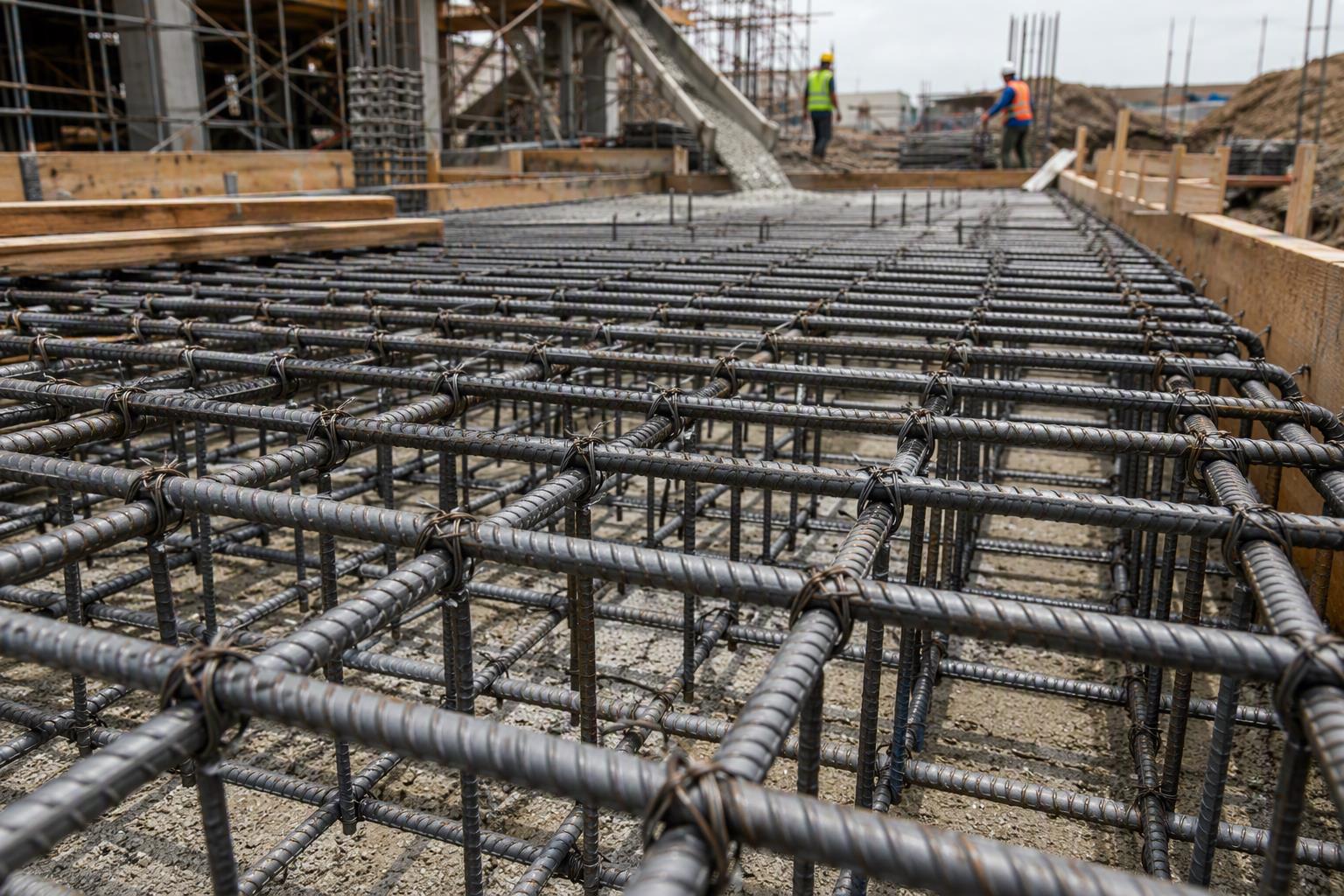
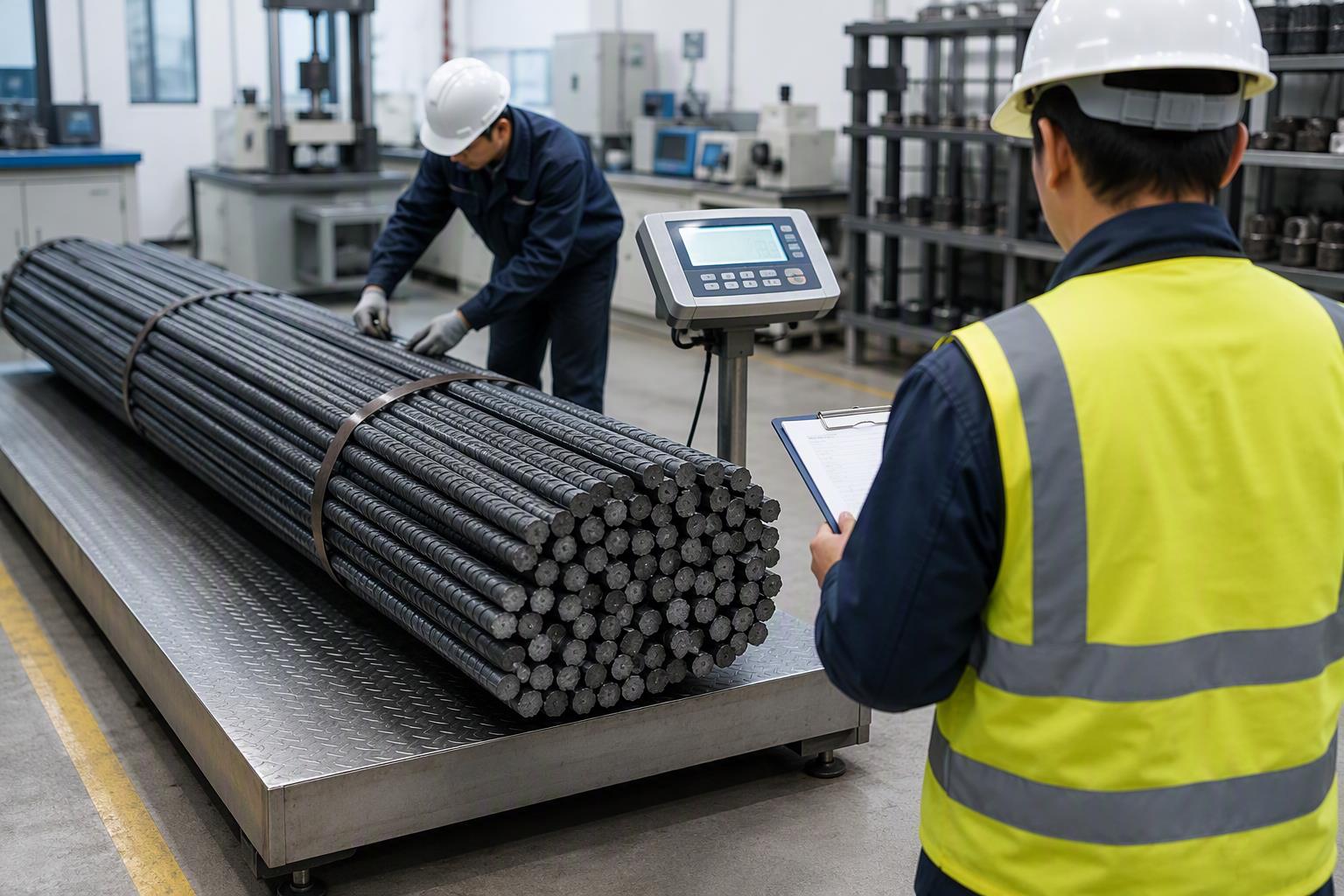
Whether you are estimating a foundation, comparing mill quotes or checking a delivery at the port, the same discipline applies: calculate with W = d²/162, compare against the nominal table, verify actual mass on arrival and fix the settlement basis in the contract before the steel ships. For a worked example of a heavy bar, the 32 mm HRB400 deformed steel bar weighs about 6.31 kg per metre, a useful figure when estimating tonnage.
Rebar weight per meter drives every estimate: use W = d²/162, check the table, reconcile delivered weight, and put the basis in your contract.