
Zinc Coating Weight Z180 vs Z275: How to Choose?
Z180 and Z275 look identical on the shelf, but pick the wrong zinc coating weight and your steel may rust years before it should. This guide removes the guesswork.
Choose Z275 when the steel will face outdoor, coastal or industrial exposure; choose Z180 for indoor or lightly sheltered applications where first cost matters. The number is the minimum total zinc mass on both faces, in grams per square metre, and a heavier coating simply lasts longer before the steel underneath begins to corrode.
In the sections below we decode what the designations actually mean, translate them into real coating thickness, map them to real environments, weigh formability and cost, and end with a specification checklist you can hand to any supplier. If you buy galvanized coil, tube or sheet, this is the decision framework you need before the purchase order goes out.
What Do the Z180 and Z275 Numbers Actually Mean?
Most coating codes read like alphabet soup, yet choosing wrong shortens service life for years. Decode Z180 and Z275 before you order, not after.
Z180 and Z275 are metric coating designations from ASTM A653/A653M: the minimum total zinc mass on both surfaces, in grams per square metre — 180 or 275 g/m² by the triple-spot test.
Where the designations come from
Continuous hot-dip galvanized sheet and coil are sold against coating designations set out in standards such as ASTM A653/A653M, which is the specification most international mills quote for zinc-coated steel. In the metric (SI) system of that standard, each “Z” code states a minimum coating mass measured across the whole sheet — both faces combined — and expressed in grams per square metre of sheet area. Z180 therefore promises at least 180 g/m² of zinc across both surfaces, and Z275 promises at least 275 g/m². The imperial cousins are the familiar G60 and G90 codes, which sit on the same spectrum: G90 corresponds closely to Z275, while G60 sits between Z180 and Z275.
Why the mass is measured on both faces
Coil and sheet are coated on a continuous line where both sides pass through the zinc bath, so no manufacturer can sell a “one-sided” coating on flat product. Quoting a total for both surfaces is simply the honest way to state what the line actually produces. When engineers talk about service life they usually think in terms of one exposed face, which is why the next section converts these totals into per-side thickness.
Triple-spot versus single-spot testing
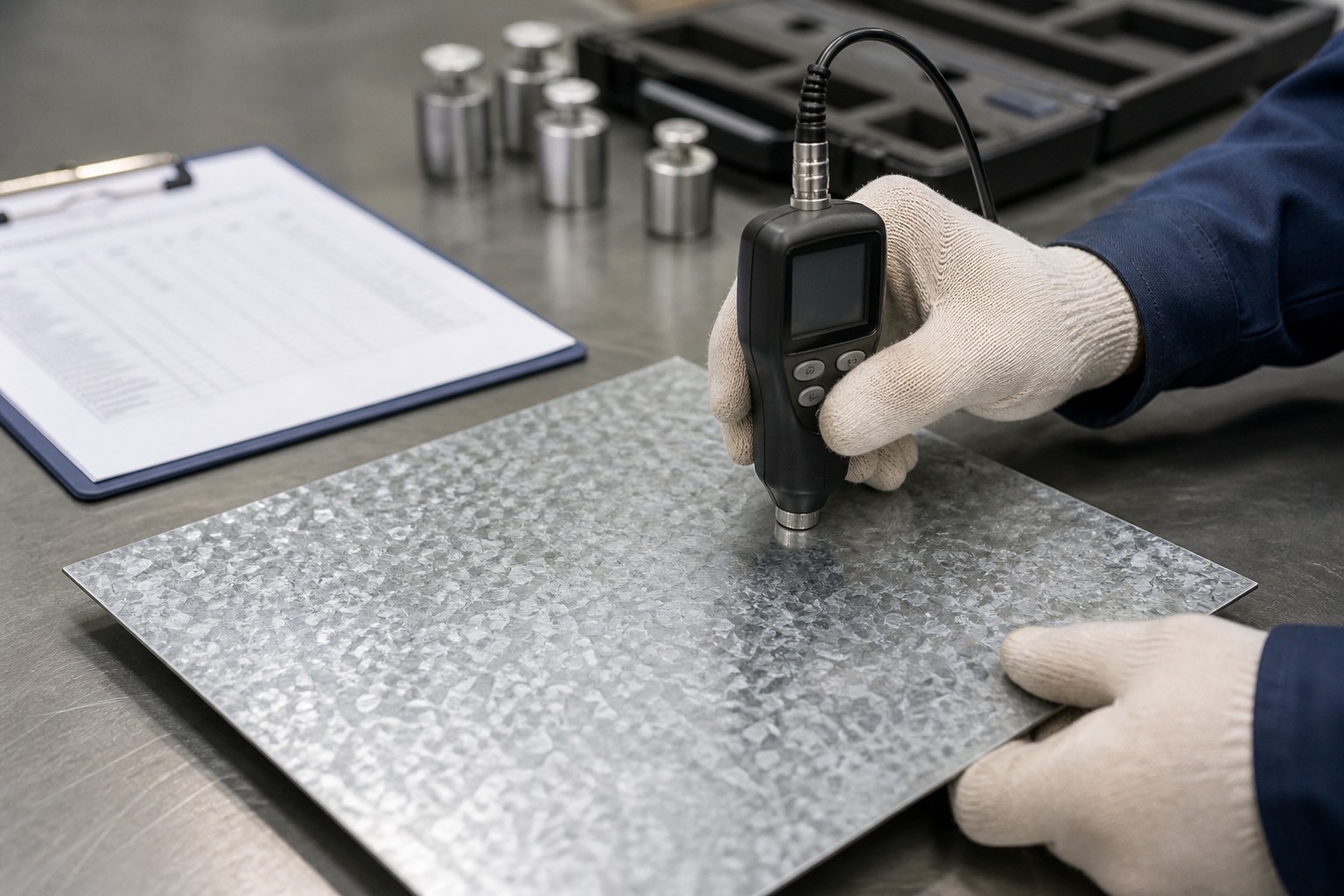
Under ASTM A653/A653M the coating is verified with a triple-spot test, which averages three measurements taken across the width of a sample, plus single-spot checks at any one location. The designation number refers to the triple-spot minimum. Incoming inspection with a magnetic coating thickness gauge is the practical way for a buyer to confirm the coil really meets its certificate — a topic covered later in this article.
How Thick Is the Zinc on Z180 and Z275 Steel?
A number in grams means little until you picture microns of zinc on each face. Here is the thickness math behind both grades.
Expect roughly 12–13 µm of zinc per side on Z180 and 19–20 µm per side on Z275 — about 0.5 mil versus 0.75 mil — on the same base steel.
Converting grams to microns
Zinc has a density of approximately 7.14 g/cm³, which makes the conversion straightforward. A Z180 coil carries 180 g/m² across both faces, so each face averages 90 g/m². Dividing 90 by 7.14 gives about 12.6 µm per side. The same arithmetic on Z275 — 137.5 g/m² per face — yields roughly 19.3 µm per side. These figures are per exposed face, which is the number that matters when you estimate how many years the zinc will last in a given atmosphere.
Why “total both sides” can mislead
A quick glance at a certificate shows the big total — 275 g/m² sounds enormous — but remember that figure is split across two faces, and part of the coating is consumed forming the intermetallic alloy layer at the steel–zinc interface. The free zinc that actually corrodes sacrificially is a little less than the full arithmetic thickness suggests. This is normal and is exactly why the alloy layer exists: it bonds the coating to the steel far more strongly than a simple paint film.
How the coating is verified
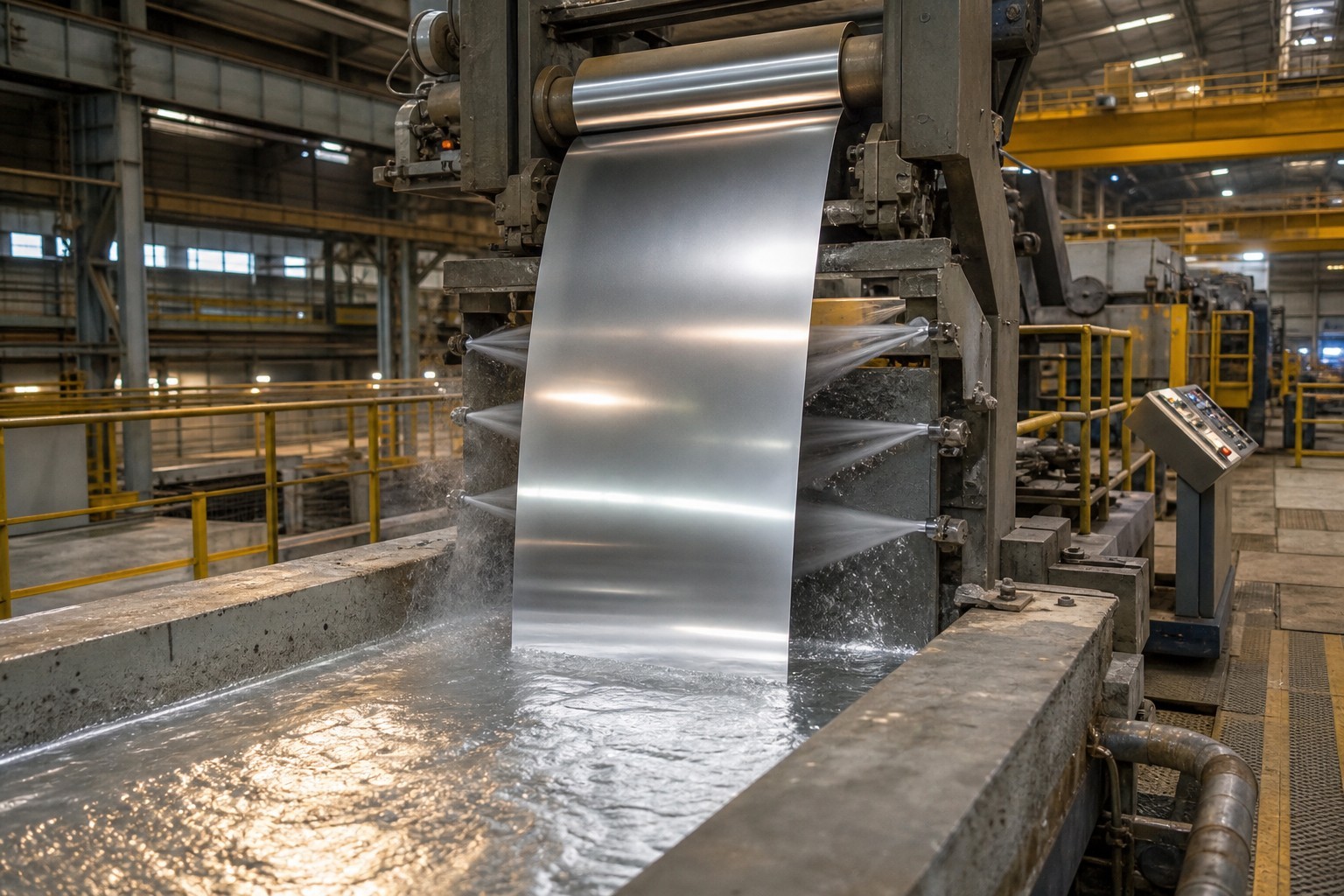
Mills verify coating mass gravimetrically — a weighed sample is stripped of zinc in an inhibited acid solution and weighed again, and the mass loss divided by the sample area gives the coating mass. Buyers more commonly use a portable magnetic gauge, which measures thickness directly on the surface, as shown in the inspection image below. Standards such as ISO 1461:2022, which governs batch hot-dip galvanized coatings on fabricated articles, rely on the same weighing principle, so the test philosophy is consistent across the galvanizing world even though the products differ.
Which Environments Demand Z275 Instead of Z180?
Zinc corrodes slowly indoors and quickly by the sea. Match the coating to the atmosphere, or pay for the mismatch twice.
Use Z275 for outdoor, industrial or marine exposure; reserve Z180 for dry, sheltered interiors where condensation is rare and the frame is protected from weather.
Reading the corrosion environment
The American Galvanizers Association publishes decades of field data showing that zinc consumption depends almost entirely on the environment: clean rural air consumes zinc slowly, urban and industrial atmospheres faster, and coastal salt-laden air fastest of all. Because the corrosion rate is roughly linear over time, doubling the coating mass approximately doubles the time to first maintenance in the same location. That simple relationship is the whole argument for Z275: an extra 95 g/m² of zinc is not a marketing upsell, it is a measurable extension of the protective life.
Where Z180 is genuinely enough
Large volumes of galvanized steel never see rain. Suspended ceilings, cable trays, internal racking, HVAC duct supports, light interior framing and components that will be painted or enclosed all spend their lives in near-constant low humidity. For those duties Z180 typically outlives the building, and choosing Z275 would simply donate money to the mill. The hot-dip galvanization process itself is identical for both grades — only the bath immersion parameters and line speed differ — so the performance gap is purely a matter of how much zinc you pay for.
Where Z275 is the minimum, not the premium
Outdoor structural frames, perimeter fencing, agricultural buildings, solar mounting structures, exposed handrails and any component within a few kilometres of the coast should default to Z275 at a minimum. In aggressive industrial or marine zones, experienced specifiers step up to Z350 or Z450 rather than debating Z180 versus Z275 at all. If in doubt, remember that retrofitting corrosion protection to an installed structure costs many times the price difference between these two grades — so when you compare zinc coating weight options across our galvanized steel tube range, choose the heavier class whenever the end use is even partly exposed.
Does a Heavier Zinc Coating Hurt Forming, Welding or Bending?
Heavier zinc resists corrosion but complicates fabrication — tight bends, welding fumes and cut edges all behave differently as coating mass grows.
In practice both Z180 and Z275 form well on modern equipment; the real differences appear in very tight bends, at welded joints and wherever the coating is cut or ground away.
Bending and roll forming
The zinc layer is ductile enough to survive normal bending radii, but it is not infinitely elastic. On a tight inside radius the zinc can develop micro-cracks, and although these seldom reduce corrosion protection dramatically — the exposed steel at the crack is still protected galvanically by surrounding zinc — they look alarming on painted or visible surfaces. Z275, being roughly 50 percent thicker, asks for a slightly larger minimum bend radius than Z180 on the same base steel. Roll formers and press-brake operators should set tooling generously and watch for powdering on the outside of the bend, which signals that the radius is too tight for the coating.
Welding and cut edges
Zinc boils at around 907 °C, well below the melting point of steel, so welding galvanized material produces dense white zinc oxide fume that must be extracted — welders should never work without local exhaust ventilation. The heat of the weld also destroys the coating in the heat-affected zone, and shearing or sawing creates bare cut edges that will never be recoated. On Z275 these bare zones are identical in width to those on Z180, but because the surrounding coating is heavier, the galvanic protection they receive from adjacent zinc is actually stronger and lasts longer. For assemblies that will be welded first and galvanized afterwards, batch hot-dip processing is governed by ASTM A123/A123M, which specifies minimum coating thickness by steel section thickness.
Does coating change the steel’s mechanical properties?
No — the zinc layer adds no meaningful strength or hardness, and the base steel grade (commercial, forming, structural, or high-strength low-alloy) is chosen separately from the coating designation. The two decisions are independent: a structural grade can be ordered as Z180 or Z275, and a forming grade can too. What the coating does change is surface behaviour: heavier coatings tolerate slightly less aggressive lubrication practice and can wear forming dies a little faster because zinc is abrasive to tooling over long production runs. If your process involves tube manufacturing from strip, our earlier article on the types and benefits of galvanized steel tube walks through how welded hollow sections behave under forming and finishing.
Is Z275 Worth the Extra Cost Over Z180?
Nobody pays for grams of zinc; they pay for years of protection. The Z275 premium is small against premature replacement.
Z275 adds roughly 95 g/m² more zinc than Z180 — about 24 kg extra per tonne of 0.5 mm coil — which usually costs far less than one early rust repair.
The arithmetic behind the premium
Coating mass difference is easy to price because it is pure tonnage. A 0.5 mm galvanized coil weighs about 3.9 kg per square metre, so one tonne covers roughly 255 m². Moving from Z180 to Z275 adds 95 g/m² of zinc — the difference between the two designations — which totals about 24 kg of extra zinc on that tonne of coil, or roughly 2.4 percent of the coil’s weight. On thicker steel the percentage shrinks because a tonne of 3 mm plate covers far fewer square metres, but the decision logic is unchanged: the Z275 surcharge tracks the zinc market, and zinc prices move independently of steel prices.
When Z180 is the smarter buy
For truly indoor, low-corrosion duties, Z180 is not a compromise, it is the correct engineering choice. Buying Z275 for a suspended ceiling grid wastes the premium, adds no measurable life, and slightly increases the weight your fixings must carry. The same logic applies when the component will receive a full paint system, be enclosed in concrete, or be replaced on a fixed schedule regardless of condition. In those cases the extra zinc is simply dead capital.
When Z275 pays for itself
Once the steel faces weather, the comparison inverts. A fence, portal frame or solar rack expected to serve twenty years in an industrial atmosphere will consume a meaningful fraction of a Z180 coating within a decade, whereas Z275 comfortably covers the same horizon. Because the corrosion rate is linear, the time to first maintenance scales almost directly with coating mass: the 53 percent extra zinc on Z275 buys roughly 50 percent more service life in the same environment. Against that, our 0.5 mm galvanized steel coil with a Z180 zinc coating weight remains attractive precisely because it targets sheltered, forming-heavy applications where the lighter class is defensible — but for outdoor structures, specify Z275 and stop second-guessing.
How Do You Specify the Right Zinc Coating Weight for Your Project?
A one-line coating code prevents years of dispute. Put the designation, the test method and the surface finish in writing on every order.
Write, for example, “Z275 to ASTM A653/A653M, triple-spot minimum”, state the base steel grade and gauge, and require a mill test certificate with every coil or bundle.
The five-line ordering checklist
First, name the coating designation and the standard it is certified against — “Z180 to ASTM A653/A653M” or “Z275 to EN 10346” style language leaves no room for interpretation. Second, state the base steel: commercial quality for general work, forming or deep-drawing quality for heavy bending, or a structural grade where load-bearing strength is required. Third, give the gauge and width — for example 0.5 mm coil — because coating mass is specified per square metre, so the buyer pays for area, not thickness. Fourth, choose the surface treatment: passivation, light oiling, or chromate-free treatment for painted applications, plus whether regular spangle, minimized spangle or extra-smooth finish is acceptable. Fifth, require the test certificate showing triple-spot and single-spot coating mass results for the actual lot.
Verify what you receive
Certificates are only as good as the inspection behind them. A portable magnetic thickness gauge costs little and turns a five-minute warehouse check into hard evidence: measure several points across the width and along the length of a coil, convert the reading to mass using the density figure shown earlier, and compare against the ordered designation. Discrepancies of more than a few percent justify a formal claim before the coil enters production, not after a corrosion failure two years later.
When in doubt, ask the mill
Coating weight interacts with forming practice, welding schedules, storage and even the way coils are strapped and shipped. A reputable supplier will tell you honestly whether Z180 will serve an application, because mis-specification returns to them as warranty claims and lost repeat business. Describe the environment and the fabrication process rather than just quoting a code — that context is what lets a mill recommend the right class confidently. For a project-specific recommendation on galvanized coil, tube or sheet, contact our steel specialists and include your gauge, exposure conditions and fabrication method; you will receive a specification proposal rather than a generic catalogue answer.
Conclusion
Match the environment, not the habit: Z275 for outdoor exposure, Z180 for sheltered service. Verify the designation on delivery and let the certificate settle the argument.