
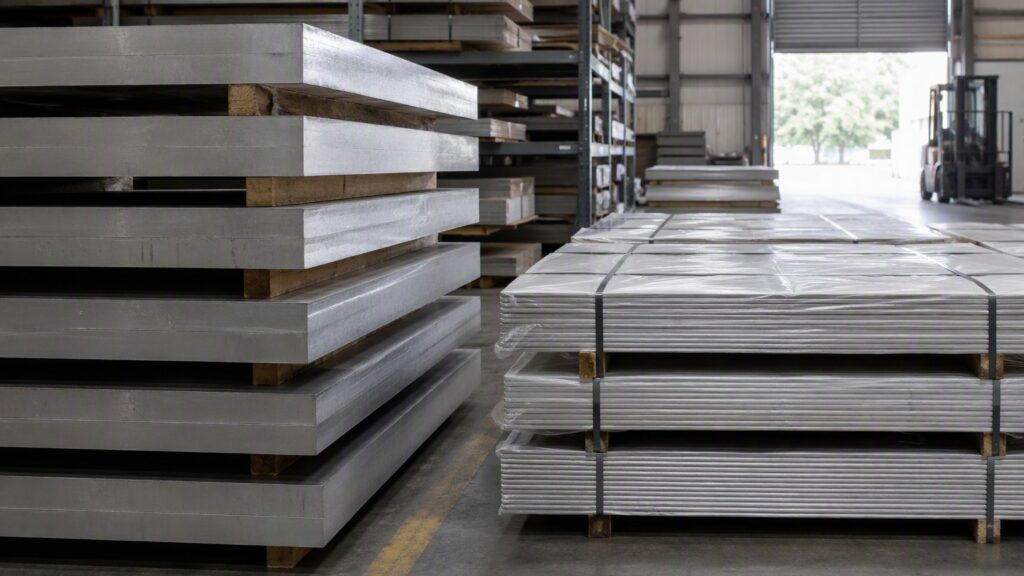
Aluminum Sheet vs Plate: How Do You Tell Them Apart by Thickness and Choose the Right Form?
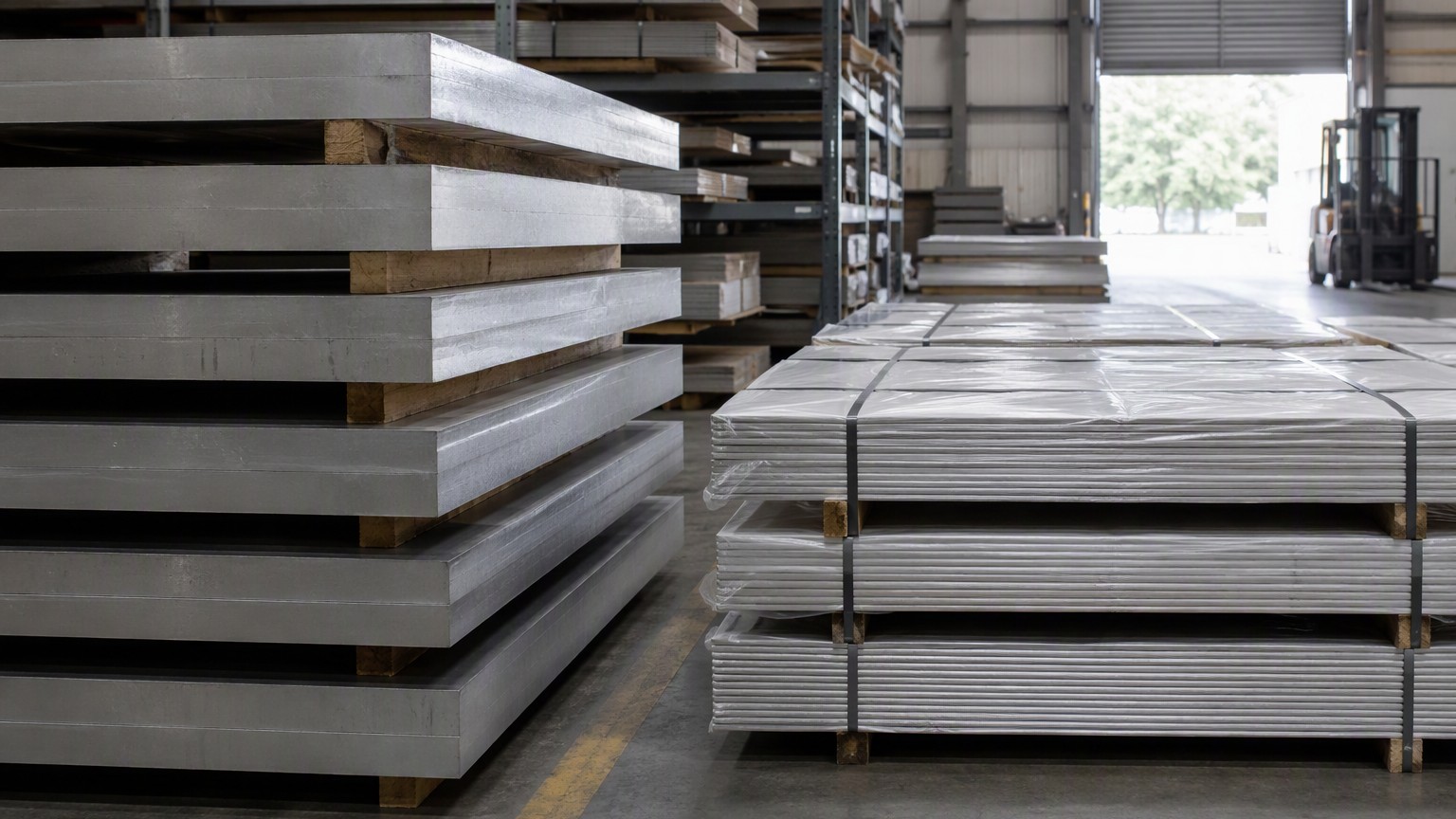
Order the wrong form and the material arrives either too stiff to bend or too thin to machine flat. One number decides it: thickness.
Aluminum sheet is the thin, formable flat product, conventionally under 6.35 mm (0.250 in). Aluminum plate begins at 6.35 mm and above. Both are covered by ASTM B209 and ISO 6361-2, and the thickness you specify — not the alloy name — decides formability, processing route, tolerance and price.
Transition: sheet and plate come from the same rolling line, share the same alloy designations and often sit on the same pallet in a mixed export load. The differences only become visible later — at the press brake, at the machining centre, in the tolerance table and on the freight invoice. This guide follows the decision in the order a buyer or engineer actually makes it: what really separates the two forms, where the standards place the boundary, how each form is processed and priced, which applications each suits, how to write a purchase order without ambiguity, and which mistakes send the wrong material to site.
What Is the Real Difference Between Aluminum Sheet and Aluminum Plate?
Both products share the same alloys and often the same finish. Only thickness, and everything that thickness allows, separates sheet from plate.
Aluminum sheet is thin flat-rolled product supplied in coils or cut lengths; aluminum plate is the thicker flat-rolled product, generally from 6.35 mm (0.250 in) upward, supplied flat. Width limits, edge condition, tolerance tables and handling equipment all change at that line.
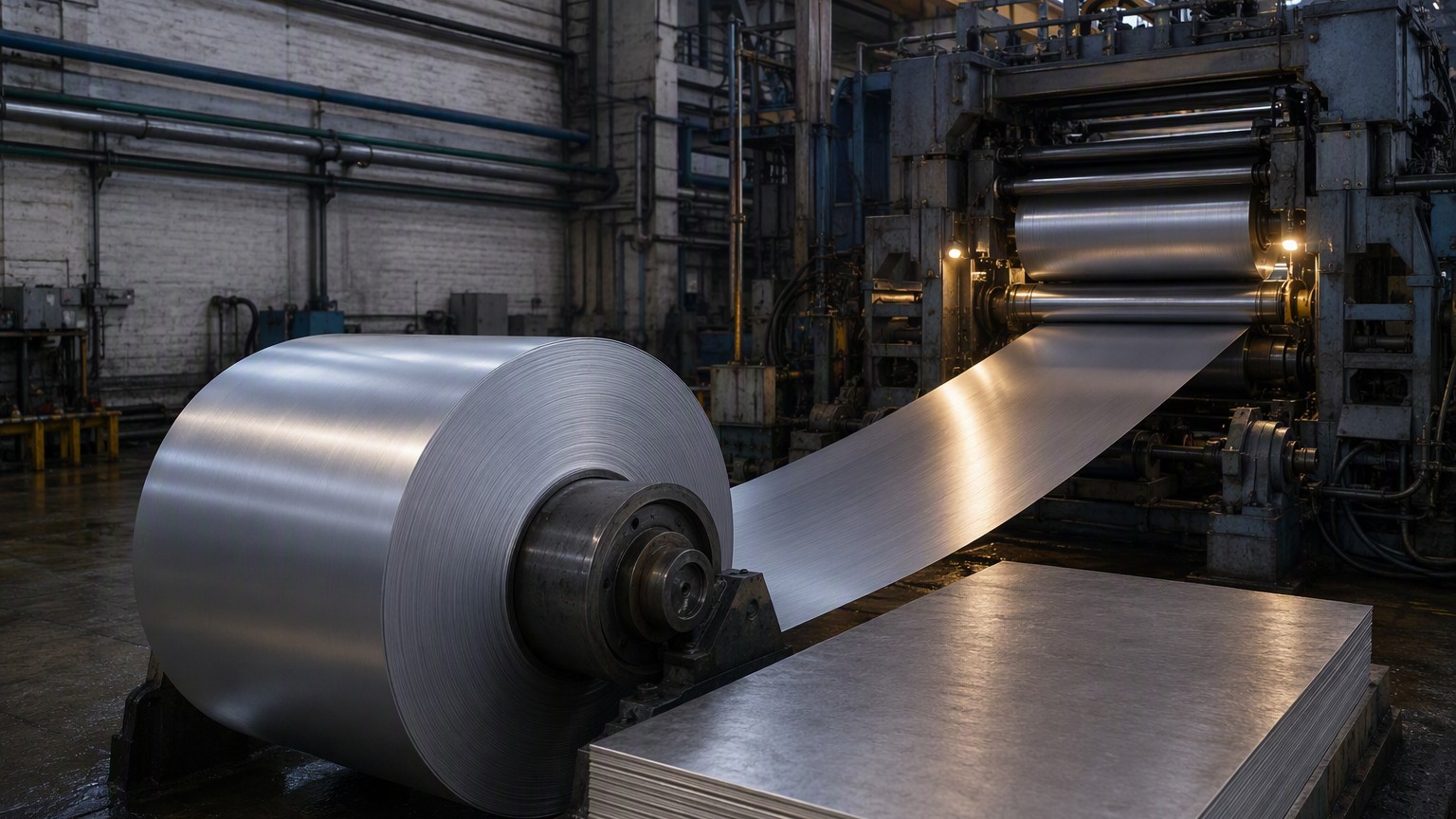
Both products are rolled from the same cast slab, carry the same four-digit alloy numbers and can share an identical mill finish, so a buyer standing in front of a wrapped bundle cannot tell them apart by appearance alone. What separates them is thickness and everything that thickness allows: whether the material can be coiled at all, which mill route it travels, which tolerance tables apply, how it is packed and how it is processed downstream. The rolling route is where the divergence begins. Flat-rolled aluminum starts as a cast slab or a continuously cast coil, is hot rolled down to a transfer gauge, and then splits into two routes. Sheet is cold reduced further, annealed, and temper rolled to reach a thin gauge with a controlled surface, leaving the mill as coil or as cut-to-length flat product. Plate stops earlier in the sequence: it is hot rolled to final thickness, may be stretched or given thermal stress relief, and is delivered flat, piece by piece, frequently with sawn or sheared edges and a mill finish surface. The distinction also decides which downstream equipment can handle the order: a coil line, a cut-to-length line or a plate saw, and that practical difference is often what a first-time buyer notices before any metallurgical difference becomes visible.
Why the 0.250 in line became the industry boundary
The boundary is practical rather than metallurgical, which is why it has survived for decades despite the arrival of better mills and better levelers. Below roughly a quarter of an inch (6.35 mm), the product can be coiled without the surface cracking that heavy deformation of thick sections would invite, it can be cold reduced economically on conventional mills, and it can be handled by slitting and cut-to-length lines at high speed. Above that line, coiling becomes difficult, cold reduction stops paying for itself, and gauge control depends on the hot mill, the leveler and any stress relief that follows. Coilability, handling and gauge control — not chemistry — are the reasons the trade line sits at 0.250 in rather than at some metallurgically meaningful number. A second consequence follows from the same logic. Because sheet and plate are produced on different equipment and measured against different tables, the tolerance band that a mill will quote for 3 mm sheet is not the band it will quote for 8 mm plate, even in the same alloy and temper. Buyers who understand that the line exists for manufacturing reasons, not marketing ones, stop expecting plate to be held to sheet tolerances and stop being surprised when it is not.
How the supply form differs — coil, cut length and plate
The supply form then dictates the commercial language of the order, and this is where most of the practical friction between buyer and mill actually sits. Sheet is bought as coil, strip or flat cut sheet, and a coil quotation normally carries an inner diameter, a coil weight range and a width, with the finished sheet produced later by slitting and cut-to-length processing. Plate is bought as individual pieces, measured as width × length × thickness, and quoted with cut-size charges, pallet or crate packing and handling notes attached to each line. The weight difference is straightforward physics rather than a mill decision: a 1250 × 2500 mm sheet at 3 mm weighs roughly 25 kg, while the same sheet at 8 mm weighs about 68 kg, which moves it out of the two-person lift and into crane, cradle and edge-protection territory. Fully understanding the family also means reading the alloy and temper designation system used for wrought aluminium, because 5052-H32 sheet and 5052-H32 plate are the same alloy delivered in two very different commercial packages. Our own aluminum sheet and plate product range spans both forms — plate, foil and coil in the 1000–6000 series — which is a useful reminder that the form, not the alloy, is usually the variable a buyer forgets to state.
Where Does the Thickness Boundary Sit in ASTM, EN and ISO Standards?
Standards do not use the words sheet and plate casually. Their definitions decide which tolerance table, test schedule and certificate apply to your order.
ASTM B209/B209M covers aluminum and aluminum-alloy flat sheet, coiled sheet and plate in one specification. ISO 6361-2 specifies the mechanical properties of wrought aluminum sheets, strips and plates. European practice divides the same products across the EN 485 series.
Standards do not use the words sheet and plate casually — their definitions decide which tolerance table, which test schedule and which certificate apply to your order. A quotation that names an alloy and a thickness but not a standard leaves the mill free to choose the tables it finds most convenient, and those tables differ in ways that only show up after the material has been cut. The reason the boundary matters commercially is that each standard publishes separate tables for mechanical properties, dimensional tolerance and permissible flatness, and those tables change with product form and thickness. The practical response is simple: put the standard number on the inquiry. Doing so keeps the mill and the buyer reading the same table, makes the mill test certificate checkable against a named document, and removes the argument that usually follows when a delivery meets one standard and fails another that the buyer assumed. A quotation that leaves the standard unstated also leaves the inspection criteria unstated, which means an argument about the delivered band is decided by whichever document the mill chose rather than by the requirement the drawing assumed. Naming the standard costs one line on the inquiry and settles the question permanently for every later order.
What ASTM B209 actually covers
The ASTM B209/B209M specification covers aluminum and aluminum-alloy flat sheet, coiled sheet and plate in the alloys and tempers listed in its own tables, and it treats all three forms inside one document. It distinguishes mill finishes in a way buyers should note: plate in all alloys, and sheet in heat-treatable alloys, are supplied mill finish, while sheet in non-heat-treatable alloys can also be ordered one-side bright or two-sides bright. Alloy and temper designations follow ANSI H35.1/H35.1M, and the specification treats SI and inch-pound values as separate systems whose values must not be combined — the detail that catches buyers who pair a millimetre thickness with a decimal-inch tolerance and then wonder why the delivered band looks wide. Bending, marking, general quality, stress-corrosion behaviour and exfoliation resistance are written into the specification as testable requirements rather than recommendations, and the specification points to companion documents for related products, including tread plate and marine 5xxx tempers such as H116 and H321 that carry additional corrosion testing. Reading the scope before quoting a mixed enquiry is therefore the fastest way to see whether a project needs the general specification or one of its specialised companions. The fact that flat sheet, coiled sheet and plate sit inside one specification is worth noting, because a quotation may legitimately reference the same document while supplying a different product form.
How ISO 6361 and EN practice divide the same products
ISO 6361-2 sits in a multi-part series rather than standing alone. Part 1 covers technical delivery conditions, part 2 specifies the mechanical properties of wrought aluminum sheets, strips and plates for general engineering applications, and later parts handle chemical composition and dimensional tolerances; the scope of part 2 is explicitly limited to flat-rolled products, which is precisely the boundary line a buyer needs to understand. Designations of alloys and tempers in the series follow the ISO 2107 system, so a European enquiry and a US enquiry for the same 5052 or 6061 product can look superficially similar while quoting different tolerance values and different temper definitions. European practice, in turn, divides the same family of products across the EN 485 series, which is why a purchase order that simply says “to standard” is ambiguous even when the alloy is correct. The workable convention — and the one experienced importers adopt early — is to choose one standard family, state it on the drawing and on the purchase order, and require the mill test certificate to be issued against that named family. That single decision eliminates the most common dispute on flat-rolled aluminum: a delivery that satisfies the document the mill was working to and not the one the buyer had in mind.
Why Does the Sheet vs Plate Decision Change Processing and Price?
Two orders of the same alloy, one 3 mm and one 8 mm, never travel the same route through the mill, and the invoice shows it.
Sheet is cold reduced, coiled and sold by weight, so slitting and cut-to-length processing stays cheap. Plate is hot rolled flat, often stress relieved, priced by piece and cut size, and carries more handling and machining cost per part. Thicker material also needs fewer forming operations.
Two orders of the same alloy — one 3 mm, one 8 mm — never travel the same route through the mill, and the invoice reflects it long before the material reaches production. Cost differences therefore sit in three places rather than one, and buyers who compare only the headline per-kilogram figure are comparing a small part of the picture. The first cost is the mill route: cold reduction, annealing and temper rolling add passes that plate never sees, while plate depends on the hot mill, the leveler and often a stress-relief step. The second is handling and freight, where a coil of sheet moves on a forklift while plate moves on cradles and pallets, frequently needing a crane and edge protection, with freight charged on weight and volume together. The third is downstream processing, where thin sheet feeds roll formers, presses and slitters at high speed, while plate goes to saws, waterjet or plasma tables and machining centres at a much slower rate per kilogram. Buyers comparing quotations across regions therefore need to compare the scope of supply as carefully as the price, since two mills may quote the same alloy and gauge while including or excluding processing steps that change the delivered cost substantially. Reading a quotation as a scope document rather than a price list is the habit that prevents this class of surprise.
Processing route — cold reduction versus hot rolled plate
Cold reduction is what gives sheet its combination of thin gauge, controlled surface and consistent mechanical properties, and it is the reason sheet producers can hold gauge tightly across a coil. Applying the same sequence to heavier material would be uneconomic, so the industry stops cold rolling well before plate gauges and relies instead on the hot mill plus leveling; where dimensional stability is critical, a stretch or thermal stress relief is added. That has a direct consequence for flatness. Sheet flatness is substantially controlled by tension and leveling inside the coil line, where the material is under continuous tension, whereas plate flatness depends on the leveler and on how the piece was handled and stacked afterwards. For machined parts this is not cosmetic. A plate that has not been adequately relieved can move after the first heavy cut, releasing internal stress as material is removed; the buyer then blames the machine shop for a problem created upstream by the mill route and the temper selected. The same logic explains why tooling plate is usually ordered in a stress-relieved temper rather than the strongest available one: stability during machining matters more than a higher nominal strength that the part never needs.
Where the cost really sits in a plate order
Plate quotations are frequently misread because the headline per-kilogram figure is not the delivered cost. Industry data published by The Aluminum Association shows how much of this market moves on mill orders, shipments and downstream processing rather than on one spot metal price, and the same logic applies to a single container. Cut-size charges, sawing or waterjet time, certificate packages, protective packing and the difference between a full pallet and a part pallet routinely outweigh a modest movement in metal price, which is why two quotations for the same tonnage can differ by more than the material itself. Weight, by contrast, is fixed by physics and worth calculating before ordering: with a density of about 2.70 g/cm³ for aluminum, a 1250 × 2500 mm sheet at 3 mm weighs roughly 25 kg while the same sheet at 8 mm weighs about 68 kg. Both may fall in the same freight class, but one is a two-person lift and the other is a crane job, and that difference shows up as a line item on the quotation long before it shows up on site. Calculating that weight before ordering, rather than after, is what turns a handling problem into a planning decision, and it takes less than a minute with the density figure above.
Which Form Suits Bending, Machining and Structural Applications?
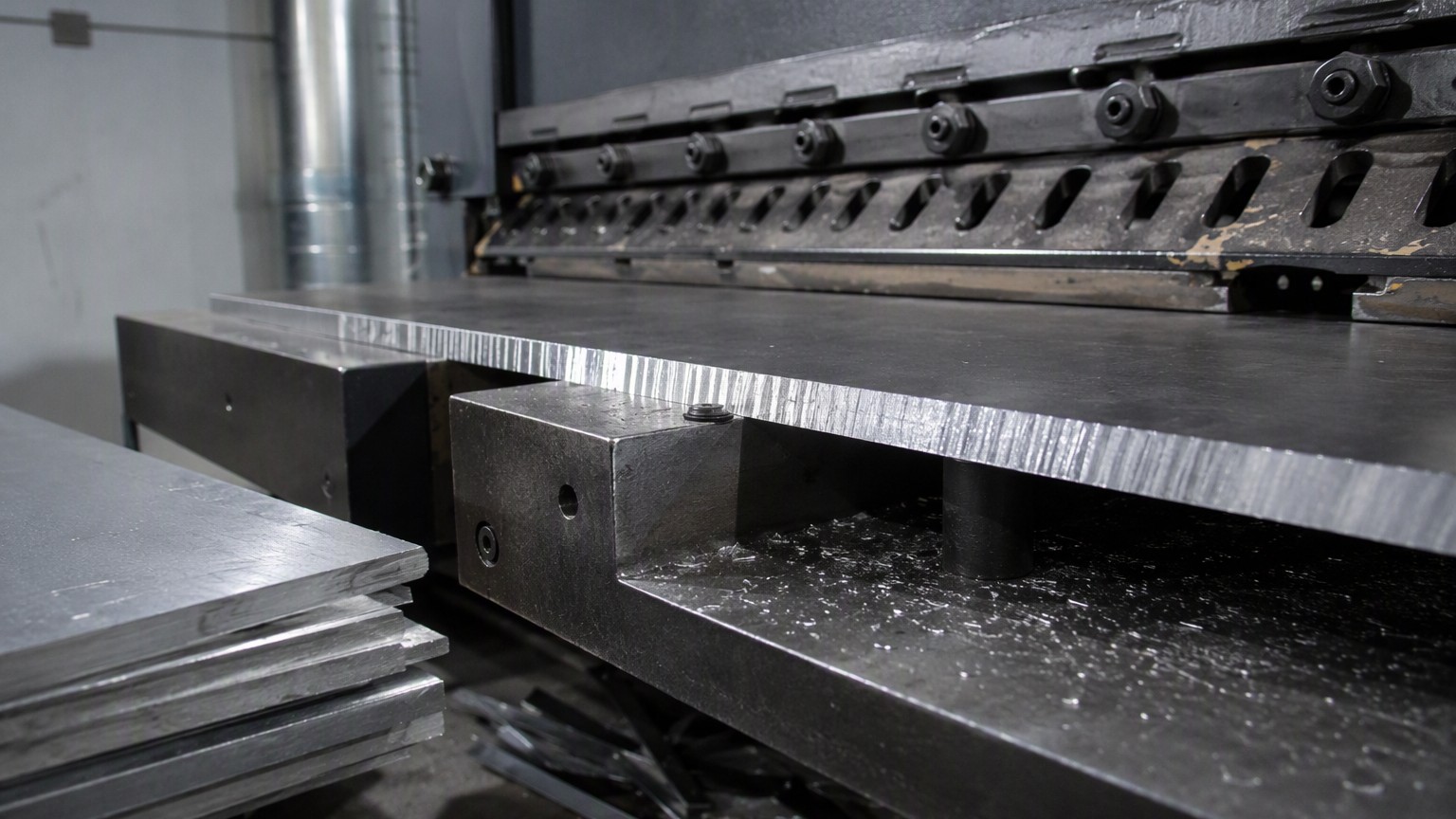
A press brake tells you immediately whether the material should have been sheet; a machining centre tells you the opposite.
Thin aluminum sheet suits roll forming, brake bending, stamping, cladding and heat-transfer applications. Thicker aluminum plate suits machining, tooling, tank and flange work, structural brackets and marine fabrication. Choose by the process the part must survive, not by habit.
A press brake tells you immediately whether the material should have been sheet, and a machining centre tells you the opposite, which is why the selection question is best answered by naming the process the part must survive rather than by habit or by what is already in the rack. Selection then becomes straightforward. If the part must take a tight bend without cracking, sheet wins on geometry, because the outer-fibre strain in bending rises with thickness for any given bend radius, so reducing thickness allows a proportionally tighter radius in the same material. If the part must hold a machined face, carry a load or take a tapped thread, plate wins, because stiffness rises steeply with thickness and there is enough material to machine features without the workpiece deflecting or springing. Where both demands appear together, in a bent bracket that also carries machined pads for example, the usual answers are a mid-gauge product with an adequate bend radius, a change of temper to something more forgiving, or a fabricated assembly of sheet and plate instead of one piece of unnecessarily thick stock. In practice this means the drawing, not the warehouse, decides the form: the forming operations a part must survive and the surfaces it must present are what make sheet or plate the correct input.
Forming and bending — where thin gauges win
Sheet alloys in the 1xxx, 3xxx and 5xxx families are supplied in tempers designed for forming, and 5052-H32 has become the default answer for panels and cladding precisely because it bends, rolls and welds without much drama. Roof and wall cladding, truck side panels, signage, appliance skins, cable trays and heat-exchanger fins all exploit the same property: thin material deforms predictably, springs back within a controllable range and can be corrected with a small over-bend. Roll forming in particular requires coil-fed material, so sheet is the only practical input for continuously profiled products — a plate cannot be fed into that line at all, which is why cladding profiles in 0.5 mm and 0.8 mm are produced at speed while heavier sections are press-braked piece by piece. Springback deserves specific attention here, because it scales with strength and thickness together: a high-strength temper in a heavier gauge will spring back noticeably more than the same alloy in a softer temper, and the tooling and over-bend allowance must be chosen accordingly. Where a design genuinely needs plate and bending in one part, the drawing should state a minimum inside bend radius relative to thickness and specify the temper explicitly, since 6061 in a fully aged condition is the least forgiving option in the 6xxx family and is not the right choice for tight forming work.
Machining, tooling and structural duty — where plate wins
Plate exists because thin sheet cannot be gripped, faced and drilled without deflecting away from the tool. Jigs, fixtures, mould backing plates, tank heads, flanges, transport frames, machine bases and marine structures are all made from plate, usually in 5052, 5083 or 6061, and often in a stress-relieved temper such as T651 where dimensional stability after machining is the entire point of the order. The extra thickness also buys weld preparation that sheet cannot offer: a plate edge can be beveled, fit up and welded with enough remaining section to carry the load, whereas a sheet joint must be flanged, backed, doubled or riveted, each of which adds an operation and a failure point. Handling tells the same story from the other direction. Plate is easy to clamp, easy to fixture and stable under a machining load, while sheet needs vacuum tables, magnetic or mechanical clamping and careful support to avoid chatter. For buyers, the practical rule is short enough to remember: plate is chosen when the drawing contains material to remove, and sheet is chosen when the drawing contains material to form. Our technical note on how aluminum plate grades 5052, 6061 and 7075 compare covers the alloy side of that decision in detail, and the 6061 aluminum plate in 2 mm format shows how a mid-thickness product can serve both light forming and machining duty without moving up to heavy plate.
How Do You Specify Thickness, Tolerance and Temper on a Purchase Order?
“Aluminum plate, 6 mm, 6061” is not a specification; it is an invitation to a dispute about what arrives.
State alloy, temper, form (sheet or plate), nominal thickness with the tolerance class, width and length, quantity, edge condition, surface finish, flatness expectation, packing and required documents. Add the standard number so mill and buyer reference the same tables.
“Aluminum plate, 6 mm, 6061” is not a specification; it is an invitation to a dispute about what arrives, and the dispute will be decided by whoever wrote the clearer document. The reason to write everything down is that each line of the order has a supplier-side decision behind it. Thickness without a tolerance class leaves the mill free to deliver anywhere inside the widest permissible band. A named form without dimensions leaves the cut size open, and cut material cannot be returned. Temper without a test requirement leaves verification to chance, and the buyer discovers the problem only after the parts have been machined. A workable purchase order therefore reads like a checklist rather than a description, and the buyer who builds that checklist once can reuse it across alloys and gauges without renegotiating the meaning of every line. It also makes arrival inspection mechanical instead of argumentative, which matters most on the first order from a new mill, when neither side yet has a working relationship to fall back on. Two buyers ordering identical material from the same mill can therefore receive very different results, not because the mill treated them differently but because one inquiry constrained the supplier and the other did not. The checklist is the whole difference.
The specification lines that prevent disputes
Eight lines cover almost every flat-rolled aluminum order. Alloy and temper, written in the designations used by the quoted standard. Product form, stated explicitly as sheet or plate rather than implied. Nominal thickness in millimetres or inches with the tolerance class named, and one unit convention preserved throughout, because the standard treats SI and inch-pound values as separate systems that must not be mixed. Width and length, plus whether cut-to-size or random length is acceptable. Quantity expressed both in pieces and in weight, since one controls production planning and the other controls freight. Edge and surface condition, including whether mill finish is acceptable or a brighter finish is required. Flatness and any inspection requirement, which is essential for machined parts. Packing, marking and the documents required at delivery, including the mill test certificate. Two of these lines cause most of the friction in practice: form and tolerance class. A supplier quoting coil when plate was intended, or delivering at a wider tolerance than the drawing assumed, is usually following an ambiguous instruction rather than ignoring a clear one. Where thickness tolerance is the deciding factor, it is worth comparing how flat-product tolerances are normally expressed in our guide on how flat-product sizes and tolerances are written, because the logic of a nominal thickness plus a permissible band works the same way for aluminum.
Verifying thickness and temper on arrival
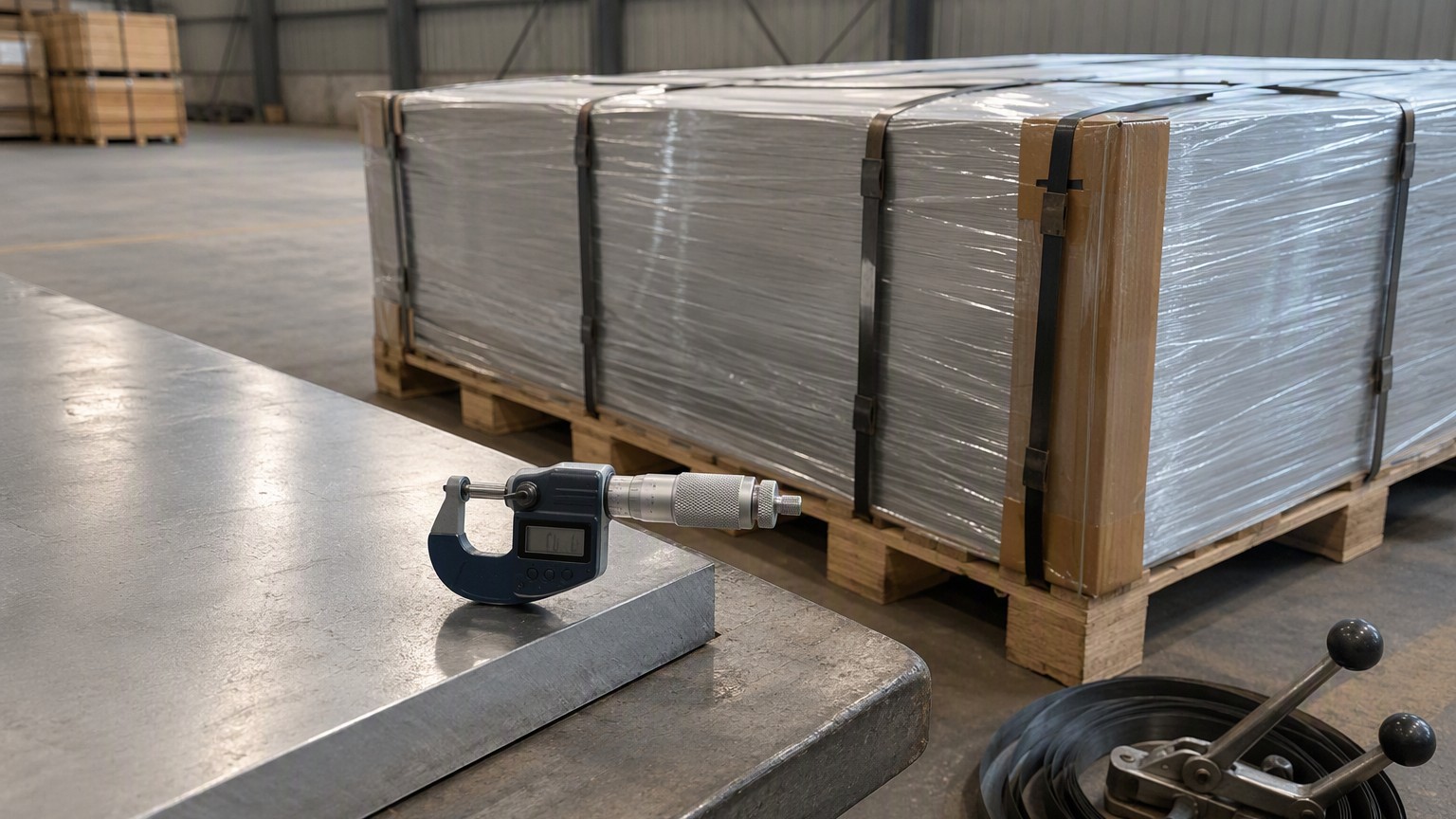
Verification should be planned before the material lands, not improvised after a problem appears. A calibrated micrometer or an ultrasonic thickness gauge, used at several points across each piece rather than at the centre only, will show whether the plate sits inside the agreed band and whether thickness varies across the width — an edge that measures nominal while the middle is low is a different problem from a uniformly thin delivery, and the correction is different too. Flatness must be checked on a true surface such as a surface plate or a level floor with straight edges, never on the pallet the material arrived on, because packing and stacking can flatten a bowed plate temporarily and hide the defect until it is unpacked at the machine. For temper, the certificate is the first piece of evidence and a hardness check is the quick second opinion; where the application is critical, a small number of tensile coupons resolve the question properly and cheaply compared with scrapping finished parts. Record the results against the certificate numbers and keep them with the goods-inward paperwork. Buyers who do this consistently stop discovering thickness problems at the cutting stage, when the material has been paid for and partly consumed, and they gain a factual basis for any claim that has to be raised later.
What Mistakes Cause the Wrong Sheet or Plate to Arrive?
Most wrong deliveries are not mill errors. They are order errors that looked entirely correct until the material reached the saw.
The usual causes are omitting the product form, treating 6 mm as sheet when the mill treats it as plate, assuming thicker means stronger, ignoring flatness for machined parts, and ordering a tolerance class the mill does not offer in that gauge.
Most wrong deliveries are not mill errors at all; they are order errors that looked entirely correct until the material reached the saw. Each mistake has a short and rather boring fix, and the fix is always a line of text somewhere in the inquiry. Write the form and the boundary question becomes irrelevant. Write the tolerance class and the gauge debate disappears. Write the flatness requirement and the machining distortion claim never starts. The mistakes below repeat across markets and industries because the underlying documents — drawings, emails and abbreviated inquiries — leave room for interpretation, and interpretation is exactly what a mill will not do without written instruction. There is also a commercial asymmetry that makes these errors expensive: the buyer discovers the problem after cutting, when the material cannot be returned in its original condition, while the mill can point to a document that permitted what was supplied. Closing those gaps in the inquiry usually means that the second order from the same mill needs almost no discussion at all. The asymmetry is worth restating in commercial terms: the buyer absorbs the cost of cutting and scrapping, while the mill is protected by a document that permitted what was delivered, so the discipline has to sit on the buyer side of the transaction.
The boundary is 6.35 mm, not 6 mm
Round numbers create round problems. A requirement written as “6 mm sheet” sits within rounding distance of the conventional plate threshold, and two suppliers can legitimately read it in different ways — one quoting coil-fed sheet, the other quoting a 6.35 mm plate — while both believe they answered the question. The safer habit is to quote the actual nominal thickness together with the form and the standard, for example sheet in 5 mm or plate from 8 mm, and to avoid describing anything within a fraction of a millimetre of the boundary without stating the intended form explicitly. Buyers sourcing across regions should also expect different conventions in the documents they receive, because a supplier working in inch-pound units may express the same material as 0.250 in, which converts to 6.35 mm and not to 6 mm. The distinction is not pedantry: it decides whether the material arrives as a coil that must be processed again or as a flat piece ready for the saw, and it changes handling, packing and cutting charges on the same order value. When in doubt, write the intended use as well as the thickness — “6.35 mm plate for machined pads” removes the ambiguity that a bare dimension creates.
Thickness is not strength
The second recurring error is the belief that plate is automatically stronger than sheet. Strength comes from alloy and temper, not from form: a 5052-H32 sheet and a 5052-H32 plate share the same nominal properties, and a heat-treated 6xxx plate is substantially stronger than a soft 1xxx sheet of any thickness. Thickness buys stiffness, load-bearing section, machining allowance and weld preparation — real and valuable benefits, but different ones. Overspecifying thickness to chase strength therefore increases weight, cost, cutting time and handling effort while leaving the property that was actually needed untouched. The correct sequence is to select alloy and temper for the required strength and corrosion behaviour first, then choose thickness for stiffness and processing, and only then decide whether the resulting product is sheet or plate. Following that order also prevents a second common mistake, which is specifying a high-strength temper where formability was the real constraint: a part that must be bent to a tight radius rarely wants the hardest temper available, and the design intent is better served by a softer temper at a slightly greater thickness than by a stronger temper that cracks at the brake. Deciding which demand dominates, formability or strength, before choosing a gauge resolves that trade-off early, when changing the order is still free.
Conclusion
Sheet is thin, coiled and formable; plate starts at 6.35 mm and is sold flat. Specify alloy, temper, thickness, tolerance and form, and the drawing will match the delivery.
For inquiries about aluminum sheet and plate thickness availability, alloys, tolerances and delivery terms, send us the specification and the required quantity and we will confirm what can be supplied and certified.