
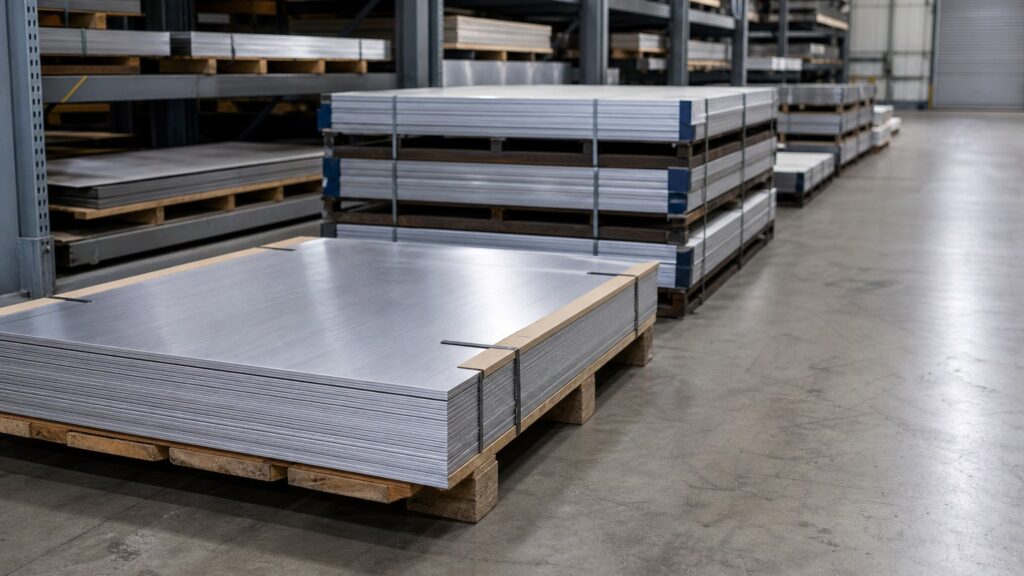
Aluminum Plate Grades: How Do You Choose Between 5052, 6061 and 7075?
Choosing the wrong aluminum plate grade is expensive. You overpay for strength you never use, or you discover a cracking problem only after the parts are cut.
5052 is the corrosion-resistant, highly formable choice; 6061-T6 is the balanced structural workhorse; 7075-T6 is the highest-strength aerospace grade. Match the grade to the dominant demand: corrosion, weldability and cost favour 5052; strength with machinability favours 6061; maximum strength-to-weight favours 7075.
Transition: the three grades look identical on a pallet, so the decision has to be made on data rather than on appearance — alloying system, temper, mechanical properties, corrosion behaviour and the way the plate behaves in the workshop. The six sections below follow the order a buyer or engineer actually works through: what separates the 5052, 6061 and 7075 families, how their properties compare side by side, which grade wins for corrosion and marine service, when 6061-T6 earns its price premium in structures, why 7075 is reserved for aerospace and highly stressed parts, and finally what a purchase order must state so that the plate delivered is the plate intended.
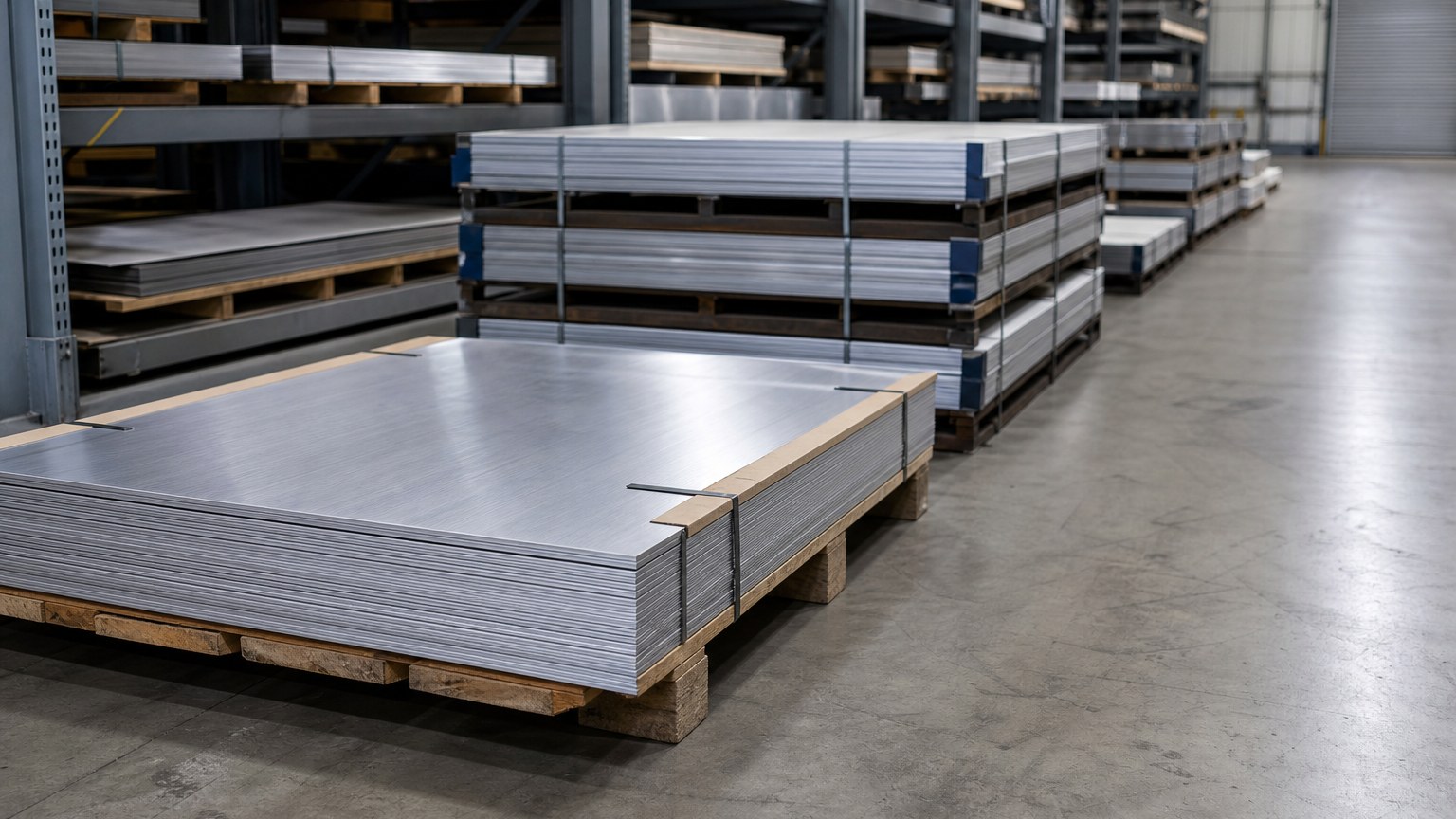
What Actually Separates the 5052, 6061 and 7075 Aluminum Plate Families?
The three plates feel identical and weigh almost the same. Everything that matters — strength, weldability, corrosion behaviour — comes from the alloying system inside them.
5052 is an aluminium-magnesium alloy; 6061 is aluminium-magnesium-silicon with copper and chromium additions; 7075 is an aluminium-zinc-magnesium-copper alloy. Those three systems produce three different families: work-hardened, precipitation-hardened, and high-strength aerospace plate.
The four-digit designation is not arbitrary
The first digit of an aluminium alloy designation identifies the alloying system, and that is the single most useful thing to know before reading any properties table. The 5xxx series is alloyed mainly with magnesium, the 6xxx series with magnesium and silicon, and the 7xxx series with zinc. A 5052 plate therefore belongs to the same family as marine-grade sheet, a 6061 plate to the same family as extruded structural profiles, and a 7075 plate to the same family as high-strength aircraft plate. Once a buyer recognises the family, the general behaviour becomes predictable: 5xxx alloys are strong in the work-hardened condition and exceptional in corrosive environments, 6xxx alloys respond to heat treatment and remain readily weldable and machinable, and 7xxx alloys deliver the highest strength of the three with the largest penalties in formability and welding. This is why a specification that says only “aluminium plate” is not a specification at all. Grade and temper together define the material, and the 6061 aluminium alloy reference published on Wikipedia is a convenient place to see how a single grade is documented across ASTM, EN, ISO and GB standards. A buyer who can read that documentation can also check a mill certificate against it, which is the practical reason the family logic is worth learning before any quotation is requested.
Work hardening versus precipitation hardening
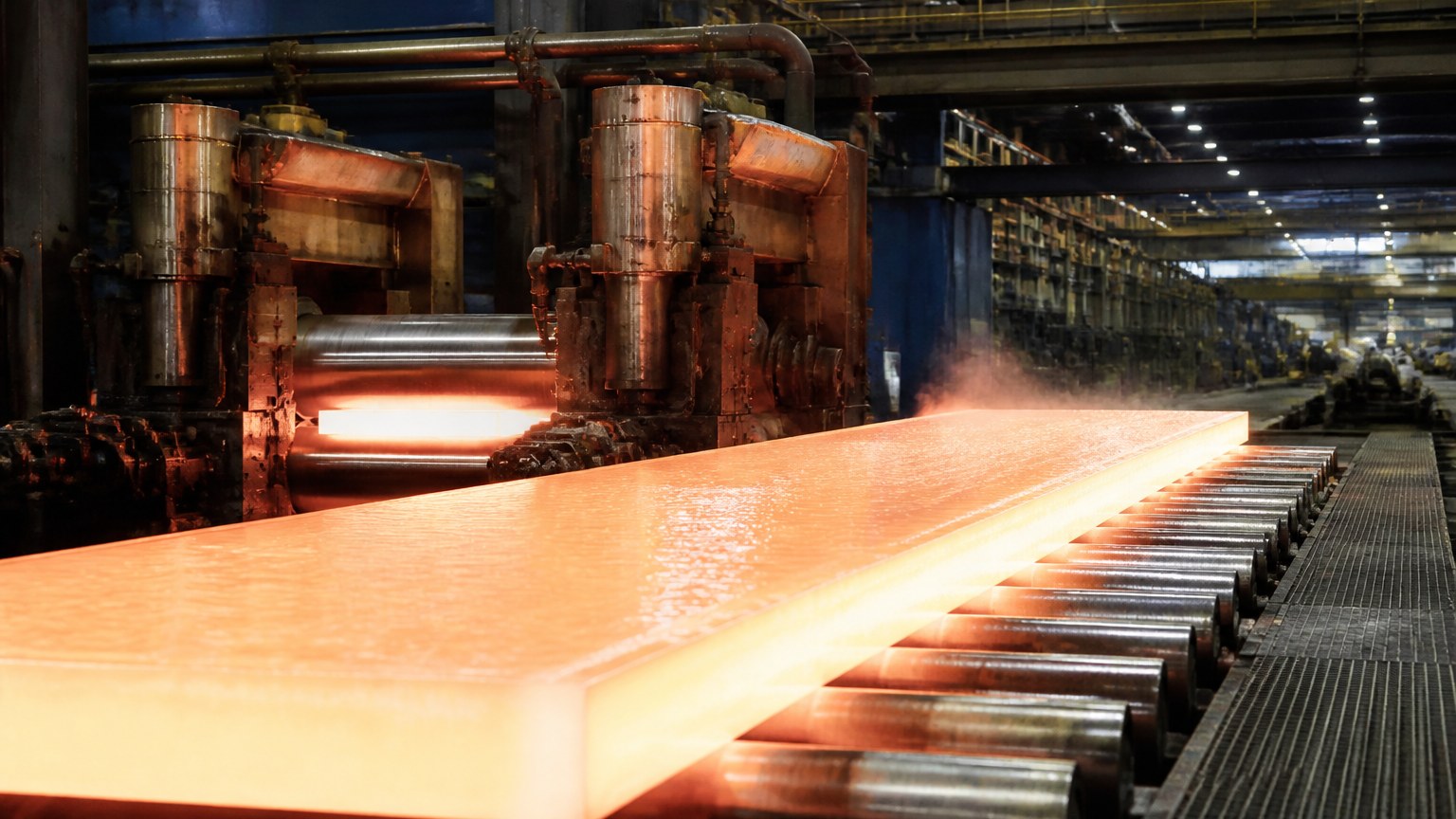
How the alloy reaches its strength changes what a fabricator can do with it. 5052 is not heat treatable; it gains strength from cold rolling, which is why it is supplied in tempers such as O, H32 and H38 — each successive H temper is stronger and less ductile than the last. 6061 and 7075 are heat treatable: they gain strength from solution treatment and artificial ageing, which is why they are supplied in tempers such as T4, T6 and T651. The practical consequence is that a 5052 plate cannot be re-strengthened after welding or severe forming, whereas a 6061 part can in principle be re-heat-treated. It also explains the shape of the property tables: for 5052 the spread within one grade is large because the temper does the work, while for 6061 the difference between the annealed and the T6 condition is a multiple of the strength. It is also why two plates of the same grade from two suppliers can behave differently in the press brake, purely because one was supplied in a harder temper than the other. Checking the temper on the certificate is therefore not a formality; it is the fastest way to confirm that the material in the rack matches the drawing.
Why the alloying addition changes the workshop outcome
Magnesium gives 5052 its corrosion resistance and its ability to be bent and deep drawn without cracking, but it also makes the alloy strain-hardened rather than heat-treatable. Silicon and magnesium together in 6061 form the magnesium silicide precipitates that respond to ageing, which is why 6061-T6 can reach a strength approaching that of some stainless steels while remaining machinable and weldable. Zinc in 7075, together with magnesium and copper, produces the finest and densest precipitate structure of the three and the highest tensile strength, at the cost of lower formability and greater susceptibility to stress corrosion cracking when the surface is unprotected. None of the three is universally better; each is a deliberate trade. That trade-offs framework is the same one described in our aluminum plate grades product range, where each grade is listed with the temper and thickness range normally supplied. Read that list as a statement of what a mill can certify rather than as a ranking, because the same alloy in a different temper is effectively a different material for design purposes. The sections that follow treat the three families on that basis, comparing them at the tempers in which they are normally ordered and at the thicknesses most often stocked.
How Do the Mechanical Properties of 5052, 6061 and 7075 Compare?
Side-by-side numbers are the fastest way to eliminate a grade. The spread within each grade is as important as the difference between grades.
5052 ranges roughly from 195 MPa to 290 MPa tensile depending on temper, 6061-O starts near 124 MPa and 6061-T6 reaches about 310 MPa, and 7075-T6 reaches 572 MPa with a yield strength near 500 MPa in the T651 condition.
| Property | 5052 (Al-Mg) | 6061 (Al-Mg-Si) | 7075 (Al-Zn) |
|---|---|---|---|
| Main alloying elements | Mg 2.2–2.8%, Cr up to 0.35% | Mg 0.8–1.2%, Si 0.4–0.8%, Cu 0.15–0.40% | Zn 5.6–6.1%, Mg 2.1–2.5%, Cu 1.2–1.6% |
| Typical density (g/cm³) | 2.68 | 2.70 | 2.81 |
| Weight of a 3 mm plate (kg/m²) | 8.04 | 8.10 | 8.43 |
| Typical tensile strength | 195 MPa (O) to 290 MPa (H38) | 150 MPa max (O) to about 310 MPa (T6) | 570–572 MPa (T6 / T651) |
| Typical yield strength | 89.6 MPa (O) to 255 MPa (H38) | 83 MPa (O) to about 240–270 MPa (T6) | 500 MPa (T651) |
| Heat treatable | No — work hardened | Yes | Yes |
| Corrosion behaviour | Excellent, including seawater and salt spray | Good; best when anodised or painted | Moderate; requires protection against stress corrosion |
| Typical applications | Tanks, marine structures, heat exchangers, fuel lines, flooring panels | Structural frames, machine parts, tooling, truck bodies, boat fittings | Aircraft structures, highly stressed machined components, bicycle and drivetrain parts |
Reading the table correctly
The most common misuse of a comparison table is to compare the highest number of one grade with an average number of another. The 290 MPa figure for 5052 applies to the hardest H38 temper, where elongation has dropped to roughly seven per cent; the 195 MPa figure applies to the fully annealed O temper, which is soft and highly formable. Likewise, the 310 MPa typical tensile strength of 6061 applies to the T6 temper; in the annealed condition the same alloy does not exceed about 150 MPa. Comparing 5052-H38 with 6061-O and concluding that 5052 is stronger is technically true and practically useless. Read the table across a single temper column, and then ask which temper the application can actually tolerate. Where the finished part will be bent, welded or extensively machined, the softer temper is often the correct engineering choice even though the numbers look weaker on paper. Suppliers usually stock one or two standard tempers per grade, so the temper that can be delivered within the required lead time is part of the specification, not an afterthought. This is also why the ASTM B209 specification for aluminum and aluminum-alloy sheet and plate publishes separate mechanical property requirements for every alloy and temper combination rather than a single figure per grade.
Temper matters more than grade
A second trap is to assume that upgrading the grade always increases performance. A 6061-T4 plate and a 5052-H38 plate are closer in strength than most buyers expect, yet they behave completely differently in fabrication: the 5052-H38 will resist bending and may crack at a tight radius, while the 6061-T4 bends more readily and gains strength later through ageing. In a project where the plate is formed into a tank shell, that difference decides the outcome more than the headline grade does. The same logic applies to 7075: choosing 7075 instead of 6061 buys a very large strength increase in the T6 or T651 condition, but it also removes most of the welding route and demands a protective finish, so a design that requires field welding cannot simply be “upgraded” to 7075 without redesigning the joint. Temper selection, weldability, forming radius and surface protection belong in the same conversation as grade selection, because separating them is what turns a valid material comparison into a project problem. A short list of the tempers a supplier normally stocks in the thicknesses required is often more useful than a long specification, because it narrows the design conversation to material that can actually be delivered on schedule.
Which Grade Should You Choose for Corrosion Resistance and Marine Service?
Salt exposure punishes optimism. In marine and coastal duty the grade that resists pitting and salt-spray attack is worth more than the grade with the higher tensile figure.
Choose 5052 when corrosion resistance and formability outrank strength. It resists seawater and salt spray exceptionally well, is not heat treatable, and is supplied in work-hardened tempers that combine moderate strength with good ductility for tanks, hulls and architectural panels.
Why 5052 dominates salt-spray duty
The magnesium content that makes 5052 work-hardenable also gives it a naturally protective surface behaviour in chloride environments, which is why it is a primary candidate for marine structures such as liquefied natural gas tanker tanks and why it is widely used for fuel lines, tanks and heat exchangers. In practice this means a 5052 plate can be used with minimal coating in coastal service, whereas a 7075 plate in the same location would need a protective system because of its greater susceptibility to stress corrosion cracking in the presence of chlorides. The comparison is not about which plate is “better” but about which plate tolerates the environment without a maintenance programme: a surface that must be recoated every few years changes the lifetime cost of the project, and that cost belongs in the grade decision. For sheet-metal work with tight bends, 5052 also offers an advantage that the numbers do not show — the alloy tolerates cold forming without the cracking risk that limits harder tempers, so fewer parts are lost to rework. A typical order for coastal fabrication might be a 5052 aluminum plate in 3 mm, supplied in a work-hardened temper for tank cladding or panel work, with the temper stated on the order because it controls both the bend radius and the final strength.
Where the other two grades fit in a corrosive environment
6061 is not a marine grade in the sense that 5052 is, but it performs well in coastal and industrial atmospheres when it is anodised or painted, and it brings strength and machinability that 5052 cannot match in the T6 temper. The reason is metallurgical: copper, which is present in 6061 at 0.15–0.40 per cent, improves the ageing response and the strength but reduces general corrosion resistance relative to the 5xxx family. 7075 is at the opposite end of the corrosion spectrum for unprotected service, since its zinc-rich chemistry and high strength leave it exposed to stress corrosion cracking, and it is normally specified with a protective finish. In other words, the corrosion question is not settled by one generic ranking; it is settled by asking whether the part will be left bare, and if not, what finish will be applied. A buyer who writes the intended finish into the order removes most of the guesswork from the corrosion discussion, because the grade and the coating are then evaluated together instead of one after the other. The same logic governs material choices in other product families, where the metal is selected for the process and the service environment rather than for the headline strength figure; the wider background of 5052, including its magnesium content of 2.2–2.8 per cent, is set out in the reference material on 5052 aluminium alloy.
What to verify before signing a marine order
Three items settle most corrosion-related disputes. First, the alloy and temper as written on the mill certificate, checked against the alloy designation and mechanical properties in the ordering specification. Second, the surface condition on arrival: water staining, edge damage and transit marking are not corrosion, but they become corrosion initiation sites if the plate is stored unwrapped on a quay. Third, the intended finish and the environment it will see, so that a grade chosen for coastal duty is not left bare where a protective coating is actually required. An importer who writes those three items into the order converts a vague concern about “rusting” into an auditable requirement, and the inspection at destination becomes a simple documentary check rather than a dispute about whether a plate was acceptable when it left the mill. Where the application also demands high strength and a welded assembly, the correct answer is usually not to upgrade the grade but to reconsider the design: a corrosion-resistant grade with a heavier section or a reinforcing member frequently outperforms a high-strength grade fighting its environment. Written that way, the corrosion decision becomes a documented requirement that can be verified at the port rather than a judgement call made after the material has been cut.
When Does 6061-T6 Justify Its Higher Price in Structural Work?
Structures fail at joints, not on average strength. 6061-T6 is chosen because it is the strongest plate that still machines, welds and anodises predictably.
Specify 6061-T6 when a part must carry structural load, be machined to close tolerances and possibly be welded. It delivers roughly 310 MPa typical tensile strength and about 270 MPa yield in T6, machines cleanly, and is the most common general-purpose aluminium alloy for structural and mechanical work.
The machining argument
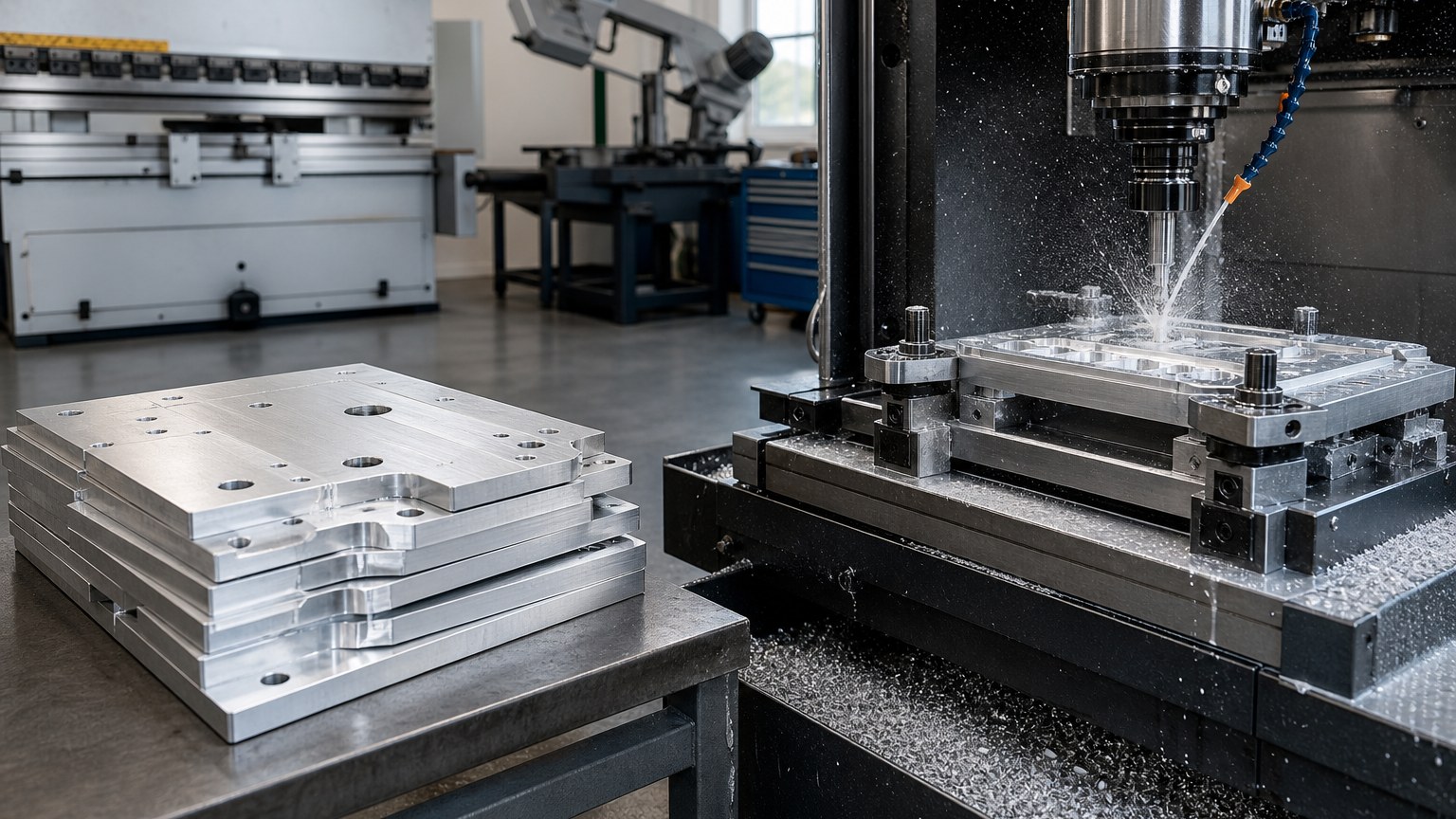
6061-T6 machines better than either of the other two grades in most workshop conditions. Its chips break cleanly, the surface finish after milling is consistent, and the material holds dimensions without the spring and distortion that softer tempers can produce on thin sections. In a job shop, that translates directly into cycle time: a part that comes off the machine within tolerance needs no rework, no straightening and no second operation. The alloying system is what makes this possible — silicon and magnesium form the magnesium silicide precipitates that raise strength during artificial ageing, and the copper addition of 0.15–0.40 per cent sharpens the ageing response further, which is why the T6 temper reaches typical values around 310 MPa tensile and 270 MPa yield. Compared with 5052, the same plate thickness carries substantially more load before yielding, so a designer can either reduce section or increase the safety margin at the same weight. Compared with 7075, 6061 gives up strength but keeps a much wider manufacturing window, and for the majority of industrial parts — frames, brackets, jigs, machine guards, tooling plates, truck and trailer components — that window is worth more than the extra megapascals. This is also why 6061 is the default recommendation when a part will be machined first and welded second, since the alloy remains highly weldable and the strength lost in the heat-affected zone can be quantified and designed around.
Designing around the weld-affected zone
Welding 6061 in the T6 temper locally reduces the strength near the weld to roughly that of the T4 condition, and the industry rule of thumb — reflected in the design guidance published by the Aluminum Association — is to treat the strength adjacent to the weld as substantially lower than the parent metal unless the assembly is re-heat-treated afterwards. A competent design response is to place welds where the stress is low, to thicken the material locally rather than globally, and to avoid locating welds at the point of maximum bending moment. Where the weld is unavoidable at a high-stress location, post-weld artificial ageing can recover much of the lost strength in the affected zone. This is a design detail rather than a reason to avoid the grade, and it explains why 6061 is specified so often in welded frames and enclosures: the material is predictable, so the knock-down factor can be applied with confidence instead of being discovered during testing. Practically, this leads to the most common purchase pattern for this grade, where a fabricator orders a 6061 aluminum plate in 2 mm or a thicker 6061 plate for machining, and states the temper, the thickness tolerance and the intended weld procedure on the order so that the shop and the mill are working from the same assumption.
Cost, availability and the honest comparison
6061 generally costs more than 5052 of the same thickness, and the premium is justified only when the part needs the extra strength or the machining behaviour. For purely decorative panels, covers or lightly loaded enclosures, 5052 delivers adequate mechanical performance with better corrosion resistance and a lower price per kilogramme, which is why specifying 6061 for every component is a common and expensive habit. The reverse error is equally common: using 5052 for a machined structural bracket that repeatedly distorts, then spending the saving on rework. The decision rule that holds up in practice is to ask what the part must do first. If it must carry load, be machined and hold tolerance, 6061-T6 is normally correct. If it must resist the environment and be formed, 5052 is normally correct. If it must be as light and strong as possible and can be protected and machined from solid, 7075 becomes the candidate. Availability supports the same logic: 6061 is the most widely stocked of the three in general engineering sizes, so lead time is rarely the constraint, while 7075 is often stocked in a narrower range of thicknesses, and 5052 sits in between with strong availability in sheet and thin plate.
Why Is 7075 Reserved for Aerospace and High-Stress Applications?
Removing one kilogramme from an aircraft structure is worth money in fuel and payload. 7075 exists because that trade can justify a grade that resists welding and demands protection.
7075 is chosen when strength-to-weight matters and the part can be machined from solid rather than welded. In the T6 and T651 tempers it reaches about 570 MPa tensile and 500 MPa yield, but it forms poorly and is prone to stress corrosion cracking without a protective finish.
The strength-to-weight case
The zinc-magnesium-copper system in 7075 produces a dense, finely dispersed precipitate structure, and that is the source of its very high strength. At a density of 2.81 g/cm³ it is only about five per cent heavier than 6061, yet its typical tensile strength is close to double, so the specific strength — strength per unit of mass — is the highest of the three grades discussed here. For a structure whose weight is the binding constraint, that ratio is the entire argument: a fitting machined from 7075 can replace a heavier steel component, or a 6061 component of larger section, without losing load capacity. The trade is that the same alloy forms poorly at room temperature and is more susceptible to embrittlement than many other aluminium alloys, so it is normally used in machined, forged or heavily stiffened configurations rather than in formed sheet. Protection is part of the specification, not an option: because high-strength 7xxx plate is vulnerable to stress corrosion cracking in chloride-bearing environments, protective finishes or coatings belong in the drawing. The public documentation of the grade, including its composition of roughly 5.6–6.1 per cent zinc with 2.1–2.5 per cent magnesium and 1.2–1.6 per cent copper, is summarised in the background material on 7075 aluminium alloy.
What 7075 will not tolerate
Three limitations define the boundary of the grade. The first is welding: 7075 is not a weldable structural material in the way 6061 and 5052 are, so a design that depends on welded joints should not be converted to 7075 without redesigning the connection, typically to fastened or bonded joints. The second is forming: 7075 has low formability at room temperature and is prone to springback, which is why elevated-temperature forming routes exist for it and why most 7075 parts are machined from plate rather than bent from sheet. The third is corrosion protection: because the alloy is sensitive to stress corrosion cracking, sharp internal corners, unprotected edges and machined surfaces left bare in a chloride environment are all risk locations. A buyer who respects those three constraints obtains a material with excellent fatigue resistance and a very high strength-to-weight ratio; a buyer who ignores them inherits cracking problems that no inspection regime can repair. For thick plate, the T651 temper is often specified precisely because it is stress-relieved by stretching, which improves dimensional stability during machining and reduces the distortion that would otherwise appear when a heavy section is cut away. Those three constraints are easy to state on a drawing and expensive to discover in service, so the grade decision belongs at the design stage rather than at the machine.
Choosing 7075 without over-specifying
The most frequent error with this grade is using it where it is not needed. Because 7075 sounds more advanced, it is sometimes substituted for 6061 in components that are welded, bent or left unprotected — and those are precisely the applications where the grade performs worst. The disciplined approach is to first establish whether the component is weight-critical, then confirm that it can be machined to shape rather than welded or formed, and only then specify 7075 in a documented temper such as T6 or T651. Where any of those conditions fails, the honest answer is usually a return to 6061-T6 with a revised section, or to 5052 with a corrosion allowance. That sequence protects both the budget and the schedule: 7075 plate is stocked in a narrower range of thicknesses and tempers than 6061, so an over-specified grade can add lead time as well as cost. It is also worth noting that thickness affects the achievable properties in the same alloy, which is one reason our thickness guide for aluminium products exists in the same content set: the number a designer writes on the drawing determines which tempers and mechanical properties a mill can actually certify. Ask for the achievable property range at the thickness you need before the order is placed, not after the plate has been cut to size.
What Should a Purchase Order Specify So You Get the Right Aluminum Plate Grade?
An order that names only a grade leaves the two variables that decide the delivered properties — temper and thickness tolerance — to someone else’s default.
State the grade, the temper, the thickness and its tolerance, the dimensions, the quantity by weight or piece count, the applicable specification, the inspection requirement, the surface finish and the packing. With those items in writing, the mill certificate can be checked line by line on arrival.
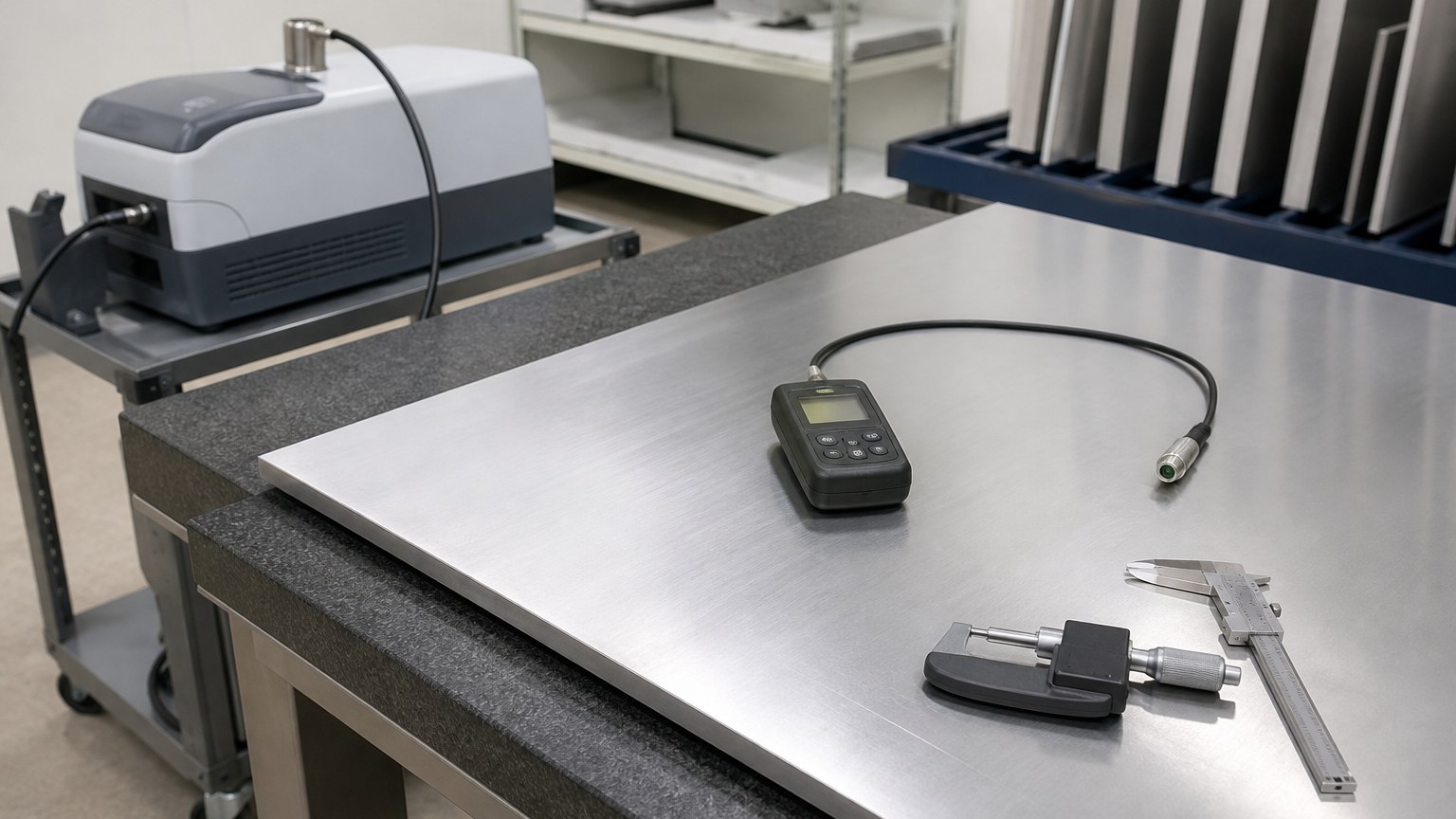
The eight-line specification that prevents disputes
Most aluminium plate disputes trace back to an order that omitted one of eight items. Grade and temper come first, because they control both strength and forming behaviour. Thickness with its tolerance comes next, expressed against the applicable specification rather than as a nominal figure, since a plate ordered at three millimetres may be acceptable within a defined tolerance band and unacceptable outside it. Dimensions and quantity follow, with the quantity stated in the unit that will be verified at destination — pieces, square metres or tonnes — and the same unit used on the packing list so the two documents reconcile. The applicable product specification, together with the testing and inspection requirement, converts a commercial order into a technical one: it states which mechanical properties must be certified and whether inspection is a mill function or is witnessed by a third party. Surface finish and edge condition finish the list, because a plate delivered without the agreed finish is a rework cost even when the chemistry is correct. Packing belongs in the same group, since edge protection, interleaving and moisture protection determine what the plate looks like after a sea voyage. Writing these eight lines once creates a template that can be reused for every subsequent order, and it makes the receipt inspection a fifteen-minute documentary check instead of an argument.
Documents and verification on arrival
For flat-rolled aluminium, the mill test certificate is the document that ties the delivered plate to the ordered material. It should report the alloy and temper, the heat or lot number, the chemical composition, and the mechanical properties as tested, and those properties should be compared against the requirements of the ordering specification for that specific alloy and temper combination — not against a general impression of what that grade “usually” achieves. The standard practice is to reconcile the certificate, the packing list and the physical bundles in one pass: count and match the bundles, confirm the markings, and check that the weight reconciliation agrees. Where the application is safety-related, the certificate type is specified in advance, because a certificate issued by the manufacturer for its own product and a certificate countersigned by an independent inspection representative offer different levels of assurance, and the order is the only place where that choice can be made cheaply. Buyers who want to see the range normally supplied, including plate grades and tempers, can review the material families listed by our steel and aluminium supply team before drafting the inquiry. Keeping the certificate, the packing list and the bundle markings together in one file makes the reconciliation repeatable for the next shipment and turns a routine receipt into evidence if a claim is ever raised.
Turning the specification into a working inquiry
The fastest way to get comparable quotations is to send every supplier the same technical paragraph: grade, temper, thickness and tolerance, dimensions, quantity unit, applicable specification, inspection requirement, finish, and packing. Offers received against an identical brief can be compared on price, lead time and mill origin without any of the usual hidden differences, and the successful supplier’s certificate can be verified against the same text that was used for the inquiry. Two practical additions improve the outcome further. First, ask for the temper that will actually be delivered, not the temper that is theoretically available, because that is the variable most often silently changed. Second, ask whether the plate can be supplied cut to size, since a mill that can deliver a 1500 by 3000 millimetre plate cut to a required size removes a handling and scrap cost from the buyer’s process. Once the grade decision is made and written down in this form, the remaining work is documentation, and documentation is far cheaper than a rejected consignment. Two habits make the result durable: record the temper actually delivered against the temper ordered, and photograph the bundles as received, so that any later question about surface condition can be answered from the file rather than from memory.
For inquiries about 5052, 6061 or 7075 plate, thickness availability and delivery terms, send us the specification and the required quantity; we will confirm the grade and temper that can be certified and quote against it.
Conclusion
5052 for corrosion and forming, 6061-T6 for machined structural work, 7075 when strength-to-weight decides. Specify grade, temper, thickness, tolerance and inspection, then verify the mill certificate against that order.