
PPGI Roofing Sheet: Which Profile, Colour and Fixing Method Should You Choose?
Specify the wrong PPGI roofing sheet and the building leaks, fades and corrodes within a few seasons. Profile, coating and fixing decide whether that happens.
A PPGI roofing sheet is a prepainted galvanized steel sheet roll formed into corrugated or trapezoidal profiles. Choose the profile for span and drainage, a polyester or SMP coating in the required RAL colour, 0.4–0.6 mm thickness, and fix it with self-drilling screws on every second rib.
Transition: because the delivered sheet is decided by four separate choices — substrate, coating, profile and thickness — a buyer who treats “PPGI roofing sheet” as a single product usually discovers the mismatch on site rather than at the quotation stage. The six sections below follow the order an importer or roofing contractor actually works through: what the material is and how it is made, which profiles can be formed from it, how to specify colour and coating system, how to match thickness to span and purlin spacing, how to install it so that it does not leak, and what to verify before the container is loaded.
What Is a PPGI Roofing Sheet and How Is It Made?
PPGI roofing sheet is not a material you can order by name alone. Substrate, coating build-up and profile each change the delivered product.
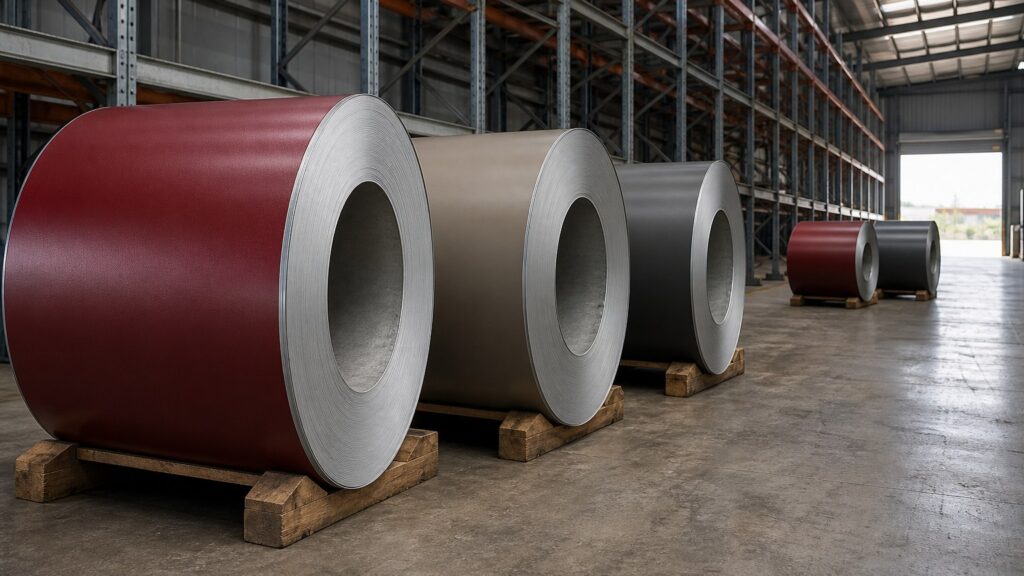
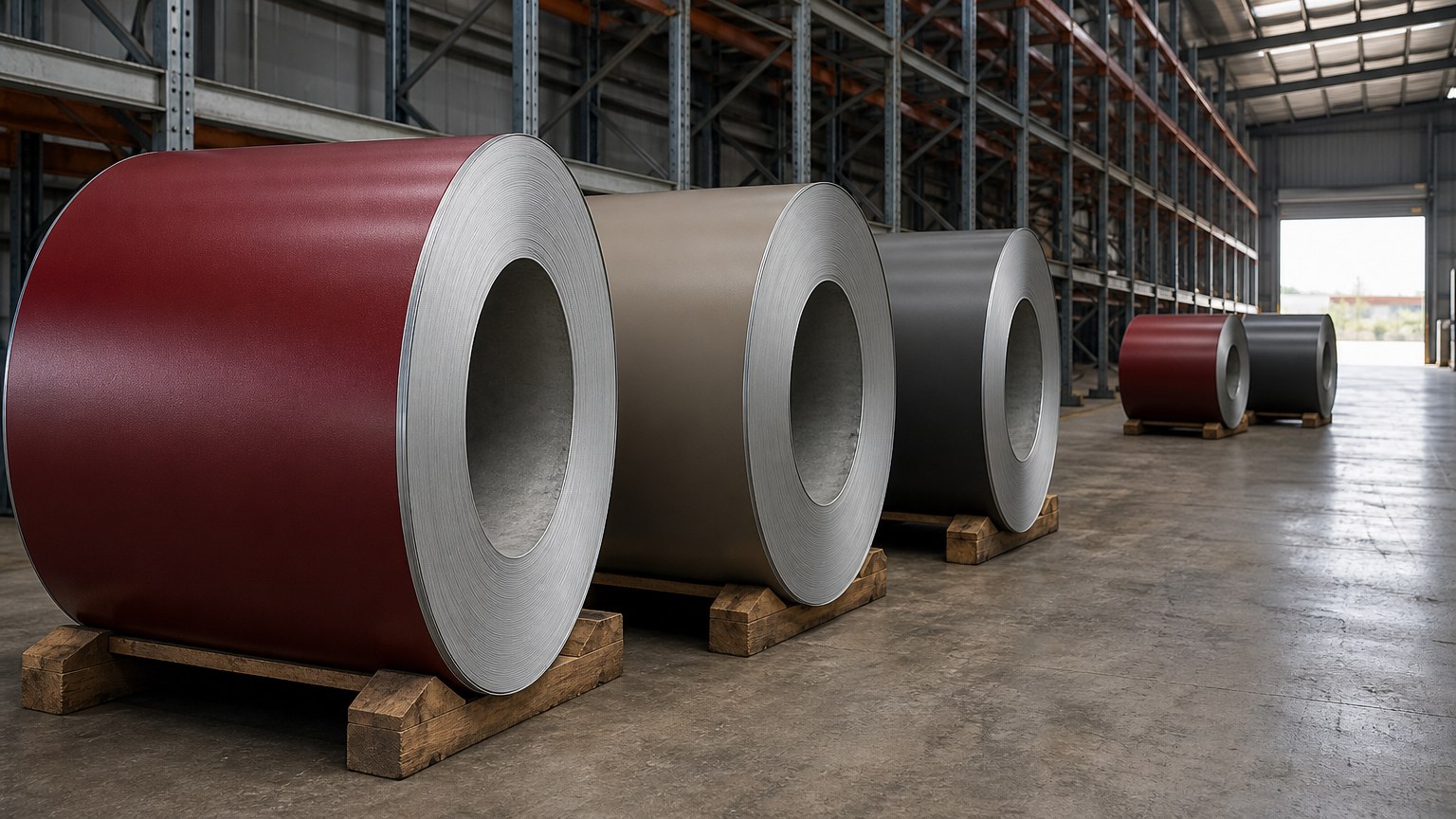
PPGI stands for prepainted galvanized iron: a galvanized steel coil is organically coated on a continuous coil-coating line and then roll formed into roofing profiles. The zinc layer supplies corrosion protection and the organic coating supplies colour and weather resistance.
Substrate comes first
Every PPGI roofing sheet starts life as a steel coil. In most export orders the substrate is a cold-reduced mild steel strip that has been hot-dip galvanized, so the sheet carries a zinc layer on both faces and the organic coating is applied over that zinc. The zinc is not decorative. It is the sacrificial layer that protects the steel when the painted surface is scratched, cut or drilled, which is exactly what happens during installation, and it is the reason a coated sheet keeps working after it has been damaged. The zinc coating weight therefore belongs in the specification next to the paint, not behind it. An order that states only a colour and a thickness and leaves the zinc weight open can be supplied with a lighter coating that passes a visual inspection and fails sooner in service, and the difference will only appear after several years of weathering. It is worth remembering that a roofing sheet is also a structural element, so the steel behind the zinc matters as well: a low-carbon drawing-quality steel behaves differently under bending and under wind uplift from a structural grade, and the mill certificate should name the steel standard rather than only the coating weight. Buyers new to coated products often assume that the paint is the product and the steel is only a carrier; in practice the reverse is closer to the truth, because the coated surface is only as durable as the metal underneath it.
The coil-coating line
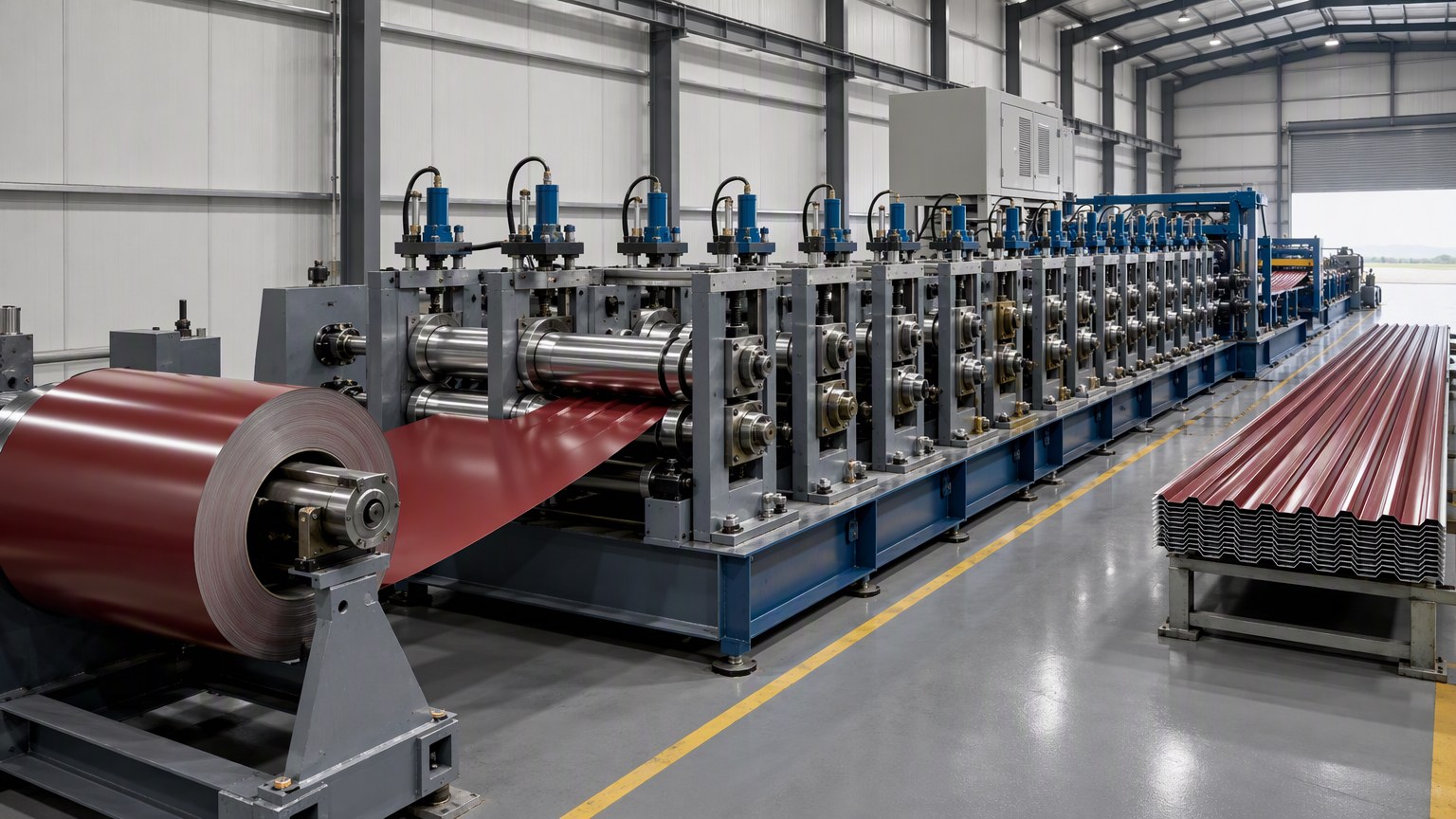
The paint is applied before the strip is cut and formed, not after. A continuous coil-coating line runs the strip through cleaning, chemical conversion treatment, a primer coat, a curing oven, a finish coat, a second curing oven and a cooling section before the coil is rewound. Because the metal is coated while it is still a flat strip, the whole surface including the edges is treated uniformly, which is very difficult to achieve by painting formed parts. The definitions, substrate types and process steps are set out in the prepainted metal (coil coated metal) overview on Wikipedia, which follows EN 13523-0 and EN 10169 terminology. Two consequences matter to a buyer. First, the film thickness is set at the coil stage and cannot be improved later, so a thin coating stays thin for the life of the roof. Second, the coating protects the cut edges only by the small amount of paint that wraps them, which is why the zinc layer underneath carries so much of the corrosion duty at every cut, hole and fixing. A third consequence is less obvious: because the strip is coated flat and then formed, the paint film has to survive roll forming itself, which is why coil coaters specify a minimum flexibility for the finish and why a coating hard enough to resist scratching on site can still crack at a tight bend if the resin was not chosen for forming.
Where the profile is added
Only after coating does the strip go to a roll forming line, where successive stations bend it into corrugated or trapezoidal ribs. Nothing about the chemistry changes at that point; the profile is geometry, and geometry is what decides span, drainage and stacking. That separation matters commercially, because two orders with identical coating specifications but different profiles are different products with different load behaviour and different shipping densities. A buyer who fixes the coating first and the profile second usually gets a better price, since the coil can then be bought at the most economical width and the tooling change is planned rather than improvised. Profile also decides how much of the coil ends up as usable coverage: the same tonne of coated coil delivers a different number of square metres depending on the effective width and the lap allowance of the chosen profile, so a quotation that compares price per tonne across two different profiles is comparing two different things. For the range of colour coated galvanized roofing sheets available in both coil and formed form, the PPGI roofing sheet product page lists the coating weights, base metal thicknesses and profile options that can be certified on a mill certificate, which makes it a practical reference while the enquiry is being drafted.
Which Roof Profiles Can Be Roll Formed from PPGI Roofing Sheet?
Profile is the cheapest way to change performance and the most expensive thing to change later. It fixes span, drainage, overlap and shipping volume.
The common PPGI roofing sheet profiles are corrugated (wavy), trapezoidal (angular ribs), standing seam and tile-effect. Corrugated suits low-cost industrial roofs, trapezoidal suits longer spans and heavier rain, standing seam suits concealed fixing, and tile-effect suits a residential appearance.
| Profile | Rib geometry | Commonly supplied effective width | Fixing method | Typical use |
|---|---|---|---|---|
| Corrugated (wavy) | Continuous round-crested wave | About 760–1000 mm | Through-fixed, screw in the crest | Warehouses, sheds, agricultural and low-cost industrial roofs |
| Trapezoidal | Flat crests with angled webs, several ribs per sheet | About 900–1125 mm | Through-fixed, screw in the crest, washer seated on the flat land | Industrial and commercial roofs with longer spans |
| Standing seam | Raised interlocking seam | About 300–500 mm | Concealed clips, no through fixings | Low-slope and architectural roofs, high-wind locations |
| Tile effect | Pressed tile or shake pattern | About 1000–1100 mm | Through-fixed on the crest | Residential and mixed-use buildings |
Corrugated profiles
A corrugated PPGI roofing sheet uses a continuous wave of round-crested ribs. It is the oldest and usually the cheapest profile, it drains well because water has an uninterrupted path down the slope, and it tolerates minor unevenness in the supporting structure. Its weakness is span: for the same steel thickness, a wave carries less stiffness than an angular rib of similar depth, so corrugated sheets normally need closer purlin spacing, and a larger share of the sheet width is consumed by the side lap. Corrugated galvanised iron has been used as roofing since the nineteenth century and remains the standard low-cost industrial solution, which also means it is the profile most likely to be quoted with the thinnest base metal thickness on the market and with generous claims about effective width. The trade-off against trapezoidal sheet is aesthetic and structural rather than technical. Corrugated profiles do have two genuine advantages that are often overlooked: they handle curved or irregular building geometry better than angular profiles, because the wave bends more readily along the run of the roof, and they shed small debris and water along an open trough rather than across a flat land that can hold a puddle when the roof slope is shallow.
Trapezoidal profiles
Trapezoidal sheets replace the wave with flat crests and angled webs. The angular section is materially more efficient in bending, so a trapezoidal PPGI roofing sheet spans further at the same thickness, or, looked at the other way round, the buyer can step down to a thinner and cheaper gauge for the same purlin spacing. The flat crest is also a better platform for a sealing washer, because the washer seats on a flat land instead of on a curve, which is one reason trapezoidal sheets dominate new industrial and commercial roofs. In transport, trapezoidal sheets are nested and banded crest to crest, so a given container holds more coverage than the same volume of loosely stacked corrugated sheets. The trade-off is that the profile depth consumes more of the fixing height, the sheets are less forgiving of a purlin line that wanders, and a very deep trough on a shallow roof can trap water if the minimum slope is not respected. Rib depth is therefore part of the same conversation: a deeper rib raises the section capacity but also raises the cost per square metre and the risk of visible oil-canning on a wide flat pan, so the profile should be chosen against the actual purlin spacing rather than simply for the heaviest rib in a catalogue.
Standing seam and tile-effect profiles
Standing seam hides the fasteners entirely: adjacent sheets are joined by a raised interlocking seam and clipped to the purlin beneath, so the roof surface is pierced nowhere except at the eaves and ridge terminations. That removes the single most common leak path, which is why standing seam profiles are specified for low-slope roofs, high-wind regions and buildings where a clean geometric roofline is part of the design. The cost is higher, and installation requires trained crews plus the correct clip and expansion detail, because a concealed-fix roof installed without allowing for movement will either open along the seam or buckle across the pan. Tile-effect profiles press a tile or shake pattern into the same galvanized substrate and are chosen when a building has to look residential while the budget has to stay industrial; the coating system, not the pattern, still governs service life. Profile selection is therefore not a detail to be left to the supplier. It should be written into the enquiry together with the effective width and the purlin spacing that the sheets have to work with, because those three items together decide whether the finished roof performs as the design intended. It is also worth confirming the seam profile and the clip type early, because concealed-fix systems are tool-specific and a later change of supplier can mean a different clip that will not match sheets already delivered to site.
Which Colour and Coating System Should You Specify for a PPGI Roofing Sheet?
Colour is the visible half of the specification and the smaller half of the decision. The resin system decides how long the colour survives.
Polyester (PE) is the standard economical coating, silicone-modified polyester (SMP) resists chalking and fading better, PVDF gives the longest colour retention for architectural work, and plastisol provides the thickest barrier film for aggressive environments. All are matched to a RAL colour standard reference.
| Coating system | Typical total dry film | Colour retention | Environment it suits | Relative cost |
|---|---|---|---|---|
| Polyester (PE) | About 20–25 µm | Moderate under strong UV | Inland and moderate-UV roofs | Low |
| Silicone-modified polyester (SMP) | About 20–25 µm | Better chalk resistance than PE | Humid and high-UV inland regions | Low to medium |
| PVDF fluoropolymer | About 23–27 µm | Longest colour and gloss retention | Architectural and high-UV roofs | High |
| Plastisol | About 100–200 µm | Moderate, but thickest barrier | Industrial and chemically aggressive atmospheres | Medium to high |
Resin system before colour
The colour of a PPGI roofing sheet comes from pigments dispersed in a resin binder, and it is the binder that decides how the film behaves. Polyester is the workhorse: inexpensive, easy to apply and adequate on inland roofs where UV intensity is moderate. Under strong sun it chalks and fades progressively, which is why the same colour can look noticeably lighter after several summers. Silicone-modified polyester improves chalking resistance without the cost of a fluoropolymer and is the usual upgrade for humid or high-UV inland regions. PVDF systems carry a significantly higher price but hold colour and gloss far longer, which is why specifiers reach for them on architectural roofs where repainting is impractical. Plastisol takes a different approach altogether: the film is an order of magnitude thicker and acts as a physical barrier, so it suits aggressive industrial atmospheres where chemical and abrasion resistance matter more than gloss, at the cost of a softer surface that marks more easily during handling and installation. Matching the resin to the environment is therefore more useful than matching the colour to a mood board, and the two decisions should be taken together rather than one after the other if the roof is expected to keep its appearance for its full service life.
Micrometres of coating, not just a colour code
Buyers routinely specify a colour and omit the film thickness, which is where disputes begin. Primer, topcoat and backing coat are each measured in micrometres, and the same RAL colour can be supplied at a thin film that survives a factory inspection and at a thick film that survives a decade of weather. Ask for the coating build-up in writing, and on arrival spot-check it with a magnetic coating thickness gauge rather than relying on appearance. It is also worth deciding in advance which side carries the full system: roofing sheets normally take the full topcoat on the weather side and a thinner backing coat underneath, while a sheet used on a visible soffit or a cool-room wall may need both sides coated. Where the roof is coastal, the coating specification should be read together with the zinc weight, because a heavy paint film over a light zinc layer protects the visible surface while leaving the cut edges and the fixings exposed to the same salt atmosphere that the coating was chosen to resist. Film thickness is also the easiest claim to verify cheaply, which makes it the single most useful number to write into a purchase specification. Where the order will be inspected by a third party, the same clause should also name the test method and the acceptance tolerance, so that a disputed reading on site has a defined basis instead of becoming a matter of opinion.
Colour choice and the RAL system
For commercial roofs the colour decision is usually driven by heat load, appearance and availability. Light colours reflect more solar radiation and keep the deck cooler; dark colours hide soiling but absorb heat and show scratches more readily. Standard industrial shades such as RAL 3005 wine red, RAL 8017 chocolate brown and RAL 7016 anthracite grey are stocked by most coil producers, so a stock shade is normally cheaper and faster than a custom match. The RAL numbering system itself is administered by RAL gGmbH in Germany and is the reference used on drawings worldwide, so colour-coordinated orders should always quote the RAL number rather than a descriptive name such as “dark red”, which different suppliers interpret differently and under different light. As a worked example, a PPGI roofing sheet in 0.35 mm RAL 3005 is a stock combination that keeps both the colour and the coating within a standard production window, and it is the kind of combination worth choosing when the delivery date matters as much as the exact shade. Where a project runs over several buildings or phases, fixing the RAL numbers at the outset also prevents a later batch from arriving in a visibly different tone. That is the reason a shade approved from a screen or a printed swatch should always be confirmed against a physical RAL fan before production is released.
How Thick Should a PPGI Roofing Sheet Be for Your Span and Load?
Thickness is the number buyers negotiate hardest and understand least. It sets strength, cost and how the roof behaves under wind uplift.
PPGI roofing sheet is commonly supplied between about 0.30 mm and 0.80 mm base metal thickness. Thinner sheets need closer purlin spacing; 0.40–0.50 mm covers most industrial roofs, while 0.60–0.80 mm is used for long spans and high wind zones.
| Base metal thickness | Indicative purlin spacing (trapezoidal profile) | Typical application |
|---|---|---|
| 0.30–0.35 mm | Up to roughly 0.9 m | Short-span sheds, canopies, temporary structures |
| 0.40–0.50 mm | Roughly 1.0–1.2 m | General industrial and commercial roofing |
| 0.60–0.80 mm | 1.5 m and above | Long spans, high wind zones, walkable roofs |
Base metal thickness is not total thickness
The first trap is which thickness is being quoted. Base metal thickness measures the steel before coating; total thickness includes the zinc and the paint. A 0.40 mm base metal sheet with a heavy zinc coating and a thick plastisol film can measure close to 0.46 mm with a calliper, and an inexperienced buyer who checks the delivered sheet against the nominal figure may conclude, wrongly, that an oversized sheet has arrived. The reverse problem is more serious: a supplier quoting “0.40 mm” on a total-thickness basis can deliver steel closer to 0.35 mm, which is a thinner and weaker sheet trading under the same name. Always state base metal thickness, and where the project is load-sensitive, quote the coating weights separately so that the steel and the coating can each be verified on arrival. The purlin spacing figures shown above are indicative only and must be replaced by the profile supplier’s load tables for the actual wind and snow load of the project. Thickness tolerance belongs in the same sentence as thickness, because a sheet can be legitimately delivered at the bottom of a permitted tolerance band and still be compliant, and it is far cheaper to agree that band when the order is placed than to argue about it after the container has been unpacked.
Span, purlin spacing and wind uplift
A profiled sheet behaves as a thin continuous beam spanning between purlins, so its capacity depends on the section’s moment of resistance, a combination of steel thickness and rib depth, rather than on thickness alone. Two profiles of the same gauge can carry very different loads, and the same profile carries less when the purlin spacing increases. Wind uplift usually governs on low-slope roofs in exposed locations: the roof is loaded from below by suction, and the fixings, not the sheet, are frequently the first element to fail. Thickness and fixing pattern therefore belong in the same sentence, and a design that increases thickness while leaving a sparse fixing pattern has not solved the problem it was meant to solve. Where a roof is stepped, curved or carries plant, the local loads should also be checked rather than assumed to be covered by the general figure. The same reasoning applies to maintenance access and to a single person standing on a sheet, which is a serviceability check rather than a strength check but often decides the gauge in practice, particularly on plant roofs where service engineers walk the same bay every year. On a wide bay, adding a purlin or a secondary member in the right place frequently costs less than upgrading the gauge across the whole roof.
Practical selection
As an indicative guide, sheets of about 0.30 to 0.35 mm base metal thickness are used on short-span sheds and canopies; 0.40 to 0.50 mm covers the majority of industrial and commercial roofing; and 0.60 to 0.80 mm is specified where spans are long, where the roof must be walkable for maintenance, or where wind loads are high. Those bands are a starting point, not a design. The purlin spacing must be confirmed against the profile supplier’s load tables for the actual wind and snow load, because the same 0.45 mm sheet that is comfortable at one metre spacing can be marginal at one and a half metres, and the correct answer changes again when the roof pitch is low and the uplift is distributed differently. Buying one gauge heavier than the calculation requires is a cheap safety margin; buying one gauge lighter in order to win a price comparison is the most expensive decision a roofing buyer can make. Where the quantity is large, it is worth asking the supplier to run the load check against the actual purlin layout and issue it in writing, so that the design basis travels with the invoice and can be reconciled at the destination.
How Do You Install a PPGI Roofing Sheet So That It Does Not Leak?
Almost every leaking metal roof fails at a fixing or an overlap, not in the middle of a sheet. Installation detail decides the outcome.
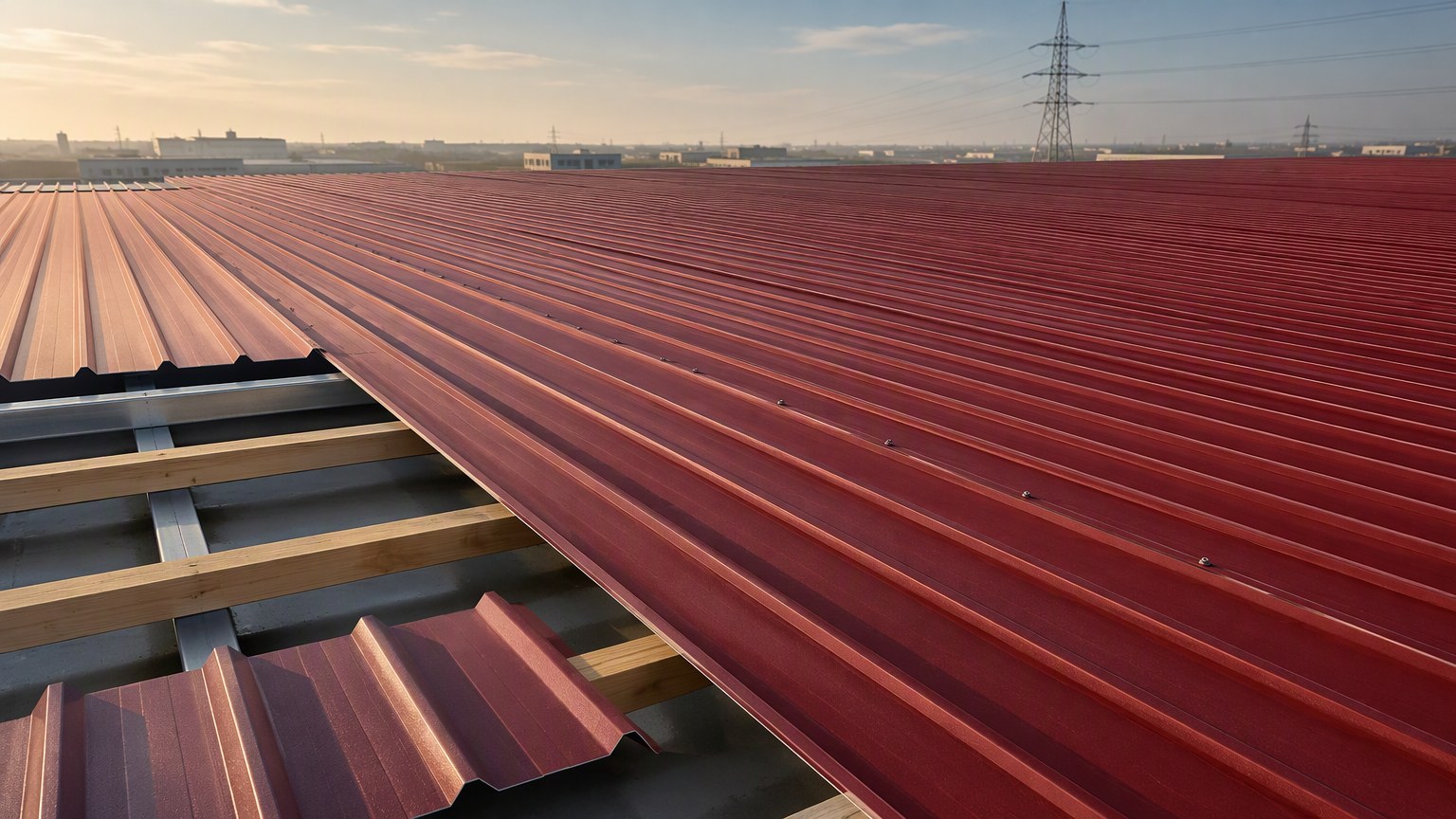
Install the sheets from the eaves upward, run the side and end laps away from the prevailing weather and down the slope, fix with self-drilling screws fitted with EPDM washers at the spacing the load table requires, and never over-tighten them.
Overlap direction and side laps
The most common installation mistake is running the side laps the wrong way. Water must never be given a path into the joint, so sheets overlap in the direction of the prevailing wind and the end laps always run downhill. A side lap that faces the weather will still look correct from the ground and will leak in the first driving rain, which is why inspection from the roof surface rather than from the scaffold is the only meaningful check. Where the roof slope is shallow, the end lap length has to increase, and on low-slope roofs a sealing tape or mastic in the lap becomes a requirement rather than an option. Slope, lap length and sealing method should be confirmed together before the first sheet goes up, because they are interdependent and none of them can be corrected cheaply once the roof is closed. It also helps to mark the lap line on the purlins before laying begins, so that the crew works to a visible reference instead of estimating an overlap that then varies from bay to bay, which is how a roof ends up with correct details in one area and an open lap two bays along.
Fixings and washer compression
Self-drilling screws with bonded EPDM washers are the standard fixing for a through-fixed PPGI roofing sheet. The washer is the seal and the screw is only the clamp. Over-tightening crushes the washer and leaves a ring of compressed rubber that will crack, while under-tightening leaves the washer standing proud and open to wind-driven water. The correct condition is a washer that is firmly seated and visibly compressed but not flattened, and the driver torque setting should be tested on a spare sheet before production fixing begins. Screws should be driven perpendicular to the sheet, into the crest of the rib on trapezoidal profiles, at the spacing given by the load table, commonly every second rib along the purlins, with edge and end zones fixed more densely because those are the areas of highest uplift. Cutting swarf must be removed as the work proceeds rather than at the end of the day, and a damaged washer should be replaced rather than reused, since the cost of one screw is trivial against the cost of a leak above a production area. Where a roof is fixed through an insulation layer, the screw length and the washer type both have to change, and the fastener must be long enough to engage the purlin fully without crushing the insulation beneath the sheet. Fixing a short trial panel and then inspecting it with a torqued driver is the cheapest way to set the standard that the whole roof will be built to.
Movement, walking and accessories
Coated steel expands and contracts with temperature, and a long roof run moves measurably between a winter night and a summer afternoon. Fixings and lap details that assume a rigid structure are the ones that fail at the ends of the run, so the layout must leave the eaves and ridge details free to accommodate that movement. During installation, weight should be kept over the purlins rather than between them, and sheets should not be walked across in soft-soled shoes at unsupported mid-span. The accessories then decide as much as the sheets: ridge cappings, barge boards, flashings and gutter details are where roofs leak most often, and they should be ordered in the same colour and coating system as the sheets so that weathering stays uniform across the whole roof. The general principles behind these details are shared across all metal roofing systems, and the known differences between PPGI and PPGL coatings are worth reviewing before deciding whether a zinc or an aluminium-zinc substrate is the better base for a coastal installation. Walking boards or a spreader should be used wherever access is unavoidable, and the crew should step over the rib rather than on the flat pan. Finally, the fixing and lap details at the very end of a long run deserve a second look, because that is where thermal movement accumulates and where the first leak will appear if expansion was never allowed for.
What Should You Check Before You Order a PPGI Roofing Sheet?
The quotation is where most of the cost is fixed and most of the risk is created. A short checklist prevents both unpleasant surprises.
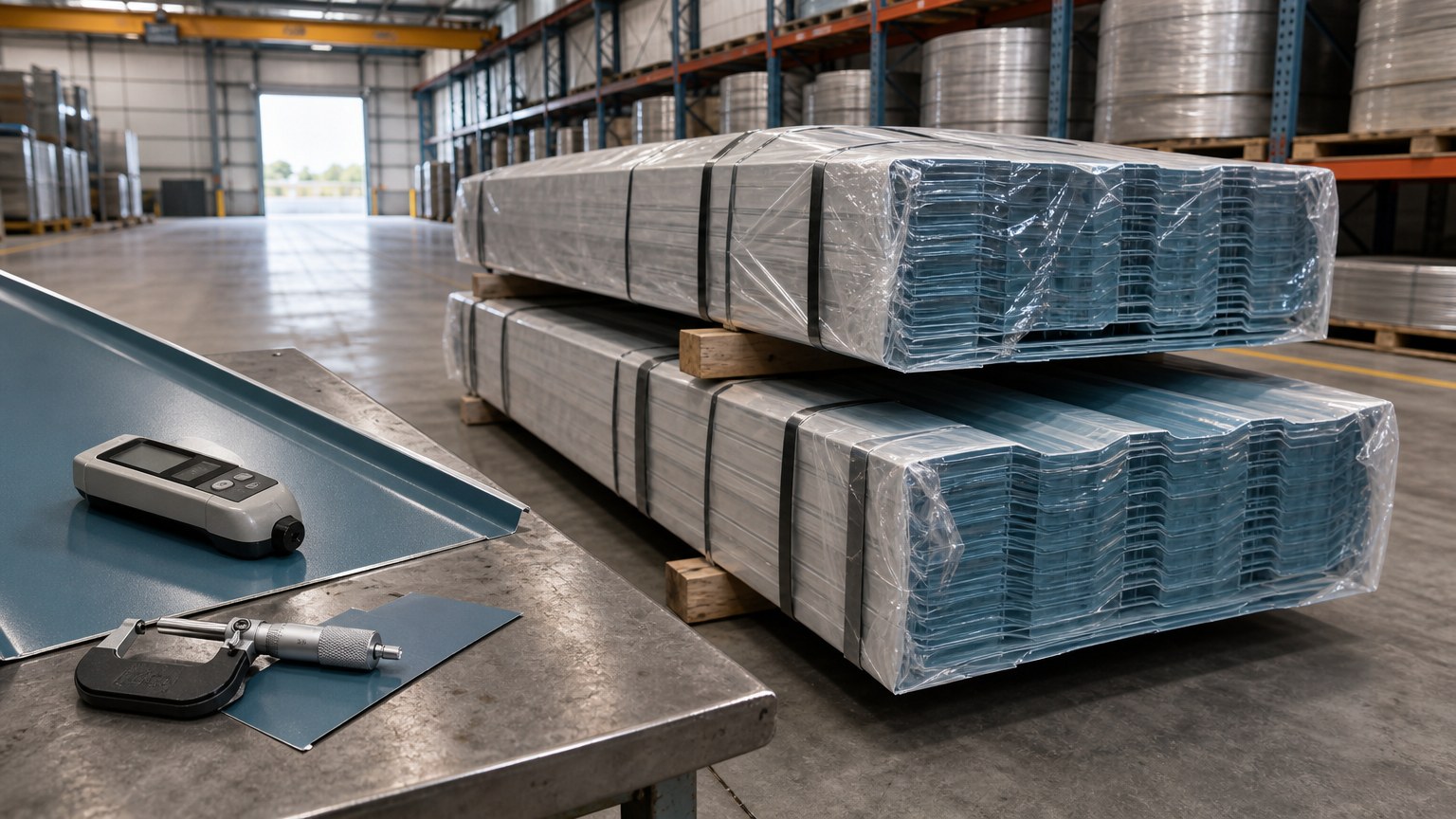
Confirm base metal thickness, zinc coating weight, coating system and film thickness, RAL colour, profile and effective width, sheet length, quantity and packing method, then require a mill test certificate and a coating specification sheet with the order.
Write the specification, not the product name
“PPGI roofing sheet” is a category, not a specification. An order that states only the category leaves the supplier free to choose the substrate, the zinc weight, the resin, the film thickness and the profile, and the delivered sheet will be commercially defensible, compliant with nothing in particular, and impossible to compare with a competitor’s quotation. A usable enquiry states base metal thickness with its tolerance, zinc coating weight per face, coating system and total dry film thickness, RAL colour code, profile type and effective width, sheet length and quantity, and the packing method. When all of those items are written down, quotations become comparable line by line and disputes become documentary rather than commercial. The same paragraph can be reused for every subsequent order, and it has a second benefit that is easy to overlook: a supplier who receives a complete specification will often quote more competitively, because the risk of a later specification argument has been priced out of the offer before it is sent. Two habits make the specification stick: keep the paragraph as a master template so that every future enquiry is worded identically, and attach it to the purchase order, so that the text the supplier quoted against is also the text that governs the shipment. A specification that lives only inside an email thread will be reinterpreted as soon as that thread is lost.
Certificates and inspection on arrival
Ask for a mill test certificate covering the steel chemistry and mechanical properties, and a coating specification sheet giving primer and topcoat weights. Standards such as ASTM A755/A755M define what a prepainted metallic-coated steel sheet for exterior building products must satisfy, so a supplier who can cite the standard and the test methods is easier to audit than one who answers with adjectives. On arrival, spot-check what can be checked quickly: base metal thickness with a calliper well away from the cut edges, coating thickness with a magnetic gauge, colour against a RAL reference under daylight, and the surface for transit scratches and white rust. Water staining from transit is a handling issue rather than a coating failure, but it becomes a corrosion site if the bundles are then stored unwrapped in a damp yard. Keeping the certificate, the packing list and the bundle markings together in one file makes the reconciliation repeatable, and it turns a routine receipt into usable evidence if a claim is ever raised. For high-value or safety-related projects the inspection level is worth agreeing in advance, because a certificate issued by the mill for its own product and a certificate countersigned by an independent inspector offer very different levels of assurance, and that choice can only be made cheaply before the material is produced rather than after it has been shipped.
Storage, forming and cutting on site
Colour coated steel is far more sensitive to site handling than bare galvanized sheet, because the visible surface is a paint film. Bundles should be stored under cover, off the ground, on timber dunnage with ventilation between the packs, and never with the protective film left on in direct sun for weeks. Cutting should avoid heat where possible: an abrasive disc scorches and discolours the coating at the cut edge, whereas a shear, a nibbler or a profile cutter leaves a clean edge that needs only touching up with matching repair paint. Swarf must be brushed off immediately, because steel filings left on a wet painted roof rust within days and stain permanently. If you are sourcing a prepainted steel coil or formed roofing sheets for a project, send the profile, thickness, coating and quantity, and the quotation can be built around a specification you can verify on arrival rather than one you have to accept on trust. Offcuts and pierced sheets should be touched up as they are created rather than left for a later visit, because a cut edge that has already flashed rust cannot be restored simply by painting over it. A short toolbox briefing on handling, cutting and swarf removal before the first bundle is opened protects far more value than any repair programme afterwards, and it costs the contractor nothing but a few minutes of the crew’s time on the first morning.
Conclusion
Profile sets span and drainage, coating sets service life, thickness sets strength and fixing detail sets watertightness. Specify all four in writing.
Request a quotation: send your roof slope, span, purlin spacing, profile and RAL colour requirement through our contact page and we will confirm the base metal thickness and coating build-up that can be certified for your project.