
Rebar Couplers vs Lap Splices: Which Connection Saves More Steel?
On a large project the choice between mechanical couplers and lap splices is not a detailing detail — it decides how many tonnes of bar you buy and how the cage gets built.
Short answer: rebar couplers join bars end to end with a mechanical device and normally consume far less steel than a lap of 40–50 bar diameters, but they add component cost, need prepared bar ends and demand tighter workmanship. Laps are cheaper per joint and tolerate rougher site conditions.
Both methods are accepted by the major design codes, so the decision is rarely about whether a connection is “allowed” and almost always about quantity, labour, congestion and inspection. This guide compares them on the four measures that actually change a project — steel consumption, behaviour under load, installation effort and total cost — and ends with a decision routine you can apply to a live bar list.
What Is a Rebar Coupler and How Does It Connect Two Bars?
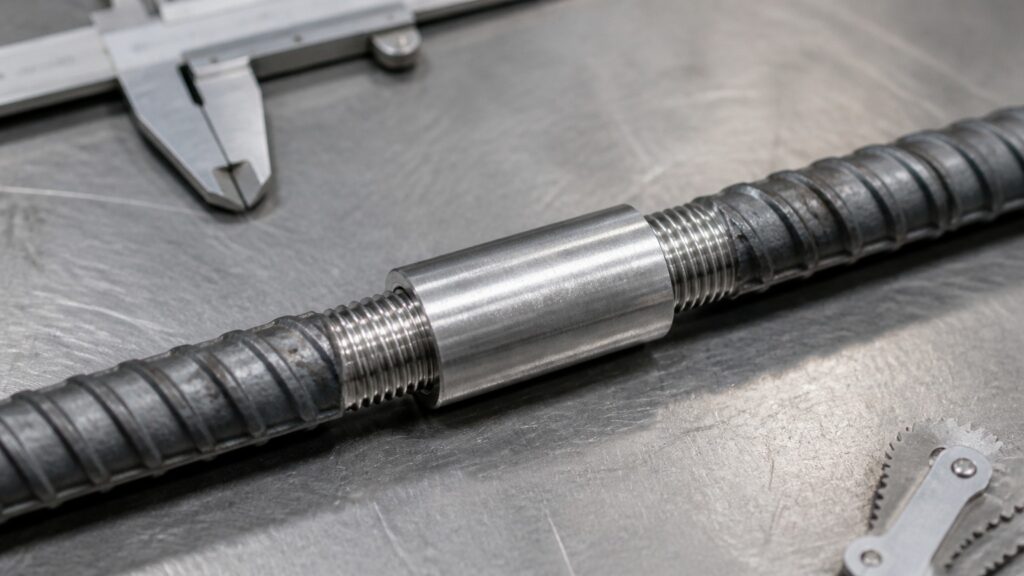
A coupler is a purpose-made device that transfers force from one bar to the next through a mechanical connection rather than through a length of overlap.
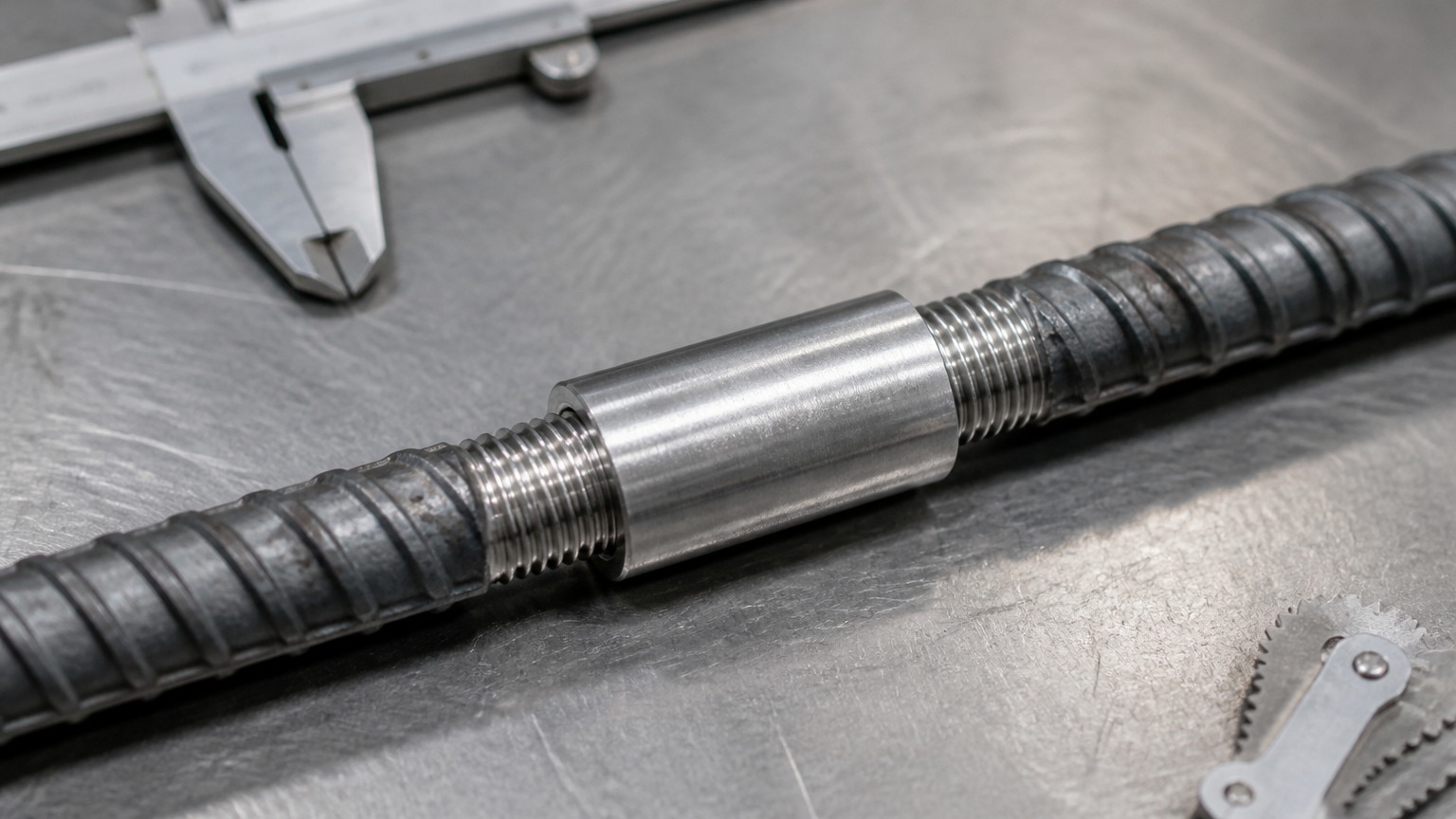
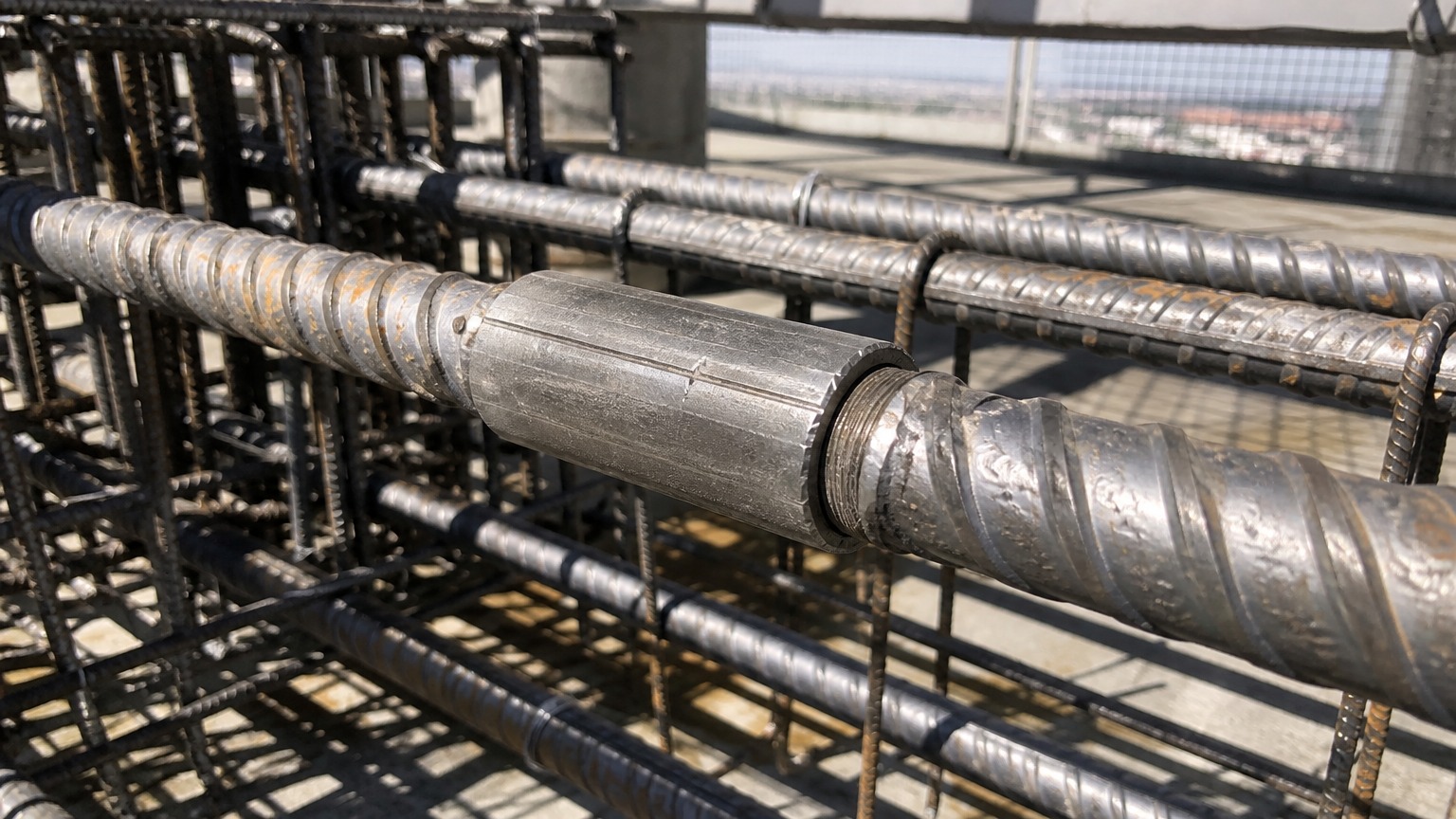
A rebar coupler joins two bars end to end using threads, a sleeve or a swaged fitting, so the connection occupies the length of the device instead of a lap, and the force path runs through the coupler body and the prepared bar ends.
The common coupler families
Three families dominate international supply. Taper-threaded couplers cut a tapered thread on each bar end and screw the bars into a matching sleeve, producing a connection that bears on the threads and seats metal to metal. Parallel-threaded couplers use a straight thread, often rolled rather than cut, and are frequently supplied as a sleeve plus lock nuts or as a sleeve that is itself threaded internally on both ends. Sleeve or swaged couplers do not cut the bar at all: a metal sleeve is slipped over the butted ends and pressed onto the ribs, so the connection relies on deformation rather than on machined threads. Each family implies a different shop process — thread cutting or rolling, or a pressing machine — and therefore a different equipment list at the fabricator or on site.
What the bar end must be prepared to accept
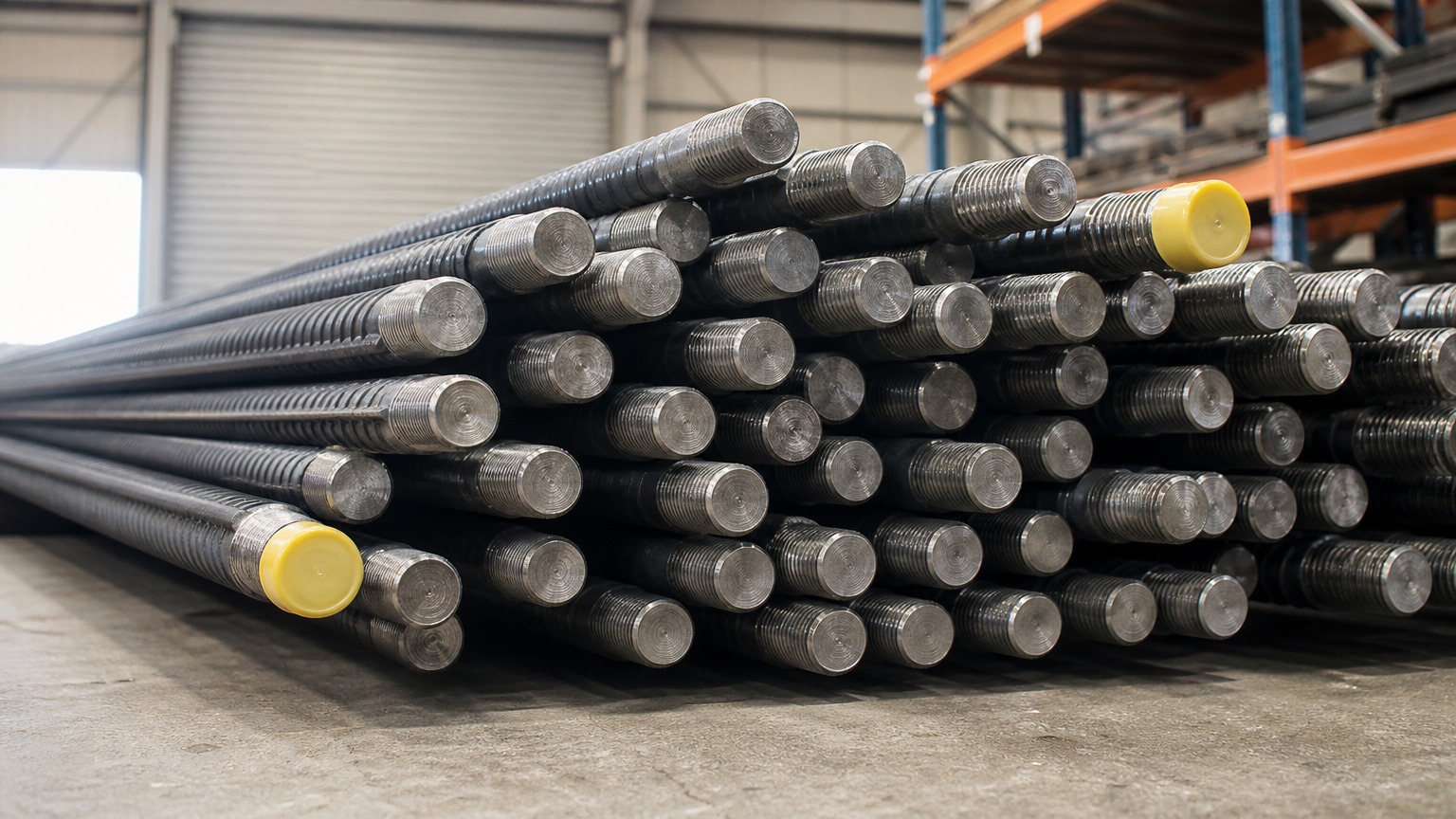
This is where couplers change the way steel is ordered. The bar is no longer cut to any convenient length: the end must be sawn square, because a burred or angled end cannot produce a concentric thread or a fully seated swage. Bars intended for threaded couplers are often supplied with the thread already rolled at the mill or fabricator, which means the thread quality becomes part of the delivery record, and the ends must be protected in transit and storage. A bundle that arrives with bent, flattened or rusted bar ends is unusable for couplers even though the steel inside is perfectly good — a risk that simply does not exist for a lap splice. Standards such as ISO 6935-2 set the rib geometry and mechanical requirements for the bar that both connection methods ultimately rely on.
How Does a Lap Splice Compare in Steel Consumption?
The comparison is arithmetic, and the arithmetic usually favours couplers by a wide margin on any member where bars are spliced in quantity.
A lap consumes an extra length of bar equal to the overlap at every splice point, whereas a coupler consumes the length of the device. On typical detailing, that difference alone can remove several percent of the reinforcement tonnage.
Working the numbers on one splice
Take a 20 mm bar lapped at 40 bar diameters: the overlap alone is 800 mm of bar that exists only to transfer force, and both bars are paid for across that length. Substitute a coupler of roughly 100–150 mm and the saved bar length is in the order of 650–700 mm per joint — approaching 2 kg of steel per splice at nominal bar weight. Multiply by the number of splices in a column stack or a long wall and the saving becomes tonnes rather than kilograms. It also changes the cutting schedule: bars are ordered slightly shorter, which reduces both material cost and the weight that has to be lifted and craned.
| Measure | Lap splice | Mechanical coupler |
|---|---|---|
| Bar length consumed at each joint | Full overlap, commonly 40–50 db in tension | Device length only, typically a fraction of the overlap |
| Extra components | None beyond tying wire | Coupler body, threads or swage, plus machine tooling |
| Cage congestion | Doubles the bar count locally | Single bar line through the joint |
| Site skill dependency | Low — tying and measuring | High — square cuts, clean threads, torque control |
Where the saving is real and where it is not
The saving is greatest where splices are frequent and bars are heavy: column stacks in tall buildings, long retaining walls, diaphragm walls and precast connections, where the same joint repeats hundreds of times. It is least convincing in light, short-member work — a slab or a small footing may contain very few splices at all, in which case the coupler premium is paid for almost no benefit. It also disappears if the design has to be changed to accommodate the coupler: adding a starter bar, thickening a cover zone or increasing a cage length to fit a prepared end can consume more steel than the lap ever cost.
Which Method Performs Better Under Cyclic and Seismic Loading?
In a cyclically loaded member the connection is a controlled discontinuity, so how it behaves under reversal matters more than its static strength.
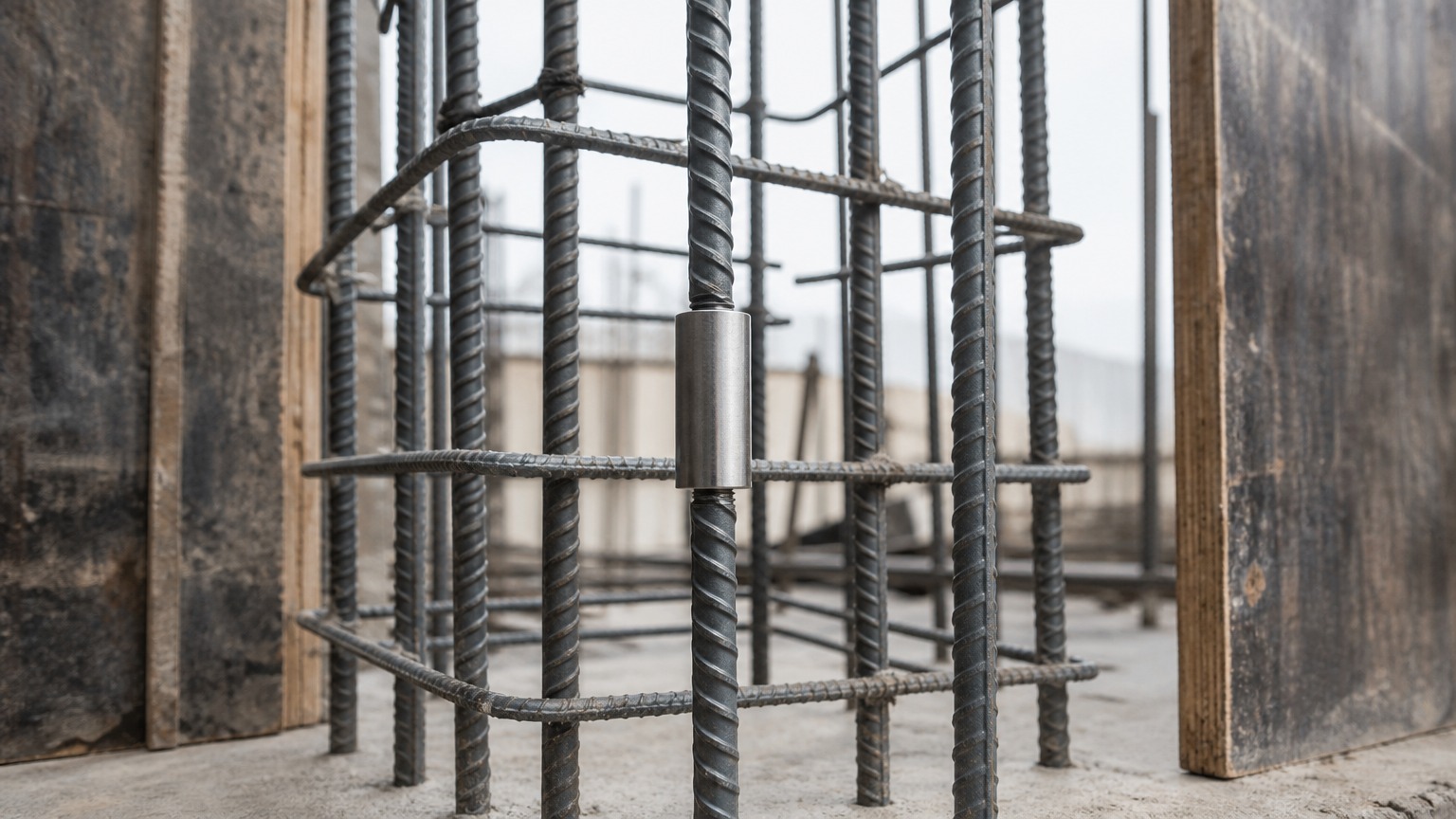
Mechanical couplers can be qualified to develop the full specified strength of the bar and are widely used where continuity, congestion or fatigue demands it; a competent lap does the same job through bond, but its performance depends on the concrete around it remaining intact.
Strength classes and what they promise
Codes define splice performance classes by what the connection must achieve rather than by the product used. Type 1 tension splices in ACI 318 are commonly required to develop at least 125 percent of the specified yield strength of the bar, whereas the higher class demands the full specified tensile strength of the bar — the requirement quoted in ASTM A615/A615M for mechanical and welded splices in Grade 100 material, where the stated minimum is 115,000 psi [790 MPa]. That distinction matters commercially as well as technically: a coupler qualified for the higher class is tested and certified differently from one qualified only for the lower class, and the two are not interchangeable in a specification just because both are described as “mechanical splices”.
Why laps and couplers fail differently
A coupler is a discrete steel component. When it is correctly made up, its failure mode is a bar break or a thread failure, and both are functions of the device and the prepared end. A lap is not a component at all: it relies on the concrete embedding both bars, so its performance depends on member geometry, cover, confinement and cracking. Under cyclic loading that difference becomes visible. Laps in a crack zone lose bond effectiveness as cracks open and close, while a properly installed coupler keeps its capacity regardless of local cracking — one reason couplers appear in seismic detailing and in congested joints where laps cannot physically be staggered. Both connections ultimately depend on the bond that makes reinforced concrete behave as a composite material.
The trade-off nobody should ignore
Couplers concentrate the connection demand into a small volume of steel, so a defective thread or an under-torqued sleeve is a local weakness with no redundancy. A lap distributes its demand over a long bond length, so minor workmanship errors are absorbed more gracefully. Where inspection is weak, that robustness has real value; where inspection is strong and the specification is well written, the coupler’s predictability usually wins.
What Installation, Inspection and Skill Does Each Method Require?
The two methods move the work to different places — a lap is tied on site, while a coupler is prepared before the bar ever reaches the cage.
A lap needs measured overlaps, staggered positions, tight tying and stirrups continued through the lap; a coupler needs square-sawn ends, clean threads or a clean swage, correct torque and a record of who made it up.
Installation routine compared
For a lap, the sequence is familiar: cut to length, position, measure the overlap, tie at both ends and at intervals along the lap, ensure transverse bars confine the splice, and stagger adjacent splices. The work is unskilled but repetitive, and it scales with the number of splices rather than with their sophistication. For a coupler, the critical work happens earlier. Bar ends must be cut with an abrasive saw rather than a shear or torch to avoid a deformed end face; threads must be protected during transport and storage; the sleeve must be assembled to the specified engagement; and the assembly must be tightened with a torque wrench or a calibrated machine to the supplier’s stated value. Anything skipped in that list produces a connection that looks correct in a photograph and is not.
Inspection and records
Lap inspection is dimensional: the inspector measures overlap, checks the stagger, counts the ties that confine the lap and verifies that the bars match the marks. Coupler inspection is both dimensional and process-based: end squareness, thread condition, engagement depth and torque all need checking, and torque is normally witnessed and recorded rather than measured after the fact. That creates a documentation burden — but also an opportunity, because a witnessed torque record is far stronger evidence of a compliant connection than a photograph of a tied cage. Both methods, however, depend on the same underlying record: knowing which heat of steel went into which bar mark, which is why material certification belongs in the joint’s paperwork. The mechanical behaviour of the bar itself — rib pattern, deformation geometry and grade marking — is described in the reference material on rebar.
When Do Couplers Cost More Than the Steel They Save?
Steel saving is only one line in the comparison; components, preparation and inspection can outweigh it quickly.
Couplers add unit cost, fabrication cost, tooling and inspection cost. Where splices are few, bars are light, or threads must be cut on site, the saved tonnage can be worth less than the added process.
The cost lines that decide it
First the component: a coupler carries a unit price per joint and is not part of the mill price of the bar. Second the preparation: sawing ends square, cutting or rolling threads, and protecting them adds labour hours that laps do not need. Third the tooling: threading machines, presses or torque equipment must be bought, hired or mobilised. Fourth the risk: a rejected coupler joint is often rejected at the end of a long chain of work, so the rework cost is higher than for a lap that can be re-tied in minutes. Fifth the schedule: when couplers are supplied with the bar, they also arrive with the bar’s lead time, which is not always the same as the mill’s steel lead time.
Where laps quietly cost more
The reverse case is easy to overlook. A lap that doubles bar count at a congested joint can force a wider member, a bigger cover, or a change in bar arrangement — and member size is one of the most expensive variables in a concrete structure. Long laps in a thin wall can also make it impossible to satisfy cover while placing the steel, forcing a redesign at the most inconvenient moment. In those situations the coupler is cheaper even if its component price never appears on a cost sheet, because what it buys is concrete volume and buildability rather than steel.
How Do You Decide Between Couplers and Laps on Your Project?
The decision is repeatable if you score the joints rather than the project as a whole.
Count the repeated splices, check the splice class the design code demands, price the preparation chain and the inspection time, then use couplers where the recurring joints are heavy and congested, and laps everywhere else.
A short decision routine
Start by counting splice points in each member type and how often the same joint repeats — that number drives every other consideration. Next, establish the performance class the design code requires and confirm the coupler you are pricing is qualified to it. Then price the whole chain for the couplers you need: device, preparation, tooling, inspection and the length of bar you no longer buy. Finally, test the answer against buildability: where a lap makes the cage impossible to place or forces a member to grow, couplers win on grounds that have nothing to do with tonnes. The outcome on most projects is a hybrid — couplers at the repetitive vertical joints in columns and walls, laps in slabs and foundations where splices are few and space is generous.
Getting the bar side right either way
Whichever connection you choose, the steel underneath it has to suit the process. Bars destined for threaded couplers are normally ordered slightly longer to allow for the thread, and they must be cut square, which is one reason to keep the cutting method under control from the first delivery — a subject we cover in our notes on bar bending and cutting tolerances. Grade selection also matters, because deformed steel bar rebar for a column stack is usually specified with a ductility class that supports seismic detailing. If you need a bar list prepared for either connection type, send it to our team through the contact page and we will confirm grade, diameter and length availability — our supply range on the deformed bar (rebar) product line includes the common export sizes such as HRB400E 14 mm rebar in 12 m lengths.
Conclusion: couplers save the most steel where heavy bars are spliced repeatedly; laps win on cost everywhere else, so score the joints before choosing.