
How Do You Protect Rebar from Corrosion on Site?
Rust on reinforcement gets treated as normal on most sites — right up to the day an engineer rejects a delivery, or a coastal structure spalls a decade early.
Short answer: keep bars off the ground and under cover, use them first-in-first-out, accept only light surface rust, and rely on the real defences — adequate concrete cover, dense low-permeability concrete and, in aggressive exposure, galvanized, epoxy-coated or inhibitor-treated reinforcement.
Corrosion protection is not one action but a chain: how the steel is made, how it is stored, how much rust is tolerated before the pour, what the concrete provides, and how the finished structure is detailed. Break any link and the others have to work harder. This guide walks that chain in order, so the specification you write matches the exposure the structure will actually face.
Why Does Rebar Corrode, and When Does It Matter?
Steel corrodes because it wants to return to the oxide it came from; in reinforced concrete the question is only how long the concrete can hold that reaction back.
Rebar corrodes electrochemically when water and oxygen reach the steel surface and the passive oxide layer breaks down, which happens through carbonation of the concrete or through chloride ingress — and the resulting rust occupies several times the volume of the steel it consumed.
The mechanism in plain terms
Fresh concrete is strongly alkaline, and in that environment steel forms a thin, stable passive film that prevents further reaction. Two processes destroy that protection. Carbonation occurs when carbon dioxide from the air diffuses into the concrete and neutralises the alkalis that maintain the passive film; the front moves inward slowly, and once it reaches the reinforcement the steel is no longer protected. Chloride ingress works differently and faster: chloride ions — from seawater, marine spray, de-icing salts or contaminated aggregates — break down the passive film locally and set up pitting corrosion. Once pitting starts, the pit deepens while the surrounding steel stays passive, so section loss is concentrated at a few points rather than spread evenly. The electrochemistry behind both mechanisms is set out in the reference article on corrosion.
Why corrosion matters structurally
Rust expands as it forms — the oxide volume is several times that of the iron consumed — so the pressure it exerts cracks the concrete from the inside out. That sequence explains the visible symptoms: first hairline cracks along the line of the bars, then rust staining on the surface, then spalling that exposes the bar and accelerates everything. Structurally, the consequence is a double loss: the bar section carrying tension shrinks while the concrete that was supposed to bond to it breaks away. For a project in a mild inland environment that may take decades; for a structure in a chloride-rich environment — coastal, marine, desalination, chemical or salt-exposed — it can begin within a few years, which is why exposure class rather than habit should drive the specification.
How Do You Store Rebar to Prevent Rust?
Most rust found on site was created in the storage yard, not in service, and almost all of it is preventable with arrangements that cost very little.
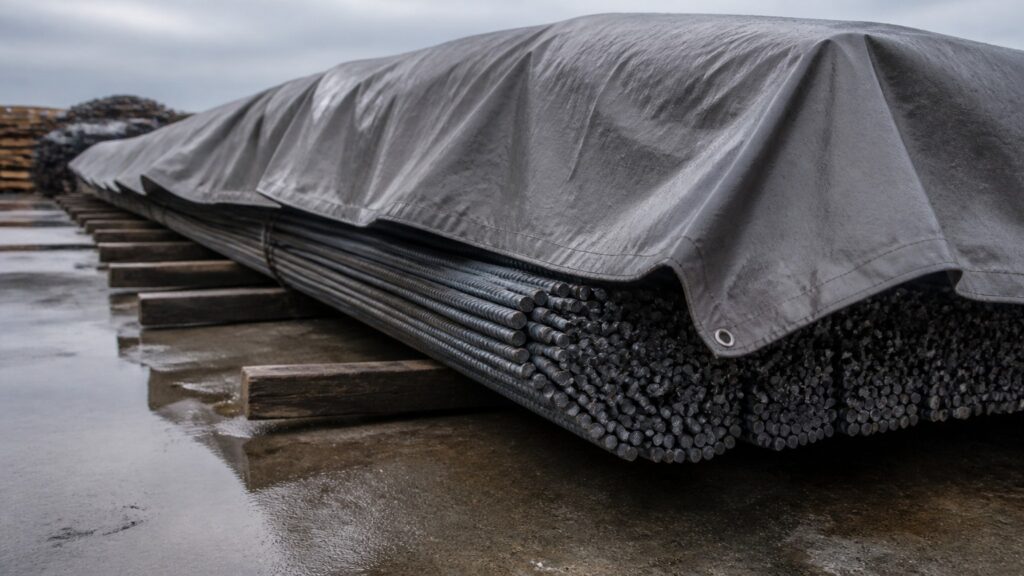
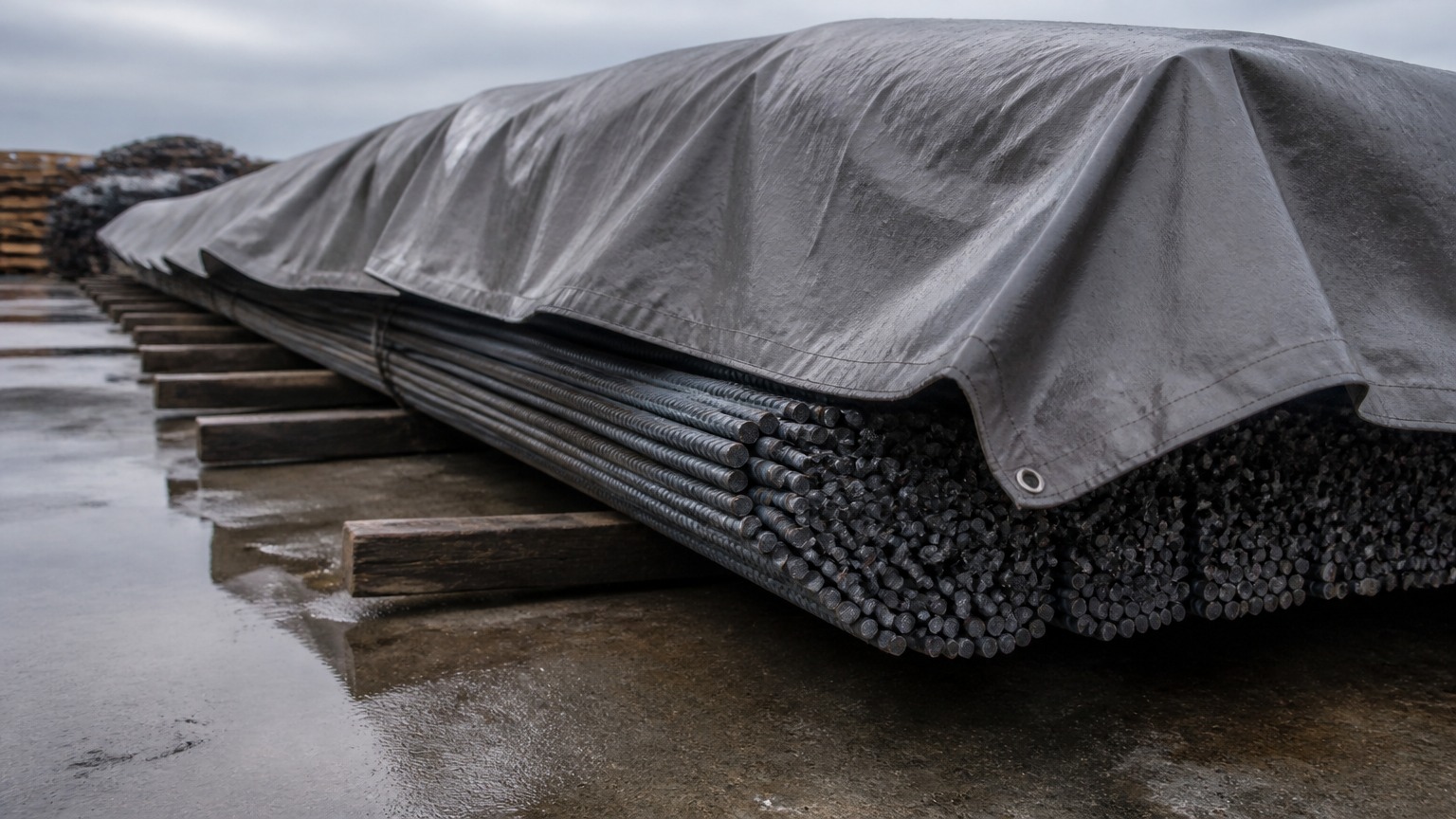
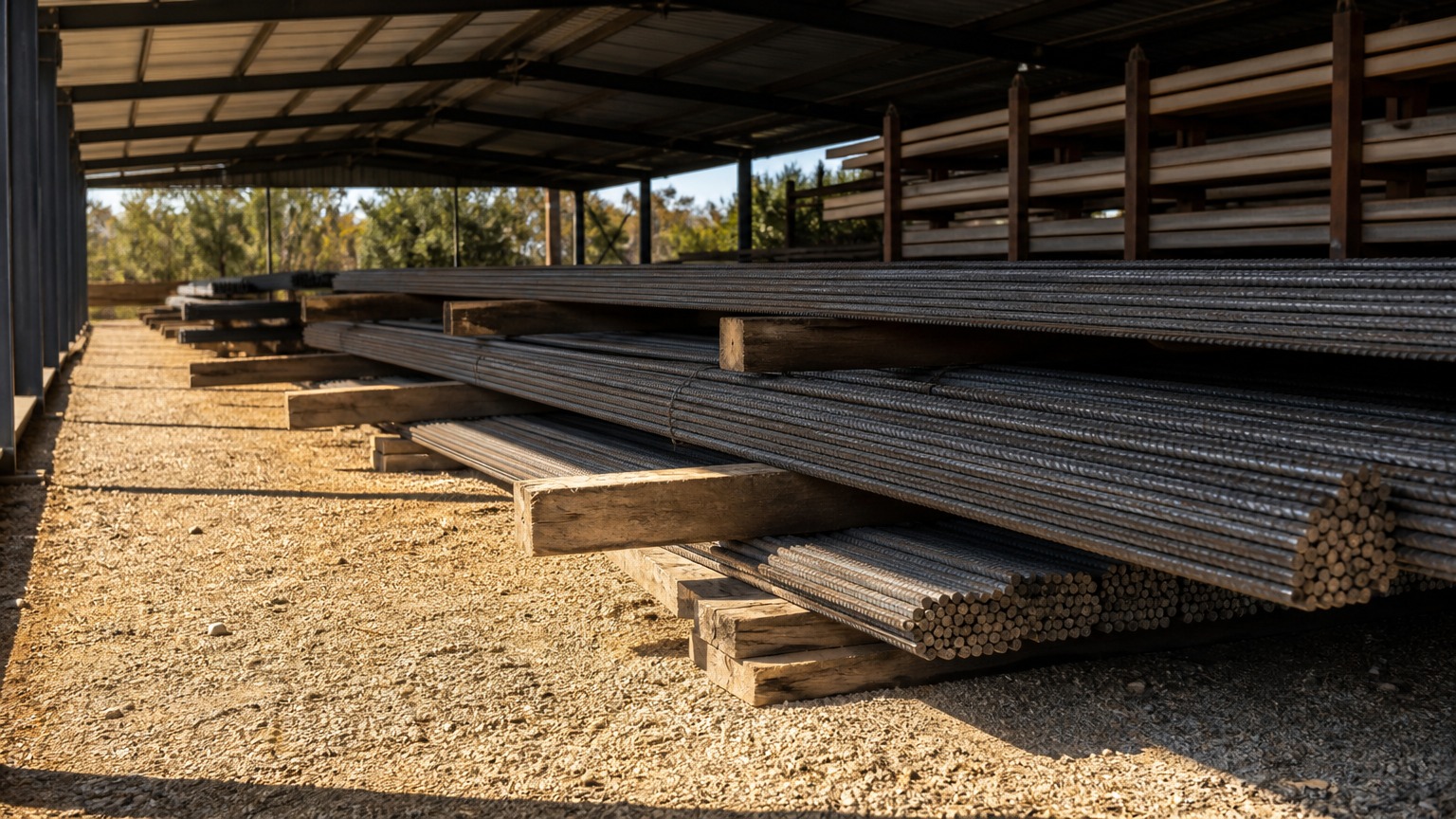
Store rebar clear of the ground on timber or steel dunnage, under cover or under sheeting, with ventilation rather than sealed wrapping, and rotate stock so the oldest bars are used first.
Ground clearance and cover
Bars sitting directly on wet ground or standing in a puddle are effectively in an immersion test. Dunnage that lifts the bundle 150–300 mm above the surface, with a waterproof sheet over the top and air able to move underneath and around the sides, keeps the steel dry through rain cycles. Fully wrapping a damp bundle is worse than leaving it ventilated, because trapped moisture condenses on the steel overnight and stays there. Bundles should also be kept away from salt-laden sources — coastal wind, salt spread on access roads, and stockpiles of chlorides or fertilisers stored nearby.
Rotation, handling and segregation
Two habits protect a store more than any covering. The first is first-in-first-out: bars delivered in March should leave the yard before bars delivered in June, which prevents old bundles from sitting in the damp through the whole construction cycle. The second is keeping coated or specially protected bars segregated from ordinary stock, because protected surfaces are easily damaged by dragging a bundle across the one beneath it or by handling them with chains. Lifting with fabric slings rather than chains, storing by mark, and noting delivery dates on the bundle tag are simple measures with a measurable effect on the amount of remedial cleaning the site has to do.
What Is the Difference Between Surface Rust and Section Loss?
Not all rust is a defect, and a specification that treats it as one wastes money — while the opposite habit lets real damage through.
Light flash rust is a thin surface layer that is harmless to bond if it is not flaking, whereas pitting, laminar flaking and measured section reduction are defect conditions that must be removed or the bars rejected.
Judging what you are looking at
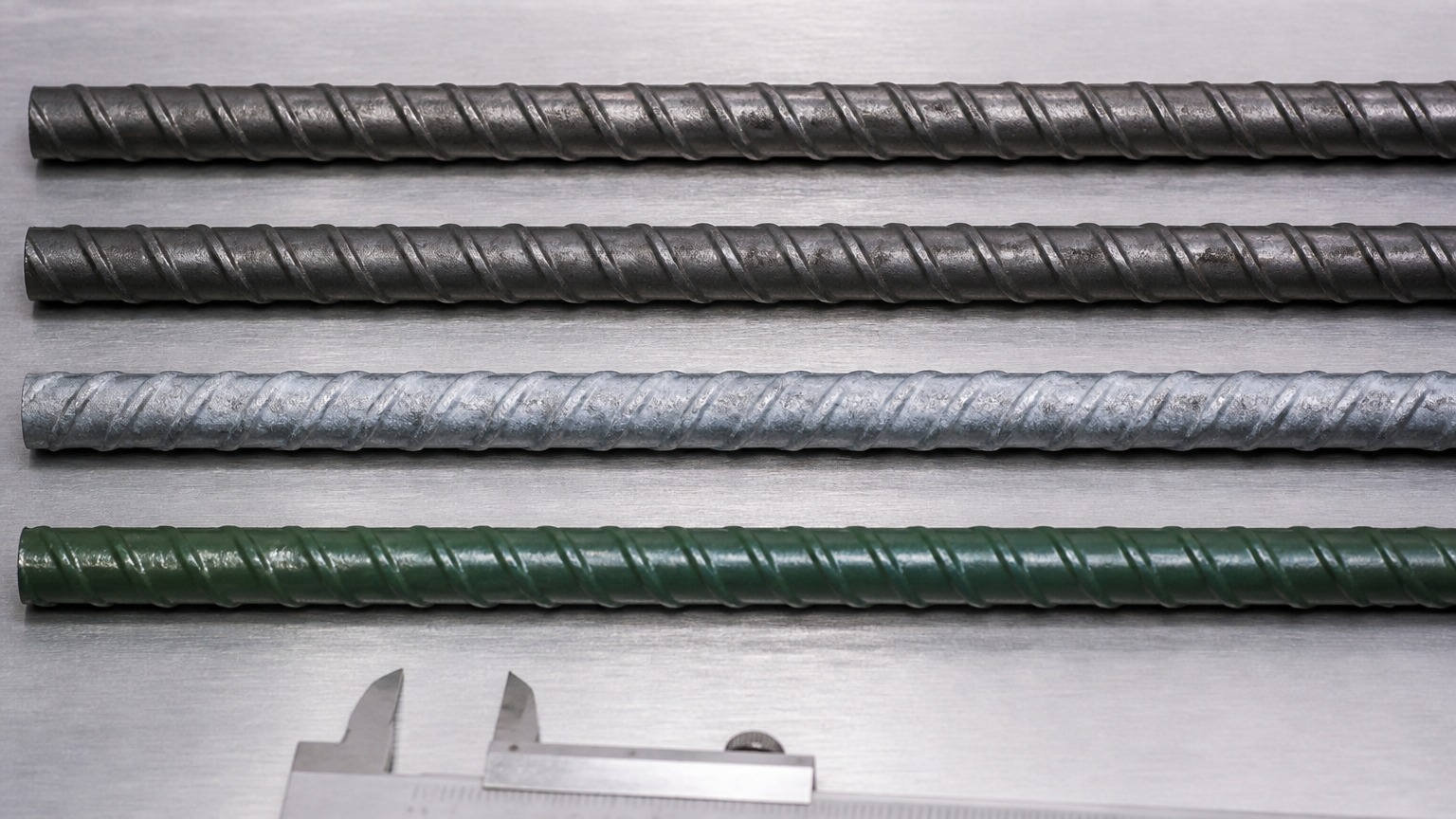
Surface discolouration is normal on steel that has been exposed to weather. What matters is depth and adherence. A thin, tightly adhering oxide film leaves the ribs crisp and the bar diameter unchanged; a flaking layer peels away as you rub it and reveals wet steel underneath, and the bar carries visible pits once the layer is removed. Section loss should be assessed against the nominal diameter rather than judged by eye: measure across a set of bars with a caliper and compare with the tolerances of the standard the bars were supplied to. The same bars that look “badly rusted” in a photograph are often within tolerance, and the same smooth-looking bars sometimes show deep pits at the rib roots where water collects.
What to do about each outcome
Light, non-flaking surface rust can be left in place on plain carbon bar, because mechanical bond comes from the ribs and not from a bright surface. Flaking or heavily pitted bars should be cleaned by wire brushing or blast cleaning where the project allows, or rejected where they cannot be brought back to the specified tolerance. Heavily rusted bars must never be straightened or bent further after cleaning, because the corrosion has already consumed ductility. Sorting out this question before the cage is tied is far cheaper than discovering it at the inspection — and because it is a dimensional question, the check only needs a tape and a caliper alongside the nominal sizes published in our reference sheet of bar diameters.
Which Protection Options Actually Work?
Protection is layered, and the cheapest layer — good concrete — does most of the work in the majority of structures.
Adequate cover and dense concrete provide the first defence; galvanizing, epoxy coating, corrosion inhibitors and stainless or low-carbon chromium bars add further protection in aggressive exposure, at rising cost and with their own handling rules.
Cover and concrete quality first
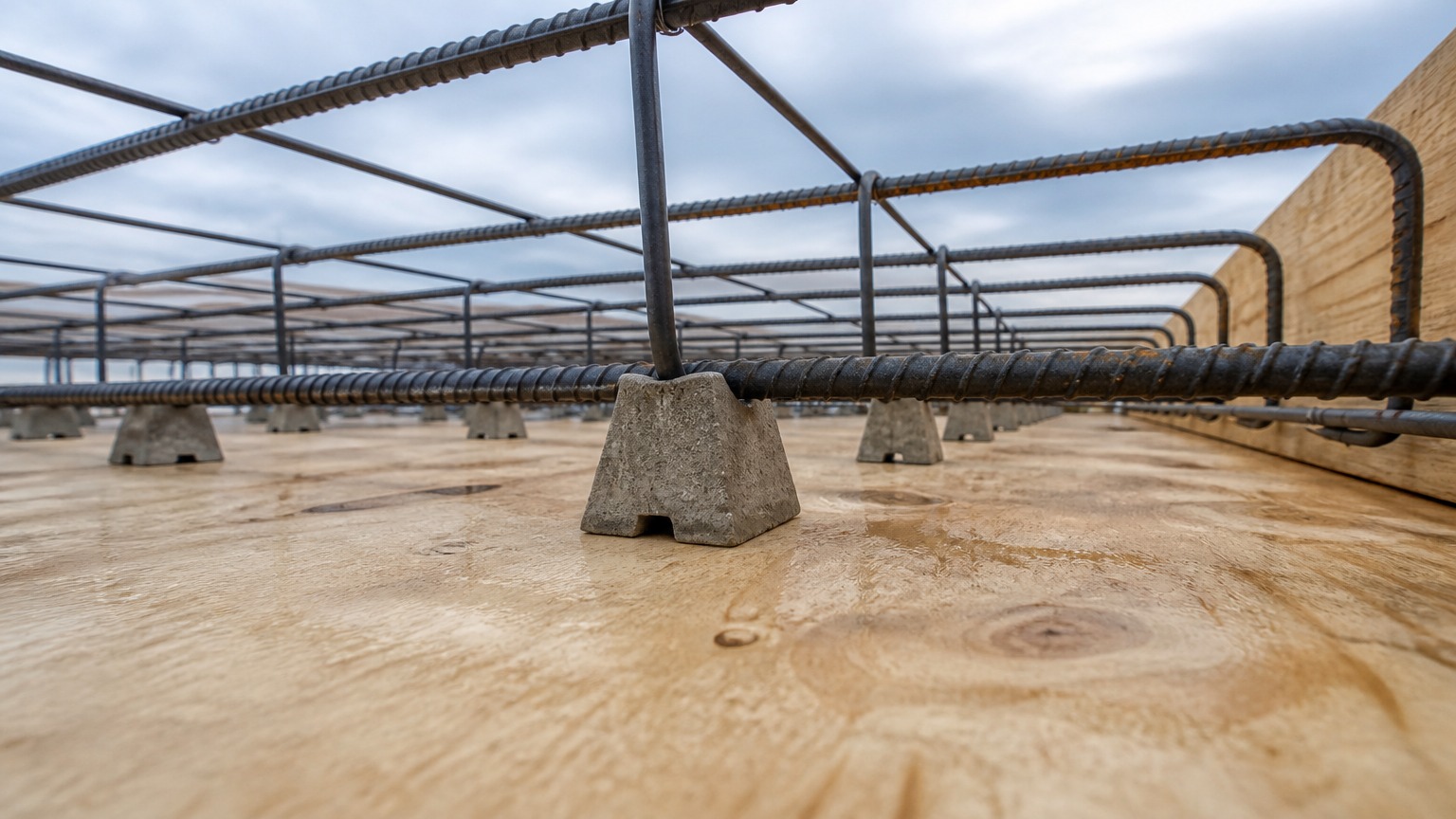
No coating outperforms a correctly detailed, well-consolidated, low-permeability concrete with adequate cover, and no project should reach for a premium steel before it has secured that. Cover is the distance that carbon dioxide, water and chloride have to travel before they reach the steel, and it is the single most controllable variable on site: spacers that do not crush, chairs that do not sink, and formwork that is not forced inward during vibration. Concrete quality is the second half of the same defence — a low water-to-cement ratio, adequate cementitious content and full curing produce a dense microstructure that slows both carbonation and chloride movement. Inspection effort spent on cover and curing is usually cheaper than any coating decision, so it belongs at the top of the protection plan rather than in a footnote.
Metallic and organic coatings
Galvanizing applies a zinc coating that protects the bar both by providing a barrier and by sacrificial action if the coating is damaged, and it suits chloride-laden exposures. It is not a licence to handle bars roughly: coated bars must be stored and cut carefully, and cut ends expose bare steel. Epoxy coating provides a barrier against chloride and is widely used in bridge decks and marine structures; its weakness is mechanical damage during handling and site work, because a coating break concentrates corrosion activity at the break, and it attracts its own lap length requirements. Chemical corrosion inhibitors added to the concrete mix work by modifying the chemistry at the steel surface and are normally specified with a particular exposure and product in mind, so they should be selected with the concrete designer rather than added on site.
When to change the material
Where exposure is severe and the design life is long, the most reliable option is a bar that is inherently more resistant, such as a stainless or low-carbon chromium reinforcing steel, or a plain carbon bar with a supplemented chromium content in a corrosion-resistant grade. Those bars cost a multiple of ordinary carbon steel, so they are normally confined to the members with the highest consequence of corrosion — splash zones, parapet and edge elements, marine piles — rather than applied across an entire structure.
How Do You Inspect Reinforcement Before Pouring?
Reinforcement inspection covers far more than corrosion, but the corrosion-related checks are quick and they are the ones most often skipped.
Before the pour, verify cover against the drawings, check that spacers are intact, confirm that bars are free of flaking rust, oil or mud, and record the condition of the cage in photographs with a scale visible.
The corrosion-specific checks
Walk the cage and look for the conditions that start corrosion early: bars touching formwork or resting on the ground; spacers crushed or missing under heavy bars; bars coated in mud or oil that will create a bond-free zone; water standing in the formwork; and bundles of old bar left exposed in a corner and then tied in. Each of these is a corrosion risk that no coating or concrete mix can compensate for, because it removes the protective layer locally at the exact point where the structure needs it. The remedy is procedural rather than metallurgical: cover trials before the main pour, enforced spacer spacing, and a clean-before-tying rule.
Recording the evidence
Photographs with a scale, the bar mark visible and the date are the cheapest insurance in reinforcement work, and they connect directly to the material record. The certificates supplied with the steel state the heat analysis and mechanical properties, including the grade and standard the bars were rolled to, while the photographic record shows that the bars arrived at the right place in the right condition. Store those images by pour reference rather than by date, and keep one set with the material certificates, so that a question raised months later can be answered from a single folder instead of a site visit.
What Should You Specify for Humid or Coastal Projects?
In aggressive exposure the specification decisions have to be made before the order, because most of them cannot be retrofitted on site.
For humid or coastal work, specify adequate cover for the exposure class, select the concrete mix for chloride resistance, choose between galvanized, coated or inherently resistant bars, and set handling and storage rules as part of the supply contract.
Design decisions that cannot be fixed later
Cover, concrete mix design and bar type are all fixed before the first delivery. That is why exposure class should be stated explicitly in the inquiry rather than left to be inferred from the project location: the difference between an inland warehouse and a marine splash zone changes the cover requirement, the concrete specification and the bar selection — and a mill supplying on a generic carbon steel specification has no way to know which one it is feeding. If a project cannot confirm its exposure class, the safe assumption for coastal work is the more severe one, since the cost of extra cover is small compared with the cost of early repair.
Making the supply chain part of the protection
Three clauses in a purchase order do most of the work. Bundle tagging that identifies grade, heat number and delivery date supports rotation and traceability. Packing that protects bar ends and coated surfaces prevents damage that becomes a corrosion site on site. And a documented, consistent standard for the steel itself — a defined grade and standard such as ASTM A615/A615M or ISO 6935-2, and where relevant its comparison with the alternatives covered in our notes on construction steel bar standards — keeps the material part of the specification fixed while the site works on the other parts. If you are ordering reinforcement for a humid or coastal project, describe the exposure to our team through the contact page and we will confirm what our carbon steel bar range can support: the rebar product range includes grades such as HRB500E 22 mm rebar supplied in 12 m lengths.
Conclusion: corrosion protection is a chain — dry storage, honest rust assessment, adequate cover and dense concrete first, with coated or resistant bars reserved for aggressive exposure.