
How Hard Is Stainless Steel Plate?
Buyers assume “stainless” means “hard”, then find a 2 mm plate scratches like brass — and a supplier’s datasheet that quotes no hardness value at all.
Short answer: most stainless steel plate supplied for general use is soft by design. Annealed 304 and 316 plate typically sits near 70–90 HRB (roughly 150–200 HV), fully austenitic and non-hardenable by heat treatment. Hardness rises only with the martensitic, duplex or precipitation-hardening grades, or with cold work.
The confusion is understandable, because “hardness” and “strength” are used interchangeably in conversation and mean different things on a mill test certificate. The sections below separate the two, give the values you can expect from the common grades, and show how to specify the property you actually need — whether that is scratch resistance on a food line or a non-magnetic 316L sheet that has to be formed, not cracked.
What Does Hardness Actually Mean for Stainless Steel Plate?
Hardness is not one property but a family of them, and each one measures a different kind of resistance.
Hardness describes a metal’s resistance to localised plastic deformation — a scratch, an indentation or a point load. It is measured by pressing a defined indenter into the surface under a known force and reading the size of the mark left behind.
Why hardness is a surface property, not a bulk one
The first thing to unlearn is the idea that hardness is a single number that belongs to “stainless steel”. Hardness is measured at a point, on a surface, with a specific test. A plate can be soft in the annealed core and measurably harder at a sheared edge, because the shear has cold-worked the material locally. A welded zone can be harder than the parent plate, or softer, depending on the filler metal and the heat input. This is why a certificate that states one hardness figure for a whole heat of steel is a statement about the sample that was tested, and why the standards that govern stainless steel plate treat hardness as an acceptance limit rather than a precise design value. When a mill supplies plate to a specification such as ASTM A240/A240M, the hardness requirement is expressed as a maximum for the annealed condition — a ceiling intended to guarantee formability — not as a target the mill tries to hit. It is also worth remembering what makes the material stainless in the first place: a chromium-rich passive film, as set out in this stainless steel overview, which has nothing to do with hardness and can be damaged by heavy cold work, embedded iron or an inadequate pickled surface.
What the common hardness scales mean
Three scales cover almost all stainless plate trade. Rockwell B (HRB) uses a 1/16 inch steel ball and is the scale written into most flat-product specifications for soft austenitic and ferritic grades; Rockwell C (HRC) uses a diamond cone and is reserved for harder, heat-treated material. Vickers (HV) presses a square-based diamond pyramid and is the scale most often quoted for duplex and welded material, because it can test a small area and can be converted across the whole hardness range. Brinell (HBW) presses a hard ball and is common in heavy plate and castings. The important practical point is that the scales are not interchangeable: 90 HRB is soft, while 40 HRC is hard, and a supplier who answers “about 40” without naming the scale has told you nothing. Conversion tables exist, but they are approximations, so a purchase specification should always name the scale as well as the number.
How Hard Is Stainless Steel Plate in the Common Grades?
The answer depends almost entirely on which family of stainless steel you are buying.
Annealed austenitic plate (304, 304L, 316, 316L) typically measures about 70–90 HRB, ferritic 430 sits at up to roughly 89 HRB, duplex 2205 is harder, and martensitic or precipitation-hardening grades can exceed 40 HRC.
Typical hardness and strength by grade family
The table below gives the ranges seen in normal trade supply. They are guidance for grade selection, not a substitute for the mill test certificate, which is the document that proves what a specific heat actually achieved.
| Grade family | Typical grade | Typical hardness as supplied | Heat-treatable? | Typical minimum tensile strength |
|---|---|---|---|---|
| Austenitic | 304 / 304L | 70–90 HRB (≈150–200 HV) | No | 515 MPa (304); 485 MPa (304L) |
| Austenitic | 316 / 316L | 70–90 HRB (≈150–200 HV) | No | 515 MPa (316); 485 MPa (316L) |
| Ferritic | 430 | up to ≈89 HRB | No | 450 MPa |
| Duplex | 2205 | ≈250–300 HV | No | 620 MPa |
| Martensitic | 410 / 420 | 35–50 HRC after hardening | Yes | 450 MPa (410); 550 MPa (420) |
| Precipitation hardening | 17-4PH | up to ≈40 HRC (H900) | Yes | 1,310 MPa (H900 condition) |
Reading the pattern behind the numbers
The pattern is metallurgical, not arbitrary. Austenitic grades such as 304 and 316 have a face-centred cubic crystal structure that stays austenitic at room temperature, so they cannot be hardened by heating and quenching — the structure simply does not transform. They work-harden instead: bend, roll or shear them and the surface gets harder while the core stays soft, which is a nuisance in forming and a benefit in service. Ferritic grades such as 430 have a body-centred cubic structure and are also not hardenable by heat treatment in practice; their hardness is set by composition and annealing. Duplex 2205 is a deliberate mixture of the two structures and is intrinsically harder and stronger than either, which is why it is quoted in HV. Martensitic grades such as 410 and 420 are the exception that most buyers have in mind when they say “stainless should be hard”: they can be austenitised, quenched and tempered to a chosen hardness, trading ductility and corrosion resistance for it. Precipitation-hardening grades such as 17-4PH reach high strength through a low-temperature ageing treatment that keeps distortion small, which is why they are common in shafts and pump parts. If you are choosing between the two archetypes — the non-magnetic, corrosion-first stainless steel plate versus a hardenable martensitic grade — the deciding question is whether the application values corrosion resistance and formability or wear resistance and edge retention.
Is Hardness the Same as Strength in Stainless Steel?
They rise together, but they are not the same measurement, and one does not replace the other.
Hardness measures resistance to indentation or scratching; tensile strength measures the stress needed to pull a specimen apart. For steels the two correlate approximately, so hardness is a convenient shop-floor proxy for strength — but the correlation is a rule of thumb, not an identity.
Where the correlation is useful
In a rolling mill or a fabrication shop, a portable hardness reading takes seconds and a tensile test takes a machined specimen, a testing machine and a day. That economics is why the reference tables in ASTM E18 include hardness values that correspond to tensile strength, and why hardness is widely used for acceptance testing of commercial shipments. For a homogenous, annealed austenitic plate, a reading of 80 HRB tells you the material is in the soft, formable condition you ordered, and a reading of 100 HRB tells you something is wrong — either the grade is not what the paperwork says, or the plate has been heavily cold-worked, or the test itself was performed badly.
Where the correlation misleads
It breaks down in exactly the cases that matter most. Duplex and cold-worked austenitic plate can show the same hardness on the surface while differing substantially in tensile behaviour, because cold work hardens the surface layer first. A heat-treated martensitic plate can be hard and strong but brittle, and hardness says nothing about toughness — a 50 HRC plate may have poor impact resistance even though its strength is impressive. Welded joints are worse: the heat-affected zone can be softer than parent metal but more susceptible to cracking, and a single hardness traverse across a weld, read as a strength map, can lead a buyer to accept a joint that should have been rejected. Hardness also tells you nothing directly about corrosion performance, which is what most stainless steel is actually bought for; a hard, cold-worked 304 surface can be more prone to stress corrosion cracking than the same plate in the annealed condition. The practical rule is to use hardness as a screening tool and a certificate check, and to rely on tensile and corrosion testing when the application depends on strength or durability.
How Do You Measure Stainless Steel Hardness in Practice?
The test method matters as much as the number, because different methods stress different volumes of material.
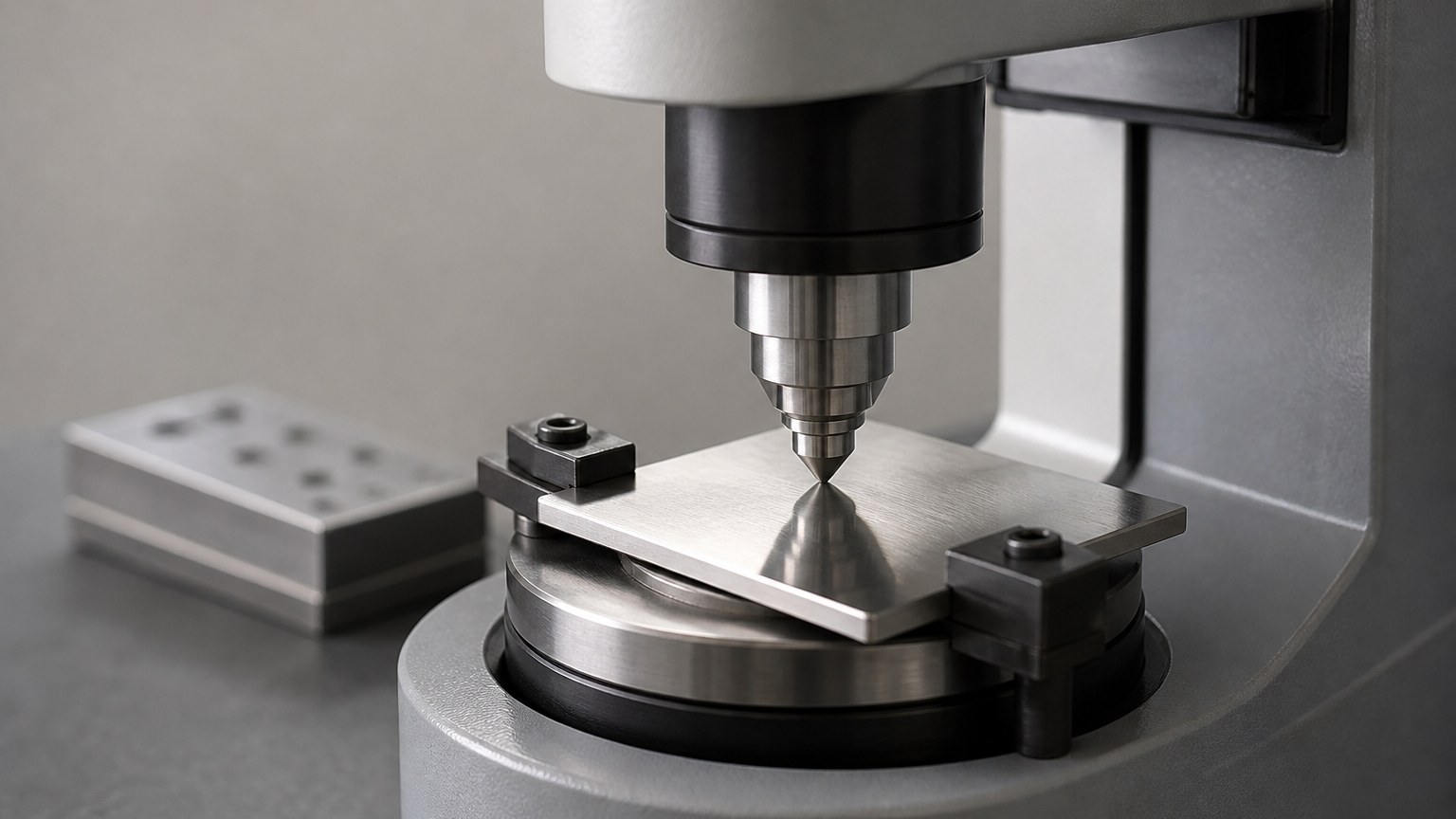
Rockwell presses a ball or cone into the surface and reads the depth of penetration; Vickers and Brinell use optical or diameter measurement of the indentation. Portable rebound testers are a shop-floor check, not a certification test.
Laboratory methods and what they suit
Rockwell B, defined by ASTM E18 and its ISO equivalents, is the default for annealed stainless plate and strip because it is fast, needs little preparation and is specified directly in flat-product standards. Rockwell C is used for hardened martensitic and precipitation-hardening material. Vickers, described in detail on the Vickers hardness test reference page, uses a diamond pyramid and a measured diagonal; it is the preferred method when the test area is small — a weld, a heat-affected zone or a thin sheet — and when results must be compared across grades of very different hardness. Brinell uses a larger ball and a correspondingly larger indentation, which averages out local variation and suits thick plate and castings. Microhardness testing at very low loads is used to profile a weld or a surface-treated layer. In all cases the surface must be flat, clean and representative, and the plate thickness must be adequate for the indenter load, or the reading is measuring the anvil rather than the steel.
Portable testers and the traps they set
Portable rebound (Leeb) and ultrasonic contact testers are common at goods-in inspection because they are fast and non-destructive, but they are indirect methods whose results depend on surface finish, part thickness, curvature and mass. The same plate can read differently on a polished surface and a mill finish, or on a thin sheet that deflects under the probe. For austenitic stainless the additional complication is magnetic response: cold-worked or lightly magnetic areas can bias some instruments. The workable routine is to correlate the portable instrument against a bench reading on a reference block every shift, record the method and instrument alongside the value, and escalate to a laboratory test whenever a shipment is marginal. That discipline is what turns a hardness number from a conversation into evidence — and it is the same principle behind verifying grade identity with surface finishes such as 2B, BA and No.4 and PMI checks before the material is released to production.
Can Stainless Steel Plate Be Hardened to Resist Wear?
Sometimes yes, sometimes never — and the answer decides whether a grade change is needed or a surface treatment.
Austenitic grades cannot be hardened by heat treatment and gain hardness only through cold work. Martensitic and precipitation-hardening grades are hardenable by heat treatment. Nitriding and other surface treatments add a hard case to an otherwise soft plate.
What each route actually delivers
Cold work is the only lever on 304 and 316. Rolling the plate to a harder temper, or buying it in a spring temper rather than annealed, raises hardness and strength together, but it also consumes ductility and makes subsequent forming harder; a heavily cold-worked sheet that must later be bent will crack at the outside of the bend. Heat treatment is available to the martensitic family: 410 and 420 are austenitised then quenched and tempered to a chosen hardness, with 420 able to reach roughly 50 HRC and higher-carbon variants going further. The trade is real — corrosion resistance falls as hardness and carbon rise, so a hardened 420 knife plate is far more corrosion-prone than a soft 304 sink top. Precipitation-hardening grades such as 17-4PH reach high strength through a low-temperature ageing step, which is attractive when a machined or formed part must keep its dimensions. Surface hardening applies to any substrate: gas or plasma nitriding diffuses nitrogen into the surface to create a hard case over a tough core, and is used on shafts, valve parts and moulds. The decision rule is simple. If the requirement is wear resistance on a large flat surface, question whether stainless steel is the right material at all before paying for a hardenable grade you cannot weld or form easily. If the requirement is a hard edge or a wear face on a small area, harden by grade or by surface treatment and leave the bulk of the plate soft. And if the requirement is really corrosion resistance with reasonable mechanical properties, stay with the annealed austenitic grades and stop looking for hardness you do not need.
Grade substitution is also where supply and specification quietly diverge. A comparison of how grade 304 and grade 316 differ in corrosion resistance and cost shows that the two are near-identical in hardness yet behave differently in chloride service, which is why a hardness-driven downgrade from 316 to 304 to save cost usually destroys the reason the stainless was chosen.
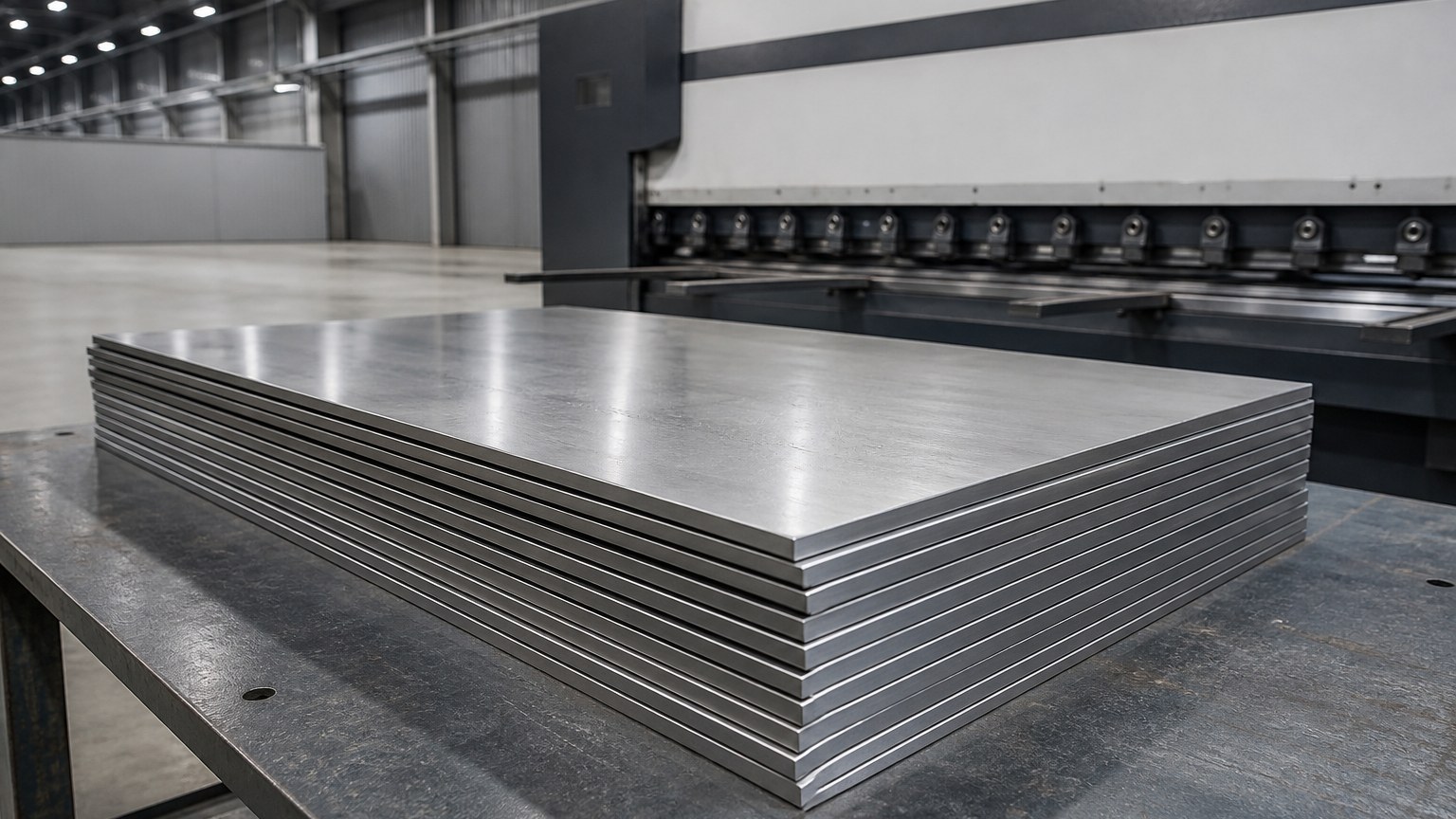
How Should You Specify Hardness When You Buy Stainless Steel Plate?
A hardness requirement is only useful if it names the scale, the condition and the test method.
Specify the grade and condition first, then name the hardness scale (HRB, HRC or HV), the limit, and the standard the test follows. Leave hardness out of the specification when the application does not need it.
A short specification routine
Start with the function: corrosion resistance and formability, wear resistance, or structural strength. Corrosion-first applications are served by annealed 304L or 316L, and the correct specification is a maximum hardness — normally 92 HRB or less for 304 and 95 HRB or less for 316L — which is a guarantee of the soft, formable condition rather than a performance target. Wear-first applications need a hardenable grade, and the specification should state the heat-treatment condition as well as the hardness, because a hardness figure without a tempering condition is meaningless. Structural applications should be specified by tensile and yield strength from the applicable standard, with hardness accepted only as a supplementary check. Whichever route is taken, the purchase order should name the test standard, the sampling frequency and the document that proves it, because the value that ends up on site is the one written on the mill test certificate. Buyers who also need to confirm that a delivery matches its paperwork should treat hardness as one input among several — dimensional check, PMI, surface inspection and certificate review all sit in the same acceptance plan.
Getting the plate and the paperwork right
Three practical points close most hardness disputes. First, agree the condition in writing: “annealed, 2B finish, maximum 95 HRB to ASTM E18” is enforceable, while “hard stainless” is not. Second, state whether the plate is supplied to a maximum or a minimum — most flat-product specifications set maxima for annealed grades, so a buyer who writes a minimum has written a requirement the mill may never be able to certify. Third, decide in advance what happens if a reading falls outside the limit, since a retest at a different location on the same plate is a routine and legitimate step, not evidence of bad faith. Suppliers who export regularly will accommodate a jointly witnessed test on request, and that is usually cheaper than a rejected container. If you are working through exactly this question, send the grade, thickness, temper and hardness range to tell our team the specification you need and we will confirm what is available from stock and what has to be rolled to order. Our export range includes annealed austenitic plate in the common finishes and thicknesses, and a good starting point is 316L stainless steel plate in 2 mm 2B finish, which is supplied in standard 1219 × 2438 mm and 1500 × 3000 mm sizes and certified against the flat-product standard.
Conclusion: annealed 304 and 316 plate is soft by design at roughly 70–90 HRB; only martensitic, duplex, precipitation-hardening or cold-worked material is genuinely hard, so specify the property you need.