
Aluminum Strip: Where Is It Used in Industry?
Specifying the wrong strip grade shows up as transformer losses, cracked fins or failed coatings. The industry answer is narrower than most buyers expect.
Short answer: Aluminum strip is the coiled, slit flat-rolled product used wherever a continuous, formable, conductive or corrosion-resistant metal band is needed — transformers and busbars, heat-exchanger fins, cable shielding, roofing and cladding, gutters, cookware, closures and packaging.
Everything that decides whether your strip performs or fails is fixed before the coil leaves the mill: alloy, temper, gauge, width tolerance and edge condition. The sections below follow the material through the industries that consume it — electrical and energy equipment, construction products, heat transfer, packaging and consumer goods — and then close with how to write the specification and check what arrives. Read to the end and you will know which alloy family your application actually needs, and which questions to put to a supplier before you commit to a purchase order.
What Is Aluminum Strip, and How Is It Made?
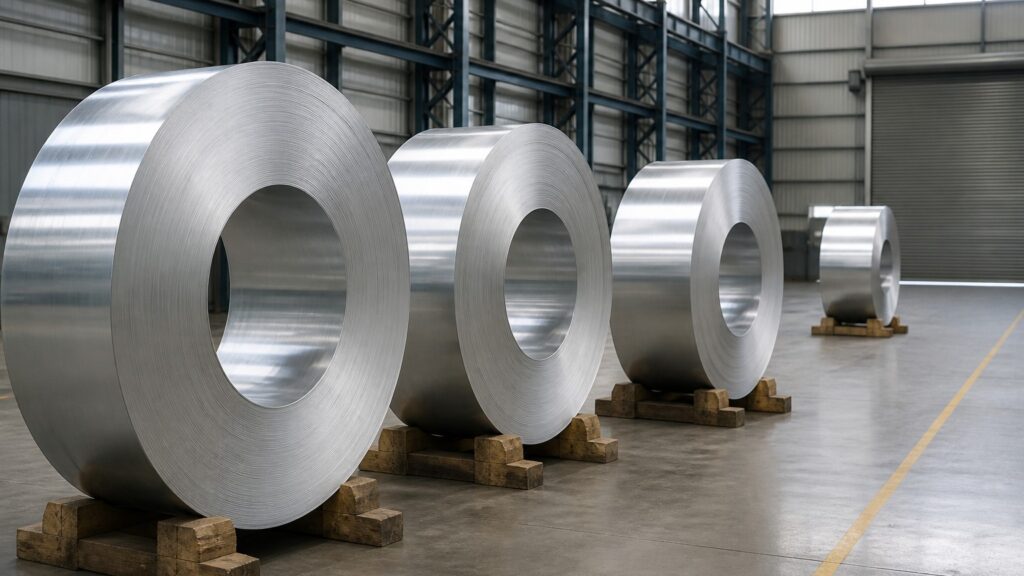
Strip is not a different metal — it is sheet supplied in coil and cut to width. That format is what most production lines can actually feed.
Short answer: Strip is flat-rolled aluminium delivered in coil, normally produced by continuous casting or slab rolling, then cold rolled, annealed and slit to the ordered width and edge condition.
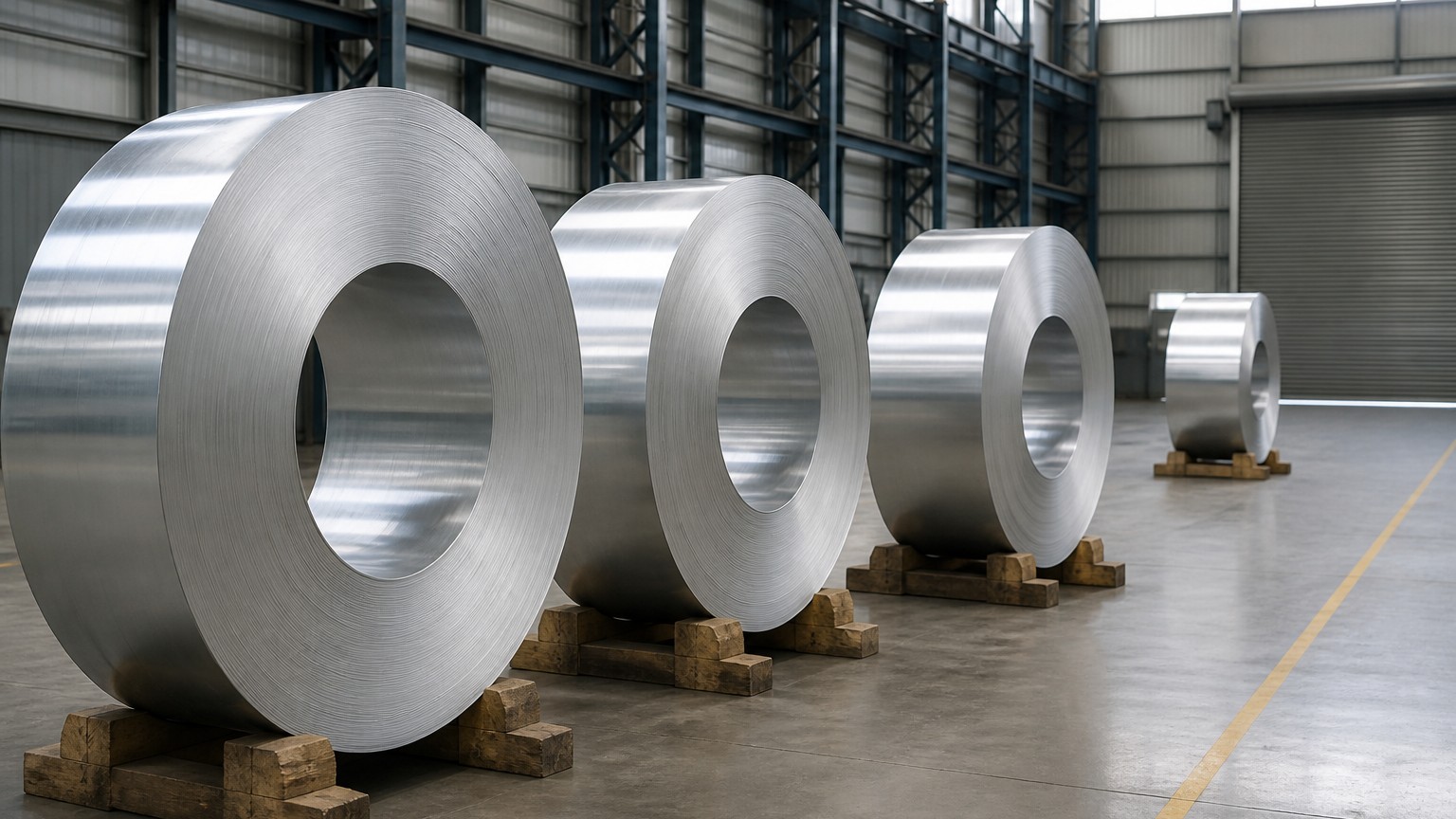
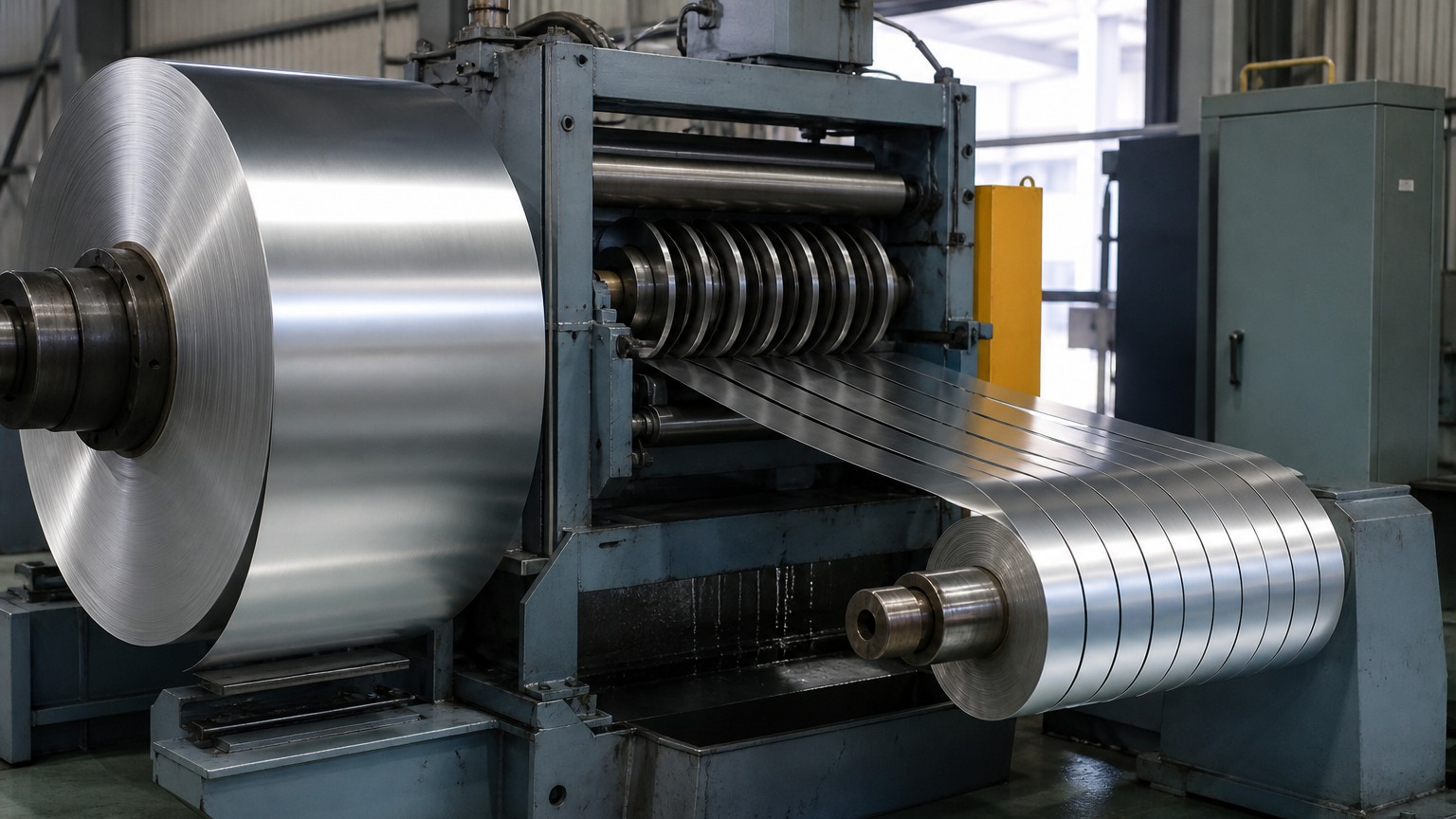
Dive deeper: Start with the sequence. Aluminium strip begins as either a cast slab or a continuously cast thin strip; the material is hot rolled, then cold rolled to the final gauge, annealed or partially work-hardened to the ordered temper, and finally slit to width. Slitting is the step that turns a mill-width coil into the narrow bands your press, winder or roll former can accept, and it is also the step where edge condition is decided — a properly set slitter produces a clean edge, while a poorly set one leaves a burr that embarrasses every downstream operation. Two families of specification govern the result. In the United States, ASTM B209/B209M covers aluminium and aluminium-alloy flat sheet, coiled sheet and plate, and it does not merely list alloys: it requires that sheet and plate be capable of being bent cold through a specified angle around a pin without cracking, and that plate show no evidence of stress-corrosion cracking. That single requirement is why a strip that survives a tight bend on your line is not luck — it is the test the standard was written around. In the international system, ISO 6361 covers wrought aluminium sheets, strips and plates, with part 2 specifying mechanical properties for general engineering applications. That matters commercially, because “0.5 mm strip” carries different tolerances and different minimum properties under ASTM, EN, ISO and GB/T unless you name the document in the enquiry. The metal itself sets the baseline. Aluminium is light, corrosion-resistant and thermally conductive — density around 2.70 g/cm3, elastic modulus about 70 GPa, and it protects itself with a thin, self-healing oxide layer rather than rusting the way steel does. Alloying changes that baseline, and alloy designations are registered with The Aluminum Association, which is why an alloy number is reliable shorthand across suppliers and languages. Around 85% of all aluminium is used for wrought products such as rolled sheet, strip and foil, so strip is the mainstream of the industry rather than a specialty. Once you accept that the format is a coil and the variables are alloy, temper, gauge and edge, the only open question is which industry the strip is going into — and that is where the following sections go. Buyers who want the full format and tolerance baseline can review the aluminum coil and strip range before writing a specification.
Where Is Aluminum Strip Used in Electrical and Energy Equipment?
Electrical work is where strip’s conductivity, low weight and formability line up with three different jobs: conducting, shielding and earthing.
Short answer: Strip becomes transformer windings, busbars, cable shielding tape, earthing strap and battery connections — duties where a wide, thin conductor is wound or laminated instead of cut to length.
Dive deeper: Conducting is the first job, and it is a compromise rather than a contest. Aluminium carries less current than copper for the same cross-section, so an aluminium winding or busbar is designed thicker or wider to reach the same rating; what it returns is roughly one third of the weight and a lower and more stable price base, which is why distribution transformers, induction motors and switchgear busbars are routinely wound or fabricated from strip. The grades used here are the high-purity end of the 1xxx family — 1050, 1060, 1070 and the electrical-conductor grade 1350 — because iron and silicon impurities, helpful in structural alloys, raise resistivity. That is not a minor footnote: if a coil is bought as “aluminium strip” without a conductivity requirement, the supplier is entitled to ship an alloy that will run hotter in service, and the loss appears as heat rather than as a visible defect. Annealed tempers such as O are typical for windings, because the strip has to turn tightly around a core without cracking, while busbar strip is often supplied in a harder temper where stiffness and flatness matter more than bend radius. There is a good reason the modern reference literature treats wrought aluminium alloys as a family defined by alloying and temper rather than by a single property: selecting for conductivity means removing what strengthens the metal, and every other application in this article makes the opposite choice. The second job is shielding. Thin aluminium tape is applied longitudinally or helically over cable cores to give electrostatic screening and a moisture barrier, which is why it is specified by thickness, width, elongation and conductivity rather than by mechanical strength. The third job is connection and earthing: battery tab strip, laminated busbar, earthing and bonding strap in switchgear and enclosures, and the aluminium strip used in some DC link and power-electronics assemblies. All three duties share one caution. Aluminium sits low in the galvanic series, so wet contact with copper or steel sets up galvanic corrosion unless the joint is designed for it — bimetallic washers, plating or a transition joint are the normal answers. Winding, taping and bonding all begin with strip whose purity is written into the purchase order; where flat plate is also part of the assembly, our notes on 1050A and 1070 aluminum plate grades cover the same grade logic in a different delivered format, and the choice between the two formats is set out in our guide to choosing between aluminum coil and sheet.
Where Does Aluminum Strip Appear in Construction and Building Products?
Construction consumes strip twice: once as a visible, weather-resistant skin, and again as the hidden flashings, gutters and insulation facings nobody photographs.
Short answer: Painted or plain strip becomes roofing and wall cladding panels, gutters, downpipes, flashings, window and facade components, insulation jacketing and ductwork, usually in 1100, 3003 or 3105 alloys.
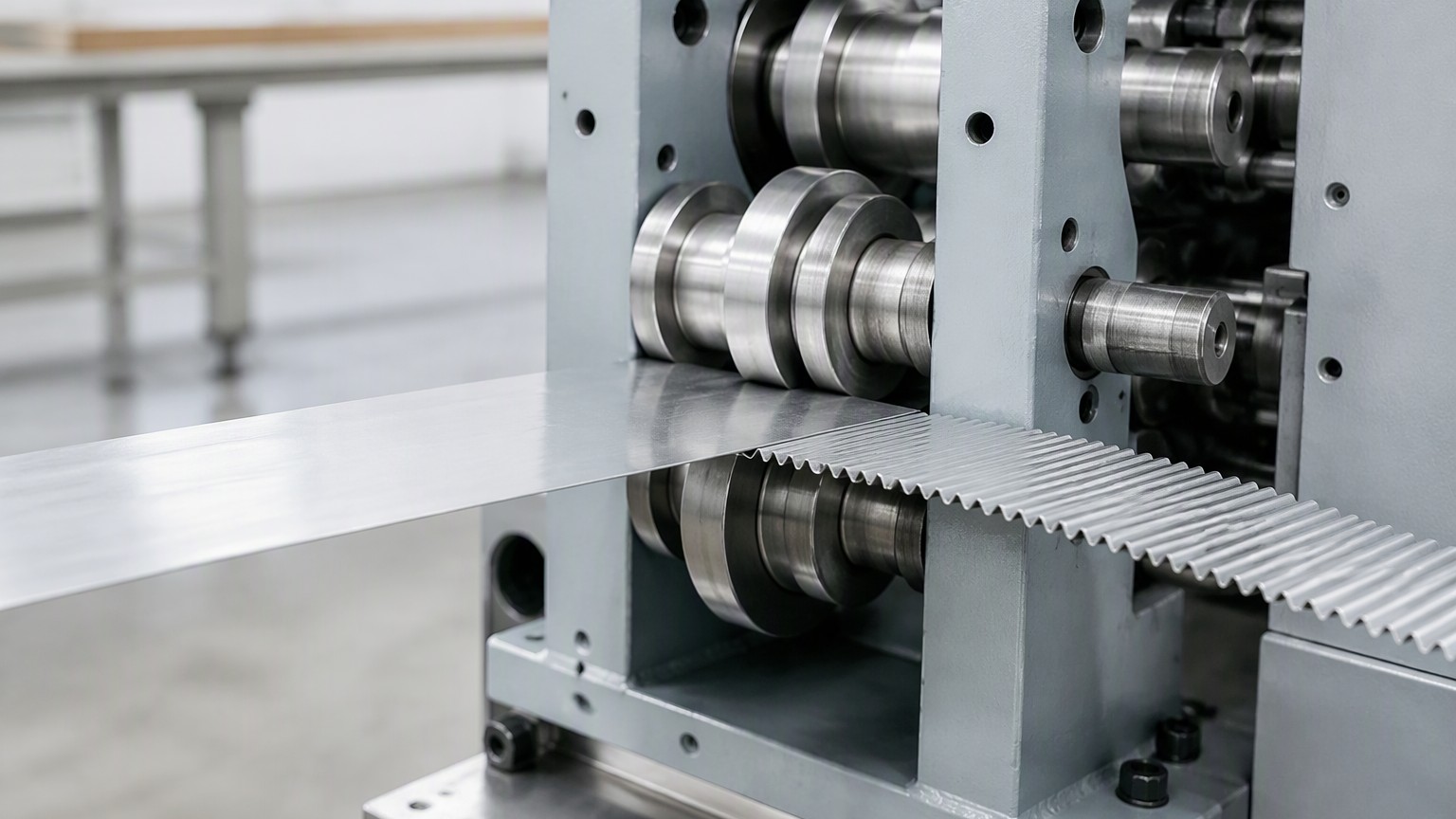
Dive deeper: The construction case rests on three properties that strip has and heavier formats do not deliver as economically: it is light enough to be handled by two people on a roof, it forms a protective oxide layer instead of rusting, and it takes a coil-coated paint finish that survives decades of weather. Roll forming is what makes the economics work. A coil is fed continuously through a series of forming stands that turn flat strip into a trapezoidal or corrugated profile, pierce and notch it, and cut it to the ordered length at line speed — and because the profile is formed from strip rather than from sheet blanks, there is almost no offcut. The same logic produces gutters, downpipe sections, verge and ridge flashings, and the profiled sheets used for industrial sheds, cold-storage buildings and agricultural structures. Alloy choice follows the exposure. Inland, sheltered, painted structures are commonly built from 1100 or 3003, while 3105 is a frequent choice where a combination of formability, corrosion resistance and moderate strength is wanted for siding, roofing and signage trims. Strip thickness for these products sits in the thin end of the sheet range — typically a fraction of a millimetre up to about 1.5 mm — which is exactly the band where coil handling beats flat-sheet handling, because a stack of thin cut sheet distorts under its own weight while a coil does not. Two design cautions deserve a place in the specification. First, aluminium must be electrically isolated from steel and copper in wet conditions; the standard detail is a separating tape, gasket or isolating washer at every fixing, and the same rule applies where aluminium cladding meets galvanized steel purlins. Second, thermal movement: aluminium expands and contracts noticeably more than steel, so panels are fixed with slotted or oversized holes and designed movement joints rather than being pinned rigidly at every rib. Insulation jacketing belongs in the same section because it uses the same material for a different reason. All-aluminium laminate or 0.5 mm to 1.0 mm strip facing on mineral-wool, PIR and pipe insulation is chosen as a vapour and weather barrier, and here the requirements are surface cleanliness, flatness and a coil that unwinds without coil set — the kind of day-to-day detail that decides whether an installer’s line runs at speed or fights the metal.
Which Industries Use Aluminum Strip for Heat Transfer and Cooling?
Heat transfer is the largest single technical use of thin strip, and it is the application where gauge tolerances stop being paperwork and start being performance.
Short answer: Fin stock for air conditioners, refrigeration coils, radiators, heat pumps and process coolers is punched and formed from thin aluminium strip, most often in the 3xxx family such as 3003, valued for conductivity and corrosion resistance.
Dive deeper: A fin is a surface-area product, so the material cost of a coil is dominated by how thin the strip can go while still surviving the fin press and the finished product’s corrosion environment. This is why fin-stock strip is specified to tight gauge tolerance in the first place: a strip that varies in thickness across its width does not form uniformly, and the resulting fin has a different height at one edge, which shows up later as a poor bond to the tube and a coil that under-performs. The 3xxx family dominates because manganese additions give moderate strength with good formability and corrosion resistance, and because the alloy behaves predictably through the very high-speed punching and fin-forming operations that define the process — hundreds of fins per minute, each with a louvre pattern formed by tooling rather than by heat. Thinner gauges of the same family are used for the closely spaced fins inside residential air conditioners, while slightly heavier strip appears in commercial refrigeration, process coolers and industrial heat exchangers where the fins have to survive cleaning and mechanical handling. Some coil is supplied with a thin brazing cladding so that the fin-to-tube joint forms during furnace brazing; in that case the strip is a composite product and the supplier has to confirm its clad layer rather than only its core alloy. The practical constraints buyers meet are duller than the metallurgy and just as decisive. Surface cleanliness matters because residual oil interferes with brazing and with hydrophilic coatings. Flatness and camber matter because the fin press feeds continuous strip and any lateral drift produces a stepped edge and scrap. Elongation and bend behaviour matter because the fin pass is a forming operation, and the ASTM bend requirement that governs flat-rolled products is the reason a supplier can promise the strip will form without cracking. Packaging matters more than in most applications because the coil is unwound on a precision machine: interleaved paper, edge protection and moisture protection against condensation in transit are worth writing into the enquiry. For a family of thin, formed, continuously fed products, a representative starting point is 3003 aluminum coil in 1.0 mm, supplied in work-hardened tempers for production lines that form rather than machine.
How Is Aluminum Strip Used in Packaging, Cookware and Consumer Goods?
The visible uses are the familiar ones: caps, cans, cookware and nameplates. The reason strip wins here is surface quality and formability at very thin gauges.
Short answer: Closure and lid stock, aerosol and food-container components, cookware blanks punched from strip, packaging tape, nameplates, licence plates and signage trims are all made from thin aluminium strip with a controlled surface finish.
Dive deeper: Packaging is where strip is judged almost entirely on appearance and hygiene, and where the standards are set by forming rather than by strength. Closure stock has to be coated, printed, lacquered and then formed into a cap or a lid with a lining inside it, so the two variables that matter most are surface uniformity and the ability to take a coating without pinholes; the alloy families used here lean toward the iron-and-silicon-bearing grades such as 8011 alongside the purer 1xxx grades, chosen for a combination of formability, corrosion resistance and the clean surface a coating needs. Deep-drawn food containers, trays and aerosol components follow the same logic at slightly heavier gauges, and the relevant forming limit is simply how much the metal can be stretched before it tears. Cookware uses strip in a different way: circular blanks are punched or blanked from coil and then drawn into pans and lids, so the buyer’s interest is width and gauge consistency plus a surface that anodizes or coats evenly — the same 1050, 1100 and 3003 grades that appear elsewhere in this article, in the tempers that suit drawing. Aesthetic and identification products consume strip in smaller volumes but with the tightest surface requirements of all, because any rolling mark, stain or edge burr is visible on the finished panel. Nameplates, licence plates, road signs and appliance trims are commonly made from 3105 or 3003 strip that has been coated or anodized, and the practical specification points are surface finish, flatness, cut-edge quality and colour consistency between coils. Two commercial realities shape this whole category. The first is that gauge is a price lever: because the coil is sold by weight, moving to a slightly thinner strip reduces material per part, and the only thing standing between a buyer and that saving is whether the thinner material still forms and still passes the customer’s abuse test. The second is traceability, which the packaging and appliance sectors take more seriously than most: the alloy, temper and heat number on the coil stencil have to match the mill certificate, because a substitution in this category is usually discovered by the end customer rather than by incoming inspection. The broader context for how alloy families and tempers are designated and registered is documented by The Aluminum Association, whose designations are the common language between a converter, a mill and a labelling line on three different continents.
How Do You Choose the Right Aluminum Strip for Your Application?
Choosing strip is a short series of eliminations: alloy, temper, gauge, width and edge, then the paperwork that proves the coil matches what you ordered.
Short answer: Fix the alloy from the service environment, the temper from the forming operation, the gauge and width tolerance from the machine that will run it, and the edge condition from the finished part — then verify all four against the certificate at goods-in.
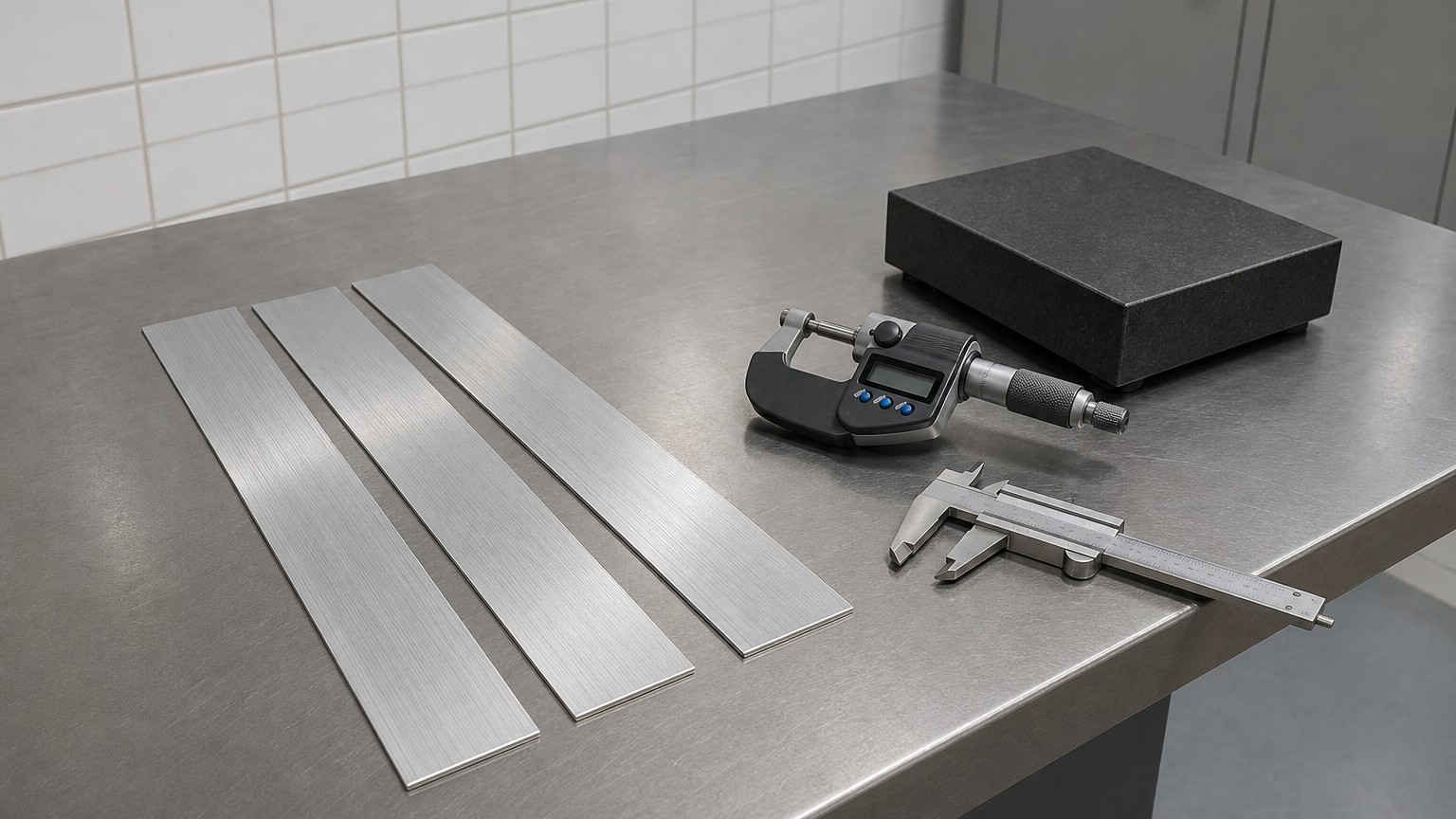
Dive deeper: Work in the order that eliminates options fastest. Alloy first: if conductivity drives the part, specify the 1xxx family and name a conductivity requirement; if formability, corrosion resistance and general fabrication drive it, a 3xxx alloy such as 3003 is the natural start; if the part is a visible decorative or architectural panel, choose a grade with a proven finish cycle. Temper second, because it is the variable that most often causes an avoidable failure: the same alloy in O condition will fold around a core, and in a hard work-hardened temper it will crack, so “same alloy, different temper” is a completely different product even though the invoice looks similar. Gauge and width third, with the caveat that tolerances must be quoted against a named standard rather than assumed — ISO 6361-2 and ASTM B209/B209M both define the mechanical property baseline for flat-rolled products, and the tolerance tables are the part of the specification that decides whether your line runs or stops. Edge condition fourth: slit edge for formed and wound parts, mill edge where the edge is trimmed away anyway, and a stated burr limit whenever the strip is handled by hand or fed into a precision press. Then put verification into the purchase order instead of hoping for it later. Ask for the mill certificate to state the standard the material was produced to, the alloy, the temper, the heat number and the mechanical results; ask for the coil stencil to match that certificate; and check gauge and width with a calibrated gauge at several points across the coil rather than trusting the label. Photograph any edge damage, water staining or wrap slippage before the packaging is discarded, because a claim raised after the wrap is gone is a claim you will have to argue. None of these steps is expensive, and together they replace assumption with evidence. If the application is still open — a new fin press, a busbar redesign, a first attempt at a coated architectural panel — the fastest way to close it is to send the drawing, the service environment and the annual tonnage to our team: send us your strip width and monthly volume and we will come back with the alloy, temper, gauge and edge condition we would quote, together with the paperwork that travels with the coil.
Conclusion: From transformer windings to roofing, fins and closures, aluminum strip wins on conductivity, formability and a self-healing oxide layer — so specify alloy, temper, gauge and edge, then verify.