
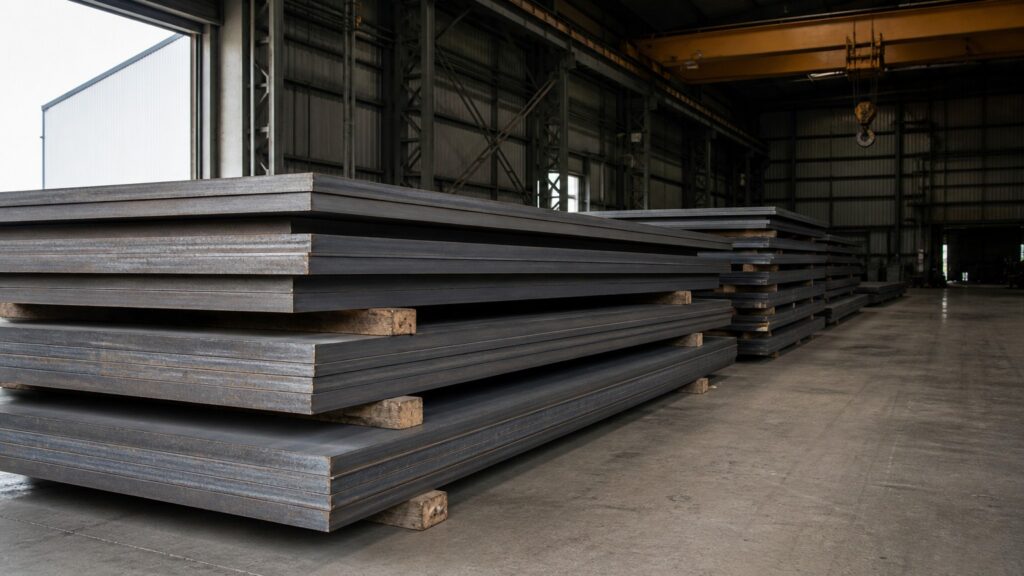
Q235B vs Q355B: Which Carbon Steel Grade Should You Specify?
Write the wrong grade into a purchase order and the cost appears months later — as weld repairs or rejected sections. Grade choice is commercial, not just metallurgical.
Short answer: Specify Q235B for loads that fit a 235 MPa minimum yield — general structures, platforms, ducts and light fabricated frames. Specify Q355B when you need 355 MPa minimum yield, so you can cut section thickness by roughly a third and still carry the same load.
The two grades are not rivals so much as two rungs on the same ladder, and the step between them is only 120 MPa wide. Almost everything that matters commercially — price per tonne, weld procedure, forming force, coating area, freight weight — follows from which rung you pick, and whether your design is limited by strength or by stiffness. We will work through what the designation actually encodes, how the strength gap behaves in real structures, how chemistry changes welding and bending, where each grade earns its money, how the Chinese grades map onto EN and ASTM equivalents, and finally how to write the requirement on an order and check it on delivery.
What Do the Numbers and Letters in Q235B and Q355B Actually Mean?
The designation is a promise about yield strength, quality class and impact testing — read it as three separate pieces of information.
Short answer: The letter Q stands for yield strength in the Chinese national standards, and the number is the minimum yield in MPa for thin sections. The trailing B is the quality class, which sets the impact test temperature.
Dive deeper: Start with the two documents, because Q235B and Q355B do not even come from the same standard. Q235 is defined in GB/T 700, the specification for carbon structural steels, and Q355 is defined in GB/T 1591, the specification for high strength low alloy structural steels. That single fact explains most of the behavioural difference between them. GB/T 700 governs ordinary carbon structural steel, where the alloying is minimal and the grade is separated mainly by carbon content and by the quality class that follows it. GB/T 1591 allows deliberate micro-alloying additions — niobium, vanadium, titanium and sometimes a small amount of aluminium for grain refinement — which is how the same nominal carbon level can deliver 120 MPa more yield strength without becoming a difficult material to weld. Knowing which standard your order sits under matters at the inspection stage, because tensile testing frequency, chemical limits and retest rules differ between the two documents. Now read the number. In both standards the figure is the minimum yield strength in megapascals, but it is only valid up to a stated thickness, conventionally 16 mm. Above that, the mill is allowed to de-rate the grade: a thicker plate is slower to cool, holds a coarser grain and simply cannot promise the same yield through its whole section. On a 40 mm or 60 mm plate the guaranteed yield for a Q355 product can drop by tens of MPa, and the exact reduction is given in a table in the standard rather than in the grade name. Buyers who write “Q355” on a 50 mm plate and expect 355 MPa in every direction have misread their own specification. The trailing letter is the second promise, and it is about toughness rather than strength. In GB/T 700 the classes run from A to D, with A carrying no impact test requirement and the later letters requiring a Charpy V-notch test at progressively lower temperatures — B at plus 20 °C, C at 0 °C and D at minus 20 °C. That is why Q235B is the workhorse grade in mild climates and ordinary indoor service, and why nobody should specify Q235B for equipment that will sit at minus 15 °C in winter. In GB/T 1591 the same letter logic applies, with B tested at plus 20 °C and later letters extending downwards for cold-climate and offshore work. Finally, keep one history note in mind: Q355 was called Q345 before the standard was revised, so older drawings, older certificates and older supplier catalogues may still say Q345 where a modern specification would say Q355. The two designations are not identical in every table, but for steel bought today the Q355 figure is the current one and Q345 is the legacy name.
How Much Stronger Is Q355B in a Real Structure, and When Does That Extra Strength Not Help?
The headline gap is 51 percent, but real designs rarely see the whole of it.
Short answer: Q355B carries roughly 51 percent more guaranteed yield than Q235B, so a strength-limited member can be about a third thinner. But both grades share the same elastic modulus, so a stiffness-limited member gains nothing at all.
Dive deeper: Do the arithmetic first. 355 divided by 235 is 1.51, so Q355B promises about half again the yield stress of Q235B. Turn that around and a member governed purely by yielding needs about 235/355, or roughly 66 percent, of the cross-sectional area — a 34 percent saving in steel for the same working load. That is a serious number on a large structure, and it is the whole commercial case for the higher grade. Now do the honest second half of the arithmetic. Every carbon steel, whether it yields at 235 MPa or 355 MPa, has essentially the same elastic modulus, about 200 GPa, and the same density, about 7.85 g/cm³. Stiffness depends on Young’s modulus and on the second moment of area, and strength plays no part in it. So if your member is limited by deflection — a long span that must not sag more than span/200, a long unsupported column, a slender beam carrying a light load over a big opening — switching from Q235B to Q355B changes almost nothing. You would make the section thinner, the second moment of area would fall, the deflection would rise, and you would end up putting the thickness back. This is the single most common specification error in imported structural steel: a buyer upgrades the grade to “save weight” without checking which criterion governs the member. There is a second limitation that is easy to miss. Not every member yields before it buckles, and stability is not a strength property in the way that yield is. A thin compression flange, a slender web or a long unstiffened column can fail by local or global buckling while the stress in the metal is still far below either grade’s yield point. Raising the yield stress does not raise the buckling load in the same proportion, because buckling depends on geometry and stiffness rather than on yield alone. Fatigue is a third place where the higher grade disappoints: fatigue life follows stress range, geometry and weld detail quality, not the static yield strength of the parent plate, so upgrading the grade rarely buys additional cycles unless the detail itself is improved. The practical conclusion is a simple test. Ask whether the governing design check is stress or deflection and stability. If it is stress, Q355B pays. If it is deflection, stability or fatigue, keep Q235B and spend the money on geometry, stiffeners and better weld details instead. Buyers who want to see the plate options and thickness ranges available in each family can review the Q235B vs Q355B carbon steel sheet range before writing the enquiry.
Which Chemistry and Toughness Differences Decide Welding and Cold Forming?
Both grades are low carbon and weldable, but the higher grade is doing more metallurgical work behind the scenes.
Short answer: Q355B carries a tighter phosphorus and sulphur ceiling and up to slightly higher manganese, and it relies on micro-alloying and fine grain size for strength. That makes it more sensitive to heat input and to over-bending than Q235B.
Dive deeper: Chemistry explains why the two grades behave differently in a fabrication shop even though both fall comfortably inside the low carbon range. Q235B in GB/T 700 permits carbon up to about 0.20 percent and caps manganese in the region of 1.40 percent, with phosphorus and sulphur typically held at 0.045 percent maximum. Q355B in GB/T 1591 keeps carbon at or below roughly 0.20 percent as well — that is deliberate, because carbon is the cheapest strengthener and also the fastest way to destroy weldability — but it raises the manganese ceiling to about 1.60 percent and, more importantly, tightens phosphorus and sulphur to around 0.035 percent. Cleaner steel is tougher steel, which is precisely what the B class impact requirement at plus 20 °C is asking for. The rest of the strength in Q355B comes from grain refinement, achieved with small niobium, vanadium or titanium additions and controlled rolling practice. Fine grain boundaries obstruct dislocation movement, raising yield strength while simultaneously improving toughness — an unusual combination that coarse chemistry alone cannot deliver. Two practical consequences follow. The first concerns welding. Q355B usually carries a slightly higher carbon equivalent than Q235B, which means a marginally higher risk of a hard, crack-sensitive heat affected zone, especially in thick sections and in high-restraint joints. Many fabricators respond by specifying minimum preheat for the higher grade, by controlling heat input within a narrower window, and by tightening interpass temperature limits, all of which should be captured in a qualified welding procedure rather than decided on the shop floor. On thinner sheet — 2 mm to 6 mm, the range where most hot rolled and cold rolled steel products are bought for general fabrication — the practical difference is small and everyday gas metal arc procedures handle both grades without drama. The second consequence concerns forming. Because Q355B has a higher yield point, it springs back further after bending and it reaches its forming limit sooner, so a bend radius that succeeds on 2 mm Q235B sheet may crack on 2 mm Q355B sheet. Ordering the right bend radius, or asking the mill to supply material with a tested minimum inside bend radius, is cheaper than discovering the limit in your press brake. Q235B is the more forgiving grade to form, to rework and to straighten after distortion, which is one reason it remains the default for general plate work, ducting and non-critical framing.
Where Does Each Grade Earn Its Money on a Project?
The cheaper grade per tonne is not always the cheaper grade per finished member, and the difference runs both ways.
Short answer: Q235B wins where sections are standard, stiffness governs, or fabrication is manual and small-volume. Q355B wins where the structure is strength-limited, the tonnage is large, or the client enforces a specific design code with a minimum grade.
Dive deeper: Begin with the price structure. Q235B sits at the bottom of the structural carbon steel price ladder because it needs less alloying and less process control; Q355B normally carries a price premium per tonne, in part for that alloying and controlled rolling, and in part because it is often rolled in thicker or less common sections where mill scheduling is tighter. The premium is real but it is paid per tonne, whereas the saving is in tonnes. On a strength-limited frame, saving roughly 34 percent of the steel weight almost always beats a single-digit percentage price premium per tonne, which is why large warehouse portals, crane runway beams and heavily loaded transfer structures are routinely specified in Q355B or its EN equivalent. Now reverse the argument. Two costs scale with the number of pieces rather than with tonnage: cutting, drilling and welding labour, and surface protection. If you have reduced the section thickness, you have not reduced the number of connections, and you may have increased them, because thinner plate is more prone to local distortion and sometimes needs stiffeners that a thicker Q235B section would not. On a small job the engineering and fabrication effort of redesigning for the higher grade can outweigh the metal saving entirely, which is why so much general fabrication stays on Q235B. Then add the coating arithmetic. Paint, galvanising and shot-blasting are all priced per square metre of surface, and surface area does not fall as fast as weight when you thin a section — a thinner plate has proportionally more surface per kilogram. A weight-driven saving in the mill can therefore be partly handed back at the galvaniser. Freight is the one line where the higher grade is unambiguously better: fewer tonnes and less volume per member means more structure per container, and on an ocean shipment the freight saving can be surprisingly material. The fourth factor is contractual rather than economic. Design codes, client specifications and insurance-driven structural standards sometimes set a minimum grade directly, and a project audited against a named code will simply not accept a substitution downwards, whatever the arithmetic says. Where that is the case, the decision was made before you quoted, and the only remaining question is whether you buy the grade from a mill that can document it properly. A typical formed product such as a hot rolled carbon steel sheet Q235B in 2.0 mm is the right answer for light framing, enclosures and platform decking where deflection rather than stress governs, and a Q355B equivalent becomes the right answer the moment spans grow and the design check turns to bending stress.
Which EN, ASTM and Japanese Grades Are Close Equivalents?
No two standards describe steel in exactly the same words, so equivalence is always a comparison rather than an identity.
Short answer: Q235B sits alongside EN 10025–2 S235JR and, more loosely, ASTM A36. Q355B sits alongside S355JR and, less closely, ASTM A572 Grade 50. Always confirm equivalence against the mechanical property table, not the grade name.
Dive deeper: The comparison is genuinely useful because offshore clients often write one system while the mill rolls another, and because a mill certificate has to satisfy the reviewing engineer, not the buyer’s memory. Take the European side first. EN 10025 defines non-alloy structural steels with minimum yields of 235 MPa, 275 MPa and 355 MPa, and the suffix JR denotes impact testing at plus 20 °C — the same temperature class as the letter B in the Chinese grades. So S235JR and Q235B are close equivalents, and S355JR and Q355B are close equivalents, provided the thickness range and the impact energy requirement are checked rather than assumed. The reason they are “close” and not identical is that the two systems set their own chemical ceilings, their own tolerance tables and their own testing frequency, so a certificate to one standard does not automatically satisfy the other. Now the American side, which is where most confusion starts. ASTM A572/A572M covers high strength low alloy structural steel with grades defined by minimum yield in ksi, and Grade 50 corresponds to 50 ksi, approximately 345 MPa — numerically between Q355 and Q345, so substitution requires care. ASTM A36 is different again: it is a general structural steel with a minimum yield of 36 ksi, roughly 250 MPa, which places it above Q235B in strength but with a chemistry and a testing regime of its own, and it is frequently accepted as a substitute for Q235B in general fabrication while failing a strict equivalence review. Anyone who needs to compare systems in detail should work from a description of steel grades and their designation logic rather than from a conversion chart alone, because national suffix letters and quality classes are not interchangeable between systems. Two rules keep substitution safe. First, compare four numbers in parallel: minimum yield, tensile range, impact temperature and impact energy. If any one of them is weaker on the substitute, you have changed the specification, not translated it. Second, check the thickness at which the yield value applies, because every system de-rates with thickness and the de-rating tables do not match. Where a project genuinely needs the material to behave the same for corrosion allowance, coating or weld procedure qualification, treat the substitution as a technical change requiring the engineer’s approval. A full set of Q235B and Q355B carbon steel products across sheet, coil, pipe and bar makes it easier to buy one grade consistently rather than mixing three systems across a single project.
How Do You Specify and Verify the Grade You Order?
Grade disputes are almost never about metallurgy; they are about what the paperwork failed to say.
Short answer: Name the standard, the grade, the quality class and the thickness range on the order, and require a mill test certificate that traces the heat number to the marking on the material. Then verify thickness and marking at goods-in.
Dive deeper: Build the enquiry so that the steel cannot arrive ambiguously. That means writing the standard number as well as the grade — “Q355B to GB/T 1591” rather than “Q355” — and stating the delivery condition, the dimensions with tolerances, and any requirement that goes beyond the standard, such as a minimum impact energy, a maximum carbon equivalent, a tested bend radius or ultrasonic inspection. Add the surface requirement, because hot rolled sheet supplied structural steel for exposed or coated work is judged on scale, flatness and edge condition as much as on strength. Then specify the documents. A mill test certificate should state the standard the heat was produced to, the heat number, the chemical composition, the tensile and yield results, the elongation and the impact result where the quality class requires one. Ask for the certificate to reference the heat numbers that will appear on the material itself, because a certificate that cannot be tied to a physical coil or plate proves nothing. At goods-in, three checks repay their time. First, read the stencil or tag on the material — grade, heat number, dimensions and coil or plate number — and match it against the packing list and the certificate. Second, measure thickness with a calibrated gauge at several points, recording the minimum rather than the average, since a stack that passes on average can still dip below the permissible minimum somewhere. Third, look for the failure modes that matter in transit: edge dents from strapping, water staining between sheets or inside a coil wrap, and rust that has begun under the strapping before the ship left port. Photograph anything doubtful before the packaging is discarded, and raise the claim while the material is still in its original form. Finally, keep the grade decision documented on the drawing, not only on the purchase order, so that the next revision of the project does not quietly swap one grade for the other. If you would like the grade, the standard, the thickness range and the inspection points written into a quotation for your own project, send us your specification and our team will confirm supply, tolerances and documentation against it.
Conclusion: Choose by design check, not habit: pick Q355B where stress governs the member, keep Q235B where deflection does, and always write the standard number on the order.