
Steel Coil: Hot Rolled vs Cold Rolled — What’s the Difference?
Order the wrong coil and every operation downstream inherits the problem: cracking at the press brake, waviness in the finished panel, rust blooming under the paint.
Hot rolled steel coil is rolled above the steel’s recrystallization temperature and supplied with a scaled surface, wider tolerances and a lower price. Cold rolled coil is rolled below that temperature, which gives a smoother surface, tighter thickness control and higher strength at a higher price.
This guide works through the questions coil buyers actually ask: what each product is, how the two processes differ inside the mill, what changes in the mechanical properties and tolerances, where each coil is used, which standards govern it, and how to write an enquiry that a mill can quote against without guessing.
What Exactly Is a Steel Coil, and How Is It Made?
A coil is a delivery format, not a product. That single fact explains most of the confusion in coil enquiries.
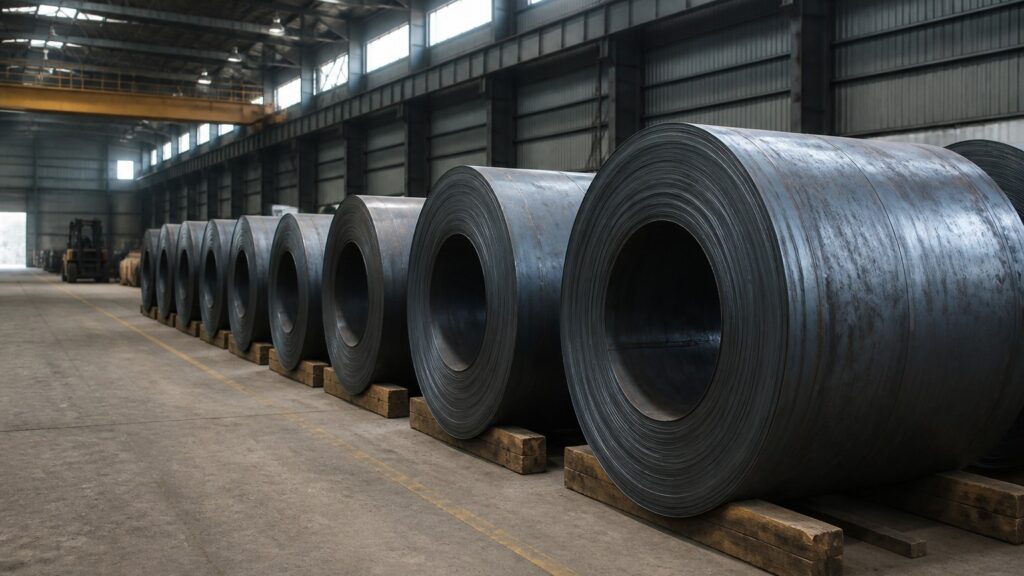
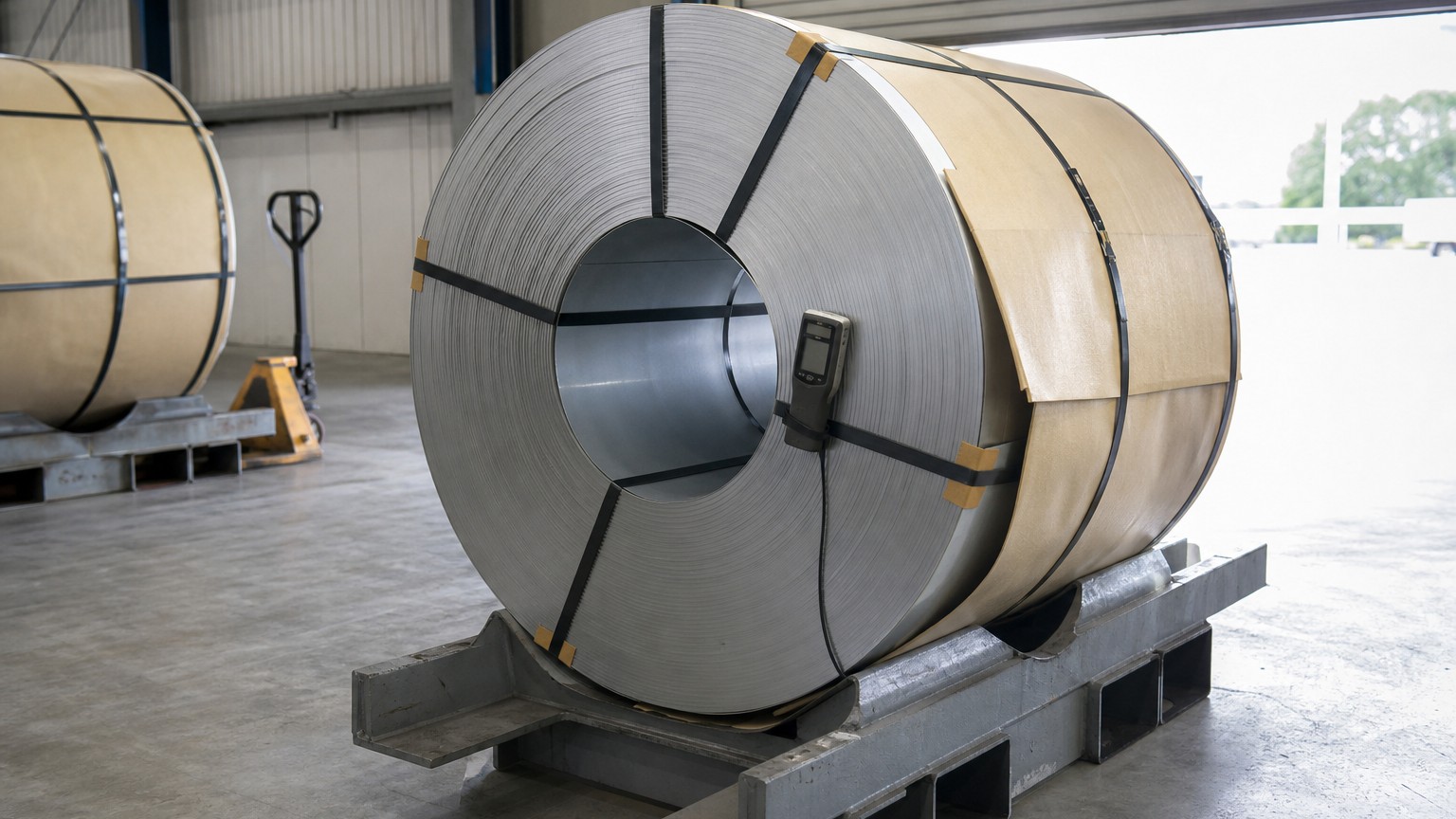
A steel coil is a continuous length of flat steel wound into a spiral. It begins as a continuously cast slab, is reheated and rolled down to strip thickness in a hot strip mill, and is then either shipped as hot rolled coil or processed further into cold rolled coil.
From slab to coil
Almost every ton of flat steel starts the same way. Liquid steel is continuously cast into a slab — a rectangular section, typically a couple of hundred millimetres thick and one to two metres wide — and that slab, not the coil, is the unit the flat-product mill actually consumes. The slab is reheated to rolling temperature in a reheat furnace, pushed through a roughing train that reduces it in a handful of heavy passes, and then through a finishing train of several stands that bring it to the ordered thickness. The strip leaves the last stand still hot enough to glow, is cooled on a run-out table under controlled water sprays, and is wound into a coil by the down-coiler.
That coiler is where the product gets its identity. From that point onward, every downstream process — pickling, cold reduction, annealing, coating, slitting, cut-to-length — begins by uncoiling the same strip again. A coil is therefore best understood as a quantity of flat steel in its most transportable form, and the process route it travelled is what defines the properties a buyer inspects.
Why the coil format has commercial consequences
Because a coil is one continuous length, a defect anywhere in the strip travels with the whole coil — and so does a good result. Consistent gauge and consistent surface across thousands of metres are the two advantages a coil gives you that a stack of cut sheets does not, and they are worth paying for when the coil feeds an automated line.
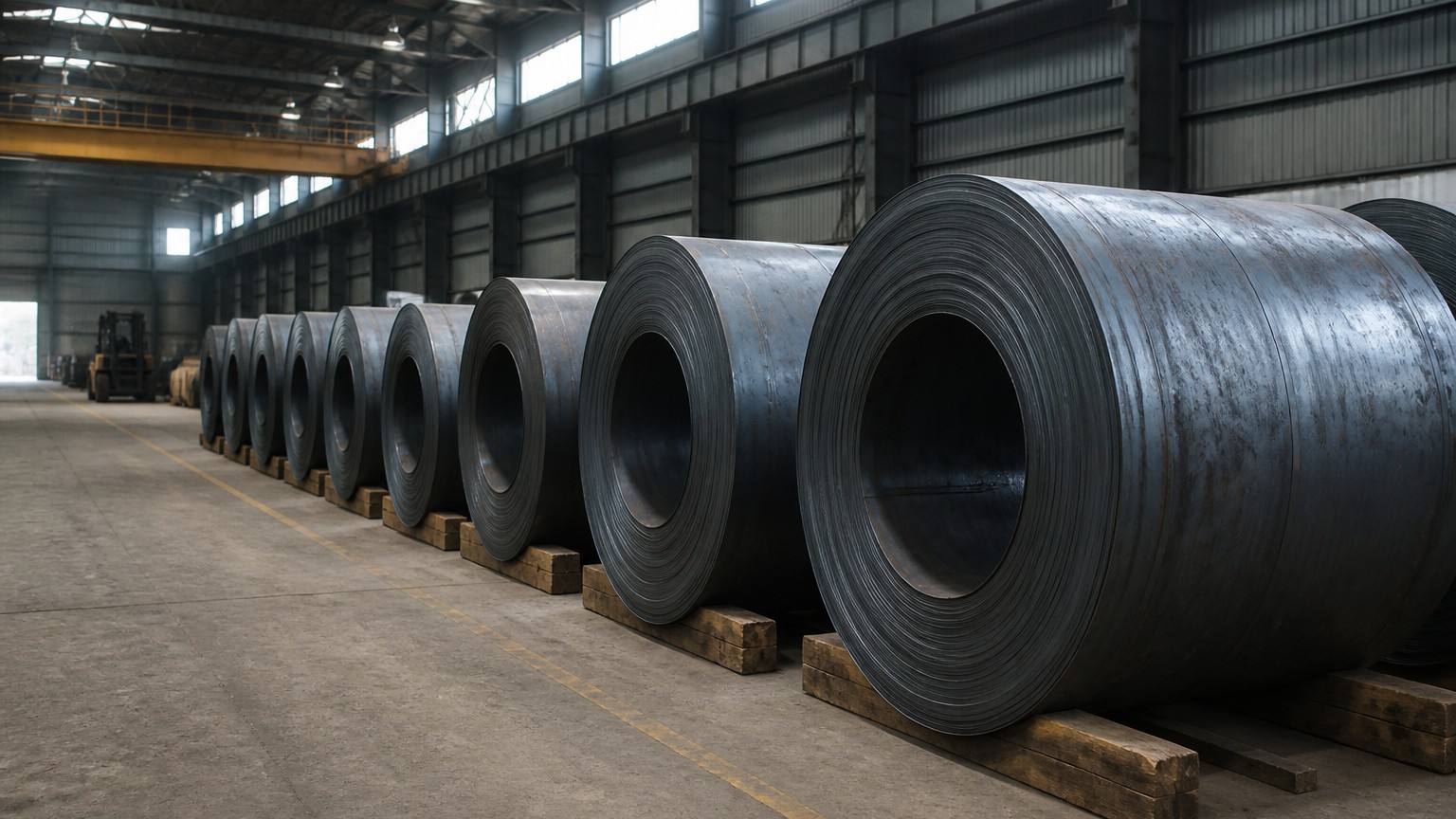
Coil weight is set by the mill’s coiler together with the strip width and gauge rather than by the buyer, so a purchaser who needs a particular handling weight is really specifying a width, or a slit coil, rather than a lighter coil. Handling matters too: coils are moved by crane, stored eye-to-sky or eye-to-wall, and loaded into containers on cradles, so the packing requirement belongs in the enquiry alongside the dimensions rather than in a follow-up email after the contract is signed. A coil that cannot be unloaded safely at the destination port has failed before the first cut is made.
The distinction that frames everything else
One clarification prevents a great deal of wasted correspondence. A steel coil is not automatically either hot rolled or cold rolled. Those are two different process routes applied to the same starting slab, and the coil you receive is defined by which route it travelled. Surface condition, thickness tolerance, strength, flatness and price all flow from that single choice, which is why the comparison below begins inside the mill rather than on the specification sheet.
How Do Hot Rolling and Cold Rolling Differ Inside the Mill?
The dividing line between the two processes is temperature, and almost every other difference follows from it.
Hot rolling takes place above the steel’s recrystallization temperature, so the grains recrystallize as they deform and the metal stays soft. Cold rolling takes place below that temperature, usually at ambient conditions, so the metal strain-hardens, gains strength and accepts a much finer surface.
The hot route: recrystallization and mill scale
In the hot strip mill, steel is deformed while it is still above its recrystallization temperature. Deformation is followed immediately by recrystallization, which keeps the microstructure equiaxed and stops the material work-hardening as it passes through successive stands. Rolling schedules deliberately keep a finishing temperature safely above that threshold, so the final passes genuinely deform the metal rather than bending a cold skin, and the reference literature on how metal rolling works describes the same sequence: rolling above the recrystallization temperature is hot rolling, rolling below it is cold rolling.
The trade-off is surface. At rolling temperature steel oxidises, and the strip leaves the mill covered in mill scale — a bluish-black layer of mixed iron oxides, largely wustite, hematite and magnetite, usually well under a millimetre thick. Scale is not dirt and it is not a defect; it is a normal product of the hot process, and its presence is the reason a hot rolled coil cannot simply be painted without preparation. It also has a practical consequence for downstream processing: because scale is electrochemically cathodic to the steel beneath it, a break in the layer concentrates corrosion at that break rather than spreading it evenly.
The cold route: pickling, reduction and annealing
Cold rolling is a second pass on an already hot rolled coil, which is why cold rolled supply tightens whenever hot rolled supply does. Because the incoming strip carries scale, the first step is pickling: the coil is uncoiled continuously through an acid bath — hydrochloric acid in most modern lines — which dissolves the oxides and leaves a clean, grey, matt surface. The pickled strip is then cold reduced on a tandem or reversing mill, and here the metallurgy changes.
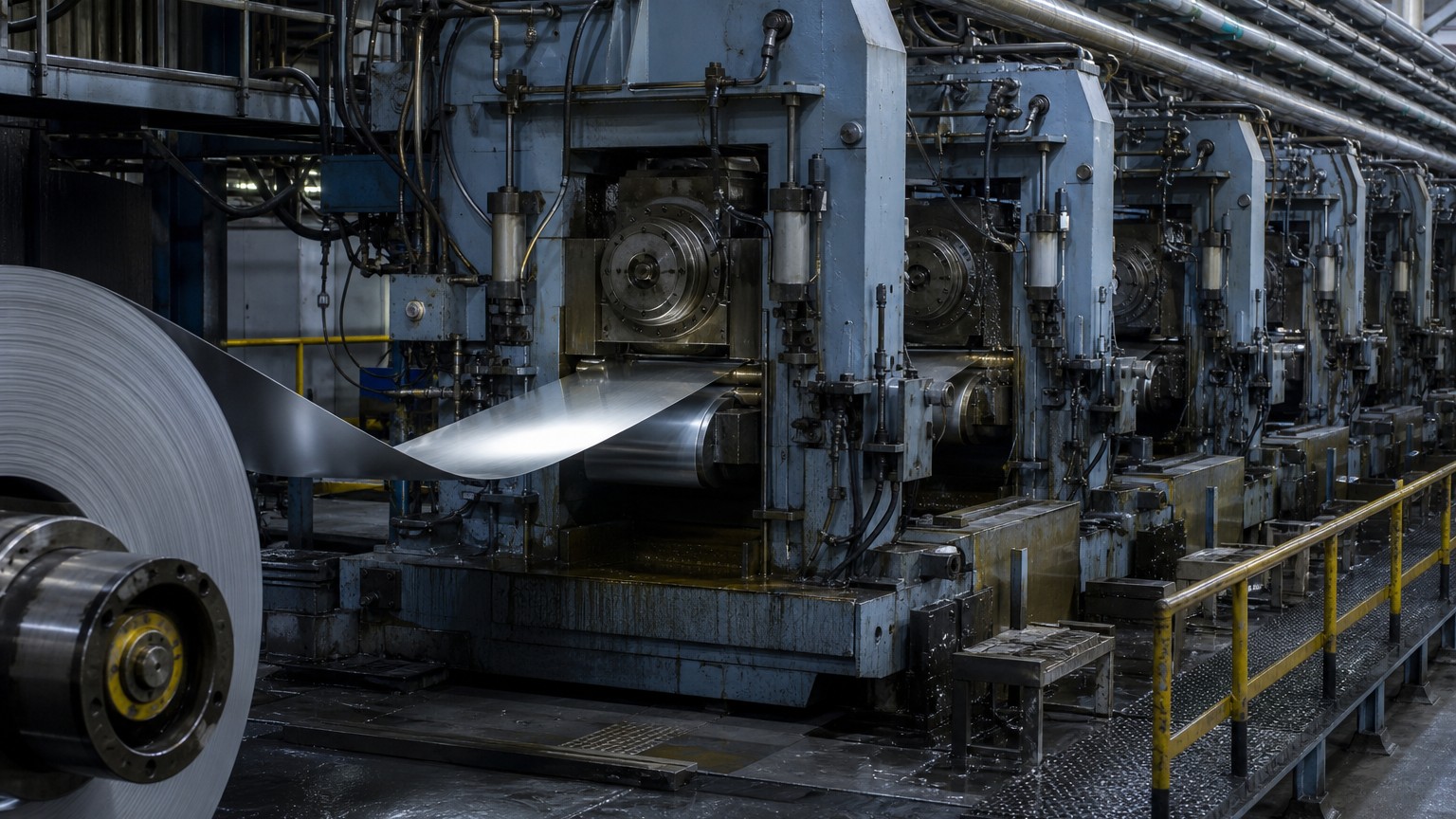
Working steel below its recrystallization temperature strain-hardens it, and the strength increase is commonly quoted at up to about twenty per cent, which is why a cold rolled coil is stronger than a hot rolled coil of the same base grade. The harder work rolls and the absence of high-temperature oxidation also deliver a far smoother surface and much tighter thickness control. Cold rolling cannot take the same reduction per pass as hot rolling, so a cold mill uses several stands or several passes — and that is why cold rolled coil is generally a thinner product. The work-hardened strip is then annealed and temper rolled to reach the commercial tempers that customers actually order, which is where the familiar designations such as full hard, half hard, quarter hard, skin passed and annealed originate.
Pour the same coil through both routes and you get two products that share a chemistry and almost nothing else. Surface, tolerance, strength and formability all move together, which is exactly why the choice should be driven by the forming operation and the visible face of the finished part rather than by price per ton. Our own hot rolled steel coil range is supplied in the as-rolled and pickled conditions that most roll-forming and structural lines require.
What Are the Mechanical and Dimensional Differences Between the Two Coils?
The two products are not substitutes at different prices. They are different materials with different limits.
Hot rolled coil generally runs from about 1.5 mm to 12 mm, with wider tolerances and a scaled surface. Cold rolled coil runs thinner, from roughly 0.3 mm to 2 mm, with far tighter gauge and flatness tolerances and a smooth, uniform surface.
What the numbers mean in practice
The most useful way to read a coil comparison is to ask what each difference does to your process. Thickness tolerance decides whether a stamping press produces a consistent part or a scatter of near-misses, because the press gap is set once and the material must respect it. Flatness and crown decide whether a laser-cut blank stays on the table or lifts an edge into the cutting head. Yield strength decides whether a bend springs back within tolerance or needs a correction pass. Surface condition decides whether a visible panel can go straight to the paint line or needs grinding, pickling or a full pretreatment.
Those four questions map cleanly onto the two routes. Hot rolled coil is made in heavier gauges because the process removes thickness efficiently at temperature, and it carries a scale layer that must be removed before any coating that the customer will see. Cold rolled coil is made in lighter gauges because the cold mill takes smaller reductions per pass, and its smooth surface plus tight gauge control is what makes it the default substrate for exposed automotive panels, appliance skins, furniture and pre-painted products. Strength behaves in the same direction: the same base steel comes out of the cold mill harder than it left the hot mill, and that extra strength is either useful — a thinner part carrying the same load — or a nuisance, when deep drawing is required and the material must be annealed back to a workable state. The table below sets the two routes side by side on the properties that decide a purchase.
| Property | Hot rolled steel coil | Cold rolled steel coil |
|---|---|---|
| Rolling temperature | Above the recrystallization temperature | Below the recrystallization temperature |
| Typical thickness range | About 1.5 mm to 12 mm (heavier gauges on request) | About 0.3 mm to 2 mm |
| Surface condition | Mill scale as rolled; pickled and oiled on request | Smooth, uniform, annealed and temper rolled |
| Thickness tolerance | Wider, typically a few per cent of nominal | Tight and closely held across the coil |
| Strength, same base grade | Lower, fully recrystallized structure | Higher, work-hardened by cold reduction |
| Formability for deep drawing | Limited by scale and gauge variation | Good to excellent in the annealed and drawing qualities |
| Relative cost | Lower per ton — fewer process steps | Higher per ton — extra pickling, reduction, annealing, tempering |
| Typical uses | Structural and general fabrication, pipe and tube making, roll forming, heavy components | Appliances, automotive panels, furniture, pre-painted and coated products |
The practical reading of that table is that the extra cost of a cold rolled coil is not premium for its own sake. It buys several additional process steps, each of which removes a specific source of variation — scale, gauge scatter, hardness variation — and a buyer should only pay for it when the end product actually needs one of those steps removed. Our hot rolled steel coil Q235B in 3.0 mm is a working example of the heavier end of that range, supplied in the coil form that roll-forming and general fabrication lines run every day.
Where Should You Use Hot Rolled Coil, and Where Does Cold Rolled Coil Win?
Application decides the route far more reliably than price does — and the wrong choice shows up at the press, not at the warehouse.
Choose hot rolled coil for structural fabrication, pipe and tube making, roll-formed sections and parts that will be ground or painted after forming. Choose cold rolled coil where the surface is visible or the gauge tolerance is tight — appliances, automotive panels and coated products.
The dividing question: what happens after the coil is uncoiled?
The single question that settles most coil decisions is what the next operation does to the strip. If the strip is slit and fed into a roll-forming line that turns it into a hollow section, a purlin or a guard rail, the finished face is either hidden or coated afterwards, and nothing in the process punishes a scaled surface. Hot rolled coil is the correct and economical answer, and a pickled-and-oiled variant handles the cases where the forming line cannot tolerate scale at all.
If the strip is blanked and drawn into a component whose surface will be seen by an end customer — a refrigerator door, a washing machine side panel, a filing cabinet, a light fixture — then every property of the cold route is doing necessary work. The smooth surface accepts a paint or a powder coat without a pretreatment that would cost more than the material difference. The tight gauge keeps a deep draw from tearing. The uniformity keeps a visible panel free of the orange-peel effect that follows from gauge variation and coarse grain.
Where the boundary is blurred, and where it is not
The boundary is genuinely soft in a few places. A pickled and oiled hot rolled coil often displaces a cold rolled coil in applications that need a clean surface but not a thin gauge or a drawing-quality microstructure, and that substitution is normally a straightforward saving. A cold rolled coil, however, has no substitute in the other direction: you cannot deep draw a 6 mm hot rolled plate into an appliance housing, and you cannot buy a 0.5 mm hot rolled coil at commercial scale at all.
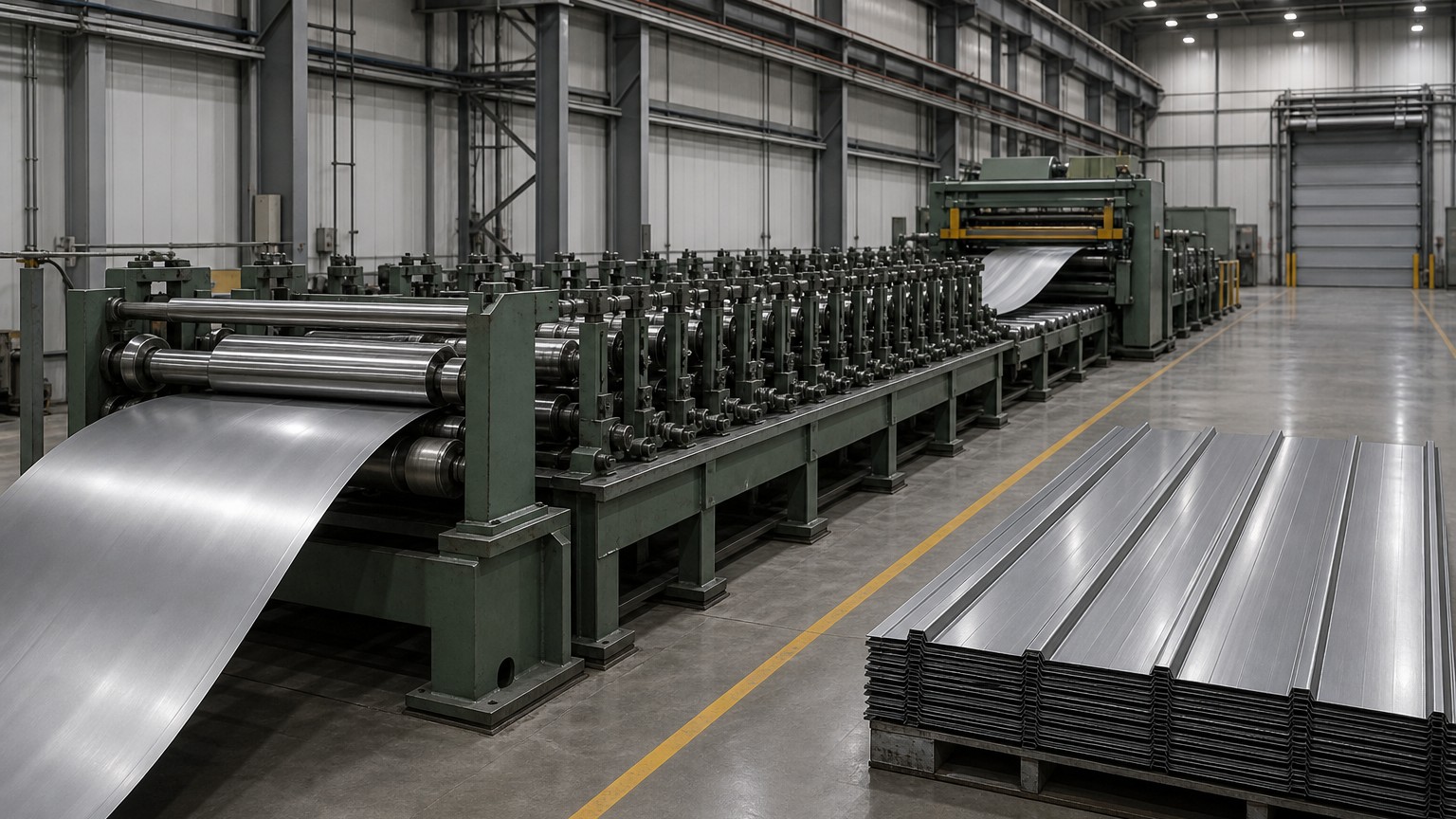
Coated products are a useful illustration of how the two routes feed each other rather than compete. A continuously galvanized or a pre-painted coil is built on a substrate whose surface quality is inherited from the base coil, so the coating operation is intolerant of scale and of gauge scatter — which is why the strip going into a coating line is almost always a cold rolled one. That inheritance is described in our guide to how coated coil is specified and produced, where substrate condition is treated as a process variable rather than a purchasing detail.
Which Standards and Grades Apply to Hot Rolled and Cold Rolled Coil?
A coil that meets a standard is not the same as a coil that meets your process — but the standard is where every argument has to start.
Hot rolled carbon sheet and strip is commonly ordered to ASTM A1011/A1011M; cold rolled carbon sheet to ASTM A1008/A1008M. Overseas buyers also meet EN 10130 and JIS G3141 designations such as DC01 and SPCC, while Chinese mills supply Q235B and SPHC to GB standards.
What each specification actually controls
Standards for flat products do two jobs. They fix the chemical composition and the mechanical property limits — yield strength, tensile strength, elongation — and they fix the dimensional and surface requirements: thickness tolerance, width tolerance, camber, flatness and the permitted surface imperfections. A buyer who quotes a grade without quoting a standard has specified half a product, because the same grade name can carry different tolerance tables in different systems.
The named specifications map onto the two routes in a predictable way. Hot rolled carbon sheet and strip for structural and general purposes is covered by the ASTM A1011/A1011M specification, while cold rolled carbon sheet is covered by ASTM A1008/A1008M. On the international side, ISO 3574 governs cold-reduced carbon steel sheet of commercial and drawing qualities and applies specifically to applications where surface is of prime importance — a wording that neatly captures what the cold route is sold for. In European practice the cold rolled family appears as EN 10130, and in Japanese practice as JIS G3141, where designations such as SPCC denote commercial-quality cold-reduced sheet. On the hot side, GB/T 700 supplies the familiar structural grades, and Q235B is the workhorse: a general structural steel with a specified minimum yield strength of 235 MPa, widely produced and widely traded.
Where specification mistakes actually happen
Most specification errors are not exotic. The first is quoting a grade without a standard, which leaves the tolerance table undefined and makes two offers technically incomparable even when the price looks identical. The second is quoting a surface condition as a word rather than a requirement: “pickled” without a surface quality class, or “galvanized” without a coating weight. The third, and the most expensive, is quoting the thickness of a coil without declaring whether the tolerance is applied to the nominal thickness, the minimum thickness, or the average across the coil — because a mill optimising to the minimum will ship a product that passes its own inspection and fails yours.
The fourth is forgetting that a coil is inspected as a coil. Mill certificates, coil identification and traceability matter more than they do for cut sheet, because once a coil is uncoiled and slit into narrower strip the link between a finished part and its heat number is only as good as the record kept at receiving. Our carbon steel product range is supplied with mill test certificates and batch traceability for exactly this reason, whether the order is plate, coil or pipe.
How Do You Specify and Buy Steel Coil Without Costly Mistakes?
Most coil disputes are decided at the enquiry, months before anyone sees the material.
Specify seven things before requesting quotations: grade and standard, thickness with its tolerance basis, width, coil weight or inner diameter, surface condition, edge condition, and packing with the destination port. Only then are offers comparable.
The seven-line enquiry that removes the guesswork
Start with the material. Name the grade and the standard together — for example a hot rolled structural coil to a named specification, or a cold-reduced carbon sheet of a stated drawing quality — rather than a grade name alone. Then state the thickness and, in the same line, whether the tolerance is applied to nominal, minimum or average thickness, because that single clause changes the tonnage a mill will quote you and the price it will hold.
Width comes next, with the edge condition. A mill edge and a slit edge are different products with different burr conditions, and a slitting operation adds both cost and lead time. Then the coil parameters that decide handling: coil weight range and inner diameter, since a line with a fixed mandrel cannot load a coil whose bore does not match. Surface condition must be explicit — as rolled, pickled and oiled, annealed, or a specific temper such as full hard or quarter hard — and coating weight belongs here if the coil is coated rather than bare.
Finally comes packing, which is routinely the most underestimated line. Coils travel by sea and are stored outdoors at both ends of the voyage, so whether a coil is wrapped in VCI paper, steel-strapped, eye-to-sky with edge protectors, or shipped on a cradle changes both the rust risk and the loading plan. Our team will review a coil specification line by line before quoting, and it is worth sending the intended process route as well as the material specification: if the strip will be drawn, slit, laser cut or coated, saying so often reveals a substitution that saves money without changing the finished part.
For buyers working with an existing drawing, the fast route is to send the drawing and the annual or monthly volume together, because volume is what makes a mill coil order economic against a stock purchase. If the specification is still open on any of those seven points, send your coil specification for a quotation and let our export team confirm grade, tolerance basis and packing before you commit to a purchase order.
Conclusion: Which Coil Should You Specify?
Match the route to the forming operation: hot rolled for heavier or hidden work, cold rolled where the surface is seen. Confirm grade, standard and tolerance basis before comparing prices.