
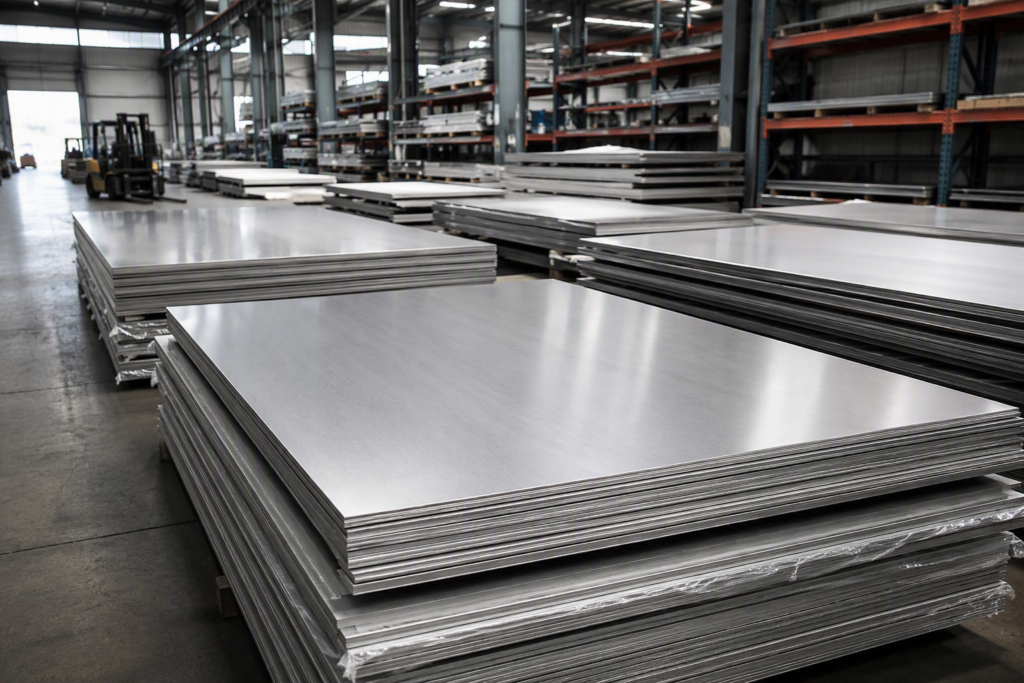
304 vs 316 Stainless Steel Plate: Key Differences and How to Choose
If you are sourcing stainless steel plates for an industrial project, you have almost certainly faced the same question: 304 or 316? Both are austenitic stainless steels with excellent corrosion resistance, but they are not interchangeable. Choosing the wrong grade can mean premature rusting, higher maintenance costs, or an unnecessarily expensive material budget. This guide breaks down the real differences between 304 and 316 stainless steel plate and gives you a practical framework for deciding.
What Is a 304 Stainless Steel Plate?
304 is the most widely used stainless steel grade in the world. It contains approximately 18% chromium and 8% nickel, which is why it is sometimes called “18/8” stainless steel. The high chromium content forms a protective oxide layer on the surface that resists corrosion in most atmospheric and mild chemical environments. Common applications for 304 stainless steel plate include food processing equipment, kitchen appliances, architectural cladding, storage tanks, and general industrial fabrication. It is a versatile, cost-effective choice when the environment is not aggressively corrosive.
What Is a 316 Stainless Steel Plate?
316 stainless steel adds approximately 2% molybdenum to its composition (about 16% chromium, 10% nickel, 2% molybdenum). Molybdenum is the key difference: it significantly improves resistance to chlorides and industrial chemicals, especially pitting and crevice corrosion in saltwater environments. Because of this, 316 stainless steel plate is the standard choice for marine applications, chemical processing plants, pharmaceutical equipment, coastal architecture, and any environment exposed to de-icing salts or seawater. The 316L variant (low carbon) is preferred where welding is involved, as it minimizes carbide precipitation and maintains corrosion resistance in the heat-affected zone.
Key Differences Between 304 and 316 Stainless Steel Plate
| Property | 304 Stainless Steel Plate | 316 Stainless Steel Plate |
|---|---|---|
| Chromium content | ~18% | ~16% |
| Nickel content | ~8% | ~10% |
| Molybdenum | None | ~2% |
| Corrosion resistance | Good (atmospheric, mild chemicals) | Superior (chlorides, saltwater, acids) |
| Pitting resistance | Moderate | High |
| Weldability | Excellent | Excellent (316L preferred) |
| Relative cost | Lower | Higher (roughly 20–30% more) |
| Typical uses | Food equipment, architecture, tanks | Marine, chemical, pharmaceutical, coastal |
How to Choose Between 304 and 316
Ask yourself three questions before ordering:
- Will the plate be exposed to chlorides or salt? Coastal construction, marine equipment, chemical plants, and environments with de-icing salts demand 316. Chlorides are the most common cause of pitting corrosion on 304.
- What is the operating temperature? Both grades perform well across a wide temperature range, but for highly corrosive chemical processes at elevated temperatures, 316 is the safer choice.
- What is your budget and service life target? 304 is more economical upfront and is perfectly adequate for most interior and dry environments. If the installation is hard to replace or maintain, the extra cost of 316 often pays for itself over the asset’s lifetime.
If your project environment is not aggressively corrosive, 304 stainless steel plate gives you excellent value. If the plate will live near the coast, in a chemical plant, or anywhere chlorides are present, spec 316 and protect your investment.
Where to Buy Stainless Steel Plates
When sourcing stainless steel plates, work with a supplier that can provide full specifications, mill test certificates, and consistent thickness tolerances. Shaanxi Shuncheng Tian Steel supplies 304, 304L, 316, and 316L stainless steel plates in a wide range of sizes and finishes (2B, No.1, No.4, mirror), with strict quality control on every delivery. Contact our team for a quotation tailored to your project requirements.
FAQ
Is 316 stainless steel worth the extra cost?
In marine and chloride-rich environments, yes. The additional molybdenum prevents pitting and crevice corrosion that would eventually require costly replacement of 304 plates.
Can 304 and 316 plates be welded together?
They can be welded using appropriate filler material (typically 316L filler), but the welded joint will only offer corrosion resistance equivalent to the less resistant base metal, so consider the environment carefully.
How can I tell 304 and 316 apart?
They look almost identical. A chemical spot test (molybdenum test) is the reliable field method, or request the mill test certificate from your supplier to verify the grade. Need help selecting the right stainless steel plate grade for your project? Contact Shuncheng Steel for expert guidance and a fast quotation.