
Square vs Round Steel Tube: Which Profile for Your Application?
Every structural or mechanical project that needs hollow steel sections eventually faces the same specification question: square or round? The two profiles look similar in a product photo and can even share the same wall thickness and nominal size, yet they behave differently under load, connect to other members in different ways, and carry different price tags in most markets. Choosing the wrong one usually means rework on site, extra fabrication cost, or a structure that is heavier than it needs to be.
This guide compares square vs round steel tube across the factors that actually drive material selection — geometry and strength, torsion and bending behaviour, connection and fabrication ease, corrosion protection, and typical applications — so you can specify the right profile for your application the first time and compare supplier quotes on an equal basis.
Square vs Round Steel Tube: What Is the Real Difference?
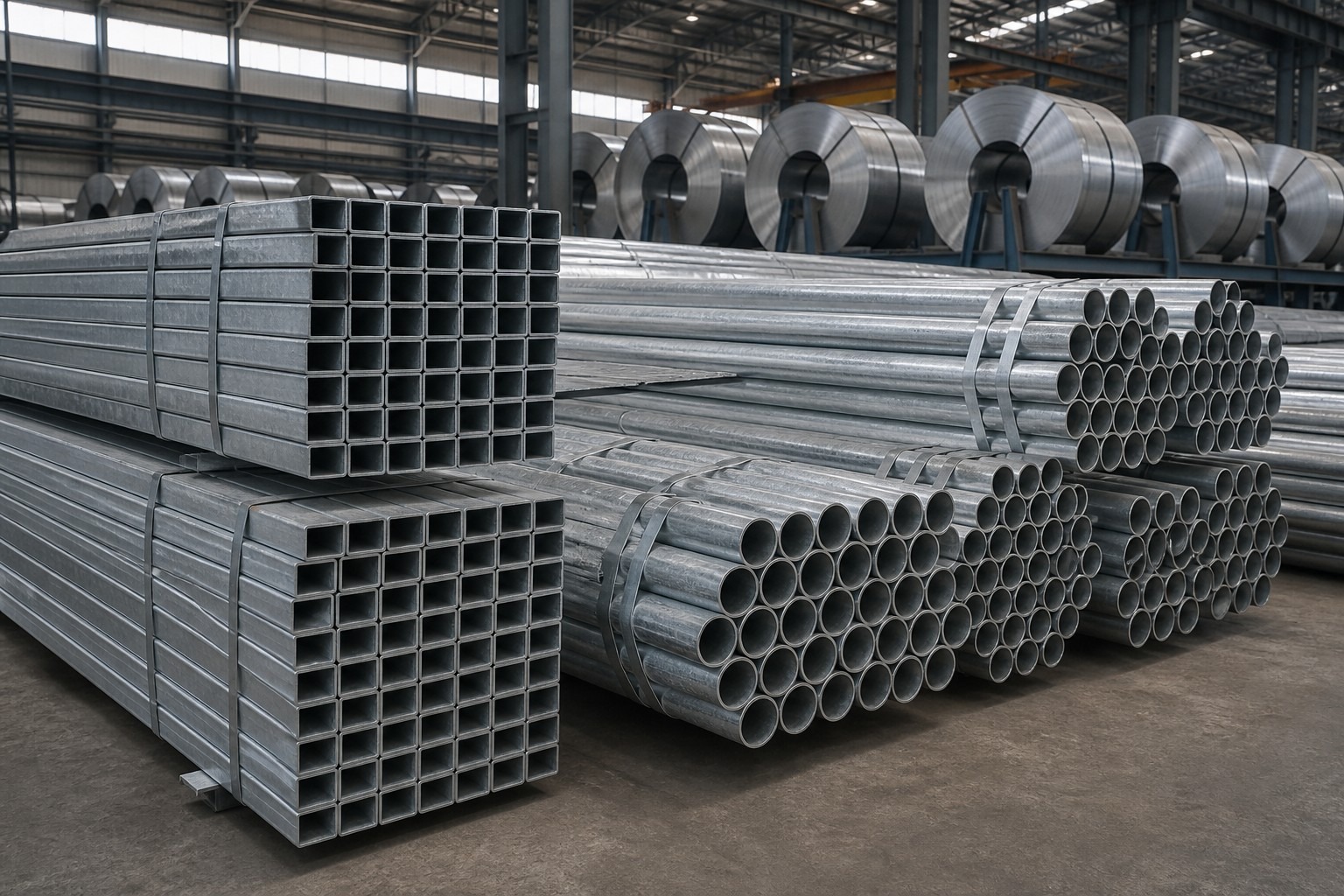
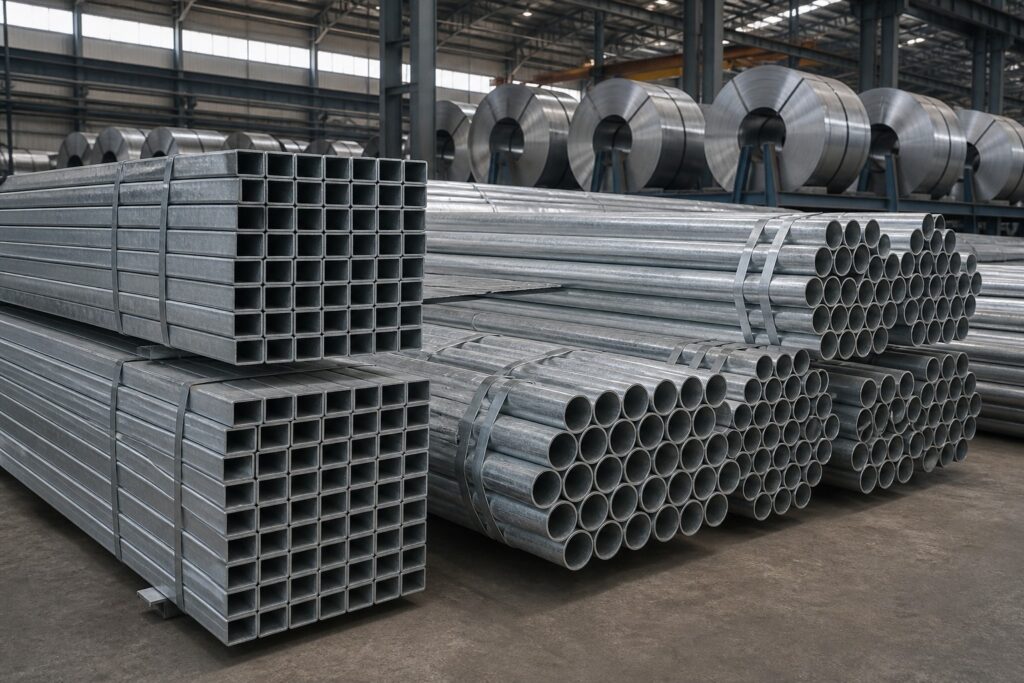
Both profiles belong to the family known internationally as hollow structural sections (HSS). In European and many other markets the same products are labelled CHS, SHS and RHS — circular, square and rectangular hollow sections — and they are dimensioned by their outer size and wall thickness rather than by pipe nominal sizes. As the reference article on hollow structural sections explains, these are structural profiles, not pressure piping: HSS dimensions are based on the exterior profile, and their corners are rounded to a radius of roughly twice the wall thickness.
Square tube is a square hollow section with four flat faces and rounded corners; round tube is a circular hollow section with a uniform curved surface. Because the geometry differs, the way each section distributes material around its centre determines its performance under different types of loading — which is the heart of the square vs round steel tube decision.
Structural Performance: Bending, Compression and Torsion
The single most useful engineering fact about these two shapes is that round hollow sections distribute material evenly around the neutral axis, while square sections concentrate more of the material away from the centre in two perpendicular planes. Each arrangement wins in different situations:
- Round tube is the most efficient shape for torsion and for compression in any direction. Because a circle is symmetric around every axis, a round section resists twisting loads better than a square section of the same area, and it has no preferred weak direction. This is why round tube is the default for torque-transmitting members, columns that may be loaded from any direction, and lattice or frame members in which forces arrive from changing angles.
- Square tube is more efficient when the load direction is known and connections need flat faces. For a column or beam bending about one known axis, a square section can be oriented to present its strongest axis to the load, and its flat sides simplify bolting, welding and clamping. Square sections also behave well under loading from two perpendicular directions because their geometry is uniform about both axes.
In practice this means: if your member is loaded mostly in one or two known directions and must connect to other members — frames, racks, gates, supports — square tube usually wins on fabrication simplicity. If the member is a column in an open structure, a torque shaft, or anything where loads arrive from unpredictable directions, round tube is usually the better structural choice.
| Comparison point | Square tube (SHS) | Round tube (CHS) |
|---|---|---|
| Cross-section | Flat faces, rounded corners | Uniform curved surface |
| Bending about a known axis | Efficient; orientable to the load | Efficient; equal in all directions |
| Torsion resistance | Good but lower than round for same area | Best shape for torsion |
| Connection ease | Flat faces: simple welds, bolts, clamps | Curved surface: saddles, cope cuts, sleeves |
| Appearance | Clean modern lines, architectural | Traditional, smoother silhouette |
| Typical relative cost | Varies by market and size | Varies by market and size |
Standards govern these products tightly. In North America, cold-formed welded and seamless structural tubing is produced to ASTM A500/A500M, which covers round, square, rectangular and special shapes for welded, riveted or bolted construction of bridges and buildings. In Europe, the equivalent products are defined by the EN 10210 and EN 10219 families, which classify square and rectangular sections as SHS and RHS and circular sections as CHS. Whatever standard applies to your market, the grade, size and tolerance should always be confirmed in writing against the mill certificate before shipment.
Galvanized Square and Round Tube: Corrosion Protection Matters
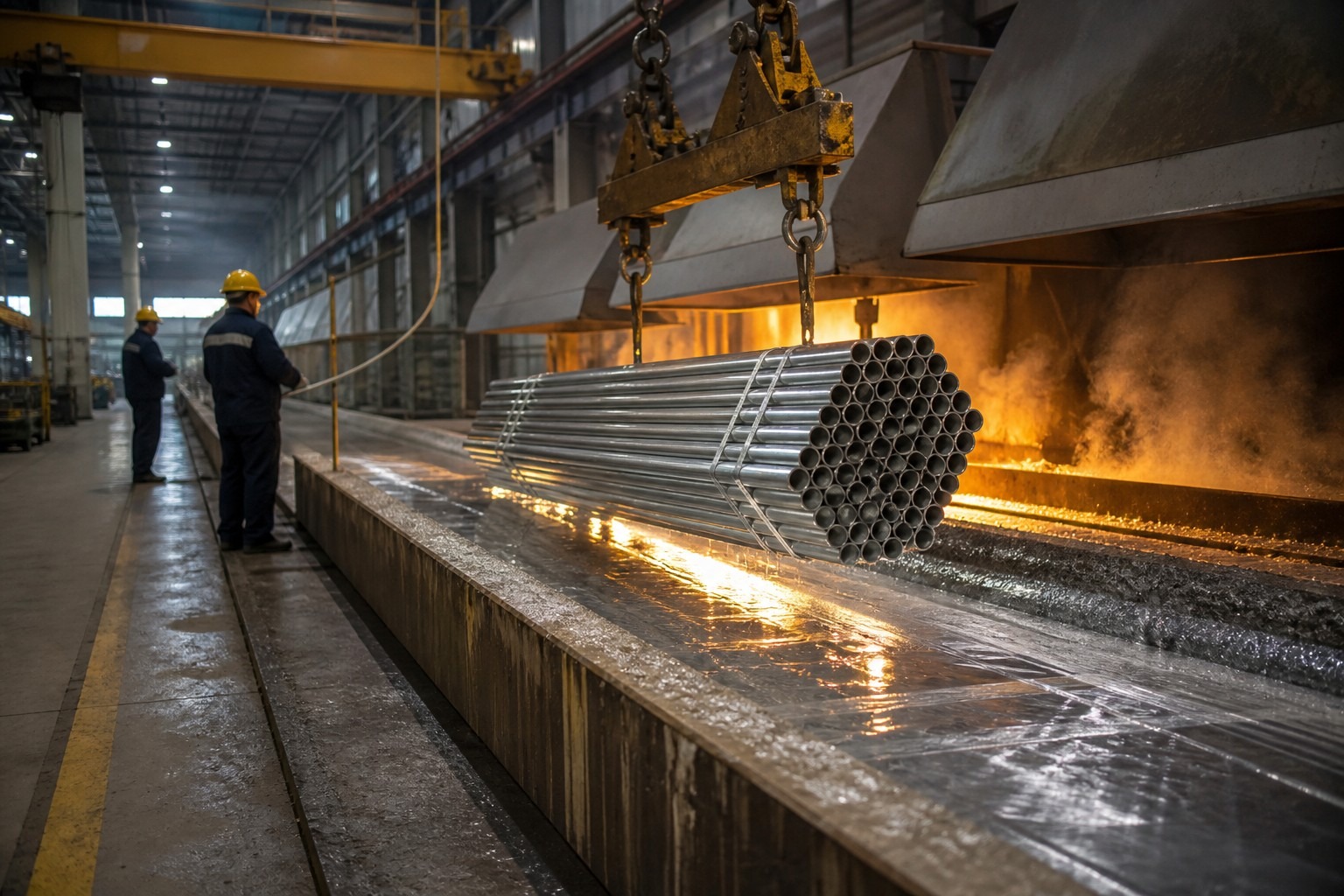
For outdoor, humid or coastal applications, structural tube is usually supplied galvanized. Galvanization coats the steel with zinc, which corrodes preferentially and protects the base metal; when the zinc is applied by immersion in molten zinc at around 450 °C it is called hot-dip galvanization, producing a metallurgically bonded coating that resists mechanical damage far better than thinner electroplated layers. For hollow sections, hot-dip galvanizing coats both the outside and the inside surface of the tube, which is important because the interior of a sealed or semi-sealed section is otherwise impossible to protect after fabrication.
Coating weight is specified per square metre of surface — common designations such as Z180 or Z275 refer to grams of zinc per square metre on continuously galvanized strip, while batch hot-dip galvanizing of finished tube is usually specified by average coating thickness in micrometres. The choice affects service life directly: heavier coatings last longer in aggressive environments but add cost, and the internal coating of square and round tube is limited by how easily the molten zinc drains from the corners and the curved surfaces. For galvanized square tube, corner geometry can influence coating distribution, which is one more reason to specify the coating requirement explicitly and confirm it on the certificate.
Applications: Where Square Tube Wins, Where Round Tube Wins
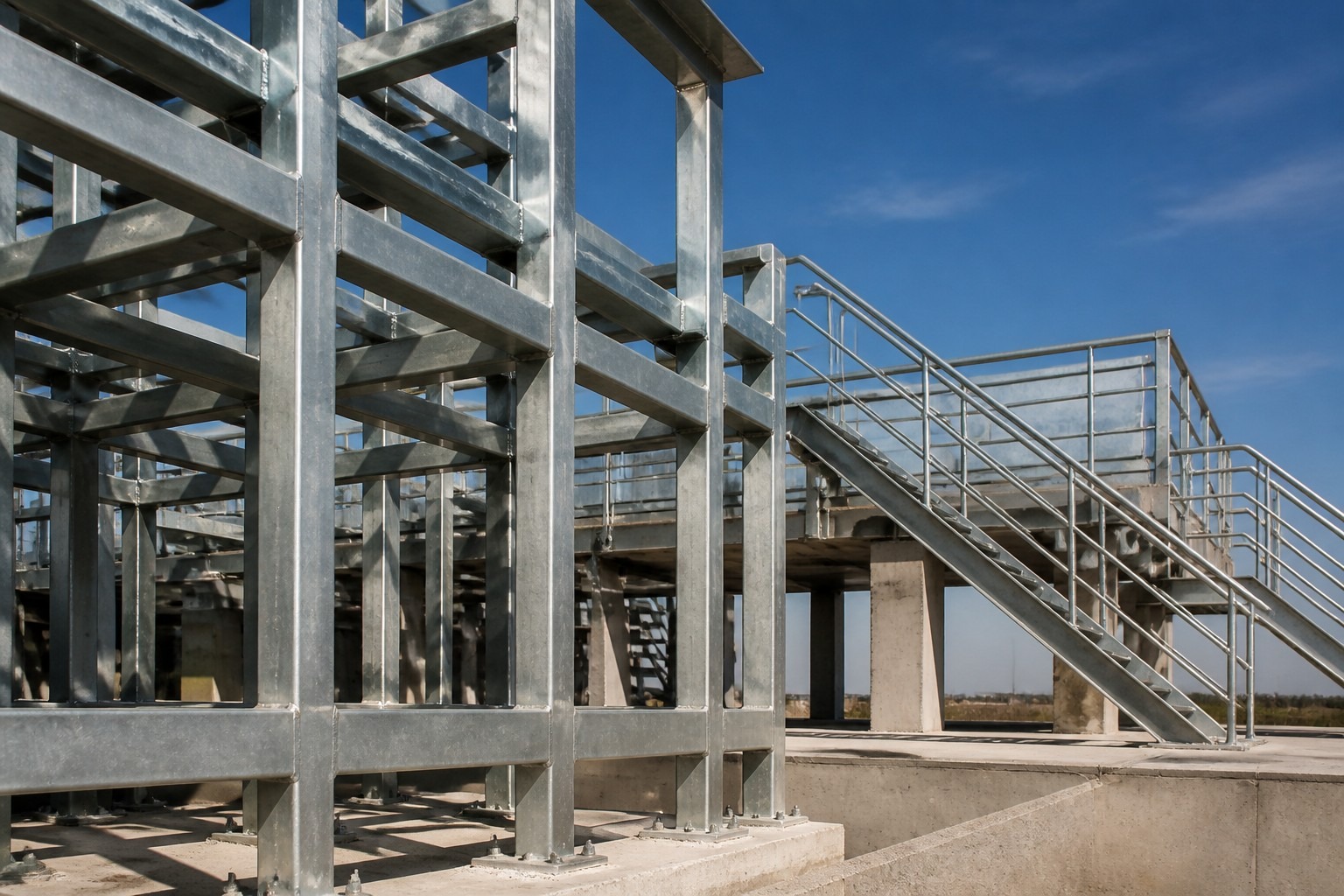
The practical selection rule mirrors the structural facts above. Choose square or rectangular tube when the member is a frame element with known load directions and bolted or welded connections:
- Square tube is the workhorse for: structural frames and mezzanine supports, gates, doors and fencing panels, machine frames and equipment stands, racks and shelving, solar panel mounting structures, and architectural exposed steel where flat surfaces and clean lines are wanted. The flat face also makes it easy to mount brackets, hinges and fixings without curved-surface adapters.
- Round tube is preferred for: handrails, balustrades and guardrails (comfortable to grip and no sharp edges), playground and street furniture, flagpoles and lighting columns, torque-transmitting and drive components, vehicle roll structures, and columns in open structures where loads can arrive from any direction.
- Combined use is common: many projects use round tube for posts or railings and square tube for the structural frame, choosing each profile where it works best and connecting them with standard fittings or site welding.
Because tube is a structural product rather than a pressure-carrying pipe, fluid conveyance is normally outside its design role — if your application carries pressurized liquids or gases, a steel pipe manufactured to pipe standards is the correct product family. The difference is worth repeating because buyers sometimes cross-specify by mistake: structural tube is dimensioned by outer size and wall thickness for load-bearing duty, while pipe is dimensioned by nominal size and schedule for pressure duty.
How to Choose Between Square and Round Steel Tube
Work through this checklist when comparing square vs round steel tube for a new project:
- Define the loading. Is the member primarily in compression, bending, or torsion? Torsion and unpredictable load directions favour round tube; known one-way or two-way bending favours square tube.
- Design the connections. Count how many brackets, bolts, hinges or clamps attach to the member. More connections strongly favour square tube’s flat faces.
- Check the environment. Outdoors, coastal or humid conditions call for galvanized or otherwise coated tube — confirm the coating specification and weight with the supplier.
- Confirm the standard and grade. State whether the project is specified to ASTM A500, EN 10219, or another standard, and require the mill test certificate to match the ordered grade, size and coating.
- Compare like for like. When requesting quotes, compare the same size, wall thickness, grade, coating and standard — never only the headline price per ton, because a lighter coating or a thinner wall will always look cheaper on paper.
Wall thickness deserves attention too: for the same outer size, a thicker wall increases both load capacity and weight per metre, so over-specifying thickness is one of the most common ways buyers inflate project cost. Ask for the section properties of the exact profile (mass per metre, moment of inertia, section modulus) when comparing offers, and let the engineer confirm the minimum wall that satisfies the design load.
Frequently Asked Questions
Is square or round steel tube stronger?
It depends on the type of loading. For bending about one known axis, a square tube can be oriented to be very efficient, and its flat faces make connections simpler. For torsion and for compression with loads from any direction, round tube is structurally more efficient because its material is distributed evenly around the centre. The honest answer is that “stronger” cannot be judged without knowing the load case and the section size.
Is square tube more expensive than round tube?
Prices vary by market, size and coating, and no fixed rule applies in every season. Square tube often carries a small premium over round in some sizes because of the extra forming steps in the shaping mill, but the difference is usually modest compared with the cost of the coating and the grade. Request both options for your exact size and compare section properties — the more meaningful saving is usually in matching the wall thickness to the real design load.
Can square and round tube be welded together?
Yes. Both are weldable carbon or galvanized steel sections; when welding galvanized tube, the zinc coating in the weld area must be removed first and re-coated afterwards, because welding over zinc produces fumes and weakens the joint. For structural connections between the two profiles, the fabricator will either cope the round member to fit the flat face of the square member, or use purpose-made fittings.
Is galvanized tube suitable for outdoor use?
Yes — that is its main purpose. Hot-dip galvanized tube resists atmospheric corrosion for decades in most environments, and the coating protects the outside and inside surfaces of the section. Service life depends mainly on the coating weight and the aggressiveness of the local environment, so coastal and industrial sites generally need heavier coatings.
Specify the Profile Correctly, Then Compare Prices
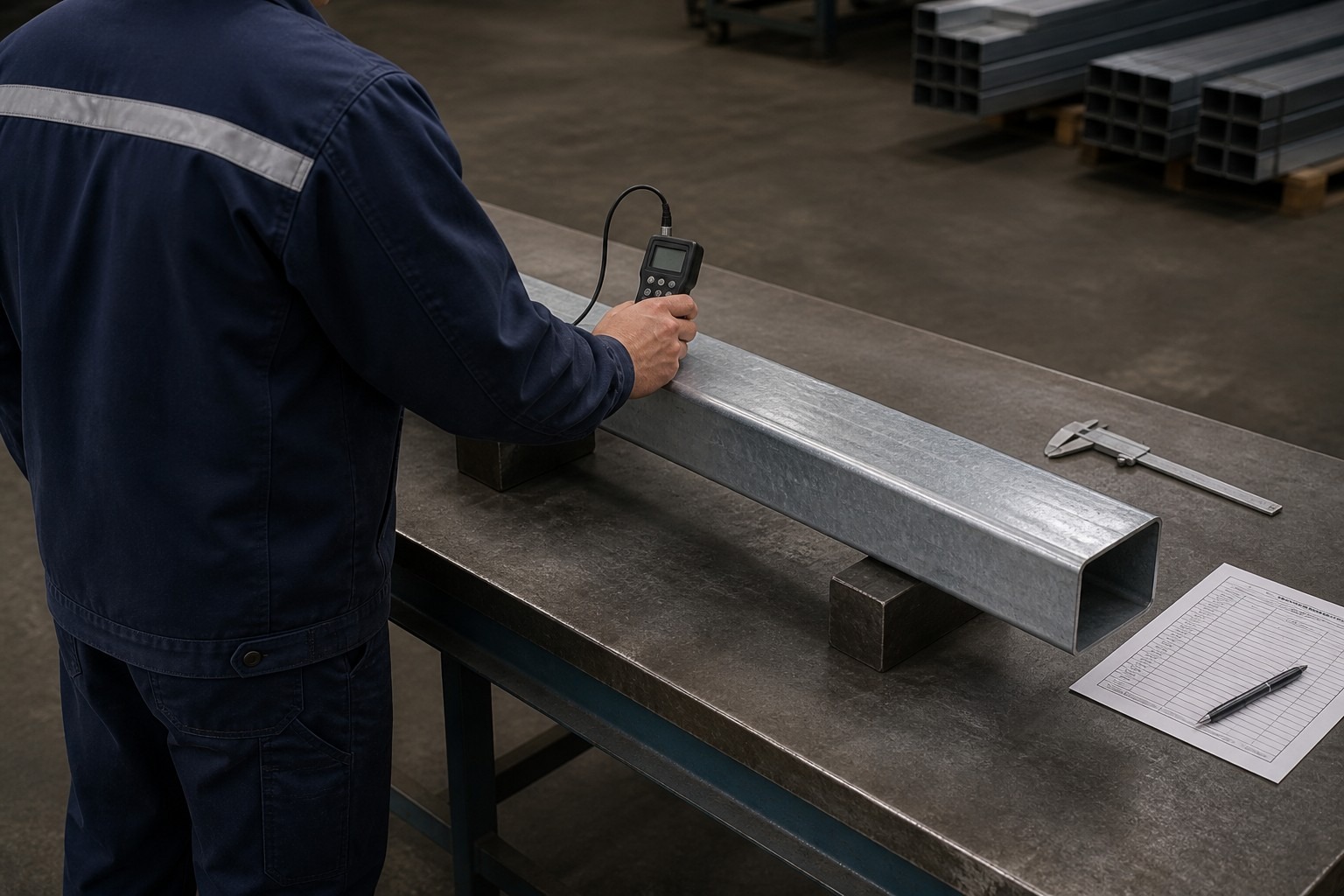
The most expensive mistake in buying steel tube is comparing offers that are not on the same specification basis. Fix the profile, outer size, wall thickness, grade, standard and coating first — then let suppliers quote against that fixed baseline. Whether you need square tube for a frame, round tube for handrails, or a mixed package for a complete structure, sending the drawing or the load requirements is the fastest way to get a specification that matches the job instead of a generic catalogue price.
For galvanized hollow sections supplied in common structural sizes, explore our range of galvanized steel tube in square and round profiles. If your project is already specified, see today’s related product, a galvanized square steel tube 50×50 mm with 2.5 mm wall, commonly used for frames, gates and support structures. Contact Shuncheng Steel with your sizes, quantities and target standard for mill-direct pricing and full test-certificate support.
When the profile choice lands on a heavy square section for racking or mezzanines, the 50x50mm galvanized steel tube page shows the 2.5 mm wall and Z200 coating options we stock.
Related Reading
New to hollow sections and how they differ from pipe? Our guide on seamless vs welded pipe explains the manufacturing and testing logic of tubular products, and the steel pipe schedule chart article covers how wall thickness is expressed in the pipe world. For a broader look at how cold-formed steel sections are made and used, the overview of cold-formed steel is a useful technical primer.