
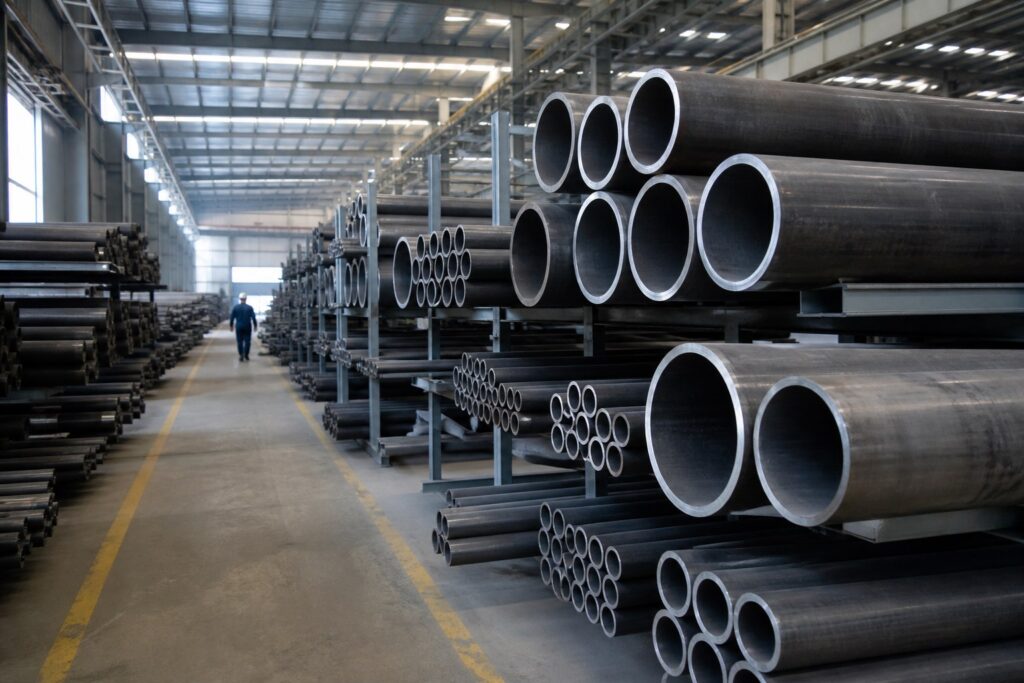
Steel Pipe Schedule Chart: Sch 10 to Sch 160 Wall Thickness
When a buyer asks for “a 6-inch steel pipe”, no quotation can be written yet. “6-inch” is only the nominal size: it fixes the outside diameter, but the wall thickness can be anything from a thin Sch 10S skin to a heavy Sch 160 shell. That one number — the pipe schedule — decides the pressure rating, the weight per meter, the price per ton, the welding preparation and, in many cases, whether the pipe satisfies the project code at all. This guide explains the steel pipe schedule chart from Sch 10 to Sch 160: what schedule numbers actually mean, the real wall thicknesses for the sizes buyers order most often, how schedule choice interacts with material grade, and how to specify the schedule correctly so the pipe that arrives matches the pipe you designed. The dimensions referenced throughout follow the ASME B36.10M wall-thickness series for carbon steel pipe and B36.19M for stainless steel pipe.
What Is a Steel Pipe Schedule?
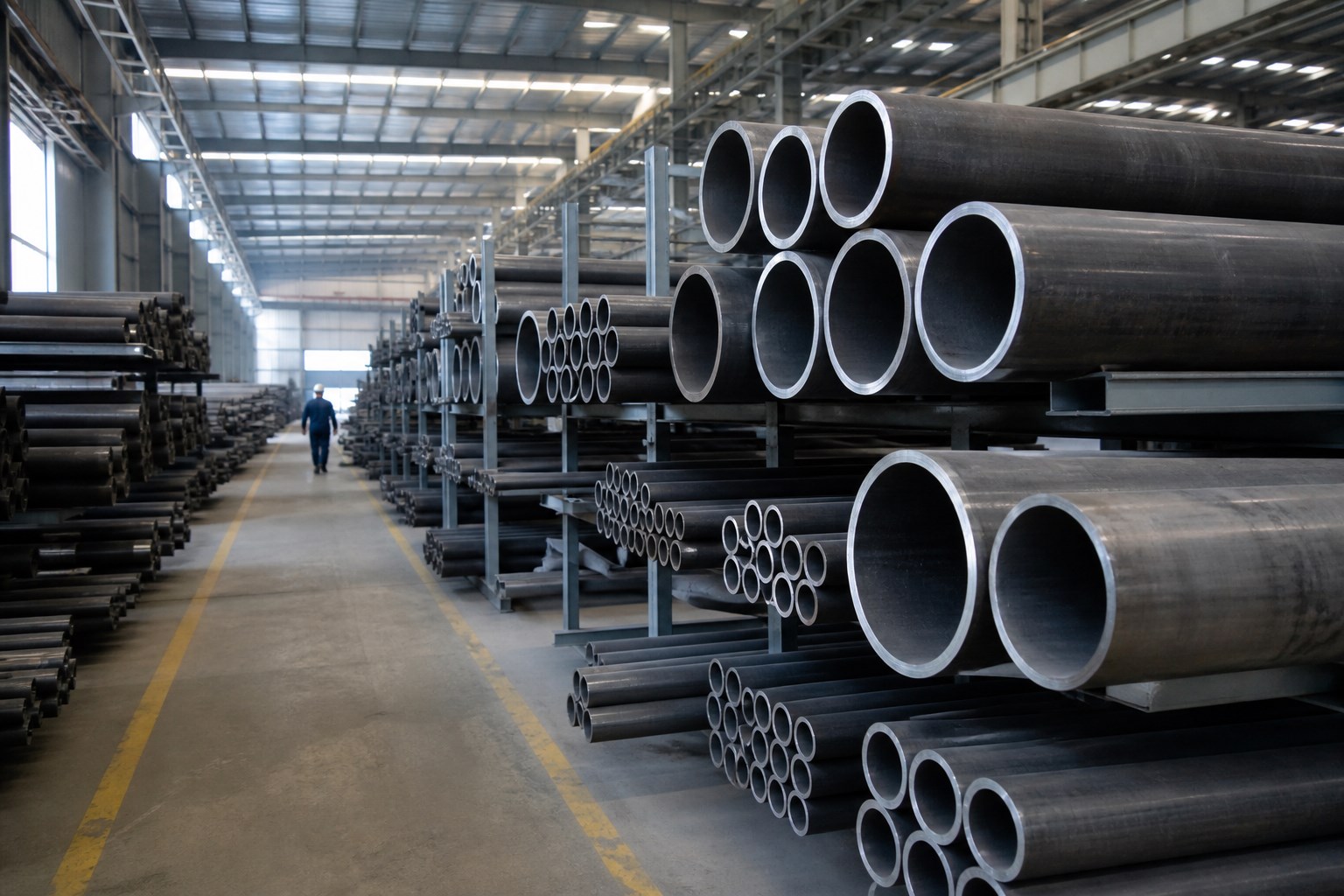
A pipe schedule is the standard designation for wall thickness within the nominal pipe size (NPS) system. For every NPS, the outside diameter is fixed — an NPS 6 pipe is always 6.625 inches (168.28 mm) outside, regardless of wall — and the schedule selects how thick that wall is. Schedule 40 is the everyday default, Schedule 80 is the heavy-workhorse wall, and Schedules 10, 60, 120 and 160 fill the range between thin and very heavy. Stainless steel pipe adds the “S” suffix series (5S, 10S, 40S, 80S) with its own thinner walls. The system grew out of the old iron-pipe designations STD (standard), XS (extra strong) and XXS (double extra strong), which are still used today: STD is identical to Sch 40 up to NPS 10, and XS is identical to Sch 80 up to NPS 8. When you see a schedule chart or a supplier’s dimension table, the same pipe can therefore be described two ways — a habit that causes frequent specification errors in international orders. The schedule number itself is a convenient shorthand rather than a physical measurement: the number is roughly related to the ratio of design pressure to allowable stress for a given size, which is why higher numbers mean thicker walls. Schedule dimensions apply across the whole pipe family: carbon steel seamless steel pipe, welded pipe, stainless pipe, alloy pipe and line pipe all follow the same OD and wall-thickness tables, so a single chart serves most procurement documents.
How Schedule Numbers Work: Fixed OD, Growing Wall
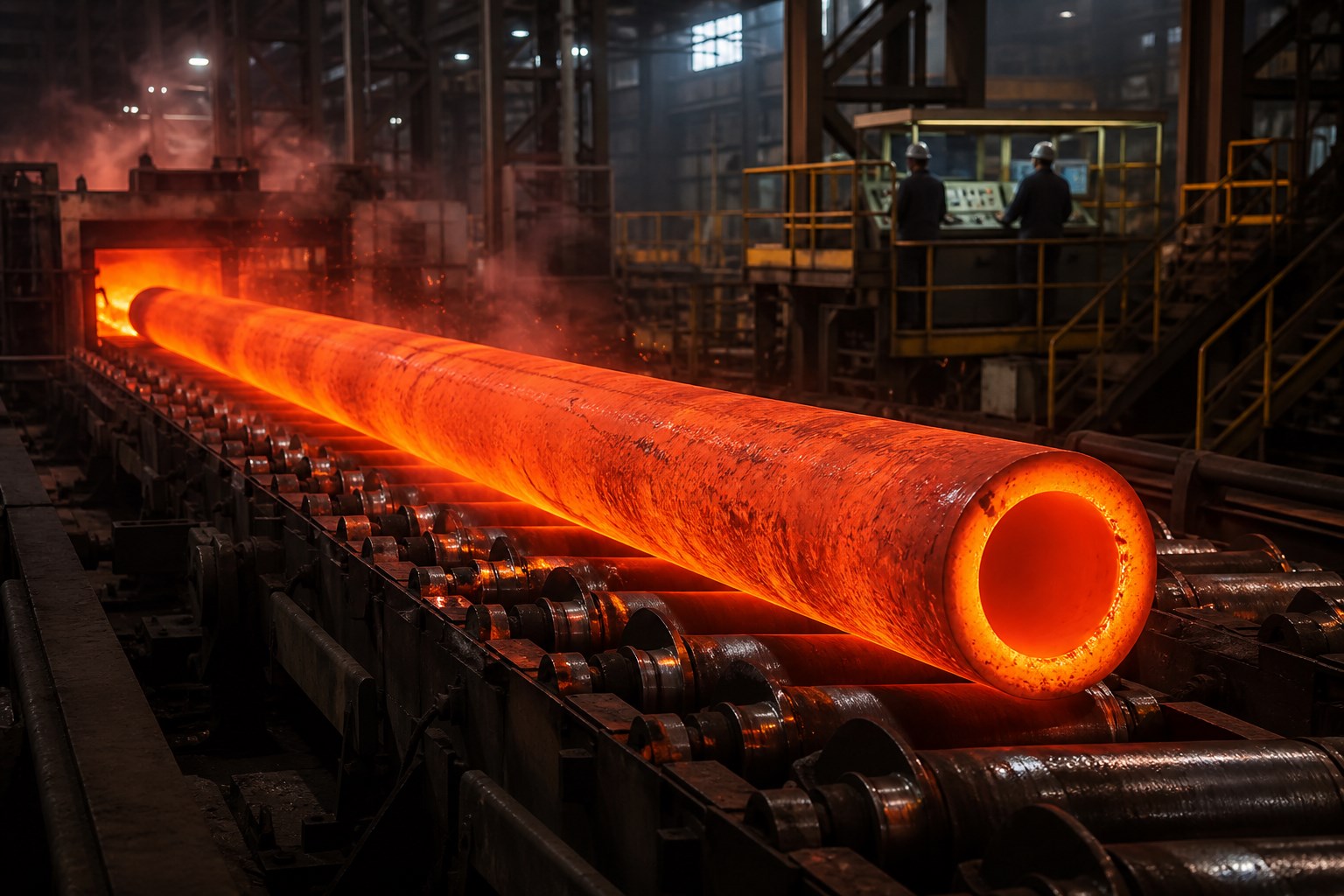
The logic of the system is simple once it is stated: the outside diameter is fixed for each nominal size; the wall thickness increases with the schedule number. An NPS 4 pipe in Sch 10S has an outside diameter of 4.500 inches and a wall of 0.120 inch; the same NPS 4 in Sch 160 has the same 4.500-inch OD but a 0.531-inch wall — nearly 4.5 times thicker, and correspondingly a smaller inside diameter (about 3.438 inches). This is why a schedule can never be chosen independently of the size: pressure capacity is a function of the wall thickness relative to the diameter, so a thick schedule on a small pipe may matter less than a moderate schedule on a large pipe. In the mill, thicker walls are produced by rolling or drawing the hollow to a heavier wall on the same outside diameter, then finishing and straightening to the dimensional tolerance of the standard — which is also why seamless and welded production routes matter for very thick schedules, a point covered in our guide to seamless vs welded pipe. For design engineers, the governing documents are the piping codes (for example ASME B31.3 for process piping and B31.8 for gas transmission), which convert the service conditions into a required wall thickness, after which the designer rounds up to the nearest standard schedule. Buyers rarely need to run that calculation themselves, but they do need to know that the schedule on the purchase order is the design output — changing it without re-checking pressure is a real safety and compliance risk, not a cost-saving option.
Steel Pipe Schedule Chart: Sch 10 to Sch 160 Wall Thickness
The table below lists standard wall thicknesses for the most commonly ordered sizes, based on the ASME B36.10M schedule series (values in inches with millimetres in brackets). Schedules 10S and 40S/80S are shown because stainless pipe in the S-series is dimensionally identical to these walls up to NPS 8.
| NPS | DN | OD in (mm) | Sch 10S in (mm) | Sch 40 in (mm) | Sch 80 in (mm) | Sch 160 in (mm) |
|---|---|---|---|---|---|---|
| 1/2 | 15 | 0.840 (21.34) | 0.083 (2.11) | 0.109 (2.77) | 0.147 (3.73) | 0.188 (4.78) |
| 3/4 | 20 | 1.050 (26.67) | 0.083 (2.11) | 0.113 (2.87) | 0.154 (3.91) | 0.219 (5.56) |
| 1 | 25 | 1.315 (33.40) | 0.109 (2.77) | 0.133 (3.38) | 0.179 (4.55) | 0.250 (6.35) |
| 1-1/2 | 40 | 1.900 (48.26) | 0.109 (2.77) | 0.145 (3.68) | 0.200 (5.08) | 0.281 (7.14) |
| 2 | 50 | 2.375 (60.33) | 0.109 (2.77) | 0.154 (3.91) | 0.218 (5.54) | 0.344 (8.74) |
| 3 | 80 | 3.500 (88.90) | 0.120 (3.05) | 0.216 (5.49) | 0.300 (7.62) | 0.438 (11.13) |
| 4 | 100 | 4.500 (114.30) | 0.120 (3.05) | 0.237 (6.02) | 0.337 (8.56) | 0.531 (13.49) |
| 6 | 150 | 6.625 (168.28) | 0.134 (3.40) | 0.280 (7.11) | 0.432 (10.97) | 0.719 (18.26) |
| 8 | 200 | 8.625 (219.08) | 0.148 (3.76) | 0.322 (8.18) | 0.500 (12.70) | 0.906 (23.01) |
Reading the chart: a 6-inch Sch 80 pipe, for example, has an outside diameter of 6.625 inches and a wall of 0.432 inch (10.97 mm), which puts its inside diameter at about 5.761 inches. The same size in Sch 10S has only a 0.134-inch wall and a much larger bore — the two pipes are the same price per meter of steel at roughly half the weight, but they are entirely different products in pressure terms. Always state both the NPS and the schedule, never one without the other.
Which Schedule Should You Use? Sch 40 vs Sch 80 vs Sch 160
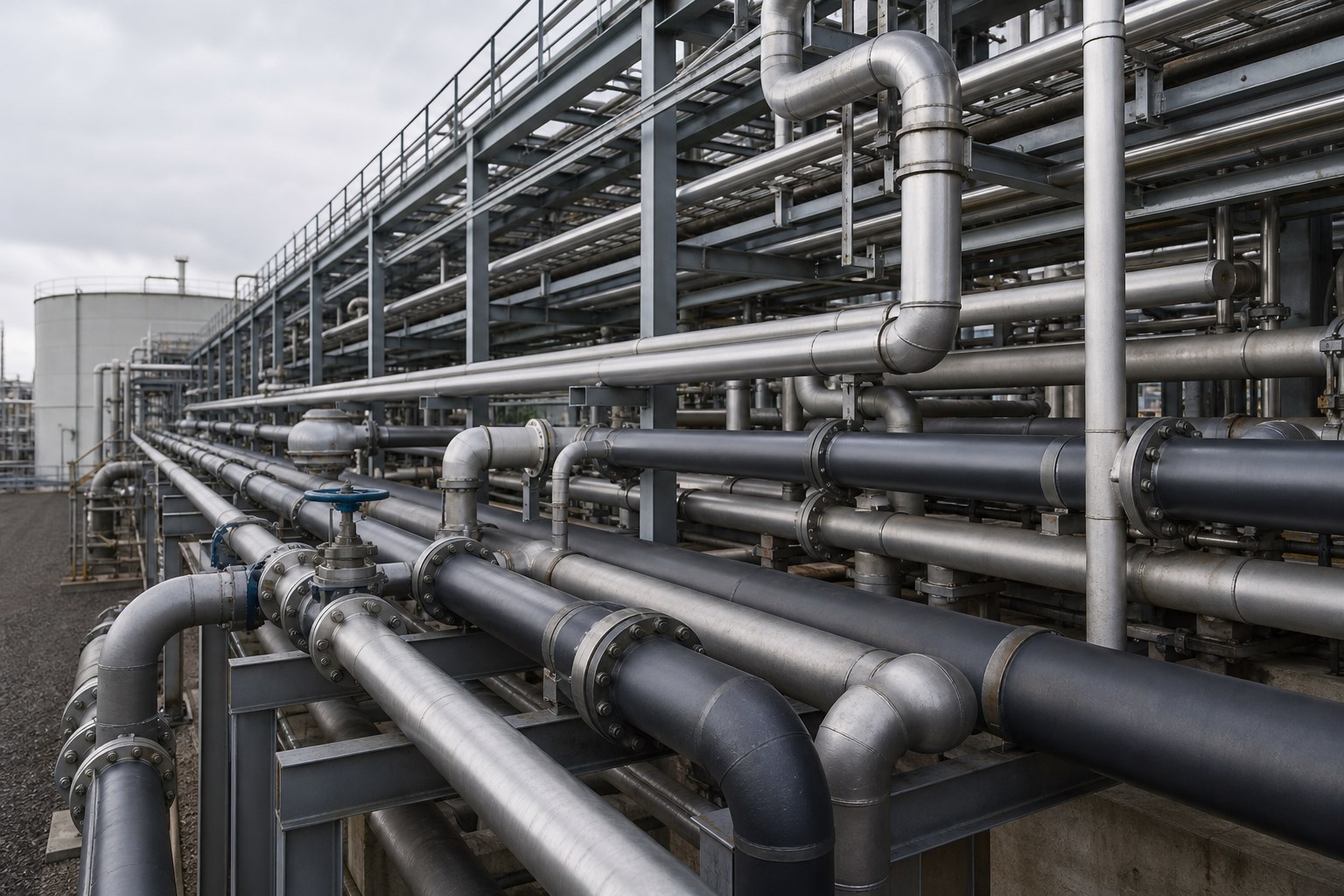
Choosing a schedule is a trade between pressure capacity, weight, cost and availability:
- Sch 10S / thin walls — light and inexpensive, common for stainless process lines and low-pressure or gravity services where corrosion allowance matters more than pressure. Not suitable for threading; joints are welded or flanged.
- Sch 40 (STD) — the worldwide default for general water, air, steam and structural piping. It is the most stocked schedule in every material, which means the best availability, the fastest lead time and the most competitive price per meter.
- Sch 80 (XS) — roughly double the wall of Sch 40 at small sizes; the standard choice for higher-pressure hydraulic, chemical and industrial lines, and for pipe that will be threaded, since thick walls carry threads without weakening the body.
- Sch 160 and above — heavy-wall service for very high pressures and severe mechanical duty, where the pipe body itself provides much of the strength. Material cost and weight rise steeply, and welding requires careful preheat and procedure qualification.
Wall thickness also drives cost more than buyers expect: for a given size, moving from Sch 40 to Sch 80 can add 40–80% to the steel weight per meter (for NPS 6 it rises from 18.97 lb/ft at Sch 40 to 28.57 lb/ft at Sch 80), and the price follows weight, not the schedule label. If a project genuinely has a choice between schedules, quote both and compare on a like-for-like basis with the design code in hand — the cheapest pipe that meets the code is the right economic answer, and paying for Sch 160 where Sch 80 satisfies the design is simply wasted tonnage.
Stainless Steel Pipe Schedules: 5S, 10S and B36.19M
Stainless steel pipe is dimensioned to a different standard — ASME B36.19M — which keeps the same outside diameters as B36.10M but offers the thinner S-series walls (5S, 10S, 40S and 80S). The S-series exists because stainless pipe is frequently used for corrosion resistance rather than pressure, and thin walls keep material cost and weight down. Up to NPS 8, 40S and 80S walls are identical to Sch 40 and Sch 80; from NPS 10 upward the S-series is thinner than the equivalent carbon schedule, so stainless and carbon dimensions must never be mixed in one table. For corrosion-resistant process lines, stainless steel pipe in 304/304L and 316/316L is most often supplied in Sch 10S, 40S or 80S depending on the fluid pressure. When a thicker wall is required for mechanical strength or to compensate for pressure — for example a 6-inch line in Sch 80 — buyers can order a standard Sch 80 wall in stainless, produced to the same dimension series and to specifications such as ASTM A312, the governing standard for seamless and welded austenitic stainless steel pipe. A practical example of that specification in Sch 80 is the 304 Stainless Steel Pipe 6 inch Sch 80, supplied seamless for high-pressure process service.
Weight, Pressure Rating and Testing
Two practical numbers follow from the schedule. First, pipe weight per unit length, which determines freight cost and support spacing, is calculated from the outside diameter and wall thickness by the standard weight formula for carbon steel pipe (weight per foot ≈ 10.69 × (OD − wall) × wall, with dimensions in inches). Second, the pressure rating of a pipe rises with wall thickness but falls as the outside diameter grows, which is why a 2-inch Sch 80 line can carry far higher pressure than a 12-inch Sch 40 line of the same material. Whichever schedule is specified, the standard requires proof that the wall is present and sound: hydrostatic testing of every pipe, and mechanical and dimensional checks against the product standard. Carbon steel pipe is commonly ordered to ASTM A53 (welded and seamless, black and hot-dipped galvanized) or ASTM A106 for seamless high-temperature service, while line pipe for oil and gas follows the API 5L specification family — each standard states its own wall-thickness tolerances and testing package, so the schedule alone is never a complete specification.
How to Specify the Schedule When You Order
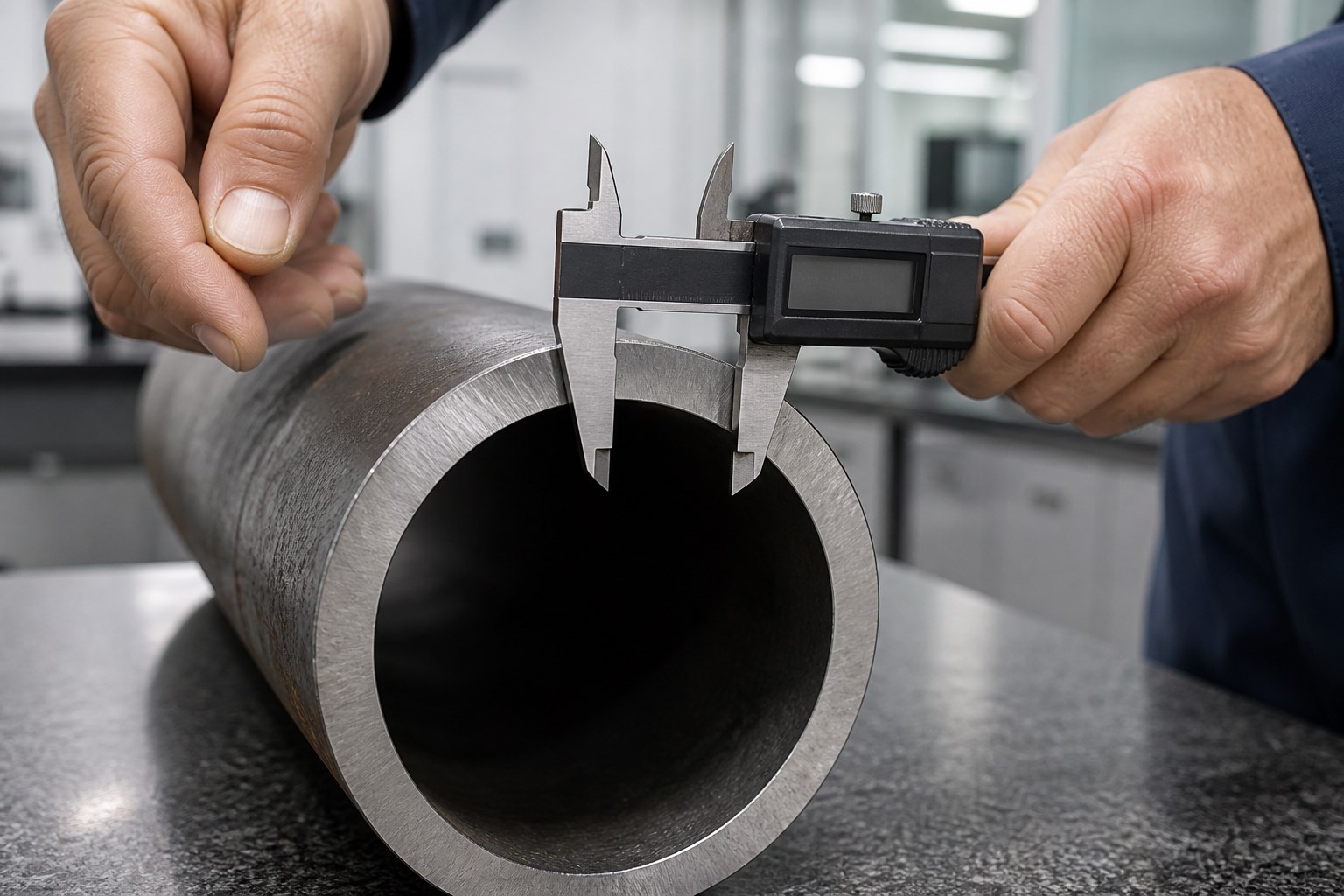
When you send an inquiry for steel pipe, write the complete designation — size, schedule, material grade, standard, and end finish — for example “NPS 6, Sch 80, ASTM A312 TP304L, seamless, plain end, 6 m”. A quotation that only says “6-inch steel pipe” is not comparable with another supplier’s quote until the schedule is fixed, and switching schedules after award is the most common source of change orders and inspection rejections in pipe procurement. On receipt, the wall thickness is verified with a mechanical caliper or ultrasonic gauge at the pipe end and along the body, and against the mill test certificate, which records the heat chemistry, the mechanical test results and the dimensional checks. Checking the wall at the end is fast and tells you immediately whether the pipe is the schedule you paid for — a Sch 40 pipe delivered against a Sch 80 order fails at the first inspection even if the OD and length are correct. Finally, remember that schedule interacts with everything downstream: heavier walls need different welding procedures, higher preheat and more filler metal; thinner stainless walls are more prone to distortion if welded carelessly; and some schedules (especially the thin S-series) cannot be threaded at all. Read the piping code, fix the schedule, then compare supplier pricing on an identical specification basis.
Frequently Asked Questions
What does Sch 40 mean in pipe?
Sch 40 is the most common wall-thickness schedule for steel pipe. It means the wall thickness listed under “Schedule 40” in the ASME B36.10M tables for the pipe’s nominal size — for example 0.154 inch for NPS 2 and 0.280 inch for NPS 6. Up to NPS 10, Sch 40 is identical to the older “standard weight” (STD) designation.
Is a higher schedule number stronger?
Yes, in pressure terms: a higher schedule means a thicker wall for the same outside diameter, and the pressure rating of the pipe rises with wall thickness. The trade-offs are higher weight per meter, higher material cost, reduced inside diameter (and therefore lower flow capacity at the same OD), and more demanding welding requirements.
What is the difference between Sch 40 and Sch 80?
For the same nominal size, Sch 80 has a substantially thicker wall than Sch 40 — roughly 40–100% thicker depending on size. Sch 80 is used where the design pressure or mechanical loads exceed what Sch 40 can carry, and it is the preferred schedule for threaded pipe. For example, NPS 4 is 0.237 inch in Sch 40 versus 0.337 inch in Sch 80, and NPS 6 is 0.280 inch versus 0.432 inch.
Specify the Schedule, Then Compare Prices
The fastest way to waste a procurement cycle is comparing quotations that are not on the same schedule basis. Fix the NPS, the schedule, the grade and the standard first; then the price comparison is honest, the delivery promise is meaningful, and the inspection on arrival is quick. If you are unsure which wall thickness your service conditions require — or you want to confirm that a specific schedule is available in seamless or welded, carbon or stainless — send your working pressure, temperature, size range and quantity to our team at Shuncheng Steel and we will review the application with you and quote against the exact specification. New buyers often begin with our beginner guide to seamless pipe manufacturing and applications, and then compare how the production route changes what can be specified — both are part of the same dimensioning system explained above.