
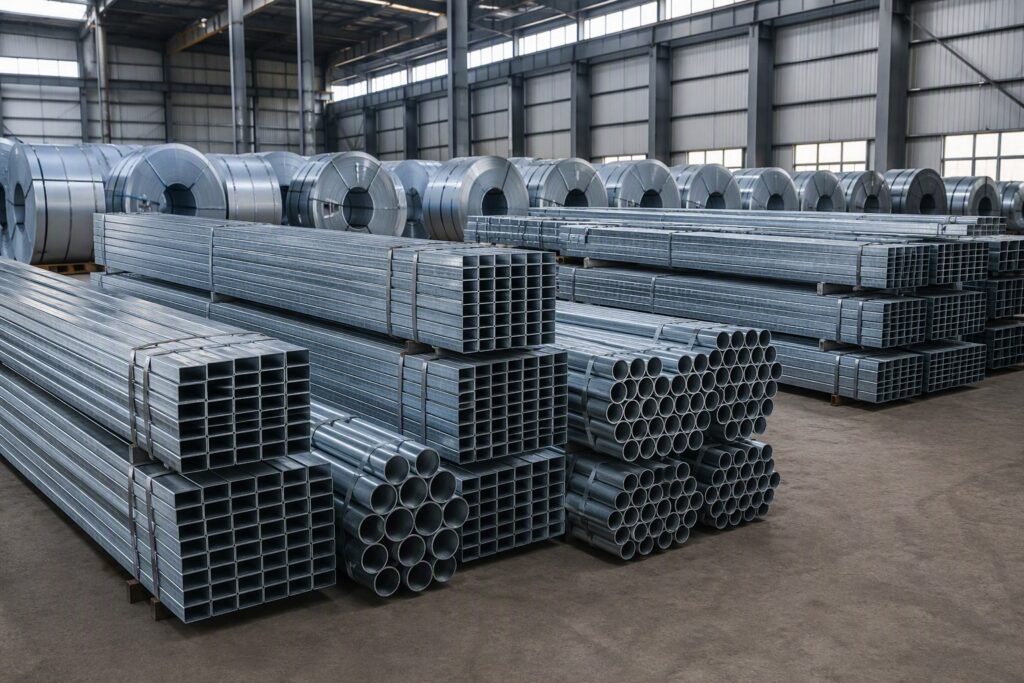
Galvanized Tube Sizes: Standard Dimensions and Wall Thickness
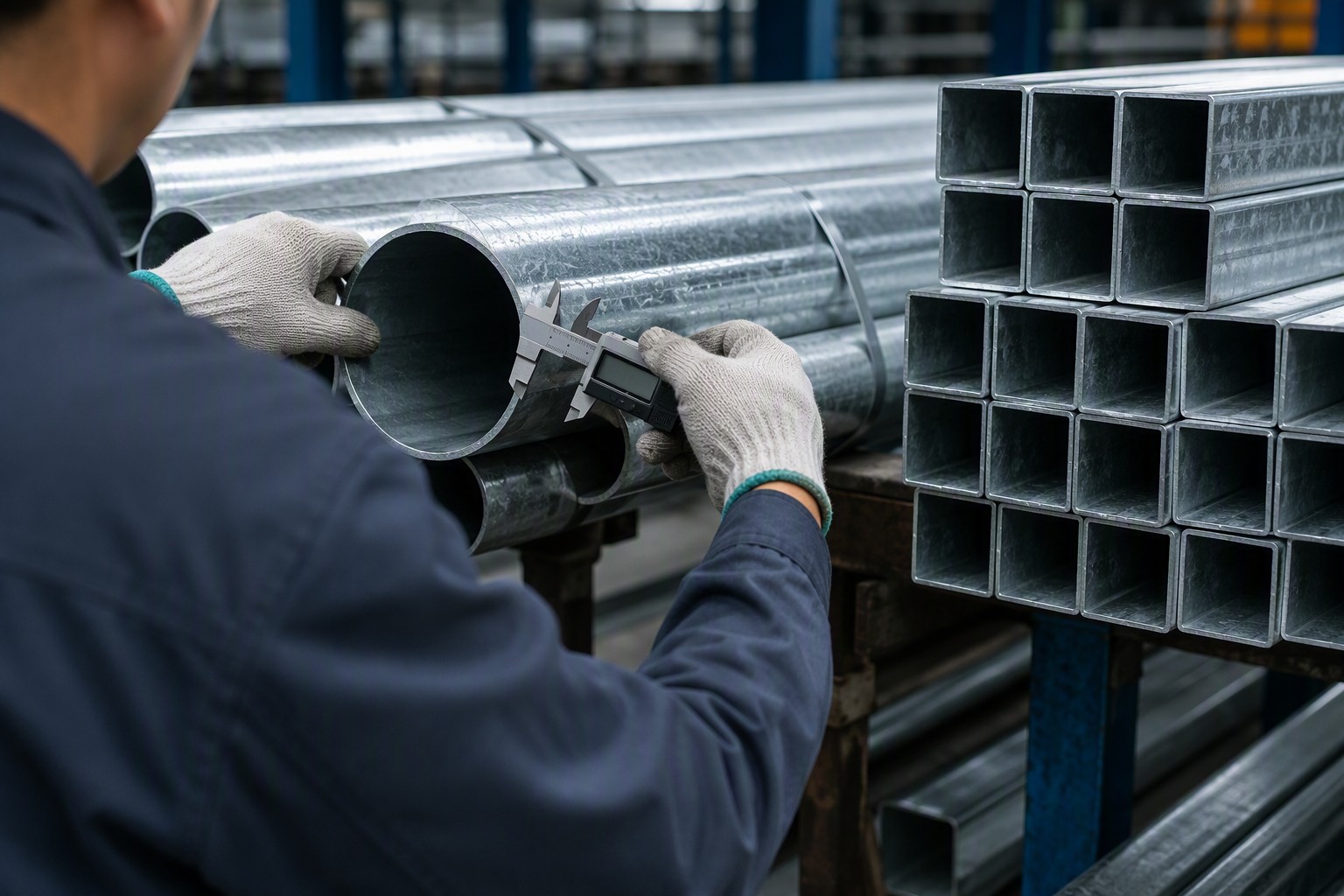
When a buyer opens a quotation for “galvanized tube”, the first question is never about zinc — it is about numbers. What outside dimension? What wall thickness? What length? A 40×40 mm square tube and a 2-inch round tube are completely different products with completely different prices, weights and applications, and mixing them up in an inquiry wastes everybody’s time. This guide explains the galvanized tube sizes you will meet in international procurement — how round, square and rectangular tubes are dimensioned, which standards define the tables, what wall thickness ranges are normally supplied, and exactly how to write a size specification that leaves no room for misunderstanding. The full range we work with — including outer dimensions, wall thicknesses and lengths available from stock and production — is summarized on our galvanized steel tube product page.
How Galvanized Tube Sizes Are Described
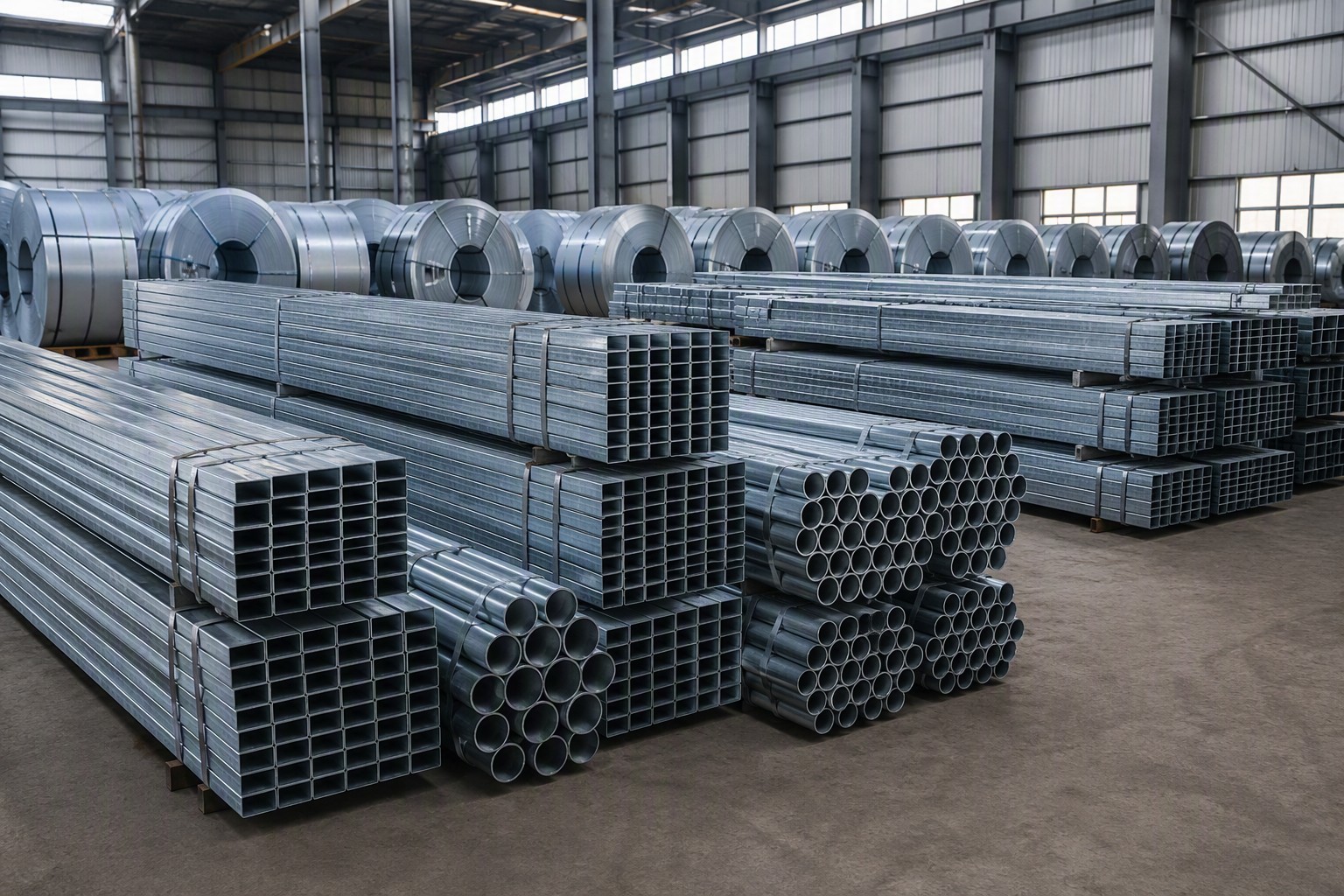
Galvanized steel tube is made in three cross-section families, and each family has its own way of writing the size:
- Round tube — written as outside diameter (OD) × wall thickness, for example 26.9 × 2.0 mm or, in the North American system, NPS 1/2 to NPS 4 with a schedule or wall figure.
- Square tube — written as side × side × wall, for example 40 × 40 × 2.0 mm. Only one side is stated because both sides are equal.
- Rectangular tube — written as width × height × wall, for example 60 × 40 × 2.0 mm, with the larger dimension written first by convention.
Every order also needs a length (normally 6 m or 12 m, or random 5.8–6.1 m for pipe) and, separately from the geometry, a zinc coating specification — because the coating is a functional layer that also adds a measurable amount to the outside dimensions. Galvanization itself, whether hot-dip batch galvanizing or continuous strip galvanizing before forming, is described in detail in the Wikipedia article on galvanization; what matters here is that two tubes with the same steel dimensions but different coating systems are still “the same size” for design purposes within normal tolerances.
Standard Square and Rectangular Tube Sizes
Square and rectangular hollow sections are the workhorses of fences, gates, handrails, greenhouse frames, solar mounting structures, storage racks and light structural frames. In metric markets the sizes follow the EN 10219 series (cold-formed welded structural hollow sections) and the Chinese GB/T series, while North American projects specify ASTM A500, the ASTM A500/A500M standard for cold-formed welded and seamless carbon steel structural tubing. The most commonly ordered square sizes and their typical wall thicknesses are:
| Square size (mm) | Common wall thicknesses (mm) | Typical weight at 2.0 mm wall (kg/m) |
|---|---|---|
| 20 × 20 | 1.0 – 2.0 | approx. 1.13 |
| 25 × 25 | 1.2 – 2.5 | approx. 1.44 |
| 30 × 30 | 1.2 – 2.5 | approx. 1.76 |
| 40 × 40 | 1.5 – 3.0 | approx. 2.39 |
| 50 × 50 | 1.5 – 4.0 | approx. 3.01 |
| 60 × 60 | 1.5 – 4.0 | approx. 3.64 |
| 80 × 80 | 2.0 – 5.0 | approx. 4.90 |
| 100 × 100 | 2.0 – 6.0 | approx. 6.15 |
Rectangular profiles follow the same wall series on larger plan dimensions — typical combinations are 40 × 20, 50 × 25, 60 × 30, 60 × 40, 80 × 40, 100 × 50, 100 × 60 and 120 × 60 mm, again with walls from about 1.5 mm up to 5–6 mm on the heavy end. Two important purchasing notes: first, galvanized square and rectangular tube is usually formed and high-frequency welded from pre-galvanized strip, so the zinc coating is continuous over the whole section including the weld zone; second, the outside dimension of a square or rectangular section is measured across flats — the corner radius is part of the standard’s geometry and must not be treated as a sharp 90° corner. If you need a full checklist of coating options and available section sizes, browse our galvanized steel products line.
Round Galvanized Tube Sizes: NPS and Metric OD Series
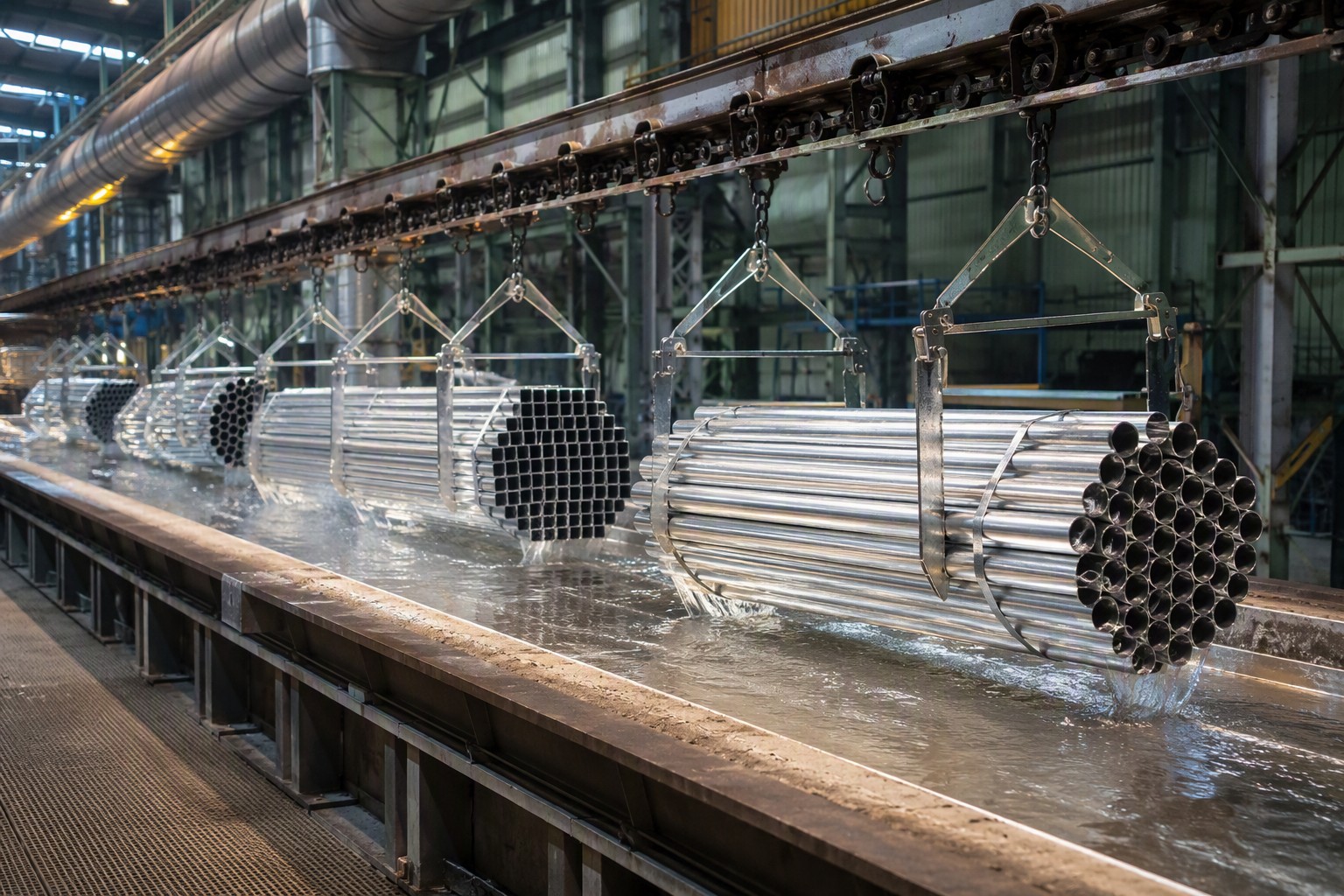
Round galvanized tube divides into two naming worlds. In North America and the oil-and-gas-influenced markets, round sizes are stated in NPS (Nominal Pipe Size), where the nominal number does not equal the real outside diameter — an NPS 2 pipe is actually 60.3 mm OD. The underlying dimensioning rules are explained in the Nominal Pipe Size reference, and the standard that governs welded and seamless hot-dipped galvanized pipe in this system is ASTM A53/A53M, covering pipe from NPS 1/8 up to NPS 26. In metric and European markets, round sizes are written directly as OD × wall in millimetres, following the EN 10255 dimension series that replaced the old BS 1387 imperial gas-tube sizes. The two series overlap exactly at the OD:
| NPS | DN | Outside diameter (mm) | Typical walls (mm) |
|---|---|---|---|
| 1/2 | 15 | 21.3 | 2.0 – 3.2 |
| 3/4 | 20 | 26.9 | 2.0 – 3.2 |
| 1 | 25 | 33.7 | 2.0 – 3.6 |
| 1-1/4 | 32 | 42.4 | 2.0 – 3.6 |
| 1-1/2 | 40 | 48.3 | 2.0 – 4.0 |
| 2 | 50 | 60.3 | 2.0 – 4.5 |
| 2-1/2 | 65 | 76.1 | 2.3 – 5.0 |
| 3 | 80 | 88.9 | 2.3 – 5.5 |
| 4 | 100 | 114.3 | 2.5 – 6.0 |
Above DN 100 the metric and imperial tables continue to align (139.7, 168.3, 219.1 mm and so on), and wall thickness can be ordered either as a plain metric wall (for example 2.5 mm) or as a schedule wall (Sch 40, Sch 80) where the tube is expected to carry pressure. Round galvanized tube is used for water and gas conveyance, scaffolding, fencing posts, handrail, and mechanical tubing, and it is frequently threaded at both ends when supplied as pipe. If you are comparing round sizes by schedule instead of by millimetre wall, our steel pipe schedule chart explains how Sch 10 to Sch 160 wall thicknesses relate to each nominal size.
Wall Thickness Ranges and What They Mean for Weight
Wall thickness is the number that moves weight, price and strength the most. For round tube the standard weight formula is kg/m ≈ 0.02466 × (OD − wall) × wall, with both dimensions in millimetres — so a 2-inch (60.3 mm) tube with a 2.0 mm wall weighs about 2.88 kg/m, while the same OD at 4.5 mm wall weighs about 6.19 kg/m, more than double the steel for the same outside diameter. For square and rectangular sections the formula is kg/m ≈ 0.00785 × 4t × (a − t), where a is the side and t the wall in millimetres — a 40 × 40 mm tube goes from about 2.39 kg/m at 2.0 mm wall to about 3.45 kg/m at 3.0 mm wall.
Two practical consequences follow. First, freight and support design should always be based on the theoretical weight of the exact wall ordered, not on the size name. Second, wall thickness directly limits what the tube can do: light walls (1.0–1.5 mm) suit cladding, trim and light fencing; medium walls (2.0–3.0 mm) carry structural frames, gates and railing; heavy walls (4.0 mm and above) are specified for load-bearing posts, columns and mechanical service where strength matters more than cost per metre. Dimensional tolerances on the wall are set by the product standard — typically ±10% — and the outside dimension tolerance is a small fixed fraction of a millimetre plus a proportional allowance, so always order to the standard (EN 10219, ASTM A500, ASTM A53 or GB/T) rather than to a bare drawing note.
Zinc Coating Classes: the Coating Is Part of the Specification
Galvanized tube is ordered with a coating class as well as a size, and there are two different systems in circulation. Batch (after-fabrication) hot-dip galvanizing follows ISO 1461, which expresses the coating as a minimum average thickness in micrometres — roughly 45 µm average for steel thinner than 1.5 mm, rising to about 70 µm for 3–6 mm sections and 85 µm above 6 mm. Continuous strip galvanizing, used when the tube is formed from pre-galvanized coil, follows the EN 10346 style of designation, where Z180 means a nominal total zinc weight of 180 g/m² measured on both faces together (about 12–13 µm per face) and Z275 means roughly 19–20 µm per face. The American Galvanizers Association publishes a thorough explanation of how these coating systems are specified, applied and measured on galvanizeit.org.
For size purposes the coating matters in one specific way: the zinc layer adds to the finished outside dimensions. After batch hot-dip galvanizing, the outer surfaces of a tube typically grow by roughly 0.1–0.2 mm across the diameter or across the flats, and the bore shrinks by a similar amount — insignificant for almost every application, but a real issue if the tube must slide into a pre-fabricated sleeve, fit an existing coupling, or meet a close machining allowance. When that is the case, tell the supplier that dimensions must be held after galvanizing, or order the base steel one wall-thickness step down and confirm the finished size on the mill certificate.
How to Write a Galvanized Tube Size Specification
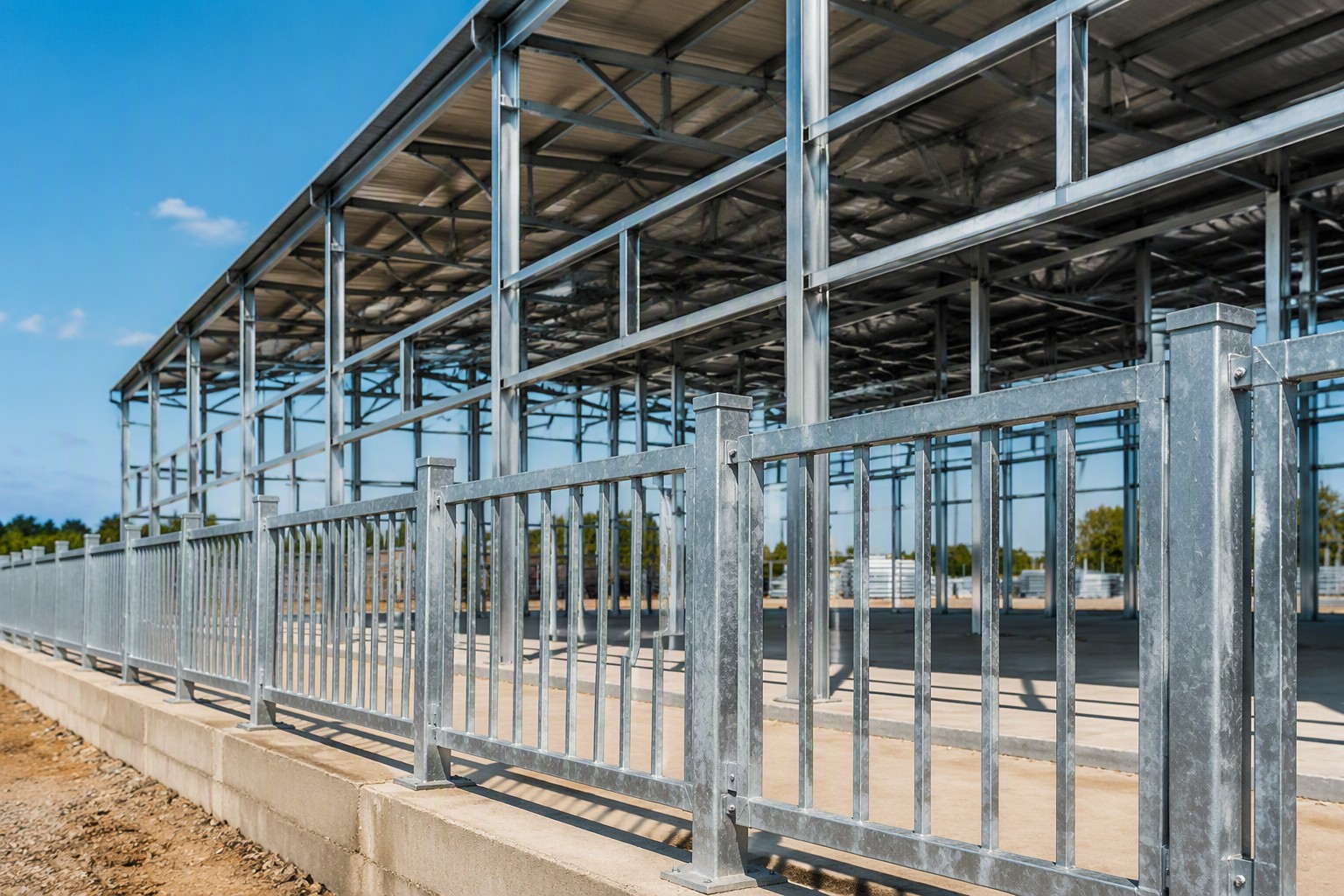
A complete size specification has five parts: cross-section and dimensions, wall thickness, length, standard, and coating. A correct inquiry line looks like this: “Galvanized square tube, 40 × 40 mm, 2.0 mm wall, 6 m length, EN 10219 S235JRH, hot-dip galvanized to ISO 1461” — or, for a round product, “Galvanized round tube, NPS 2 (60.3 mm OD), 2.5 mm wall, 6 m, ASTM A53 Grade B, hot-dip galvanized”. If you omit the standard, the supplier must guess whether the wall tolerance, corner radius, coating requirement and test certificates should follow the American, European or Chinese system — and the guess is rarely the one you wanted.
It is equally important to state whether your dimensions are for the bare steel or the finished galvanized product, and whether ends are plain, threaded or prepared for welding. Buyers who skip these details discover the difference only at inspection, when the delivered tube does not fit the fittings ordered against a bare drawing. When you are choosing the material system itself — for example deciding between galvanized tube and stainless for a coastal or chemically aggressive environment — our comparison of carbon steel vs stainless steel pipe covers the corrosion and cost trade-offs that apply to tube selections as well.
Frequently Asked Questions
What size is a 2-inch galvanized round tube?
A “2-inch” galvanized round tube is NPS 2 / DN 50, which has an outside diameter of 60.3 mm regardless of wall thickness. With the very common 2.5 mm wall it weighs about 3.56 kg/m, and with a 3.2 mm wall about 4.48 kg/m. If the size is written as “2 inch x 2.5 mm”, it normally means 60.3 mm OD with a 2.5 mm wall in the metric-European convention.
What lengths are galvanized tubes supplied in?
Standard supply lengths are 6 m and 12 m, with random lengths of 5.8–6.1 m common for pipe-family products; cutting to exact customer lengths is normally available on request. Length tolerance and straightness are defined by the product standard being ordered.
Are galvanized tube dimensions measured before or after galvanizing?
By default the tube size refers to the steel section before coating; after batch hot-dip galvanizing the outside dimensions typically grow by about 0.1–0.2 mm. If the finished (after-coating) size must be held to a close tolerance, state that explicitly in the order so the supplier can adjust the base steel accordingly.
Send Us Your Size, We Will Confirm the Details
The fastest way to get a correct quotation is to send the complete size designation from the list above — section type, outside dimension, wall thickness, length, standard and coating class. If you are unsure which standard your project should use, or whether a particular galvanized tube size is available with the wall thickness and coating you need, send your inquiry to Shuncheng Steel with your application details and quantities — we will confirm availability, confirm the dimensional and coating details against the standard, and quote you on an identical specification basis so the delivered tube matches the one you designed.
For a round profile example with standard dimensions, the 2 inch galvanized round steel tube page lists the 48.3 mm OD section, wall thickness and coating available.