
Deformed Steel Bar (Rebar): Grades and Uses in Construction
Every reinforced concrete structure — from a residential foundation slab to a highway bridge — depends on one unglamorous product: the deformed steel bar, better known as rebar. Concrete is excellent at carrying compression, but it cracks under tension. Steel reinforcement carries that tension, and the ribs rolled into a deformed bar are what lock the two materials together so they work as one. Get the grade, size, or source wrong, and the failure may not appear until years later, deep inside a structure that is expensive to repair.
This guide explains what a deformed steel bar is, how it is manufactured, which grades and standards you will meet when buying internationally (ASTM, ISO, GB/T), the standard sizes and weights used in estimating, and where each grade earns its keep in real construction. If you are an importer, contractor, or project buyer comparing quotes, the second half of the article gives you a practical checklist — and shows where to start on our rebar product range when you are ready to source.
What Is a Deformed Steel Bar (Rebar)?
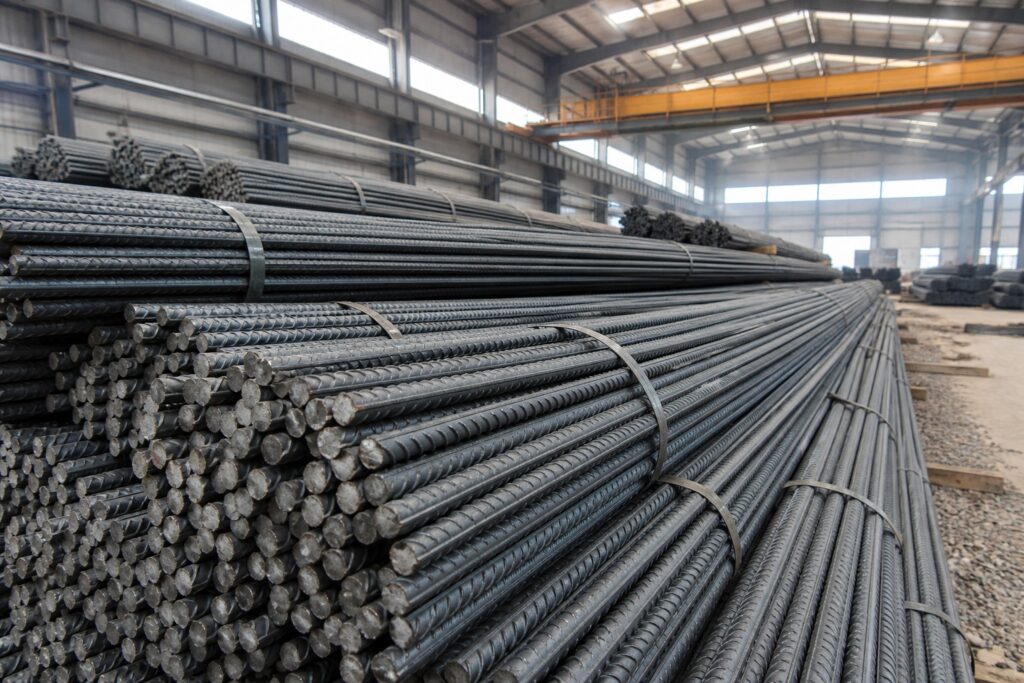
A deformed steel bar is a hot-rolled steel bar whose surface carries a continuous pattern of ribs, lugs, or indentations, specifically designed to reinforce concrete. The term rebar — short for reinforcing bar — is used interchangeably in the industry, and the massed product is often called reinforcing steel. The deformations are not decorative: they create a mechanical interlock between the steel and the surrounding concrete, dramatically improving bond strength and reducing the risk of the bar slipping under load. A plain round bar of the same diameter relies only on chemical adhesion and friction, which is why plain bars are limited to light duty and why most structural reinforcement is specified as deformed.
Why is the steel needed at all? Reinforced concrete works because the two materials cover each other’s weaknesses. Concrete resists compression very well but has low tensile strength; steel, in turn, is strong in tension. When a beam bends, one face compresses while the other stretches — the embedded deformed bars absorb the stretching forces that the concrete alone cannot survive. Steel and concrete also expand at broadly similar rates with temperature change, so the two materials stay in harmony through heating and cooling cycles instead of tearing apart at the interface. That compatibility, combined with the bond created by the ribs, is the engineering foundation of almost every modern building, bridge, dam, and tunnel.
How Deformed Steel Bars Are Manufactured
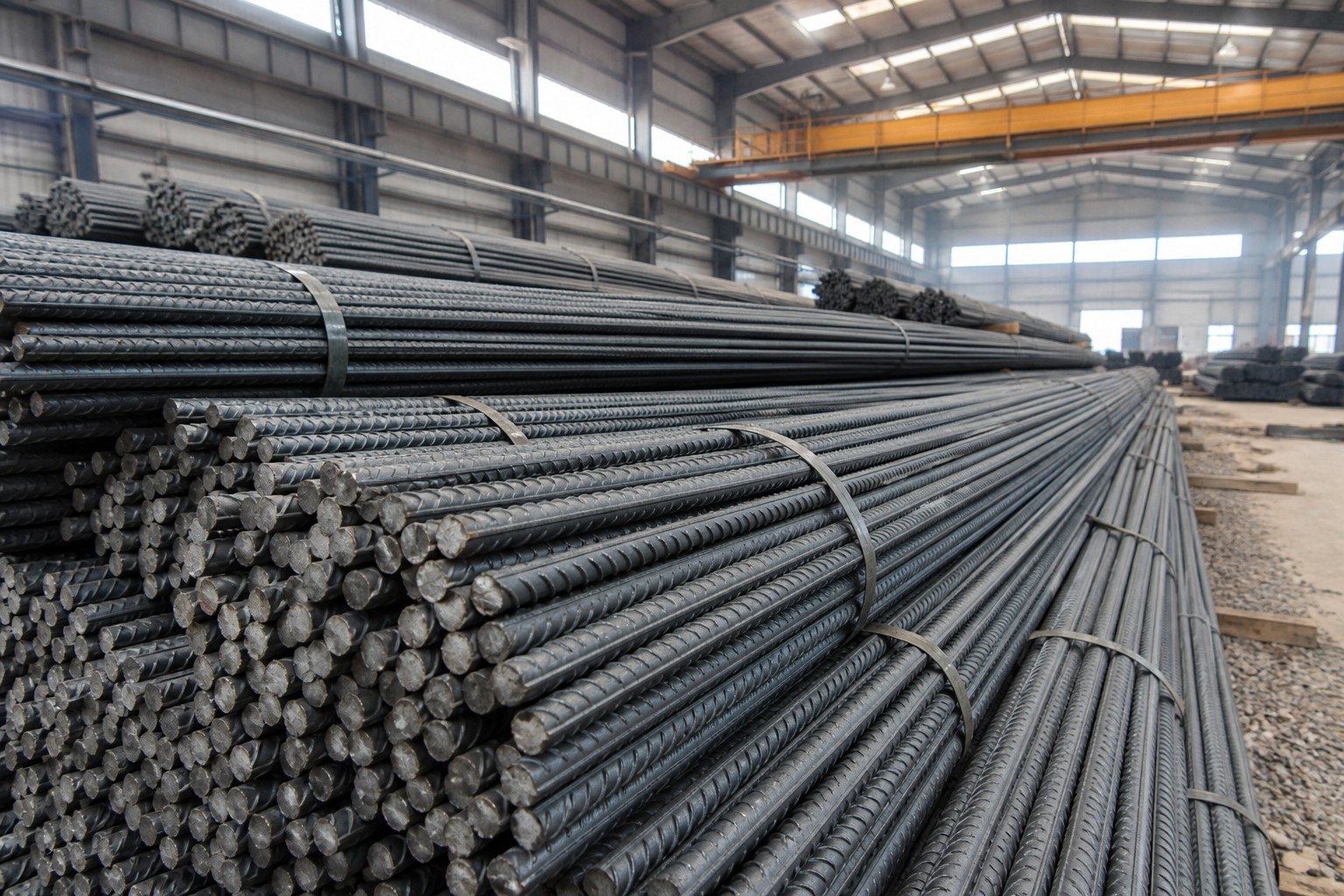
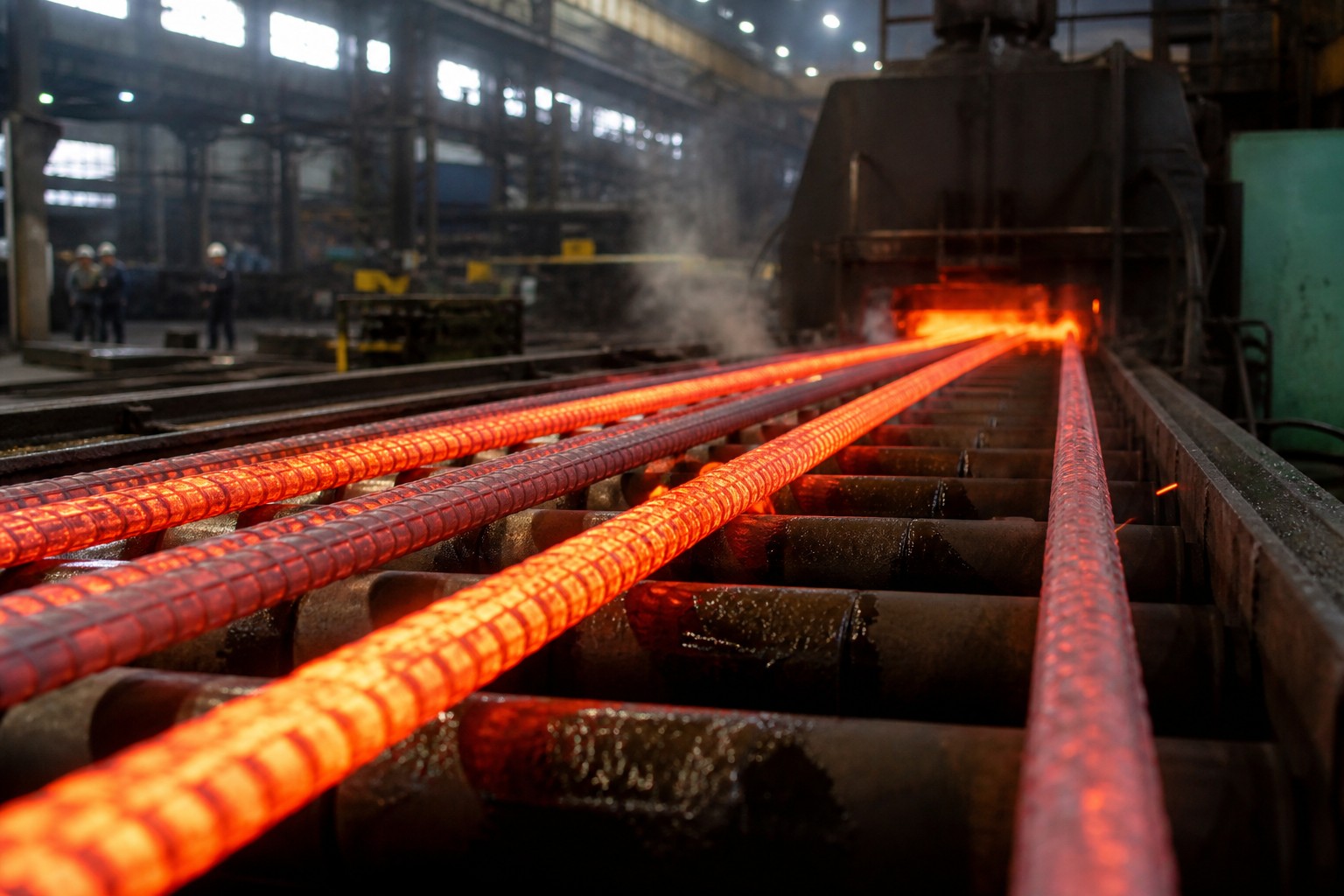
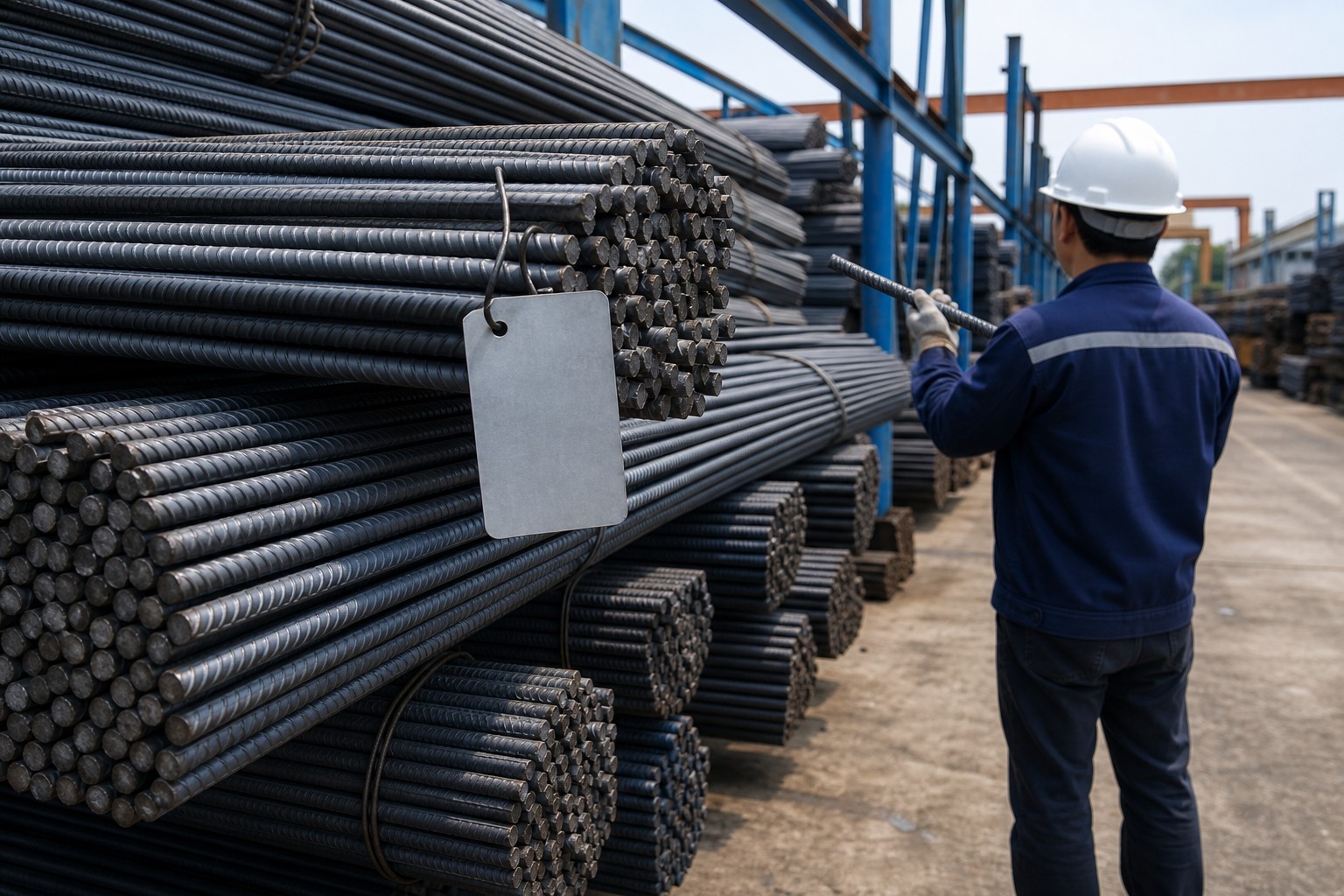
Deformed steel bars are produced from steel billets in a hot rolling mill. The billet is reheated to rolling temperature, then passed through a sequence of roll stands that progressively reduce its cross-section to the required diameter. The final stands carry the rib pattern: as the hot bar passes through, the rolls impress the transverse ribs and longitudinal markings that give the product its deformed surface. After rolling, the bars run through a controlled cooling zone, are cut to length — commonly 9 m or 12 m, depending on the market and container plan — and are bundled, tied, and tagged for shipment.
Quality control runs through every step. Samples from each heat are tested for yield strength, tensile strength, elongation, and bend performance against the governing standard, and the heat number and grade marking are rolled into the bar itself so that every length can be traced back to its melt. Reputable mills back the shipment with a mill test certificate showing the chemical composition and mechanical results for each heat. That documentation matters far more at the receiving end than at the rolling end: if the certificate and the rolled markings do not match, the bars should not be accepted into the structure.
Deformed Steel Bar Grades and Standards
Deformed bar grades are defined by standards bodies, and each standard family names its grades differently even when the mechanical properties are similar. Buyers working across borders need to translate between them — a Grade 60 bar under ASTM A615, a B500B bar under European practice, and an HRB400 bar under the Chinese GB/T 1499.2 system are all products of the same philosophy: a guaranteed minimum yield strength combined with ductility and bendability requirements.
The most widely specified standard in North America is ASTM A615/A615M, which covers deformed and plain carbon-steel bars for concrete reinforcement in grades based on minimum yield strength — Grade 40 [280 MPa], Grade 60 [420 MPa], and higher-strength Grade 80 [550 MPa] and Grade 100 [690 MPa]. Grade 60 is the default for most structural work in the United States and Canada. For international projects, ISO 6935-2:2019 is the reference standard for ribbed bars for concrete reinforcement, and it is frequently paired in contracts with European grade designations such as B500B. In Chinese-standard projects, GB/T 1499.2 covers hot-rolled ribbed bars in grades such as HRB400 and HRB500, with the “E” suffix (HRB400E, HRB500E) indicating enhanced seismic ductility requirements that matter in earthquake zones.
| Standard family | Typical grade | Minimum yield strength | Common markets |
|---|---|---|---|
| ASTM A615/A615M | Grade 60 [420] | 420 MPa (60,000 psi) | United States, Canada, Latin America |
| ISO 6935-2 / European practice | B500B / B500C | 500 MPa | Europe, Middle East, Africa, international contracts |
| GB/T 1499.2 | HRB400 / HRB400E | 400 MPa | China-standard projects, Asia, Africa |
When a project specifies a grade, that grade is a promise about minimum yield strength and ductility — not a fixed chemistry. Two suppliers quoting “Grade 60” can still differ in micro-alloying, weldability, and bend performance, which is why the test certificate and the mill’s quality system matter as much as the grade name. A good example of a widely stocked construction grade is our HRB400 deformed steel bar in 20 mm, supplied in 12 m lengths for general structural use.
Deformed Steel Bar Sizes, Weights and Lengths
Deformed bars are ordered by nominal diameter, and estimating quantities is straightforward because the theoretical weight per meter follows a standard formula: weight (kg/m) ≈ 0.00617 × diameter² (diameter in mm). The table below lists the metric diameters most commonly traded and their theoretical weights; the ASTM equivalent bar numbers are shown for reference.
| Nominal diameter (mm) | Approx. ASTM bar No. | Theoretical weight (kg/m) | Typical uses |
|---|---|---|---|
| 8 | No. 2 (small) | 0.395 | Stirrups, ties, light mesh |
| 10 | No. 3 | 0.617 | Slabs, walls, light foundations |
| 12 | No. 4 | 0.888 | Slabs, beams, columns (light) |
| 16 | No. 5 | 1.580 | Beams, columns, footings |
| 20 | No. 6 | 2.470 | Columns, heavy footings, piles |
| 25 | No. 8 | 3.850 | Heavy columns, bridge members |
| 32 | No. 10 | 6.310 | Large columns, transfer structures |
Lengths follow market convention: 12 m is the standard stock length in most Asian and many African markets, 6 m is common for small projects and palletized container loads, and US projects typically buy in 20 ft or 40 ft (6.1 m or 12.2 m) stock lengths. Whatever the length, the number of bars in a bundle is calculated from the theoretical weight so that the shipment can be verified by weighing on arrival — a 20 mm bar at 2.47 kg/m means a 12 m bar weighs about 29.6 kg, and a bundle count can be cross-checked against the invoice within seconds.
Common Uses of Deformed Steel Bar in Construction
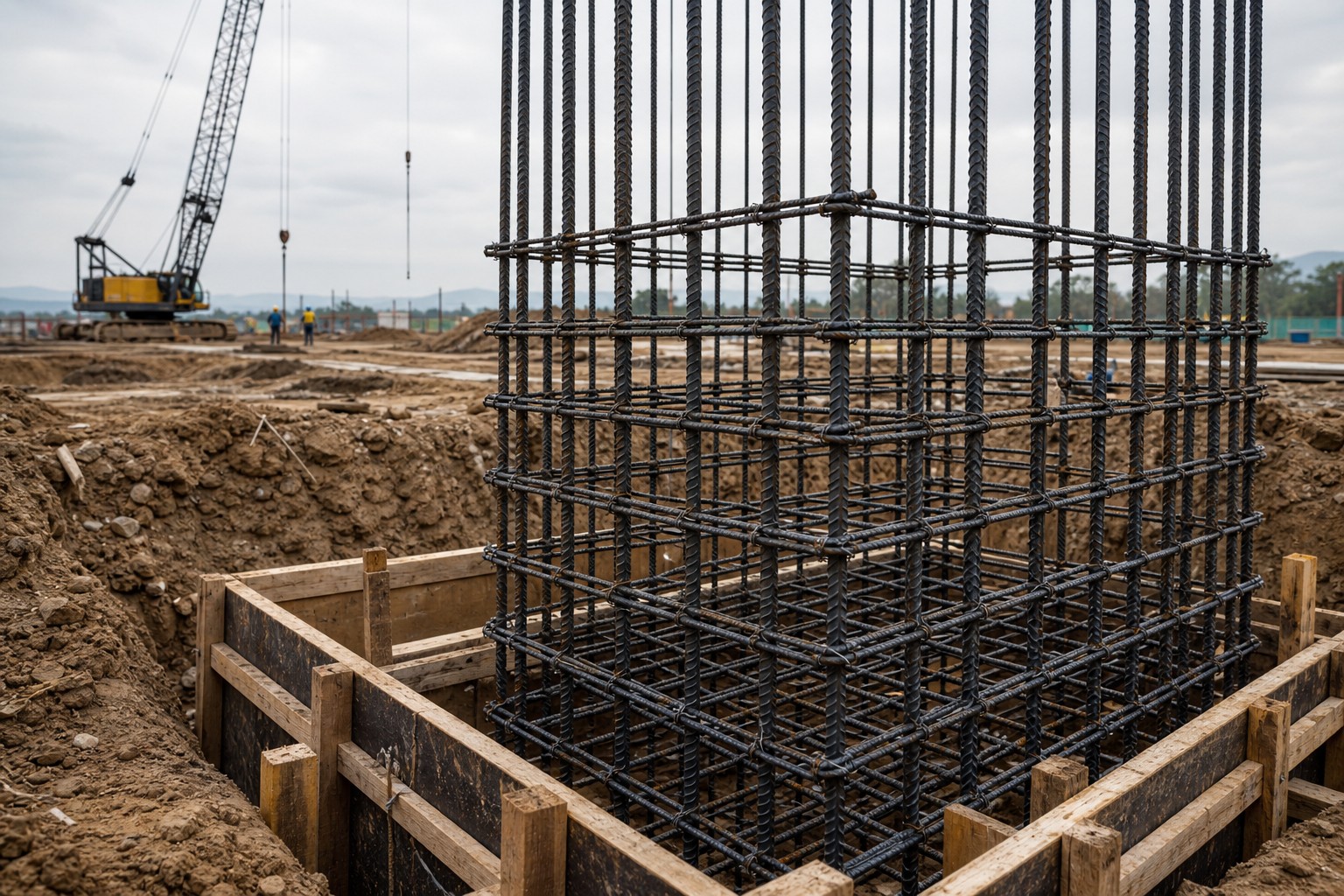
Deformed steel bar is the skeleton of reinforced concrete, and its uses track the anatomy of a structure:
- Foundations and footings — raft slabs, strip footings, and pile caps are heavily reinforced because they transfer the entire building load into the ground and are almost impossible to repair after backfilling.
- Columns and beams — vertical bars carry compression and bending in columns while ties or stirrups hold the cage together and resist shear; beams use bottom bars for tension and top bars over supports.
- Slabs and walls — floor slabs, roof slabs, and shear walls use grids of smaller-diameter deformed bars, typically 8–16 mm, to control cracking and distribute loads.
- Bridges and infrastructure — bridge decks, abutments, retaining walls, and tunnel linings are among the most demanding applications because they combine heavy dead load, live traffic load, and exposure to de-icing salts or seawater.
- Precast and prestressed elements — precast beams, piles, and panels are fabricated with deformed bar cages under factory-controlled conditions, then delivered to site.
Construction sites rarely use one steel product in isolation. A commercial building, for example, combines deformed bar in the concrete frame with galvanized steel tube for railings, ladders, and structural supports, and coated steel for roofing and cladding. For buyers managing whole projects, consolidating these orders with one supplier simplifies inspection, documentation, and container loading — a point we come back to below. The Concrete Reinforcing Steel Institute (CRSI) publishes extensive guidance on detailing and placing reinforcement if your team wants the industry-standard reference on the construction side.
How to Choose the Right Deformed Steel Bar for Your Project
Choosing deformed steel bar is a specification exercise, not a shopping exercise. Work through these points in order and the correct product usually declares itself:
- Read the structural drawings and standard. The engineer has already specified the grade and diameter. Your job is to supply exactly what the drawing says — substituting a “similar” grade without approval is how structures get built out of spec.
- Match the standard to the project’s jurisdiction. US and Canadian projects will reference ASTM; international and many Middle East and African projects reference ISO 6935-2 or European grade designations; China-funded or China-standard projects will reference GB/T 1499.2. If in doubt, ask the engineer which standard governs — the same discipline we outlined when comparing carbon steel vs stainless steel pipe for process lines: define the governing standard before comparing prices.
- Check ductility class for seismic zones. Earthquake-resistant structures need higher elongation and toughness — for example HRB400E under GB/T 1499.2 or B500C under European practice. A higher yield grade is not automatically the safer choice if the design relies on ductile behavior.
- Confirm length and bundling for your logistics. 12 m bars fit standard 40 ft containers lengthwise with planning; 6 m bars are easier to handle and palletize. Confirm cutting, bundling, and tie requirements with the supplier before ordering.
- Require documentation and marking. Every bundle should carry tags with grade, heat number, and size, and the shipment should include a mill test certificate. Verify that the rolled markings on the bars match the certificate before payment or dispatch.
- Inspect for rust and damage policy. Light surface oxidation is normal and acceptable on carbon steel rebar, but heavy rust, pitting, or contamination affects bond and should be rejected. Confirm the supplier’s policy on surface condition and storage before you commit a container.
Price per tonne is the last variable, not the first. A deformed steel bar quote only means something when the grade, standard, length, bundling, and certification are fixed. Once those are locked, compare landed cost — not just the ex-works price — because freight, insurance, and inspection fees often differ more between suppliers than the steel itself does.
Frequently Asked Questions
What is the difference between Grade 60 rebar and HRB400 rebar?
They are cousins under different standard families. Grade 60 under ASTM A615/A615M guarantees a minimum yield strength of 60,000 psi (about 420 MPa). HRB400 under GB/T 1499.2 guarantees 400 MPa. Both are general-purpose structural grades for beams, columns, and slabs; the practical difference is which standard the project drawings cite, so choose per the governing specification rather than by the number alone.
What size of deformed steel bar is used for foundations?
It depends on the load, but common practice spans 12 mm to 20 mm bars for typical building footings and raft slabs, with 16 mm and 20 mm dominating heavier soil conditions and larger column loads. Small-diameter bars (8–10 mm) appear in slab grids and as stirrups. The structural engineer’s drawing, not a general rule, is the authority for foundation bar sizes.
Is deformed rebar always better than plain round bar?
For structural reinforcement, yes — the deformations provide the mechanical bond that plain bars lack, which is why virtually all load-bearing concrete reinforcement is deformed. Plain round bars remain useful for light, non-structural duties such as small ties and supports. If a drawing says deformed, do not substitute plain round bar: the bond strength, and therefore the structure’s behavior, is different.
Talk to a Rebar Supplier Before You Spec
Reinforcement steel is a commodity only on paper. In practice, grade traceability, test certificates, surface condition, and honest logistics planning separate a smooth project from a delayed one. Send your required grade, diameter, length, quantity, and governing standard to our team at Shuncheng Steel, and we will confirm availability, provide mill test certificates, and work out the most economical bundling and container plan for your site. We supply deformed steel bar alongside our other construction and industrial steel ranges, so a consolidated inquiry usually saves you both time and freight.