
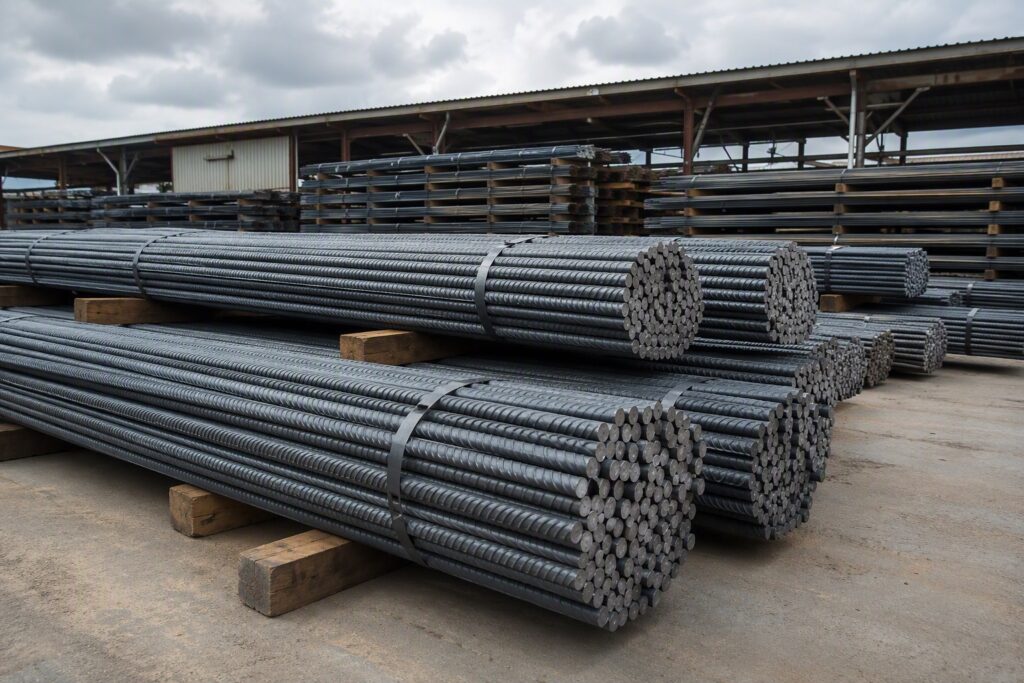
Rebar Bending and Cutting: Standard Shapes and Tolerances
Before deformed steel bar ever reaches the concrete, almost every piece of it is cut to length and most of it is bent. Stirrups, ties, hooks and lapping details are fabricated off the critical path so that the site crew can fix reinforcement quickly and correctly, and the quality of that rebar bending and cutting work decides how well the whole reinforced concrete structure performs. This guide explains the standard shapes a bar bender produces, the bend diameters and tolerances that design codes expect, the cutting methods used in practice, and exactly what information a buyer or contractor should put on an inquiry so that cut and bent rebar arrives right the first time. If you are sourcing the material itself, the supply range at Shuncheng Steel’s deformed steel bar line covers the common grades and diameters from 6 mm to 36 mm, while Shaanxi Shuncheng Tian Steel Co., Ltd. is a direct mill exporter for construction steel products.
Why Rebar Is Bent and Cut Before It Is Placed
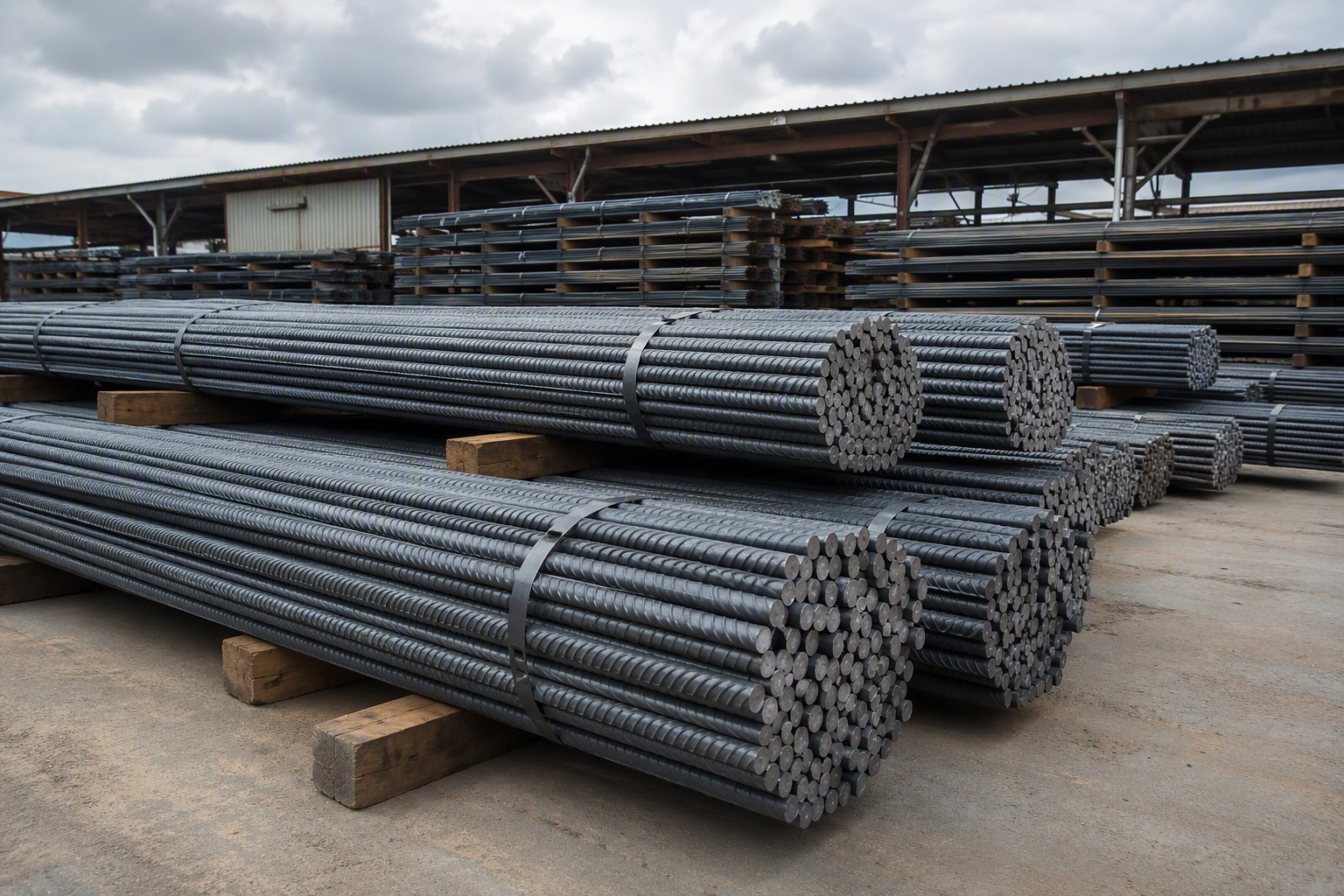
Concrete is strong in compression but weak in tension, so steel reinforcement is embedded where the structure is expected to carry tensile forces, forming what engineers call reinforced concrete. The steel and the concrete must act as one member, which only happens if the bar cannot pull out of the concrete under load. That bond comes from two things: the ribs rolled into the bar surface, and the mechanical anchorage created by hooks and bends at the bar ends. A straight bar that simply ends inside a beam or column has little resistance to slipping; a bar finished with a 90° or 180° hook engages a much larger volume of concrete and develops its full strength.
Bending and cutting therefore serve three purposes. First, they shape the steel to fit the geometry of the member — stirrups wrap around longitudinal bars, column ties confine the core, and slab bars are cut to bay dimensions. Second, they provide anchorage and laps that transfer stress between bars. Third, they allow the concrete cover to be maintained, because a correctly bent bar can be positioned with the required clearance from the form face. The bars are supplied straight and long from the mill — typically 6 m, 9 m or 12 m — and all of this shaping work is done cold in the fabricator’s shop or on site by bar cutters and benders, never by heating the steel.
Standard Bending Shapes: Hooks, Stirrups and Ties
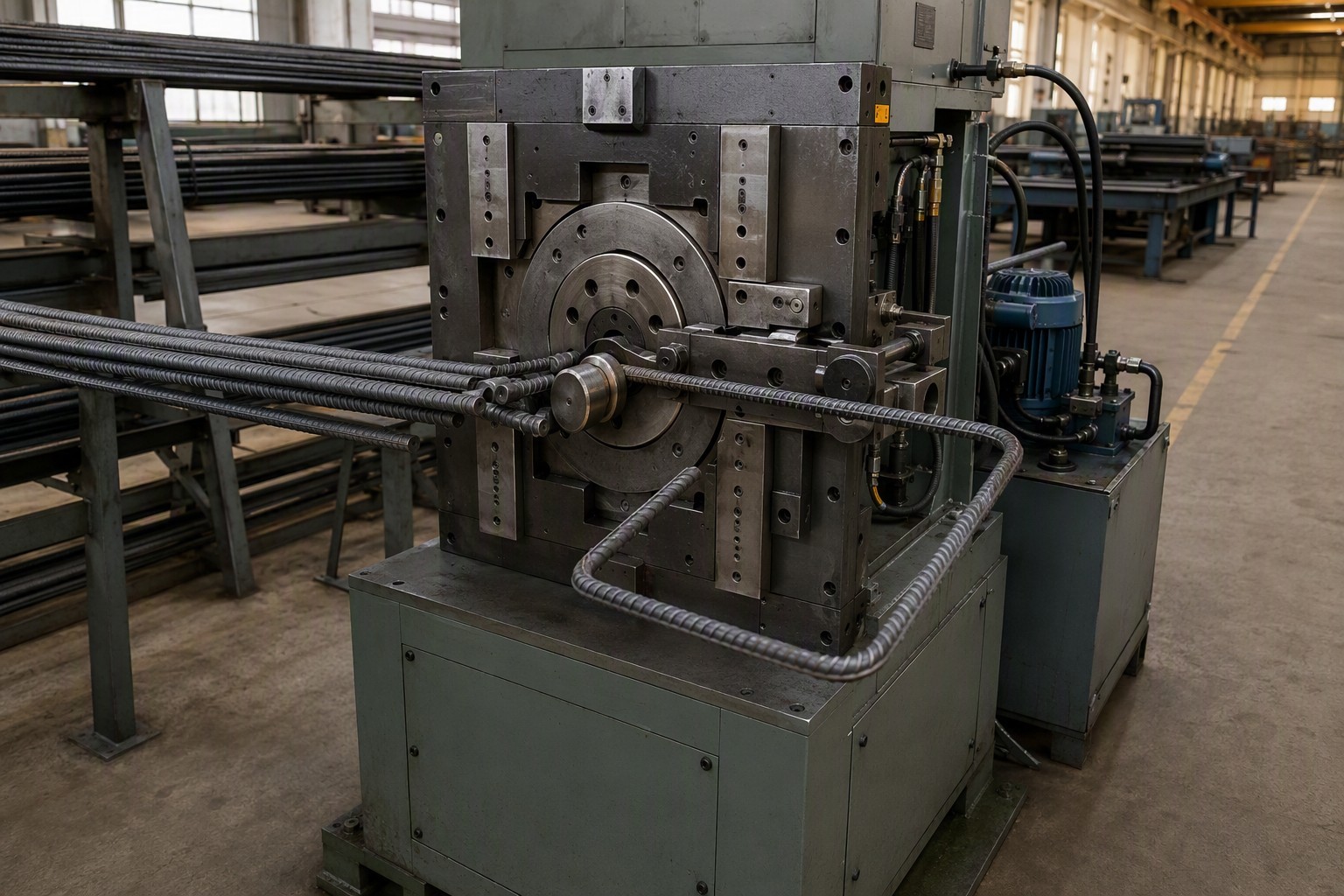
Although an individual project drawing can call for almost any angle, international practice is built on a small family of standard shapes. The definitions of the bars themselves — the rib geometry, grades and marking of deformed reinforcement — are covered in the rebar reference material; what follows are the shapes a bending shop makes from straight stock:
| Shape | Typical bend geometry | Where it is used |
|---|---|---|
| Straight cut bar | No bending, cut to exact length | Slab distribution bars, longitudinal bars cut to member length |
| 90° hook | Right-angle bend at one or both ends | Anchorage of main bars at beam ends and column heads |
| 180° hook (standard hook) | U-turn bend forming a semicircular end | Classic anchorage detail for plain and deformed bars in beams and slabs |
| 135° hook | 135° bend commonly on one end of a stirrup | Stirrups and ties where a closed, non-slipping anchorage is required |
| Stirrup (U, rectangular, closed) | Rectangular or polygonal closed loop with hooks | Shear reinforcement in beams, confinement of columns |
| Lapping / spliced bar | Straight with possible end hooks for lap length | Joining bars where full length is not available |
The most common fabrication jobs are stirrups and ties, because a beam or column consumes them in large numbers and they are identical once the bar diameter and member size are fixed. A typical beam stirrup is a closed rectangular loop with a 135° hook on one corner and a 90° hook on the other, arranged so that the hooks engage the core concrete. Column ties follow the same logic and are spaced along the column height. Because all of these items repeat, fabricators set up automatic stirrup bending machines that feed straight bar from a coil or stock length and produce hundreds of identical pieces per hour with consistent bend angles — which is why specifying the shape clearly in the order matters more than the shop’s skill.
Bend Diameters: How Tight a Bend Is Allowed
Rebar bending quality is controlled above all by one number: the diameter of the former (mandrel) that the bar is bent around. If the bend is too tight, the outside fibre of the bar strains beyond the steel’s ductility and micro-cracks open on the tension face — invisible at first, but a real weakness under service load and a certain rejection in the standard bend test. Design codes such as ACI 318 therefore specify minimum bend diameters for every bar size and application. The widely used rule-of-thumb values are a former diameter of about four times the bar diameter (4db) for smaller stirrup and tie bars, and six times (6db) or more for larger bars and for main-bar hooks — values that appear consistently across North American, European and Asian design practice. The exact figures to apply on a given job come from the design code and from the product standard the bar was supplied to, and a responsible fabricator confirms the mandrel size before production rather than assuming it.
Two further rules apply in every shop. Bending must be done cold: heating rebar to make it easier to bend is not permitted under normal fabrication practice, because the heat alters the metallurgical structure and the mechanical properties that the grade certificate guarantees. And once a bar has been bent, it should not be re-bent or straightened unless the project specification explicitly allows it — every cycle of bending works the steel and consumes ductility. These precautions are why the bend test described below is part of the quality system rather than an optional extra.
Rebar Cutting Methods and Equipment
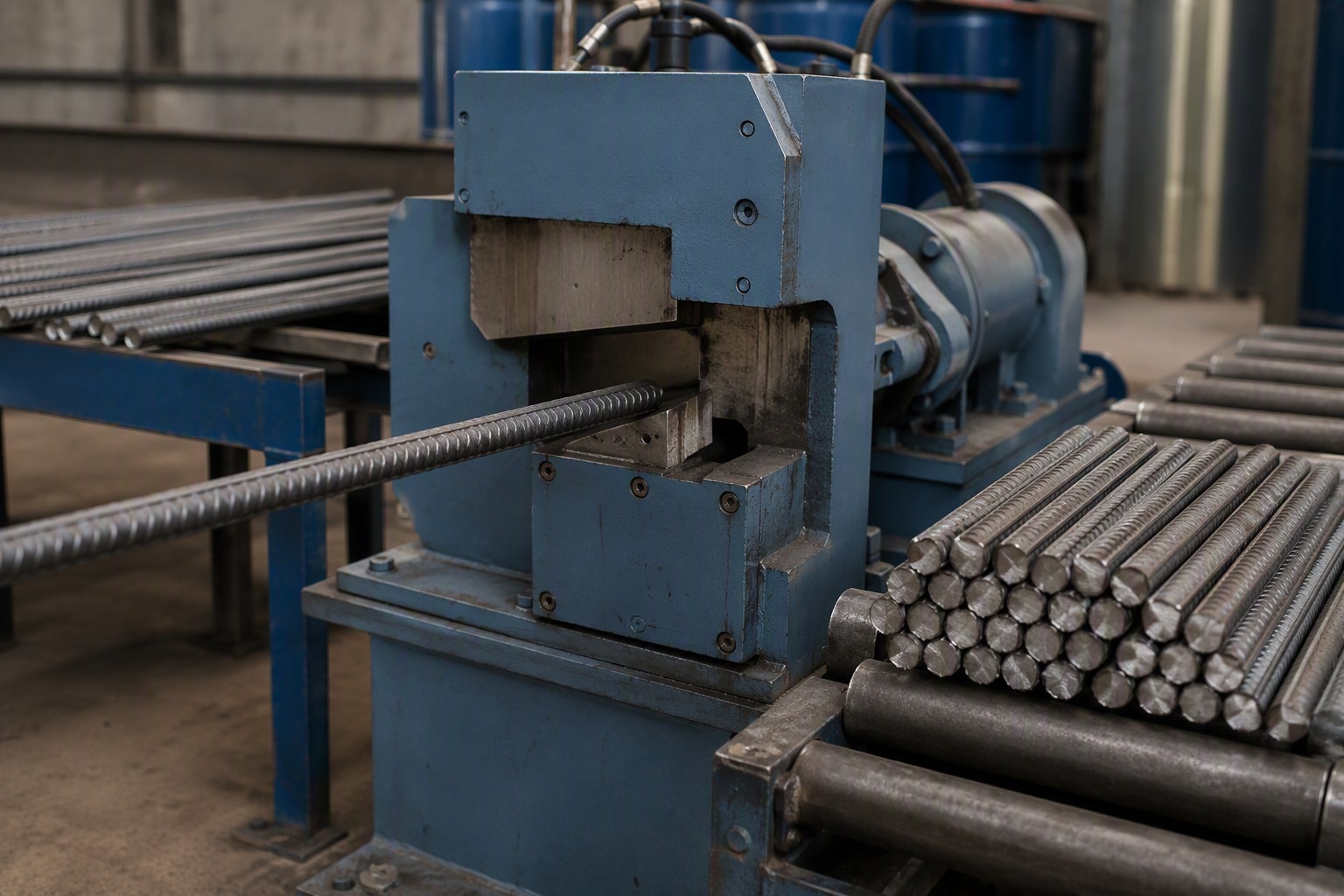
Rebar is cut cold, at three possible points in the chain: at the rolling mill by the line’s cold shear, at the fabricator’s shop, or on site. The equipment used differs mainly in capacity and portability:
- Hydraulic shears and guillotine cutters — the standard shop and site tool for diameters up to about 32–40 mm. They cut by shearing action, are fast, and produce a clean square end when the blades are maintained.
- Abrasive cut-off saws and diamond-blade saws — used for larger diameters, for trimming to fine tolerances, and where a shear is not available. They are slower and produce sparks and dust, but the cut face is smooth.
- Automatic bar straightening and cutting lines — fed from coil, these straighten, cut to programmed length and count pieces automatically; they are the backbone of high-volume stirrup and tie production.
- Oxy-fuel or plasma torches — not used for normal rebar cutting, because localised heating can change the steel’s properties; the same metallurgical caution applies to flame-cutting other hot-rolled products such as seamless steel pipe, where thermal cutting needs procedure control.
Cut length accuracy matters because it determines lap lengths, cover and bar spacing in the finished member. A practical shop tolerance for cut lengths is commonly specified in the region of ±25 mm (about one inch) for site bars, with tighter values for prefabricated items that must fit pre-formed cages; whatever the project requires, the tolerance should be stated in the order and agreed with the supplier rather than left to chance. Shear-cut ends are normally left as sheared; if a square, burr-free end is needed for threaded or mechanical connections, that is a separate processing step and should be called out explicitly.
Tolerances and Inspection: What the Standards Check
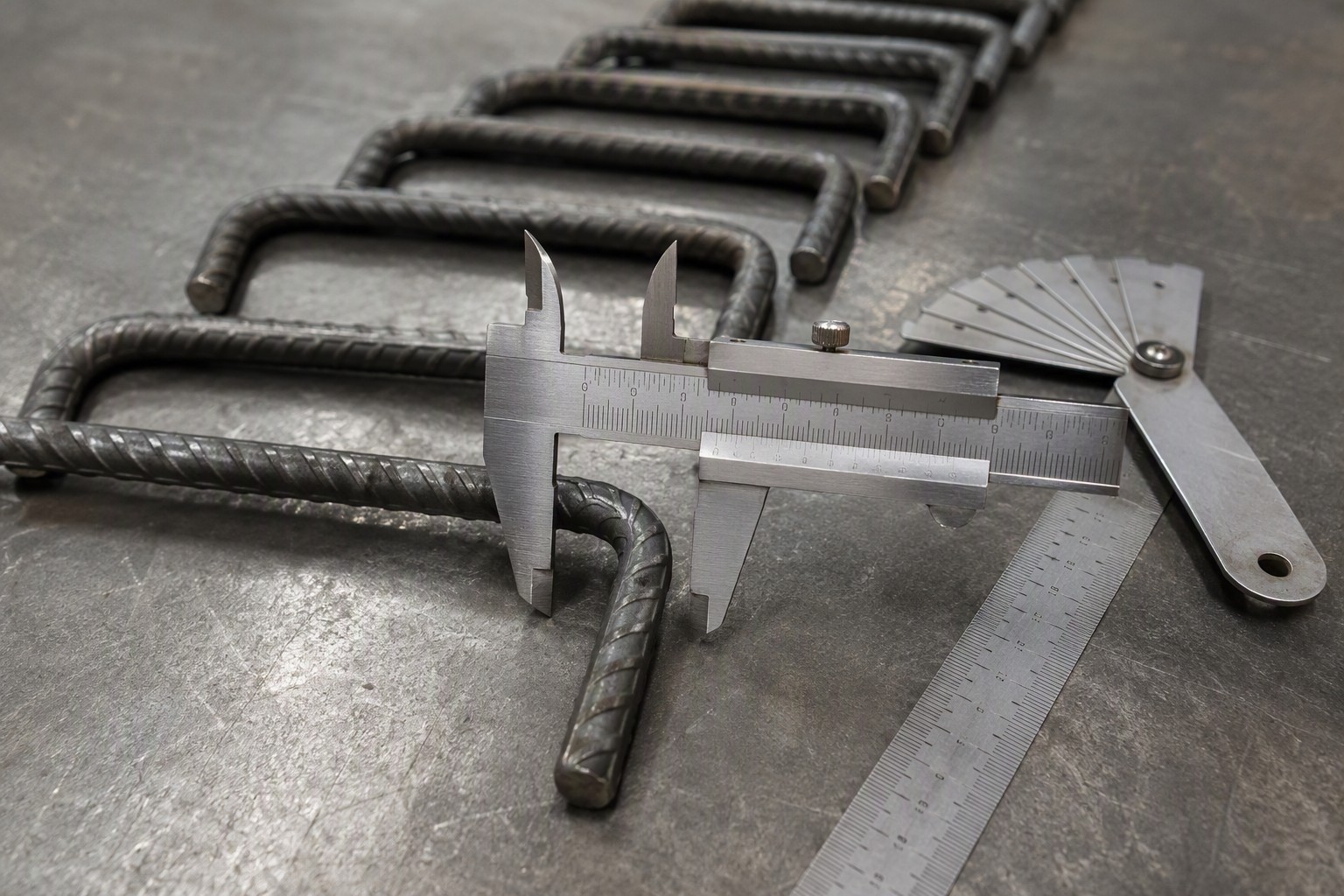
Two levels of checking apply to cut and bent rebar. The first is the mill level: the product standard itself verifies that the steel can be bent without cracking. ASTM A615/A615M, the standard specification for deformed and plain carbon-steel bars for concrete reinforcement, requires tensile testing, bend testing and deformation (rib) checks on samples, plus marking of the finished bars; ISO 6935-2, the international standard for ribbed bars for the reinforcement of concrete, likewise specifies mechanical properties, geometric tolerances on the ribs and a bend test performed at room temperature, in which a full-size sample is bent through 180° around a former of the specified diameter and must show no cracks on the tension face. When you buy from a mill that supplies to ASTM A615, ISO 6935-2 or the equivalent Chinese GB/T grades, the bend test certificate is your evidence that the grade can withstand the bending your fabricator will apply.
The second level is the fabrication level: dimensional checks on the finished pieces. A fabricator’s inspection routine typically covers cut length, the position of each bend along the bar, the internal bend diameter, the bend angle, and the overall shape against the shop drawing or the bar bending schedule. Simple and reliable tools — a tape, a square, a protractor or angle template, and callipers for the bend diameter — are sufficient for routine control, and pieces are rejected if the outside of any bend shows cracking or if the shape deviates beyond the tolerances agreed for the order. For large or critical projects, inspection can also include verification of the grade markings rolled into the bar and a review of the mill test certificates, so that the steel being bent is actually the grade that was ordered.
How to Order Cut and Bent Rebar: the Bar Bending Schedule
The professional way to communicate rebar bending and cutting requirements is a bar bending schedule (BBS) — a table that lists every shape in the structure with its mark number, bar size, number of pieces, shape code, cut length and bend details. Shape coding systems such as the BS 8666 series used widely in international practice translate each geometric shape into a short code, so a supplier in another country can bend exactly the right shape without re-interpreting a drawing. When you request a quotation for fabricated rebar, provide:
- the grade and standard (for example HRB400 per GB/T, Grade 60 per ASTM A615, or B500B per EN 10080);
- the bar diameter for each mark;
- the shape code or a dimensioned sketch of each bend;
- the cut length and quantities per mark;
- the bend diameter requirements if they differ from the code default;
- any special requirements such as bundling, tagging per mark, or coupler-prepared ends.
If the project has not yet produced a schedule, a supplier can usually help convert the structural drawings into one before quoting — but the schedule should be agreed in writing before production starts, because bending is a one-way operation: a bar bent to the wrong shape cannot simply be straightened and reused. Sending your schedule to Shuncheng Steel’s sales team with the application details lets us confirm the grade, standard and available diameters, and quote fabricated rebar on an identical specification basis.
Frequently Asked Questions
What is the minimum bend diameter for rebar?
Design codes typically require the former (mandrel) diameter to be about four times the bar diameter for smaller stirrup and tie bars and six times the bar diameter or more for larger bars and main-bar hooks. The exact value depends on the bar size, the grade and the design code governing the project (such as ACI 318); the fabricator should confirm the mandrel size before bending, and the bend must be made cold.
Can rebar be bent on site after delivery?
Yes — portable hydraulic benders and shears are standard site equipment, and site bending of straight bars is common. What is not allowed is heating the bar to make it bendable, or re-bending and cold-straightening bars that have already been bent, unless the project specification permits it, because both operations damage the steel’s ductility and can create unseen cracks.
How do I know the bars I ordered can be bent without cracking?
Ask the supplier for the mill test certificate and check that the bar was supplied to a standard that includes a bend test, such as ASTM A615/A615M, ISO 6935-2 or the GB/T grades. Those standards bend full-size samples through 180° around a specified former and require no cracks, which is the same condition your fabricator’s bending must meet.
Send Us Your Bar Bending Schedule for a Quote
Rebar bending and cutting is where specification discipline pays off: correct shapes, correct bend diameters and agreed tolerances keep the project on schedule and the structure sound. If you are procuring deformed bars — straight, cut to length, or fully bent to schedule — send your size list or bar bending schedule to Shuncheng Steel, tell us the grade, diameter and standard, and we will confirm availability and quote on the exact specification your drawings require.
Related Product: Deformed Steel Bar (Rebar) HRB400 12 mm — hot-rolled ribbed bar supplied in 12 m lengths, suitable for cutting and bending to your project schedule.