
Aluminum 8011 vs 1235: Which Alloy Should You Choose for Foil Production?
One wrong alloy choice in a foil order locks up metal, money and rolling capacity, and the error surfaces only after the campaign ends. Here is the fix.
Aluminum 1235 is a 99.35% pure 1xxx alloy chosen for ultra-thin converter, cigarette and medical foil where ductility and barrier matter most. Aluminum 8011 is an Al-Fe-Si 8xxx alloy with higher strength, chosen for household foil, containers, blister packs and lacquered foil. Pick 1235 for thinness, 8011 for strength.
Choosing between aluminum 8011 and 1235 is really a question about what the foil has to do in service, not about which number sounds more advanced. The two grades sit in different alloy families, behave differently on the rolling mill, win different applications and carry different economics that only become visible when you cost the metal per square metre rather than per tonne. In this guide we explain how each alloy is built chemically, how their mechanical behaviour and rollability differ, which applications each one owns, how cost, yield and downgauging arithmetic shift the decision, and how you can verify the chemistry you actually received before the container is loaded.
What Are Aluminum 8011 and 1235 Made Of?
Both alloys are rolled from continuously cast stock, but their chemistry pulls them in opposite directions.
Aluminum 8011 is an 8xxx alloy built on iron and silicon, typically 0.5–0.9% silicon and 0.6–1.0% iron, with a minimum aluminum content of 98.0%. Aluminum 1235 is a 1xxx alloy with a minimum of 99.35% aluminum and deliberately minimal alloying additions.
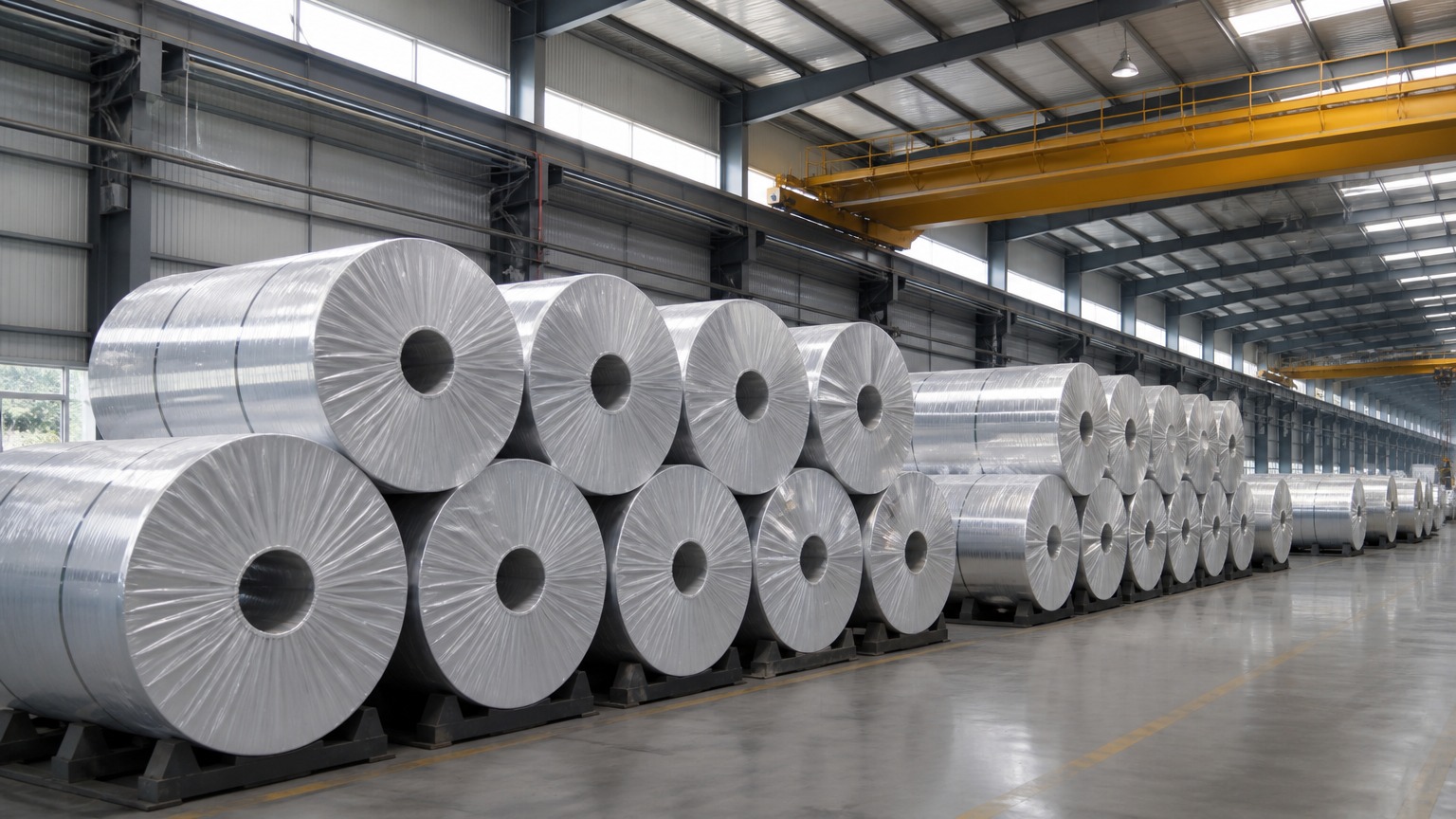
Dive deeper: the four-digit logic and why the 8xxx family behaves differently. Every wrought aluminum alloy carries a four-digit designation, and the first digit tells you the alloy family before you read anything else. A 1xxx alloy is at least 99% aluminum and exists mainly because of its purity: conductivity, reflectivity, corrosion behaviour and ductility are inherited from the base metal rather than engineered into it. That is exactly what 1235 is, at a minimum of 99.35% aluminum, and it is the reason 1235 is often called a converter foil grade — a foil designed to be laminated, printed or lacquered downstream rather than to carry structural load on its own. The 8xxx family is the catch-all group reserved for alloys whose principal additions fall outside the familiar copper, manganese, silicon, magnesium and zinc systems, and 8011 belongs there because its defining additions are iron and silicon taken together. In 8011 those two elements do not simply sit in solid solution; they precipitate as fine second-phase particles, largely iron aluminide and Al-Fe-Si phases, and those particles are what lift the alloy’s strength above a pure grade. The trade-off is that the same particles limit how far the metal can be deformed before it cracks, so 8011 is normally specified in O temper for household and container work and in H22, H24, H26 or H18 for further-fabrication grades where the extra strength is the whole point. The distinction matters commercially as well as metallurgically, because 8011 reaches a given strength at a lighter gauge and can therefore be downgauged wherever stiffness is not the limiting factor. The designation system itself, including the meaning of each series and the temper letters that follow the number, is set out in the Wikipedia overview of aluminium alloys. Both families are listed side by side in our aluminum foil range, where household foil is normally supplied in 8011 while cigarette foil is supplied in 1235.
| Property | Aluminum 1235 | Aluminum 8011 |
|---|---|---|
| Alloy series | 1xxx — essentially pure aluminum | 8xxx — Al-Fe-Si alloy |
| Aluminum content | 99.35% minimum | 98.0% minimum |
| Principal additions | Very low iron and silicon | Si 0.50–0.90%, Fe 0.60–1.00% |
| Secondary limits (typical) | Kept deliberately low to preserve purity | Cu ≤0.10%, Mn ≤0.20%, Mg ≤0.05%, Zn ≤0.10%, Ti ≤0.08% |
| Typical foil tempers | O, H18, H19 | O, H18, H22, H24, H26 |
| Typical role in foil | Converter, cigarette and medical foil | Household, container, blister and lacquered foil |
How Do 8011 and 1235 Differ in Strength and Rollability?
On the rolling mill the two alloys behave differently, and that difference decides how thin you can go.
8011 delivers higher tensile strength and better dead-fold, so it holds a crease and supports its own weight. 1235 is softer and more ductile, rolls to thinner gauges with fewer breaks, and conducts heat and electricity more efficiently.
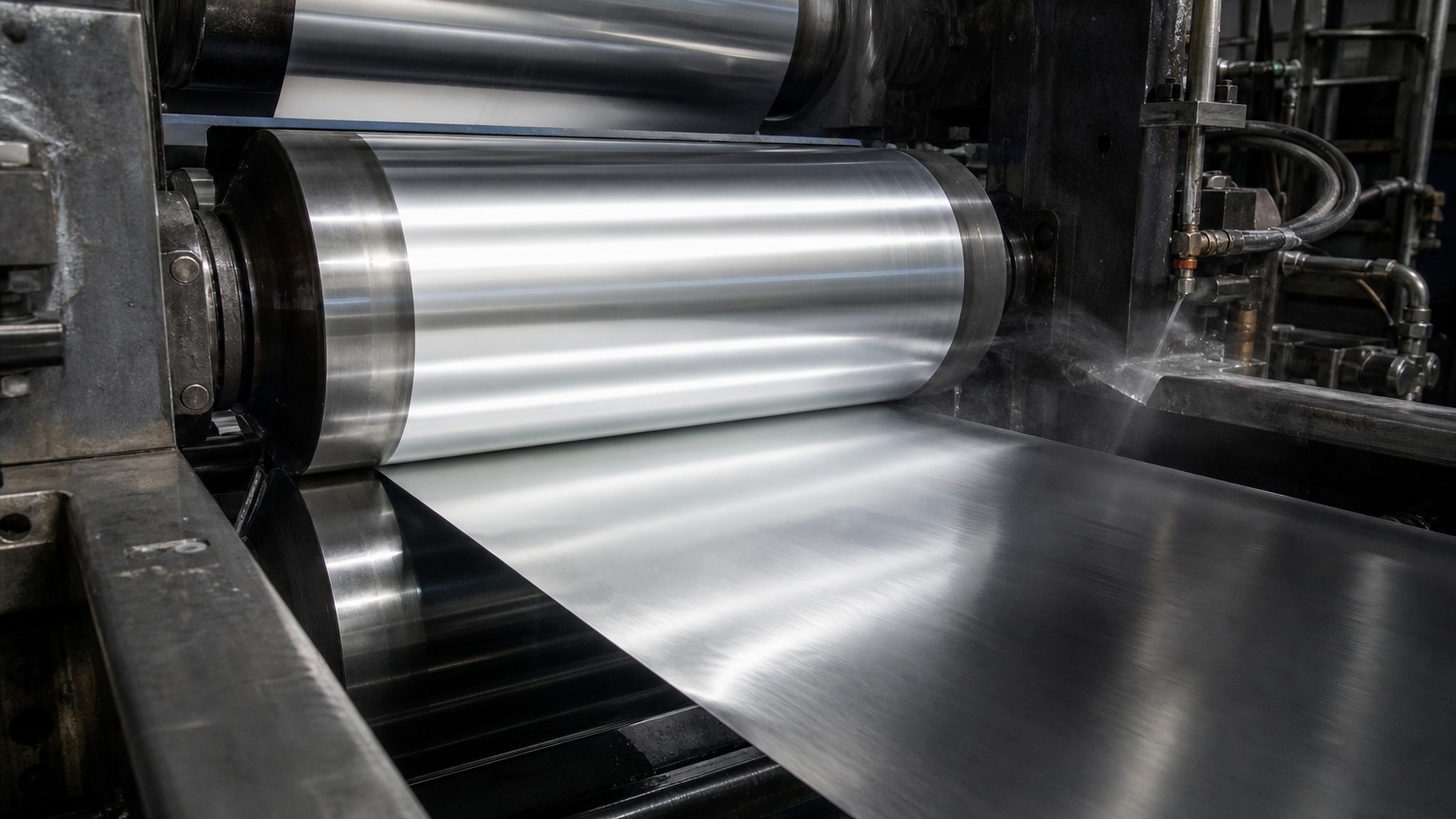
Dive deeper: temper, work hardening and the two-sheet rolling trick. Strength in foil is never a single number; it is the result of how much the metal has been work-hardened and how much second-phase structure it carries. Both alloys are supplied in several tempers, and the temper letter matters as much as the alloy number. An O temper is fully annealed and therefore soft and highly formable, which is what wrapping and pressing operations need. H18 and H19 are fully hard, strain-hardened grades used where the foil must resist handling without stretching. Between them sit H22, H24 and H26, which are strain-hardened and then partially annealed back to a controlled level of strength, and these are the tempers most often chosen for further fabrication. Because 8011 carries iron and silicon particles, it reaches a higher strength than 1235 at the same temper, which is why 8011 is preferred where the foil acts as a semi-structural skin in laminated packaging or must resist puncturing in a container wall. Because 1235 is nearly pure, it work-hardens less aggressively, stays ductile and rolls to extremely thin gauges with a lower risk of edge cracking or breakage — exactly what a converter needs when laminating foil to paper or film at nine microns or less. Thin gauges also change the production method. Below roughly 0.025 mm the final pass is normally rolled with two sheets stacked together and separated afterwards, which is why foil has one bright side and one matte side; that structure is a rolling signature rather than a defect, and in decorative work the bright face is usually the one chosen for its reflectivity. The thickness window for both alloys in packaging service is wide: ASTM B479-19 covers annealed aluminum and aluminum-alloy foil from 0.00025 in. (0.0064 mm) up to but not including 0.006 in. (0.15 mm), and names 1100, 1145, 1235, 8011, 8079 and 8111 among the alloys it governs. That list is a useful way to confirm that the grade your converter asks for is a recognised foil alloy rather than a sheet grade being sold as foil.
Which Applications Should Aluminum 8011 Be Used For?
Most foil you meet in a kitchen, a pharmacy or an air conditioner started life as 8011.
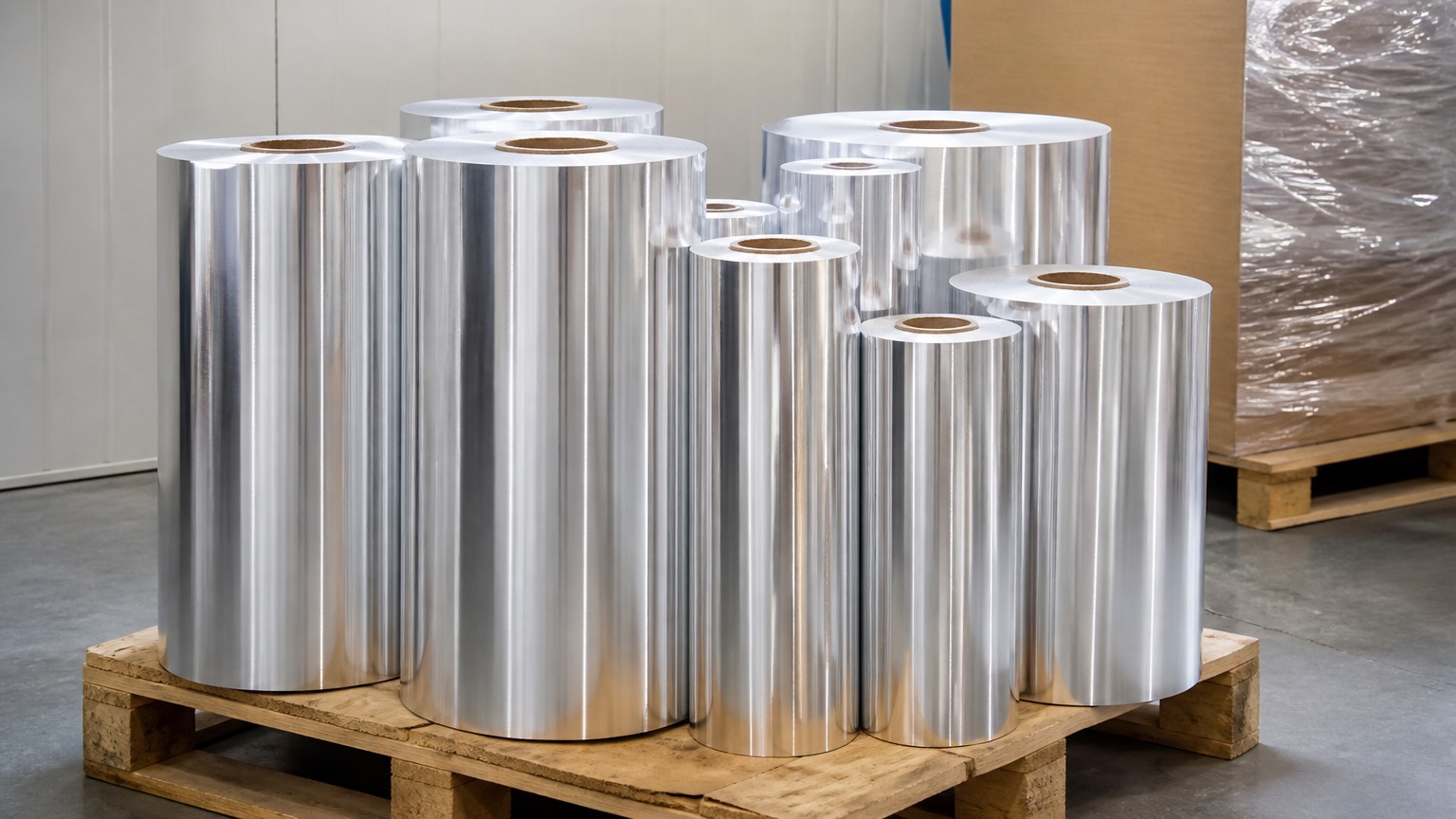
8011 serves household foil, semi-rigid containers and trays, pharmaceutical blister foil, air-conditioner and insulation foil, and further-fabricating foil that is lacquered or laminated downstream.
Dive deeper: why 8011 became the packaging workhorse. 8011 is the default packaging and fabrication alloy because it is the most economical way to get enough strength and formability into a very thin sheet at high volume. In household foil it is supplied in O temper, where the soft, dead-folding behaviour lets the sheet wrap a bowl without springing back, and the same property makes it suitable for semi-rigid containers that must be pressed into shape and then hold that shape through filling, sealing and transport. In pharmaceutical packaging, 8011 is used as a base web for blister lidding and push-through packs, normally in H18 or H19 temper so the lid stays flat and opens cleanly, and typically combined with a heat-seal lacquer that bonds to the blister film; our own foil classification lists medical foil in 1235, 8011 and 8111 in H18 and H19 tempers, which is a fair reflection of how often those families overlap in that application. Further-fabricating foil is the broadest category and is usually ordered in O, H22, H24, H26 or H18, because downstream converters laminate it to paper and film, coat it with lacquer, print it, emboss it or slit it into lid stock, and the final properties then come from the composite rather than from the metal alone. Air-conditioner foil follows the same logic: it is commonly supplied as 1100, 8011 or 3102 in H22, H24, H26 or H19 temper and wrapped around heat-exchanger fins where a thin, corrosion-resistant and thermally conductive layer is wanted. The last common role is as an insulation facing, laminated to fibre insulation or foam, where the foil’s low emissivity reflects radiant heat and its strength resists tearing during installation. For a buyer the practical message is simple: 8011 is chosen when the foil has to do mechanical work — hold a shape, resist a puncture, survive a press — and when volume justifies a purpose-built alloy rather than a pure grade. Two further benefits follow from that: it tolerates normal rolling and annealing schedules without exotic processing, and it accepts organic coatings and adhesives predictably, which is why so much lacquered lid stock begins as 8011. High-volume programmes are usually run close to the minimum practical gauge, and a good example of how far an 8xxx grade can be pushed is Aluminum Foil 8079 0.006mm, which uses a higher-iron 8xxx chemistry to hold strength at a thickness where a pure grade would struggle.
Which Applications Should Aluminum 1235 Be Used For?
Where purity and barrier performance outrank strength, 1235 is the first choice.
1235 serves cigarette foil, medical and pharmaceutical foil in H18 or H19 temper, converter foil for lamination at very thin gauges, and decorative or embossed foil that needs a clean bright surface.
Dive deeper: the jobs that are really purity jobs. 1235 exists because some foil applications are purity applications in disguise. Cigarette foil is the classic case: it is supplied in the soft O temper, wrapped tightly around a bundle and required to be chemically inert, tasteless and consistent from coil to coil, so the alloy is kept as close to pure aluminum as the specification reasonably allows. Medical foil is the second large home for 1235, and there the requirement is barrier performance combined with cleanliness. A push-through blister pack needs a pinhole-free web that blocks moisture and oxygen for the whole shelf life of the drug, and the higher the purity of the foil, the fewer the second-phase particles that could act as a pinhole initiation site during rolling and forming. That is why medical foil is commonly supplied in H18 or H19 temper in 1235, 8011 or 8111, with 1235 selected when the converter needs maximum ductility during lamination and forming. Converter foil is the third and often the largest volume: 1235 is laminated to paper, polyethylene or other films to build the multi-layer composites used for sachets, pouches, lids and aseptic packaging, and in that role the metal is usually the thinnest functional layer, frequently around six to nine microns. At those gauges the foil is no longer self-supporting. It is there to provide a barrier, and its mechanical strength comes from the substrate it is bonded to, which is precisely why ductility matters more than tensile strength. Decorative and embossed foil is the fourth common use, and 1235’s bright, uniform surface takes a print, a lacquer or an embossed pattern cleanly because there are fewer non-uniform features to disturb the finish. Finally, 1235 is the reference choice whenever electrical or thermal conductivity is part of the requirement, since it is alloying elements that degrade a pure metal’s conductivity. The general physical behaviour of the material, including the working definition of aluminium foil as sheet below 0.2 mm thick with gauges down to about 6 µm in regular commercial use, is summarised in the Wikipedia entry on aluminium foil. Rolls of this grade are produced on the same rolling and slitting lines as the 8xxx family at our aluminum rolling and coating operations. The short version for a buyer is this: 1235 is selected when the foil must be inert, thin, bright and low-defect, and 8011 is selected when it must also be strong.
How Do Cost, Yield and Downgauging Change the 8011 vs 1235 Decision?
The cheaper alloy on the quotation is not always the cheaper foil on the shop floor.
1235 needs higher-purity primary metal and usually costs more per tonne, while 8011 reaches the required strength at a lighter gauge, so area yield per tonne and total cost per square metre can favour either alloy.
| Foil thickness | Approximate area produced per tonne | Typical service |
|---|---|---|
| 0.006 mm | ≈ 61,500 m² | Thin converter and blister foil |
| 0.009 mm | ≈ 41,000 m² | Lamination and cigarette foil |
| 0.012 mm | ≈ 30,700 m² | Household foil, general packaging |
| 0.020 mm | ≈ 18,400 m² | Semi-rigid containers and trays |
| 0.050 mm | ≈ 7,400 m² | Insulation facing and heavy gauge work |
Dive deeper: the two numbers that actually decide the economics. Two figures govern the cost of any foil programme: the metal price you pay per tonne, and the area of foil that tonne actually produces. The second figure is easy to underestimate. Because area yield is inversely proportional to thickness, thinning a foil by 10% produces roughly 11% more square metres from the same weight of metal, so any grade that lets you hold the required properties at a lighter gauge is worth more than its quoted price suggests. This is where 8011 has a structural advantage. Its iron and silicon additions raise strength and dead-fold, so wherever the foil must support itself, resist puncture or hold a pressed shape, 8011 can often be run lighter than a pure grade would allow, and on a large annual volume a single gauge step is worth more than a whole percentage point of metal price. The argument cuts the other way at the thin end. Below a certain gauge the controlling problems are pinholes, edge cracks and rolling breaks rather than strength, and 1235’s higher purity and ductility let a mill run thinner with fewer defects and better surface quality. If a programme lives in the six to nine micron range, a small price advantage for 8011 can disappear quickly once downgauging stops helping and reject rates start to bite. Scrap and recovery belong in the same calculation, because foil production generates trim and offcuts that are recycled internally, and alloys with a broader scrap tolerance are easier to keep inside that loop than grades tied to a narrow purity window. Processing cost differs too: 8011 typically needs no special handling, while the highest-purity grades demand cleaner melting practice and tighter process control, an overhead that is real even when it never appears on a quotation line. Finally, remember that metal price is the most volatile input in the whole calculation. Aluminum is a globally traded commodity and a market move can swamp a small alloy premium inside a single quarter, so a current view of the trend is worth more than a price fixed months ago; the Aluminum Association tracks the market background industry-wide at aluminum.org, and our own aluminum price trend analysis is worth reading next to any quotation you receive. Cost the foil per square metre, not per tonne, and the 8011 versus 1235 decision usually makes itself.
How Do You Verify Which Alloy You Actually Received?
Two coils can look identical on the truck and still be two different alloys underneath the wrap.
Verify the alloy against the mill test certificate, confirm chemistry by chemical and spectrochemical analysis, check temper and thickness with instruments, and retain a sample from every batch.

Dive deeper: a verification routine that holds up after the container lands. The only document that turns a verbal promise about alloy into a contractual fact is the mill test certificate, and it should name the alloy, the temper, the cast or heat number, the chemical composition and the mechanical results for the coil you actually received. Chemistry is verified by chemical and spectrochemical methods, and ASTM B479-19 requires that the chemical composition conform to the provisions of the specification and be determined by those methods, so a certificate that merely restates the alloy number without supporting composition data is a claim rather than evidence. Mechanical verification is a separate step, and the same standard requires the tensile breaking load to be tested twice using two samples taken from different rolls of foil, precisely because foil properties can vary between coils inside a single batch; if your certificate carries one result, ask how the sampling was performed. On the floor, the fastest checks are the ones that catch the commonest substitutions. Thickness is measured with a micrometer or a continuous beta gauge, and foil specified at 0.006 mm but delivered at 0.008 mm is a 25% shortfall in area yield even though it may feel correct in the hand. Temper is confirmed by a simple bend or dead-fold test alongside the certificate, because foil softened to O temper springs back differently from an H18 grade. Alloy identity can be checked on site with portable XRF or optical emission instruments, which is the practical version of the spectrochemical analysis the standard describes, and it is worth retaining a sample from each production batch so that a later dispute can be settled by measurement rather than memory. Finally, verify packaging and labelling against the purchase order, because mix-ups usually happen in handling rather than in melting; European Aluminium publishes industry guidance on material flow and handling conventions that many buyers use as a reference point. The full set of verification steps — certificate review, instrument checks and retained samples — is exactly what a disciplined supplier should be able to evidence before dispatch. If you would like the alloy, temper and thickness confirmed against the mill documentation, send your foil specification to our team and we will match it line by line before the coil ships.
Conclusion: Choose 1235 when thinness, purity and barrier performance lead; choose 8011 when strength, containers and lacquered foil lead. Verify the chemistry on a mill test certificate before you commit.