
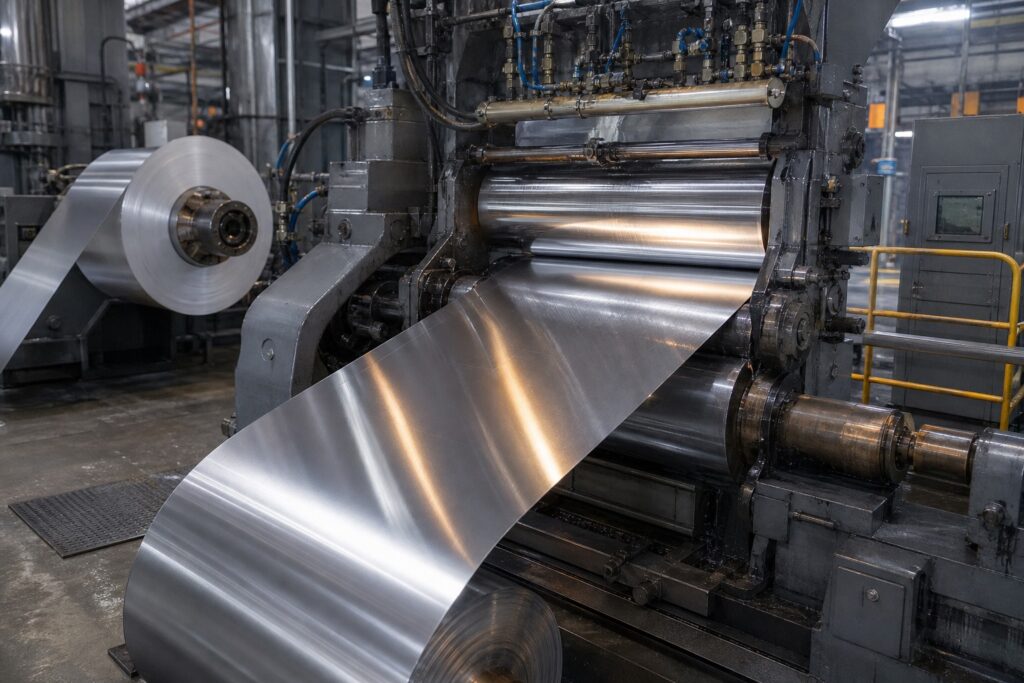
Aluminum Foil Roll: Which Types and Alloys Fit Your Industrial Application?
One wrong alloy choice can wreck an entire lamination line. Foil problems rarely show at goods-in; they surface weeks later, inside your finished product.
An aluminum foil roll is thin aluminium strip below 0.2 mm, wound onto a core and supplied in alloys such as 1235, 8011, 8079 or 1100, in tempers from soft O to full-hard H18, and in widths typically from 20 mm to 1500 mm for packaging and industrial use.
Choosing a foil roll is therefore a specification exercise, not a shopping exercise. The sections below work through what a foil roll actually is, which alloys and tempers do which job, how thickness and width are decided, where the material is used, and how to inspect a delivery before it enters production.
What Is an Aluminum Foil Roll and How Is It Made?
Foil is not rolled like plate. Below a certain gauge the process changes completely, and so does the material you receive.
An aluminum foil roll is produced by rolling cast or continuously cast stock down through cold rolling mills until the strip is under 0.2 mm, then double-rolled for the final passes, annealed, slit to width and rewound on a core.
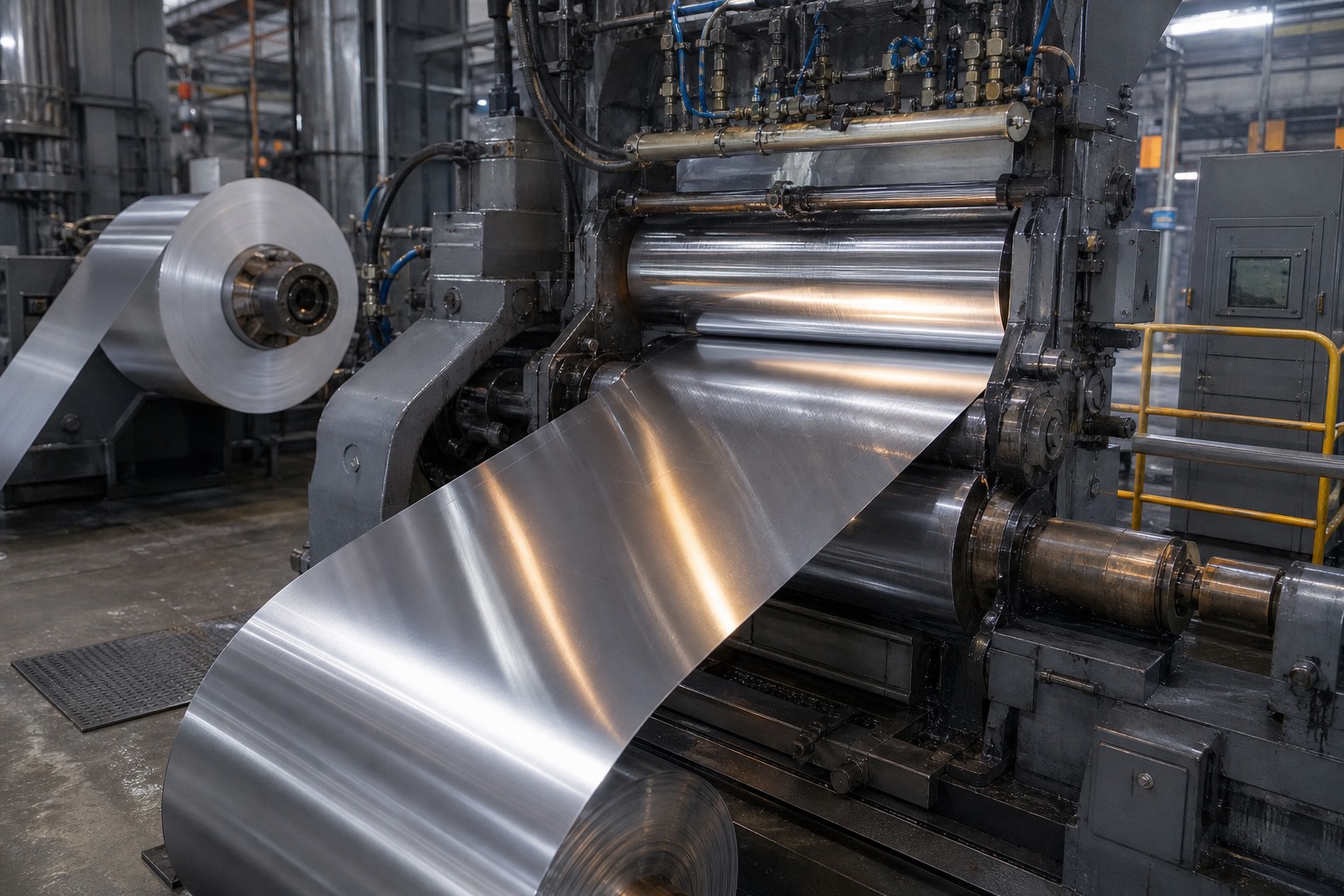
Dive deeper: from cast stock to a wound roll. A foil roll does not begin life as a thin strip. It begins as cast material roughly 6 to 8 mm thick, produced either by direct-chill casting of a rolling ingot that is subsequently hot rolled, or by continuous casting, in which molten aluminium solidifies between rolls into a thin strip. The industry treats continuous casting as the less energy-intensive route, and it has become the preferred process for many foil lines, as the encyclopedic description in Wikipedia’s overview of aluminium foil explains. From there the material is cold rolled in a series of passes, each one reducing gauge and lengthening the strip, until it reaches single-rolling territory. Then the process changes character. For the final passes on gauges below about 0.025 mm, two sheets are rolled together in a technique known as double rolling or pack rolling, which doubles the effective gauge entering the roll gap, reduces the risk of tearing, improves thickness control and raises productivity. When the two sheets are separated, the faces that were in contact come out matte and the outer faces come out bright, which is why household foil always has a shiny side and a dull side, and why buyers sometimes wrongly assume the two sides perform differently in service. After rolling, the strip is annealed to reach the ordered temper, slit to the exact width on slitting lines, wound onto steel or paper cores, and wrapped for transport. Every step is recorded against a coil number, and that record is what later appears on the mill certificate. For buyers ordering against the foil specification families such as ASTM B479, EN 546 or GB/T 3198, that traceability chain from cast to finished roll is the first thing worth asking to see.
Which Aluminum Alloys Are Used for Foil Rolls?
Alloy choice decides strength, corrosion resistance, food-contact suitability and, quietly, your price per tonne.
Alloy 1235 and 8079 are the workhorses for thin packaging and lidding foil, 8011 dominates household and pharmaceutical foil, 1100 and 1050 suit cable wrap and decorative work, and 3102 or 3003 serve heat-exchanger fin stock.
Dive deeper: reading an alloy table like a buyer. The alloy is the first line of a foil specification because it sets the balance between strength, formability, barrier performance and cost. The grades most often traded for packaging foil, including 1100, 1145, 1235, 8011, 8079 and 8111, are exactly the family covered by the standard specification for annealed aluminium foil used in flexible barrier and food-contact applications — ASTM B479 requires a minimum aluminium content of 98.00% and covers foil from 0.0064 mm up to but not including 0.15 mm. Within that family the differences are practical rather than academic. Alloy 1235 is a near-pure foil alloy used for cigarette foil, laminates and general wrapping, where softness and barrier matter more than strength. Alloy 8011, an Al-Fe-Si alloy, is the workhorse for household foil, semi-rigid containers and pharmaceutical packaging because it combines good formability with slightly higher strength than near-pure grades. Alloy 8079 is chosen when gauge goes very thin, in lidding stock and some pharmaceutical laminates, because it tolerates the low gauges at which pinholes would otherwise multiply. Alloy 1100, and its higher-purity relatives 1050 and 1145, are common for cable wrap, insulation facing and decorative work, where electrical or reflective behaviour matters more than mechanical strength; our notes on 1050A and 1070 aluminum plate grades set out how those purer grades behave. Alloy 8021 is a blister-packaging favourite for the same reason as 8079. In heat exchangers and air-conditioning coils the picture changes: fin stock is supplied in manganese-bearing alloys such as 3102 or 3003 in partial-hard tempers, where stiffness and formability for fin forming outweigh perfect barrier. A sensible quotation names the alloy for the application — not just the word foil.
| Alloy | Typical foil use | Common temper | Why it is chosen |
|---|---|---|---|
| 1235 | Cigarette foil, laminates, general wrapping | O | Near-pure, soft, high barrier |
| 8011 | Household foil, containers, pharmaceutical | O, H18, H22 | Formability with useful strength |
| 8079 / 8021 | Lidding foil, blister packaging | O, H18 | Stable at very low gauges |
| 1100 / 1050 / 1145 | Cable wrap, insulation facing, decoration | O, H18 | Purity, conductivity, reflectance |
| 3102 / 3003 | Air-conditioner and heat-exchanger fin stock | H22, H24, H26 | Stiffness for fin forming |
What Do Temper Designations Like O, H18 and H22 Mean on a Foil Roll?
Two rolls can carry the same alloy and the same thickness and still behave differently on your machine. Temper is the reason.
Temper describes the metallurgical state of the strip: O is fully annealed and softest, H18 is full hard from cold work, and H22, H24 and H26 are partially annealed tempers that offer progressively more strength with less ductility.
Dive deeper: what the temper code is telling you. Aluminium foil is supplied in the O (annealed) and H (strain-hardened) tempers defined by the international designation systems, and the code is not decoration — it predicts how the strip will behave in converting. “O” means fully annealed: the softest, most ductile condition, chosen for wrapping, deep drawing, laminating and any operation with tight folds, because a soft foil conforms and stretches instead of cracking. The H series describes how much cold work, and sometimes how much partial annealing, the strip has received. H18 is effectively full hard — the strongest and least ductile condition — typically used where stiffness matters, such as fin stock, some lidding applications and any case where the foil must hold a shape; H19 is a slightly harder variant of the same family. H22, H24 and H26 are the quarter-hard, half-hard and three-quarter-hard tempers obtained by cold working and then partially annealing back to a controlled strength level, which is why they appear so often on air-conditioning and heat-exchanger foil. The practical consequence for a buyer is that alloy and temper are not interchangeable. A soft O-temper roll substituted for an H22 fin-stock roll will not hold a fin profile, and a full-hard H18 roll used where O temper was specified will micro-crack at the fold. Tensile properties are verified by the tension testing methods for metallic foil referenced in foil specifications, and the measured values should appear on the mill certificate beside the alloy and gauge. When a supplier quotes only “8011 foil” with no temper code, the quotation is incomplete. Before comparing prices, check the aluminum foil roll options on offer and insist on a temper code for every one of them.
Which Thickness and Width Should You Specify for an Aluminum Foil Roll?
Gauge is where money and risk meet. A few microns decide both barrier performance and whether the roll survives your machine.
Foil is defined as aluminium under 0.2 mm; household foil runs about 0.016 mm, heavy-duty around 0.024 mm, lidding and laminating foil commonly 0.006 to 0.030 mm, and insulation or cable wrap 0.030 to 0.150 mm, with rolls usually slit from about 20 mm to 1500 mm.
Dive deeper: why a few microns decide everything. Thickness in foil is measured in microns and fractions of a micron, and the difference between 6 µm and 12 µm is not a rounding error — it is a different product. Two effects dominate. The first is pinhole population: as gauge falls, the probability that the rolled strip contains microscopic through-thickness holes rises sharply, and those pinholes, not the nominal gauge, determine how well the foil actually blocks moisture, oxygen and light. That is why very thin converter foil is often laminated to a polymer film, which restores the barrier at a fraction of the cost of going thicker. The second effect is machine behaviour: a thinner strip is more sensitive to tension variation, more likely to wrinkle, and more likely to break at the slitting and rewinding stage, so the gauge you specify has to match the equipment that will run it. Width is the second half of the specification and is equally unforgiving. Foil rolls are normally slit to order from wider mill rolls, and widths range from roughly 20 mm for narrow cable or insulation tapes up to about 1500 mm for wide lidding and laminating stock. Slit edges must be clean and free of burrs, because a burred edge will tear in a high-speed converting line. How metal rolling works explains the reduction sequence that dictates what gauge tolerance a mill can actually hold. Ask each supplier to quote one package: nominal gauge with its tolerance, width with its tolerance, core inside diameter — commonly 76 mm or 152 mm — roll outside diameter or roll weight, winding direction, and whether interleaving or edge protection is supplied. A quotation that lists a nominal gauge with no tolerance band gives you no basis to reject a roll that sits at the wrong end of it. When you need a defined starting point, our aluminum foil 8011 in 0.02 mm is supplied in soft temper with the gauge and width written into the order.
What Are the Main Industrial Applications of Aluminum Foil Rolls?
Foil is invisible in most finished products. That is precisely why buyers underestimate how much the specification matters.
Roughly three-quarters of aluminium foil goes into packaging — food, pharmaceutical and cosmetics — while the rest serves thermal insulation, HVAC ducts, cable shielding, heat-exchanger fin stock, electronics and decoration.
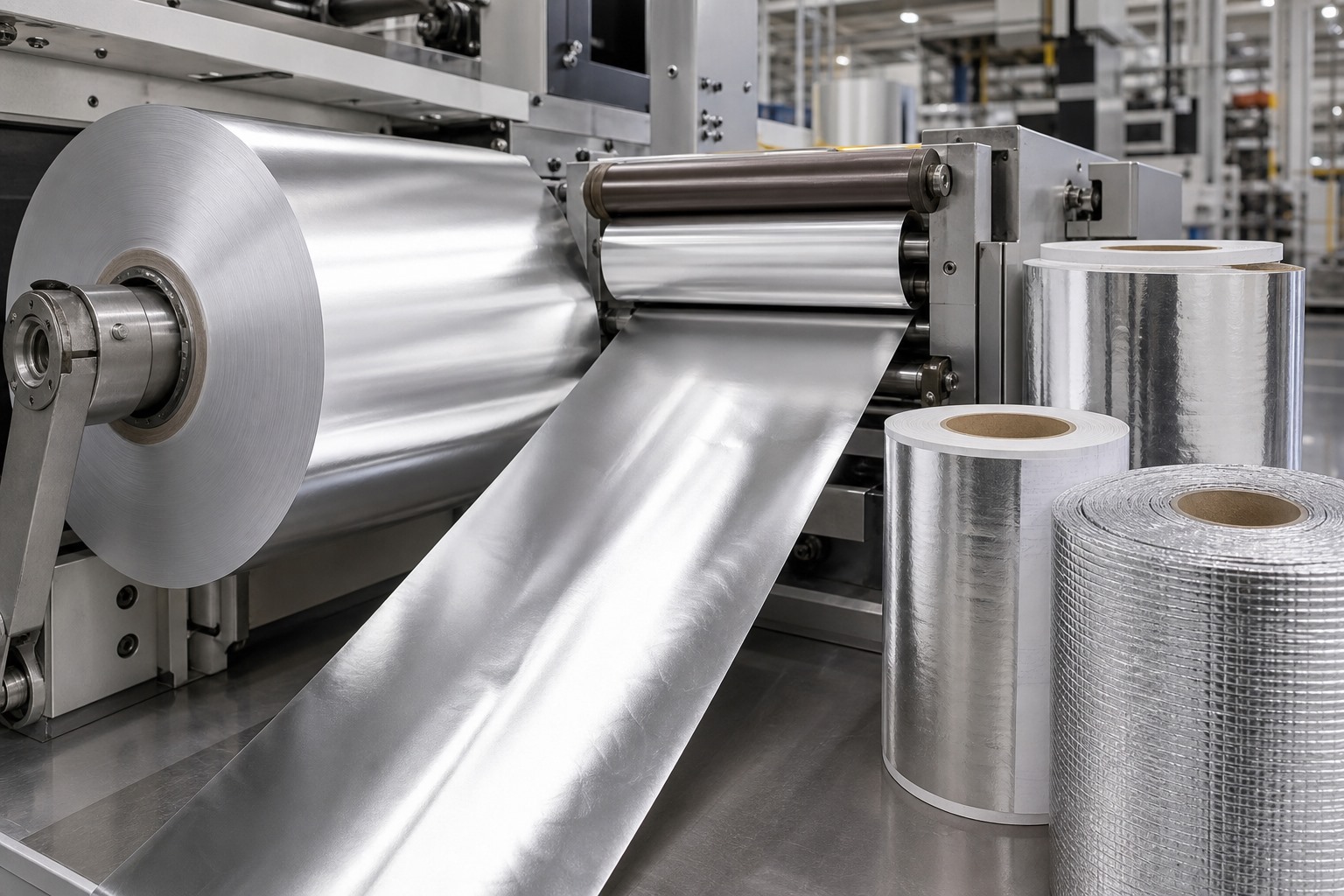
Dive deeper: where foil rolls actually go. Aluminium foil’s market is dominated by packaging, with industry figures cited in the encyclopedic summary of aluminium foil putting roughly three-quarters of consumption into packaging for food, cosmetics and chemicals and about a quarter into industrial uses such as thermal insulation, cables and electronics. The industrial quarter is where specification mistakes cost the most, because those applications stay invisible until they fail. In food packaging the foil works as a barrier layer: laminates of foil with paper and polymer film become aseptic cartons, sachets, lids and wrappers, where the foil blocks light, oxygen and moisture, the polymer provides heat sealability and the paper provides strength. In pharmaceuticals, blister and strip packaging uses thin, harder-temper foil that can be printed and push-through punched without tearing, and lidding foil for containers follows the same logic. In construction and HVAC the material acts as a radiant and vapour barrier, laminated to insulation boards, duct wrap and reflective sheeting; polished foil reflects the great majority of the radiant heat reaching it, which is the entire basis of its performance in those systems. In electrical engineering, cable foil shields conductors, while in appliances the same material becomes heat-exchanger fin stock and air-conditioner coil fin. Lithium-ion battery manufacturing consumes large volumes of very thin foil as a current collector, an application that demands extremely tight gauge control and a clean surface. Foil’s recyclability is a genuine procurement argument too: aluminium can be recycled repeatedly without losing its properties, and recycling it takes a small fraction of the energy needed for primary production — a point industry bodies such as The Aluminum Association make central to the material’s case. Whatever the end use, the roll that reaches the line was specified for it, which is why generic “foil” quotations create so many problems. You can compare gauge, temper and alloy options across our aluminium product range before you write the inquiry.
How Do You Inspect and Store an Aluminum Foil Roll Before Production?
Most foil complaints start at goods-in. An hour of checking prevents a month of converting losses.
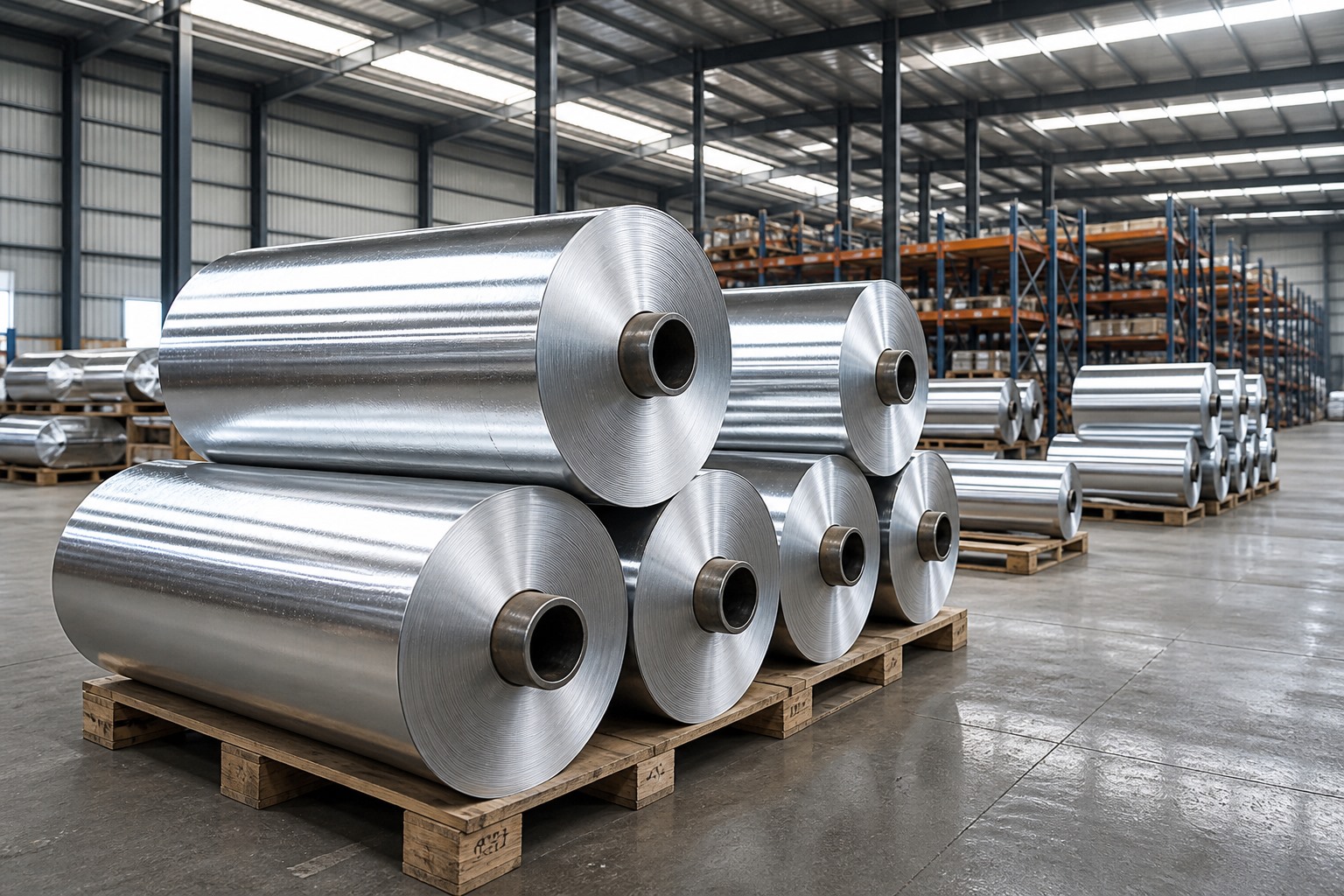
Check the mill certificate against the order, measure gauge with a micrometer at several points across the width, confirm alloy and temper, inspect for edge damage, telescoping, dents and moisture, and store rolls horizontally in dry, ventilated conditions on their original cores.
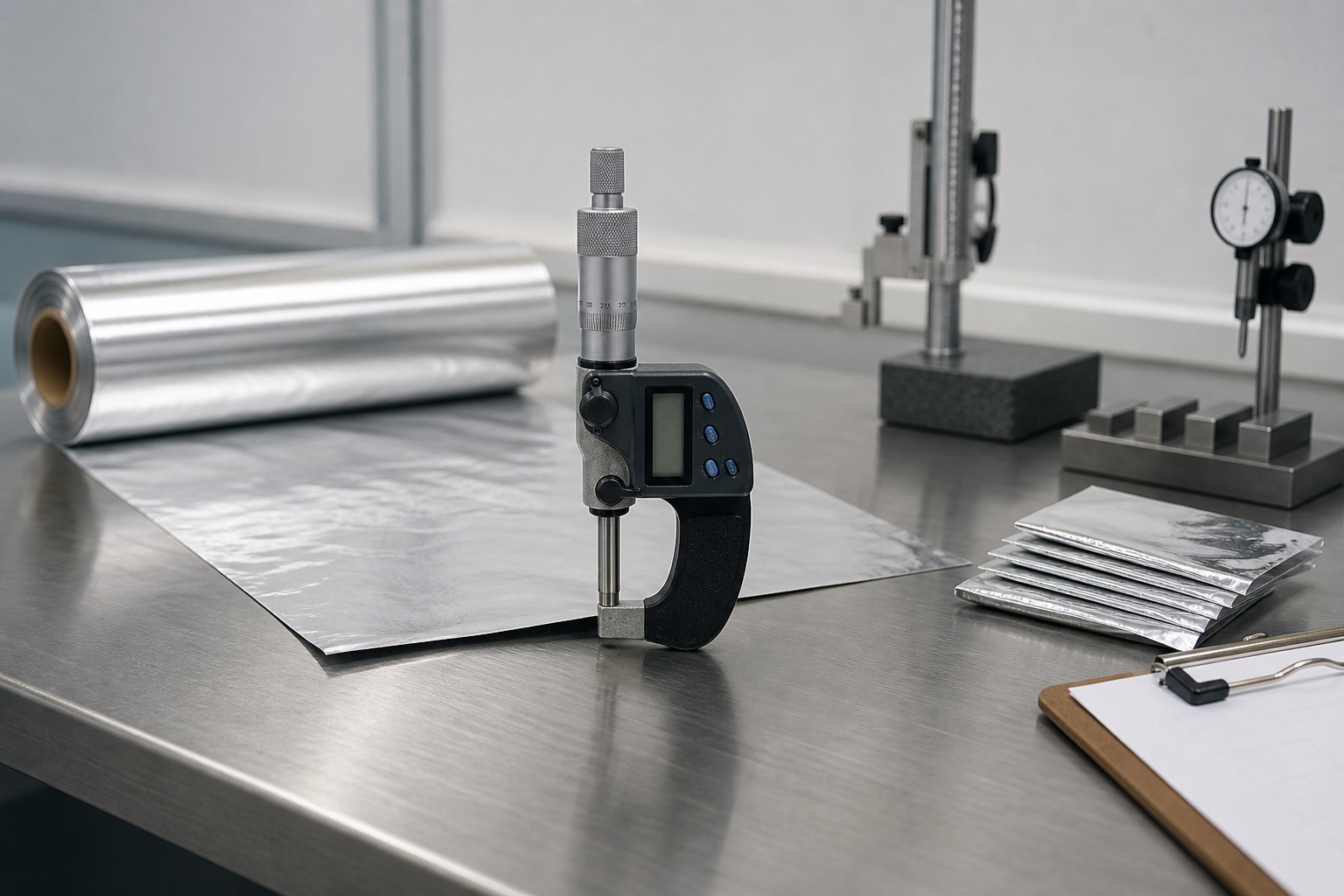
Dive deeper: the goods-in check that prevents a lost week. Foil arrives looking identical whether it is exactly what you ordered or a grade away from it, and unwinding a roll to investigate is not an option on a production floor, so everything hinges on documents and fast measurements. Start with the mill certificate and match it line by line against the purchase order: alloy designation, temper code, nominal gauge and tolerance, width, core diameter, coil number and the mechanical values from tension testing, plus any food-contact or migration statement your customer requires. Then measure. An electronic micrometer or foil gauge read at five points across the width and at several positions along the roll will show whether gauge sits inside tolerance or drifts. A consistent shortfall at one edge points to a rolling problem; random scatter points to a quality problem; either is worth a conversation before the roll is loaded onto the line. Inspect the edges for burrs and nicks, the most common cause of web breaks downstream, and check the roll itself for telescoping, dents, crushed edges, water staining and loose winding. Confirm the packaging as well: moisture barrier wrap intact, desiccant present if specified, and rolls secured so they cannot shift in transit. In the warehouse, store foil indoors, dry and ventilated, off the floor and away from doors where condensation forms. Keep rolls in their packaging until use, handle them on the core rather than the edge, and run stock first-in-first-out so the oldest material is consumed first rather than left to oxidise at the back of a rack. If you want the incoming inspection checklist we use, together with the gauge, temper and width options available for packaging, insulation and fin-stock foil, request a quotation from our export team and we will send the specification sheet with the price.
Conclusion: Alloy, temper, thickness and width are one decision, not four. Specify them in writing and verify them on arrival — then the foil roll performs as ordered.