
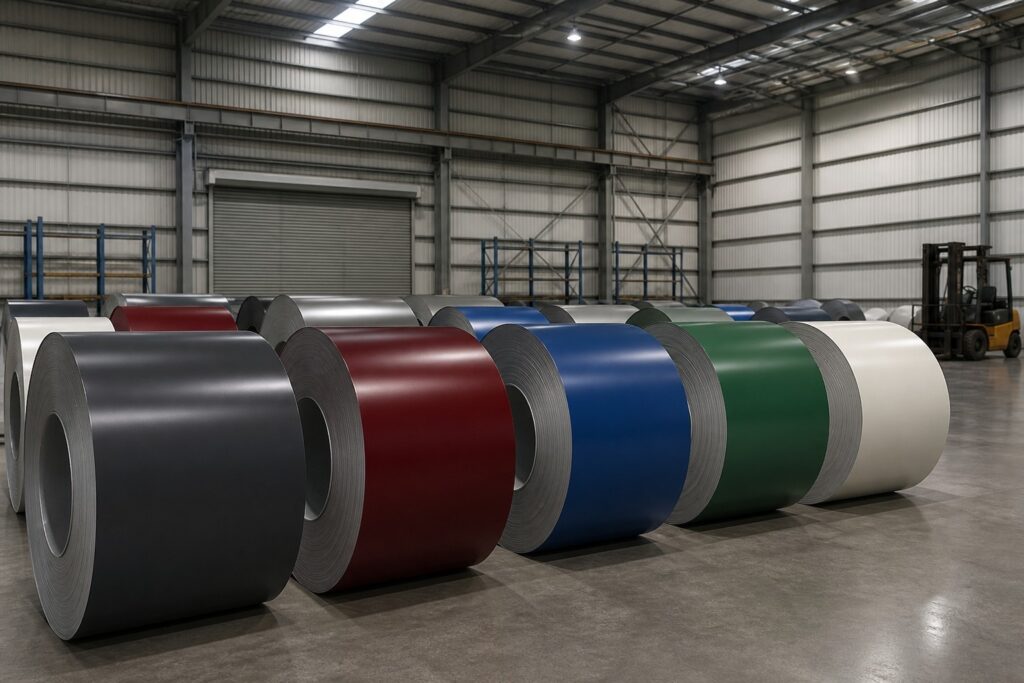
RAL Color Chart for Coated Steel: What Are the Most Popular Roofing Shades?
One faded roof panel or one mismatched delivery can turn a color decision into a costly argument. Pick a RAL shade the wrong way and the roof repays the mistake for decades.
The RAL color chart for coated steel is a standardized four-digit color system, and the most requested roofing shades are RAL 9002 grey-white, RAL 7016 anthracite grey, RAL 3005 wine red, RAL 5010 gentian blue and RAL 8017 chocolate brown.
Choosing a roof color feels like an aesthetic decision, but on coated steel it is a technical specification with a number, a substrate and a paint system attached to it. In this guide we explain how RAL codes are structured, which shades dominate roofing and cladding, how the same code can look different on galvanized and galvalume substrates, how paint systems and gloss change the way a shade ages, and how you can verify a color match before a coil leaves the factory.
What Is the RAL Color Chart and How Are Coated Steel Shades Numbered?
Buyers who order by a name, a photo or a screenshot usually pay for it later. RAL replaces guesswork with a number that both the supplier and the buyer can check against the same physical reference.
RAL CLASSIC is a four-digit color system introduced in 1927 and administered in Germany; the first digit names the color family, and a coated steel shade is specified by its RAL code, not by a verbal description.
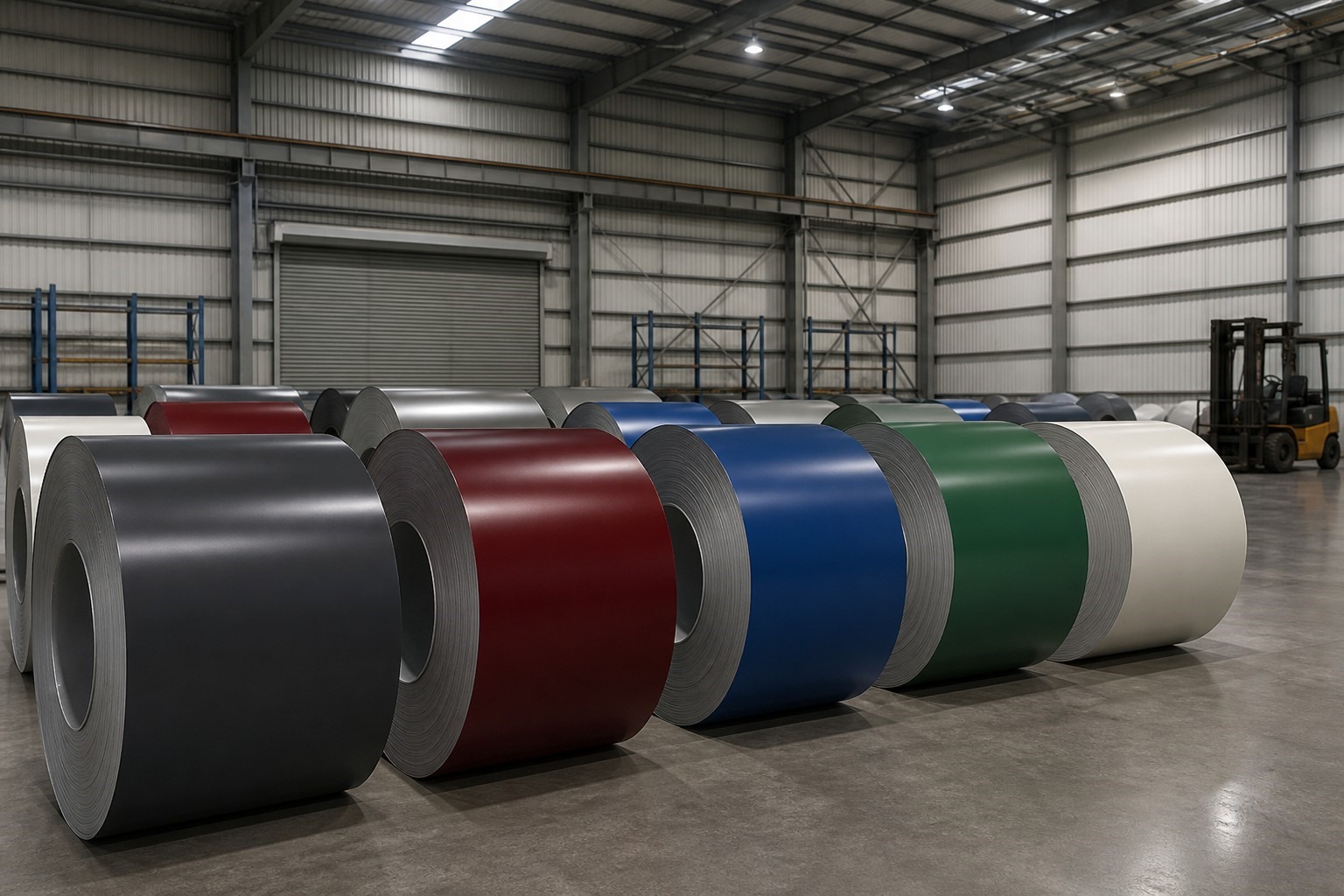
Dive deeper: the numbering logic behind every RAL code. RAL began in 1927 when a German committee, the Reichs-Ausschuß für Lieferbedingungen und Gütesicherung, published an initial collection of forty colors to stop manufacturers and customers from exchanging physical samples for every order. Those colors were later reorganised into the four-digit system used today, and in 1961 the collection was revised and expanded into RAL 840-HR, the set of roughly two hundred classic colors that is still in use. The structure of a code is simple and easy to decode: the first digit identifies the color family, so every number starting with 3 is a red, every number starting with 5 is a blue, every number starting with 6 is a green, and so on through yellows, oranges, violets, greys, browns and the white-to-black range. That family logic is why a trained buyer can often guess the general shade of an unfamiliar code before opening a fan, and it is also why transposed digits are dangerous: RAL 3005 and RAL 5003 are not close relatives but completely different colors, which is precisely why RAL colours were given supplementary names in the 1960s, to catch exactly this kind of human error in orders and on packing lists. The full structure of the system, including the later RAL Design and RAL Effect collections for architects, is described in the Wikipedia overview of the RAL colour standard. For the coated steel buyer the practical message is narrower: when a quotation says RAL 3005, both parties are bound to one published standard, and a color check at delivery is a comparison of numbers rather than an argument about opinions. Naming the system matters as well, because RAL codes are used across paints, powder coatings and plastics, and the same code can be produced on very different materials; on coated steel the code refers specifically to the organic paint film applied by the coil coater, which is why the same RAL 9002 can look slightly different on a polyester sheet than on a powder-coated component made by a different process.
Which RAL Shades Are Most Requested for Steel Roofing and Cladding?
Some RAL codes appear on roofs everywhere; others almost never. Knowing which shades dominate helps you order sensibly, match extensions later and avoid dead stock.
Light roofs are led by RAL 9002 grey-white, RAL 9003 signal white and RAL 9006 white aluminium; dark roofs are led by RAL 7016 anthracite grey and RAL 7024 graphite grey; walls and trims add RAL 3005 wine red, RAL 5010 gentian blue, RAL 6005 moss green and RAL 8017 chocolate brown.
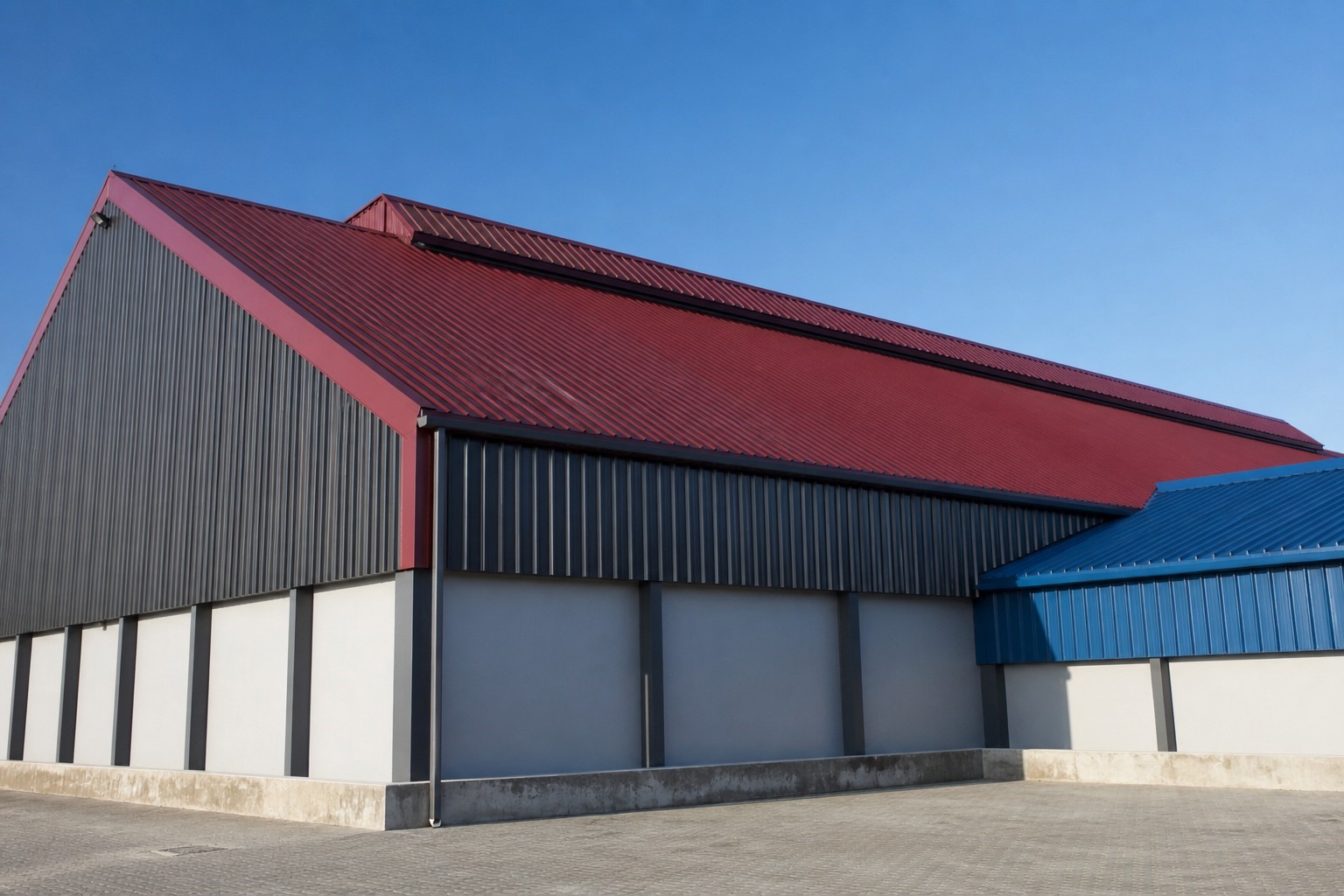
Dive deeper: reading the popular shades like a specifier. When importers ask which colors sell, they usually want a short list they can quote against, and in practice the coated steel roofing market keeps returning to a compact set of neutrals plus a handful of saturated accents. On the light side, RAL 9002 grey-white is arguably the single most common roof and wall color in European-style industrial building, because it reads as clean white without the harsh glare of a pure white under strong sun; RAL 9003 signal white is the brighter alternative, RAL 9010 pure white sits between them for architectural panels, and RAL 9006 white aluminium is a metallic grey-white frequently chosen for cladding because the aluminium pigment gives the profile a more premium, engineered look. On the dark side, RAL 7016 anthracite grey dominates modern warehouse and logistics design, often paired with a light wall band, while RAL 7024 graphite grey offers a slightly softer dark alternative that hides surface dust better in polluted or coastal air. The accent colors then carry the architectural identity: RAL 3005 wine red is a deep, muted red used for trim, gable ends and feature walls on thousands of agricultural and industrial buildings; RAL 5010 gentian blue is the classic blue for facades and roofing on commercial buildings; RAL 6005 moss green blends industrial sheds into rural and forested sites; and RAL 8017 chocolate brown is the standard dark brown for agricultural buildings and fencing panels in many markets. A specification table gives a compact reference for quoting and reordering.
| RAL code | Color name | Family (first digit) | Typical role on roofing and cladding |
|---|---|---|---|
| RAL 9002 | Grey-white | 9xxx white/black | Light roofs and walls, industrial buildings |
| RAL 9003 | Signal white | 9xxx white/black | Bright white roofs and facades |
| RAL 9006 | White aluminium | 9xxx white/black | Metallic-looking cladding and architectural panels |
| RAL 7016 | Anthracite grey | 7xxx grey | Dark roofs and walls, modern logistics buildings |
| RAL 7024 | Graphite grey | 7xxx grey | Dark cladding that hides dust well |
| RAL 3005 | Wine red | 3xxx red | Trim, gable ends and feature walls |
| RAL 5010 | Gentian blue | 5xxx blue | Facades, roofs and commercial building accents |
| RAL 6005 | Moss green | 6xxx green | Rural and agricultural building cladding |
| RAL 8017 | Chocolate brown | 8xxx brown | Agricultural buildings and fencing panels |
Two practical points follow from the list. First, order neutrals and accents from the same color family system and the same supplier so that extensions, flashings and replacement panels bought years later still match, because every coil coater mixes to the RAL reference but can drift slightly from another mill’s interpretation of it. Second, remember that a color which looks excellent on a small sample can overwhelm a large roof plane: light colors reflect heat and soften the visual mass of a big building, while dark colors absorb heat, emphasise surface unevenness and show chalk and dirt sooner, a trade-off that matters more on a 5,000-square-metre roof than on a sample card.
Why Does the Same RAL Code Look Different on Galvanized and Galvalume Coils?
The identical RAL code can arrive looking brighter on one coil and deeper on another. The substrate underneath the paint is usually the reason, not the paint itself.
Galvanized (GI) and galvalume (GL) substrates reflect light differently through the paint film, so the same RAL topcoat can appear slightly lighter, cooler or more metallic depending on the base metal, the spangle and the film thickness.
Dive deeper: what the substrate does to the color you see. A coated steel roof is not a solid colored object; it is a translucent-to-opaque paint film sitting on a metallic layer, and light that is not absorbed by the pigment bounces off that metal and back through the film. The character of that reflection changes with the substrate. A hot-dip galvanized substrate carries a zinc layer that is bright and slightly blue-grey when freshly produced, and the way that zinc reflects light is described in the Wikipedia article on hot-dip galvanization, which also explains the metallurgical bond formed when strip passes through the molten zinc bath. Galvalume substrate carries an aluminium-zinc alloy coating with a different microstructure and a noticeably brighter, more silvery reflection, and the composition and corrosion behaviour of that alloy family are covered in the Wikipedia overview of galvalume coatings. Because the two metal surfaces reflect different amounts of light back through the film, the same RAL code can look a shade lighter and cooler on a galvalume coil than on a galvanized coil from the same paint line, particularly in lighter colors and in lower film builds. Two further variables widen the gap. The first is spangle: a regular-spangle galvanized surface has visible crystal patterns that can ghost through thin, light-colored films, which is why mills offer minimised-spangle and zero-spangle substrates for smooth painted finishes. The second is the paint film itself: a thicker, more opaque film hides the metal better and makes color appearance more consistent across substrates, while a thin economy film lets the metal dominate. The practical consequence for a buyer is that a color sample or an existing roof should be matched against the same product family you intend to order; a RAL 5010 sample made on galvanized substrate may not represent the shade you receive on a galvalume coil, and the difference between the two product families is examined in our comparison of PPGI vs PPGL coated steel, where the substrates, coating systems and typical applications are set out side by side. When you order a dark or mid-tone shade such as RAL 5010 on a 0.45 mm galvalume substrate, for example a PPGL color coated steel coil in RAL 5010 supplied for roofing programs, the metallic influence is reduced but not eliminated, which is one more reason to request a physical painted sample made on the actual substrate rather than a generic color card.
How Do Paint Systems and Gloss Change How a RAL Roofing Shade Ages?
A RAL code fixes the color on day one, but not the color after ten summers. The paint resin and the gloss level decide how quickly that code fades, chalks and shifts.
Polyester, SMP, HDP and PVDF systems weather at very different rates, and gloss level changes the perceived depth of a shade; specifying a RAL code without a paint system and a film thickness leaves the color’s future undefined.
Dive deeper: why the same RAL number can fade differently. The RAL code identifies the target color, but nothing in the code tells you how long that color will stay close to the target, because durability is set by the chemistry of the paint film. Standard polyester is the economical default for roofing: it forms well, holds color acceptably in moderate climates and keeps roofs affordable, but under intense UV it chalking, the surface slowly eroding into a chalky powder that washes away pigment, and the gloss drops noticeably within a few years, so a RAL 3005 polyester roof in a tropical climate can look visibly washed out while the identical code in a premium system still reads as wine red. Silicon-modified polyester adds weather resistance for hot, high-UV markets at the cost of some formability. High-durability polyester was developed to close the gap between SMP and fluoropolymers, delivering gloss and color retention close to premium systems while keeping the economics of a polyester, which is why HDP is increasingly specified for industrial roofing where the owner wants the color to outlive the first lease. Polyvinylidene fluoride (PVDF) systems sit at the top of the range and are the standard for coastal high-rise and landmark buildings where a twenty-year-plus color warranty is expected. The physical mechanism behind all of this is that UV radiation breaks down the resin at the surface, and the breakdown products scatter light and carry away pigment, which is why dark saturated colors and certain red and blue pigments are more demanding than light neutrals: they absorb more energy and any loss of pigment reads immediately as a change of shade, while a grey-white that fades slightly still looks grey-white. Gloss level interacts with the same process, because a high-gloss film shows chalking and dirt sooner while a lower-gloss film hides surface degradation better on large roof planes. The complete production route from flat strip to finished colored coil, including the pretreatment, priming and curing stages that make a durable film possible, is outlined in the Wikipedia article on prepainted metal. For the buyer the specification rule is short: a RAL code alone is not a complete color specification, and when a supplier quotes a shade without naming the paint system, the film thickness and the gloss level, the missing words are precisely where the color’s future is decided; to compare options against a written baseline you can review the substrate, coating and paint combinations listed on our RAL color coated steel specification page before you commit.
How Does the Coil Coating Line Keep the RAL Shade Consistent Across the Coil?
A roof made from one coil looks uniform; a roof made from three coils often does not. Consistency is engineered on the coating line before the coil ever ships.
Coil coating applies primer and topcoat to flat strip at constant line speed, so film thickness and color are uniform across the width and along the length, and batch-to-batch shade control keeps later deliveries close to the first one.
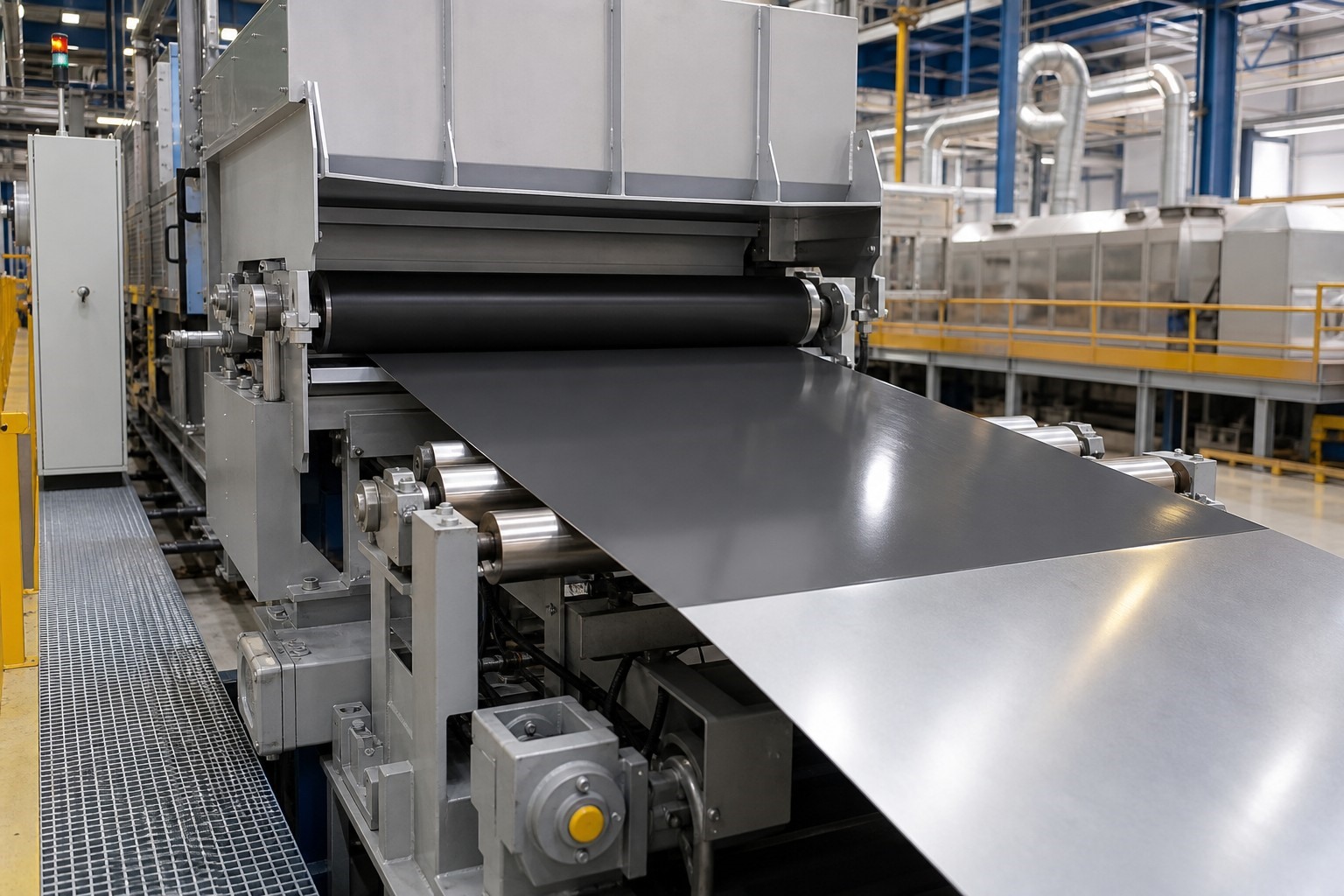
Dive deeper: the process steps that make color repeatable. Color consistency on coated steel is not a matter of luck or operator skill at the end of a spray gun; it is built into a continuous, automated process that treats every square metre of strip identically. The strip is first cleaned and chemically pretreated so that the paint has a stable surface to bond to, then a primer is applied by rollers, then the finish coat is applied at a controlled wet film thickness, and the strip passes through an oven where the film is cured at a controlled temperature profile before being cooled and rewound. Because the line runs at constant speed with fixed roller gaps and stable oven temperatures, the dry film thickness and the color of the finished coil are remarkably uniform from the inner lap to the outer lap, which is exactly the property that site-applied painting cannot deliver on profiles with ribs, corners and concealed surfaces. The same process logic also controls batch-to-batch consistency: a coil coater that manages its paint batches, records its oven parameters and checks color against the RAL reference at regular intervals can ship a second delivery months later that still sits inside the agreed tolerance of the first one, while a mill that treats color as a visual afterthought produces coils that drift as paint batches and line settings change. This is the point where the substrate, the paint system and the coating line meet the buying decision: a technically specified coil from a disciplined line gives you panels that match across deliveries, while a price-only purchase can leave you with a roof whose second extension no longer matches the first. Two practical checks protect the buyer. Ask the supplier how they control shade between production batches and whether they retain a physical sample of each batch, and ask for the actual film build and coating weights in writing rather than a verbal assurance, because those numbers are what the line actually controls; for a deeper walk through substrate and coating choices, our material selection guide for color coated rolls explains how each variable contributes to the final appearance and service life of the product.
How Can You Verify a RAL Color Match Before the Coil Is Shipped?
Color arguments are cheapest before the coil is loaded into a container. A few minutes of verification at ordering and on arrival can prevent a roof that does not match its own specification.
Verify color with a physical painted sample made on your substrate, compare it under standard light with a fresh RAL fan, and if numbers matter, use a spectrophotometer to confirm the colour difference is inside an agreed tolerance.
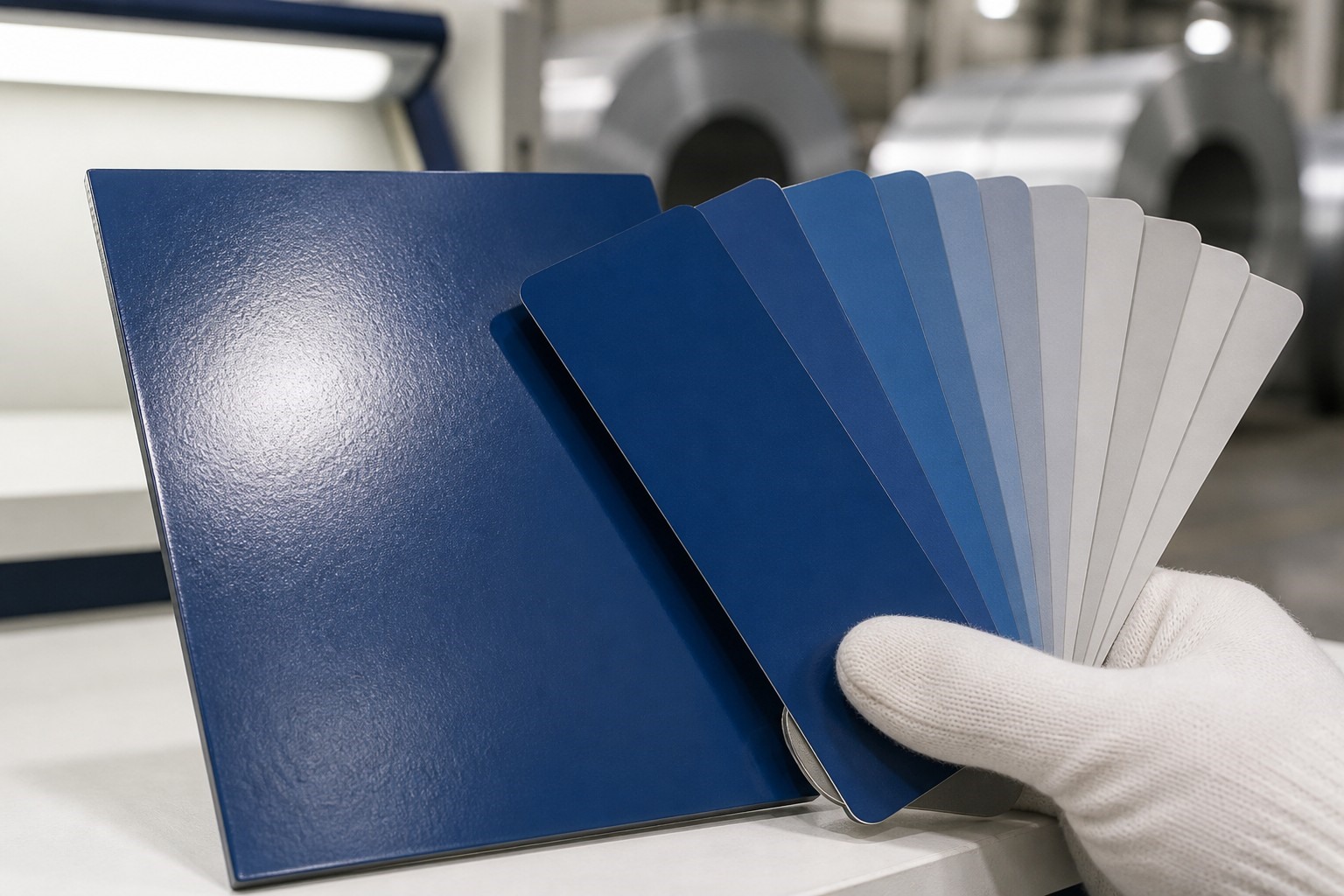
Dive deeper: a color verification routine that survives the shipment. The first rule of color verification is to compare like with like: a RAL code printed on a paper chart, a plastic chip and a coated steel coil all refer to the same published standard, but the gloss, texture and metallic reflection of each material make the perceived color slightly different, so the only reliable reference for a coated steel order is a painted sample made on the same substrate with the same paint system as the production coil. Order that sample before you commit to a large quantity, keep it in a dark drawer, and use it as the receiving reference when the coil arrives. The second rule is to control the light: color matching should be done under standardised daylight conditions, because a shade that matches under warm shop lighting can look different under overcast daylight, and the human eye is notoriously bad at judging small differences between two adjacent surfaces and even worse at judging a coil against a faded memory of a sample. The professional tool is a spectrophotometer, which measures the color numerically and reports the difference against the reference as a delta value, letting buyer and supplier agree in advance on an acceptable tolerance instead of arguing afterwards about whether a coil is too light or too dark. Where no instrument is available, a freshly calibrated RAL fan is the minimum tool, and the official reference for the RAL CLASSIC collection, including the licensed fans and color cards, is the RAL Farben official website; beware of cheap printed imitations, because the whole point of RAL is that everyone compares against the same published standard. The third rule is to check more than the color itself: gloss level should be measured with a gloss meter and film thickness with a coating thickness gauge, because a coil that matches in color but sits outside the agreed gloss range will still look wrong on the roof when its neighbours reflect light differently. Finally, put the verification result on paper: ask the supplier to confirm the RAL code, paint system, film build, gloss range and batch number on the mill certificate, and keep the physical sample so that future extensions can be matched against the same reference. For a project where the color, substrate and coating must all line up, you can send the RAL code and your roof profile to our export team and ask for a RAL color coated steel quote with the full specification and test documents attached.
Conclusion: RAL turns color from opinion into number, but the number works only with the right substrate, paint and verification. Specify all four, and the roof keeps its promise.