
Steel Coil Packing: How Do You Prevent Rust in Transit?
A single wet container can turn a full coil shipment into a claim. Rust rarely announces itself — it starts on an edge, in a lap, under a band.
Short answer: Dry the coil, keep moisture out and keep the package sealed. Wrap in VCI film with humidity trapped by desiccant, protect both rims with edge protectors, apply tight steel strapping on timber saddles, and load coils eye-to-sky on dunnage so the wrap is never punctured.
Transition: Steel coil packing is a sequence, not a product, and each step removes one of the three things rust needs. The six sections below follow that sequence in the order a mill, service centre or trader actually works through it: what causes transit rust, which packing method fits which coil, how to choose wrapping materials, how to prepare the metal surface, how to load and block the coils in a container, and how to inspect and document the job before the doors close.
What Causes Rust on Steel Coil in Transit?
Rust needs water, oxygen and a bare ferrous surface. A six-week sea voyage supplies all three, quietly and at scale.
Short answer: Transit rust comes from condensation, not from rain. A coil loaded warm in humid air cools at sea; water condenses onto the cold steel, and wherever air or chloride reaches a bare edge, corrosion starts within days.
Dive deeper: The mechanism is worth understanding because it explains why a coil that looked perfect at the mill gate arrives with brown edges. Steel leaves a rolling mill warm, and in a humid port it holds a film of adsorbed moisture that no amount of visual inspection will show. Once the container is closed and the ship moves into cooler water, the steel surface falls below the dew point of the air around it. Water condenses on the metal, and because the interior of a container is a nearly closed system, that water cannot escape — it drips from the roof onto whatever sits below. This is the effect shipping crews describe as container rain, and it is the single most common cause of transit corrosion in coiled products. Three variables decide how severe it becomes. The first is the temperature differential between loading and voyage: a coil loaded at 35 °C in Southeast Asia and discharged in a European winter will sweat far more than one that travelled between similar climates. The second is the amount of free water already inside the package — residual mill coolant, rain picked up during handling, damp timber dunnage, even the moisture naturally present in wood. The third is access to oxygen and chloride. A wrap that is sealed and dry starves the surface of the electrolyte it needs; a wrap that is torn, loose at the eye, or made from untreated timber that releases moisture actively feeds the reaction. Chlorides matter because they break down the protective oxide that would otherwise slow attack, which is why coastal storage and salt-laden port air are worse than an inland warehouse at the same humidity. Practical guidance on loading and packaging practice is set out in ASTM A700, which covers packaging, marking and loading methods for steel products for shipment — useful evidence to quote when a buyer asks what standard the packing follows. The same material appears in a very different condition depending on where it came from, so it is worth knowing how the broader carbon steel coil and sheet range is delivered before assuming all coils need identical protection.
Which Steel Coil Packing Methods Actually Work?
Not every coil needs the same armour. Over-packing wastes money; under-packing costs a claim and a customer.
Short answer: Match the packing to the voyage and the value of the surface. Domestic trucking needs only edge protection and bands; a sea voyage needs VCI film, desiccant, rim protection and a lined or wrapped outer skin.
Dive deeper: Packing methods sit on a ladder, and the correct rung depends on how long the coil will be exposed, how corrosive the route is, and how visible the surface must stay. At the bottom is bare banding: the coil is secured with steel straps and nothing else. It is acceptable for a coil moving a few hundred kilometres on a dry day to a covered warehouse, and it is a false economy anywhere else. One rung up is banding plus corner or rim protection, which stops the strap itself from marking the coil edge and keeps the outer laps from opening in handling. Above that sits wrapping in a plain polyethylene or waxed paper with moisture-absorbing material inside — the traditional approach, effective when the wrap stays intact, but vulnerable at the eye and anywhere a strap crosses the film. The upper rungs add vapour-phase protection. VCI film releases corrosion-inhibiting vapour into the enclosed airspace, and the vapour condenses onto the steel to form a molecular barrier that works even in areas the film does not touch. Combined with desiccant and a sealed outer wrap, that package can hold a coil through a long humid voyage. At the top of the ladder is fully crated or boxed packing with a lined case, an option usually reserved for narrow slit coil, high-value surface-critical material, or small coils shipped as break-bulk cargo. The commercially sensible practice is to write the required rung into the purchase order instead of leaving it to the forwarder. The table below summarises what each level buys and what it costs in packing time and material. Read it as a decision aid rather than a tariff, then confirm the specification against your destination climate and the surface quality your customer inspects.
| Packing level | What it includes | Best suited to | Relative cost and effort | Main residual risk |
|---|---|---|---|---|
| Bare banding | Steel straps only | Short inland journeys, dry climate | Lowest | Condensation and edge marking |
| Banding plus rim protection | Straps with corner or edge protectors | Domestic truck and rail movements | Low | No barrier against humidity |
| Wrap with desiccant | Film or waxed paper, absorbent sachets | Short sea legs, covered storage on arrival | Moderate | Torn wrap at the eye or under straps |
| VCI wrap with desiccant | VCI film, edge protectors, sealed outer skin | Long ocean voyages, humid destinations | Higher | Poor sealing at the coil eye |
| Crated or lined box | Lined case, full rim and face protection | Narrow slit coil, surface-critical material | Highest | Cost and container volume |
How Do You Choose Wrapping Materials and Desiccants for a Sea Voyage?
The materials decide whether the package breathes moisture in or keeps it out — and the difference is measured in grams of water.
Short answer: Choose VCI film rated for ferrous metals, add desiccant sized to the enclosed air volume and voyage length, seal the wrap at the eye and the circumference, and avoid untreated timber that releases its own moisture.
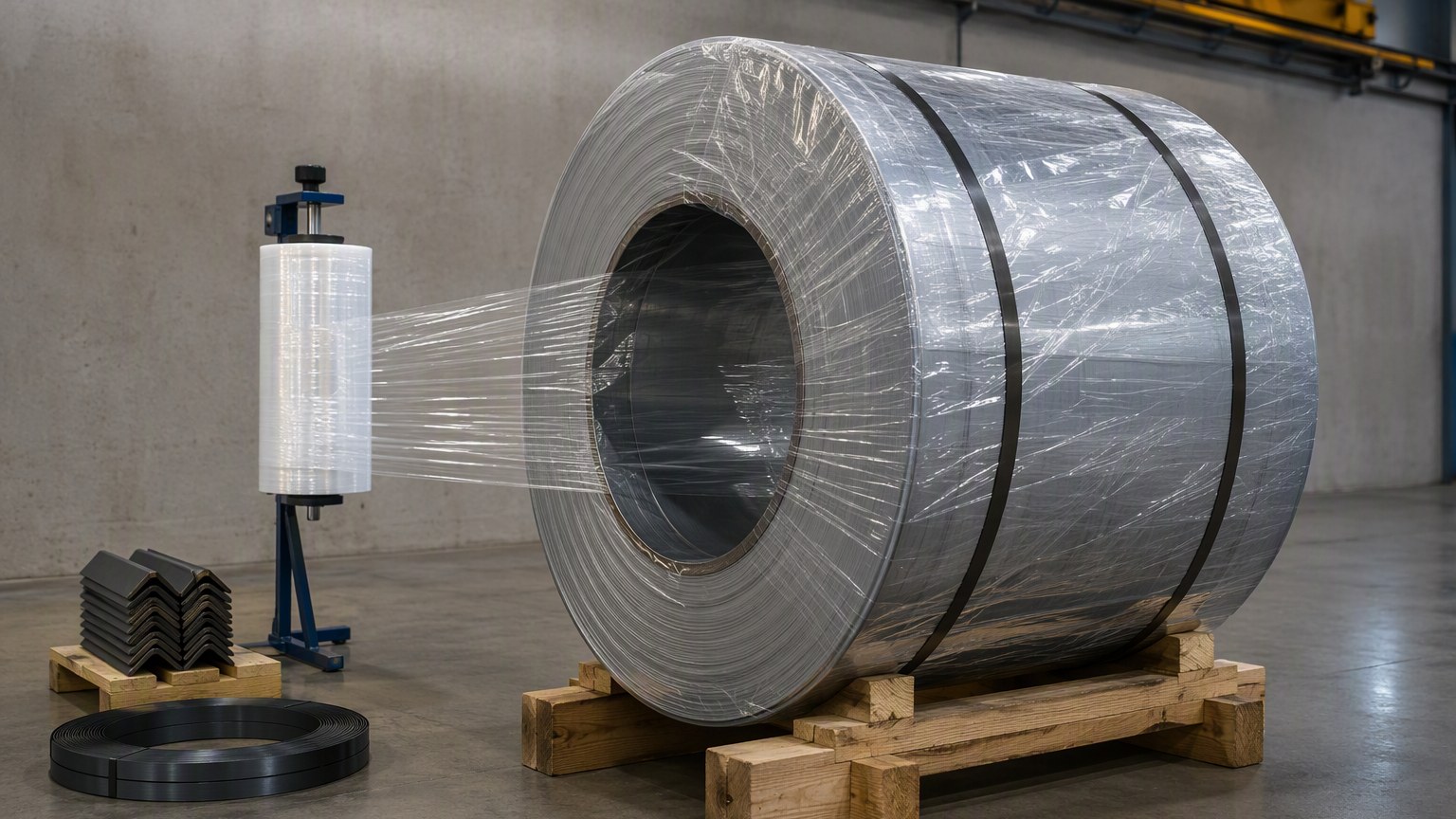
Dive deeper: Start with the film, because two rolls that look identical behave differently. VCI film works by releasing inhibitor vapour into the airspace and forming a protective layer on the steel; how it is described in technical literature is worth reading, since the mechanism explains the limits of the technology as well as its strengths — see the overview of volatile corrosion inhibitors for the vapour-transport and condensation behaviour involved. A film designed for ferrous metals is not the same formulation as one intended for copper or for mixed-metal loads, and using the wrong one can leave a reactive residue on the surface. Film thickness and strength matter as much as chemistry: a thin film tears on the coil rim during strapping, and a torn film loses its enclosed atmosphere entirely, which is why many shippers run two layers or add a separate outer skin. Next, size the desiccant properly rather than adding a token sachet. Desiccant is specified against the volume of air trapped inside the wrap, the mass and thermal history of the steel, the expected voyage duration and the humidity band of the route, and it is normally expressed in units of water-absorbing capacity. Under-specify it and the material saturates in the first week, after which it stops protecting anything; over-specify it and the cost climbs without a corresponding benefit. Placement is as important as quantity: sachets belong where water will collect, near the eye and along the lower edge of the coil, not taped to a flat face where condensate drains away from them. Then consider everything else inside the package. Untreated or green timber dunnage can release significant moisture into an enclosed space and quietly undo a well-specified VCI film; kiln-dried timber and dry saddles remove that variable. Cardboard and paper absorb moisture and should not be counted as barriers. Finally, agree the packing specification in writing, with the film type, the desiccant quantity, the protective materials and the timber condition all named, because a packing slip that says only “export packing” leaves the whole decision to whoever is standing at the wrapper. Context on the scale and behaviour of the industry that supplies this material is available from worldsteel steel facts, which is useful background when a buyer questions why packing discipline varies between mills.
How Do You Prepare the Coil Surface Before Packing?
Packing protects a surface. If that surface already carries water, salt or loose scale, the best wrap in the world seals the problem in.
Short answer: Confirm the coil is dry and cooled, leave the correct mill oil or rust-preventive film in place, remove standing water and debris from the eye and edges, and never pack a coil that is still warm from processing.
Dive deeper: Preparation is the step most often skipped under time pressure, and it is the cheapest one to get right. The first check is temperature. A coil that is still warm from pickling, rolling or slitting will cool inside the wrap and pull moisture out of the very air the film has enclosed, so it must be allowed to reach ambient temperature before wrapping. The second is dryness. Visible water on the face, in the eye or along the edges has to be removed rather than wiped; the objective is a surface with no free water and no damp film trapped under the wrap. The third is the condition of the protective layer already on the steel. Mill-applied rust-preventive oil and passivation films are there to help, and stripping them without a replacement layer removes protection the customer paid for. If the surface has to be oil-free for a downstream process such as painting or coating, that requirement belongs in the purchase order so the mill can apply the correct removable product rather than shipping a dry, unprotected coil into a humid voyage. Freshly cut edges deserve particular attention, because shear and slit edges expose uncoated steel and hold a thin bead of moisture more readily than a rolled face. Wipe those edges, and where the specification calls for it, apply a touch-up rust preventive before the rim protector goes on. Surface condition also interacts with how the material was produced in the first place. A coil rolled and pickled on a continuous line arrives with a different scale and oil condition from a cold reduced coil, and the two do not tolerate identical preparation; the comparison in our guide on how hot rolled and cold rolled steel coil are produced explains where that difference comes from and why it changes what has to be protected. Where the coil is being cut to length or blanked at the destination, protect the material at the level the final part requires — a surface-critical appliance panel in cold rolled steel sheet SPCC in 1.0 mm tolerates far less edge staining than a hidden structural component. Finally, remember that corrosion is an electrochemical process, not a simple wetting event, which is why chloride contamination is so damaging; the mechanism is well summarised in the reference material on corrosion and it explains why rinsing with clean water matters if a coil has been splashed with seawater.
How Do You Load and Block Packed Coils in a Container?
The best-wrapped coil in the shipment is the one that arrives intact. Loading decides whether the wrap survives the voyage.
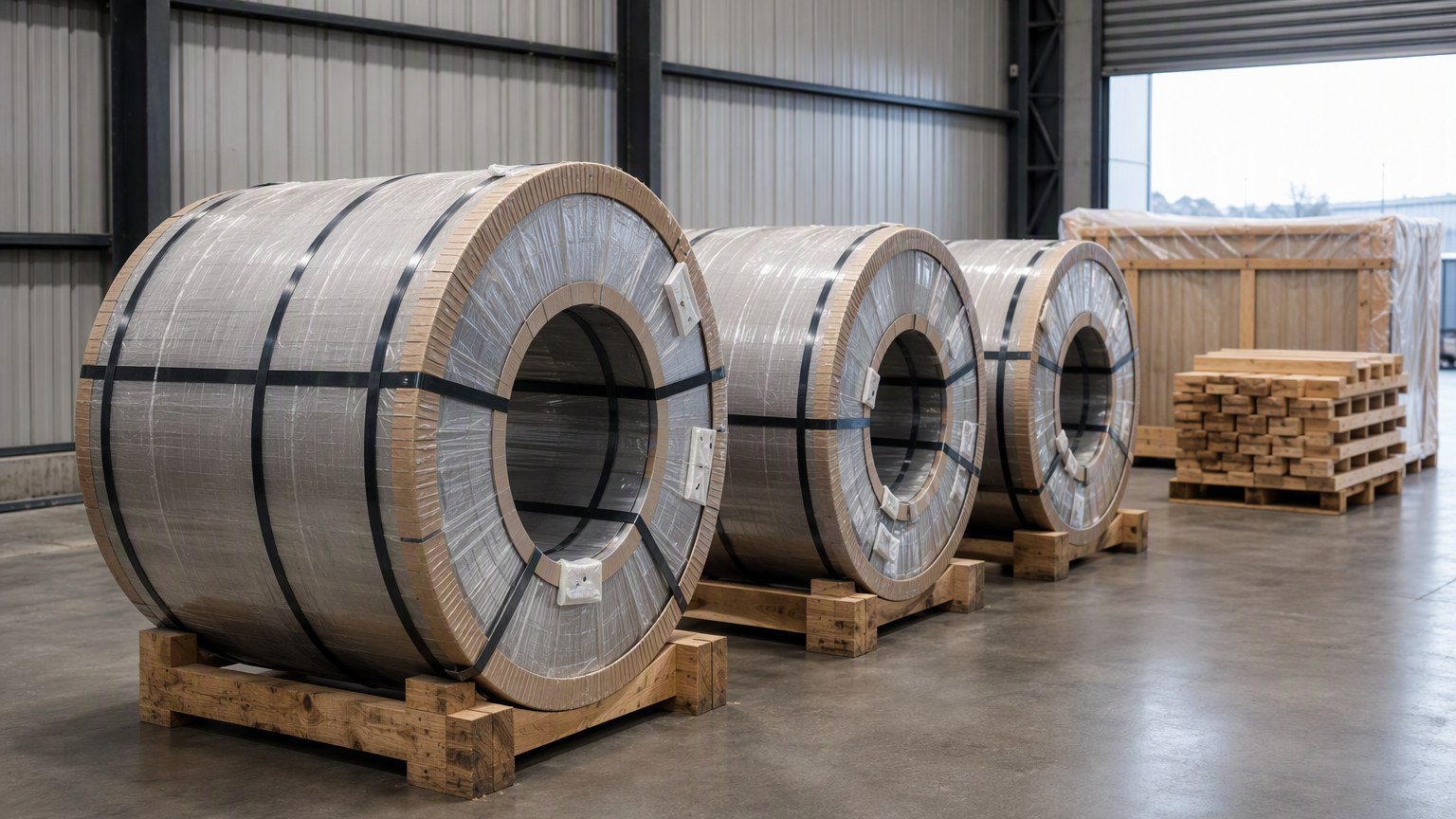
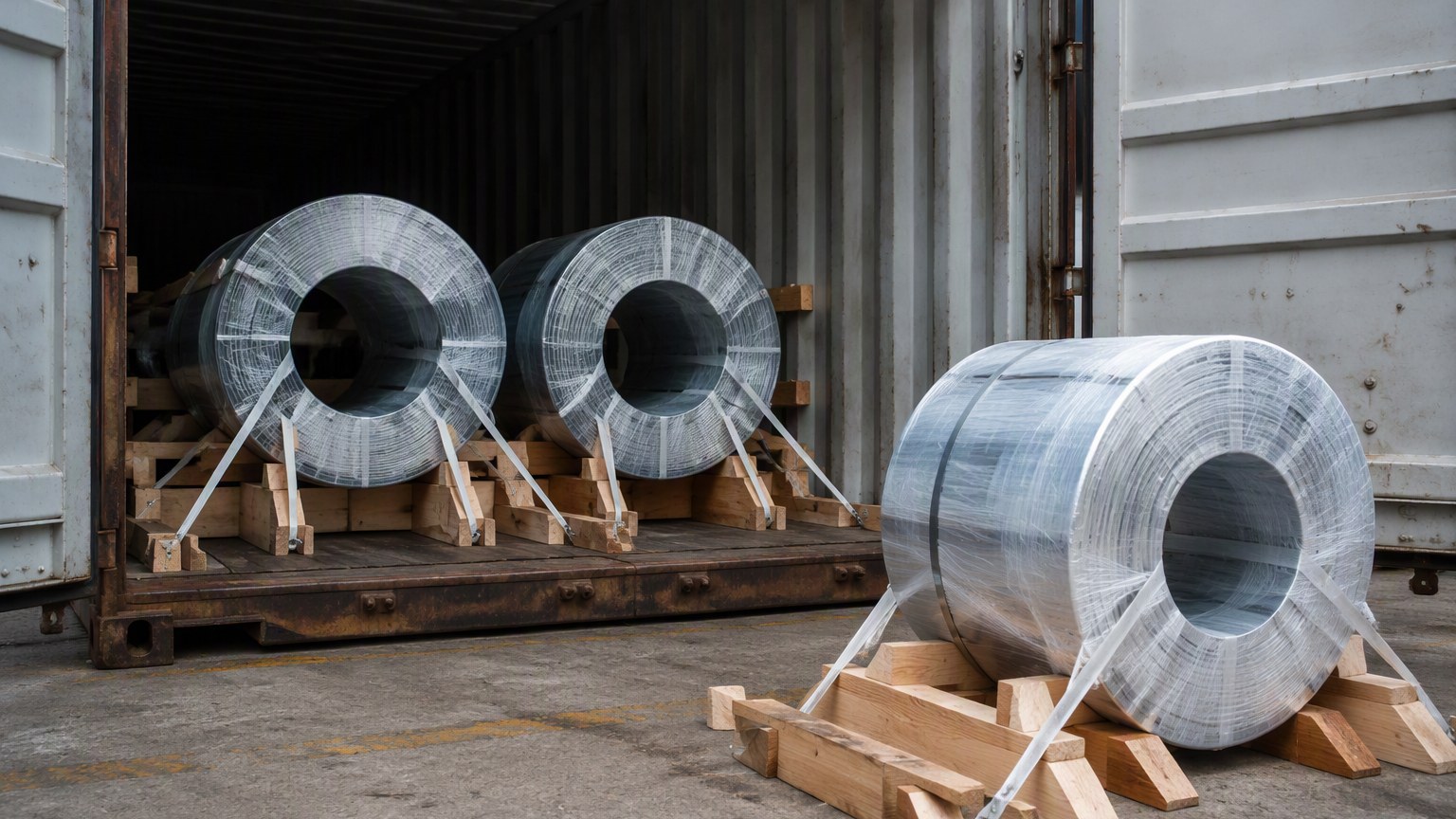
Short answer: Load packed coils eye-to-sky on timber saddles or dunnage, block and brace every coil so it cannot move, spread the mass along the container floor, and keep the wrap away from sharp edges and strap contact points.
Dive deeper: Loading is where packing quality is either preserved or destroyed, and the failure modes are predictable. Coils loaded eye-to-sky stand on a cradle or a bed of timber dunnage with the eye vertical, which concentrates the mass on the container floor and keeps the centre of gravity low; the alternative, eye-to-wall, spreads the same tonnage along the length of the box and suits narrow strip. Whichever orientation is used, the rule that matters is that nothing may move. Timber chocks and wedges are driven against the coil circumference, lashing straps pass over the coil body and anchor to the container floor lashing points, and at least one blocking member is placed to prevent fore-and-aft movement during heavy weather. Nails and staples are a particular hazard: a single exposed nail head or a sharp edge on a steel chock will pierce a VCI wrap on the first surge and open the enclosed atmosphere. Where a strap crosses the wrap, place a protective pad or a corner protector so the band cannot cut into the film or mark the coil edge under load. Weight distribution is the second constraint, and it is where the arithmetic in our guide to steel coil weight calculation becomes a loading instruction rather than an accounting exercise. The practical payload ceiling for a twenty-foot box carrying heavy coil is set by road and axle limits rather than container volume, so the number of coils is usually decided by tonnage, and a single dense coil may need to travel at one end of the box with the rest of the mass distributed to keep every axle legal. The third constraint is moisture management in the container itself. Container desiccant bags hung internally, dry and clean pallets, and a check that the container roof does not drip are cheap additions, and they matter because condensate from the roof can run down onto wrapped coils for weeks. Finally, photograph and record the loaded configuration before the doors close — a photo of the blocked and lashed load is the only proof of packing quality if a claim is raised later.
How Do You Inspect and Document Coil Packing Before Shipment?
Documentation is not paperwork for its own sake. It is the difference between a settled claim and an argument.
Short answer: Walk the package before loading, record film type, desiccant quantity, strapping and dunnage, photograph each coil, keep the packing specification and material certificates with the shipping documents, and note any deviation in writing.
Dive deeper: An inspection that takes fifteen minutes per consignment prevents disputes that take months. Start with the wrap itself: check that the film is continuous, that the seal at the coil eye is closed, that no strap has cut into the material and that the rim protectors are correctly positioned on both faces — not only on the outer face. Confirm the desiccant quantity actually installed matches the specification, because it is common for a wrapper to use what is on the shelf rather than what the order requires. Then verify the strapping. Bands should be tight, correctly spaced, secured with the right seals and free of sharp burrs, and they should not sit directly on an unprotected edge. Check the saddles and dunnage: dry, sound timber, free of nails, splinters and protruding fasteners that could puncture the wrap. Confirm that the coil markings are legible and correctly positioned, since identifying a coil on arrival at a port is far easier with a clear tag than with a heat number stamped somewhere under a film wrap. Next comes the record. Photograph every coil from at least two angles before the wrap is applied and again afterwards, capture the loaded container, and keep the packing specification, the material certificates and any third-party inspection report together with the shipping documents. If the customer or their inspection agency has required a specific packing standard or a witnessing inspection, arrange it at this point rather than after the container has sailed. Deviations deserve the same discipline. If material for the ordered specification could not be sourced and an equivalent film was used, write it down at the time and notify the buyer, because a silent substitution discovered at the destination looks like concealment even when the packing is technically sound. A documented packing record also gives the mill a feedback loop: coatings, film types and desiccant quantities that consistently produce clean arrivals can be standardised, and the ones that generate repeat edge staining can be changed at the source.
Ready to move from a specification to a shipment that arrives clean? Send us the grade, thickness, width, coil weight and destination port you are working to, and our team will confirm the packing level, film and desiccant quantity we would apply and the certificates that travel with the coils. You can request a steel coil packing quotation directly and tell us whether the material must arrive surface-clean for forming, coating or resale.
Conclusion: Steel coil packing works when the metal is dry, the wrap stays sealed and the coil cannot move. Control all three and transit rust stops being a lottery.