
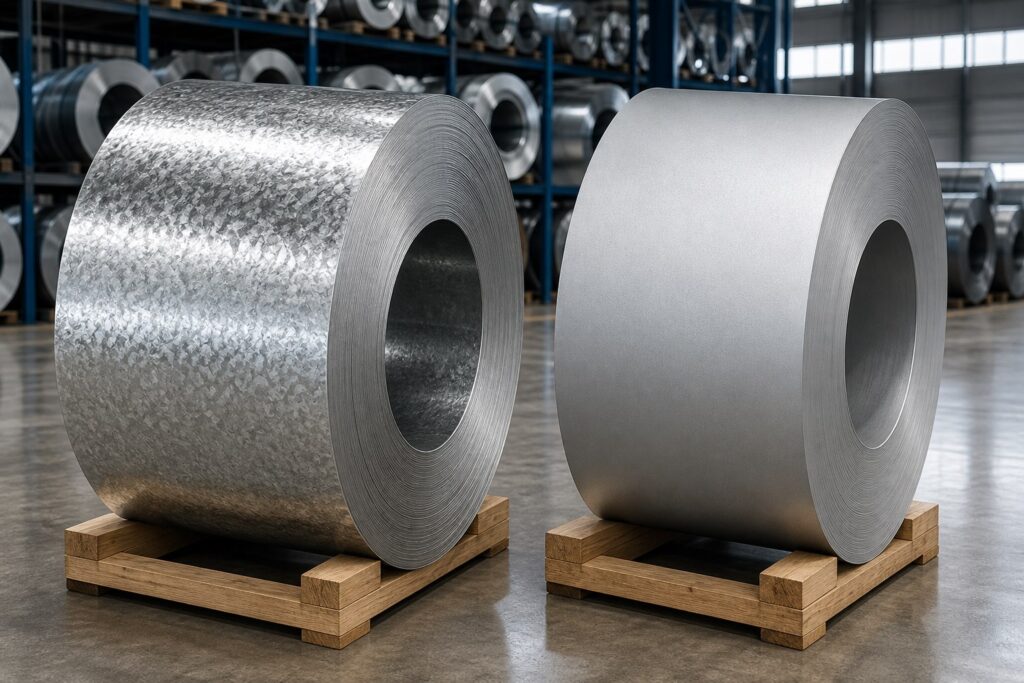
PPGI vs PPGL: Which Coated Steel Is Right for You?
A roof that rusts at the cut edge, or a coil that fades within three years, is almost never a paint failure — it is a substrate choice made before the paint was ever discussed.
PPGI is prepainted galvanized steel, built on a zinc-coated substrate; PPGL is prepainted galvalume steel, built on an aluminium-zinc alloy-coated substrate. Choose PPGL for open, humid or coastal exposures and PPGI for economical general-purpose roofing and cladding.
The two names look almost identical, yet the metal beneath the paint decides cut-edge behaviour, service life and price. In this guide we unpack the naming, compare the corrosion chemistry of the galvanized and galvalume substrates, map each family to the buildings and climates where it genuinely pays, confirm that the paint systems on both are shared, explain the cost and supply trade-offs, and end with a receiving checklist that proves the coil you paid for is the coil that arrived.
What Do the Names PPGI and PPGL Actually Mean?
Buyers often treat PPGI and PPGL as colours or paint qualities, but the letters describe the substrate, and the substrate decides how the product behaves for decades.
PPGI stands for pre-painted galvanized steel, whose base is hot-dip galvanized sheet with a zinc coating; PPGL stands for pre-painted galvalume steel, whose base carries an aluminium-zinc alloy coating; both receive their paint on the same continuous coil coating line.
Dive deeper: the naming tells you which metal sits under the paint. In both abbreviations, “PP” means the steel has been painted before it is cut and formed, a process the industry calls coil coating or pre-painting: the flat strip is cleaned, chemically pretreated, primed, top-coated and cured in one continuous factory line, then rewound into a coil that fabricators later cut, roll-form and profile. Because the metal is painted while it is still flat, every square metre receives an identical film build, which is why pre-painted products consistently outperform metal that is painted after forming — the general definition of pre-painted metal and the EN 10169 framework that governs it are explained in the Wikipedia overview of prepainted metal. The letter that follows distinguishes the substrate family: “GI” stands for galvanized iron, an older commercial name for hot-dip galvanized steel, whose coating is essentially zinc; “GL” stands for galvalume, the widely used commercial name for steel coated with an aluminium-zinc alloy containing roughly 55% aluminium, about 43% zinc and a small silicon addition. Galvalume itself is a licensed brand name originally developed in the 1970s, and the same alloy family is sold by other producers under names such as aluzinc or zinc-aluminium coated steel, but the chemistry and the coating behaviour are equivalent across those trade names. What matters for a buyer is a simple substitution: when a quotation says PPGI, the substrate under the paint is zinc-coated steel; when it says PPGL, the substrate is aluminium-zinc alloy-coated steel. That single difference drives the corrosion behaviour, the application map, the price premium and the verification steps discussed in the rest of this guide, so it is worth confirming the substrate family in writing on every order rather than assuming it from the paint colour.
How Do Galvanized and Galvalume Substrates Protect Steel Differently?
Both coatings stop rust, but through different mechanisms — and the mechanism reveals itself first at scratches, punched holes and cut edges.
A galvanized zinc coating protects sacrificially: it corrodes in place of the steel at exposed edges and scratches; a galvalume aluminium-zinc coating protects mainly as a barrier and performs strongly in open, unsheltered atmospheres, although it offers less electrochemical sacrifice at a freshly cut edge.
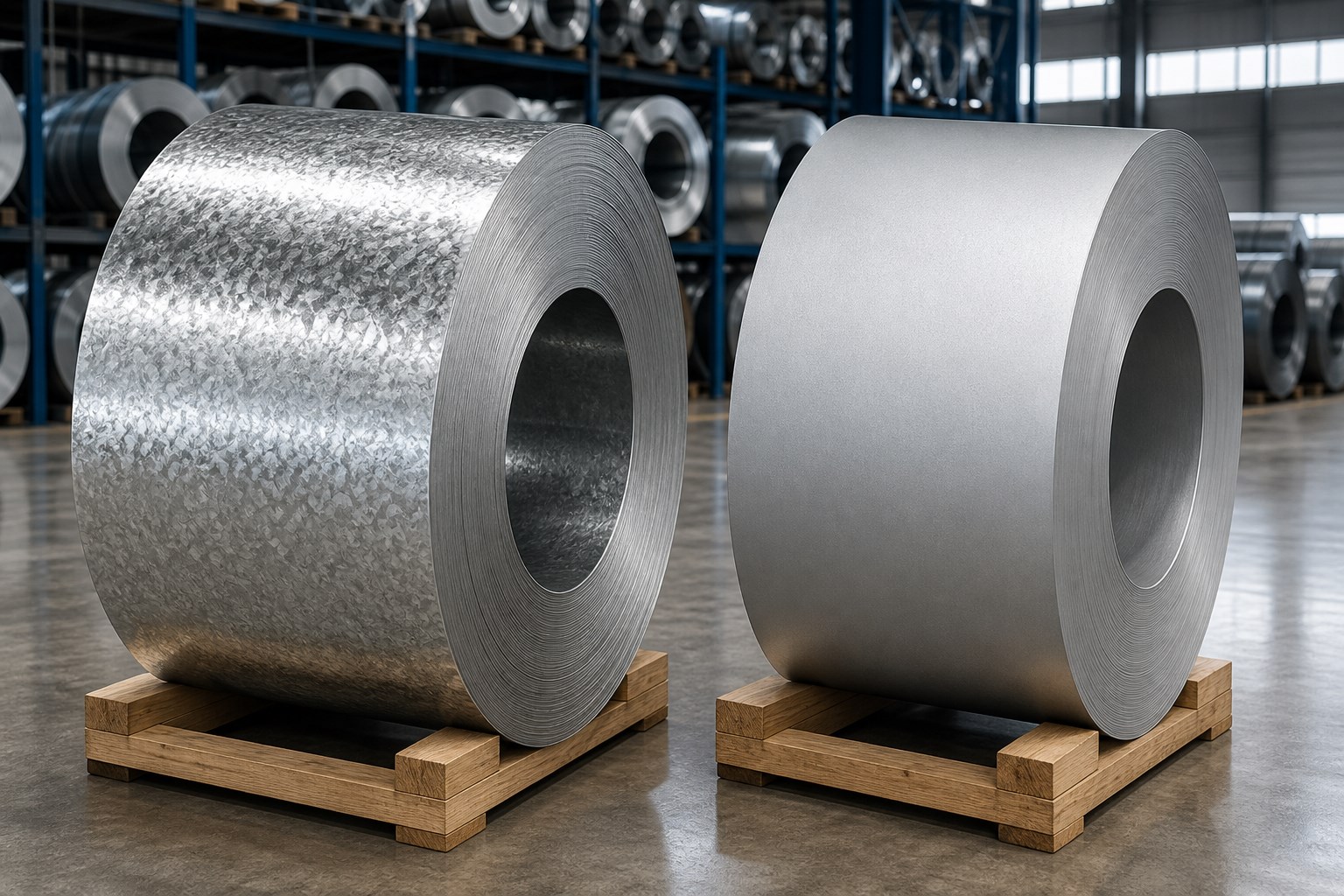
Dive deeper: zinc gives electrons, aluminium-zinc gives a shield. The protective mechanism of hot-dip galvanized coating rests on sacrificial (cathodic) protection: zinc sits above iron in the galvanic series, so when moisture reaches a scratch or a cut edge where the paint and zinc are interrupted, the surrounding zinc corrodes preferentially and keeps the underlying steel intact, a principle described in the Wikipedia article on galvanization. This is why galvanized-based products are forgiving in practice: small handling scratches, drilling damage and guillotine-cut edges remain protected as long as zinc remains nearby, and the coating is applied by dipping the strip in a molten zinc bath at roughly 450 °C, which forms a metallurgically bonded zinc-iron intermetallic layer rather than a mere surface film. Galvalume coating works differently: its aluminium-rich phases form a dense, stable oxide barrier that blocks oxygen and moisture far more effectively than zinc does in open atmospheres, which is why PPGL sheet outperforms PPGI sheet on large unbroken roof and wall planes exposed to years of rain, UV and temperature cycling. The trade-off appears at the cut edge: because the aluminium-zinc alloy is less electrochemically active than pure zinc, it sacrifices less to protect bare steel where the coating is completely interrupted, so an unprotected PPGL cut edge can show early rust staining unless the profile design, edge distance or an edge treatment compensates. Practical experience shows the two coatings respond differently to the same environment: in a dry, sheltered interior, both perform well and the cheaper zinc coating is usually sufficient; in an open, unsheltered or industrial atmosphere, galvalume’s barrier behaviour extends the life of the painted system measurably; in heavily marine splash zones, neither metallic coating alone is enough and the specification should move toward heavier coating masses or a different material class. The corrosion mechanisms, edge behaviour and cost trade-offs of the two substrate families are set out side by side in our earlier guide comparing galvanized steel vs galvalume, which is worth reading before you fix the substrate decision, because every later choice — paint system, coating mass, colour warranty and price — hangs off it.
Where Should You Use PPGI, and Where Does PPGL Perform Better?
Matching the coated steel family to the building, the climate and the forming process is where importers save the most money — or quietly lose it.
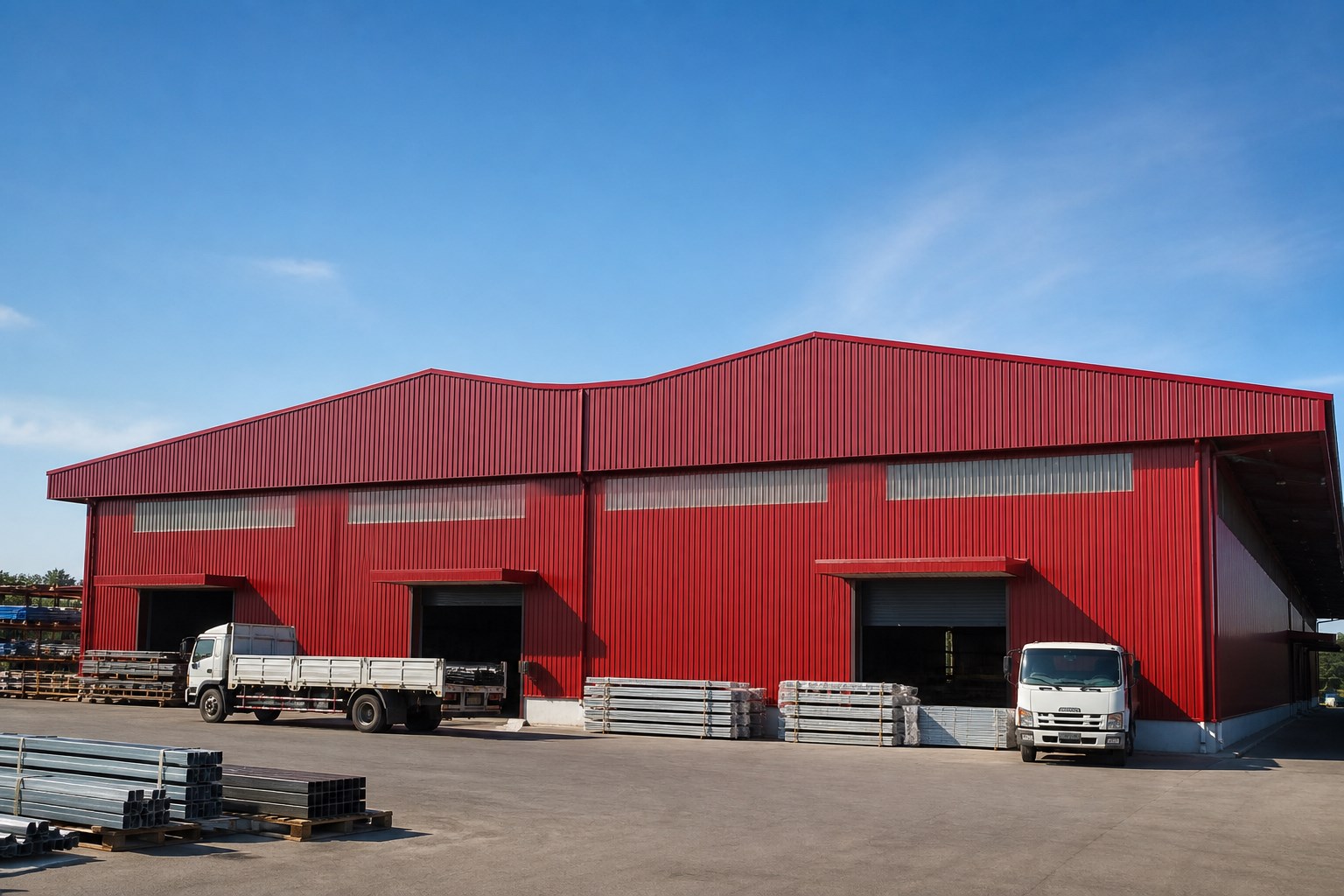
Specify PPGI for dry-climate industrial roofing and wall cladding, purlins, ductwork, household appliances and general-purpose profiles; specify PPGL for coastal buildings, agricultural sheds, cold stores and any roof exposed to long UV, heavy rain or industrial fumes where edge-to-edge durability matters more than first cost.
Dive deeper: read the building before you read the quotation. The single most reliable way to choose between PPGI and PPGL is to describe the service environment precisely. For an industrial warehouse in a dry inland climate — the most common application in many markets — a PPGI coil with a sensible zinc coating mass and a polyester or SMP paint system is usually the most economical choice, because the atmosphere never really tests the coating and the zinc continues to protect any drilling or handling damage. For a poultry or livestock shed, a fertilizer warehouse or any building where ammonia, humidity and condensation attack the metal from inside as well as outside, the barrier performance of galvalume substrate is frequently worth its premium, and many agricultural builders in practice standardize on PPGL for exactly this reason. For coastal regions, salt-laden wind attacks cut edges and fastener holes relentlessly, and specifiers generally choose PPGL with a heavier coating mass — or move to a different corrosion strategy altogether — rather than trust an economical PPGI sheet near breaking surf. The picture changes again when the product is formed into complex profiles: deep trapezoidal sheets, concealed-fix standing seam systems and sandwich panel faces bend the metallic coating and the paint film around tight radii, and both substrate families must be matched to the forming process, since an excessively brittle or thin coating will micro-crack at the bends. Colour is specified the same way for both families: an international reference such as the RAL system rather than a verbal description, because a four-digit RAL number such as RAL 3005 (wine red) or RAL 9002 (grey-white) binds the mill and the buyer to one physical standard; the history and structure of the RAL colour system are documented in the Wikipedia page on the RAL colour standard. In practice many importers keep both families in their programme — for example a warehouse roof in economical PPGI and a coastal workshop or showroom extension in PPGL — and a stocked specification such as a PPGI steel coil in 0.4 mm with a polyester finish in RAL 3005 is a common starting point for a typical industrial building envelope before the order is adapted to the actual site conditions.
Are the Paint Systems on PPGI and PPGL the Same?
Paint can look identical on both families — because it is applied on the same coating line with the same resin chemistry, independent of the substrate beneath.
Yes — polyester, SMP, HDP and PVDF topcoats, primers, film thickness and colour options are shared between PPGI and PPGL; the substrate family and the paint system are two separate lines of the specification that must both be written down.
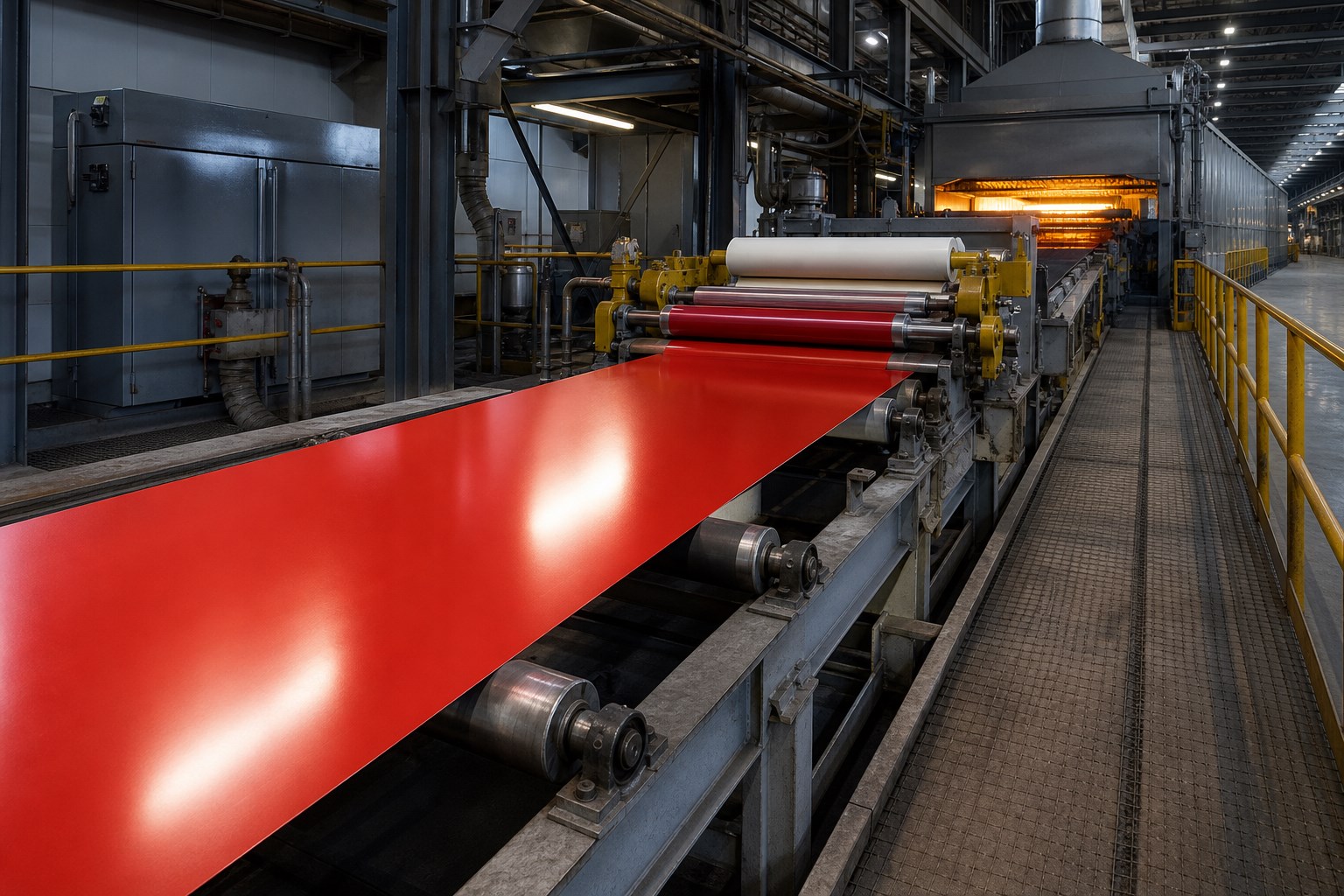
Dive deeper: the coating line does not know whether the strip is galvanized or galvalume. Both PPGI and PPGL are made on the same class of continuous coil coating line, whose basic steps are the same regardless of substrate: the strip is unwound from a decoiler, stitched to its predecessor, cleaned and power-brushed, given a chemical conversion pretreatment that makes the organic film adhere, dried, coated with a thin corrosion-inhibiting primer, cured in the first oven, cooled, coated with the finish colour, cured in the second oven, cooled again and rewound. Because the substrate metal is only one input to this sequence, the paint systems available on PPGI and PPGL are identical: standard polyester as the economical workhorse for typical building service, silicone-modified polyester (SMP) for tropical and high-UV markets, high-durability polyester (HDP) as the fastest-growing specification for industrial roofing, and PVDF fluoropolymer systems at the top of the range for coastal and landmark cladding where a long colour warranty is demanded. The governing North American specification for this product class, ASTM A755/A755M, explicitly covers steel sheet that is metallic coated by the hot-dip process — including zinc-coated (galvanized) and aluminium-zinc alloy-coated substrates — and then coil-coated with organic films for exterior exposed building products, confirming that the two substrate families are interchangeable inputs to the same prepainted product class. Two practical points follow. First, when you compare quotations for PPGI and PPGL, compare like with like: the paint system, the total dry film thickness and the coating mass of the metallic layer must be stated on both offers, otherwise part of the price difference is simply a thinner film or a lighter coating disguised as a substrate premium. Second, the reverse side matters: most coils carry a thin backing coat or a bare metallic finish on the inside, and for roofing and cladding applications the reverse-side condition influences condensation behaviour and long-term corrosion from the building interior, so ask the supplier to state the back specification as well as the face colour. PPGI and PPGL coated steel coils supplied for building projects are quoted with the substrate, coating mass, paint system and film thickness written out separately, which makes an offer comparison straightforward instead of a guessing game.
How Do Cost and Supply Differ Between PPGI and PPGL?
Galvalume substrate costs more to produce than zinc-coated steel, yet a longer service life can make PPGL cheaper per year of service in aggressive environments.
PPGL typically carries a modest price premium over PPGI for the same gauge, paint system and coating mass, reflecting the higher alloy cost of the aluminium-zinc bath; both families are widely stocked, but PPGL volumes and lead times vary more by mill and region.
Dive deeper: price per tonne versus price per year. It is tempting to compare PPGI and PPGL on price per tonne, but the honest comparison is cost per square metre per year of service, because the two products are rarely bought for the same job. In a dry industrial environment where a PPGI roof can realistically serve for a decade or more before maintenance, paying a premium for galvalume substrate buys protection the environment never tests, and the economical zinc-based product is the rational choice. In a coastal or agricultural environment where the same PPGI roof would begin to show edge staining and fading years earlier, the PPGL premium is usually recovered several times over in deferred replacement and maintenance. The premium itself is driven by alloy cost — the aluminium-zinc bath is more expensive than a zinc bath of the same mass — and by coating mass, since both families are ordered by metallic coating designations: zinc coatings are quoted in Z classes such as Z180 or Z275 (grams of zinc per square metre), while aluminium-zinc coatings use AZ classes such as AZ150 or AZ200 under the same hot-dip specification family covered by ASTM A755. Supply behaviour differs too: PPGI is produced in much larger global volume and is therefore almost always available from stock in common colours and gauges, while PPGL programmes are more selective — many mills run galvalume substrate only in the sizes and coating masses their main roofing customers actually consume, so unusual gauges or colours can mean a longer lead time or a larger minimum order. Seasonality is the other practical factor: roofing demand peaks before the wet season in tropical markets and before winter in cold markets, and both families tighten in those windows, so buyers who plan around the calendar rather than the quotation date get better prices and shorter lead times. Finally, remember that gauge, substrate and paint interact: a 0.4 mm coil in a premium paint system is not comparable to a 0.5 mm coil in standard polyester simply because both are “color coated”, and the specification discipline described earlier — substrate family, metallic coating mass, paint system, total film thickness and colour — is what makes a price comparison meaningful at all. For a full view of what we produce across both coated families and the carbon and stainless ranges that support the same projects, Shuncheng Steel’s export range is a useful starting point before you send an inquiry.
How Do You Verify the PPGI or PPGL You Receive Is What You Ordered?
A coil’s true identity is written on the mill certificate — and confirmed only by testing the delivered coil, not by admiring the document.
Check the substrate coating designation (Zxxx for galvanized, AZxxx for aluminium-zinc), the paint system, the total film thickness, the colour reference and the coil number on the mill test certificate, then verify film thickness and colour on the physical coil at arrival.
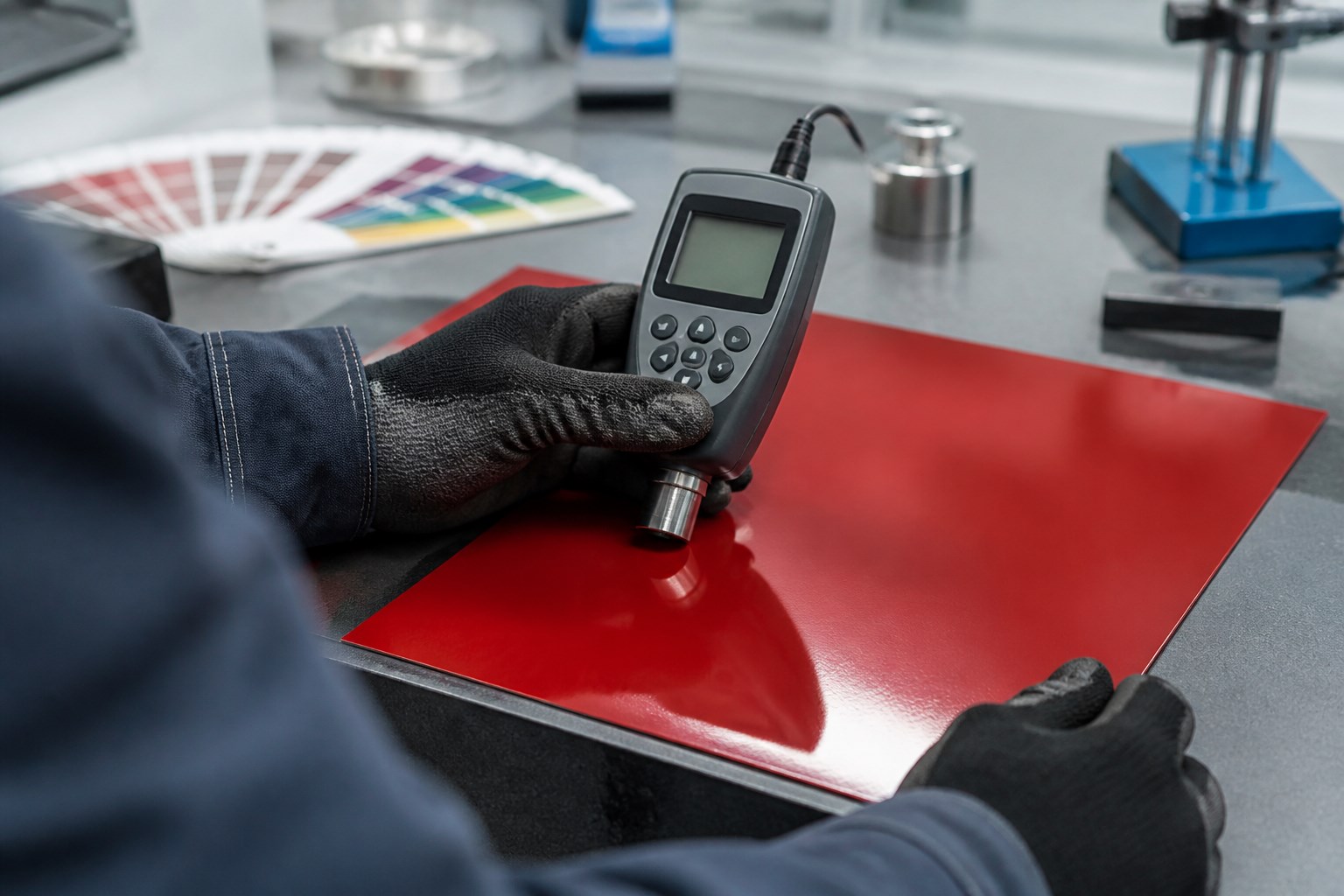
Dive deeper: a receiving checklist that catches a substituted substrate. The most common quality failure in coated steel importing is not a defective coil but a substituted one: an order placed for PPGL with an AZ coating mass arrives as PPGI with a zinc coating, or a quoted HDP system arrives as standard polyester, and the difference is invisible from the end of a coil. Verification therefore starts with the documents: the mill test certificate should state the substrate grade and the metallic coating designation — a Z class such as Z180 or Z275 if it is galvanized, an AZ class such as AZ150 or AZ200 if it is aluminium-zinc — together with the paint system and its brand, the total dry film thickness, the colour reference and the coil number, and each of those items should match your purchase order before payment is released. Then inspect the physical coil against the document. Check the coil number printed on the outer wrap and the inner paper, because coils are swapped in transit and handling more often than suppliers admit. Measure the paint film thickness with a coating thickness gauge at several points across the strip width on both the face and the reverse side; the readings should sit inside the stated tolerance, and a consistent shortfall of several microns is grounds to reject the delivery rather than to negotiate a discount. Check the colour against the agreed RAL reference with a colour fan or a colour difference meter under standard lighting, since the human eye is unreliable when comparing a fresh coil with a stored sample. Cut a small coupon and examine the edge and the sheared face: the metallic layer should be visibly continuous, and rust staining at the cut edge shortly after shearing indicates that the coating mass is thinner than specified or that the substrate family is wrong for the environment. A simple bend test over a mandrel will confirm that the film does not crack at the radius your profiles require, and a solvent rub on the painted surface gives a quick indication that the film is properly cured. These checks take less than an hour with basic instruments and turn a coil purchase from an act of faith into an audited transaction; when the delivery matches the certificate, the coil can be profiled and installed with confidence. If you need a quotation with the full specification written out — PPGI or PPGL substrate, coating mass, paint system, film thickness and RAL colour — request a quotation from our export team, and we will send the technical details and test documents together with the price.
Conclusion: PPGI and PPGL share paint lines but differ in substrate. Match the substrate to the environment, write down every layer, verify on arrival — and the roof outlasts the warranty.