
Stainless Steel 304 vs 201: What’s the Real Difference?
Buyers often swap 201 for 304 to cut cost, then watch welds rust in humid air. The difference is not cosmetic; it decides whether your project survives its warranty.
304 contains 18–20% chromium and 8–10.5% nickel; 201 replaces most of that nickel with manganese and nitrogen. The result: 304 resists corrosion better and forms more easily, while 201 costs less but is limited mainly to indoor, low-chloride, decorative work.
Every question below traces back to one trade-off: nickel. Nickel buys corrosion resistance and formability, and manganese does not replace it one-for-one. The six sections that follow work through chemistry, magnetism, corrosion, cost, application fit and incoming inspection, so you can defend a grade decision in a technical meeting — or in a claim dispute six months later.
What Is the Chemical Difference Between 304 and 201 Stainless Steel?
Both grades are austenitic, so they look identical on a shelf. The difference hides in the alloying: how much nickel is replaced by manganese and nitrogen.
304 is specified as 18–20% chromium, 8–10.5% nickel and a maximum 0.08% carbon. 201 typically runs 16–18% chromium, 3.5–5.5% nickel, 5.5–7.5% manganese and up to 0.25% nitrogen — nickel cut by roughly half, with manganese and nitrogen restoring the austenitic structure.
Nickel is the most expensive element in an austenitic stainless steel, so it is the first thing a mill trades away when it targets a lower price point. That single substitution cascades through every other property, which is why the two grades behave differently even though both carry the 300-series label.
| Element (wt %) | 304 (UNS S30400) | 201 (UNS S20100) |
|---|---|---|
| Chromium | 18.0–20.0 | 16.0–18.0 |
| Nickel | 8.0–10.5 | 3.5–5.5 |
| Manganese | ≤ 2.00 | 5.5–7.5 |
| Nitrogen | ≤ 0.10 | ≤ 0.25 |
| Carbon | ≤ 0.08 | ≤ 0.15 |
| Silicon | ≤ 0.75 | ≤ 0.75 |
| Phosphorus | ≤ 0.045 | ≤ 0.060 |
| Sulfur | ≤ 0.030 | ≤ 0.030 |
Why manganese and nitrogen are added
Nickel stabilises the austenitic crystal structure at room temperature. When nickel is removed, the structure wants to revert to ferrite and the steel loses both ductility and toughness. Manganese and nitrogen both act as austenite stabilisers, so replacing roughly half the nickel with 5.5–7.5% manganese plus nitrogen keeps the alloy austenitic. Nitrogen also contributes solid-solution strengthening, which is why 201 can still meet respectable tensile requirements despite the leaner composition.
What does not stay the same
The chromium level drops by about two percentage points. Chromium is the element that builds the passive oxide film protecting the surface, so a leaner chromium content means a thinner, slower-repairing film. Nickel also contributes to passive-film stability in chloride environments, and halving it removes that contribution. The practical consequence is not a dramatic, immediate failure — it is a shorter service life in humid, salty or acidic conditions. Composition requirements for both grades are published in the ASTM A240/A240M specification for chromium and chromium-nickel stainless steel plate, sheet and strip, and buyers should always compare the actual mill certificate against that table rather than against a supplier’s summary. If you need either grade in sheet or plate form, the 304 vs 201 stainless steel plate range we stock is supplied with grade documentation on request.
Is 201 Stainless Steel Magnetic and Does That Matter?
A magnet is the most common field test for stainless steel, and the most misleading one. Both grades are austenitic and therefore usually non-magnetic in the annealed condition.
Annealed 201 and 304 are essentially non-magnetic. Cold working, welding or shearing raises magnetic permeability in both, and 201 becomes slightly more magnetic than 304 because its higher nitrogen and manganese content work-hardens faster. A magnet therefore cannot separate the two grades.
People reach for a magnet because it is free and instant, and because 400-series ferritic grades such as 430 are strongly magnetic. The logic seems sound: if the magnet sticks, it must be a cheap grade. The flaw is that magnetism measures crystal structure, not composition. Both 201 and 304 are austenitic, and both can become partially magnetic after deformation.
Where magnetism is still useful
Magnetism is a legitimate screening tool in one narrow case: distinguishing an austenitic 300-series grade from a ferritic 400-series grade. If a supplier claims 304 and the magnet snaps hard onto an annealed, undeformed sheet, you are almost certainly looking at a 400-series product. That is a useful red flag.
Why it fails for 201 versus 304
201 work-hardens faster than 304. A 201 sheet that has been sheared, bent or drawn will often show noticeable magnetic response, while a 304 sheet from the same batch may show little. Read the other way round, a weakly magnetic 201 part can look “correct”. The test produces both false positives and false negatives, so it cannot be used as evidence in a quality dispute.
The same physical behaviour also affects forming: because 201 work-hardens more quickly, it needs higher bending forces, shows more springback, and is more prone to edge cracking in tight radii. Designers who specify 201 for a deep-drawn part usually discover this at the press, not in the specification sheet.
What to use instead
Positive material identification with a handheld X-ray fluorescence or optical emission analyser reads the actual chemistry in seconds and reports chromium, nickel, manganese and molybdenum content. That is the only field test that can separate 201 from 304 with confidence. If you are planning a drawing or bending operation and need guidance on which thickness will form cleanly, start from our chart for picking the right sheet gauge before you commit to a grade.
How Do 304 and 201 Compare in Corrosion Resistance?
The gap is small in a dry showroom and large in a humid kitchen. Chromium and nickel content decide how long the passive film survives when chlorides and moisture arrive.
304 performs well in most atmospheric and many chemical environments. 201 resists rust in dry indoor conditions and light humidity, but it is markedly less tolerant of chlorides, standing water, salt spray and acidic residue. In coastal or wash-down environments, 304 lasts significantly longer.
The mechanism behind the difference is worth understanding, because it explains why failures appear at welds rather than in the middle of a panel. Chromium forms a chromium-oxide passive film roughly a few nanometres thick, and that film self-repairs instantly when scratched — provided enough chromium is present at the surface and oxygen is available. Chloride ions attack the film locally, initiating pits. Nickel improves the film’s stability and its ability to repassivate after a chloride attack, so a grade with half the nickel has less reserve. In 201 the chromium reserve is also about two points lower, which compounds the effect.
| Environment | 304 performance | 201 performance |
|---|---|---|
| Dry indoor, decorative | Excellent | Acceptable |
| Humid interior, occasional moisture | Very good | Marginal to acceptable |
| Frequent wash-down, food contact | Good | Not recommended |
| Coastal or high-chloride air | Acceptable with maintenance | Not recommended |
| Standing water, pools, chemicals | Limited; consider 316 | Not recommended |
Why welds are the first place to fail
Welding heats metal into a temperature range where chromium can combine with carbon and migrate to grain boundaries, leaving chromium-depleted zones adjacent to the weld. Low-carbon grades such as 304L are used specifically to reduce this sensitisation effect. Grade 201 carries a higher permitted carbon level — up to 0.15% against 0.08% for 304 — so it has less headroom before sensitisation becomes a problem. On top of that, welding scale and oxides must be removed and passivated, or the weld zone never rebuilds its passive film at all. This is why a 201 assembly can look perfect at delivery and show rust lines along the welds after one humid season.
Practical corrosion guidance
Treat 304 as the default for anything that sees water, chlorides, food or cleaning chemicals, and reserve 316 for genuinely aggressive chloride exposure. Treat 201 as an indoor decorative material: dry interiors, shop fittings, appliance trim, panels that are cleaned with a damp cloth rather than hosed down. For documented composition and corrosion behaviour of the 300-series grades, the reference data on SAE 304 stainless steel is a useful starting point when comparing supplier claims.
What Is the Real Cost Difference Between 304 and 201?
The price gap is real, but it comes almost entirely from one element. Judging the two grades on purchase price alone ignores what the substitution costs later.
Because 304 carries roughly twice the nickel and two points more chromium, its price is far more sensitive to the LME nickel quotation. 201 is the lower-cost option in most market conditions, but the gap widens and narrows with nickel pricing rather than staying fixed.
It is tempting to model 201 as a fixed percentage saving, and suppliers sometimes present it that way. That framing breaks down as soon as nickel moves. A mill rolling 304 is exposed to the nickel quotation on the entire 8–10.5% nickel content, whereas a mill rolling 201 is exposed to roughly half that. When nickel is expensive, the two grades drift far apart; when nickel is cheap, the saving from switching shrinks. Anyone quoting a single permanent discount figure is describing a moment, not a market.
Costs that do not appear on the purchase order
Switching to 201 rarely saves the full headline difference once lifetime costs are counted. Fabricators report higher bending forces and more springback, which increases scrap on tight-radius work. Welders must be more careful about heat input and post-weld cleaning. In service, a 201 panel that rusts in a humid environment generates replacement labour, transport and reputational cost that dwarfs the original material saving. For interior decorative work with no moisture exposure these costs never materialise, and 201 is genuinely cheaper over its whole life.
How to frame the decision
Compare grades on cost per year of service, not cost per tonne. If a component will be exposed to moisture or chlorides and is expected to last a decade, the material saving from 201 is usually erased the first time it has to be replaced. If it is a dry, decorative, short-life fit-out, 201 is a rational engineering choice rather than a compromise. Understanding why nickel matters so much to both price and performance helps put the trade-off in context — the metallurgy of stainless steel explains how that single alloying element drives both the cost structure and the corrosion behaviour of the 300 series.
Which Applications Should Use 304 and Which Can Use 201?
Most specification errors come from matching a grade to a budget instead of to an environment. The deciding question is what the surface will meet.
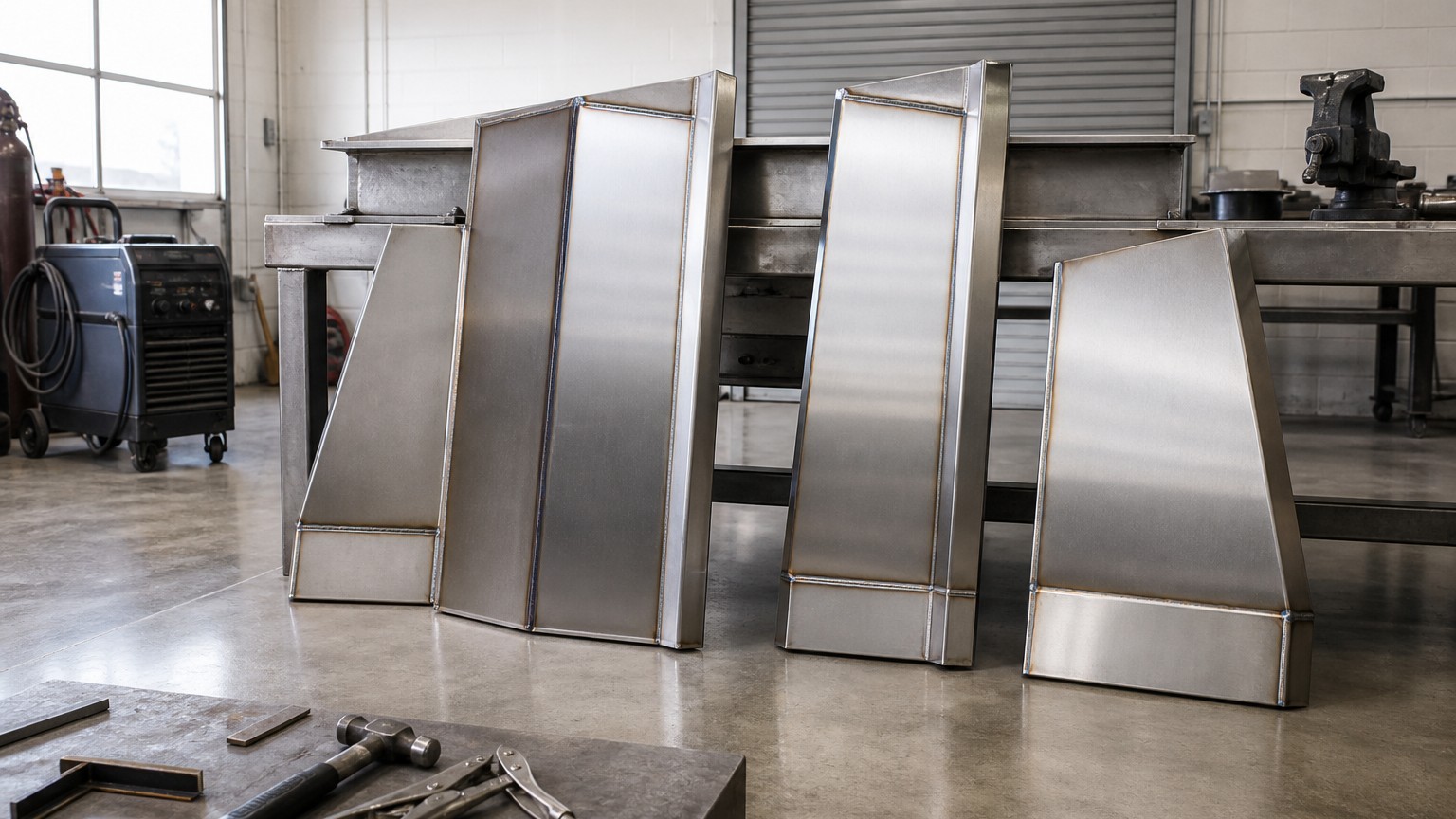
Specify 304 for food contact, wash-down areas, humid or coastal sites, medical and chemical equipment, and any welded assembly exposed to moisture. Specify 201 for dry indoor decorative work such as lift interiors, shop fittings, appliance trim and furniture frames where no chlorides or standing water are present.
Applications that suit 304
Kitchen and catering equipment is the classic case: worktops, sinks, splashbacks and extraction hoods are cleaned repeatedly with water and detergent, so the surface must repassivate constantly. Chemical and pharmaceutical process equipment, food conveyors, brewing vessels and dairy lines follow the same logic. Architectural applications in coastal cities, handrails on marine walkways, and any component that will be welded and left unpainted also belong on 304. In each of these cases the corrosion threat is continuous rather than occasional, and the material needs sufficient chromium and nickel to keep rebuilding its passive film. For coil-fed production lines, a 304 stainless steel coil in 1.2 mm × 1219 mm is a typical input for appliance trim, interior panels and formed enclosures, and the grade behaviour described above applies unchanged to coil as well as to cut plate.
Applications that suit 201
201 works well where the surface stays dry and the load is decorative rather than structural. Interior wall cladding in air-conditioned buildings, lift car panels, retail shelving, electrical enclosures sited indoors, appliance trim rings and furniture frames are all reasonable uses. It also makes sense for short-life exhibition or event structures that will be dismantled long before corrosion becomes relevant. In these conditions 201 delivers a stainless appearance at a lower material cost, and the reduced chloride tolerance never gets tested.
Where designers most often get it wrong
The recurring mistakes are predictable. Specifying 201 for bathroom fittings ignores that bathrooms are humid and frequently cleaned. Specifying it for outdoor signage ignores rain and airborne chloride. Specifying it for kitchen splashbacks ignores daily wash-down. Specifying it for anything that will be welded and then exposed to moisture ignores sensitisation at the heat-affected zone. In every one of those cases the substitution looks correct on the bill of materials and wrong in service. For visible architectural work, the surface finish also matters to both appearance and cleanability, so it is worth deciding on appearance requirements at the same time — you can choose 2B or No.4 finish for your application knowing that the finish choice does not change the underlying grade behaviour.
How Do You Verify 304 vs 201 Before Accepting a Shipment?
Paperwork is easy to copy and magnets prove nothing. Verification has to read the actual chemistry of the metal in front of you.
Request a mill test certificate that reports chromium, nickel, manganese and nitrogen for the specific heat number, then verify a sample with positive material identification. Compare the results against the ASTM A240 composition table before releasing the shipment.
Start with the mill test certificate
A mill test certificate should identify the heat number, the grade designation with its UNS number, the applicable specification, and the measured chemistry for each element. Ask for the certificate that matches the heat number actually stamped or tagged on the delivered material, not a generic certificate for the mill’s typical production. Where a buyer requires third-party attestation rather than a mill’s own declaration, that is arranged contractually with an inspection body and should be agreed before the order is placed, because it cannot be retrofitted after dispatch.
Then verify with an analyser
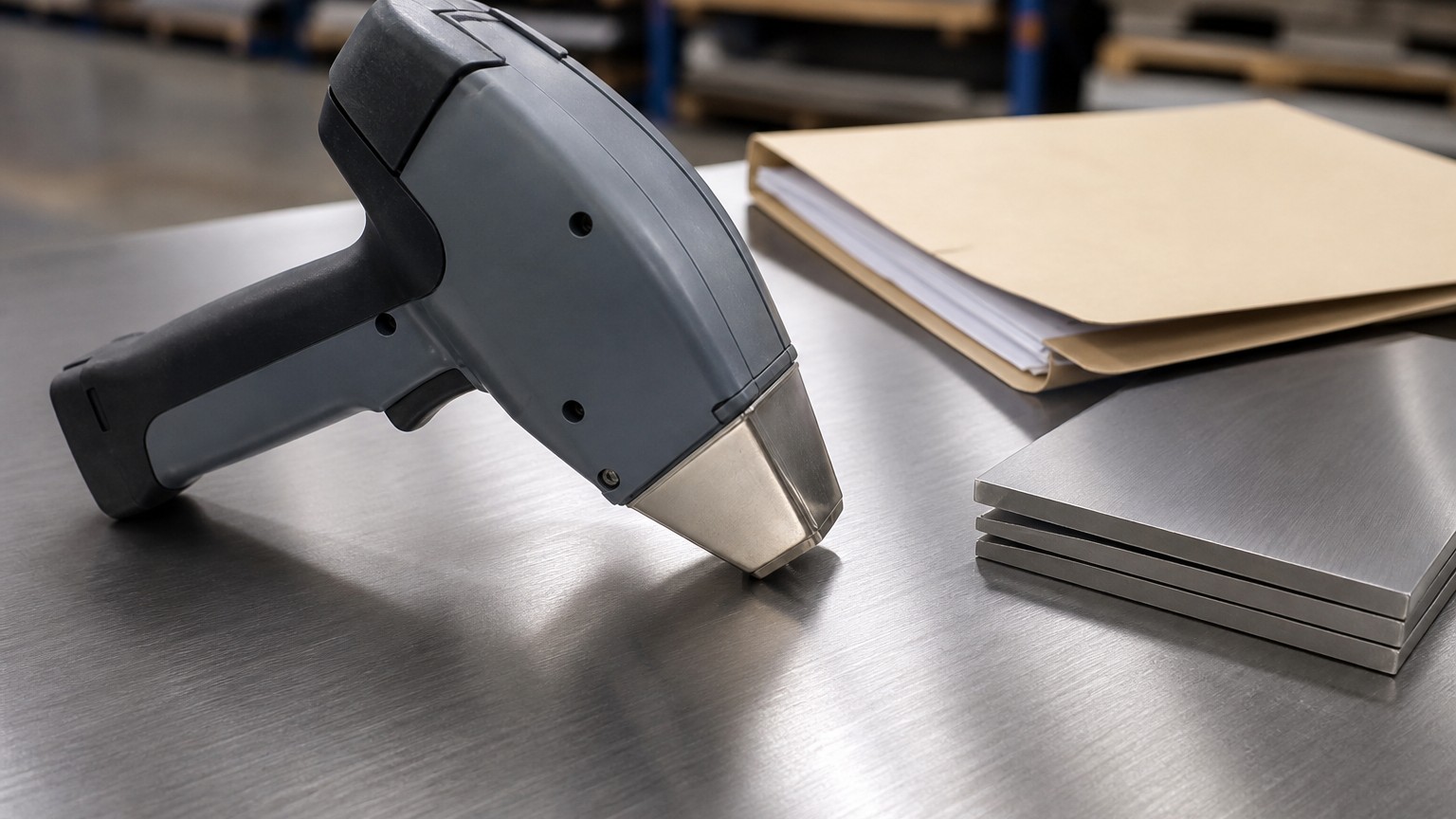
Positive material identification with a handheld analyser takes seconds per reading and reports the elements that separate the two grades. Nickel below roughly 6% combined with manganese in the 5–8% range identifies 201 rather than 304. Test several pieces, including one from each bundle or coil, and include at least one welded component, because that is where service failures concentrate. Record the readings alongside the heat numbers so the evidence survives if a dispute arises later.
Questions to put to your supplier
Ask which mill rolled the material and whether it was produced to a published specification or to an internal grade. Ask how the nickel content is controlled across heats, since a lean heat drifts toward lower corrosion performance even when it is nominally compliant. Ask whether the material is supplied with a 2B, BA or No.4 finish and whether the finish was applied before or after any annealing. Ask for the packing method and storage conditions, because wet packing accelerates rust on leaner grades during transit. Suppliers who answer these questions directly are usually the ones whose certificates match the metal. The British Stainless Steel Association publishes further guidance on grade selection and fabrication practice that is useful when drafting a specification. If you want the chemistry verified and documented on your own order, you can request a quotation and mill certificate package for the specific grade, thickness and finish you need.
Acceptance checklist
- Certificate heat number matches the tag on the delivered material.
- Chromium, nickel and manganese values fall inside the ASTM A240 range for the stated grade.
- At least three positive material identification readings recorded, including one welded piece.
- Surface finish inspected for embedded iron, scratches and weld discolouration.
- Packing and storage conditions confirmed dry before unloading.
Conclusion
Choose 304 when moisture, chlorides or food contact are involved; choose 201 only for dry, decorative, indoor work. Then verify the grade with a mill certificate, never with a magnet.