
Steel Coil Weight Calculation: What Formula Should Importers Use?
A coil that weighs more than the packing list says turns a clean quotation into a claim. Freight, duty and credit terms are priced on that number.
Short answer: Steel coil weight calculation is based on the strip, not the coil: mass = thickness × width × strip length × steel density (7.85 g/cm³ for carbon steel). When the coiled strip is too tight to measure, outer diameter, inner diameter and width give a close estimate.
Those two sentences settle the arithmetic but not the commercial risk. A coil weight figure sits at the junction of three documents that rarely arrive together: the mill’s theoretical calculation, the packing list issued before shipment, and the weighbridge ticket printed at the port. Each is generated from a different input, and importers who treat them as interchangeable discover the difference only after the container has been discharged. The sections below work through the calculation term by term, then follow the same number into the container plan, the mill certificate and the claim window.
What Is Steel Coil Weight and Why Does It Decide Your Landed Cost?
Coil weight looks like a technical detail until it multiplies through freight, duty and demurrage on a full consignment.
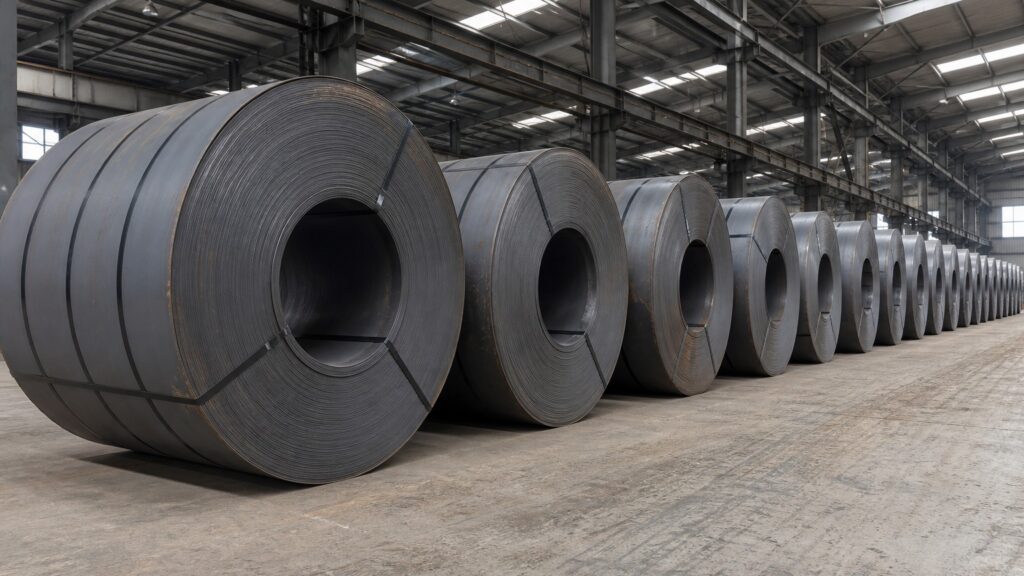
Coil weight is the mass of one continuous strip wound into a coil, normally expressed in metric tonnes and quoted either as theoretical weight, calculated from nominal dimensions, or as actual weight measured on a scale.
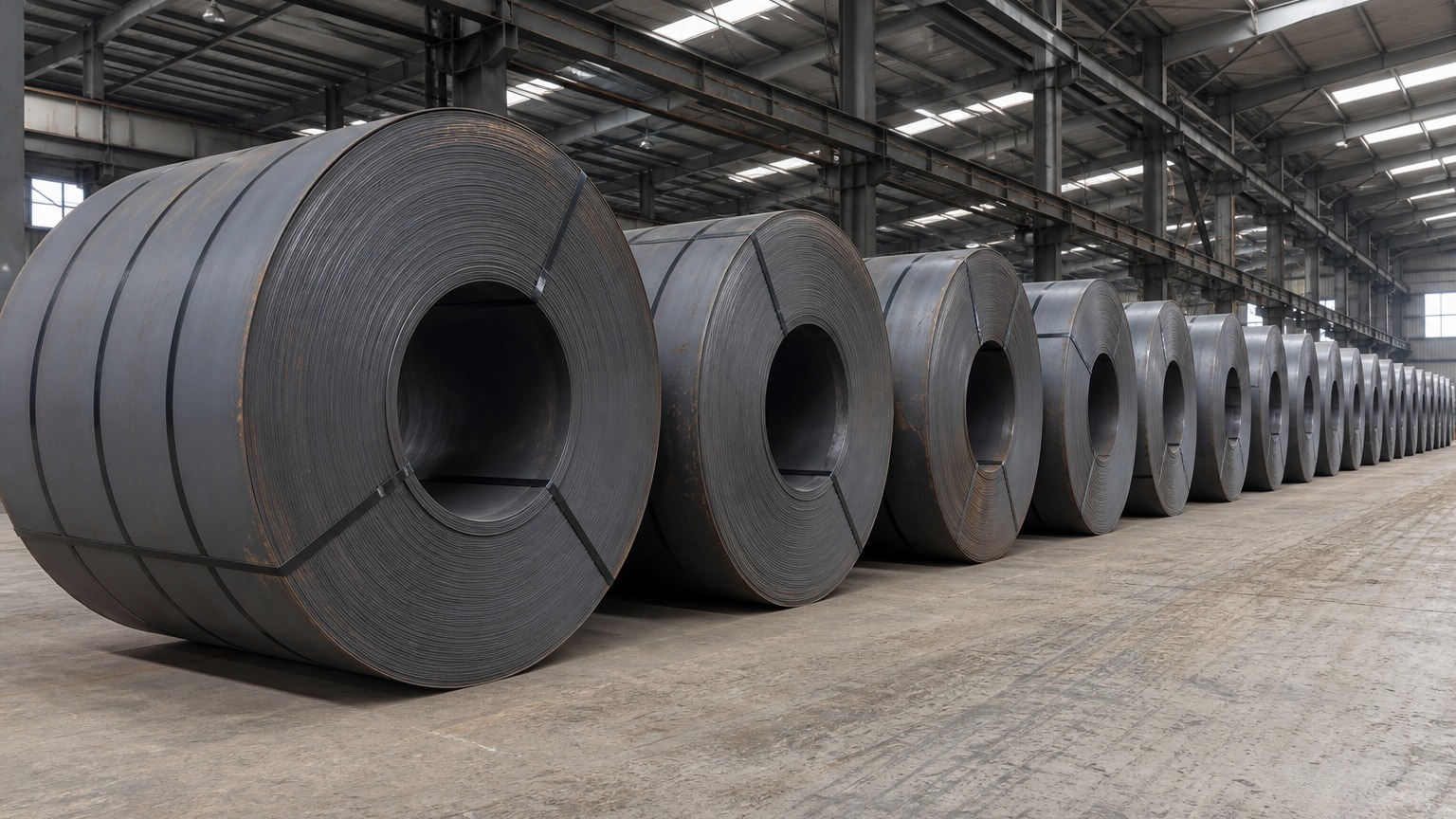
Two different numbers travel with every coil, and the gap between them is where disputes start. Theoretical weight comes from the nominal thickness, the nominal width and the length the mill believes it produced. Actual weight comes from a calibrated scale, and it includes every deviation the process allowed: a strip rolled marginally above nominal thickness, a width at the upper end of tolerance, and the mass of any coating applied after rolling. Neither number is wrong. They simply answer different questions, and a purchase order that does not say which one governs the price has not yet resolved the commercial question.
Why the number decides so much comes down to what is priced on it. Ocean freight for coil is sold per tonne or per container with a weight ceiling, inland trucking is limited by axle load, customs duty and value-added tax are assessed on declared value that follows weight, and a letter of credit may specify a tonnage band that the shipment must fall inside. A one per cent error on a 500-tonne order is five tonnes — enough to push a truck over a road limit, to break a credit term, or to leave the buyer paying for metal that arrived as extra mass on a coil that was ordered by theoretical weight.
Why the same coil can be quoted two ways
Mills that sell to distributors usually quote theoretical weight because it is stable and easy to invoice; service centres that cut the coil into sheets often buy on actual weight because they resell the metal they physically receive. Knowing which basis your supplier uses is the single most useful question to ask before comparing two quotations, because a theoretical-weight quotation can look cheaper per tonne while delivering fewer usable square metres.
Where the weight figure is used after arrival
Weight does not stop mattering at the port gate. It sets the crane and forklift class, the number of coils that fit in a truck, the storage layout in a warehouse, and the input for the next calculation — how many sheets or blanks the coil will yield once it is uncoiled, levelled and cut.
What Is the Steel Coil Weight Calculation Formula?
One multiplication covers most enquiries, provided every input is converted into the same family of units before you start.
Mass in kilograms = thickness (mm) × width (mm) × strip length (m) × density (g/cm³) ÷ 1000. For carbon steel the density is 7.85 g/cm³, so a 1,000 m coil of 1,250 mm × 4.75 mm weighs approximately 46,600 kg.
The formula is short, but each term carries an assumption. Before you trust a result, confirm that the thickness is the nominal figure the mill rolled to, that the width is the actual trimmed width rather than the ordered width, and that the length is measured rather than assumed from the coil diameter.
The formula written out term by term
Thickness enters in millimetres because that is how sheet and coil are ordered, and a 0.1 mm error on a 4.75 mm coil is a two per cent error on the final answer — larger than most buyers expect. Width enters in millimetres for the same reason, and the difference between a 1,250 mm coil and a 1,219 mm coil is a 2.5 per cent change in mass for the same length. Length is the term that most often goes unmeasured, because a wound coil hides its own length; mills derive it from the coil’s outer diameter, inner diameter and width, or from a running length counter on the line. Density is the term buyers change least often and for the wrong reasons: the number is a property of the alloy, not a variable to be tuned, and substituting one value for another simply moves the error into the invoice.
The unit conversion at the end is worth spelling out because it is where hand calculations most often fail. Multiplying millimetres by millimetres by metres gives a volume in cubic millimetres scaled by a thousand, and density in grams per cubic centimetre equals tonnes per cubic metre, which is why dividing by 1,000 returns kilograms. Buyers who work in inches and pounds can use the equivalent form of the same expression, mass in pounds = thickness (in) × width (in) × length (ft) × 3.4028 × 12, or convert a kilogram result at 1 kg = 2.20462 lb. The ASTM A1011/A1011M specification is a useful reminder here: it covers hot-rolled carbon, structural and high-strength low-alloy steel sheet and strip supplied in coils and cut lengths, which is exactly the family of product these formulas describe.
A worked example on a 4.75 mm Q235B hot rolled coil
Take a coil of 1,250 mm trimmed width, 4.75 mm nominal thickness and 1,000 m of strip. Thickness times width gives 5,937.5 square millimetres of cross-section; multiply by 1,000 m of length and the volume term becomes 5,937,500; multiply by 7.85 g/cm³ and divide by 1,000, and the coil weighs 46,609 kg, or about 46.6 tonnes. That figure sits comfortably inside the payload of a single 20 ft container for heavy cargo, which is why this size is a common export unit.
The same calculation run in reverse is what a service centre does when a customer orders a fixed number of sheets. If the finished blank is 1,250 mm × 2,500 mm × 4.75 mm, one blank weighs about 116.5 kg, and the coil yields roughly 400 blanks before edge trim and cut loss are taken out. Running the arithmetic in both directions is the cheapest way to catch an ordering error, because a coil weight and a blank count that cannot be reconciled point to a wrong assumption somewhere in the chain. Importers comparing offers on steel coil weight and dimensions should ask for both the theoretical weight and the expected actual weight before the order is confirmed.
The table below runs the same calculation across the thicknesses most often ordered for hot rolled coil at a 1,250 mm trimmed width. Values are theoretical, calculated at a steel density of 7.85 g/cm³; the actual coil weight will differ by the thickness and width tolerance the mill delivers.
| Nominal thickness (mm) | Mass per metre at 1,250 mm width (kg/m) | Theoretical coil weight for 1,000 m of strip (kg) |
|---|---|---|
| 2.0 | 19.6 | 19,625 |
| 2.75 | 27.0 | 26,984 |
| 3.0 | 29.4 | 29,438 |
| 4.75 | 46.6 | 46,609 |
| 6.0 | 58.9 | 58,875 |
Read the table as a quotation aid rather than a specification. Two coils of the same nominal thickness can still differ once width is trimmed differently, and the mass per metre column changes in direct proportion when width changes: a 1,000 mm coil of 4.75 mm strip weighs 37.3 kg/m, not 46.6 kg/m.
How Do You Calculate Coil Weight Without Knowing the Strip Length?
Most coils arrive without a length figure, so the calculation has to start from the dimensions you can actually measure at the warehouse.
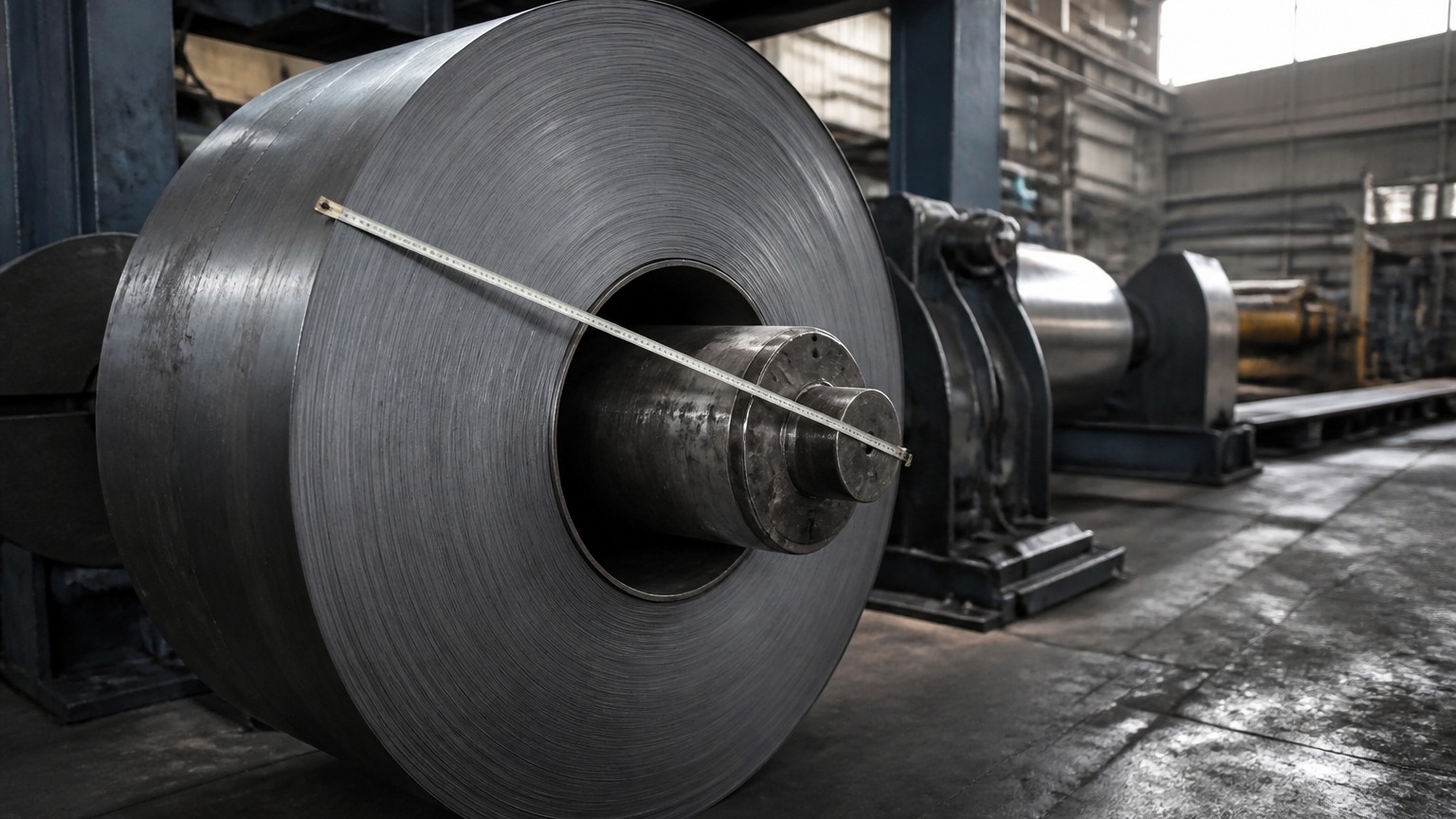
Treat the wound coil as a thick-walled ring: mass ≈ π/4 × (OD² − ID²) × width × density, with diameters and width in metres and density in kg/m³. A coil of 1.5 m outer diameter, 0.508 m inner diameter and 1.25 m width therefore weighs approximately 15.4 tonnes.
Working it through: 1.5 squared is 2.25, 0.508 squared is 0.258, and the difference is 1.992 square metres of annular face. Multiply by π/4 (0.7854) and by the 1.25 m width, and the coil occupies about 1.956 m³ of envelope. Carbon steel at 7,850 kg/m³ then gives 15,351 kg. The result is an estimate, not a certificate, because the envelope contains the small gaps between wraps and the loose outer lap that every coil carries.
Where the annulus method drifts from the true weight
The gap between wraps is the main source of error, and it behaves differently on a tight eye-to-sky coil than on a loosely wound one. A coil wound under high tension and banded immediately sits close to the theoretical envelope, and the estimate will usually land within a per cent or two of the weighbridge. A coil that was slit, recoiled and stored for months relaxes slightly, develops a visible gap between wraps, and reads heavier on the calculation than it does on the scale. The practical fix is to calibrate the method against one known coil: weigh a single coil, compare it with the annulus estimate, and keep the ratio for the rest of the consignment rather than trusting the geometry alone.
Turning the estimate into usable length
Dividing the estimated mass by the mass per metre of the strip returns an approximate length, and that single number drives most downstream planning. Mass per metre is thickness × width × density, which for a 1,250 mm × 4.75 mm strip is 46.6 kg/m. The 15.4-tonne coil therefore holds roughly 330 m of strip. Cut planning, yield calculations, and the decision on whether one coil can complete a run or two coils should be staged all depend on that length, so it is worth calculating before the coil is opened rather than after a shortfall has already stopped the line. Buyers who need the same logic in tubular products can use the equivalent method explained in our guide to the steel tube weight chart, where the shape formula changes but the unit discipline does not.
Which Density and Tolerance Assumptions Change the Result?
Two coils of identical dimensions can differ in mass by several per cent, and the difference comes from the material rather than from the measuring tape.
Carbon and low-alloy steel is calculated at 7.85 g/cm³. Austenitic stainless steel runs higher — about 7.93 g/cm³ for grade 304 and 7.98 g/cm³ for 316 — and zinc coating adds mass of its own on galvanized coil.
Density is the assumption buyers are most confident about and the one that travels furthest. A stainless coil calculated with the carbon steel figure will understate mass by about one per cent, which is small on a single coil and material on a 300-tonne order. Coated products move the number in the other direction, because zinc or paint is deposited on both faces of the strip and the added mass scales with coating weight rather than with thickness.
Thickness tolerance is larger than most buyers assume
Product standards allow the delivered thickness to sit inside a permitted band around nominal, and the band widens as the strip gets thicker and narrower. The ASTM A635/A635M general requirements for hot-rolled heavy-thickness coils are explicit that the standard includes permissible variations in dimensions and mass, which is the clearest signal that a nominal figure and a delivered figure are allowed to differ. Buyers who price on nominal thickness without asking for the tolerance table are accepting whatever variation the mill’s normal practice produces, and that variation lands directly on the invoice whenever the order is settled on actual weight.
Coil weight bands and the tolerance clause
Because a rolling mill cannot target an exact coil mass, coil weight is normally confirmed as a range around a target rather than a single figure, and a purchase order that demands an exact tonnage per coil is asking for something the process does not guarantee. State the target, state the acceptable band, and state the basis — theoretical or actual — in the same clause. A well-written clause also fixes what happens when a coil falls outside the band: whether the coil is rejected, accepted at a price adjustment, or accepted with the difference settled against the weighbridge ticket. Agreeing that in advance costs nothing and removes the argument that otherwise starts when the coils are already on the floor. Where the application also depends on how the material behaves after forming, the strip properties and the coil handling practice matter as much as the mass, which is why a hot rolled steel coil Q235B in 4.75 mm is quoted with grade, thickness, width and coil weight stated together rather than as separate line items.
How Do You Turn Coil Weight into Container and Freight Plans?
The calculation is only useful once it becomes a loading plan, and that is where the heaviest coils and the smallest containers meet.
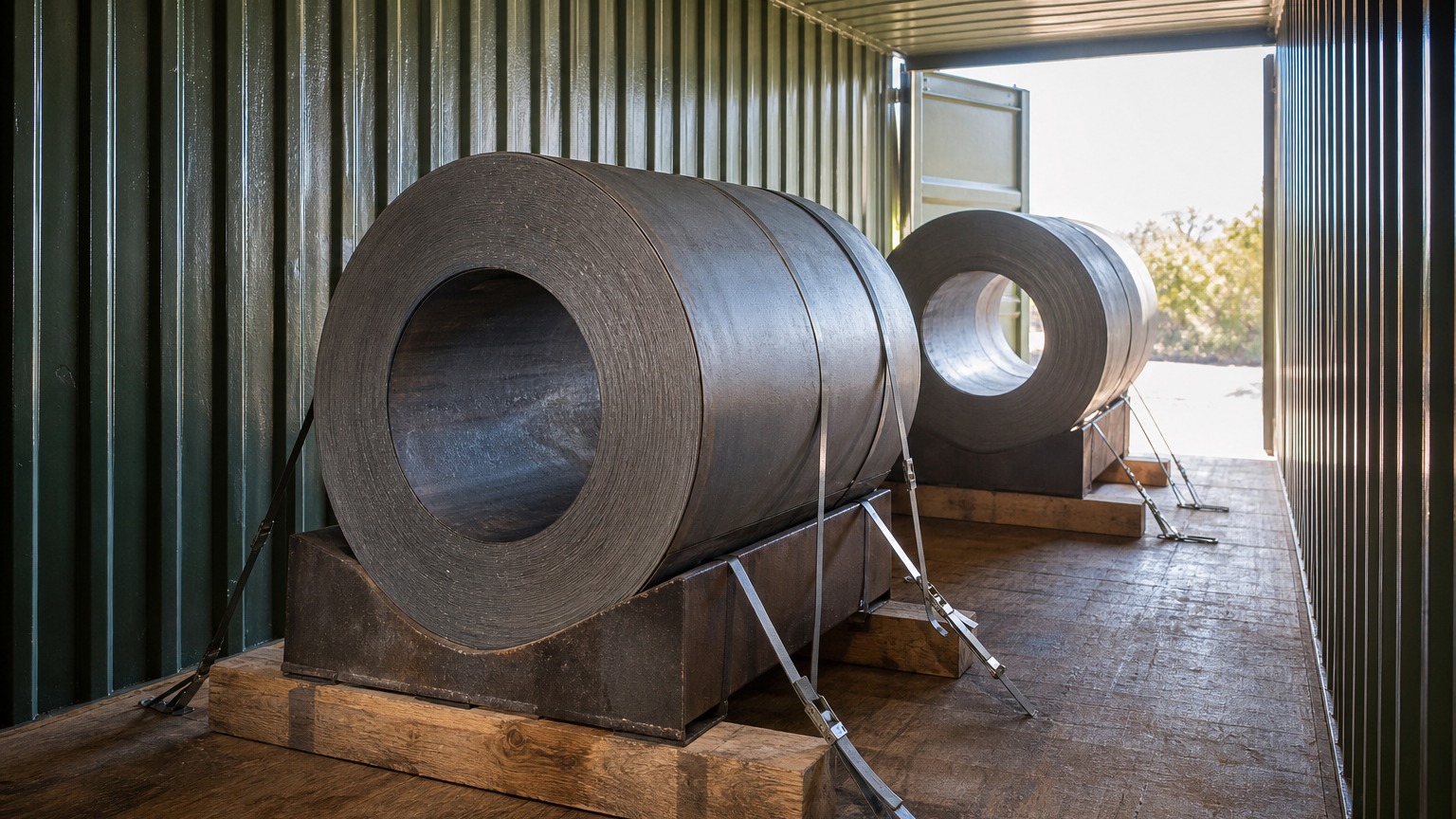
A 20 ft container is the standard unit for heavy coil cargo, and the practical limit is usually road weight rather than container volume: total cargo of roughly 25 to 28 tonnes per box is typical.
Because the limit is weight, not space, the coil plan is built around mass and eye position. Coils loaded eye-to-sky are banded onto saddles or laid on timber dunnage with the eye vertical, which concentrates load on the container floor and keeps the centre of gravity low; coils loaded eye-to-wall spread the same mass along the length and suit narrower strip. Either way the number of coils is decided by tonnage, and the reference on container capacity units is worth reading before assuming that a 40 ft box will carry twice the payload, because the heavier box carries little more cargo than the shorter one while consuming double the slot.
Matching coil diameter to the container door
Diameter sets what can physically enter the box. A coil of 1.5 m outer diameter clears a standard container door without trouble; a 1.8 m coil needs a cradle, a forklift with the right mast height, and usually a written loading plan, because the door opening is fixed and the coil only fits in one orientation. Coils above roughly two metres in diameter are normally shipped as break-bulk cargo on flat racks or in the hold, and the freight basis changes from per container to per tonne or per cubic metre. Checking the door dimension against the coil diameter before booking is a two-minute task that prevents a very expensive one.
Weight distribution and the truck leg
The inland leg is governed by axle load, not by container capacity. Heavy coils placed at one end of a container can overload a single axle even when the total tonnage is legal, which is why loading plans distribute coil mass along the floor and why a single dense coil may need to travel alone. For importers who take delivery at an inland warehouse, the practical sequence is to calculate total mass, confirm the carrier’s per-axle limit, and only then decide how many coils travel per truck. Where a shipment is split between seaborne and inland stages, the tighter of the two limits governs the whole plan.
How Do You Verify the Coil Weight You Were Charged For?
The calculation predicts the mass; only a calibrated scale proves it, and the moment to check is before the material is accepted.
Ask for the weighbridge ticket for each coil or bundle and compare it with the packing list and the mill certificate. A difference beyond the tolerance agreed in the purchase order is a commercial issue, not a rounding error.
Verification is a sequence rather than a single act. The mill test certificate carries the heat analysis, the mechanical properties and the dimensions the mill claims to have produced; the packing list translates those dimensions into a piece count and a total tonnage; the weighbridge ticket records what was actually loaded. Holding the three documents side by side shows immediately whether the shipment was invoiced on the basis the contract specified, and whether the total tonnage matches the tonnage the buyer has been asked to pay for.
Reading the discrepancy in the right direction
A coil that is heavier than nominal is not automatically good news. It increases freight and duty, it can push a container past a road limit, and if the order was priced on theoretical weight the extra mass may already have been paid for twice — once in the price and again in the logistics. A coil that is lighter than nominal is more commonly a yield problem: fewer metres of strip, fewer finished blanks, and a production plan that no longer covers the order. Both directions deserve a written position, and the cleanest position is a purchase order that names the governing basis, the acceptable band, and the remedy when the band is exceeded.
When to bring in third-party inspection
For first orders from a new supplier, or for shipments where the tonnage is large enough that a one per cent error matters, an independent inspection before loading is cheap relative to the value at stake. The inspector witnesses the weighing, records coil numbers against the certificate, and confirms the dimensions on the tag, which converts a post-arrival argument into a pre-shipment fact. Importers building a repeat programme can usually step down to documentary verification once three or four shipments have matched, then return to inspection if the pattern changes. If the weight of a future consignment needs to be estimated before it is rolled, the fastest route is to request a steel coil weight quotation with the target dimensions and let the mill confirm the coil weight band it can hold, because a supplier who answers that question precisely is usually the one whose packing list matches the scale.
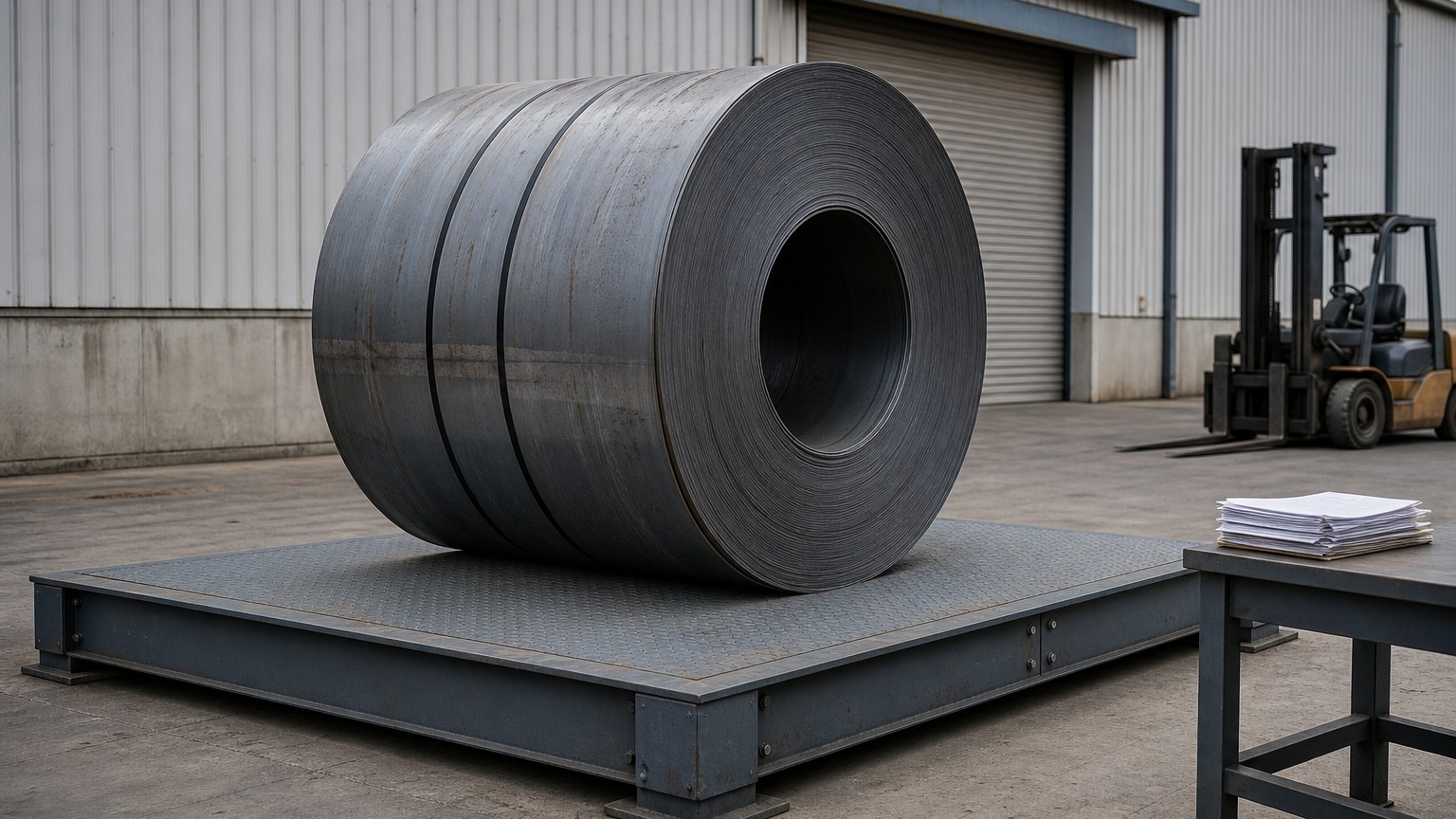
For buyers comparing coil products across the range, the wider steel product programme shows how the same discipline applies to plate, tube and pipe, where the geometry changes but the tolerance logic does not. The background on hot and cold rolling explains why thickness variation exists in the first place, and the steel industry facts published by worldsteel put the scale of global coil production into context.
Conclusion
Coil weight is arithmetic plus discipline: fix the units, confirm the density assumption, agree the tolerance in writing, and check the weighbridge ticket against the packing list.