
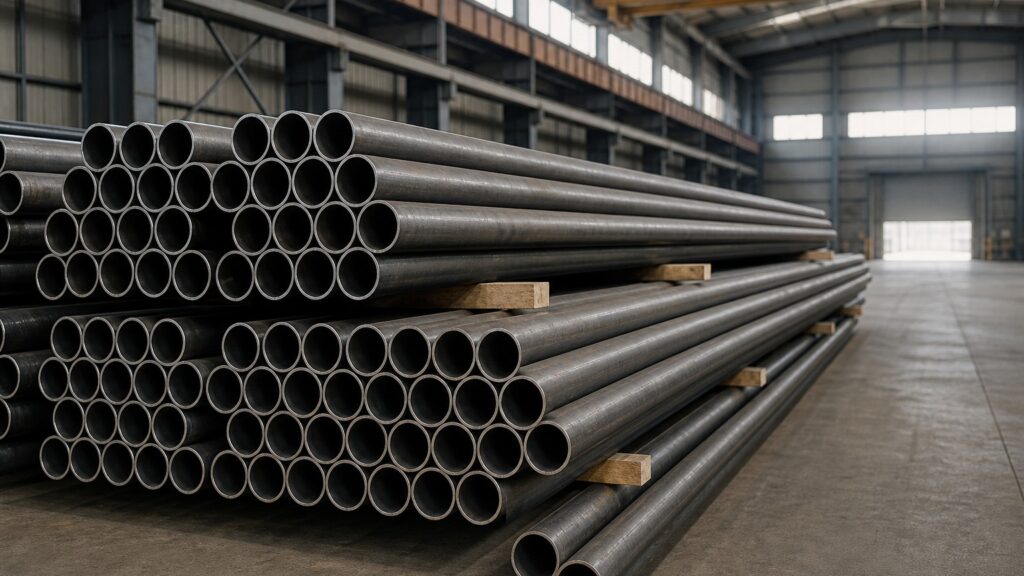
ERW vs Seamless Steel Pipe: Which One Belongs in Your Specification?
Two pipes, same nominal size and schedule, very different prices. Specify wrong and you either overpay the whole order, or accept a seam your service cannot tolerate.
ERW pipe is cold-formed from steel strip and joined along a longitudinal weld seam. Seamless pipe is pierced from a solid billet, so it has no seam. ERW costs less and holds tighter wall tolerance; seamless is chosen for high pressure, cyclic load and the strictest code services.
Transition: the two products are not interchangeable, and the choice is rarely settled by price alone. It is settled by the seam — what it is, how it was made, what inspection can prove about it, and whether your design code accepts it in place of a homogeneous wall. The sections below work through the manufacturing route, the strength comparison, the real cost structure, the application boundaries and the qualification tests, so that the next specification you write is defensible rather than inherited from someone else’s project.
What Is the Real Difference Between ERW and Seamless Steel Pipe?
The difference is not the grade, the size or the schedule — it is whether the pipe body contains a weld.
An ERW pipe is a welded pipe: steel strip is formed into a cylinder and the two edges are welded into one continuous longitudinal seam. A seamless pipe has no seam, because it is pierced and rolled from a solid billet. Everything else follows from that single difference.
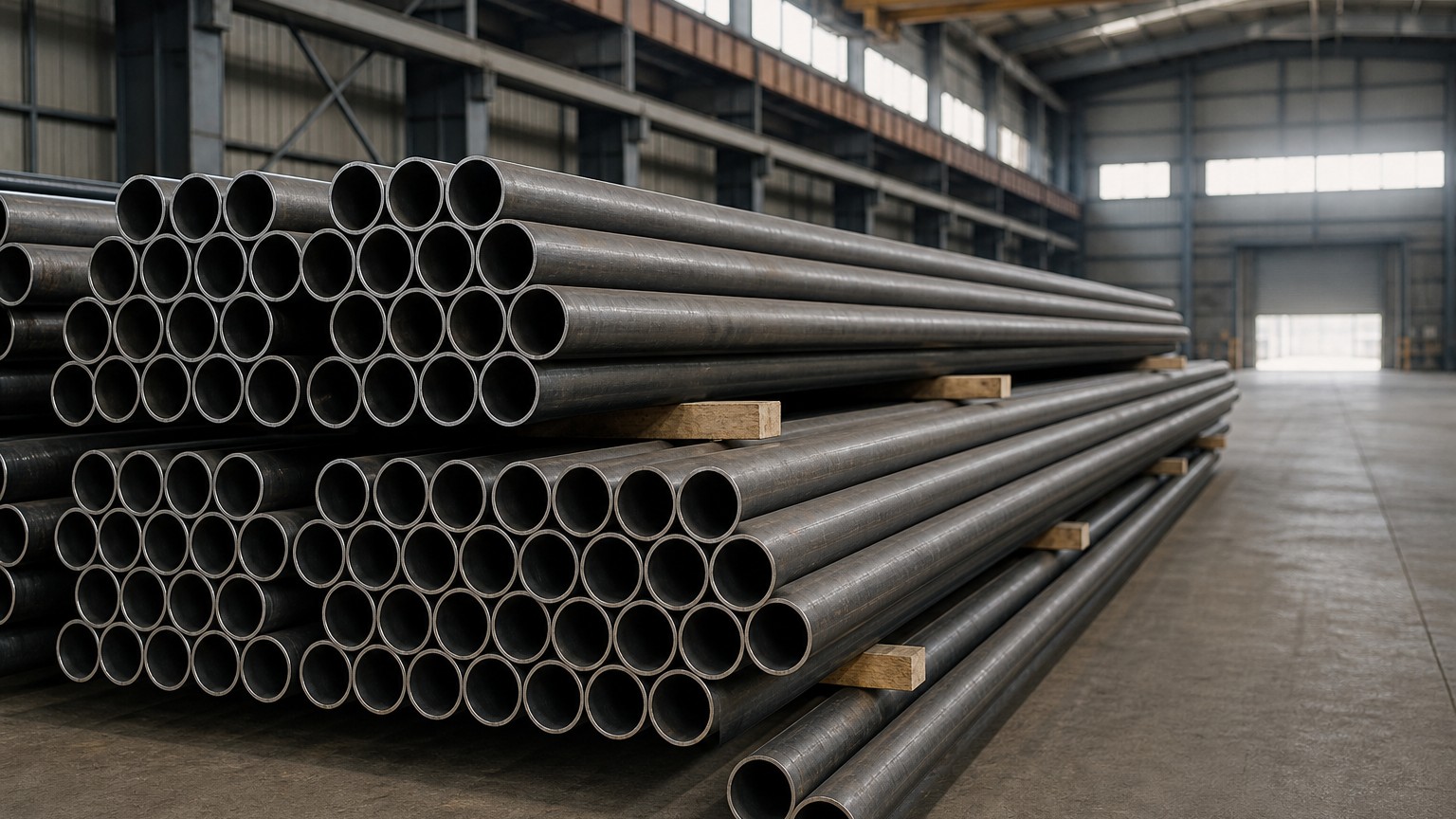
Where the seam changes the engineering
Seamless pipe is produced from a solid, so its wall is continuous in every direction, and that is the property buyers are really paying for. There is no weld metal, no heat-affected zone and no bond line, so there is no single plane in the wall where toughness, hardness or corrosion behaviour can differ from the parent metal. That uniformity is what allows a designer to treat the pipe as a homogeneous pressure boundary and to apply the stress analysis the code provides for exactly that assumption.
ERW pipe carries a longitudinal seam that must be treated as an engineered joint. In the modern high-frequency process the strip edges are heated to forging temperature by induced current and squeezed together, producing a forged bond with no filler metal — a real improvement on the obsolete low-frequency ERW, whose welds were found susceptible to selective seam corrosion, hook cracks and inadequate bonding in pipelines built before the 1970s. The seam is still a distinct region, and specifications respond to it: the weld is subject to its own examination requirements and, for line pipe, to supplementary tests that have no seamless equivalent.
There is also a geometric consequence that buyers notice long before metallurgy becomes relevant. Welded pipe is rolled from strip of accurately controlled thickness, so the wall is uniform and the outside diameter is round and consistent. Seamless pipe is formed by piercing and rolling, where wall eccentricity and diameter variation are inherent to the process, and the permitted tolerances in ASME B36.10M for welded and seamless wrought steel pipe and in the product specifications reflect that. Anyone comparing an electric resistance welding line with a pierced shell should expect the welded pipe to measure straighter, rounder and more evenly walled — and the seamless steel pipe to be metallurgically uniform instead.
How Are ERW and Seamless Pipe Actually Manufactured?
One route starts with a coil of strip; the other starts with a solid billet that has to be pierced.
ERW pipe is made by uncoiling strip, cold-forming it into a cylinder through forming rolls and welding the longitudinal seam with high-frequency induced current. Seamless pipe is made by heating a billet, piercing it with a rotary piercer, then elongating the hollow shell in a plug mill.
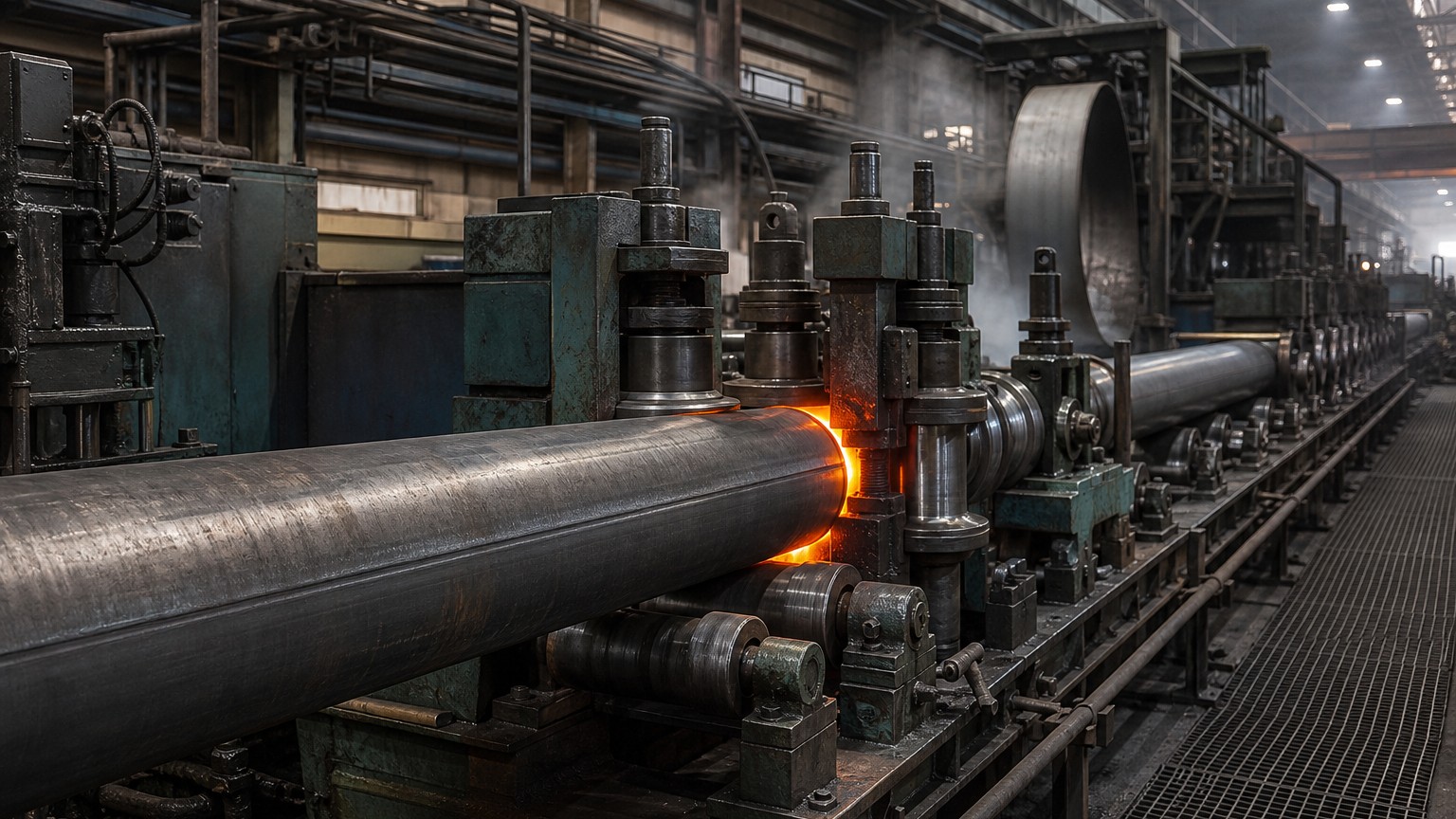
The ERW route: from strip to finished pipe
An ERW line begins with a hot-rolled coil, commonly an API 5L or ASTM-grade strip of accurately controlled thickness. The strip is uncoiled, levelled and trimmed to the width that determines the finished circumference, then cold-formed progressively — first into a U shape, then into an O shape — until the two edges meet. High-frequency current, typically in the hundreds of kilohertz, is induced into those edges and heats a narrow band to forging temperature in milliseconds. Squeeze rolls press the edges together, expelling a small bead of metal inside and outside the tube, and the bond forms without filler metal. The flash is scarfed off, the tube is sized and straightened, and it is cut to length.
Because strip width controls the diameter and coil thickness controls the wall, the process is dimensionally repeatable and efficient at long lengths. The control points are all at the seam: strip edge condition, current frequency, weld speed, squeeze force and impeder position. Get them right and the weld can outperform the parent metal in a flattening or tensile test. Get them wrong — a cold weld from insufficient heat, or a black oxide line from excess — and the defect is precisely the kind a hydrostatic test may not reveal. That is why ERW qualification puts seam examination, not the pressure test, at the centre.
The seamless route: from billet to hollow shell
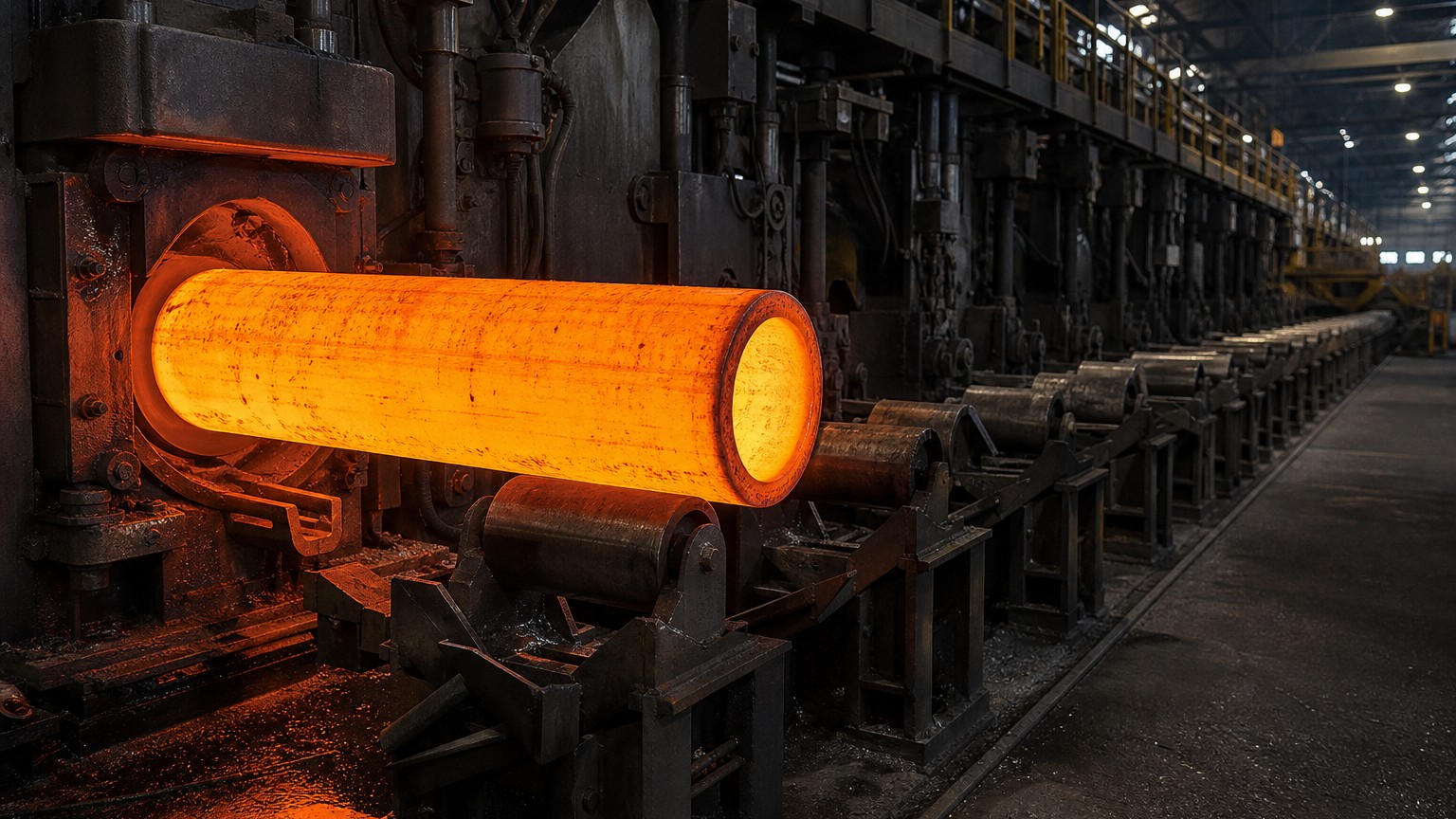
A seamless mill starts with a round billet that is cut to weight, heated in a rotary hearth furnace and then pierced. In the classic Mannesmann process, two barrel-shaped rolls rotate the billet while a plug on a mandrel is forced through the centre; the secondary tensile stresses at the core open a cavity that the plug shapes into a thick-walled hollow. That shell is then elongated over a mandrel or in a plug mill — Assel, Diescher and three-roll elongators are common variants — to reduce the wall and extend the length. Finishing passes on a sizing or stretch-reducing mill bring outside diameter and wall into tolerance, after which the pipe is cooled, straightened, cut and tested.
The consequence of that route is geometric rather than metallurgical. A pierced shell tends toward wall eccentricity, because the plug is not perfectly centred in every billet, and toward a wall variation that follows the helical path of the rolls. Modern mills hold both within the tolerance the product standard permits, but the tolerance band itself is wider than the one that applies to welded pipe. For a specification engineer the practical rule is simple: seamless buys metallurgical uniformity and pays for it in dimensional scatter.
Is Seamless Pipe Stronger Than ERW Pipe?
Pressure rating is often assumed to follow the name of the process. It does not.
Not automatically. Both are sized by the same design equations, and a welded pipe whose seam has been examined to the code requirement can carry the same design pressure as a seamless pipe of equal grade and wall. Seamless is preferred where additional seam restrictions cannot be met economically.
Design pressure is governed by the wall, not by the process
For a given grade and wall thickness, internal pressure design comes from the same equation: pressure equals two times the specified minimum yield strength, times wall thickness, times a design factor, divided by outside diameter. Nothing in that equation refers to how the pipe was made. What changes for welded pipe is the presence of a longitudinal joint factor and, in many piping codes, extra requirements on weld quality.
Where a code imposes a joint factor below 1.0 for pipe whose seam is unexamined or not radiographically verified, the welded pipe loses design pressure not because the steel is weaker but because the joint is treated as unproven risk. Demonstrate the seam examination the code accepts — ultrasonic or radiographic examination of the weld, plus the flattening, bend or tensile tests the product standard names — and the factor returns to 1.0. That mechanism is exactly what allows high-frequency welded line pipe to serve high-pressure gas transmission. Our API 5L X42 ERW line pipe in 8 inch PSL1 is supplied and certified on that basis, with the seam tested rather than assumed. The general requirements are written into ASTM A53/A53M for pipe, steel, black and hot-dipped, zinc-coated, which is the specification most buyers meet first.
Where the two processes genuinely differ in mechanical behaviour
Three differences deserve to be written into a specification rather than left to the supplier. First, wall uniformity: a seamless pipe can carry an eccentric wall, and it is the minimum wall rather than the average that the design calculation uses, so a pipe bought on average wall may be quietly derated. ERW pipe from strip holds wall more evenly and is rounder outside. Second, residual stress: cold forming followed by welding leaves a different stress pattern from hot piercing, which changes how the pipe behaves when it is cut, bent or welded into a spool, and how much it springs when a flange is fitted. Third, the seam itself. Toughness, hardness and corrosion resistance at the weld and in its heat-affected zone must be demonstrated by test, and for sour service or low-temperature service the purchaser will often specify a hardness ceiling across the seam. A seamless pipe has no equivalent location to test — which is an advantage, but only where the service actually demands it. Established guidance for comparing the two routes is collected in our seamless vs welded pipe reference.
What Drives the Price Gap Between ERW and Seamless Pipe?
Cheaper is not the same as adequate, and expensive is not the same as necessary.
ERW is usually cheaper because it consumes hot-rolled coil and needs less energy per tonne. The gap widens at small diameters and light walls, and narrows on large heavy-wall transmission pipe, where availability often decides the order.
Why the welded route costs less
The cost gap has three sources, and only one of them is the welding step itself. The first is the raw material form: ERW consumes hot-rolled coil, produced in very large tonnages and the cheapest common steel form, while seamless consumes billets that cost more per tonne and must be reheated before piercing. The second is energy and yield: piercing, elongating and sizing consume far more energy per tonne than forming and welding, and each pierced billet surrenders process scrap at the ends. The third is the shape of the size range. ERW equipment scales down to small diameters and light walls efficiently, whereas a seamless mill has a cost-effective window and becomes less competitive at very small sizes and light walls.
The commercial consequence is that the price difference is not a constant percentage. On a 2 inch schedule 40 line it can be substantial. On a 20 inch heavy-wall pipeline the two numbers converge, and the deciding factor becomes mill availability, delivery time and whether the specification permits a welded seam at all. Buyers who quote a fixed percentage saving across a whole programme usually discover this on the largest line items, which is the worst possible place to find it.
| Feature | ERW pipe | Seamless pipe |
|---|---|---|
| Manufacturing route | Cold-formed strip, high-frequency welded seam | Pierced and rolled from a solid billet |
| Longitudinal weld | One continuous seam | None |
| Wall thickness tolerance | Tighter, derives from strip | Wider, inherently process-related |
| Outside diameter roundness | Consistently good | More variation |
| Size and wall range | Small to medium sizes, long lengths | Small to large, heavy walls |
| Common specifications | API 5L, ASTM A53, ASTM A106 | API 5L, ASTM A106, ASTM A335 |
| Relative cost | Lower at small sizes and light walls | Higher per tonne |
| Preferred service | Line pipe, structural, water, general spools | High pressure, cyclic, high temperature, sour |
Reading the price against the specification, not against habit
A price only becomes meaningful when it is read against the clause that governs the seam. Two suppliers can quote the same size and schedule at different prices simply because one has included seam ultrasonic examination and the other has not; the cheaper number is not a cheaper pipe, it is a different set of tests. Before comparing quotations, fix four variables in writing: the product specification and edition, the grade and PSL level, the wall thickness basis (minimum or average), and the seam examination and test regime. Then compare. Our note on PSL1 and PSL2 requirement differences explains how much of the test and certification scope — and therefore the price — is decided by the PSL level alone.
Which Applications Suit ERW Pipe, and Which Require Seamless?
Most wrong decisions here are made by applying a habit from one product line to another.
ERW suits line pipe, water mains, structural and general-purpose spools, and any service where the seam can be examined and the pressure is moderate. Seamless is preferred for high pressure, cyclic and high-temperature service, sour service, and small-diameter high-integrity work.
Where the welded route is the better engineering answer
ERW pipe dominates long-distance transmission because the economics and the mechanics align. It can be produced in long lengths and in the wall thicknesses mainlines require, it holds a round and consistent outside diameter, which simplifies field welding and automatic ultrasonic inspection of the girth welds, and its seam can be examined at the mill by a technique that is now mature. In structural and piling work, water and slurry lines, agricultural and general mechanical service, the seam requirement is generally satisfied by a pressure test plus a dimensional and visual check, and the welded route wins outright on cost and availability. Long lengths also matter more than buyers expect, because fewer girth welds means fewer field inspection hours on site.
Where a project is priced per metre and moves large volumes of water, air or non-hazardous fluid, an ERW pipe in the appropriate standard is usually the defensible specification, provided the seam tests are stated. Where the line crosses a pipeline transport corridor with high consequence of failure, the same pipe is still acceptable — but the specification must say so explicitly, with the examination level and the acceptance criteria named.
Where seamless earns its premium
Seamless is the right answer when the pipe becomes a pressure vessel. High-pressure steam and boiler service, hydraulic systems, high-temperature process lines, and any application where the design code demands a joint factor of 1.0 with no weld, push the decision firmly toward seamless. Sour service, where hydrogen sulphide raises the risk of sulphide stress cracking, is a special case: hardness control across the weld and its heat-affected zone becomes critical, and a buyer may either specify seamless to remove the seam entirely or specify a welded pipe with a qualified seam and a certified hardness survey. Both routes exist; the wrong choice is to leave the question unstated.
Small-diameter and thin-wall service also favours seamless for a practical reason, because the ratio of seam length to wall thickness rises as the pipe gets smaller, and seam examination becomes proportionally harder to perform and to interpret. Cyclic service — pressure that swings many times a day — is the third clear case, since fatigue performance depends on surface and internal geometry, and a scarfed internal weld bead is not geometrically identical to a smooth pierced wall. The general preference across the industry, and the one worth writing into a datasheet, is that ERW is selected by economic and dimensional arguments and seamless by integrity arguments that the code will not let you argue away.
How Do You Qualify and Inspect ERW and Seamless Pipe Before Shipping?
Whoever inspects pays least, and the cheapest inspection is the one done before the container closes.
Qualify ERW pipe with seam ultrasonic or radiographic examination, a flattening or bend test and hardness checks as specified, plus dimensional and visual inspection. Qualify seamless pipe with wall thickness survey, dimensional check and the hydrostatic or non-destructive examination your specification requires.
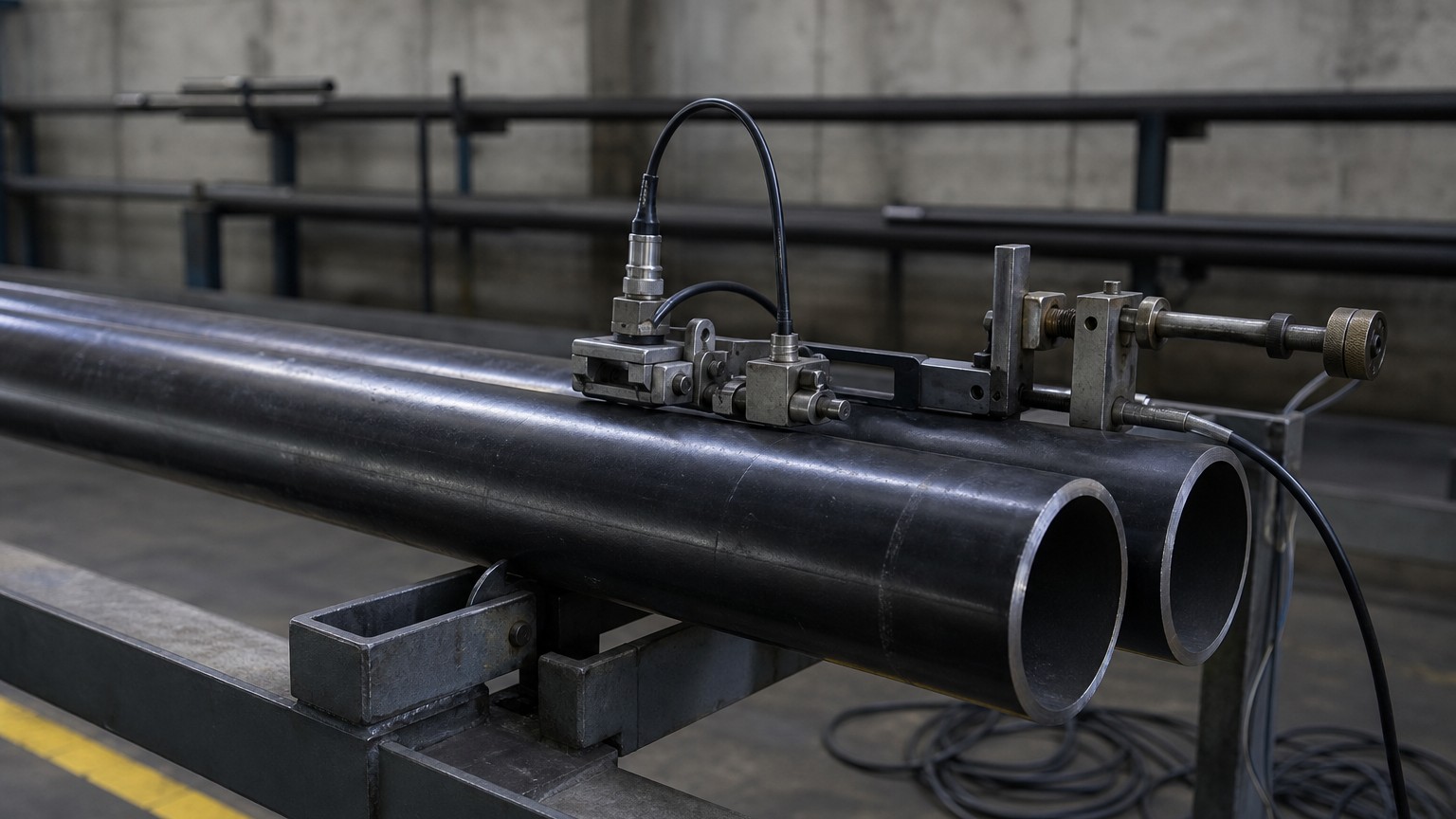
The tests that actually qualify the seam
For welded pipe the examination regime is the product, in the sense that the pipe is only as good as the evidence about its seam. Ultrasonic examination of the longitudinal weld detects lack of fusion, cold weld and hook cracks, and it is the fastest inline method available at mill speeds. Radiographic examination is used where the specification calls for it or where a dispute needs a second method, and it images the seam rather than the bond quality. Destructive sampling supports both: a flattening test flattens a ring from the pipe end until the walls touch, and a sound weld survives without opening; a guided bend test loads the seam in tension; a tensile test across the weld compares weld strength with the parent metal. Hardness traverses across the weld, the heat-affected zone and the parent metal are called for wherever sour or low-temperature service is involved.
For seamless pipe the absence of a seam shifts the inspection burden to the wall itself. A wall thickness survey around the circumference and along the length quantifies exactly the eccentricity the piercing process introduces, and it protects the design calculation directly, because the minimum wall is what the equation uses. Non-destructive examination of the body — ultrasonic for internal laminations and inclusions, electromagnetic for surface defects — is specified by the application standard rather than by the pipe standard, so a buyer who needs it must write it in. Hydrostatic testing applies to both routes, and it is worth being precise about what it proves: it demonstrates that the pipe contains pressure without leaking at the test pressure, and it does not detect a cold weld that holds at test pressure but fails in service.
Documents, marking and loading checkpoints
Two documentation habits prevent most disputes. First, require the heat or coil number to be transferred to each length or bundle, so that certificates can be matched to material rather than to a delivery note. Second, require the mill test certificate to state the standard, edition, grade, PSL level, wall thickness and heat treatment condition, and treat anything less as incomplete. Where the order value justifies it, name a third-party inspector and witness the seam examination and the dimensional check at the works, because that is the moment when a repeat test is still cheap.
Before loading, confirm four physical facts and photograph them: piece count and length against the packing list, wall thickness at the sampled positions, marking visibility on stored material, and protection. Pipe ends are the expensive surfaces, so bevel condition, end caps and internal cleanliness deserve a picture each; for welded pipe, ask for the seam position to be recorded in the loading images so that a later claim can be located rather than argued. If you want the examination level, the test scope, the wall basis and the packing agreed before anything is manufactured, send your pipe specification to our export team and we will come back with a document set that matches the service you described. Most projects do not need the most expensive pipe; they need the one whose evidence is complete.
Conclusion: How Do You Choose Between ERW and Seamless Pipe?
Choose ERW where economics, long lengths and dimensional consistency decide and the seam can be examined. Choose seamless where pressure, temperature, cyclic load or sour service demand an unbroken wall.