
ERW Pipe Manufacturing: How Does HFI Welding Produce a Reliable Seam?
Hydrostatic testing passes, then a seam fails in service. That risk is decided during ERW pipe manufacturing — long before the pipe reaches your site.
ERW pipe manufacturing cold-forms steel strip into a cylinder and forges the longitudinal edges together with high-frequency induction (HFI) current — no filler metal. Quality control depends on weld-station variables, inline seam examination, and destructive and hydrostatic tests on the finished pipe.
Transition: this guide follows the process in the order the mill runs it — forming and edge preparation, the HFI heating and forging cycle, the variables that separate a sound weld from a cold one, the examination and test regime that proves the seam, the standards that define it, and the applications where welded pipe is the right specification. If you buy, specify or inspect line pipe, the two sections that decide your order are the ones on process variables and on seam examination.
What Is ERW Pipe Manufacturing and Why Does the Welding Method Matter?
ERW is not one process but a family, and the current frequency used to heat the edges decides which one you get.
ERW pipe manufacturing forms a cylindrical shell from steel strip and welds the longitudinal seam with electric resistance. High-frequency induction (HFI) heating, in use since the 1970s, produces a forged bond without filler metal and replaced the low-frequency process whose welds proved prone to seam corrosion and hook cracks.
Why the frequency change altered the product
The original electric resistance welding of pipe heated the abutting strip edges with low-frequency alternating current. That approach worked, and it built a large part of the world’s pipeline network, but it heated a comparatively wide band of metal around the joint. The consequence showed up decades later: low-frequency ERW welds were found to be susceptible to selective seam corrosion, hook cracks and inadequate bonding, and the process was phased out during the 1970s. That history is worth knowing as a buyer, because pipe made by the obsolete process is still in service and appears occasionally on the secondary market.
High-frequency welding solved the metallurgical problem by concentrating the current. At frequencies in the hundreds of kilohertz, the current is confined close to the strip edges by the skin and proximity effects, so the heated zone becomes narrow and the temperature gradient across the bond line steep. A narrow heat-affected zone means less grain growth, less decarburisation and less opportunity for the oxide inclusions that make a seam weak. The bond is formed by forging rather than by melting, which is why the process needs no filler metal, no flux and no shielding gas — and why a properly made HFI weld can meet the mechanical property requirements of the parent strip rather than sitting below them.
What ERW is, and what it is not
It is worth being precise about the family. ERW covers both contact and induction variants of high-frequency welding, and it produces a pipe with one continuous longitudinal seam. It does not produce a seamless product, and no amount of process improvement changes that: a pierced shell has no weld, no heat-affected zone and no bond line, which is the property that matters in the most demanding services. The practical comparison between the two routes — dimensional consistency, cost structure, code treatment and application boundaries — is set out in our reference on ERW pipe manufacturing compared with the seamless route, and it is the right starting point if you are still deciding which product your project needs.
What ERW does offer is a repeatable, high-volume route from low-cost coil to a dimensionally accurate pipe. Because the wall thickness comes from the strip and the diameter from the strip width, welded pipe tends to hold a uniform wall and a round outside diameter, which simplifies field welding and automatic ultrasonic inspection of girth welds downstream. Those are commercial and dimensional advantages, not metallurgical ones, and they are the reason HFI-welded pipe dominates long-distance transmission service rather than merely serving as the cheap alternative.
How Does the HFI Welding Process Work Step by Step?
The mill does not weld a pipe; it welds two moving edges in under a second, and every step exists to make that second repeatable.
Steel strip is uncoiled, levelled, trimmed and progressively cold-formed into a cylinder until the edges meet. High-frequency current heats the edges to forging temperature, squeeze rolls press them together to form a solid-state bond, and the internal and external flash is scarfed off before sizing, straightening, cutting and testing.
From coil to formed tube
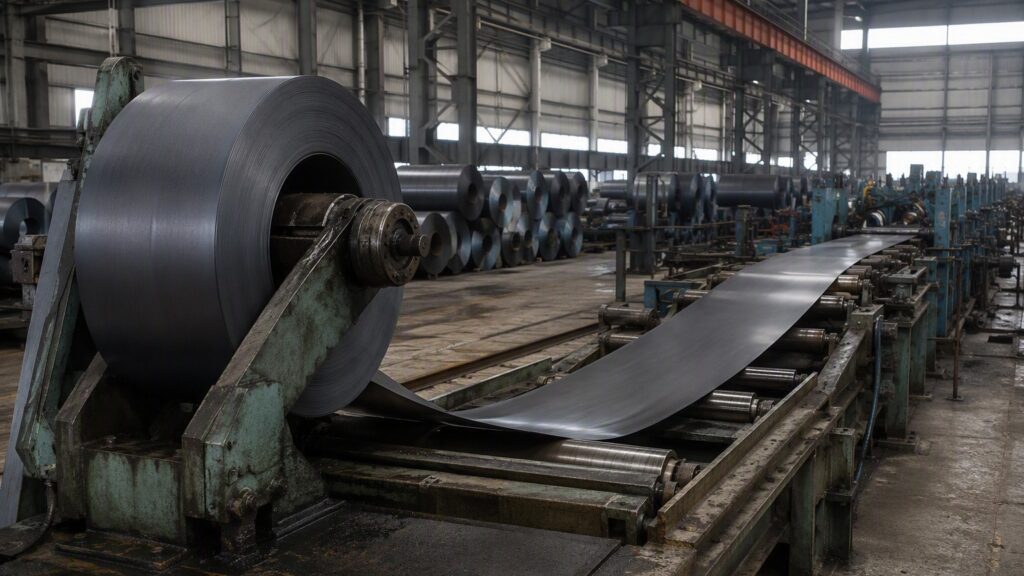
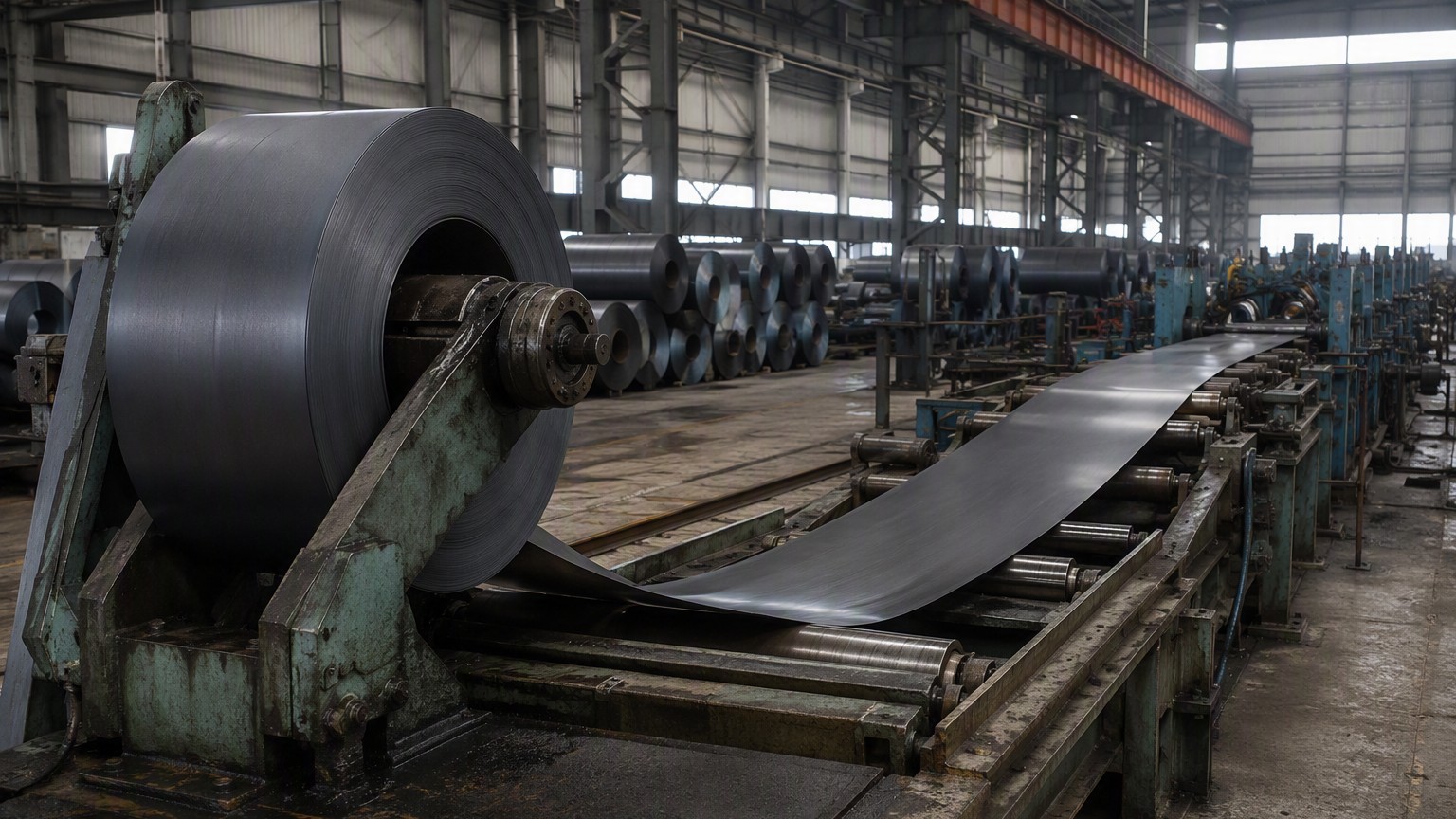
The line begins at the uncoiler with a hot-rolled coil whose thickness determines the finished wall and whose width determines the finished circumference. That relationship is the first quality control point in the whole process, because strip thickness variation becomes wall thickness variation directly, and strip width variation becomes diameter variation. The strip passes through a leveller to remove coil set, is trimmed and sometimes edge-milled or scarfed to present a clean, square edge, and then enters the forming section. Forming rolls bend it progressively — typically through a U shape and then an O shape — until the two edges come together at the weld station with the correct amount of interference. Poor edge alignment here cannot be corrected later: if the edges meet offset or at an angle, the current distribution becomes asymmetric and the weld is compromised before the first ampere is applied.
Heating, forging and the squeeze rolls
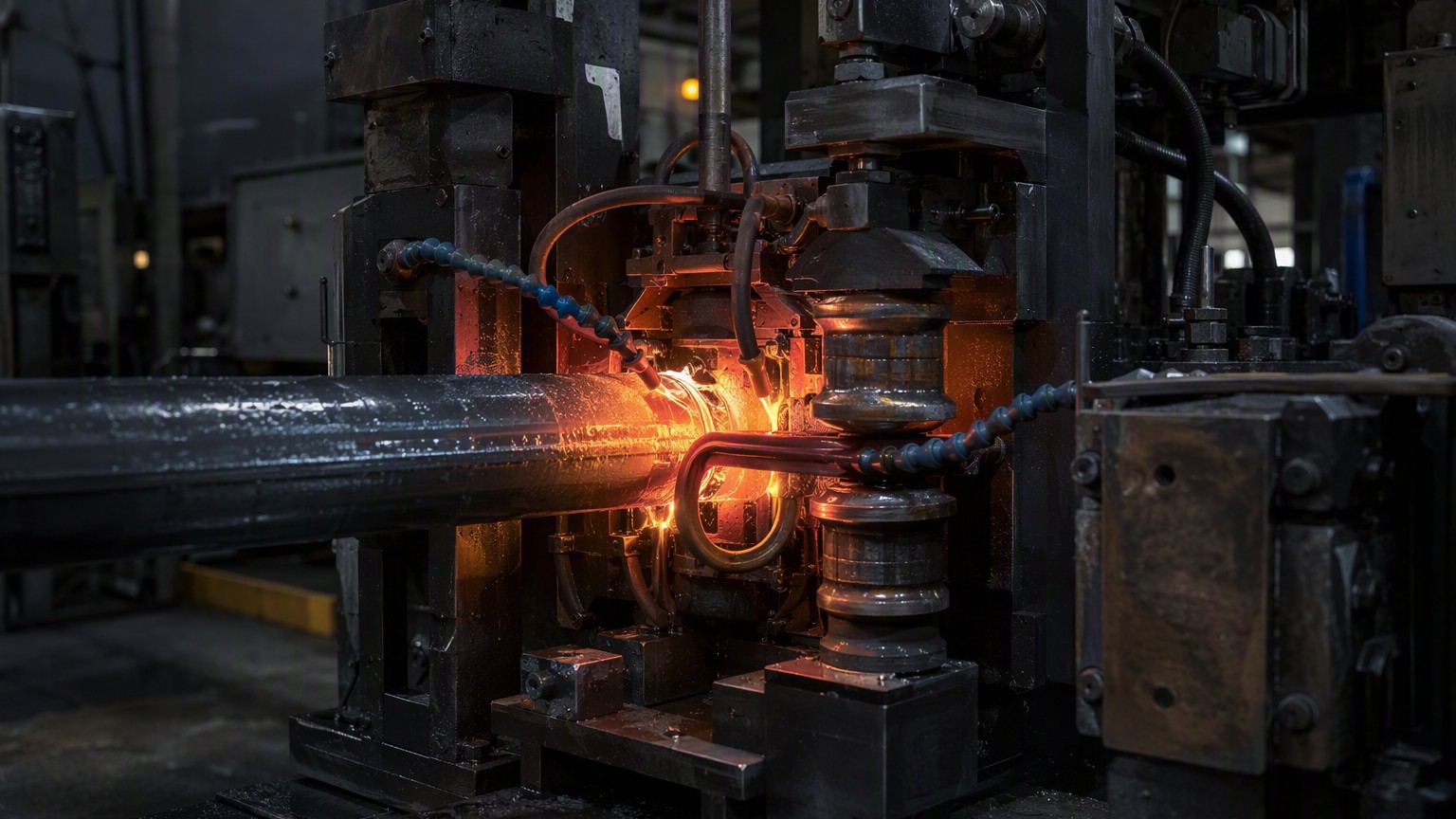
At the weld station the strip edges are brought into a V-shaped convergence. An induction coil or a pair of sliding contacts injects high-frequency current into the edge region, heating a narrow band to forging temperature in milliseconds — the mechanism described in general references on high-frequency electric resistance welding. The heated edges are then squeezed together by the weld rolls: the combination of temperature and upset pressure produces a solid-state forged bond in which the two edge faces fuse without passing through a bulk molten stage. A small bead of metal, the flash, is expelled on both the outside and the inside of the tube. An impeder — a ferrite core placed inside the tube at the weld point — concentrates the current in the edges and prevents it from straying around the inside surface, and its position and condition are among the most common causes of a badly made seam.
The visible signature of a correct weld is the scarfed surface itself. After forging, the external and internal flash is removed by scarfing tools, and what remains should be a smooth, slightly raised weld line with no visible oxide line and no steps at the toe of the seam. A dark, sharply defined line running along the weld is the classic “black line” appearance associated with an oxidised, poorly bonded joint, and it is the first thing an experienced inspector looks for on the inside surface.
Sizing, straightening and post-weld treatment
Downstream of the weld station the tube passes through a sizing mill that brings outside diameter and roundness into tolerance, a straightener that removes the forming bow, and a cut-off that produces the ordered lengths. Where the specification requires it, the weld can be normalised or otherwise heat-treated to refine the coarse grains that high-temperature welding leaves in the bond zone, which improves toughness at the seam — particularly relevant for low-temperature service. The finished pipe then goes to the testing stations, and this is where the buyer’s evidence is generated.
Which Process Variables Decide Whether the Seam Is Sound?
A sound weld and a cold weld look identical on the outside of the pipe, and the difference is usually one variable moving out of its window.
Four variables decide the result: current frequency and power, weld speed, squeeze or upset force, and edge geometry and alignment. Add the impeder position and the cleanliness of the strip edges, and those six factors account for the overwhelming majority of seam defects found in ERW pipe.
Frequency, power and weld speed
The frequency sets how narrow the heated band becomes, and the power and speed together set how much energy each millimetre of edge receives. Run the line faster without increasing power and the edges do not reach forging temperature before the squeeze rolls close: the result is a cold weld, a bond that may pass a hydrostatic test and still separate under bending or in service. Run it slower without reducing power, or raise the power without matching speed, and the edges overheat — burning, oxide formation and a coarse grain structure follow.
The window is therefore a relationship rather than a setting. Strip thickness changes the mass of metal that must be heated, so a change of wall thickness requires the power and speed to be rebalanced; the same is true when the grade changes, because higher-strength micro-alloyed steels conduct heat differently and lose toughness in the bond zone more readily. A mill that runs a mixed schedule without re-establishing the weld parameters between coils is producing variable quality even if every individual setting conforms to its own recipe.
Impeders and edge alignment
The impeder is the least glamorous and most consequential component at the weld station. Placed inside the tube immediately below the weld point, it increases the impedance of the current path around the inside of the pipe and forces the current to concentrate in the edges. If it is worn, saturated, positioned too far from the weld point or damaged, current leaks into the body of the tube: heating becomes diffuse, the edges do not reach forging temperature and a cold weld is produced while the mill still looks healthy from the operator’s panel. Impeder condition is therefore a normal part of pre-shift checks in a well-run mill, and a buyer auditing a supplier is entitled to ask how it is monitored.
Edge alignment is the second silent variable. The strip edges must meet with the correct amount of interference, squarely, with no offset and no twist. A small vertical offset produces an asymmetric current distribution and a weld whose bonding is incomplete along part of the section; an angular mismatch concentrates pressure at the outer surface. Both defects are hard to detect from outside and are precisely what inline ultrasonic examination is designed to find. Modest strip camber, poor slitting quality or worn forming rolls are the usual root causes, which is why strip quality control belongs in the weld quality discussion rather than in procurement alone.
Strip quality, edge condition and discipline
Finally, the weld inherits everything about the strip. Rust, oil, scale or a ragged slit edge produce inclusions and discontinuities in the bond; inconsistent chemistry produces inconsistent hardness across the seam; variations in yield strength between coils change how the formed edges behave under the squeeze rolls. A specification that names the grade and the standard but says nothing about edge condition, strip tolerance or coil-to-coil consistency leaves the most influential variables uncontrolled.
The practical conclusion for buyers is that ERW pipe quality is a process-capability question, not a document question. Two suppliers can both certify the same grade to the same edition of the same standard and produce materially different pipe, because the standard defines acceptance limits rather than the discipline needed to stay inside them. That is why the audit question worth asking is not “which standard do you work to” but “how do you control the weld window, the impeder and the edge condition, and what evidence can you show me from the last month of production”.
How Is ERW Pipe Quality Controlled During and After Production?
Inspection is not a final gate on ERW pipe; it is a continuous process, and the strongest evidence is generated while the pipe is still moving.
Control works in three layers: inline non-destructive examination of the full weld length, destructive tests on sampled pipe — flattening, bend, tensile and hardness — and the hydrostatic and dimensional checks that close out every length before shipment.
Inline examination of the seam
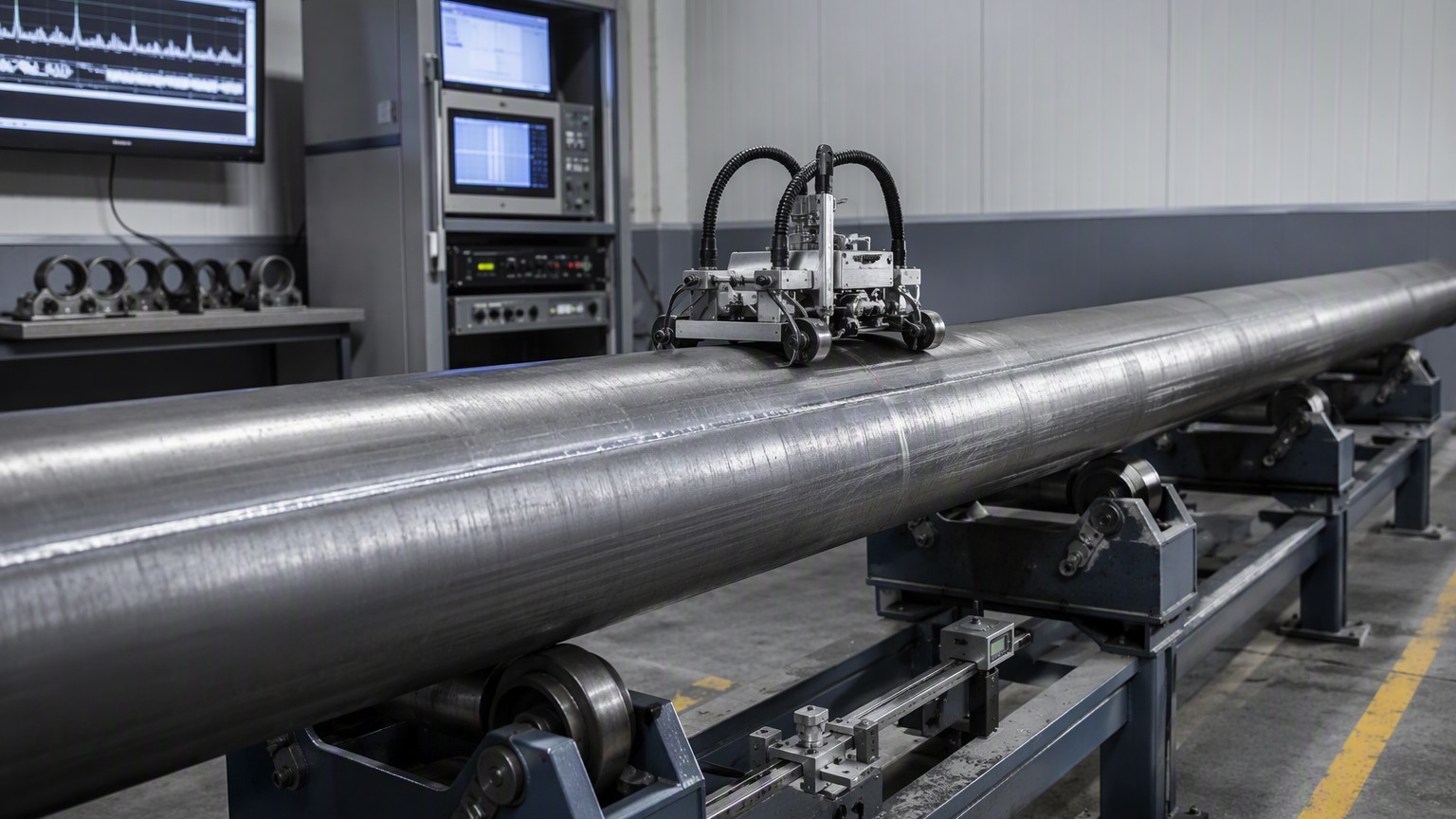
The most valuable examination of an ERW pipe is performed at line speed, immediately behind the weld station or at the end of the line, on the full length of every pipe. Ultrasonic techniques — historically single-probe, increasingly phased-array or rotating-probe configurations — are used to detect lack of fusion, cold weld, hook cracks and the oxide or inclusion lines that indicate incomplete bonding. The key word is full length: a sampling regime that examines one pipe in twenty leaves the rest of the order unverified, and the defects that matter most in ERW pipe are not reliably detectable by a pressure test.
The technique itself is standard non-destructive practice, described in general references on ultrasonic testing of welds. Electromagnetic and eddy-current methods appear in some specifications alongside ultrasonic examination, and radiographic examination is occasionally called for where a dispute or a project requirement demands a second, imaging-based technique. What matters commercially is that the examination method, its coverage, its acceptance criteria and the record it leaves behind are all stated in the purchase order. “Non-destructive testing to the standard” is not a sufficient instruction when the standard offers a menu; the menu is where the cost and the risk both sit.
Destructive tests on the sampled pipe
Destructive testing exists to prove that the bond has the properties the standard requires, and its value is that it loads the seam directly. The flattening test presses a ring cut from the pipe end until the opposing walls touch: a sound weld survives without opening, while a cold weld typically fails by cracking along the bond line. The guided bend test loads the seam in tension around a former, exposing lack of fusion that pressure testing would not reveal. A transverse tensile test compares the strength of the weld with that of the parent metal, and where sour or low-temperature service is involved, hardness traverses across the weld, the heat-affected zone and the parent metal demonstrate that the seam will not become the cracking site in service.
Hydrostatic testing, dimensions and documentation
Hydrostatic testing is mandatory under the common product specifications and demonstrates that each length contains pressure without leaking at the specified test pressure and hold time. It is a proof of containment, not of bond quality, and buyers should treat it as the floor of the evidence rather than the ceiling. Around it sit the dimensional and visual checks that decide whether the pipe will behave predictably in the field: outside diameter and ovality, wall thickness at defined positions, length, straightness, bevel geometry and end squareness, and the condition of the internal and external scarf.
Documentation ties the whole chain together. The mill test certificate should state the standard and edition, the grade and, for line pipe, the product specification level, together with chemistry, tensile results, impact values where applicable and the hydrostatic test pressure and duration. Each length or bundle should carry a heat or coil number that can be traced to the certificate, and any supplementary requirement the project invoked should appear as a result rather than as a promise. Where the order value justifies it, witnessing the seam examination and the dimensional check at the works is the cheapest insurance available, because that is the moment when a repeat test costs nothing but an hour.
Which Standards Govern ERW Pipe Manufacturing and Testing?
Standards do not make pipe good; they define what has to be proved, and the level you buy is where the cost difference lives.
Line pipe is usually ordered under API 5L, which sets two product specification levels: PSL 1 as the baseline and PSL 2 with mandatory impact testing, tighter chemistry and fuller non-destructive examination. General and mechanical welded pipe is commonly supplied to ASTM A53, whose Type E designation covers electric-resistance-welded product.
API 5L and the two product specification levels
API Specification 5L governs line pipe for pipeline transportation systems, and its two-level structure — introduced to bundle the requirements of critical transmission service into one auditable package — is the single most important commercial distinction in the specification. Under PSL 1 the purchaser receives a pipe that meets the baseline chemistry, tensile and hydrostatic requirements. Under PSL 2 the mill must additionally demonstrate impact toughness at a stated test temperature, hold carbon equivalent within a limit that keeps field welding predictable, cap the yield strength so that a joint designed for one grade is not quietly delivered at a stronger one, and apply tighter acceptance criteria across full-length non-destructive examination of the weld.
For an ERW pipe order the practical consequence is that PSL 2 is what turns the seam from an assertion into a tested feature. It is also where most of the price difference between two apparently identical quotations originates, because impact testing consumes material, tighter chemistry reduces mill yield, and full-length weld examination slows the line. Our note on PSL1 and PSL2 testing requirements works through that cost structure clause by clause. The background to the current edition, including its treatment of hardness testing and pipe end requirements, is published by the American Petroleum Institute.
ASTM A53, ASTM A106 and the general-purpose specifications
Where pipe is required for mechanical, structural or general pressure service rather than transmission, the specification framework changes but the seam logic does not. ASTM A53/A53M covers black and hot-dipped galvanised steel pipe in three manufacturing types: Type F (furnace-butt-welded), Type E (electric-resistance-welded) and Type S (seamless), in Grades A and B. That single specification intentionally groups the welded and seamless routes, which is a useful reminder that the standard does not rank them — it defines the tests each must pass. A53 requires a hydrostatic test without leakage through either the weld seam or the pipe body, plus a non-destructive electric test of the full pipe volume, and it adds tension, bend and flattening tests to demonstrate mechanical conformity. ASTM A106 applies the same seamless high-temperature service logic in carbon steel, and the dimensional conventions for all of these products are collected in ASME B36.10M, which standardises outside diameters and wall thicknesses for welded and seamless wrought steel pipe alike.
What the pressure design equation does and does not say
Internal pressure design for a pipe under the common codes is derived from an equation in which design pressure is proportional to twice the specified minimum yield strength multiplied by the nominal wall thickness and a design factor, divided by the outside diameter. Nothing in that expression refers to how the pipe was manufactured. What the codes add for welded pipe is a longitudinal joint factor, below unity where the seam has not been examined to the level the code accepts — a mechanism that prices the seam as unproven risk rather than treating welded steel as inherently weaker. Demonstrate the examination the code requires and the factor returns to 1.0, which is exactly how high-frequency welded line pipe serves high-pressure transmission systems worldwide.
None of this makes a seamless product interchangeable in reverse. A pierced shell is uniform in every direction, and where corrosion, fatigue, high temperature or sour service makes the absence of a weld genuinely valuable, no test regime substitutes for that property. Buyers comparing quotations should expect welded pipe to earn its place on evidence, and should expect that evidence to be named explicitly in the specification rather than implied by the standard. For the metal side of the same question, our overview of seamless steel pipe summarises the grades, dimensions and typical services against which a welded offer should be judged.
Which Applications Suit HFI-Welded ERW Pipe, and Where Should You Avoid It?
Most specification errors in this product family come from applying a rule of thumb from one service to another that behaves quite differently.
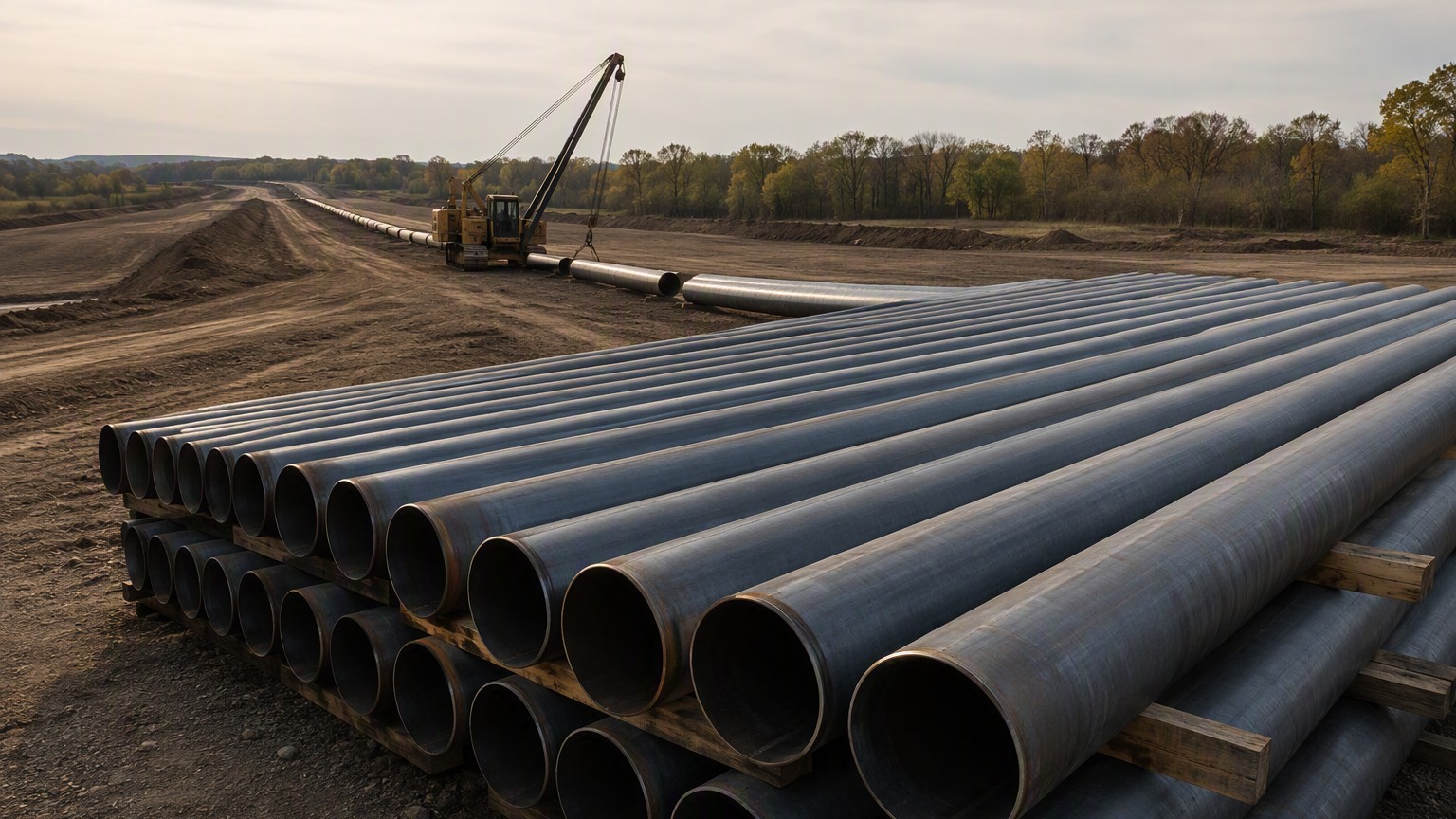
ERW pipe is the right choice for line pipe in moderate and high-pressure transmission when the seam is examined, for water and slurry mains, structural and piling work, and general mechanical spools. It is the wrong choice where an unbroken wall is a design requirement rather than a preference.
Where an HFI-welded pipe is the better engineering answer
Long-distance transmission is the classic case, and the reasons are mechanical as well as economic. Welded pipe is produced from accurately rolled strip, so the wall is uniform and the outside diameter round and consistent — both of which reduce the cost of the girth welds that join pipe into a line, because automatic welding and automatic ultrasonic inspection of those girth welds depend on a predictable geometry. Long mill lengths reduce the number of field joints further, and fewer joints means fewer inspection hours, less coating repair at the field joint and lower installation cost per kilometre.
In water supply and distribution, fire protection, piling, structural framing and general mechanical service, the pressure service is moderate and the seam requirement is normally satisfied by a hydrostatic test plus dimensional and visual inspection, with full-length weld examination available where the project wants it. In these applications the welded route wins on cost, availability and dimensional consistency simultaneously, and specifying a seamless product adds cost without adding a property the service can use. Where the pipe becomes a pressure vessel or operates under cyclic loading, the balance shifts the other way and the specification should say so explicitly.
Where seamless still earns its premium
Seamless pipe remains the defensible choice in high-temperature and high-pressure boiler and process service, in hydraulic and pneumatic cylinders, in instrument and precision tubing, and in any line where the design code requires a joint factor of 1.0 with no weld accepted. Sour service is the subtlest case: hydrogen sulphide raises the risk of sulphide stress cracking, which makes hardness control across the weld and its heat-affected zone critical. A buyer facing that service has two valid routes — specify seamless and remove the seam entirely, or specify a welded pipe with a qualified seam, a certified hardness survey and impact testing appropriate to the design temperature. The wrong answer is to leave the question unstated and accept whichever product the supplier finds convenient.
A procurement checklist before you place the order
Fix six items in writing before requesting quotations: the product specification and edition; the grade and, for line pipe, the product specification level; the wall thickness basis, minimum or average, since that is what the design calculation uses; the seam examination method and coverage; the destructive test schedule and impact test temperature; and the marking and traceability requirement on each length. Then compare prices against that single baseline rather than comparing headline numbers from offers that were never written on the same basis.
If your project involves large-diameter transmission or high-volume water and structural work, the welded route is usually the economically defensible answer, and it is worth specifying it deliberately rather than by default. A worked example of that specification is our API 5L X52 DSAW line pipe in 24 inch, which carries the test and documentation package that transmission service requires. For enquiries on line pipe, welded or seamless, send your specification to our export team with diameter, wall thickness, grade, standard and quantity, and we will confirm the mill schedule, the testing scope and the delivery window.
Conclusion: What Should You Verify Before Approving an ERW Pipe Order?
Verify the weld window, the full-length seam examination, the destructive test results and the traceability from heat number to certificate. A sound HFI weld is proven by evidence, never assumed.