
Stainless Steel Density: How Do 304, 316 and 430 Compare?
A wrong density figure silently inflates a plate quotation, a container plan and a structural load check. 304, 316 and 430 do not share the same number.
Stainless steel density is about 7.93 g/cm³ for 304, 7.98 g/cm³ for 316 and 7.70 g/cm³ for 430 at room temperature. Nickel and molybdenum raise the value, chromium and a ferritic structure lower it, and the differences change plate weight, freight cost and grade selection.
Transition: the three numbers sit within three percent of each other, which is exactly why they get ignored, and exactly why they matter. A three percent error on a twenty tonne order is six hundred kilograms of steel that someone pays for and nobody ordered. The six sections below define density for a steel buyer, give the working value for 304, 316 and 430, explain where the differences come from at the alloying level, and finish with the arithmetic that turns density into a plate weight, a coil tonnage and a freight plan you can defend. Along the way we mark the points where published data sheets disagree, because those disagreements are where purchase disputes begin.
What Is Stainless Steel Density and Why Does It Decide Your Plate Weight?
Density is the mass of one cubic centimetre of the alloy, and it is the only material input a plate weight calculation needs.
Density is the mass per unit volume of the alloy, quoted for stainless steel in grams per cubic centimetre or kilograms per cubic metre. It converts geometry into weight, so plate thickness, sheet size and coil length all depend on it.
One definition, three units and a lot of confusion
Density answers a simple physical question: how much does a fixed volume of this alloy weigh? For stainless steel the answer sits between 7.6 and 8.1 grams per cubic centimetre across the grades a fabricator actually buys, which is why the family is described as roughly eight times as heavy as water. The unit you use depends on who you are talking to. Metallurgists and mill data sheets quote grams per cubic centimetre. Logistics software, structural codes and container planners want kilograms per cubic metre, so 7.93 g/cm³ becomes 7,930 kg/m³. American and British drawings often carry pounds per cubic inch, where the same grade reads 0.286 lb/in³. All three numbers describe one material; the errors happen when a figure is copied from one column into a document using another.
There is a second source of confusion that matters more commercially. Density is a derived property, not a specified one. Standards such as ASTM A240/A240M for chromium and chromium-nickel stainless steel plate, sheet and strip control chemical composition, mechanical properties and dimensional tolerances. They do not print a density value, because density follows from the chemistry the standard already fixes: change the nickel, molybdenum or chromium balance and the mass per unit volume moves with it. So when a buyer asks for the density on a mill certificate, the honest answer is that the certificate proves the chemistry, and the density is calculated from that chemistry. Reading density as an approved property rather than a derived one is the first mistake in most weight disputes.
Where density enters the commercial conversation
Three documents carry density without ever naming it. The first is the quotation, because stainless plate is priced per tonne in most export markets, so density decides how many tonnes a fixed number of square metres actually is. The second is the packing list and container plan, because a twenty foot container accepts roughly twenty-six to twenty-eight tonnes of steel in practice, and the difference between 7.70 and 7.98 grams per cubic centimetre on a dense plate load is enough to move a shipment from a comfortable margin to an overweight container. The third is any structural or fabrication calculation, where plate weight becomes dead load on a frame, a support or a lifting beam. A fabricator using the wrong grade figure is not making a small rounding error; they are running three separate calculations on a number that belongs to a different alloy. That is why the sections that follow give each grade its own value rather than one convenient average, and why the stainless steel family is described grade by grade in the industry literature rather than as a single material.
What Is the Density of 304 Stainless Steel?
Type 304 is the reference grade for most plate enquiries, and its density is the figure buyers quote most often.
The density of 304 stainless steel is about 7.93 g/cm³, or 7,930 kg/m³, at room temperature. Published values usually fall between 7.90 and 8.00, and mills treat 7.93 as the working figure for 304 and 304L.
The working value for 304 and 304L
Type 304 is an austenitic stainless steel with roughly 18 percent chromium and 8 percent nickel, and that combination sets its mass per unit volume. The value used across mill data sheets is 7.93 g/cm³, which is 7,930 kg/m³ or 0.286 lb/in³. The low-carbon variant 304L carries essentially the same figure, because reducing carbon from a maximum of 0.07 percent to 0.030 percent removes almost no mass from the alloy. For buying purposes the two grades can share one density number, and treating them as different materials in a weight calculation only adds noise.
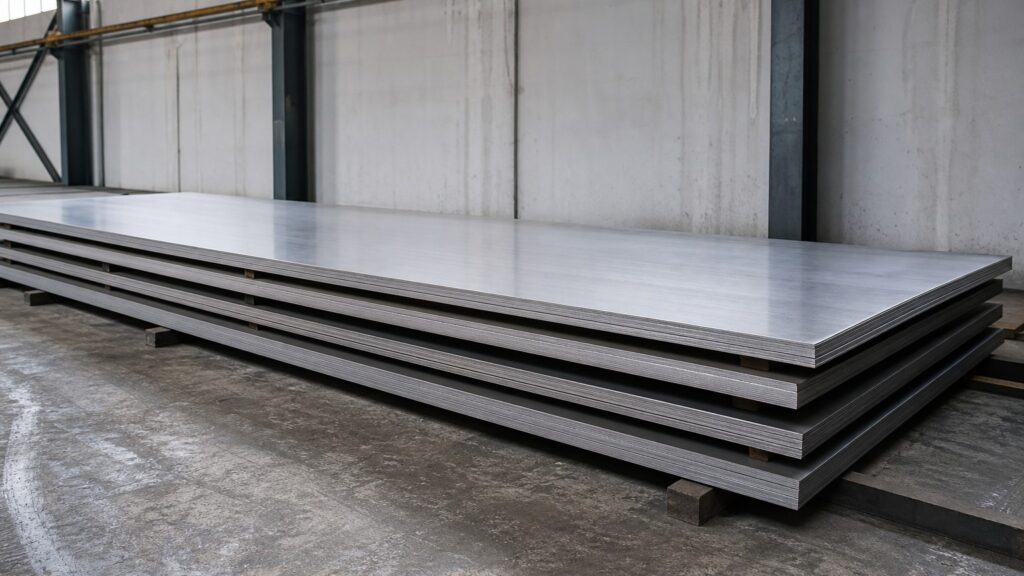
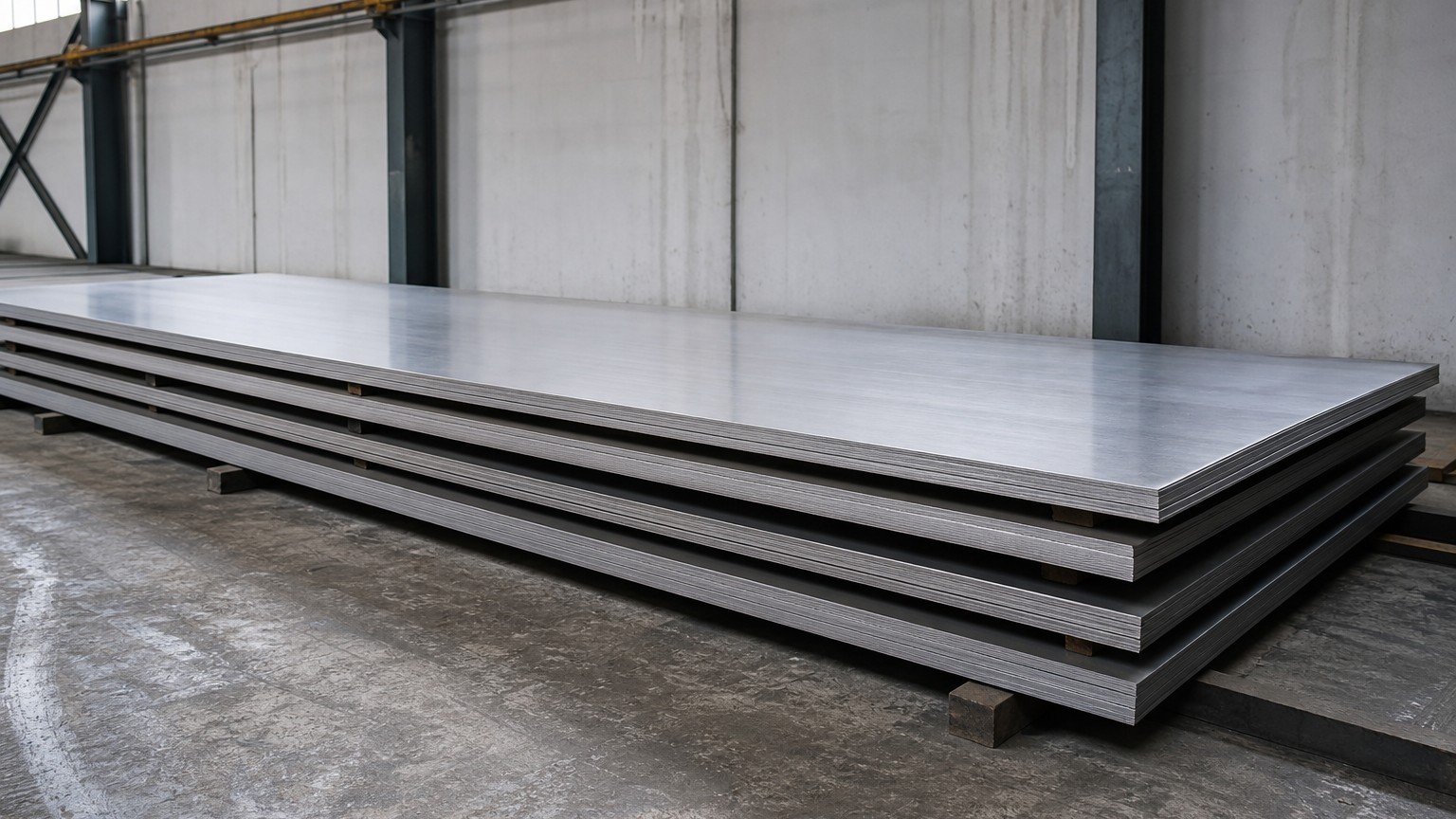
The useful part of that number is its shortcut form. Because one square metre of plate one millimetre thick contains exactly 0.001 cubic metres of metal, the mass per square metre per millimetre of thickness equals the density figure itself: 7.93 kilograms. That single coefficient removes most of the arithmetic from a plate quotation. A 5 mm plate in 304 weighs 5 × 7.93, or 39.65 kilograms per square metre. The 5 mm 2B finish material most enquiries settle on is supplied in standard 1500 × 3000 mm sheets, and 4.5 square metres at 39.65 kilograms per square metre is 178.4 kilograms per sheet, so a twenty-sheet lot is 3.57 tonnes before packaging. Knowing that the coefficient is just the density in disguise is what lets you sanity-check a mill quotation in your head, and our stainless steel density reference for 304 and 316 plate collects the thickness, size and tolerance combinations we supply against it.
Why published 304 values differ slightly
Data sheets do not disagree about physics; they disagree about rounding and about which heat of steel was measured. Composition ranges permitted by the standard allow a small legitimate spread in chemistry between heats, so a laboratory that measures a specific sample can honestly report 7.90 while a handbook that prints a nominal figure reports 7.93. Rolling direction, cold work and residual texture also shift the measured value at the third decimal place, which is measurable in a laboratory and irrelevant in a container. The practical rule for buyers is to fix one figure per grade in the purchase order, use it consistently in the calculation, and state whether the price follows theoretical or actual weight. A supplier who quotes 8.00 g/cm³ for 304 is not wrong by much, but the difference across a three hundred tonne programme is worth clarifying before the contract, not after the claim.
How Does 316 Stainless Steel Density Differ From 304?
316 is the molybdenum-bearing cousin of 304, and the molybdenum plus extra nickel make it measurably heavier.
The density of 316 stainless steel is about 7.98 g/cm³, or 7,980 kg/m³, which is roughly 0.6 percent higher than 304. The 316L low-carbon grade uses the same figure, so a 5 mm plate weighs 39.90 kilograms per square metre against 39.65 for 304.
The numbers, and what they are worth at order level
The working value for 316 and 316L is 7.98 g/cm³, or 7,980 kg/m³, and 0.288 lb/in³ in imperial units. The difference from 304 is about four hundredths of a gram per cubic centimetre, which sounds negligible until it is multiplied by tonnage. On a 5 mm 1500 × 3000 mm plate the gap is 1.1 kilograms per sheet, roughly 0.6 percent. On a two hundred tonne order it is about 1.2 tonnes, and because 316 is already the more expensive grade per tonne, the weight premium and the price premium arrive together. That compounding effect is the reason a plate weight schedule should be built grade by grade rather than on a single stainless figure, and it is also why the difference between the two grades becomes visible in a quotation long before it becomes visible on a drawing.
There is a second reason 316 buyers watch density closely. The molybdenum addition is what raises both the mass per unit volume and the corrosion resistance, so the two properties move in the same direction across the family: grades alloyed for aggressive service are also the heavier ones. If a specification calls for molybdenum-bearing plate to resist chlorides and acids, the weight consequence is not a separate decision, it is part of the same metallurgy. Fabricators running mixed 304 and 316 work should keep two coefficients on the shop floor rather than one, and anyone specifying between the two grades will find the trade-off between molybdenum cost, corrosion performance and the small weight penalty set out in our comparison of 304 and 316 stainless steel.
Where 316 density affects the delivered price
Because 316 is normally quoted per tonne, a buyer comparing offers per square metre is often comparing two different thickness conventions as well as two densities. The cure is to convert everything to one basis before comparing: kilograms per square metre at a fixed thickness, or kilograms per plate at a fixed size. Then add the two variables that mills legitimately vary, the thickness tolerance and the actual weighed tonnage. A plus-tolerance 5 mm 316 plate on a theoretical weight contract is a double effect, because the plate is slightly thicker than nominal and the density coefficient is higher than the 304 figure a competitor might have used. Separating those two effects turns a confusing price gap into a documented technical difference, which is what a purchasing decision needs.
What Is the Density of 430 Stainless Steel?
430 is the ferritic grade, and it is the lightest of the three because it carries no nickel at all.
The density of 430 stainless steel is about 7.70 g/cm³, or 7,700 kg/m³, roughly 2.9 percent lower than 304. A 5 mm 430 sheet weighs 38.5 kilograms per square metre, against 39.65 for 304 and 39.90 for 316.
The numbers for a nickel-free grade
Type 430 is a ferritic stainless steel built on chromium alone, typically around 16 to 18 percent, with no deliberate nickel addition. Removing nickel removes the densest common alloying element in the family, and the measured result is 7.70 g/cm³, or 7,700 kg/m³, and about 0.278 lb/in³. That figure sits at the low end of the stainless range, closer to carbon steel at 7.85 than to the austenitic grades above it. The commercial consequence is real but narrow: on a fixed plate size, switching from 304 to 430 saves about 2.9 percent of the mass, so a three hundred tonne programme in 430 is roughly nine tonnes lighter than the same programme in 304. For a fabricator weighing the cost of nickel against the cost of a slightly heavier and more corrosion-resistant plate, this is a legitimate input in the decision, though it is rarely the decisive one.
What decides 430 selection far more often is service environment, not weight. Because it has no nickel, 430 is ferritic and therefore magnetic, it has lower corrosion resistance than 304 in most chloride-bearing conditions, and it is generally more difficult to weld while retaining ductility. Its density is a useful secondary figure for the logistics plan; it is not a reason to choose the grade. Buyers who want the physical property data behind those statements, including thermal and magnetic behaviour rather than only mass, will find them collected on the British Stainless Steel Association’s mechanical and physical properties pages, which separates ambient temperature behaviour from magnetic and thermal categories so an engineer can read the property they actually need.
Reading 430 data sheets without tripping on the values
One caution belongs here. For 430, published density values are quoted with a wider spread than for the austenitic grades, and 7.70 g/cm³ is the figure used most consistently in mill data sheets and reference handbooks. Some sources round to 7.7, others work to two decimals only, and a few give a nominal value that reflects a specific heat rather than the grade. In a purchase order this does not matter, provided the same number is used throughout. What does matter is not mixing figures between families: an enquiry list built on 7.93 for every line, then answered in 430, produces a weight shortfall that looks like a mill error but was created at the enquiry stage. Fixing one density per grade in the specification, before the first quotation, is the cheapest insurance available against that class of dispute.
Why Do 304, 316 and 430 Have Different Densities?
Density moves with chemistry and crystal structure, not with marketing position or price.
Grade density follows alloying: nickel and molybdenum are denser than iron and raise the value, chromium is comparable to iron, and the body-centred cubic ferritic structure of 430 packs atoms more loosely than the face-centred cubic austenite of 304 and 316.
Two mechanisms, one direction of travel
The first mechanism is straightforward substitution. Stainless steel is mostly iron, with a density of about 7.87 g/cm³, and every alloying addition pulls the mixture toward its own value. Nickel is denser than iron, so a 304 chemistry carrying eight percent nickel and eighteen percent chromium lands above the iron baseline at 7.93. Adding two to three percent molybdenum and lifting nickel to about ten percent, as 316 does, adds more mass per unit volume and produces 7.98. Type 430 removes nickel almost entirely and settles at 7.70, below the iron baseline, because smaller chromium atoms dissolve in the iron lattice and reduce the average atomic mass per unit volume compared with nickel-bearing austenite.
The second mechanism is crystallographic, and it is the one most buyers never hear about. The crystal structure of an alloy determines how efficiently atoms fill space. Austenitic grades such as 304 and 316 have a face-centred cubic structure, which is relatively densely packed. Ferritic grades such as 430 have a body-centred cubic structure, which leaves slightly more free volume for the same atomic species. That is why a nickel-free ferritic stainless steel sits lower than a nickel-bearing austenitic one even before the alloying effect is counted, and it is the same structural difference that explains why 430 is magnetic and 304 normally is not. The austenitic stainless steel family is defined by that face-centred cubic lattice and the nickel, manganese and nitrogen additions that stabilise it, which is precisely the combination that produces the higher density figures. The Nickel Institute documents the alloying side of the same story for the grades where nickel is the property-carrying addition rather than a density side effect.
What this means when you compare grades
Because density is downstream of chemistry and structure, it is a reliable signature of grade family even though it is not a specification item. Within the austenitic group, expect values in the 7.90 to 8.00 band, with higher alloying pushing toward the top. Within the ferritic group, expect values nearer 7.70 to 7.75. Duplex and precipitation-hardening grades fall between and above, depending on their balance. The practical use of that pattern is verification: a plate reported as 304 should not behave like a ferritic grade on a magnet, and a mill certificate whose chemistry shows no nickel cannot reconcile with a density figure above 7.8. Density will not replace a positive material identification test, but it is a fast consistency check that costs nothing and occasionally catches a labelling error before the plate is cut.
How Do You Use Stainless Steel Density to Calculate Plate Weight?
Multiply the thickness coefficient, the width and the length, and the density is already inside the coefficient.
Stainless plate weight equals thickness in millimetres multiplied by width in metres, length in metres and the grade coefficient: 7.93 for 304, 7.98 for 316 and 7.70 for 430. The coefficient is the density in kilograms per square metre per millimetre.
The formula, and a worked example
The formula every stainless plate supplier works from is weight in kilograms equals thickness in millimetres, multiplied by width in metres, multiplied by length in metres, multiplied by the grade coefficient. For a 1500 × 3000 mm plate the area is 4.5 square metres, so the arithmetic collapses into thickness multiplied by 4.5, multiplied by the coefficient. Take a 5 mm plate in 304: 5 × 4.5 × 7.93 gives 178.4 kilograms. The same plate in 316 comes to 179.6 kilograms, and in 430 it comes to 173.3 kilograms. Those three answers differ by less than four percent, which is exactly why buyers are tempted to use one number for everything, and why doing so quietly loses or gains a few tenths of a tonne on every lot.
The same coefficient runs the coil and tube side of the business, where a long product is converted from metres into tonnes before a container is booked. If your order mixes plate and coil, the method showing how stainless steel density drives coil weight applies the identical logic to strip and coil, where width and density carry the calculation and length is measured in running metres rather than sheets. Keeping the two in one weight schedule is how a mixed order stays inside a container limit instead of being discovered at the weighbridge.
Putting the three grades in one table
The table below applies the coefficients to the plate sizes that dominate export enquiries, so the differences stay visible at a glance rather than hidden inside a percentage.
| Thickness (mm) | 304 (kg per 1500 x 3000 mm plate) | 316 (kg per 1500 x 3000 mm plate) | 430 (kg per 1500 x 3000 mm plate) |
|---|---|---|---|
| 3 | 107.1 | 107.7 | 104.0 |
| 4 | 142.7 | 143.6 | 138.6 |
| 5 | 178.4 | 179.6 | 173.3 |
| 6 | 214.1 | 215.5 | 207.9 |
| 8 | 285.5 | 287.3 | 277.2 |
| 10 | 356.9 | 359.1 | 346.5 |
Turning the number into a defensible order
Three habits convert this arithmetic into a purchase order that survives delivery. First, fix the coefficient per grade in writing, so the quotation, the packing list and the goods receipt all use the same density. Second, state whether the price follows theoretical weight, calculated from nominal thickness, or actual weight, established on a calibrated scale, because the two differ by the permitted thickness tolerance and that difference is where weight claims are born. Third, ask for the mill test certificate and read the chemistry against the density assumption, since a certificate showing a 304 chemistry with no nickel would contradict the coefficient you applied. Plates supplied for a specification such as the 5 mm 2B finish material in most architectural and process enquiries, which we supply as 304 stainless steel plate in 5 mm 2B finish, carry the same 7.93 coefficient whatever the finish, because surface treatment removes micrometres of metal and no measurable mass.
If you have a plate or coil schedule in front of you and want the tonnage, the sheet count and the container load checked against grade-specific density, send us your plate specification and we will return the calculation with the coefficient, the tolerance basis and the weight basis stated explicitly, so the figure can be compared with any other quotation line by line.
Conclusion
Use 7.93 g/cm³ for 304, 7.98 for 316 and 7.70 for 430, apply the figure grade by grade, and fix in the order whether nominal or actual weight governs.