
Anodized Aluminum: What Is the Process, Which Types Exist and Where Is It Used?
Buyers who specify a bare aluminum surface often watch it dull, stain or oxidize within one season — an expensive surprise on a facade, machine frame or finished component.
Anodized aluminum is aluminum whose surface has been electrochemically converted into a thickened, porous aluminum oxide layer. Because the oxide grows out of the metal itself rather than being applied on top of it, the finish cannot chip or peel the way paint does.
That single fact explains the appeal, but not the decisions behind it. Alloy, process type, coating thickness, colour method and sealing all change what the finished part can survive — and what it costs. The sections below work through the process chemistry, the commercial process families, alloy compatibility, real applications, inspection practice and the cost comparison to settle before you place an order.
What Is Anodized Aluminum and How Does the Process Work?
Anodized aluminum looks like a coating but is not one. The top few micrometres of the metal have been turned into oxide.
Anodizing is an electrolytic passivation process. The part becomes the anode in an acid electrolyte, oxygen ions combine with the metal surface, and a controlled aluminum oxide layer 0.5 to 150 micrometres thick forms — penetrating roughly half into the substrate and building half above it.
Pretreatment decides more of the final result than most buyers expect. The part is degreased, then etched, usually in an alkaline bath, to remove the natural oxide film and give a uniform starting texture, and finally desmutted in a nitric-acid-based solution to strip alloying-element residue such as copper or silicon smut. Skip any of those steps and the anodic layer forms unevenly; the dye uptake that follows then shows blotches that no later operation can hide.
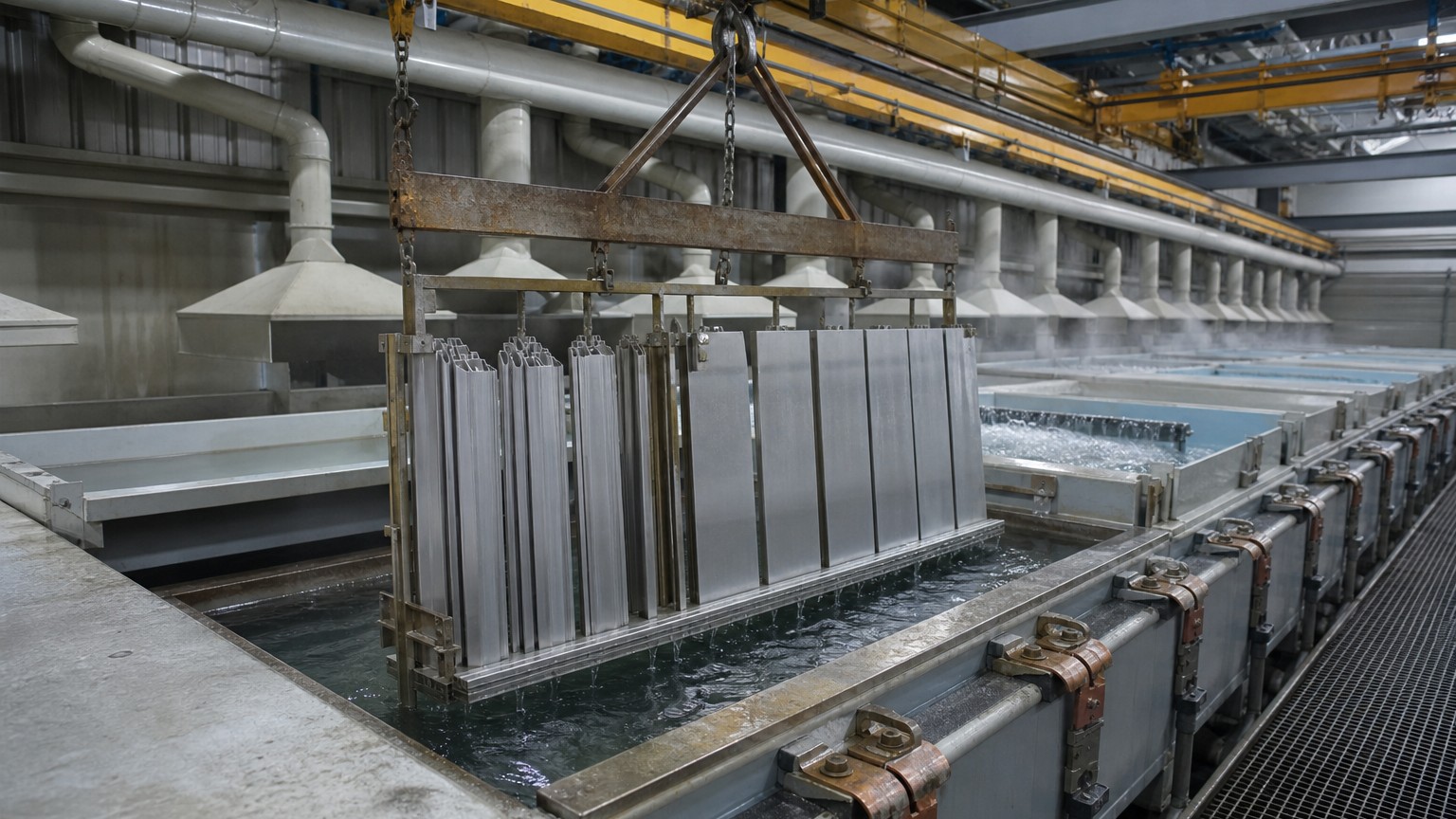
In the anodizing cell the part becomes the anode, hung on a titanium or aluminium jig, while a cathode of lead, stainless steel or aluminium sits in the tank. Dilute sulfuric acid is the workhorse electrolyte. The process was patented by Gower and O’Brien in 1927 and, as the widely cited Wikipedia overview of anodizing records, sulfuric acid remains the most common anodizing electrolyte to this day. A direct current of roughly 15 to 21 V drives oxygen ions to the aluminum surface, and the competition between oxide growth and mild acid dissolution produces a nanoporous structure with pore diameters typically between 10 and 150 nm. Those pores are the reason anodizing can be coloured at all: organic dyes, or metal salts in a two-step electrolytic colouring process, are absorbed into the pore channels and then locked in place by sealing.
Sealing is the step that turns a decorative surface into a corrosion-resistant one. Hot deionised water sealing hydrates the outer oxide and swells the pores shut, while nickel acetate and other precipitating seals fill the pore mouths with a chemically more stable compound. An unsealed anodic film behaves like a sponge — it absorbs dye beautifully and absorbs contaminants just as readily.
Two physical facts cause most specification arguments. First, the coating grows in both directions, so a 20 micrometre film adds about 10 micrometres to each surface; a thread machined to final size before anodizing will no longer gauge afterwards, and masking or post-machining has to be planned in advance. Second, anodic films are harder than the underlying aluminum but brittle, electrically insulating, prone to cracking under thermal stress above roughly 80 °C, and they never increase the strength of the part itself. Anodizing is a surface decision, not a structural one — which is why the alloy and temper you order matter as much as the finishing line that processes them. Our anodized aluminum plate, foil and coil are supplied with mill test certificates that record the alloy and temper per batch, so the anodizer starts from a known substrate rather than a surprise.
Which Types of Anodizing Are Used in Industry?
Not every anodic layer is built in the same way. The electrolyte and the electrical cycle decide hardness, colour and cost.
Four process families cover most commercial work: sulfuric acid anodizing for general and decorative use, hard anodizing for wear resistance, chromic acid anodizing for fatigue-critical aerospace parts, and phosphoric acid anodizing as a bonding pretreatment. Thickness and end use, not brand names, decide which one applies.
Type I — chromic acid anodizing
Chromic acid produces the thinnest films, typically 2.5 to 7.5 micrometres, and the process descends directly from the chromic-acid Bengough–Stuart bath used on Duralumin seaplane parts from 1923. Its reputation in aerospace comes from a smaller fatigue penalty than sulfuric acid anodizing and from a film that is more forgiving of residual stress. The trade-offs are thinner protection, tighter colour limits and the handling burden of hexavalent chromium, which is why chromic acid is reserved for fatigue-critical airframe parts rather than architectural work.
Type II — sulfuric acid anodizing
This is the general-purpose and decorative process. Films normally run from about 5 to 25 micrometres, they take dye and electrolytic colour well, and they cover window frames, signage, cookware and consumer housings. Type II is what most suppliers mean when they quote “clear anodized” or “black anodized” without further qualification. It is also the least expensive family per square metre, because the bath chemistry is simple and the cycle time is short.
Type III — hard anodizing
Hard anodizing uses colder electrolyte, higher current density and longer dwell times to build films from roughly 25 up to 150 micrometres. The result is a dense, dark, abrasion-resistant surface used on hydraulic cylinders, pistons, valve bodies and sliding wear surfaces. Part dimensions change significantly, surface finish roughens slightly and the layer is noticeably more brittle, which is why sharp external corners are normally radiused before the process and why masking is more difficult to control.
Phosphoric acid and other electrolytes
Phosphoric acid anodizing produces a thin, open film used mainly as a pretreatment to bond structural adhesives rather than as a protective finish. Oxalic acid baths, first patented in Japan in 1923 and later widely used in Germany, produced the architectural extrusions of the 1960s and 1970s before cheaper finishes displaced them. A useful industry summary of how these processes are defined, designated and compared is published by the Aluminum Anodizers Council.
Military and aerospace drawings usually call out a MIL-A-8625 type and class rather than an electrolyte, because modern specifications classify coatings by their properties — thickness, coating weight, corrosion performance — instead of by the bath chemistry that produced them. A Type II Class 2 designation, for example, means sulfuric acid anodizing with a dyed coating, and the class travels on the drawing whether the anodizer runs a small jig line or a fully automated one.
Which Aluminum Alloys Can Be Anodized Successfully?
Alloy choice drives the finish more than most buyers realise. Copper, silicon and zinc all behave very differently from magnesium.
Almost every wrought aluminum alloy can be anodized, but the result varies sharply. 5XXX and 6XXX alloys, including 5052 and 6061, anodize to clear, protective films; 2XXX copper-bearing and 4XXX silicon-bearing alloys produce darker, less protective coatings; high-zinc 7XXX alloys are difficult and usually anodized only for specific wear duties.
Alloys that anodize cleanly
1XXX pure aluminiums such as 1050 and 1100 take the brightest clear film and are chosen for lighting, reflectors and decorative trim. In the 5XXX family, 5005 and 5657 are the recognised bright-finish grades, while 5052 — the workhorse plate and sheet alloy — anodizes to a clear film with good protection, though slightly darker than the bright-finish grades because of its magnesium content. The Aluminum Anodizers Council’s alloy reference for anodizing classifies 5052 and 5252 as non-“A.Q.” types, meaning they sit outside the bright-dip architectural quality group while remaining perfectly suitable for protective finishes.
6061, 6063 and the extrusion grades
In the 6XXX family, 6063 and 6463 are the architectural extrusion standards: they anodize uniformly, hold colour well and are the default for window and curtain wall profiles. 6061 — stronger, more machined, and widely used for structural plate — anodizes less evenly because its higher silicon and copper content leaves smut and can produce a slightly grey cast. It is routinely anodized anyway, but on thicker films the colour becomes harder to match from batch to batch, which is a finishing problem rather than a metallurgical one.
Alloys that fight the process
2XXX copper-bearing alloys such as 2017 and 2024 anodize to a yellowish film with poor protective value, and 4XXX silicon-bearing alloys to a dark grey one; both are normally anodized only for cosmetic or bonding reasons. High-zinc 7XXX alloys, including 7075, are the hardest of the wrought families to finish and are usually hard anodized for specific wear duties rather than for appearance. Castings are a separate problem again: high-silicon cast aluminum anodizes to a dark, uneven layer, and only low-silicon or specially modified casting alloys produce presentable results.
Temper matters as much as chemistry, because surface condition and grain structure carry straight through into the finished film. Our overview of anodized aluminum alloy grades compares how 5052, 6061 and 7075 plate differ in strength, corrosion behaviour and finishing response before you commit to a specification.
What Are the Main Applications of Anodized Aluminum?
Anodizing earns its place wherever a surface has to survive weather, abrasion and cleaning for decades without a repaint.
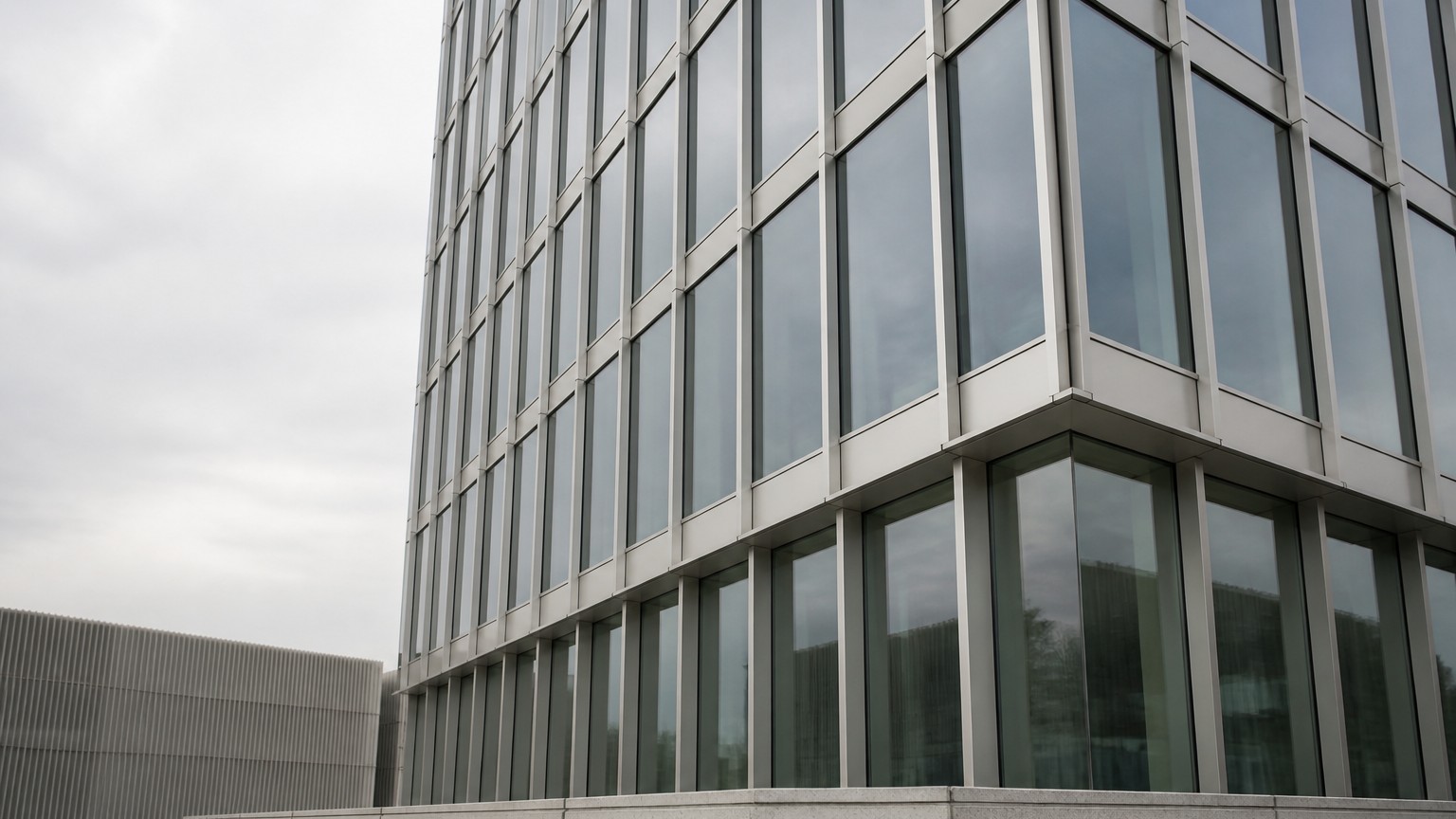
Anodized aluminum is specified for curtain walls, window and door frames, roofing and cladding, automotive trim, consumer electronics housings, cookware, hydraulic and pneumatic components, solar mounting, marine hardware and architectural signage — anywhere a durable, low-maintenance, non-painted surface is required.
Architecture and construction
Curtain walls, window frames, roofs, ceilings, escalator cladding, lobby panelling and staircases in commercial buildings worldwide rely on anodized aluminium, and the material’s track record includes some of the tallest towers ever built. The reason is structural rather than aesthetic: because the oxide is integrated with the substrate instead of applied to it, it cannot chip or peel the way an organic coating can, and the film does not need annual maintenance to keep performing.
Transport and industry
Aircraft components have used anodized aluminium since the 1920s, and the same logic runs through automotive trim, rail interiors, bicycle frames and machine guards. In hydraulics and pneumatics, hard anodizing protects cylinder bores, pistons and valve bodies against sliding wear, while the electrically insulating nature of the film is a useful secondary property in housings that must not short. Chemical and process plant equipment also uses anodized parts where a painted surface would be attacked.
Consumer, electronics and energy
Smartphone and laptop chassis, camera housings, multi-tools, flashlights, cookware, sporting goods and musical instruments rely on anodized surfaces for colour and scratch resistance. Solar mounting rails, marine hardware, pool and coastal fittings use anodized parts where salt exposure would destroy a painted finish. At the other extreme, anodized aluminium is used on spacecraft hardware, chosen to survive the thermal and radiation environment of orbit where no organic coating would last. Most of the flat, formable parts behind those products begin as 5XXX sheet: 5052 aluminum plate in 5 mm is a common choice for panels, covers and enclosures that are anodized after forming.
What the process also gives you
Beyond corrosion and wear, anodic films provide reliable adhesion for paints, primers and structural adhesives, controlled matte or glossy textures, and a deeper metallic appearance than any sprayed coating can imitate. Aluminium oxide itself, the chemistry behind the finish, is an industrial material in its own right — hard enough to be used as an abrasive, stable enough for refractory and electrical applications, and electrical insulating enough for thin-film electronics.
How Do You Specify and Inspect an Anodized Finish?
Two orders with the same nominal thickness can arrive twenty shades apart. Specification detail is what prevents that.
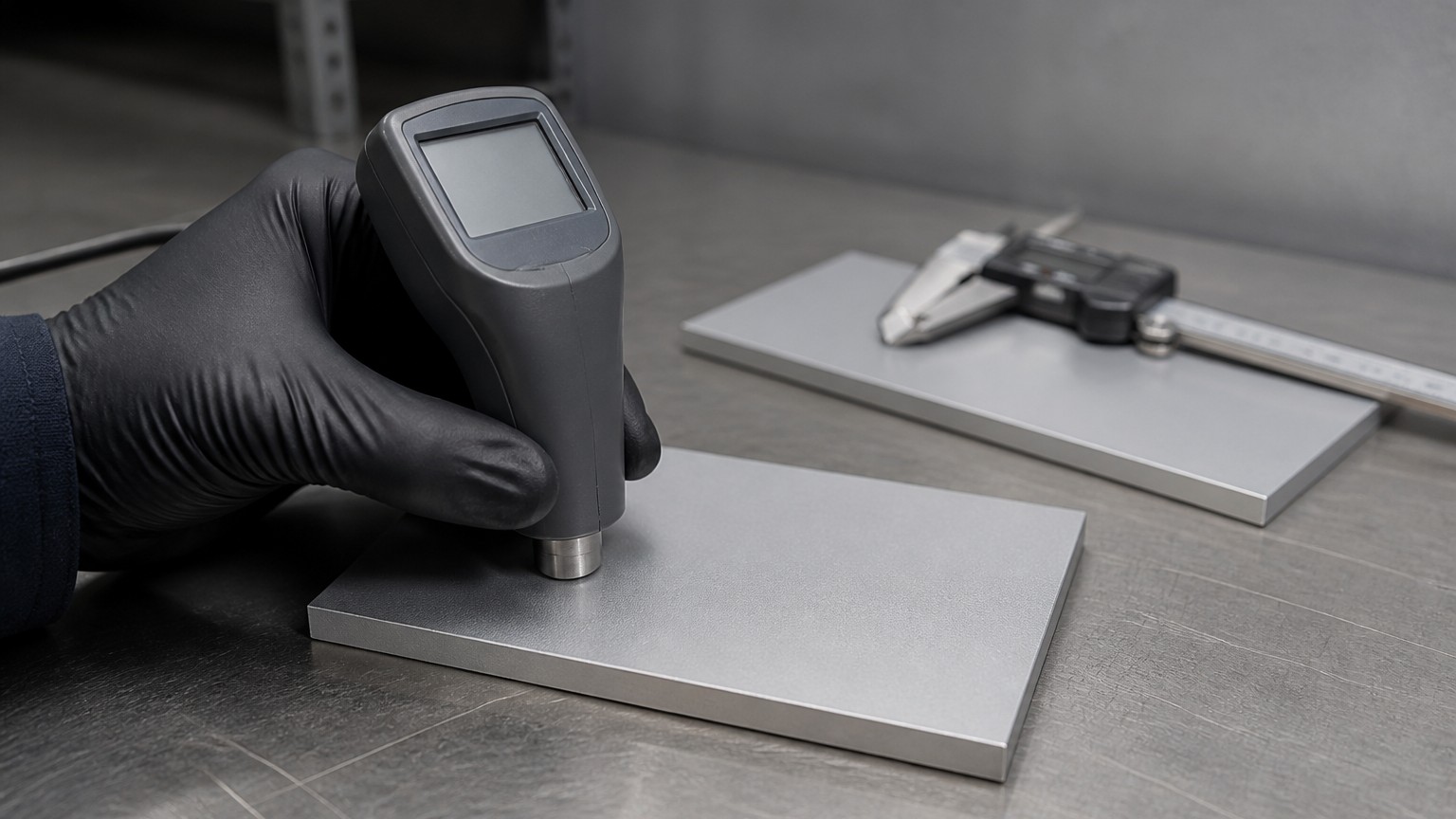
Specify the alloy and temper, the process type, the coating thickness class, the colour and gloss target, the sealing method and the acceptance tests. Inspect with coating thickness gauges, colour comparison against an approved retained sample, and a seal-quality or abrasion test where the application demands it.
What to write on the drawing
At minimum, record the alloy and temper, the process type, the nominal coating thickness class, the colour and gloss target, the sealing method and the acceptance tests. ISO 7599 exists precisely for this purpose: as the ISO catalogue entry for ISO 7599 on anodic oxidation coatings sets out, the standard defines the characteristic properties of anodic oxidation coatings on aluminium, lists the test methods for checking them, provides minimum performance requirements, and covers the grades of aluminium suitable for anodizing together with the importance of pretreatment. Aerospace and defence programmes typically substitute a MIL-A-8625 type and class designation instead.
Thickness and appearance verification
Coating thickness is measured non-destructively with an eddy-current gauge on a calibrated reference, and confirmed by microsection when a result is disputed. Colour and gloss are checked against a retained approved sample under a defined light source rather than by eye under warehouse lighting. Seal quality is verified by dye-stain or acid-dissolution testing, and abrasion resistance by a Taber-type test on hard-anodized parts. Because anodic films are only partly transparent, the substrate remains visible through them, so a colour difference can originate in the alloy, the temper or the heat-treatment history rather than in the anodizing line.
What to record on delivery
Ask for the mill test certificate for the substrate and the anodizer’s batch process record: coating thickness readings, sealing verification and the colour reference used. Combined with a retained first-article sample, that documentation is what lets a second order match a first one many months later. If you are buying semi-finished material rather than a finished part, send the alloy, temper, thickness and quantity to contact our sales team and keep the finishing steps with a qualified anodizer.
How Does Anodized Aluminum Compare with Paint, Powder Coating and Plating?
Anodizing is rarely the cheapest option per square metre. It is often the cheapest over twenty years.
Anodizing converts the surface, so it cannot chip or peel; paint and powder coating sit on the surface and can. Anodizing resists abrasion better and holds a deeper metallic look, but offers fewer colours, cannot be repaired on site, and costs more than powder coating at low volumes.
| Consideration | Anodized aluminum | Powder coating | Liquid paint |
|---|---|---|---|
| How it bonds | Oxide grown from the substrate | Applied film on a pretreated surface | Applied film on a pretreated surface |
| Chip and peel resistance | Cannot chip or peel in service | Can chip or peel at edges and fixings | Can chip or peel at edges |
| Colour range | Limited: clear, bronzes, blacks, electrolytic colours | Very wide, including metallics | Very wide |
| Field repair | Not possible; the part must be re-anodized | Touch-up possible | Touch-up possible |
| Dimensional effect | Adds half the film thickness per surface | Adds full film thickness | Adds full film thickness |
| Typical use | Architecture, wear parts, consumer housings | Frames, enclosures, outdoor furniture | General industrial |
Where the cost actually sits
Anodizing cost is driven by alloy, film thickness, colour route, jigging and, above all, load size. An anodizing tank processes a rack, and a nearly empty rack costs almost as much to run as a full one, so small quantities of thick, coloured, hard-anodized parts carry a disproportionate price. Consolidating an order is usually worth more than negotiating the bath rate, and booking capacity early matters for hard anodizing lines, which are slower per load than Type II lines.
Design and sourcing decisions that pay back
Allow for dimensional growth on machined fits, radius sharp corners before hard anodizing, specify drain points so electrolyte cannot be trapped in blind holes, and order spare parts with the production run, because a scratched anodized surface cannot be touched up on site. Where aluminium is bolted to steel in the same assembly, the insulating behaviour of the anodic film reduces galvanic risk on the aluminium side, but the steel side still needs its own protection; the principles are set out in our guide to corrosion protection systems, and they apply just as much when an anodized extrusion meets a galvanized frame.
Conclusion: Anodized aluminum is a surface conversion, not a coating: pick the right alloy, process type and sealing, specify thickness and colour precisely, and the finish will outlast the paint it replaced.
Planning an anodized aluminum order? Send the alloy, temper, thickness, colour target and quantity, and we will confirm availability, packing and the delivery schedule for your project.