
Galvanized Steel Coil: How Is It Produced and How Do You Buy It?
Order a galvanized steel coil on coating weight alone and the container can arrive with a coating too thin for your site. Zinc weight, spangle and storage decide service life.
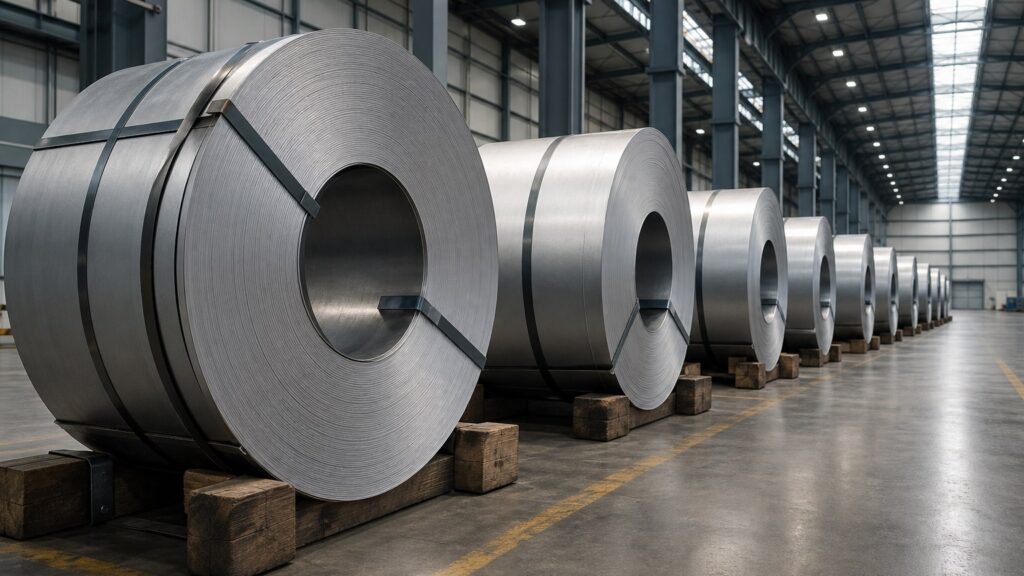
A galvanized steel coil is a continuous length of steel strip wound into a coil after hot-dip zinc coating. The zinc protects the steel as a barrier and as a sacrificial layer. Specify the coating designation from the atmosphere the finished part will face, not from the lowest quotation.
Transition: the delivered coil is the sum of four independent decisions — substrate, coating mass, surface treatment and coil geometry — and a buyer who treats “galvanized steel coil” as one interchangeable commodity usually discovers the mismatch only after the coil has been slit and formed. The six sections below follow the order a real importer or fabricator works through: what the coil actually contains, how a continuous line makes it, which coating designation to write on the order, how to verify a coil before it ships, where the material is used and how it must be stored, and finally how to buy it at a price that reflects what is really in the coil.
What Is a Galvanized Steel Coil and What Does It Actually Contain?
A coil is not one product. Substrate grade, zinc coating mass, surface treatment and temper each change the delivered material.
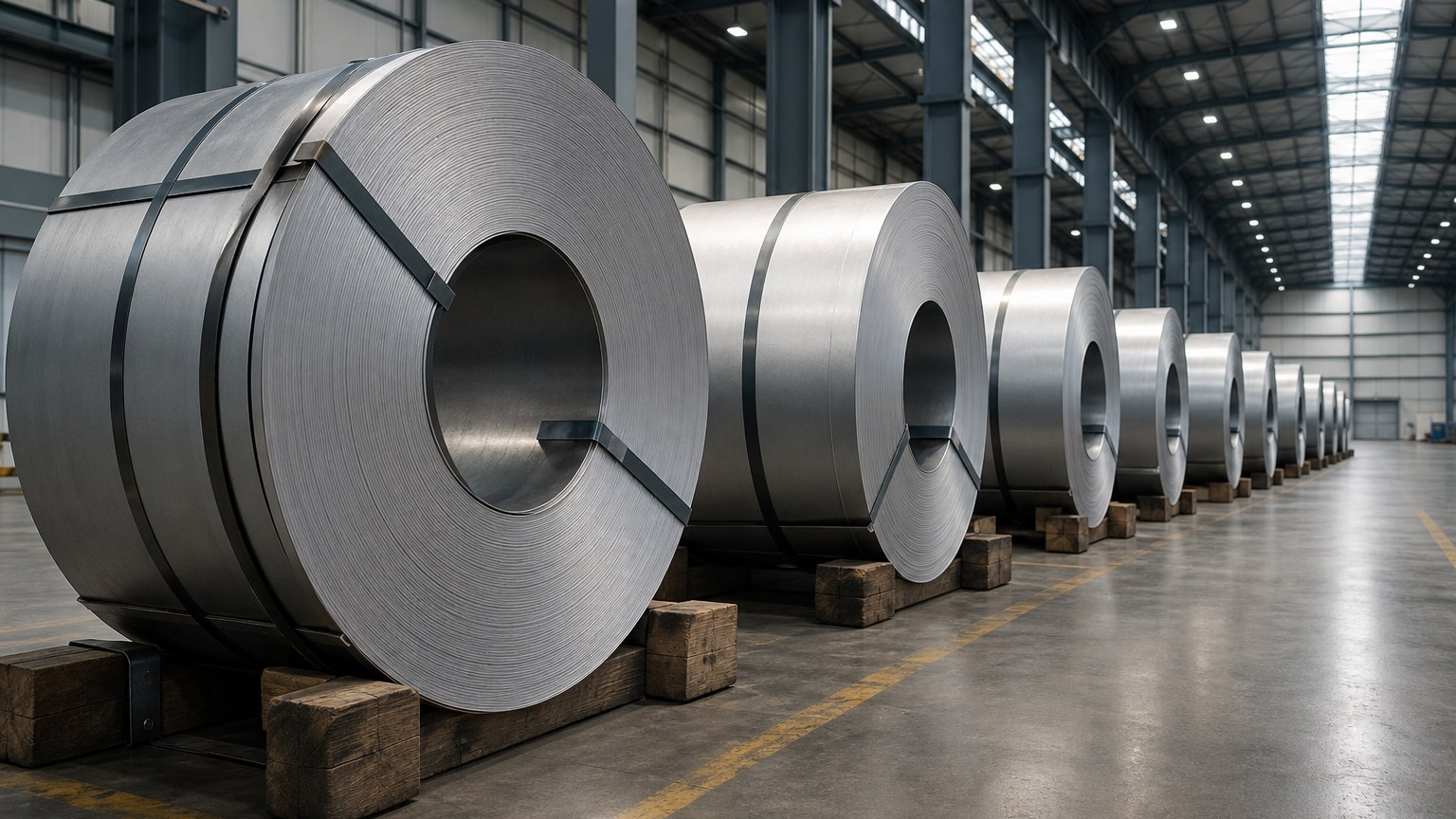
A galvanized steel coil consists of a steel substrate — usually cold-reduced, sometimes hot-rolled — coated on both faces with zinc or a zinc-iron alloy. The coating mass, the substrate grade and the surface treatment are three separate specifications that must all appear on the order.
The reason this matters is that the three specifications fail in three different ways, and only one of them can be seen on a photograph of the coil. The substrate is the structural half of the product: a drawing-quality low-carbon steel, a structural grade, a high-strength low-alloy grade and an interstitial-free deep-drawing grade behave very differently under bending, roll forming and load, and they cost different amounts even when the coating is identical. A specification that names only the coating weight leaves the substrate free to be substituted with the cheapest grade that satisfies the visual inspection, and the substitution surfaces later as cracking at a tight bend, inconsistent springback on the roll former, or a part that will not carry the design load. The coating is the corrosion half: it is the zinc that corrodes in place of the steel, which is the whole point of the process. Galvanization works because zinc is electrochemically more active than iron, so at a scratch, a sheared edge or a drilled hole the zinc becomes the anode and the exposed steel is protected by cathodic action until the surrounding zinc has been consumed. That single fact drives the buying decision: the coating is not paint, it is a measured quantity of sacrificial metal, and it is consumed over time at a rate set by the atmosphere the finished part lives in. The third specification, surface treatment, decides whether the coil can be painted, stacked, or kept in a humid warehouse without white rust forming between the wraps. Chromate passivation, oiling and anti-fingerprint films are not cosmetic extras; they change how the coil behaves between the mill and the customer. Finally, the mechanical condition — temper, yield strength, elongation — belongs on the same order line, because a coil with the correct coating but the wrong mechanical grade is still the wrong coil.
How Is a Galvanized Steel Coil Produced on a Continuous Line?
Production is one continuous sequence, and every step in it can change the coating a buyer later measures.
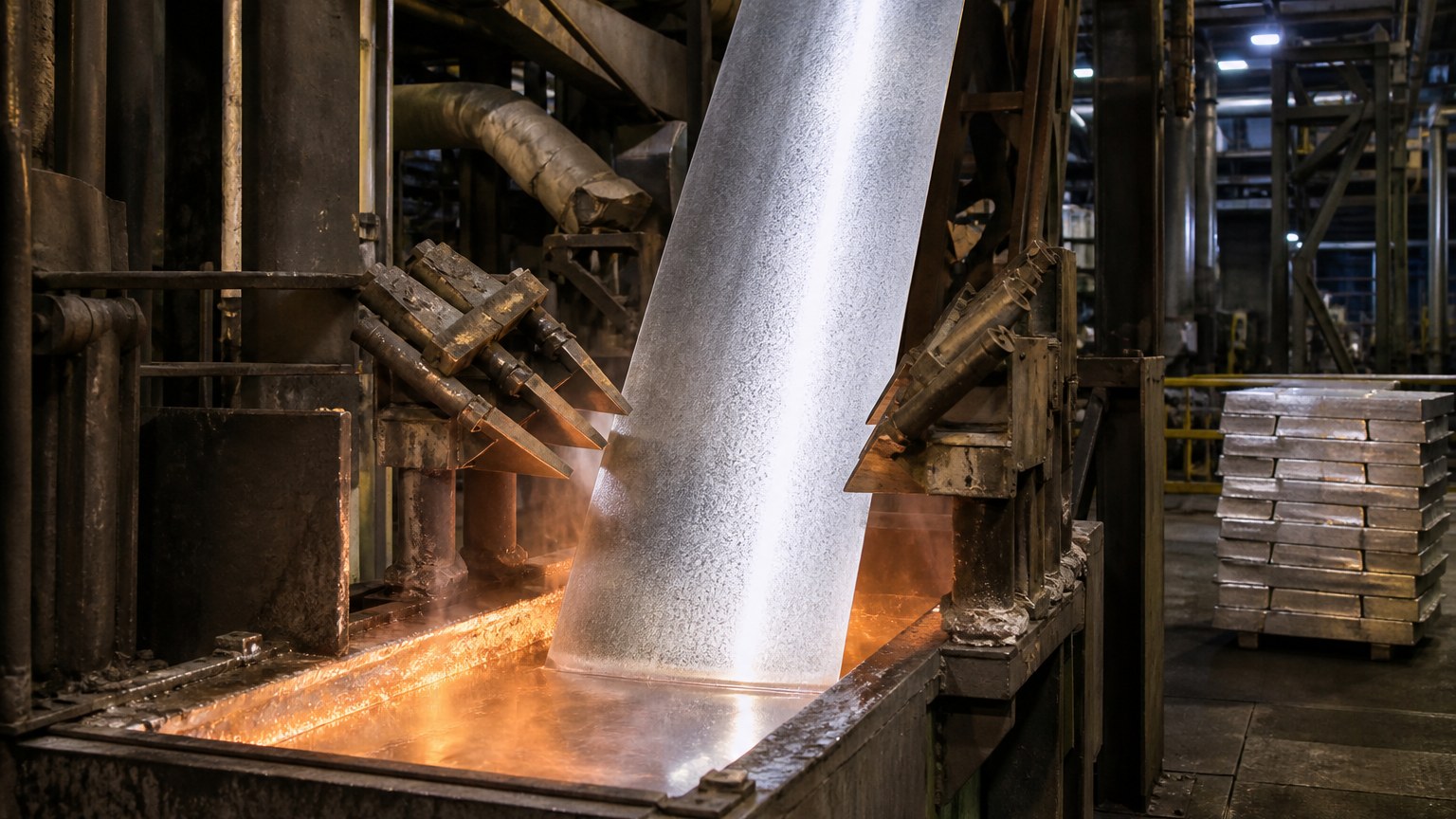
Coils are uncoiled, welded end to end, cleaned, annealed, dipped through a molten zinc bath, wiped by air knives to a set coating mass, cooled, skin-passed and recoiled. The bath runs near 450 °C, and the air knives are what actually set the coating weight.
From pickling and annealing to the zinc pot
Modern continuous lines begin with the cold-reduced coil being uncoiled into an accumulator, welded to its predecessor so the line never stops, and then chemically cleaned and annealed in a reducing atmosphere. The annealing step matters more than it appears: the strip must arrive at the zinc pot with an oxide-free, chemically active surface, because zinc will not bond to a dirty or oxidised face. Batch galvanizing of fabricated parts, in contrast, relies on caustic cleaning, acid pickling and a zinc ammonium chloride flux before immersion — a sequence that strips mill scale and deposits a protective layer so the molten zinc can wet the surface. Both routes end in the same physical event: the strip or part is immersed in molten zinc near 450 °C and forms a metallurgically bonded zinc-iron alloy layer topped by a layer of relatively pure zinc, a process described in detail in the hot-dip galvanization reference on Wikipedia. For continuous coil lines the strip passes through the pot vertically or in a catenary, and the thickness of the coating is then set mechanically rather than by a specification alone. That is the single most useful thing for a buyer to understand: on a continuous line the coating mass is a machine setting, not an intrinsic property of the steel, so two coils of identical substrate produced an hour apart on the same line can carry visibly different coating weights if the knives were reset between them. The line speed, the bath temperature, the bath aluminium content and the knife pressure all influence the final coating. A third factor, total coating mass including the alloy layer, is what the standard measures, whereas the pure-zinc layer is what resists the weather; a coating that is thick in alloy and thin in free zinc will pass a mass check and still underperform. This is why a mill test certificate that reports only total coating mass should be read together with the substrate grade, the coating type and the surface treatment, and why the pot chemistry is not something a buyer can audit after the fact.
Air knives, spangle and skin pass
After the strip leaves the zinc pot, air knives positioned just above the bath wipe surplus molten zinc from both faces and drive it back to the edges. The knife pressure, the nozzle gap and the line speed together determine how much zinc stays on the strip, so the coating mass that appears on the certificate is effectively decided in the two or three metres after the pot. Immediately after wiping, the coating is still liquid and cools into a crystalline pattern known as spangle — the characteristic visible grain that gives galvanized sheet its familiar mottled appearance. Spangle is a solidification feature rather than a quality grade, but it is a useful field indicator: an unusually fine or absent spangle usually signals that the strip was skin-passed or that the bath was treated with a spangle-suppressing addition, while a coarse, well-formed spangle generally indicates an unaltered coating. Buyers sometimes ask for a minimum and minimum spangle when what they actually need is a specific coating mass and an appropriate surface treatment, which is why the spangle request should never replace the coating designation. The line then cools and passivates the strip — typically a chromate or chromate-free passivation applied to limit white rust in transit — before a skin-pass mill lightly rolls the surface to flatten it, improve flatness and set the final surface texture. Only after these steps is the strip recoiled, weighed and banded, and by that point the material is a finished product whose three specifications are already fixed. Nothing downstream can improve the coating: a slitter, a roll former or a paint line can only preserve it or damage it, which is the practical reason the coating specification belongs on the purchase order and not in a post-delivery complaint.
Which Coating Designation Should You Specify for Your Application?
The designation is a number with a test method attached. Read it as a coating mass, not as a grade of quality.
Coating is written either in ASTM designations such as G60 and G90, which express coating mass in ounces per square foot across both faces, or in EN/ISO designations such as Z180 and Z275, which express grams per square metre across both faces. The two systems convert directly.
| ASTM A653 designation | Coating mass (oz/ft², both faces) | Approximate metric equivalent | Service environment usually specified for |
|---|---|---|---|
| G40 | 0.40 | ≈ Z120 | Interior panels and mild indoor service |
| G60 | 0.60 | ≈ Z180 | General construction, ducting, tube and racking |
| G90 | 0.90 | ≈ Z275 | Roofing, cladding and exposed outdoor steelwork |
| G115 | 1.15 | ≈ Z350 | Humid and mildly aggressive industrial atmospheres |
| G140 | 1.40 | ≈ Z450 | Severe marine and heavy industrial atmospheres |
The conversion is arithmetic rather than promotional: one ounce per square foot is about 305 grams per square metre, so a G90 coating is roughly a Z275 coating, and a buyer comparing quotations written in the two systems is comparing the same metal if the numbers convert. What is not arithmetic is which of them the order actually receives. The governing product standard for this material in North America is ASTM A653/A653M, the standard specification for steel sheet zinc-coated or zinc-iron alloy-coated by the hot-dip process, and it is worth reading the scope even if the full document is behind a paywall: it defines the coating designations, the mechanical designations and the testing regime as one package, and it explicitly covers material supplied in coils as well as cut lengths. The practical trap is triple-spot against single-spot measurement. Coating mass is not perfectly uniform across a coil width or along its length, so the standard defines where and how many readings are taken and averaged, and a supplier quoting a minimum single-spot figure and a supplier quoting a triple-spot average are describing two different floors. When a buyer needs a specific coating for a specific atmosphere, the surcharge is real, because zinc is the most expensive component in the coil by mass and a step from G60 to G90 adds roughly half again as much zinc per square metre. That is also why the cheapest G60 on the market is often a G60 nominal with the substrate downgraded rather than a genuine coating substitution — the saving is taken out of the part of the specification that cannot be seen. For the coil and sheet formats available in each designation, including coating type, surface treatment and supplied dimensions, the galvanized steel coil and sheet range lists what can be certified on a mill certificate, which makes it a useful reference while the enquiry is being drafted.
How Do You Verify Galvanized Steel Coil Quality Before You Buy?
Most coil disputes are visible before the container is sealed. They are just not visible from a photograph of the packing list.
Ask for the mill test certificate, the coating mass and its test method, the coil identity numbers, and photographs of the actual coil ends. Then confirm coating thickness with a gauge, check edge condition and wrap tightness, and verify weight per coil against the packing list.
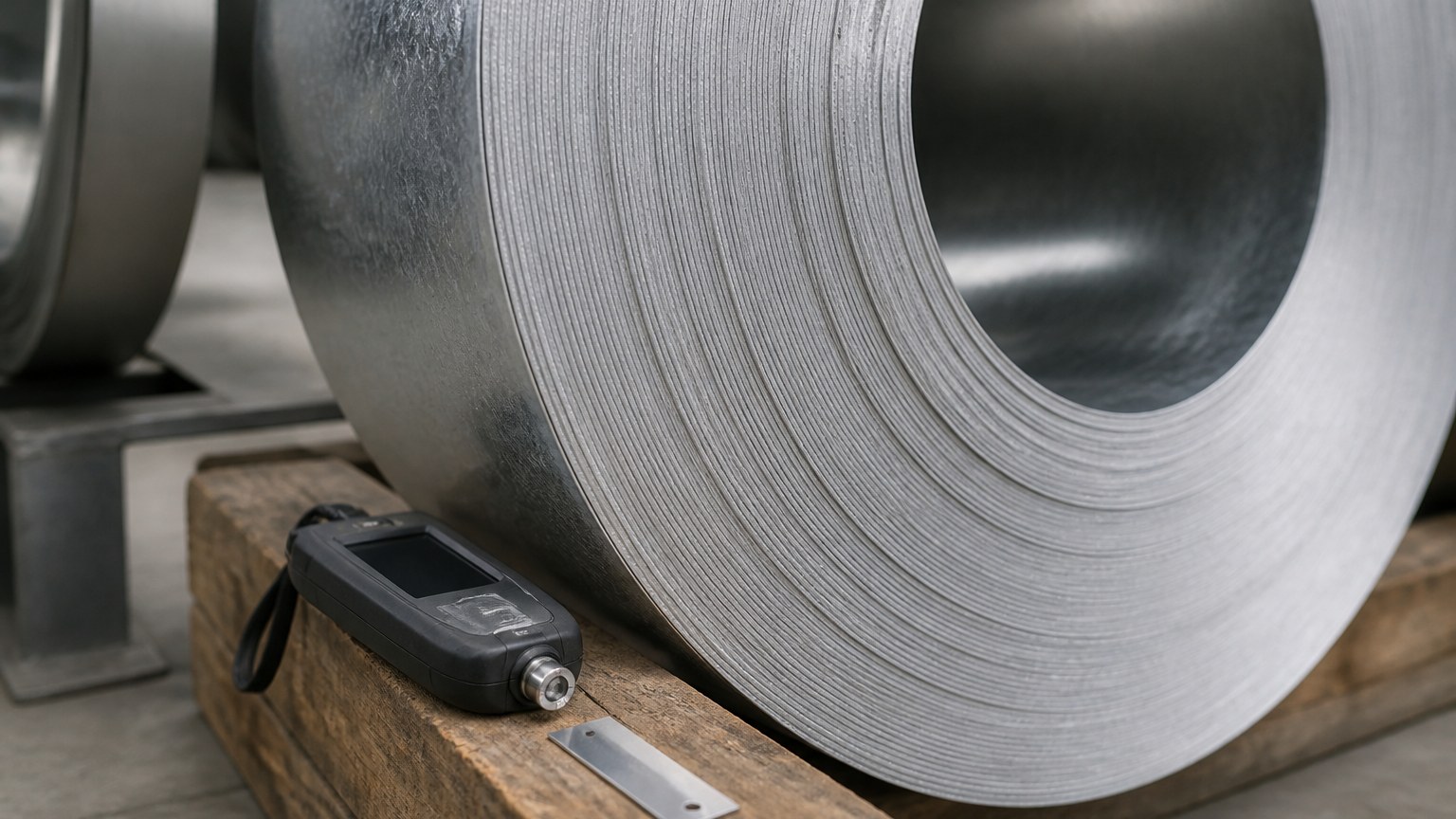
Start with the document trail, because a certificate that never mentions the coating test method, the coil number or the heat number is not traceable to the physical coil that will be loaded. A mill test certificate should connect chemical composition, mechanical properties and coating mass to a specific coil identity, and it should state whether the coating figure is a triple-spot average or a single-spot minimum. That three-stage sequence — surface preparation, galvanizing, then inspection — is the standard route set out in the American Galvanizers Association hot-dip galvanizing process overview, and inspection is the stage the buyer owns rather than delegates. Then move to the coil itself. The end face of a galvanized steel coil is the single most informative surface a buyer can inspect: the wrap should be tight and even with no telescoping, no slack wraps and no visible interleaving damage, the edge should be free of burrs and heavy edge build-up, and the eye should be round and unobstructed. Coating mass is confirmed either by a non-destructive magnetic or electromagnetic gauge on the flat of the strip, by a stripping-and-weighing test on a sample, or by an X-ray fluorescence gauge on a line that has one; the important point is that the method is stated and that readings are taken at several positions across the width, because a coil can pass at the centre and run thin at the edges. Appearance is the next signal. A uniform grey spangle with no dark patches, no white rust and no visible roll marks indicates a coating that solidified normally; whiteness between the wraps is the early stage of zinc corrosion and usually means the coil was exposed to moisture while warm or stored in a humid warehouse after transport. Surface treatment should be confirmed on the certificate as well, since a passivated coil and an untreated coil look similar in a photograph and behave differently in a humid container. Two further checks belong in the same visit: the physical dimensions — thickness, width, inner diameter and coil weight — measured rather than assumed, and a sample of the strip formed or bent to the radius the customer’s process will use. None of these checks requires a laboratory. They require that someone stands at the coil with a gauge, a tape and the certificate in hand before the container doors close, because after shipment the only remedies available are commercial, not technical. Buyers who want the same passivation and coating-weight conventions explained in more depth for a related product can compare how coating weights are specified for tube in this note on galvanized coil coating weights, where the same designation logic is applied.
Where Is Galvanized Steel Coil Used, and How Should It Be Stored?
Coil is an intermediate product. Where it ends up decides how much coating it should have started with.
Galvanized steel coil is slit and formed into roofing and wall cladding, ductwork, structural tube, racking, cable trays, appliance and automotive panels. Storage matters as much as the coating: keep coils dry, ventilated, off the floor and out of standing water, and never let condensation form between the wraps.
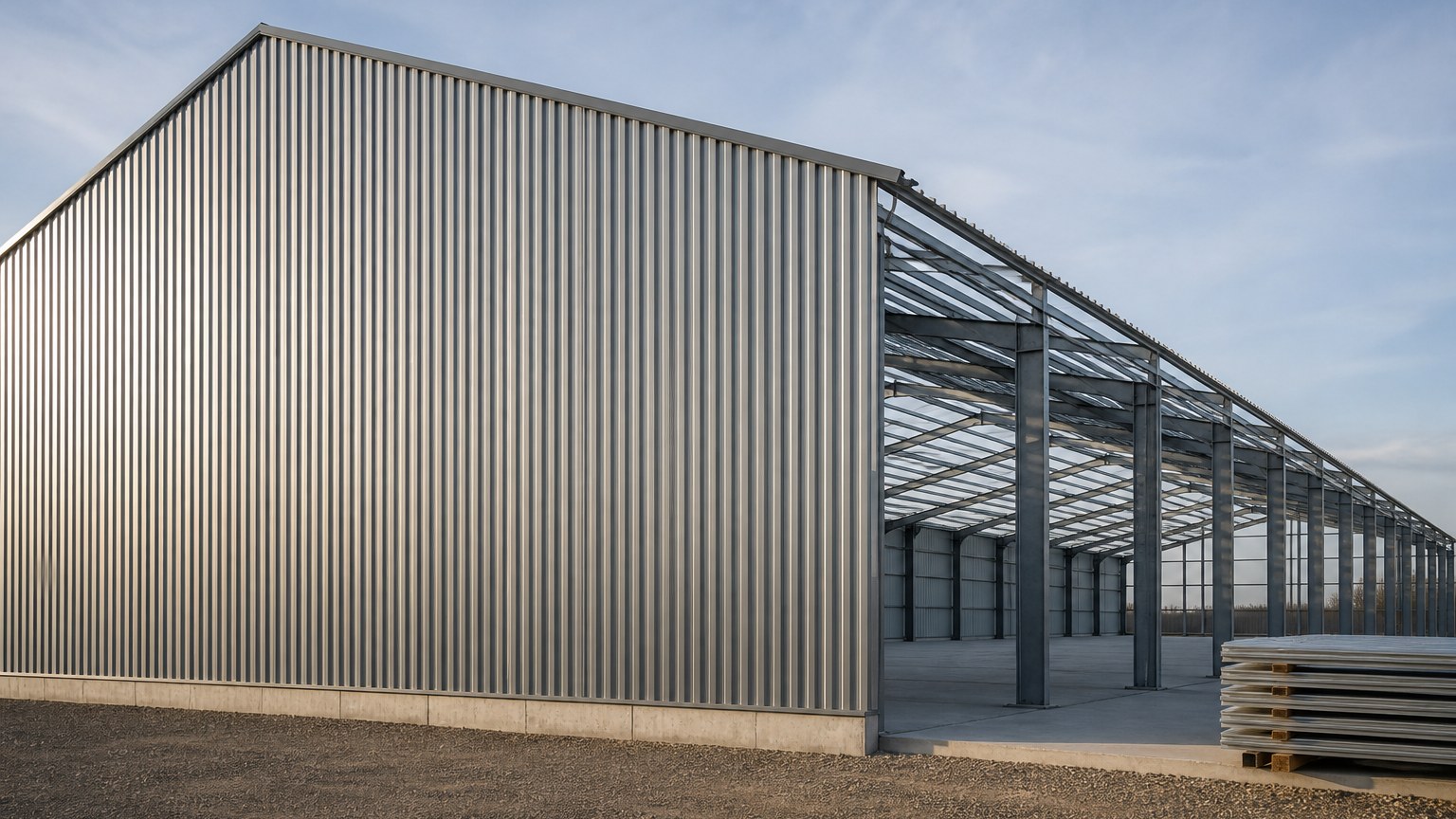
The demand for the material follows four broad application families, and each one pulls a different specification out of the same mill. Construction takes the largest share, where the coil is slit and roll formed into profiled sheet for roofing, wall cladding, purlins and light structural sections; this is the application that normally justifies a G90 or Z275 coating, because the finished sheet is exposed to rain, UV and temperature cycling for decades and the zinc is the only corrosion protection on the cut edges. Ducting and HVAC form the second family, where the coil is formed into rectangular and spiral duct with a surface treatment selected so that the finished duct can be painted or left bare inside a building envelope; here the coating is chosen for formability and appearance as much as for atmosphere, and a G60 class coating is often sufficient because the service is indoor. The third group covers tube, racking, cable trays, shelving and general fabrications, where the coil is slit to narrow strip and either roll formed and welded or drawn into profile; these products are usually galvanized before forming on a continuous line so that the weld zone is the only area with an exposed edge, and post-fabrication touch-up becomes a detail rather than a system. Appliances and automotive panels form the fourth group, where the requirement shifts toward a very consistent, formable, often skin-passed and sometimes galvannealed surface that will be painted later, and where coating uniformity matters more than coating mass. Storage is where the fourth family and the first are treated alike, and where most avoidable claims originate. Zinc corrodes in humid air even without rain, forming white rust, and the reaction accelerates when moisture is trapped between tightly wound wraps and the coil is warm. A coil should be stored under cover, raised on timber dunnage off the ground, with free air movement around it, away from drips and condensation, and preferably used in the order it arrived. Lifting should use a coil hook or a purpose-made C-hook on the inner diameter, never a wire sling through the eye that crushes the wraps. When the material is finally applied, fabricators should be aware of the normal construction detail shown in galvanized steel roofing, where the exposed silver surface carries the weather and any cut edge relies on sacrificial protection alone; for a full specification of the gauge and coating combinations supplied for this kind of work, see the 1.0 mm G60 galvanized steel coil page.
How Do You Buy Galvanized Steel Coil at the Right Price?
Two quotations for the same tonnage can differ by fifteen per cent and still be for the same product. The difference is in what is not written down.
Compare quotations line by line: substrate grade, coating designation and test method, surface treatment, thickness and width tolerance, inner diameter, coil weight, packing and shipping terms. Then check the zinc content of the quotation, because coating mass is the largest controllable cost in the coil.
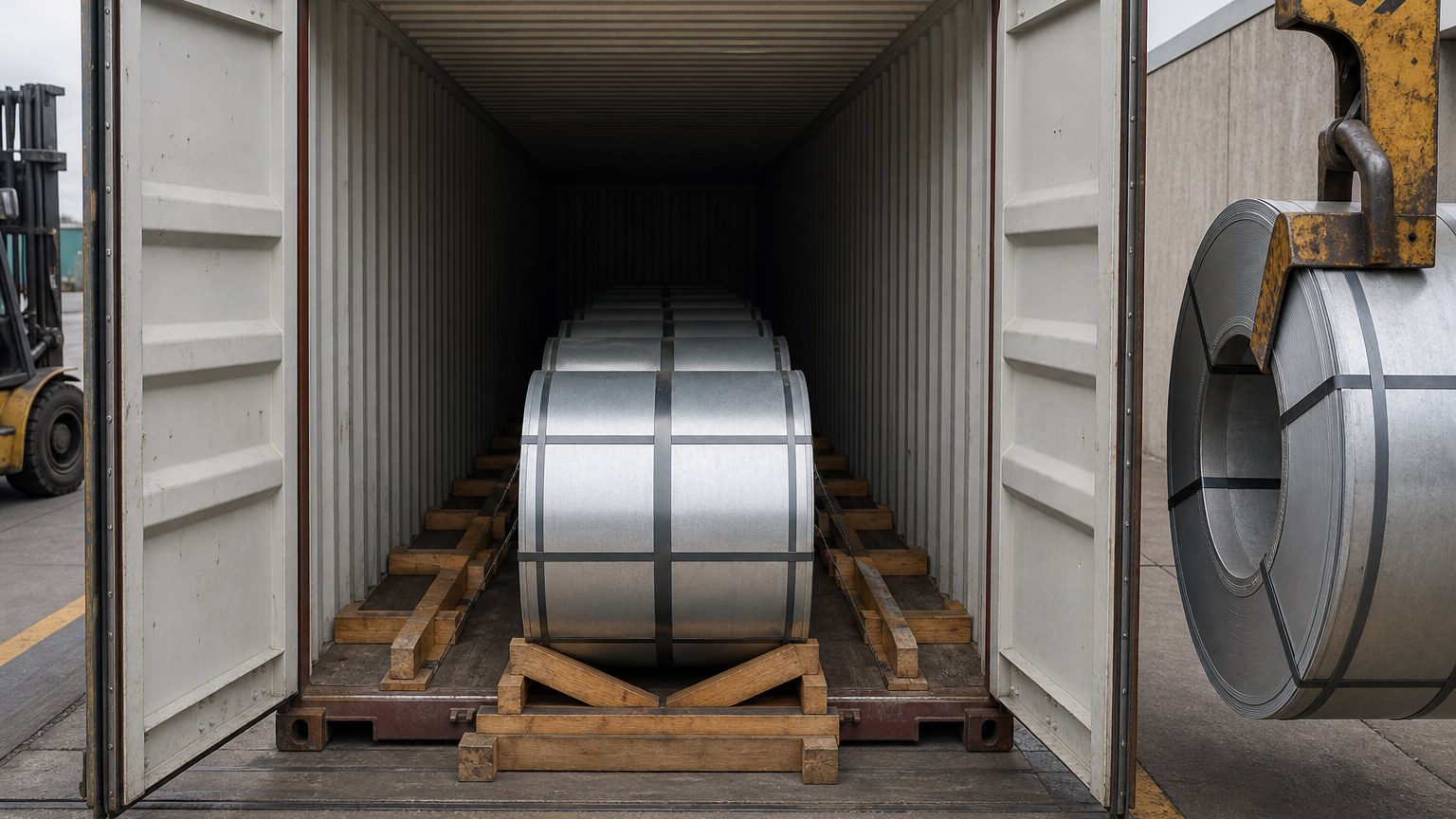
Price in this market is driven by four visible inputs and one hidden one. The visible inputs are the substrate: prevailing hot-rolled or cold-rolled coil price; the zinc content: the coating designation multiplied across the tonnage; the processing: slitting, cut-to-length or additional skin-pass work; and the logistics: coil weight and inner diameter determine how much material fits in a container, and therefore freight per tonne. The hidden input is tolerance and yield, and it is where a quotation can look cheap without being cheaper. Thickness tolerance is the clearest example. A coil supplied at the negative end of the permitted thickness range yields more square metres per tonne than one supplied at nominal, so a buyer comparing price per tonne between two suppliers is often comparing two different quantities of steel. The same logic applies to width and to edge condition: a coil that slits with low yield loss is worth more per tonne than a cheaper coil that produces more scrap. Coil geometry deserves its own line in the comparison. Inner diameter is normally 508 mm or 610 mm and must match the customer’s uncoiler mandrel; outer diameter is limited by the equipment and by safe handling; and coil weight interacts with both, since heavier coils reduce handling cost per tonne while requiring heavier lifting equipment and giving less flexibility on short runs. Packing is the final price item, and it is where claims are prevented: eye-to-sky or eye-to-wall orientation, steel strapping with edge protectors, moisture barrier and timber dunnage are all choices that cost money up front and save it at the destination. On the commercial side, the terms that need to be explicit include the standard the coil is supplied to and its edition, the inspection regime and the party that performs it, and whether a pre-shipment inspection by a third party is permitted on the buyer’s account. A supplier who resists a pre-shipment inspection on coated coil is telling the buyer something about the coating, not about the paperwork. For buyers who want the arithmetic behind the tonnage itself, the method for converting coil dimensions into weight is set out in this guide to coil weight calculation. If the specification is already fixed and the only open question is availability, send us your coil specification and we will confirm the grade, coating designation and packing that can be certified for your order.
Conclusion: A galvanized steel coil is only as good as its written specification. Fix substrate grade, coating designation and surface treatment before comparing prices, then verify all three on arrival.