
Coating Thickness on Color Coated Steel: How Many Microns Do You Need?
A roof that fades in two seasons rarely fails because of the colour. It fails because the coating film was too thin from the first day, and nobody measured it.
Short answer: For exterior color coated steel, specify a total dry film thickness of roughly 20–25 microns — typically 5–7 microns of primer plus 15–20 microns of topcoat — with at least 5 microns on the reverse side. Interior panels can run thinner.
Those figures only mean something once you know which layer you are measuring and what each micron buys. The sections below break the specification down layer by layer, show how polyester, SMP, HDP and PVDF systems change the film build, explain how thickness affects colour, gloss and formability, and close with the gauge checks that catch a downgraded coil before it reaches your line. If you buy color coated steel sheet for roofing, cladding or appliance panels, treat the numbers that follow as a specification checklist rather than a description.
What Does Coating Thickness Actually Measure on Color Coated Steel?
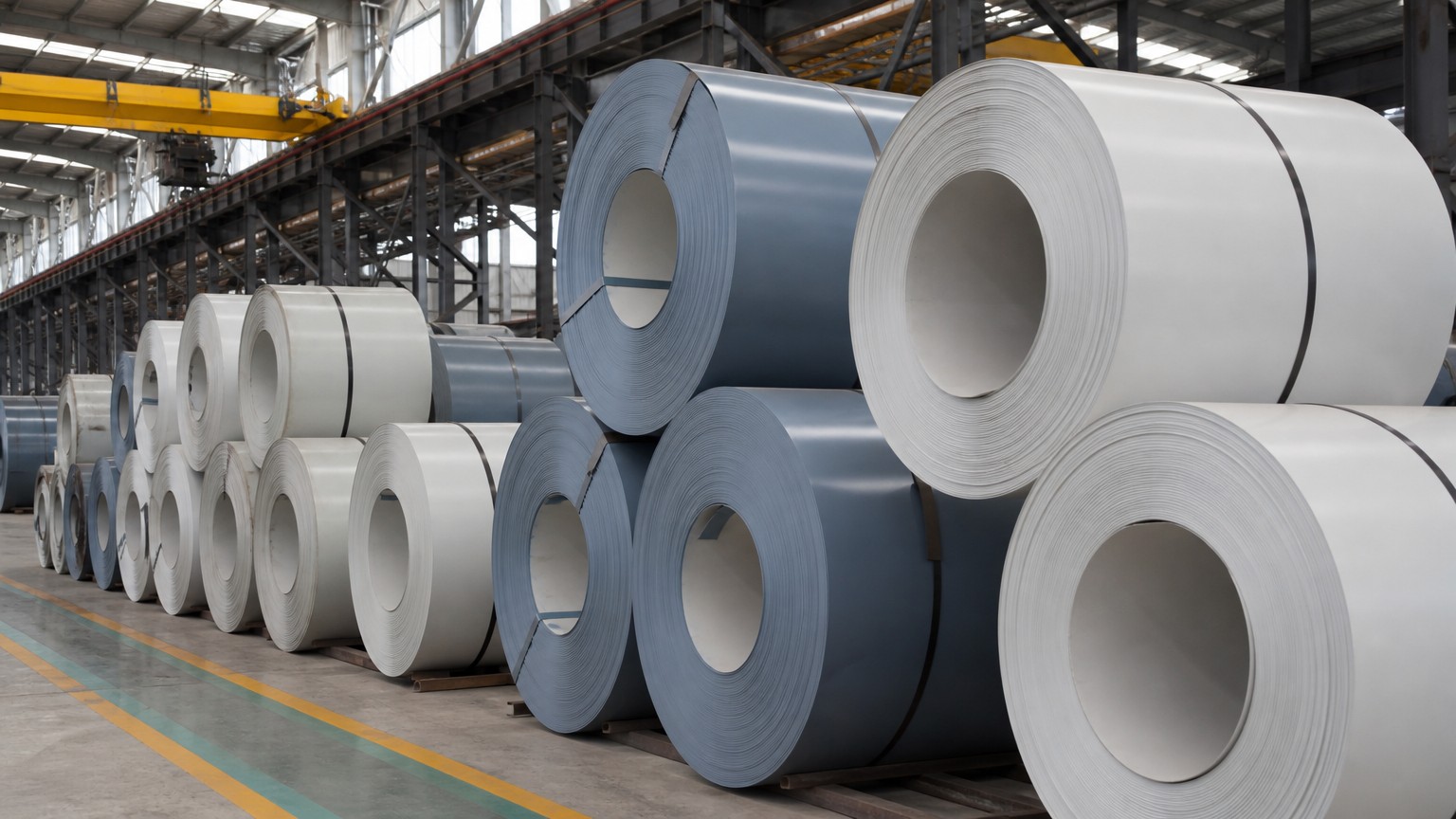
Coating thickness on a color coated coil is never one number. It is four numbers, and each one protects a different failure point.
Short answer: Total dry film thickness (TDFT) is the sum of the chemical pretreatment, the primer, the finish coat and, where specified, the backing coat, measured separately on each side of the strip.
Dive deeper: Start from the cross-section, because almost every argument you will have with a supplier about a “thin” coil is really an argument about which layer was reduced. The first layer on the steel is the chemical pretreatment, a conversion coating measured in fractions of a micron; it adds nothing measurable to the TDFT figure but decides whether the paint bonds to the metal at all. Above it sits the primer, normally 5–7 microns, which provides inter-coat adhesion and carries a large share of the system’s resistance to under-film corrosion at cut edges and scratches. The finish coat, commonly 15–20 microns on exterior products, faces sunlight, rain and abrasion, and it holds the pigments and fillers that give you colour, gloss and surface texture. Where a product is coated on both faces, a backing coat of about 5–8 microns protects the inner surface during handling, storage and profiling. Add those layers and you arrive at the 20–25 micron TDFT typical of exterior building sheet; remove the backing coat and you have the single-side figure quoted for interior panels. The practical point is that “coating thickness” on a quotation is ambiguous until it states whether the figure covers one coat, one side or the whole system. A coil advertised at 20 microns may be 20 microns of topcoat on one face, or 12 plus 8 microns split across both faces — and the second product protects a roof far less well than the first, even though the headline number looks identical. One further distinction matters just as much: film thickness is not the same as zinc coating weight. Paint is measured in microns; the metallic layer underneath is measured in grams per square metre, as Z120, Z180 or Z275. A coil can carry a generous 25 microns of paint over a minimal zinc layer and still rust from its cut edges within a few years, because paint protects the flat surface while zinc protects the damage. Only the two numbers together describe a system, and the way the continuous coil coating line builds those layers is set out in the Wikipedia overview of prepainted metal, which also notes the EN 10169 definition of the process.
How Many Microns of Coating Do You Actually Need?
The right film build is set by the environment the panel will live in, not by whichever number a competitor happens to offer.
Short answer: Allow about 20–25 microns total dry film thickness for exterior sheet in a temperate climate, 25–30 microns for coastal or heavy industrial exposure, and 15–20 microns for interior panels.
Dive deeper: Design from the outside in. Sunlight, rain, salt and airborne pollution attack the finish coat first, so the starting question is how aggressive the exposure is. A sheltered inland roof and a facade three kilometres from the sea do not need the same film, and pricing them identically either wastes money on the inland building or under-protects the coastal one. Once the exposure class is fixed, the film build follows, and it should always be written as a range with a stated minimum, because a coating line controls an average across the strip and a specification with no floor can be satisfied by a coil that is thin at the edges and thick in the middle. Two buyers asking for the same 0.6 mm strip in the same colour can therefore need different film builds, and the difference is decided by where the panel is fixed rather than by how the coil looks in the warehouse. Exposure is usually described in the industry by corrosivity category, running from a mild rural atmosphere, through urban and industrial environments, to a severe coastal or chemical setting, and each category implies its own combination of zinc coating weight and organic film build. Moving up one film class at the order stage is far cheaper than re-cladding a building two years later, which is why the table below is written as a specification pattern rather than a set of prices.
| Service condition | Typical total dry film thickness | Backing coat | Typical zinc coating weight | Typical paint system |
|---|---|---|---|---|
| Interior partitions, ceiling tiles, appliance housings | 15–18 µm | 5–6 µm | Z20–Z100, or cold rolled base | Polyester |
| Exterior roofing, sheltered inland site | 20–22 µm | 5–7 µm | Z120–Z180 | Polyester or SMP |
| Exterior cladding, humid or polluted air | 23–25 µm | 7–8 µm | Z180–Z275 | SMP or HDP |
| Coastal, heavy industrial, high UV | 25–30 µm | 8–10 µm | Z275 or aluminium-zinc | HDP or PVDF |
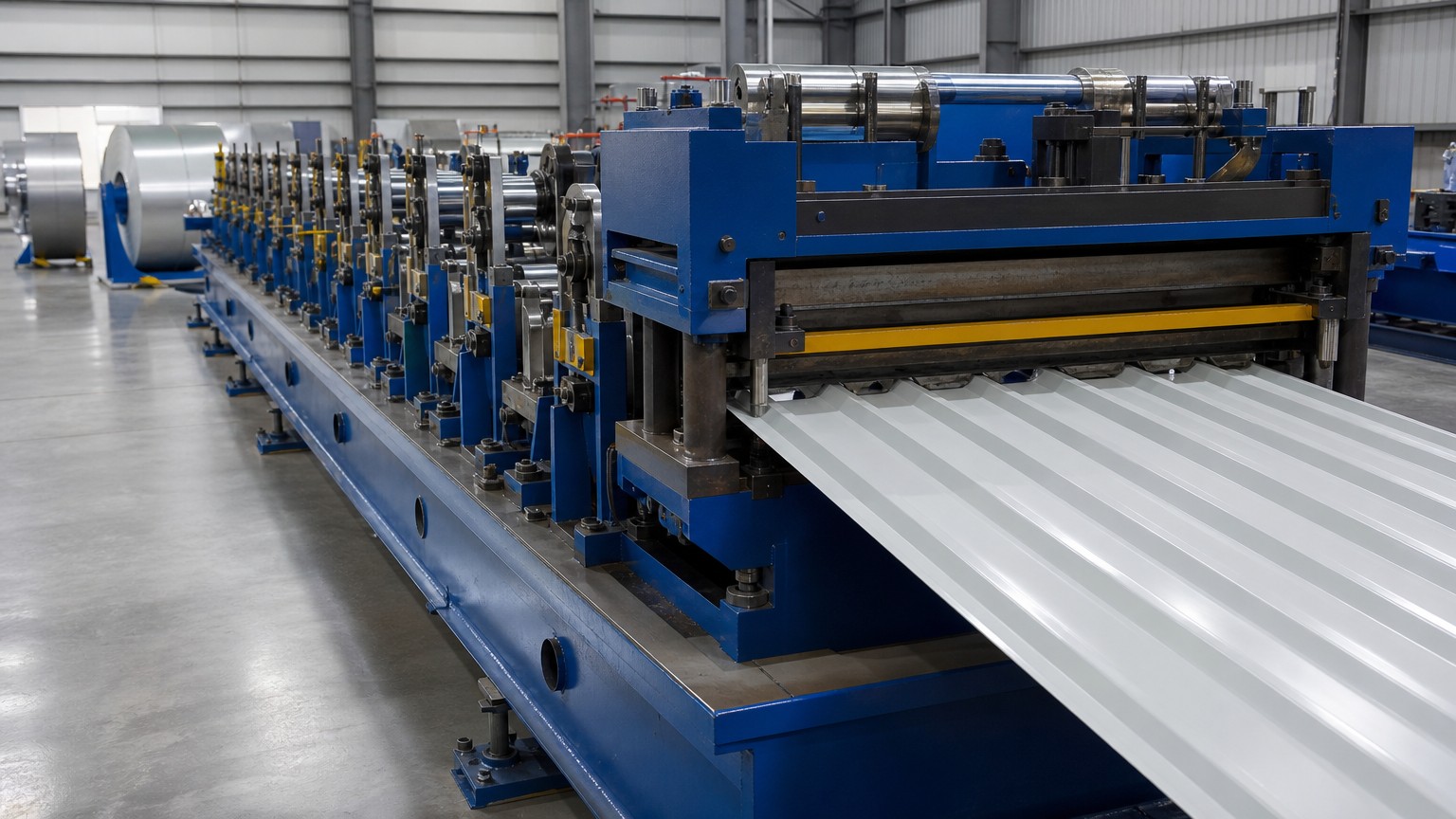
Two further variables move the numbers. The first is the profile. A trapezoidal roofing sheet is roll-formed after coating, so the film is stretched thinner over every bend and rib; a coil destined for deep profiles therefore needs a slightly heavier build than a flat wall panel to end up with the same protection at the corners. The second variable is the metallic layer beneath the paint, because paint defends the flat surface while zinc defends the cut edge, the fixing hole and the reverse face. Zinc coating weight is quoted as a mass rather than a thickness for a sound reason: it is the amount of metal deposited on the strip, and the sacrificial mechanism that lets it protect exposed steel is explained in the Wikipedia article on hot-dip galvanization. A Z180 coil carrying 22 microns of paint and a Z275 coil carrying the same 22 microns behave very differently on a coastal site, which is why the two numbers belong on the same line of the order. We publish the coating weights, film builds and paint systems available across our color coated steel coil range, so that an offer can be checked against a written baseline instead of a sales claim.
Does a Thicker Coating Always Last Longer?
More microns normally means more protection, until the film becomes brittle, expensive or impossible to form without cracking.
Short answer: Up to the design limit of the paint system, extra thickness extends service life; beyond it, each additional micron costs money, adds little protection and can reduce flexibility at tight bends and cut edges.
Dive deeper: Coating performance is not a straight line. In the thin region, every micron added to the finish coat buys a disproportionate improvement, because the film is what blocks ultraviolet light, water and oxygen from reaching the primer and the substrate. That is why a panel built at 15 microns chalks and fades noticeably faster than an otherwise identical panel built at 22 microns. As the film thickens further, the curve flattens: once the coating is thick enough to absorb the UV dose the local climate delivers, adding microns to the topcoat changes very little about how the panel weathers, because the limiting factor becomes the primer, the pretreatment or the zinc layer rather than the finish. In that region a supplier who sells “extra thick” paint as the headline benefit is often describing margin, not durability. There is also a real penalty at the top end. A heavier film is less flexible, so it can micro-crack over the tight bends of a trapezoidal profile or fail a T-bend and impact test where a thinner, better-formulated system would pass. An over-thick primer can also create inter-coat adhesion problems, because the primer layer becomes the weak link instead of the bond between pretreatment and metal. The practical rule is to treat film build as a window rather than a target: a stated minimum that guarantees weathering performance, a stated maximum that protects formability and adhesion, and a paint system whose resin family is matched to the exposure. Two coils with identical TDFT and different resins are not equivalent products — a 22 micron silicone-modified polyester and a 22 micron PVDF differ by several years of gloss retention and a significant price. Buyers who want the reasoning behind those resin choices, the substrate options and the receiving checks in one place will find them in our guide to buying prepainted steel coil, which sets the paint system, the zinc weight and the film build side by side.

How Do Paint Systems Change the Microns You Should Specify?
Polyester, SMP, HDP and PVDF are not interchangeable at the same film build, because each resin needs a different film to reach its rated life.
Short answer: Standard polyester is normally built at 20–22 microns total, SMP and HDP at 22–25 microns, and PVDF at 23–27 microns, because a fluoropolymer system delivers its service life from a heavier, denser film.
Dive deeper: The resin in the topcoat decides how the film degrades, so it also decides how much film is needed to reach a given warranty period. Polyester is the economical workhorse: flexible enough to survive profiling, colour-fast enough for typical building service of five to eight years in a moderate climate, and inexpensive enough to keep large roofs affordable, with a film build of roughly 20–22 microns across primer and topcoat. Silicone-modified polyester (SMP) hardens the surface and improves gloss and colour retention, which is why it is a common specification for roofing in tropical and high-UV markets; it is normally built slightly heavier, around 22–24 microns, and the harder film trades away some formability, so it suits moderate profiles rather than very tight bends. High-durability polyester (HDP) closes the gap to premium systems: it keeps much of the formability of a standard polyester while using more UV-stable chemistry, and it is usually specified at 23–25 microns for industrial roofs and commercial cladding where a decade or more of gloss retention is expected. PVDF sits at the top of the range, using a fluoropolymer resin that resists UV degradation, chalking and chemical attack, and it is typically applied at 23–27 microns because the protective effect comes from a continuous, dense film rather than a thick pigment layer; it is the normal specification for coastal high-rise cladding, airports and landmark buildings where a 20-year-plus colour warranty is expected. Two practical consequences follow. First, never accept a quotation that names only the resin family and the thickness: ask which grade of paint and which manufacturer, because the difference between an unbranded import paint and a branded system is often larger than the difference between two coil suppliers at the same film build. Second, tie the film build to the colour. Dark shades and certain organic pigments absorb more heat and degrade faster than light greys and whites, so a dark roof carried at the same microns as a light one will show fade and gloss loss sooner; specifying the colour by an international reference such as the RAL colour standard, rather than by name or photograph, is what makes the colour — and any later fade claim — measurable instead of subjective.
How Do You Measure and Verify Coating Thickness?
A certificate states what the coil should be. A gauge and a solvent rub tell you what actually arrived.
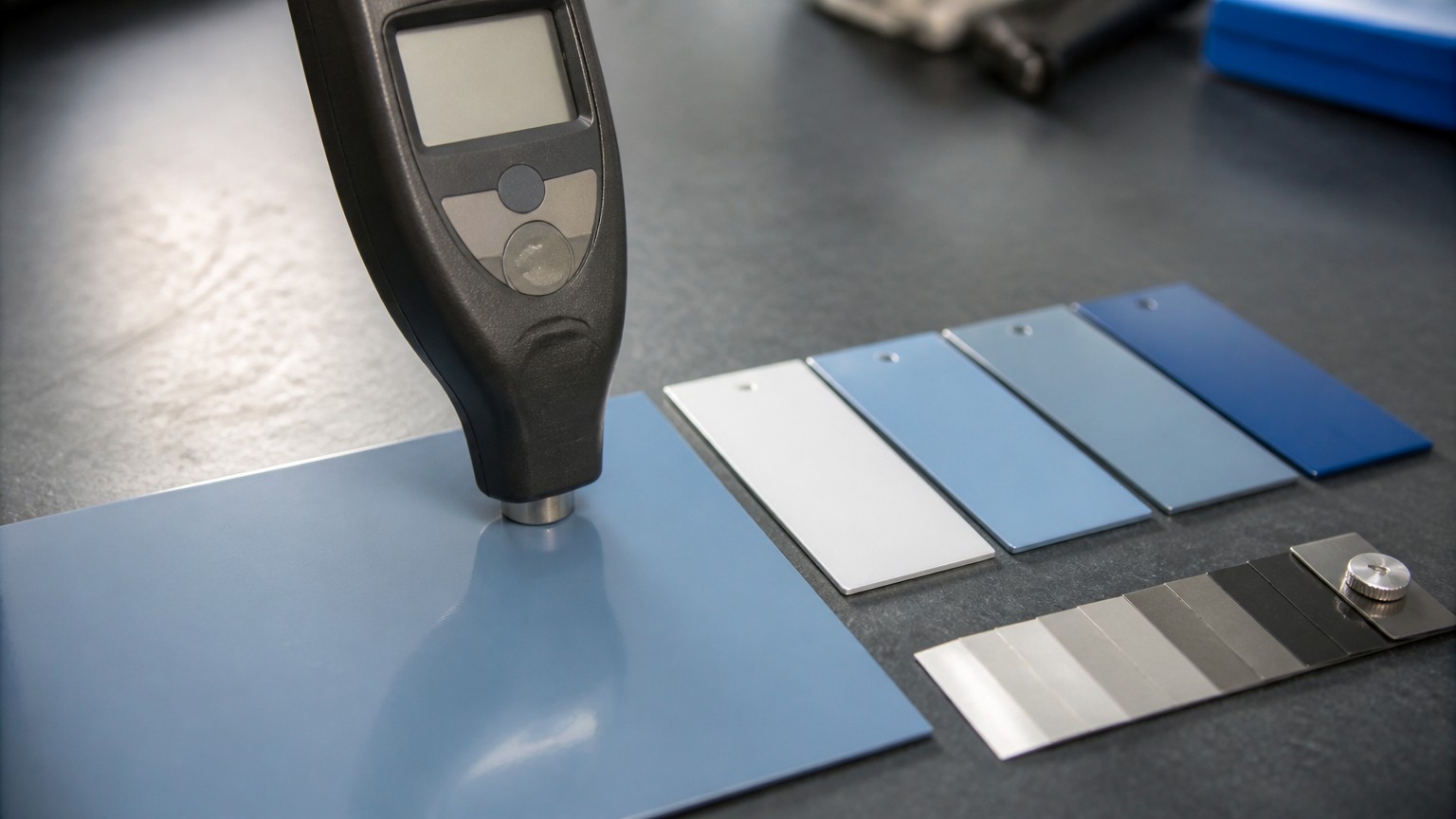
Short answer: Measure with a calibrated magnetic or eddy-current dry film thickness gauge at several points across the strip, verify the gauge against certified foils first, and confirm cure and adhesion with a solvent rub and a bend test.
Dive deeper: Film thickness is one of the few specification items an importer can verify cheaply on arrival, so it should never be accepted on paperwork alone. The standard approach uses a magnetic gauge on steel substrates and an eddy-current gauge on non-ferrous ones, and the procedure — calibration, verification of the gauge against reference foils, and a defined measurement pattern — is described in ASTM D7091-22, the standard practice for nondestructive measurement of dry film thickness of nonmagnetic coatings. Three habits separate a meaningful check from a token one. First, verify the gauge before and after the measurement session with certified foils of a thickness close to the expected reading; a gauge that is accurate at 10 microns may drift at 30, and an unverified reading is an opinion rather than a measurement. Second, distribute the readings. Coating thickness varies across the width and along the length of a coil, so five to ten readings spread across the visible face, the reverse face and both edges give a far better picture than one reading in the middle. Record the minimum as well as the average, because a coil that averages 22 microns while dipping to 15 at the edges will chalk first exactly where the edge protection is most needed. Third, use the readings as a decision tool: a consistent shortfall of several microns against the agreed specification is a reason to reject the delivery or renegotiate it, not to negotiate a small discount, because the reduction is permanent and it applies to every square metre you were sold. Beyond thickness, two simple checks confirm the film is properly made. The solvent rub, using a cloth soaked in methyl ethyl ketone, tests cure: a film that softens and wipes away after a limited number of double rubs was under-cured and will fail in the field long before it fades. The T-bend or a simple mandrel bend tests flexibility and adhesion at the same time: cracking or delamination at the bend shows that the film build is beyond what the resin can take, or that the pretreatment bond is weak. Together, a thickness gauge, a solvent-rub test and a bend test cost very little and cover most of the ways a color coated coil is downgraded in transit. Our PPGI color coated steel coil in 0.6 mm RAL 9010 is a typical stocked line for building work, and it is delivered with the coating weight, paint system and film build stated on the documents so that each of them can be measured against a written figure.
What Happens When the Coating Thickness Is Wrong?
Wrong thickness does not announce itself at goods-in. It appears on the building two or three years later, when the panels are already installed.
Short answer: Too thin a film chalks, fades and blisters early, while an over-thick, brittle film cracks at bends and cut edges; both failures are traced back to a specification that never stated a minimum, a maximum and a measurement method.
Dive deeper: Thin films fail from the outside in. With insufficient topcoat, ultraviolet light reaches the pigment system faster, so chalking — the surface slowly eroding into a pale powder — and gloss loss appear within a couple of seasons, and the same film offers less moisture resistance, which is why blistering and rust staining show up at cut edges and fastener positions first. Because the failure is a slow degradation rather than a single event, it is usually discovered after the building is occupied, when the remediation cost includes access equipment, disposal and re-cladding rather than a simple coil replacement. Over-thick films fail differently. A very heavy topcoat is less flexible, so it micro-cracks over tight bends and profile radii, and once a crack reaches the primer the corrosion mechanism starts exactly where the paint was supposed to be strongest; heavy films are also more prone to inter-coat adhesion problems and can look slightly different in gloss from the approved sample. Both outcomes trace back to the same commercial trap: an ambiguous specification. Quotations that quote “20–25 microns” without saying whether the figure covers the topcoat only, one side or the full system leave room for a coil that meets the words and misses the intent, and they give a buyer no basis for a claim. The defence is to write the order the way a coater does: substrate grade, zinc coating weight, paint system and paint brand, primer thickness, topcoat thickness, total dry film thickness with a minimum, colour reference, and the measurement method you will use on arrival. Add the mill test certificate and traceability to the heat number, and the coil becomes a specified engineering product rather than a commodity bought on price. If you would like a quotation written in that form, with each layer named, request a coating specification quotation and we will send the technical data and test documents together with the price.
Conclusion: Coating thickness is a specification, not a sales number. Write the layer-by-layer microns down, measure them on arrival, and the colour you bought is the colour you keep.