
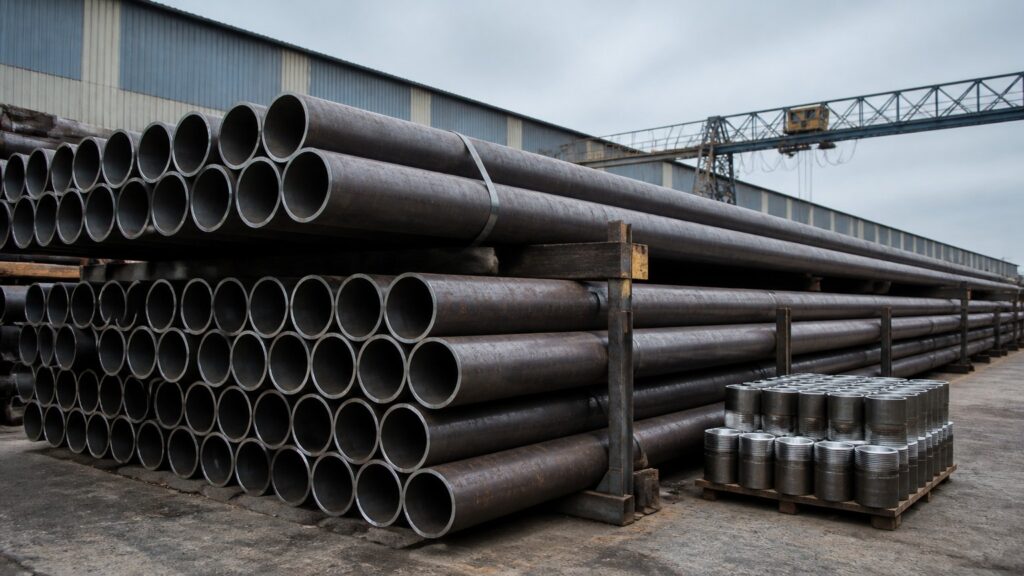
How Do You Prevent Casing Corrosion in Sour Wells?
A corroded casing string fails behind pipe, where nothing can be replaced without a workover. Most sour-service failures were written into the enquiry long before the well was ever drilled.
You prevent casing corrosion in sour wells by matching the steel to the fluid: keep hardness below the sulphide cracking limit, choose a grade and product specification level that suit the H2S and CO2 partial pressures, protect threads and internal surfaces, and verify everything with inspection and records.
That answer is short, and the work behind it is not. Sour service is the one part of tubular procurement where a single wrong number in the specification can produce a brittle failure rather than a slow leak — and where two quotations for the same size and grade can describe materially different products. The sections below follow the decision sequence a buyer should actually use: how a well is classified as sour, which mechanisms damage casing, how grade and hardness are selected, which barriers keep fluid off the steel, how a string is monitored once it is downhole, and what the purchase order and documentation must contain.
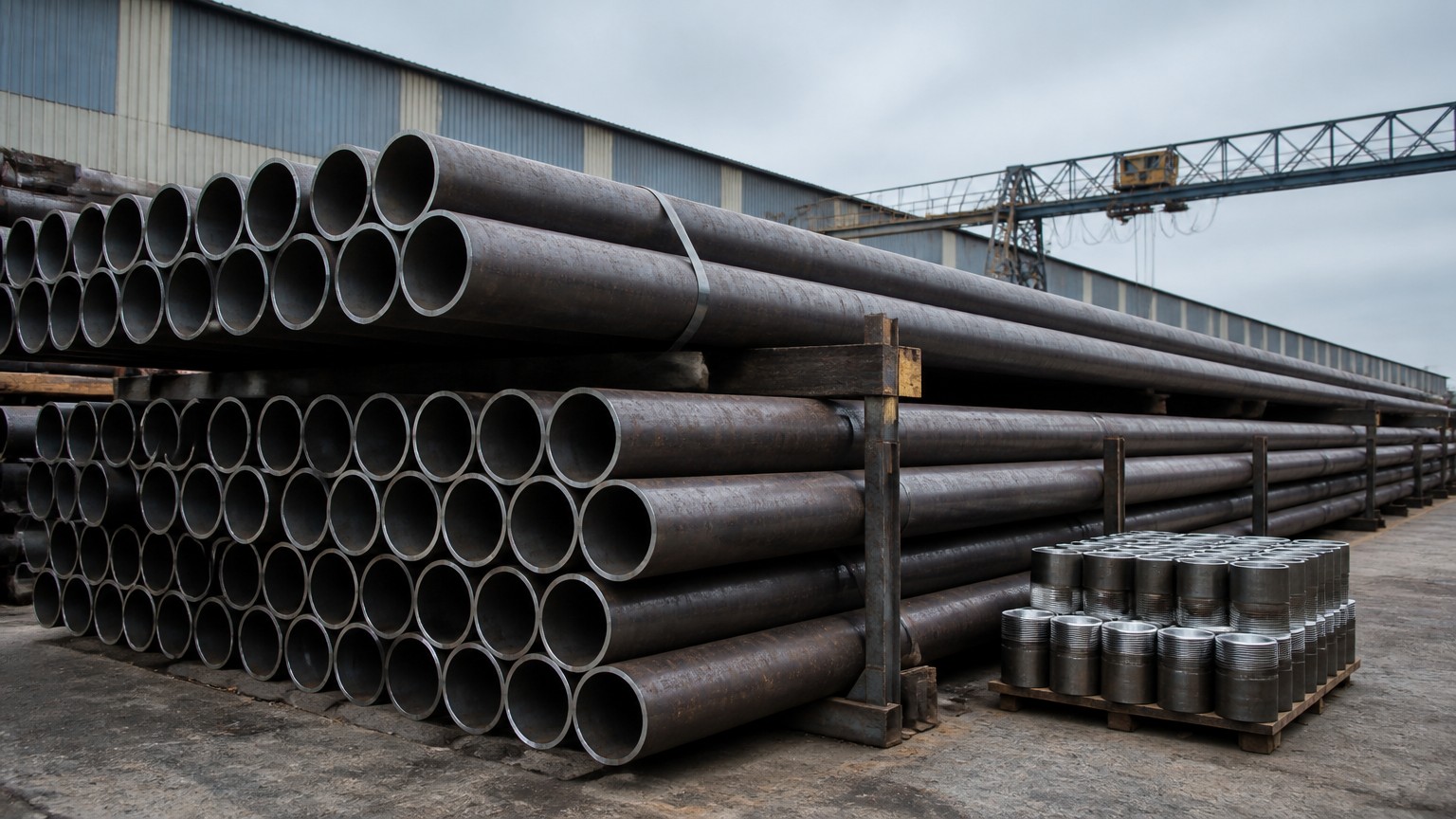
What Makes a Well Sour, and Which Part of the String Does It Attack?
Sour service is defined by hydrogen sulphide, and the classification is made before any steel is ordered.
A well is sour when the produced fluid carries significant hydrogen sulphide. Natural gas is usually treated as sour above roughly 4 ppm by volume of H2S, although thresholds vary by regulator. Casing and tubing both see the fluid, so the whole string is specified as a system.
Where the sour definition comes from
The commonly quoted threshold is a concentration, not an opinion. Sour gas is natural gas or any other gas containing significant amounts of hydrogen sulphide: the widely cited figure is more than about 5.7 mg of H2S per cubic metre of gas, equivalent to roughly 4 ppm by volume at standard conditions. The same source records how much the number moves with jurisdiction — the Texas Railroad Commission treats a pipeline carrying over 100 ppm by volume of H2S as a sour gas pipeline, while the Texas Commission on Environmental Quality has historically used a much lower figure for upstream permitting. For a buyer, the practical consequence is that “sour” is not a single global line. It is defined by the operator, the regulator and the fluid analysis for that specific field, and the specification has to name which one applies.
Both strings are in scope, for different reasons
Casing is the well’s permanent lining and tubing is the removable production conduit, but sour service does not respect the difference. The production casing is exposed to the formation fluid during drilling, completion, perforating and any period when the annulus is not fully isolated, and it is exposed to formation water on its external surface wherever the cement sheath is incomplete. Tubing is the flow-wetted component and usually sees the highest velocities, the highest partial pressures and the most intervention damage. A sour design that hardens the tubing and leaves the casing grade unqualified has protected the retrievable component and left the permanent one exposed.
Why sour service is a material decision rather than a well label
The classification also moves over time. A field that produced sweet gas for a decade can turn sour as the reservoir is drawn down or as water breakthrough occurs, and a well that produced dry gas can start carrying formation water after a workover. Because a casing string is designed once and installed once, the specification has to cover the fluids the well may see over its whole producing life, not just the commissioning analysis. The related design logic — how casing and tubing divide the work downhole and which parts of the string are flow-wetted — is set out in our overview of preventing casing corrosion in sour wells, which follows the same sequence from product family to inspection. Getting that division right matters commercially as well as technically: it decides which metres of pipe need a restricted-yield grade and which can stay in a standard carbon steel grade.
Which Corrosion Mechanisms Actually Fail Casing in Sour Service?
Four mechanisms do most of the damage: sulphide stress cracking, hydrogen-induced cracking, carbon dioxide wall loss, and localised attack during interventions.
In sour wells the dominant risk is cracking rather than general thinning. Sulphide stress cracking is a hydrogen embrittlement failure driven by H2S, steel hardness and applied stress; carbon dioxide causes gradual wall loss; acidising, oxygen ingress and dissimilar-metal contact add localised attack on otherwise sound pipe.
Sulphide stress cracking is the failure mode that decides the grade
Sulphide stress cracking is described in the literature as a form of hydrogen embrittlement caused by hydrogen sulphide. The sequence is short: wet H2S dissociates at the steel surface, atomic hydrogen enters the metal instead of recombining into gas, and the trapped hydrogen embrittles a steel that is already carrying tensile load. Failure is brittle and can occur below the material’s yield strength, which is why it defeats the intuition that a stronger grade is a safer grade. Three variables decide whether it happens — the H2S partial pressure in the wetted environment, the hardness of the steel, and the level of tensile stress — and a specification can only control two of them directly. This is also why sour failures rarely announce themselves: there is no visible wall loss to inspect, no gradual pressure decline to trend, and no warning between a sound string and a parted one.
Hydrogen-induced cracking and blistering
The same hydrogen flux produces a second family of defects when it concentrates at inclusions, laminations or hard bands in the steel rather than at a stressed surface. Hydrogen atoms recombine into molecular hydrogen inside the metal, build pressure at a discontinuity, and open a planar crack that grows parallel to the surface — hydrogen-induced cracking, with stepped cracking where several planes link up. Blistering is the visible version of the same process. The mitigation overlaps with sulphide stress cracking but is not identical: cleanliness, low sulphur, controlled inclusion shape, sound plate and seamless wall quality, and low hardness all reduce susceptibility, which is why sour-service orders commonly tighten chemistry beyond the baseline composition requirements of the grade. For a buyer, that means the manufacturing route matters — a clean, properly rolled or pierced wall with controlled chemistry resists hydrogen damage better than a pipe that only meets the minimum mechanical values.
Carbon dioxide corrosion thins the wall without cracking it
Where H2S drives cracking, CO2 drives metal loss. Wet carbon dioxide forms carbonic acid, which attacks the steel surface and produces a corrosion product layer whose protectiveness depends strongly on temperature and flow. At higher temperatures a dense iron carbonate film can slow the rate markedly; at lower temperatures, in high-velocity flow, or where the film is mechanically disturbed, the surface corrodes continuously and wall thickness falls. Most wells are not purely sweet or purely sour — both gases are usually present, and the mixture changes the risk profile rather than simplifying it. That is why a wall-thickness allowance and a grade decision should be made against the CO2 partial pressure as well as the H2S partial pressure, rather than treating the well as a single corrosion problem. For casing and tubing alike, casing corrosion prevention starts with knowing which of the two gases dominates the wetted surface at each point in the well.
Localised attack that is easy to overlook
The remaining damage mechanisms are less exotic and just as expensive. Hydrochloric acid used in matrix acidising attacks the same steel that will carry production for the next twenty years if the inhibitor package in the acid is not matched to the temperature and contact time. Oxygen introduced during interventions, fluid transfers or poor displacement practice raises corrosion rates dramatically compared with an oxygen-free system. Dissimilar-metal contact between carbon steel and a corrosion-resistant alloy accessory can drive galvanic attack on the less noble material. None of these mechanisms requires a sour well to start, and all of them are aggravated by one: an acid-damaged or oxygen-pitted surface is exactly the stress concentration and hydrogen trap that sulphide stress cracking needs to initiate.
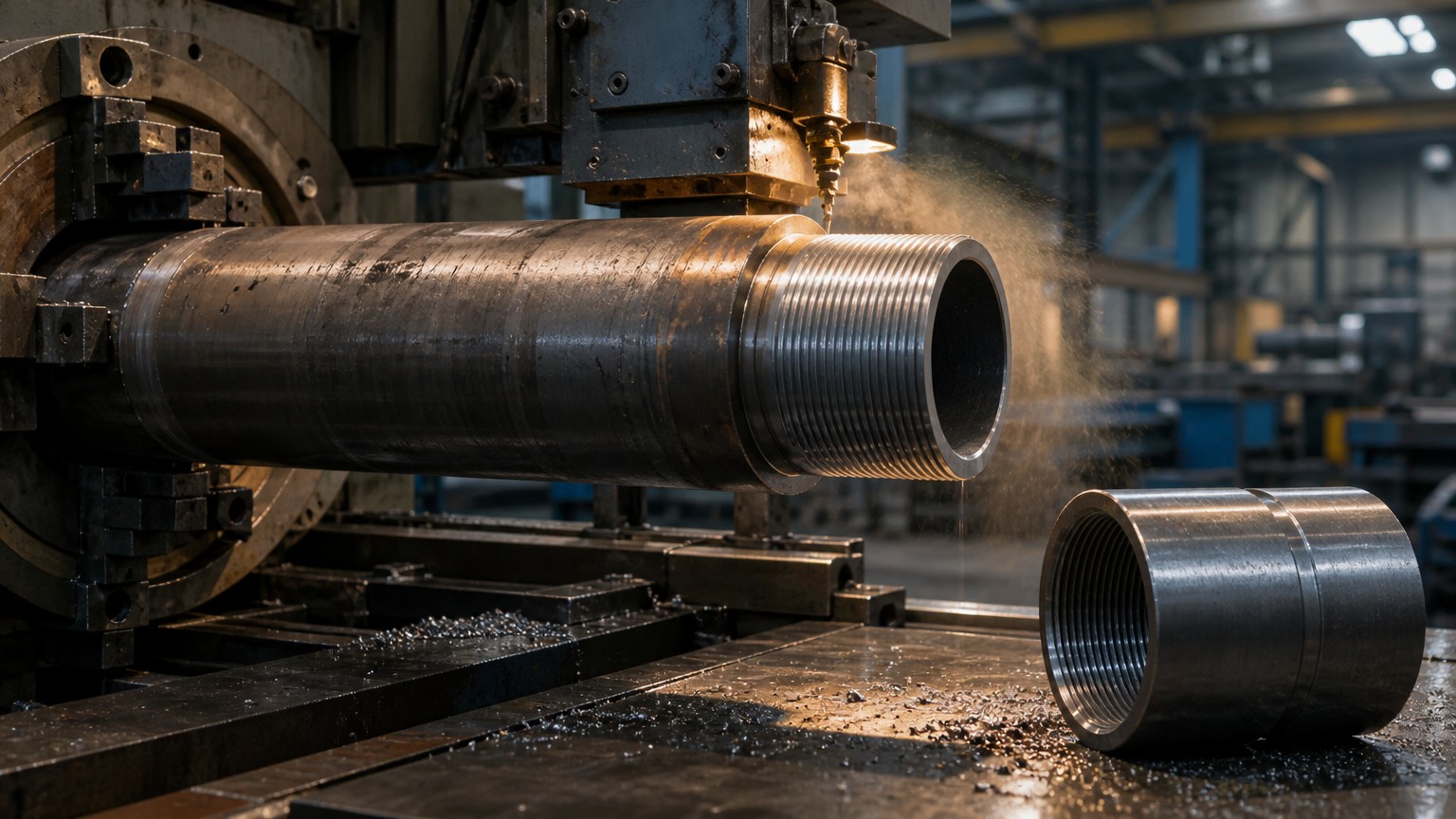
How Do You Choose a Casing Grade and Hardness Limit for a Sour Well?
Set the hardness ceiling first, then pick the strength level that still carries the load.
For carbon and low-alloy casing in sour service, hardness is the controlling variable: the familiar maximum is 22 HRC, which normally points to L80, C90 or T95 rather than N80 or P110. The grade must also suit the H2S partial pressure, the CO2 level and the temperature.
Start with partial pressure, not with strength
The material selection process begins with the environment, not with a tensile requirement. The sour-service material standard that the industry works to — commonly referenced as MR0175 / ISO 15156 — classifies environments by the partial pressure of H2S in the wetted stream, together with the in-situ pH and the presence of elemental sulphur, and the corrosion standards published by AMPP, the association for materials protection and performance, sit behind that framework. The consequence for a specification is straightforward: the same casing size can be acceptable in one well and unacceptable in the next, because the number that changed is a gas partial pressure rather than a diameter. It also means that “sour service” on a purchase order is not a specification on its own. A supplier needs the partial pressures, the temperature range, the chloride level and the intended service to select or confirm a grade, and a buyer who cannot supply them is asking for a guess rather than a selection.
Hardness is the variable that decides whether cracking can start
Sulphide stress cracking is hardness driven. Because the failure depends on hydrogen embrittling a highly stressed, high-hardness microstructure, the industry answer is to cap hardness rather than to raise strength: carbon and low-alloy steels for sour service are commonly limited to a maximum of 22 HRC, with the limit applying to the pipe body, the weld and the heat-affected zone, and to the coupling as a separate item. The practical effect is a reordering of the usual grade hierarchy. N80 and P110 are excellent sweet-service grades and are normally outside the sour envelope; L80, C90 and T95 are restricted-yield grades with controlled chemistry and heat treatment specifically so that hardness stays under the ceiling while strength is maintained. Two quotations for the same J55 or N80 size can therefore differ very substantially — not because one supplier is cheating, but because only one of them is quoting a product qualified for the service conditions.
Where the common grades sit
The ISO counterpart of API 5CT lists the grades H40, J55, K55, N80, L80, C90, R95, T95, P110, C110 and Q125 across three product specification levels. A working map of that list, in terms of sour applicability, looks like this:
| Grade group | Typical role | Sour-service position |
|---|---|---|
| H40, J55, K55 | Surface, conductor, shallow and low-pressure strings | Used where H2S partial pressure is low; hardness still has to be verified per heat |
| N80 (Type 1 and Q) | General intermediate and production casing, tubing | Sweet service; normally outside the sour envelope unless qualified by test |
| L80 (Type 1, 9Cr, 13Cr) | Restricted-yield sour-service casing and tubing | Common carbon steel sour choice; modified 13Cr versions add CO2 resistance |
| C90, T95, R95 | Higher-strength restricted-yield grades | Sour service where a stronger string is required at controlled hardness |
| P110, C110, Q125 | High-pressure sweet service and deep strings | Outside the standard sour envelope; requires specific qualification |
Use the product specification level deliberately
Grade is only half of the order. The product specification level decides how much evidence comes with it: PSL-1 is the baseline, PSL-2 adds mandatory non-destructive examination, tighter chemistry control and impact testing, and PSL-3 tightens the requirements further for the most demanding service. In sour wells the impact requirement is not a formality, because low-temperature toughness and resistance to brittle behaviour are related properties in exactly the way that matters for a cracking-dominated failure mode. A specification that names a sour-grade pipe at PSL-1 has named the material and left the assurance behind, which is why the enquiries that survive third-party inspection name the grade, the type, the heat-treatment condition and the specification level together.
Which Design and Material Choices Keep the Fluid Away from the Steel?
Grades resist corrosion; barriers decide how much of the string the fluid ever touches.
Three barriers carry most of the load: a competent cement sheath and packer that limit which surfaces stay wet, internal coatings or liners on flow-wetted pipe, and a chemical inhibition programme with residual monitoring. Threads, couplings and handling practice protect the points where a string is mechanically weakest.
The cement sheath is a corrosion barrier as well as a support
External casing corrosion needs water against the steel. Where cement fully displaces the drilling fluid around the string, that water is largely removed and the external surface is protected by both the physical barrier and the alkaline environment of the cement. Where the cement top is too low, where the bond is poor, or where the string passes through a depleted or over-pressured zone, formation water sits against the casing for the life of the well. The remedy is design and execution rather than material: centralisation, displacement efficiency, cement top placement and verification by cement evaluation logging. It is worth remembering that the highest external corrosion rates on casing are usually found in the shallowest section of the well, where formation waters are cooler and the electrochemical driving force is greatest — not deep in the hole where the grade decision normally attracts all the attention.
Internal coatings and liners for flow-wetted surfaces
An internal plastic coating is a barrier layer rather than a structural change: it isolates the steel from the produced fluid on the internal surface of tubing and casing where the fluid is in contact, and it suits water injection, produced water service and mildly corrosive production. Coatings work in their own conditions and fail in others — the barrier has to survive the temperature, the mechanical damage of running and wireline work, and the compressive stresses of make-up, and a holiday or damaged area becomes a preferred corrosion site. Liners and cladding make the same argument with a thicker, more robust barrier. For a sour string the coating question follows the grade decision, because a coating is an addition to a qualified material and never a substitute for it.
Inhibitors and residual monitoring
Chemical inhibition is the routine answer for produced fluids that cannot be economically re-metallised. A filming inhibitor adsorbs on the wetted steel surface and reduces both acid attack and hydrogen entry, and in sour wells reducing hydrogen entry is worth as much as reducing wall loss. The weakness of inhibition is that its performance cannot be verified from the surface unless it is monitored: residual inhibitor concentration in the produced water, iron counts, water chemistry and periodic caliper logs are the evidence that the programme is actually working at the downhole condition. A batch treatment that looks adequate on a tank level can be under-dosing at the point where the fluid is hottest and the velocity highest.
Threads, couplings and the accessory parts of the string
Connections are where sour service fails first in practice, because the coupling is a separate heat of steel with its own hardness and the thread root is a stress concentration. Sour-service practise therefore extends the hardness limit and the material qualification to couplings and accessory material, keeps thread protectors on the pipe until it is run, and controls make-up torque so the connection is neither loose nor yielding. The carbon steel baseline for that comparison — for example the OCTG tubing pipe 3-1/2 inch N80 supplied in seamless form — is a sweet-service product, which is precisely why a sour programme has to state that the qualified grade replaces it rather than assume the same item can be substituted.
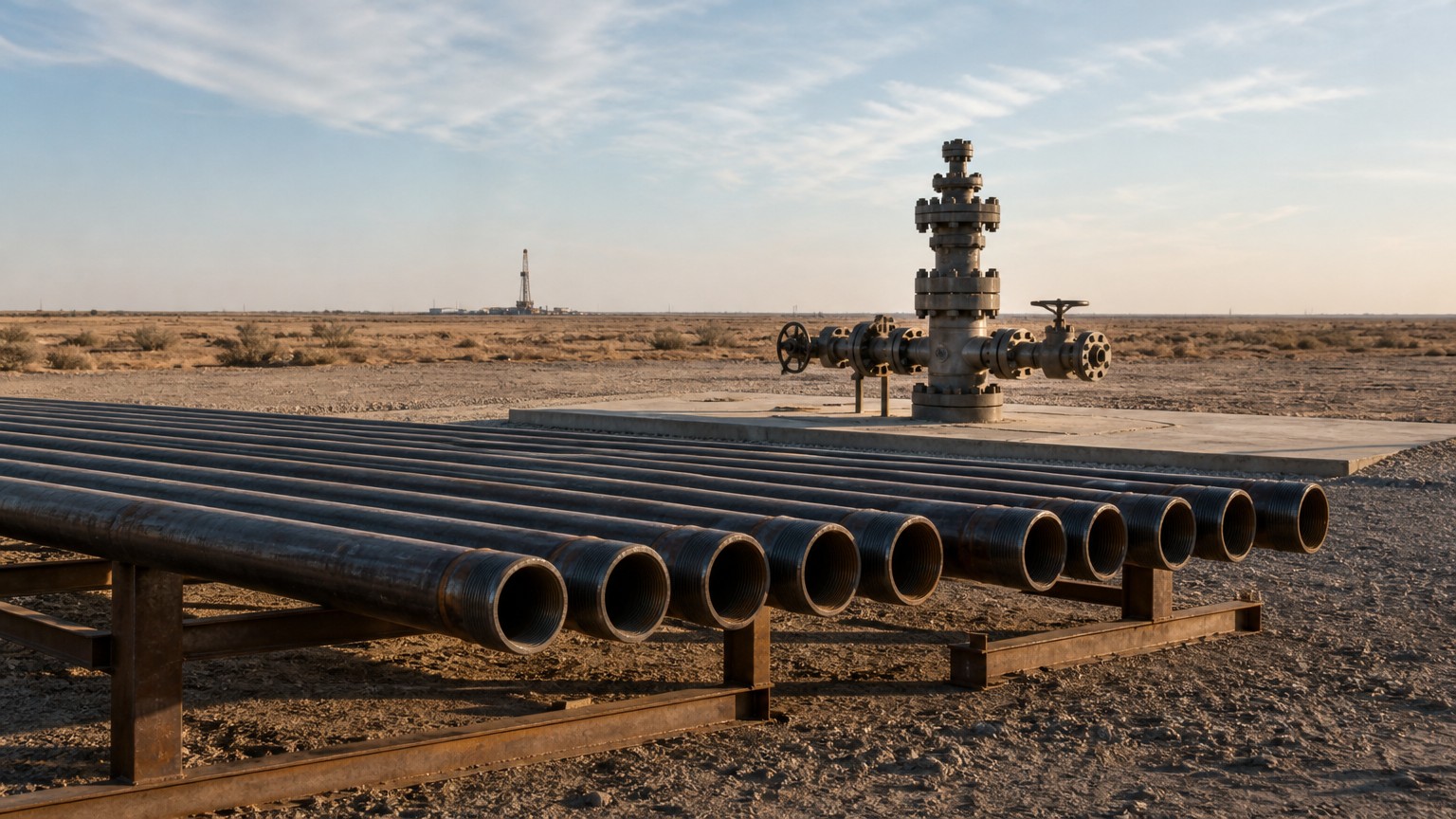
How Do You Monitor Casing Corrosion Once the Well Is Producing?
Corrosion that cannot be seen has to be measured indirectly, and it has to be measured against a baseline.
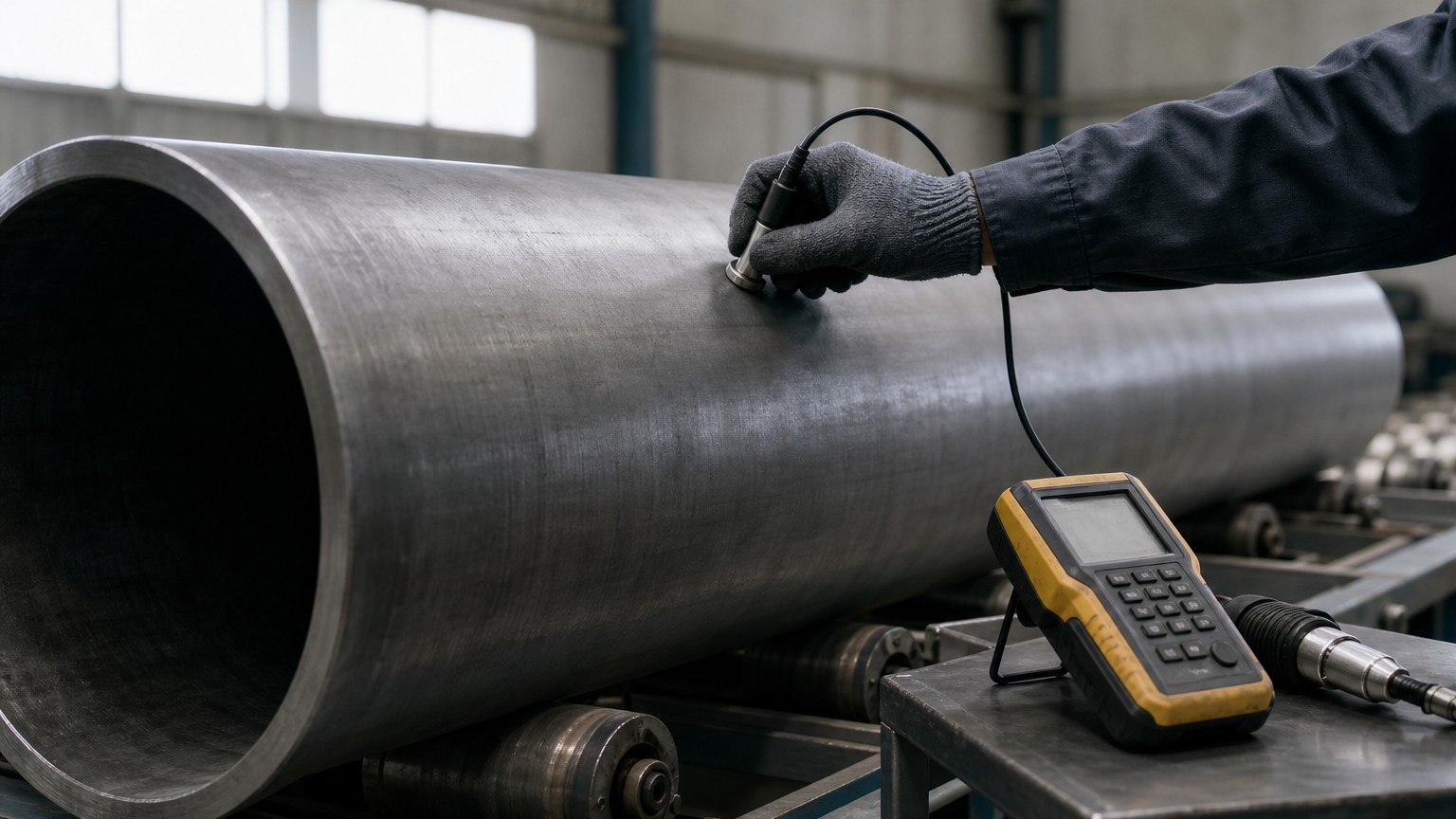
Monitoring combines chemical surveillance of the produced fluid with downhole wall-thickness logs, and where pipe is accessible at surface, direct inspection. Multi-finger calipers and ultrasonic tools record wall loss as a percentage of nominal, while radiographic techniques detect corrosion and deposits in pipe on the facility side.
Logs measure loss, but only against a first survey
Downhole wall-thickness measurement is a comparison, not an absolute reading. A multi-finger caliper records the internal profile of the casing and converts it into wall loss against nominal dimensions, and an ultrasonic tool measures wall thickness directly; both are far more useful when a baseline survey was recorded soon after completion. Without that baseline, an early survey reported years into production cannot distinguish manufacturing tolerance from corrosion, and the operator is left with a number that is difficult to act on. Logging programmes therefore tend to be scheduled around the well’s corrosion risk — the intervals where water is produced, where the fluid is hottest, and where previous surveys already showed loss — rather than run uniformly across the whole string.
Radiographic and facility-side inspection
Where pipe is accessible rather than cemented in place, direct inspection techniques apply. The ISO 20769-2:2018 standard covers radiographic inspection for corrosion and deposits in pipes by X- and gamma rays, including double-wall techniques for detecting wall loss, pitting and erosion in insulated or uninsulated lines, and it explicitly covers service-induced flaws rather than weld defects. On a sour wellsite that is the tool that answers the question for flowlines, injection lines and surface piping, while the downhole logs answer it for the cased hole. The two together give an integrity picture that neither provides alone.
Chemistry, iron counts and inhibitor residuals
The cheapest monitoring is chemical, and it is the first to be neglected. Tracking H2S and CO2 content, water cut, chloride level and pH establishes how aggressive the wetted environment actually is at any point in the well’s life, and the trend usually moves. Iron concentration in the produced water is a useful indirect indicator of corrosion activity, and inhibitor residual measurement shows whether the chemical programme is reaching the steel at the intended concentration. None of these readings is decisive on its own — a rising iron count can come from a change in flow, a new perforation or an acid job — which is why they are read as a trend alongside the logs and the production history rather than as a single verdict.
Turning monitoring into a decision
Monitoring only pays if it changes something. A loss rate that is trending upward at a defined interval typically leads to one of four responses: increase or change the inhibitor programme, plan a workover to replace the affected string, change the completion so the interval is no longer flow-wetted, or accept the remaining life against the well’s economics. Each of those responses has a procurement consequence, and the last stage of any of them is buying pipe again — which is why buyers replacing a corroded string tend to want the material documentation to be as complete as the original order. The full carbon and seamless range produced at our steel manufacturing base is supplied with the mill records that this decision needs, so a replacement string can be specified and verified on the same basis as the original.
What Should a Buyer Specify and Verify Before Sour-Service Casing Ships?
The specification is the only part of a sour-service programme that a buyer fully controls.
The order should name grade with type and heat treatment, product specification level, size and wall, connection, maximum hardness, impact test temperature, and the documentation package required. Verification then rests on the mill test certificate, hardness survey results, non-destructive examination records and third-party inspection.
Write the requirements that prevent disputes
The specification list is short and every line exists because something failed without it. State the H2S and CO2 partial pressures, the temperature range and the chloride level so the supplier can justify the grade selection. Name the grade with its type and heat-treatment condition rather than the grade alone. Cap hardness explicitly and require the limit to be demonstrated on pipe body, weld and coupling. Set the specification level, because that is what obliges non-destructive examination and impact testing. State the impact test temperature rather than leaving it to the mill’s default, since low-temperature toughness is the property that protects against brittle behaviour. Reference the sour-service material standard you intend to work to, and the API standards programme provides the delivery specification that sits above it. A purchase order that covers these lines removes the ambiguity that later becomes a claim.
Ask for the evidence, not just the certificate number
Documentation is where the specification becomes verifiable. A mill test certificate to EN 10204 3.1 or 3.2 links the delivered pipe to the actual heat tested, and the two levels are not interchangeable for a sour-service order. Hardness survey results should be traceable to the pipes supplied, not presented as a generic process capability. Non-destructive examination records for the pipe body, the ends and the coupling, thread gauging records for the connection, and a third-party inspection report where the value of the string justifies it, complete the package. The documentation questions to settle in advance are simple: which test results will be reported, against which heat numbers, and in what format, so that the review happens before shipment rather than after discharge.
Handling and installation decide as much as the steel
The best-qualified string can be compromised between the mill gate and the wellhead. Thread protectors have to remain in place until each joint is run, because a bruised thread is a leak path and a stress concentration at the same time. Storage should keep pipe out of standing water and away from the ground contact that starts external pitting. The thread compound has to suit the connection and the service, make-up torque has to follow the connection manufacturer’s figure, and field handling should avoid the mechanical damage that later acts as an initiation site. None of this is exotic, and all of it is routinely skipped when the schedule shortens — which is why the closing item on a sour-service checklist is not a material property at all, but a discipline about how the string is treated before it is turned to the right.
If you are specifying a string for a well that carries H2S, work from the fluid analysis rather than from the last order. Send us your well conditions and H2S content — grade, size, wall, connection and the documentation package you need — and we will confirm what can be supplied against that service.
Conclusion: How Do You Prevent Casing Corrosion in Sour Wells?
Prevent casing corrosion in sour wells by capping hardness, choosing a sour-qualified grade and specification level, keeping the fluid off the steel, and monitoring loss against a baseline.