
Seamless vs Welded Pipe: Strength, Cost and Application Guide
Almost every steel pipe order starts with the same question: seamless or welded? The answer decides not just the price on the quotation but the pressure rating, the delivery time, the testing paperwork and, ultimately, whether the pipe survives its service life. Yet many buyers treat the two as interchangeable and discover the difference only when an inspector rejects the shipment or a weld seam fails in service.
This guide compares seamless vs welded pipe on the four factors that actually drive procurement decisions — how each is made, how they differ in strength and reliability, what each one really costs, and which applications each type is best suited for — so you can specify the right product the first time and compare quotes on an identical basis.
Seamless vs Welded Pipe: What Is the Real Difference?
The difference is structural, not cosmetic. A seamless pipe is produced from a single solid steel billet that is heated and pierced to form a hollow shell, then elongated and sized without any longitudinal joint. Because the pipe body is one continuous piece of steel, it has no weld line anywhere along its length. A welded pipe, by contrast, starts as a flat strip, coil or plate that is formed into a cylindrical shape and joined along its length by a welding process such as electric resistance welding (ERW) or submerged arc welding (SAW).
Both product families are covered by the same international dimensioning systems — the outside diameter is fixed by the nominal pipe size and the wall thickness by the schedule, as documented in standards such as ASME B36.10M — but the manufacturing route creates real differences in microstructure, tolerances and cost. Understanding the production process is therefore the first step in any seamless steel pipe or welded pipe comparison, because each process imposes its own limits on size, wall thickness and quality consistency. As one authoritative industry reference on pipe manufacture and design explains, seamless pipe has historically been regarded as withstanding pressure better than welded types, while welded pipe has benefited from continuous improvements in process control since the 1970s.
Manufacturing Processes: How Each Type of Pipe Is Made
The production route is the root cause of every downstream difference between seamless and welded pipe — including price.
How seamless pipe is manufactured
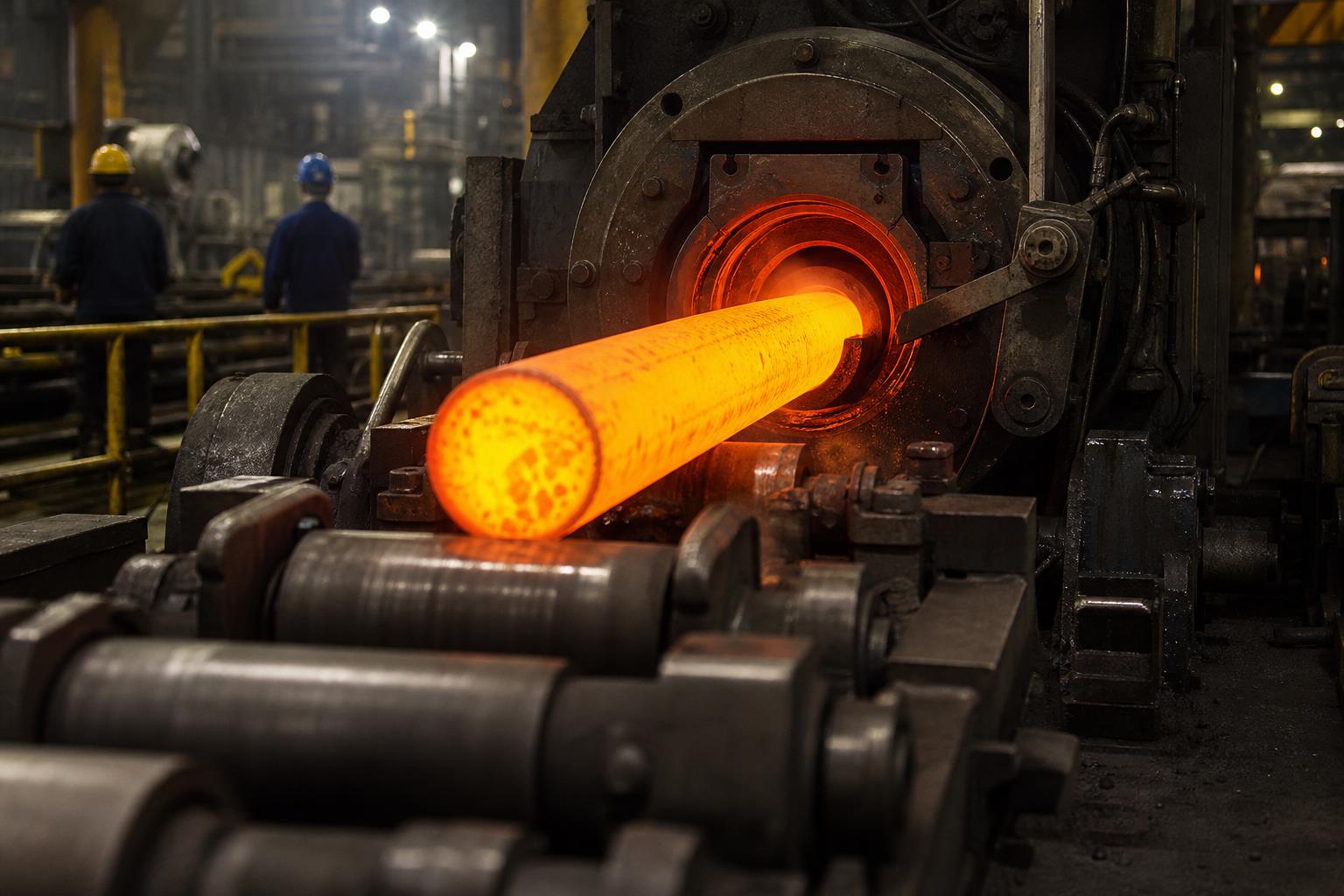
Seamless pipe begins with a solid round billet. The billet is heated to forging temperature and then pierced by a rotating mandrel in a process called rotary piercing, which opens the solid bar into a hollow shell. The shell is subsequently elongated on a mandrel mill or plug mill, reduced in diameter, and finally sized and straightened to the required outside diameter and wall thickness. The finished pipe can be further processed by cold drawing or cold rolling when tighter dimensional tolerances or thinner walls are required.
Because the entire body is formed from one billet, seamless pipe contains no longitudinal weld seam. This gives it a uniform structure around the full circumference, which is why seamless products are traditionally preferred where pressure, temperature or cyclic loading is severe. The trade-off is that the process is inherently limited in the very large diameters that can only be produced by forming and welding steel plate.
How welded pipe is manufactured
Welded pipe is made from steel coil, strip or plate. For small and medium diameters, the strip is roll-formed into an open cylinder and the two edges are joined by electric resistance welding (ERW): high-frequency current heats the abutting edges to forging temperature and the edges are pressed together to form a solid-state weld without filler metal. Modern high-frequency induction (HFI) mills produce ERW pipe with a weld zone comparable in quality to the parent metal, and the weld can be normalized by post-weld heat treatment. For large-diameter transmission pipe, longitudinal or spiral seams are welded with submerged arc welding (SAW), which deposits weld metal under a blanket of granular flux — LSAW pipe from bent plate and SSAW pipe from helically formed coil.
Welding is a continuous, high-speed operation that starts from inexpensive coil feedstock, which is the fundamental reason welded pipe is usually cheaper per ton than seamless. It also explains why welded products dominate the size ranges that seamless mills simply cannot reach economically, such as line pipe above roughly 16 to 24 inches in diameter.
| Comparison point | Seamless pipe | Welded pipe |
|---|---|---|
| Starting material | Solid round billet | Coil, strip or plate |
| Body structure | No longitudinal seam | One or more welded seams |
| Typical diameter range | Small to medium (billet-based limits) | Small to very large (up to transmission sizes) |
| Production speed | Lower (piercing + rolling stages) | High (continuous forming + welding) |
| Dimensional consistency | Good; improved by cold working | Very good; tight wall-thickness control |
| Relative cost | Higher | Lower |
Strength and Reliability: Does the Seam Matter?
The oldest argument in pipe selection is that a weld seam is a weak point. The honest answer is that it depends on the service condition and on the quality regime applied during manufacturing.
For severe services — high pressure, high temperature, thermal cycling, hydrogen service, or applications where a hidden seam defect could cause catastrophic failure — seamless pipe retains a genuine advantage. With no weld zone, there is no heat-affected zone, no weld metal chemistry to verify, and no risk of seam-related defects such as lack of fusion, hook cracks or selective seam corrosion. This is why seamless products remain standard for boiler tubes, superheater and reheater lines, hydraulic cylinders, high-pressure process piping and oil country tubular goods.
For moderate services, correctly specified welded pipe has closed most of the gap. Advances in steelmaking, forming and non-destructive testing since the 1970s allow modern ERW and SAW pipe to perform reliably where seamless was once mandatory. What matters is that the pipe is manufactured to the correct standard and that the weld integrity is demonstrated by testing rather than assumed. In practice, the acceptance criteria — hydrostatic testing, non-destructive examination of the full weld length, flattening and bend tests — are defined by the product specification, so a certified welded pipe with complete test documentation can be a perfectly sound engineering choice for water, air, structural and many process services.
Cost Comparison: Why Welded Pipe Is Usually Cheaper
Cost differences between seamless and welded pipe are driven by the process, not by quality. Seamless production starts from a more expensive feedstock, consumes more energy per ton, runs at lower productivity, and generates more yield loss in piercing and rolling. Every one of those factors adds to the final price. Welded production, by contrast, converts low-cost coil into pipe in a single continuous operation, which is why welded pipe typically commands a lower price per ton for the same grade and size.
Because market prices move with raw material costs, currency and supply conditions, no fixed percentage premium can be quoted here. The reliable planning principle is: when comparing offers, check that both quotations are for the same grade, size, schedule, testing level and specification — a “cheaper” welded price against a seamless requirement is not a saving if the product does not meet the project specification. For projects where either type is acceptable, asking for both options and weighing the price gap against the service conditions is the fastest way to a defensible purchasing decision.
Applications: Where Each Type Performs Best
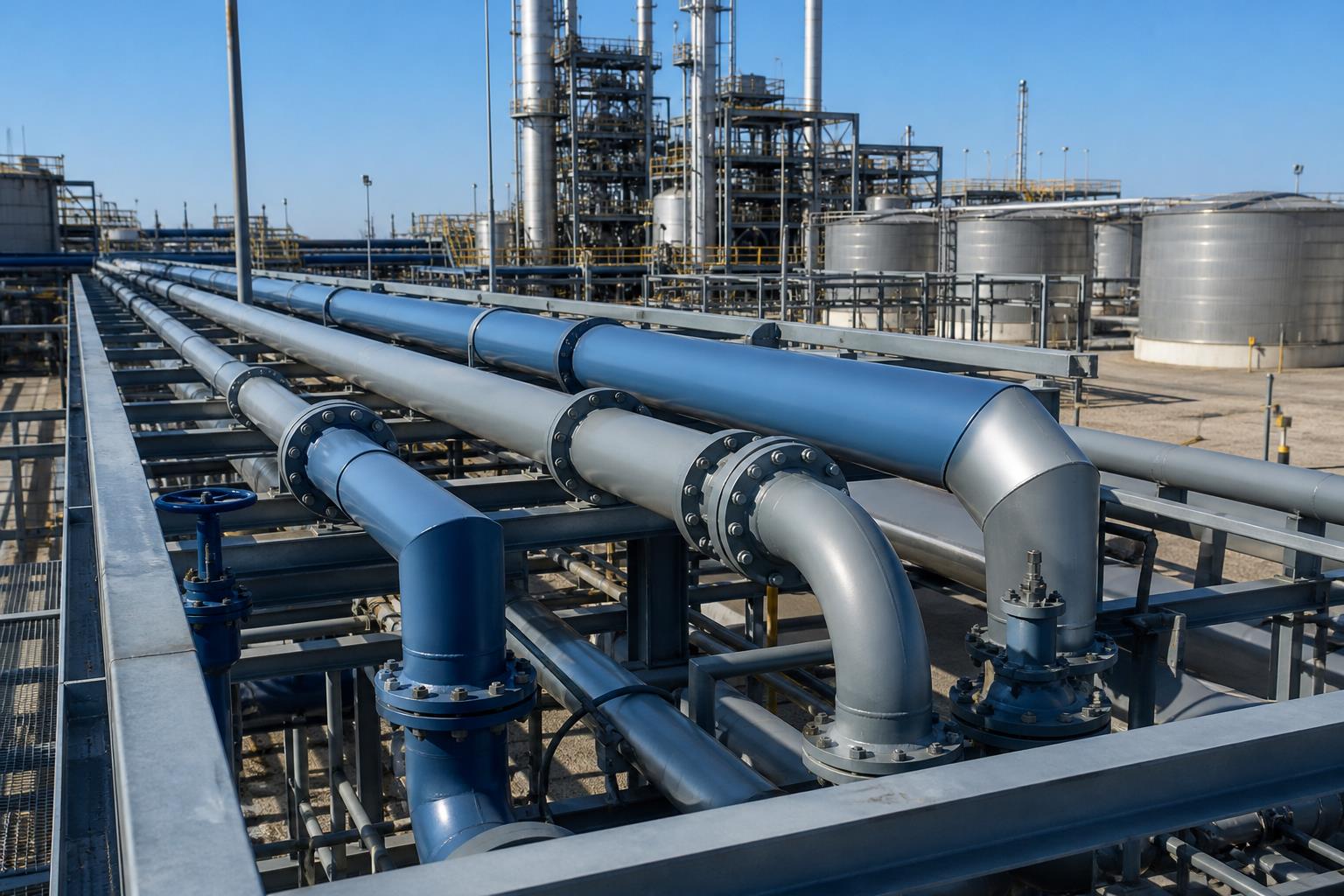
The practical selection rule is simple: choose seamless where pressure, temperature or cyclic loading demands it, and choose welded where size, cost or availability decides.
- Seamless pipe is the standard choice for: high-pressure boiler and power-plant tubing, hydraulic and pneumatic cylinders, high-temperature chemical and refinery lines, oil country tubular goods (casing and tubing), instrument and precision tubing, and any service where the absence of a longitudinal weld is an explicit design requirement.
- Welded pipe is the standard choice for: water supply and distribution lines, fire-protection sprinkler systems, structural and mechanical applications, fence and handrail tubing, large-diameter oil and gas transmission pipelines (LSAW and SSAW), and general low- and medium-pressure process piping.
- Stainless steel specifics: in hygienic and food-processing lines, welded stainless steel pipe with an autogenous weld and full passivation is widely accepted when the weld bead is dressed and the surface finish meets the standard — while seamless stainless pipe is favored for high-pressure and corrosion-critical services where weld integrity cannot be risked.
Line pipe used in oil and gas transmission is a good illustration: small-diameter, high-pressure gathering lines and risers frequently specify seamless pipe, while trunk lines and long-distance transmission use large-diameter welded pipe because seamless simply cannot be produced in those sizes at an economic cost. Understanding these boundaries prevents both over-specification (paying seamless prices for welded service) and under-specification (risking a seam where the code demands seamless).
How to Choose Between Seamless and Welded Pipe
Work through this checklist when comparing seamless vs welded pipe for a new project:
- Service conditions first. Define the operating pressure, temperature, fluid corrosivity and any cyclic or sour-service requirements before asking for quotes. Codes such as ASME B31.3 and B31.8 translate these conditions into material and testing demands.
- Check the size envelope. If the required outside diameter exceeds the practical seamless range, the decision is already made — large-diameter lines are welded pipe territory.
- Read the specification. Confirm which standard applies (for example ASTM A53, A106 or A312, API 5L, or EN equivalents) and whether it requires seamless or permits welded with defined testing.
- Compare like for like. Request both options only when the specification allows them, and compare grade, schedule, testing package and documentation — never just the headline price per ton.
- Verify the certificate. The mill test certificate must state the manufacturing route, the heat numbers and the test results. A pipe described only as “seamless or welded” on an offer is a specification risk, not a discount opportunity.
Wall thickness deserves its own mention: pipe dimensions follow the nominal pipe size and schedule system, where the outside diameter is fixed for each size and the wall thickness is selected by schedule number. The schedule you choose affects pressure rating and weight per meter regardless of the manufacturing route, so specify the schedule explicitly in every inquiry.
Quality Control and Testing to Look For
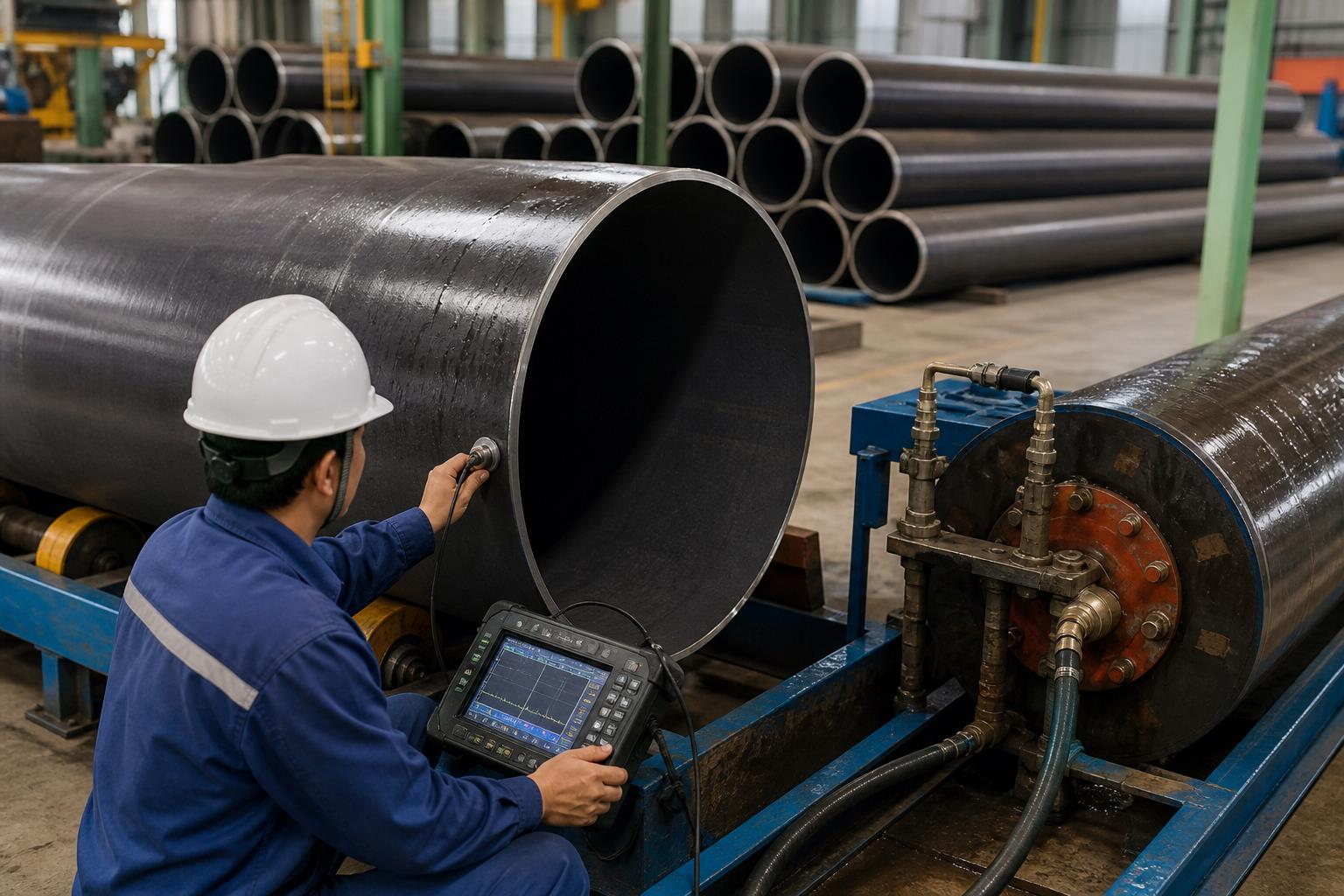
Whatever the manufacturing route, the quality story is written in the testing. Standard examinations for pipe include:
- Hydrostatic testing — every pipe is pressure-tested to prove the body and (for welded pipe) the seam are leak-tight.
- Non-destructive examination — ERW pipe is checked along the full weld length by electromagnetic or ultrasonic inspection; seamless pipe is examined over the full body for longitudinal discontinuities. The widely used ASTM A53 specification for welded and seamless pipe, for example, requires both hydrostatic testing and a nondestructive electric test of the full pipe volume.
- Mechanical tests — tension, flattening, bend and (where specified) impact tests demonstrate that the pipe meets the mechanical property limits of the grade.
- Documentation — the mill test certificate (MTC) records chemistry, mechanical results and heat traceability. For seamless pipe, verify that the body stamp and certificate match; for welded pipe, additionally confirm that the weld process type is stated (for example ERW or SAW) and that weld test results are included.
Third-party inspection is inexpensive insurance on critical orders. An inspector verifying the hydrostatic records, witnessing sample mechanical tests and confirming the product marking before shipment protects both parties — and is a routine part of international steel pipe procurement.
Frequently Asked Questions
Is seamless pipe stronger than welded pipe?
For the same grade, the base material properties are comparable, but seamless pipe has no weld zone, so there is no heat-affected area that could act as a weak point under severe conditions. That is why seamless remains the default for high-pressure and high-temperature service, while modern welded pipe with full non-destructive testing is considered reliable for a wide range of moderate services.
Can welded pipe be used for high pressure?
Yes, when it is manufactured and tested to the appropriate specification. ERW and SAW pipe are used in high-pressure transmission systems around the world. The governing factors are the design code, the pipe standard, the wall thickness, and the non-destructive testing performed on the weld — not the simple fact that the pipe has a seam.
Why is seamless pipe more expensive than welded pipe?
Seamless production starts from a solid billet, consumes more energy, runs at lower speed and produces more material loss than continuous coil-based welded production. Those process economics, not quality, are the main reason seamless pipe carries a higher price for the same grade and size.
How can I tell seamless and welded pipe apart?
Look at the surface. Welded pipe usually shows a visible longitudinal weld line on the inside and often on the outside surface; seamless pipe shows no such line. On stainless and light-gauge products the weld may be dressed smooth, so check the mill certificate, which always states the manufacturing route.
Specify Correctly, Then Compare Prices
The cheapest mistake in pipe procurement is comparing offers that are not on the same specification basis. Fix the manufacturing route, grade, size, schedule and testing requirements first — then let suppliers quote against that fixed baseline. If you are unsure whether your service conditions justify seamless pipe or whether a certified welded product is acceptable, send us your working pressure, temperature, fluid and size range and our engineers will review the application with you.
For seamless requirements, explore our full range of seamless steel pipe in carbon, alloy and stainless grades. For a fast-start example of a stainless specification, see today’s related product: 316L Stainless Steel Pipe 4 inch Sch 10, a seamless stainless pipe commonly specified for corrosion-resistant process lines. Contact Shuncheng Steel with your full specification and quantity for mill-direct pricing and test-certificate support.
Related Reading
New to pipe terminology? Start with What Is Seamless Steel Pipe? Manufacturing Process and Applications, or compare material families in our earlier guide on steel pipe selection for your project conditions.