
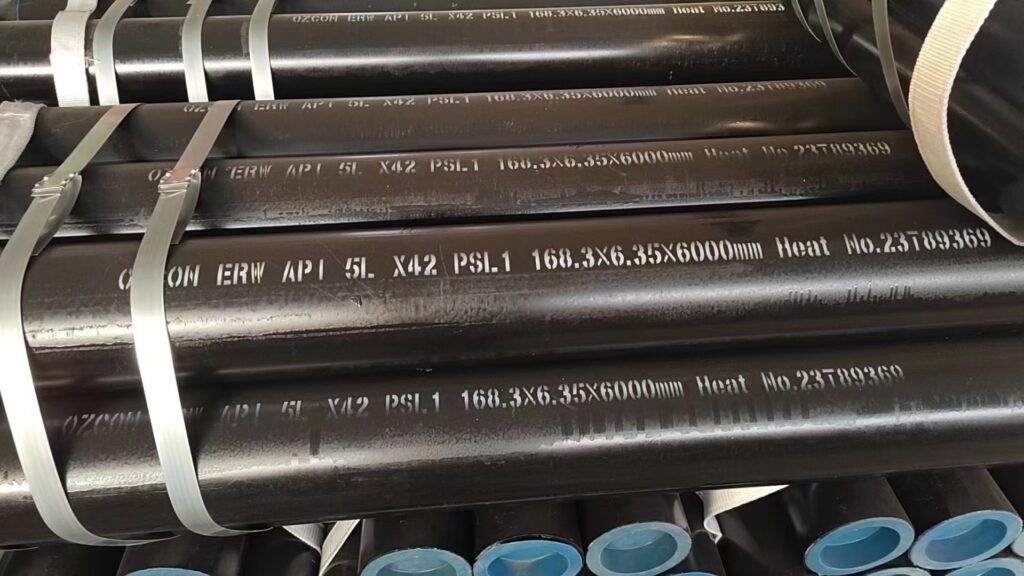
API 5L Line Pipe: The Backbone of Oil and Gas Pipelines
Behind nearly every barrel of oil and cubic meter of natural gas moved across a country sits a network of steel pipelines, and the specification that governs most of them is API 5L. Published by the American Petroleum Institute, API 5L defines the requirements for seamless and welded line pipe used to transport oil, natural gas, and other fluids over long distances. Choosing the right API 5L line pipe—grade, PSL, and manufacturing method—is one of the most important decisions in any pipeline project.
This guide explains what API 5L line pipe is, how grades differ, what PSL1 and PSL2 mean, and how to specify the right pipe for your project.
What Is API 5L Line Pipe?
API 5L is the industry-standard specification for line pipe—pipe used to transport oil, gas, and water in pipelines. It covers both seamless and welded pipe made from carbon steel, and it defines chemical composition, mechanical properties, dimensions, testing requirements, and marking for each grade.
The specification is organized into two product specification levels: PSL1 (standard requirements) and PSL2 (additional mandatory requirements). Within each level, grades are designated by letters and numbers such as B, X42, X52, X60, X65, and X70, where the number indicates the minimum yield strength in thousands of pounds per square inch (ksi).
API 5L Grades: X42 to X70
The grade number tells you the minimum yield strength of the pipe in ksi:
| Grade | Min Yield Strength | Typical Use |
|---|---|---|
| B | 35 ksi (245 MPa) | General service, low-pressure lines |
| X42 | 42 ksi (290 MPa) | Gathering lines, medium-pressure service |
| X52 | 52 ksi (360 MPa) | Midstream transmission, most common grade |
| X60 | 60 ksi (415 MPa) | Long-distance transmission lines |
| X65 | 65 ksi (450 MPa) | High-pressure, long-distance pipelines |
| X70 | 70 ksi (485 MPa) | Large-diameter, high-pressure trunk lines |
Higher grades allow thinner walls for a given pressure, which reduces steel weight and welding cost—but they also require stricter quality control and often PSL2 testing. Most midstream projects settle on X52 or X60 as the best balance of strength, weldability, and cost.
PSL1 vs PSL2: What Is the Difference?
The two product specification levels are not quality grades in the traditional sense; they are different sets of requirements:
- PSL1 covers standard requirements for composition, mechanical properties, and testing. It is suitable for many gathering lines and less demanding service.
- PSL2 adds mandatory Charpy impact testing, tighter limits on carbon equivalent (CE) and chemical composition, and stricter nondestructive examination (NDE) requirements. PSL2 is required for sour service and most high-pressure transmission applications.
When a project specifies “API 5L X52 PSL2”, the pipe must meet the full PSL2 testing and documentation package—which is why PSL2 pipe carries a higher price and longer lead time.
Seamless vs ERW vs DSAW Line Pipe
API 5L covers three main manufacturing routes:
- Seamless (SMLS): formed from a solid billet with no weld seam. Used for smaller diameters (typically up to 24 inch) and where maximum pressure reliability is required.
- ERW (Electric Resistance Welded): formed from steel strip and welded longitudinally. Cost-effective for mid-range diameters and the most common choice for distribution and gathering lines.
- DSAW / LSAW (Double Submerged Arc Welded): welded with submerged arc from both sides. Used for large diameters (24 inch and above) in long-distance trunk lines.
The right method depends on diameter, pressure, and budget: seamless for small critical lines, ERW for the mid-range workhorse applications, and DSAW for the big trunk lines.
Key Applications of API 5L Line Pipe
- Oil and gas transmission: moving crude oil and natural gas from production fields to refineries and terminals
- Gathering lines: connecting wellheads to processing facilities
- Natural gas distribution: city and regional gas supply networks
- Water and slurry transport: long-distance water, tailings, and slurry pipelines
- Export terminals and loading systems: pipeline systems at ports and storage facilities
How to Specify API 5L Line Pipe
When requesting a quotation, cover these points:
- Outside diameter and wall thickness (or schedule) and length
- Grade (B, X42, X52, X60, X65, X70) and PSL (1 or 2)
- Manufacturing method (seamless, ERW, or DSAW)
- End finish (plain, beveled, or threaded) and coating requirements (bare, varnish, 3LPE, FBE)
- Testing and documentation (mill test certificates, hydrostatic testing, NDE, Charpy for PSL2)
Where to Buy API 5L Line Pipe
Work with a supplier that can guarantee traceable mill test certificates and consistent quality across the full order. Shaanxi Shuncheng Tian Steel supplies API 5L line pipe in grades B through X70, PSL1 and PSL2, seamless and welded, in standard and custom sizes. We also supply carbon and stainless seamless steel pipes for adjacent applications. Send us your specification for a current quotation.
FAQ
What does the X in X52 mean?
The number after the X is the minimum yield strength in ksi. X52 pipe has a minimum yield strength of 52,000 psi (about 360 MPa).
Is PSL2 always required?
No. PSL2 is required when the design standard or project specification calls for it—typically for high-pressure transmission, sour service, and offshore applications. For many gathering and distribution lines, PSL1 is perfectly adequate.
What is the difference between line pipe and OCTG pipe?
Line pipe (API 5L) transports fluids through pipelines, while OCTG (API 5CT) includes casing and tubing used inside oil and gas wells. They are different specifications for different parts of the production chain.
Need API 5L line pipe for your next project? Contact Shuncheng Steel with your grade, size, and PSL requirements for a fast quotation.