
430 vs 304 Stainless Steel: How Does Magnetism Change the Choice?
A magnet falls off a 304 part and snaps onto a 430 one, and no drawing explained why. That gap stalls incoming inspections.
430 is ferritic and strongly magnetic; annealed 304 is austenitic and essentially non-magnetic. Choose 430 for dry indoor parts where cost and magnetic response matter, and 304 where corrosion resistance, deep drawing or welded joints matter more.
The two grades are usually compared as if one were simply better than the other, which is not how either behaves in service. 430 exists because a nickel-free chemistry delivers a stable price and a useful magnetic response; 304 exists because nickel buys ductility, weldability and corrosion resistance that ferritic grades cannot match. Projects go wrong when material is chosen on grade name and price alone and the magnetic behaviour of the finished part is discovered at inspection, or when a magnet test is treated as proof of grade. The six questions below follow the order that actually decides a job: what makes stainless steel magnetic, why a magnet sometimes sticks to 304, where 430 earns its place, where 304 does, which applications depend on magnetic response, and how to verify the answer before the material ships.
What Makes 430 and 304 Stainless Steel Magnetic?
Magnetism in stainless steel is decided by crystal structure, not by the grade number stamped on the certificate.
Ferritic 430 has a body-centred cubic structure and responds strongly to a magnet. Austenitic 304 has a face-centred cubic structure and is essentially non-magnetic in the annealed condition.
Dive deeper: structure decides magnetism, not the reputation of the alloy family. Stainless steel is magnetic or non-magnetic because of how its atoms are arranged, and that arrangement is fixed by the balance of chromium, nickel and the other elements in the heat. Ferritic grades such as 430, designated UNS S43000, EN 1.4016 or JIS SUS430, keep a body-centred cubic lattice — the same structural family that makes ordinary carbon steel respond to a magnet. That is why a 430 sheet will hold a magnetic catch, a magnetic sign or a work-holding magnet without any extra provision, and why 400-series stainless is the shorthand for “magnetic” in most workshops. Austenitic grades such as 304 keep a face-centred cubic lattice, and in the annealed condition that structure is paramagnetic: it responds so weakly to an applied field that practical engineering treats it as non-magnetic. The distinction has nothing to do with the chromium oxide passive film that provides corrosion resistance. That film is a surface chemistry effect, and it forms on magnetic and non-magnetic grades alike — which is exactly why corrosion performance and magnetic response have to be specified separately rather than assumed to travel together. A third structure matters as well. Martensite, which appears in stainless steel after certain heat treatments or after heavy deformation, is magnetic, and it is the reason a nominally austenitic part can surprise an inspector. The underlying compositions are tabulated in the ISO 15510 listing of stainless steel chemical compositions, and any proposed grade substitution should be checked against that composition clause rather than against the grade name a supplier quotes.
Why Does a Magnet Sometimes Stick to 304?
A magnet that sticks to 304 is usually evidence of cold work rather than proof of the wrong grade.
Cold working 304 — drawing, bending, stamping, spinning or machining — can transform part of the austenite into magnetic martensite. The effect stays local to the worked or welded zone and does not mean the material is 430.
Dive deeper: cold work, welds and why a magnet is only a screening tool. Deformation is the most common reason a 304 part turns magnetic. When austenitic stainless steel is strained, the austenite becomes unstable enough that part of it transforms into martensite, and martensite is magnetic. The transformation is concentrated where the strain is highest: the bend radius of a formed panel, the thread flank of a fastener, the wall of a spun bowl, the cut edge of a blank, or a surface that has been shot blasted or heavily ground. A flat annealed sheet may show almost no response while the same heat, formed into a component, shows a clear pull — and since nickel, chromium, nitrogen and carbon all shift how stable the austenite is, two 304 heats can behave differently in one forming operation without either being out of specification. Welds behave the same way for a different reason. Fillers such as 308L are formulated with a small amount of delta ferrite so the deposit resists hot cracking, so a weld bead or a weld overlay is frequently slightly magnetic even though the parent plate is not. Machined threads, reamed holes and abrasive-cut edges show the effect for the same deformation reason. The practical consequence is that a magnet can tell you a part is likely to be magnetic, but it cannot tell you which grade you are holding, because lightly worked 304, heavily drawn 304, a 300-series weld and a ferritic 430 can all attract a magnet to some degree. Where a component must return to a non-magnetic state, the answer is a full solution anneal followed by rapid cooling, which re-forms austenite and removes the strain-induced martensite; the general behaviour of the grade is described in the standard reference on SAE 304 stainless steel.
Where Is 430 Stainless Steel the Better Choice?
430 wins where the environment is mild, the volume is high and the cost of nickel is the deciding factor.
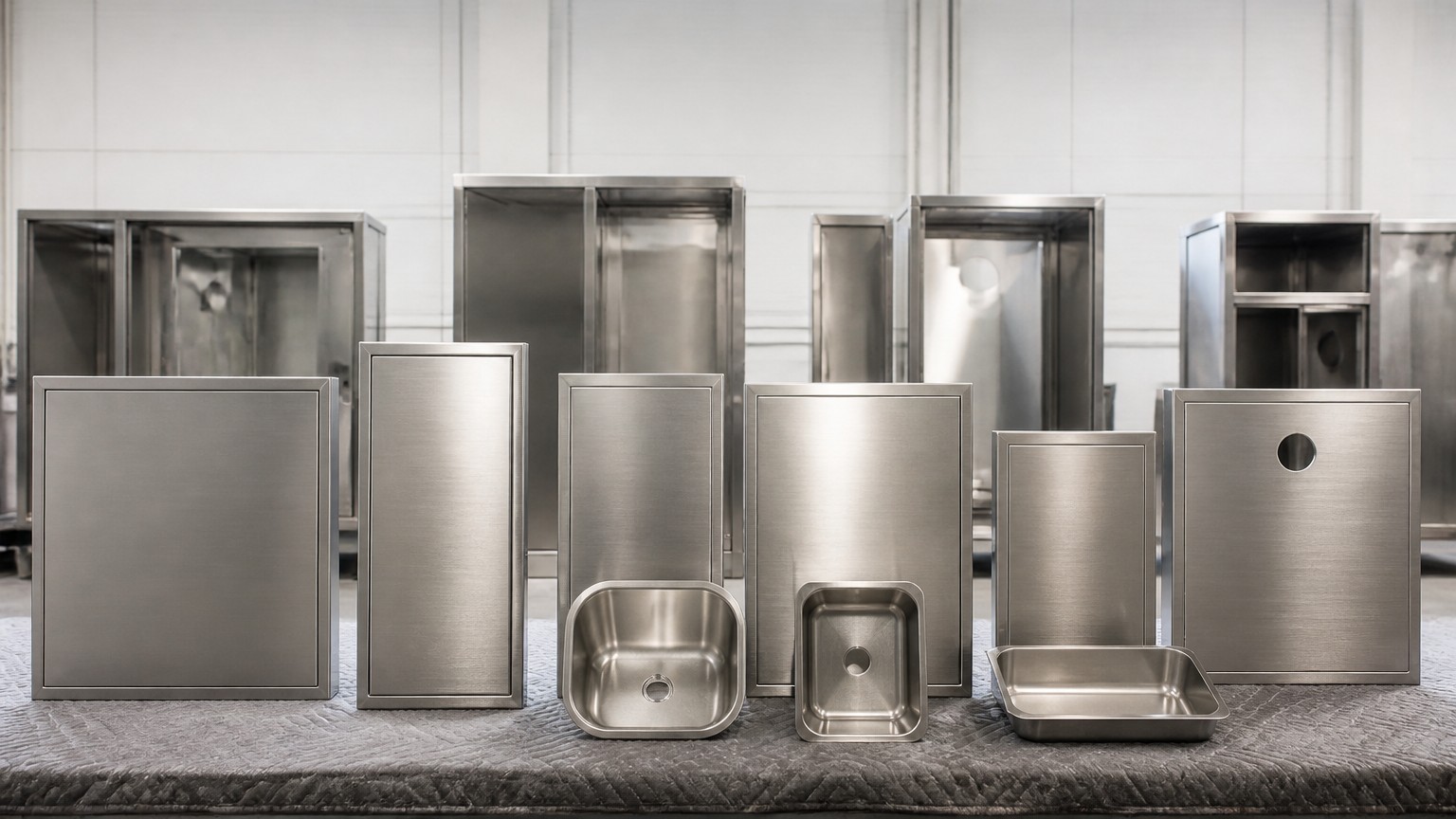
430 suits indoor appliance trim, oven and dishwasher liners, sink bowls, cladding, automotive trim and decorative panels. It resists atmospheric corrosion well, but it offers noticeably less pitting resistance than 304 when chlorides are present.
Dive deeper: why 430 keeps winning cost-driven indoor applications. The commercial case for 430 is written in its chemistry. It contains no deliberate nickel addition, so its price tracks iron and chromium rather than the nickel market, and the grade has been the standard choice for indoor, dry, decorative duties for decades. Appliance fascias, washing machine drums and door liners, cooker hoods, refrigerator panels, dishwasher interiors, toasters and microwave bodies are typical. Because the material is ferritic, it also cannot be hardened by heat treatment, which keeps the specification simple for stamping and roll forming shops that only need a consistent annealed temper. Its magnetic response is an operational advantage rather than a nuisance in several of these duties: magnetic door catches, magnetic gaskets and ferritic base plates for induction-ready cookware all depend on it, and magnetic handling equipment can move 430 blanks around a press shop without mechanical clamping. The limitations have to be respected. Ferritic grades have lower ductility than austenitic ones, so very deep draws are difficult and tight radii at low temperature should be trialled before a batch is released. Weldability is more restricted, because grain growth in the heat-affected zone reduces toughness, so many 430 assemblies are mechanically fastened or riveted instead. Corrosion resistance is adequate in rural and urban atmospheres but degrades in chloride-bearing or persistently damp service, where a molybdenum-bearing ferritic such as 434, or an austenitic grade, is the safer answer. Buyers who want to compare stocked thicknesses and finishes across both families can review 304 and 430 stainless steel plate side by side, and the reference article on ferritic stainless steel sets out the family’s metallurgy in more detail. Surface appearance is the last variable: how 2B and No.4 finishes differ matters more on a visible 430 fascia than on a hidden 304 liner.
Where Does 304 Win Over 430?
304 earns its premium wherever the surface has to stay clean and the joint has to stay sound.
304 resists pitting and general corrosion better, deep-draws and welds far more easily, and keeps useful toughness at low temperature. It is the default for food processing, kitchen equipment, tanks, process lines and outdoor exposure.
Dive deeper: the properties that nickel actually buys. Nickel stabilises the austenitic structure, and almost every advantage of 304 traces back to that. Austenitic stainless steel is tough rather than brittle, including at low ambient temperatures, so it survives handling and impact without the ductile-to-brittle transition that limits ferritic grades. It work-hardens rather than cracking, which allows deep drawing of sink bowls and vessel heads that a ferritic grade would struggle to match, and it can be welded with ordinary shop procedures and a matching filler without the grain-growth problems that make 430 assemblies awkward. In corrosion terms the difference is most visible where chlorides are present: 304 offers substantially better pitting and crevice resistance than 430 in wet, saline or food-contact service, and it is the grade that most hygiene standards assume when a stainless surface is specified in a processing plant. Two further consequences matter to specifiers. First, the non-magnetic character of annealed 304 is itself a functional property in instrumentation, sensor housings and any assembly where a stray magnetic field would degrade a reading. Second, the grade keeps an established second-source supply of standard finishes and thicknesses, which reduces the risk of a substitute being offered mid-project. Cost pressure still exists, and the practical answer in appliance and kitchenware work is often a third option rather than a return to 430: a lower-nickel austenitic such as 201, which is supplied as 201 stainless steel coil in 1.0 mm × 1219 mm for forming-intensive indoor products, keeps much of the ductility and weldability of the austenitic family while reducing the alloy cost, with the trade-off that its corrosion resistance sits between 430 and 304. Flat product for pressure vessels and general applications is normally ordered against ASTM A240/A240M, which specifies both chemistry and mechanical property requirements.
Which Applications Depend on Magnetism — and Which Cannot Tolerate It?
Sometimes magnetic response is a design requirement; sometimes it arrives as a defect report.
Magnetic behaviour is required for solenoid cores, magnetic catches, separators, motor housings and scrap handling. It is unwanted in MRI rooms, sensitive sensors, scientific instruments and any assembly that must remain effectively non-magnetic.
Dive deeper: reading a drawing for magnetic intent. Many specifications state a grade and leave the magnetic requirement implicit, which is where projects lose time. On the “magnetic is wanted” side, the requirement is usually obvious once it is stated: magnetic catches and gaskets, ferritic base plates bonded into cookware for induction hobs, conveyor and drum separators in food, plastics and recycling plants, holding magnets and magnetic work-holding in a press shop, motor housings and pole pieces, and scrap-yard lifting magnets that rely on the ferromagnetic behaviour of the load. On the “magnetic is unwanted” side, the constraint is often a system-level one rather than a part-level one: a magnetically sensitive sensor, a magnetometer, a beam-line component or an MRI enclosure will not tolerate a magnetic fastener, a magnetic bracket or a magnetic weld bead anywhere nearby, and the practical grades there are the annealed austenitic ones, often with a documented maximum relative permeability rather than a grade name alone. The awkward cases sit in between. A formed 304 housing may be acceptably non-magnetic as a flat blank and noticeably magnetic after deep drawing, so a design that is approved on flat sample data can fail on the finished part. The same applies to welded assemblies, where the ferrite deliberately present in the filler makes the deposit magnetic, and to parts that have been machined or aggressively ground. Where the requirement is genuinely marginal, it is worth writing the acceptable permeability limit into the purchase order and agreeing on the measurement method. The physical definition behind those limits is set out in the reference entry on magnetic permeability, and it explains why austenitic stainless steel sits close to the permeability of free space while ferritic grades do not.
How Do You Verify Magnetic Behaviour Before You Buy?
Incoming inspection is the cheapest place to catch a grade mix-up, and it needs the right tool for the question.
Start with the mill test certificate and heat number traceability, then confirm the grade by positive material identification. A magnet is a fast screen for magnetic response, not a grade verification, and permeability can be measured when a limit applies.
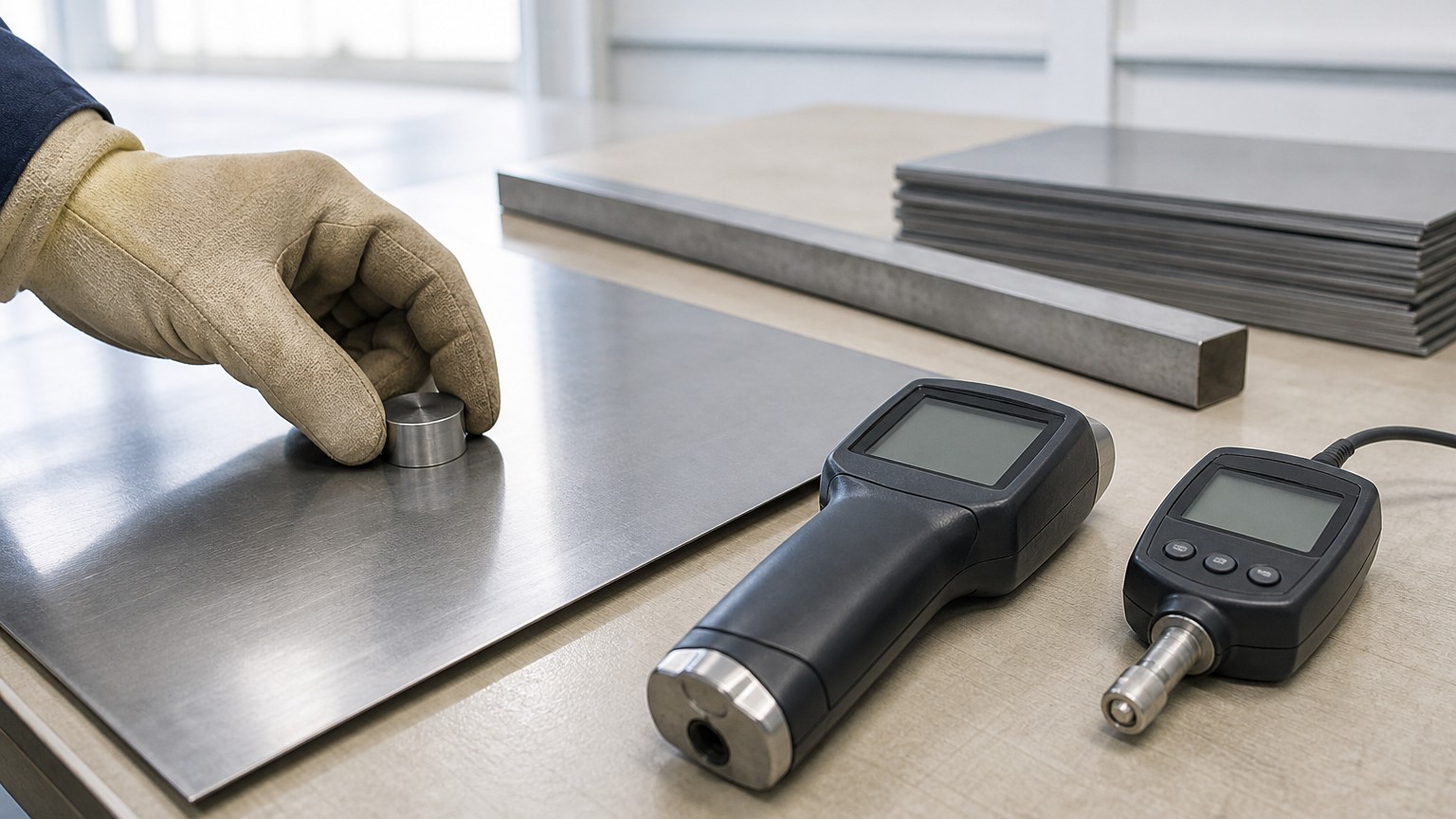
Dive deeper: a verification routine that answers the real question. There are two separate questions to answer, and they need different tests. The first question is which grade the material actually is. The mill test certificate tied to a heat number is the starting document, because it records the chemical composition and mechanical properties the mill certified, but it proves what was melted rather than what is in front of you, and it says nothing about a substitution made further down the supply chain. Positive material identification with a portable X-ray fluorescence or optical emission analyser answers the grade question directly by measuring chemistry on the actual part, and it is the only practical way to separate a cold-worked 304 that has turned magnetic from a 430 that was supplied by mistake. The second question is what the magnetic response of the finished part actually is. A magnet gives a fast, zero-cost screen: a strong, consistent pull on flat stock raises a question worth resolving, while a weak pull on a formed or welded area may be entirely normal. That screen should never be the sole basis of an acceptance decision, because the same pull can be produced by several legitimate and illegitimate conditions. Where a specification really does limit magnetic behaviour, permeability testing on weakly magnetic materials is the defensible route, and the agreed method, the measurement location on the part and the acceptance limit all belong in the purchase order rather than in an email. Documentation closes the loop: the mill certificate for the heat, the grade identification result for the sample tested, and a record of where on the component each measurement was taken. Flat product tolerances that affect what you can measure on a finished sheet are covered in the guidance on 430 stainless sheet thickness.
Conclusion
Pick 430 for dry indoor parts that benefit from magnetism; pick 304 when corrosion, forming or welding decide the outcome — and verify grade by chemistry, not a magnet.
Choosing between these grades for a specific component? Send grade, thickness, working environment and the magnetic requirement to our team and we will confirm material, finish and availability through the inquiry form on our send us your part list for a grade recommendation page.