
Aluminum Foil Thickness Guide: Which Gauge Do You Need for Your Application?
A wrong gauge choice rarely fails at goods-in. It fails weeks later, inside a leaking sachet or a wrinkled laminate, when the batch is already converted.
Aluminum foil thickness runs from 0.006 mm to 0.2 mm. Gauges below 0.010 mm suit lidding and laminating, 0.012 mm serves pharmaceutical and cigarette foil, 0.016 mm is standard household foil, and 0.030–0.150 mm covers insulation, cable wrap and semi-rigid containers.
Thickness is the one specification that decides barrier performance, machine behaviour and cost per square metre at the same time. The sections below work through how gauge is measured, why a few microns change everything, which ranges map to which end uses, how to choose and calculate, and how to inspect a delivery before it reaches your line – the same sequence we apply at Shaanxi Shuncheng Tian Steel before any roll is shipped.
What Is Aluminum Foil Thickness and How Is It Measured?
Foil is defined by its gauge, but the number on a quotation is not always the number on the roll.
Aluminum foil thickness is the measured gauge of the rolled strip, expressed in microns or millimetres. It is verified with a calibrated micrometer at several points across the width, or calculated from sample weight and area at very thin gauges, against the tolerance set by ISO 7271 or ASTM B479.
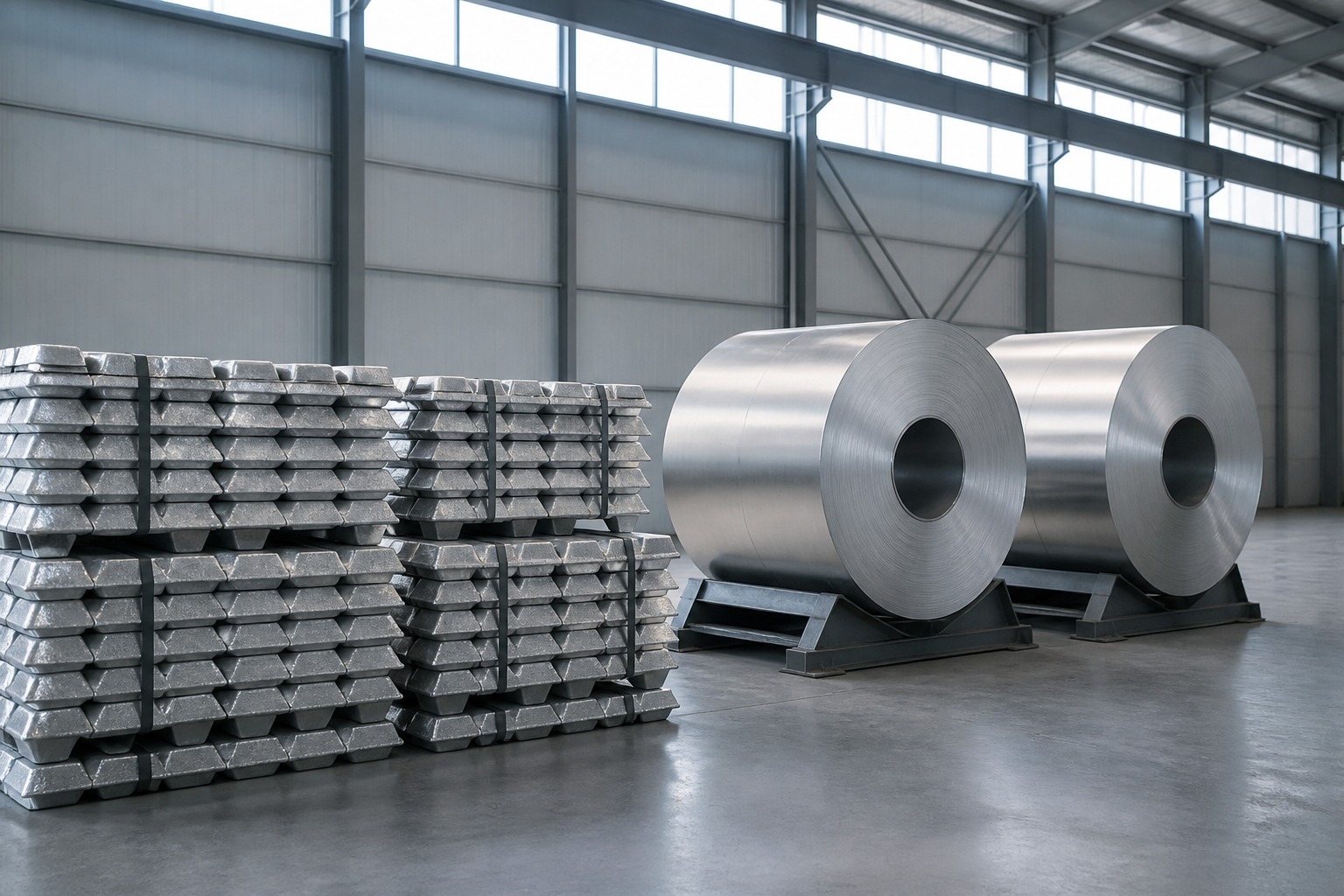
Dive deeper: three ways to measure a micron. The micrometer is the reference instrument and the one most buyers already own. A dead-weight micrometer applies a controlled measuring force, commonly around 0.5 N, so the anvil does not compress soft O-temper foil and flatter the reading; a general-purpose micrometer tightened by hand can easily read two or three microns low on annealed strip. Whichever instrument is used, the discipline is the same: zero it, measure at five positions across the width, repeat at several stations along the roll, and compare the result with the ordered tolerance rather than with the nominal number. On production lines non-contact gauges take over. Beta backscatter, X-ray transmission and eddy-current sensors measure continuously without touching the strip, which is the only practical way to control a mill running at speed, and they are what generate the thickness profile printed on a mill certificate. The third method is the mass method, and it is the one to remember when a gauge dispute starts. Cut a sample of known area, weigh it on a laboratory balance, and divide mass by area and by the density of the alloy – about 2.7 g/cm³ for the 1235, 8011 and 1100 grades used in packaging foil – to obtain average thickness. Because converting plants buy foil by area far more often than by weight, grammage (g/m²) is frequently the more honest specification, and it is a quantity a buyer can verify without owning a calibrated gauge.
Why Does Foil Thickness Matter More Than Any Other Specification?
Two rolls can share an alloy, a temper and a width and still behave completely differently on the same machine.
Thickness controls pinhole population, barrier performance, tensile strength, runnability and cost. Halving the gauge roughly doubles the number of through-thickness pinholes and reduces stiffness sharply, which is why the thinnest converter foil is almost always laminated to a polymer film.
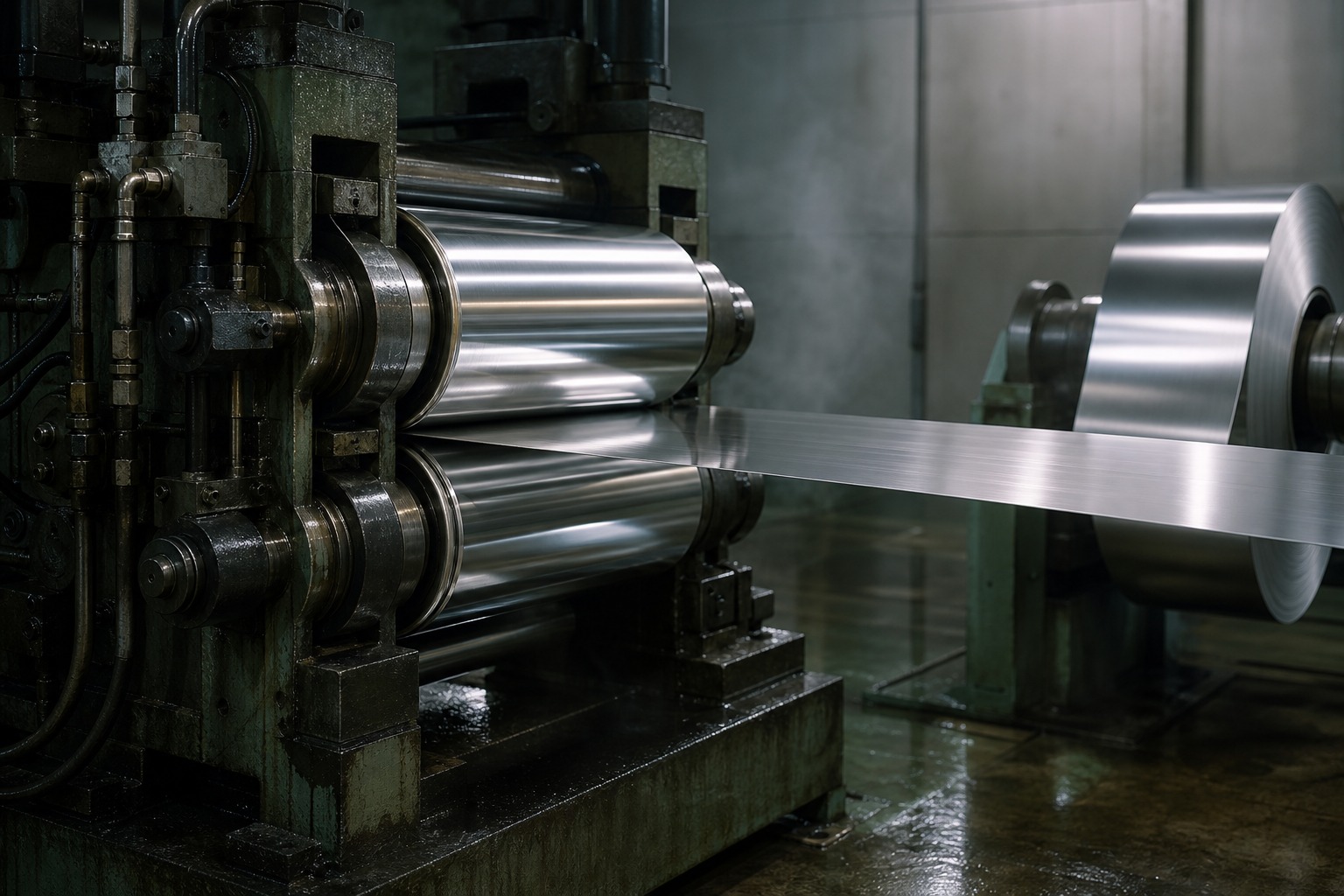
Dive deeper: pinholes, stiffness and the cube rule. Thickness governs barrier performance through pinholes rather than through diffusion. Aluminium itself is essentially impermeable to water vapour, oxygen and light at every gauge used in packaging; what leaks is the microscopic population of through-thickness holes created during rolling. That population grows steeply as gauge falls, so a 0.006 mm foil may carry measurable pinholes per square metre while a 0.030 mm foil is effectively solid. This is why the thinnest converter foils are laminated rather than thickened: a 0.006–0.009 mm foil bonded to polymer film and paper delivers the barrier of much heavier foil, with the polymer supplying the seal and the paper supplying the strength. Stiffness behaves differently again. Bending stiffness rises approximately with the cube of thickness, so a 0.012 mm foil is not twice as stiff as a 0.006 mm foil but roughly eight times stiffer. That single relationship explains most machine behaviour, because thinning a roll by a few microns can turn a stable web into one that wrinkles at the slitter, wanders under tension and breaks at the fastest station. Tensile breaking load and elongation move in the same direction, and both are written into the specification families: the standard covering annealed packaging foil requires tensile breaking load limits to be agreed and tested twice, on samples from two different rolls. Temper interacts with thickness throughout, so a soft O-temper 0.009 mm foil and a full-hard H18 0.009 mm foil are not interchangeable even though the gauge is identical.
What Thickness Ranges Map to Which Applications?
The band from 0.006 mm to 0.2 mm is not one product; it is a ladder of products with different buyers.
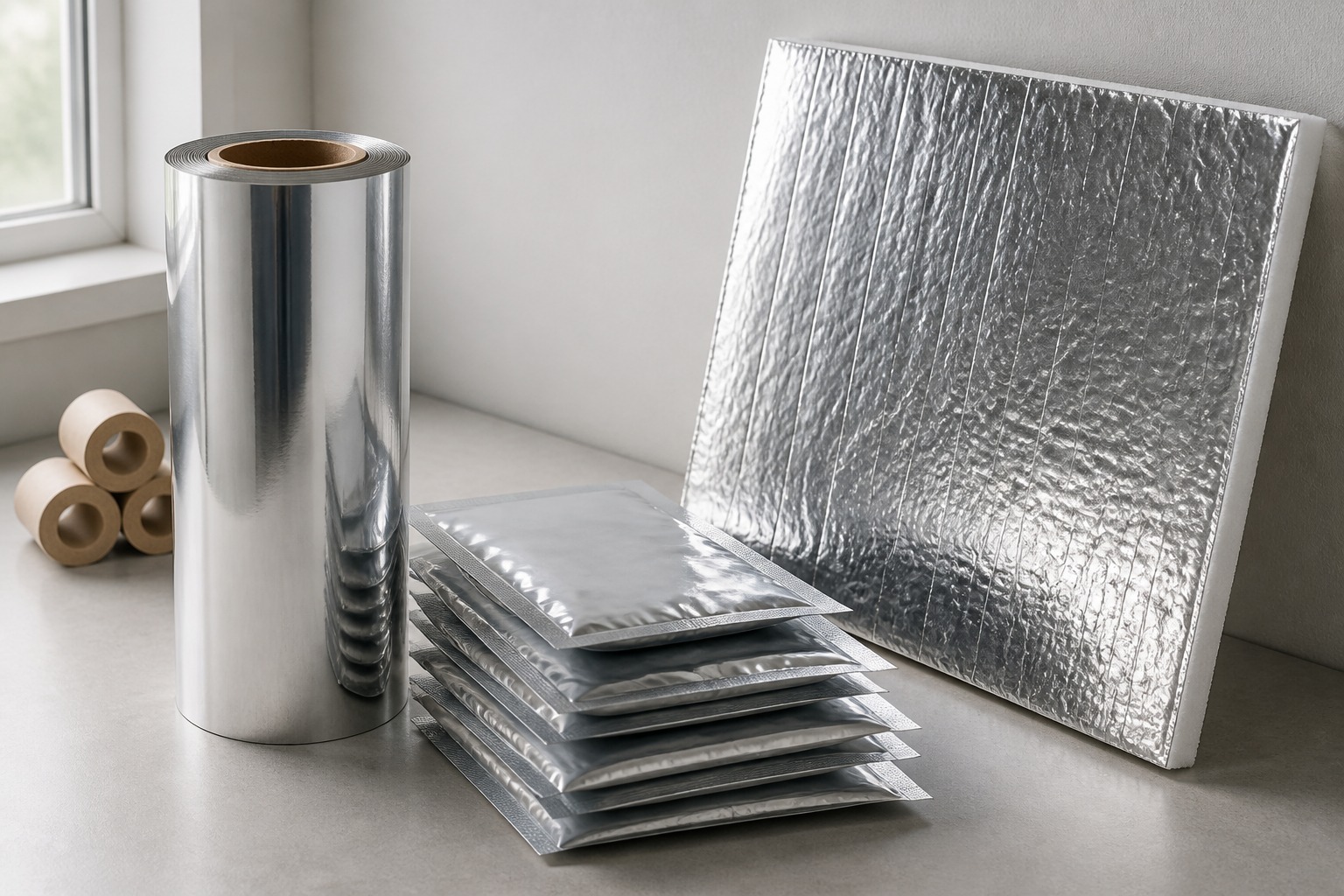
Broadly: 0.006–0.009 mm for lidding and pharmaceutical laminates, 0.010–0.012 mm for cigarette and general converter foil, 0.016 mm standard household foil, 0.024 mm heavy-duty foil, 0.030–0.050 mm insulation and cable wrap, and 0.060–0.150 mm for containers, HVAC and fin stock.
| Gauge range | Typical end use | Common alloy | Usual temper |
|---|---|---|---|
| 0.006–0.009 mm | Lidding foil, pharmaceutical and blister laminates | 8079, 8021 | O, H18 |
| 0.010–0.012 mm | Cigarette foil, general converter and laminating foil | 1235 | O |
| 0.016 mm | Standard household foil, food wrapping | 8011 | O |
| 0.024 mm | Heavy-duty household and catering foil | 8011 | O |
| 0.030–0.050 mm | Insulation facing, duct wrap, cable shielding | 1100, 1050, 1145 | O, H18 |
| 0.060–0.100 mm | Semi-rigid containers, trays, foil tape | 8011, 3003 | H22, H24 |
| 0.100–0.150 mm | Heat-exchanger and air-conditioner fin stock | 3102, 3003 | H22, H24, H26 |
Dive deeper: reading the gauge ladder like a buyer. The 0.2 mm figure that defines foil is a boundary, not a target. Above roughly 0.15 mm the material behaves like thin sheet and is normally traded as sheet, which is why ASTM B479, the standard specification for annealed packaging foil, stops at 0.15 mm and begins at 0.0064 mm. Inside that band every step exists because a specific converting operation demanded it. Lidding and pharmaceutical laminates sit at the bottom, between 0.006 mm and 0.009 mm, where the foil is always bonded to film or paper and where pinhole resistance matters more than strength. Cigarette and general converter foil at 0.010–0.012 mm is the volume workhorse, and alloy 1235 in soft temper is the classic specification for that duty. Household foil at 0.016 mm and heavy-duty foil at 0.024 mm are the two retail gauges nearly every market recognises. Above 0.030 mm the material stops being a wrap and becomes a barrier component: foil-faced insulation, cable shielding and duct wrap typically run 0.030–0.050 mm, while semi-rigid containers, trays and heat-exchanger fin stock move up to 0.060–0.150 mm, where the foil has to hold a formed shape rather than fold around one. The encyclopedic summary of aluminium foil notes that roughly three quarters of consumption goes to packaging and the remainder to industrial uses, which is a useful way to read the ladder: the packaging steps are thin, the industrial steps are thick, and the changeover happens near 0.030 mm.
How Do You Choose the Right Thickness for Your Application?
Choosing a gauge is a sequence of four questions, not a guess based on what a competitor uses.
Start from the barrier and strength the application actually needs, check what your converting equipment can run, price the options per square metre rather than per tonne, and only then fix the gauge and its tolerance in writing on the purchase order.
Dive deeper: a four-question sequence that prevents rework. First, define the barrier. If the product needs a moisture or oxygen barrier over a defined shelf life, the real question is not which gauge to buy but which laminate to build, because a thin foil bonded to film will usually beat a much thicker foil used alone, at lower cost and with better sealability. Second, check the equipment. Every converting line has a minimum gauge it can run without web breaks and a maximum gauge it can fold or form, and asking the printer, laminator or pouch machine operator for that window before requesting a quotation removes most specification errors before they are paid for. Third, price the alternatives on the same basis. Cost per thousand pouches, or cost per square metre, is the only comparison that survives contact with a real bill of materials, because thinner foil covers more area for the same weight and a higher price per tonne can still be the cheaper material. Fourth, write everything down: gauge, tolerance, temper, alloy and width, with the mill certificate required to state all five. Our aluminum foil range covers soft O tempers for wrapping and laminating work and harder tempers for fin and container stock, and every gauge is quoted with the tolerance it is supplied to. Buyers who skip the third step are usually the ones who discover on the machine that the saving was imaginary.
How Does Thickness Change Tolerance, Weight and Cost?
Price per tonne hides the number that matters, because thinner foil covers more area for the same weight.
Foil weight is density multiplied by gauge. At about 2.7 g/cm³, 0.012 mm weighs roughly 32 g/m² and 0.030 mm about 81 g/m². Tolerance bands are set by ISO 7271, and material cost is far more meaningful per square metre than per tonne.
Dive deeper: grams per square metre, the number your customer actually pays for. Weight per unit area is simply density multiplied by gauge, so 0.006 mm gives about 16 g/m², 0.012 mm about 32 g/m², 0.020 mm about 54 g/m², 0.030 mm about 81 g/m² and 0.100 mm about 270 g/m². Read that column again and the economics of foil become obvious: doubling the thickness doubles the metal, but it does not double the cost of the finished pack, because the polymer, the paper and the converting operation are unchanged. That is why moving from 0.024 mm to 0.012 mm can halve the material bill without a barrier penalty once a laminate is used properly. Tolerance changes the arithmetic less dramatically but it still matters at the margin. ISO 7271 specifies the dimensional tolerances for aluminium and aluminium alloy foil and thin strip, and a nominal gauge quoted without a tolerance band leaves a buyer no basis to reject a roll that sits at the unfavourable end of the range. Weight and yield calculations should always start from the nominal gauge and then be checked against the agreed tolerance, because a 5% overshoot on a forty-tonne order is two tonnes of aluminium nobody budgeted for. When you compare quotations, ask every supplier to state weight per square metre and tolerance together; a quotation that omits either is not quoting a specification. Our aluminum foil 1235 in 0.012 mm is a convenient reference point for the thin end of the range, and it is the gauge most often requested by converters building laminated structures.
How Do You Inspect Foil Thickness Before Production?
A roll that looks identical on the pallet can still be outside tolerance, and unwinding it is not an option on a production floor.
Check the mill certificate against the order, measure gauge with a calibrated micrometer at five points across the width at several positions along the roll, look for edge burrs, telescoping, dents and moisture, and store rolls horizontally in dry, ventilated conditions on their original cores.
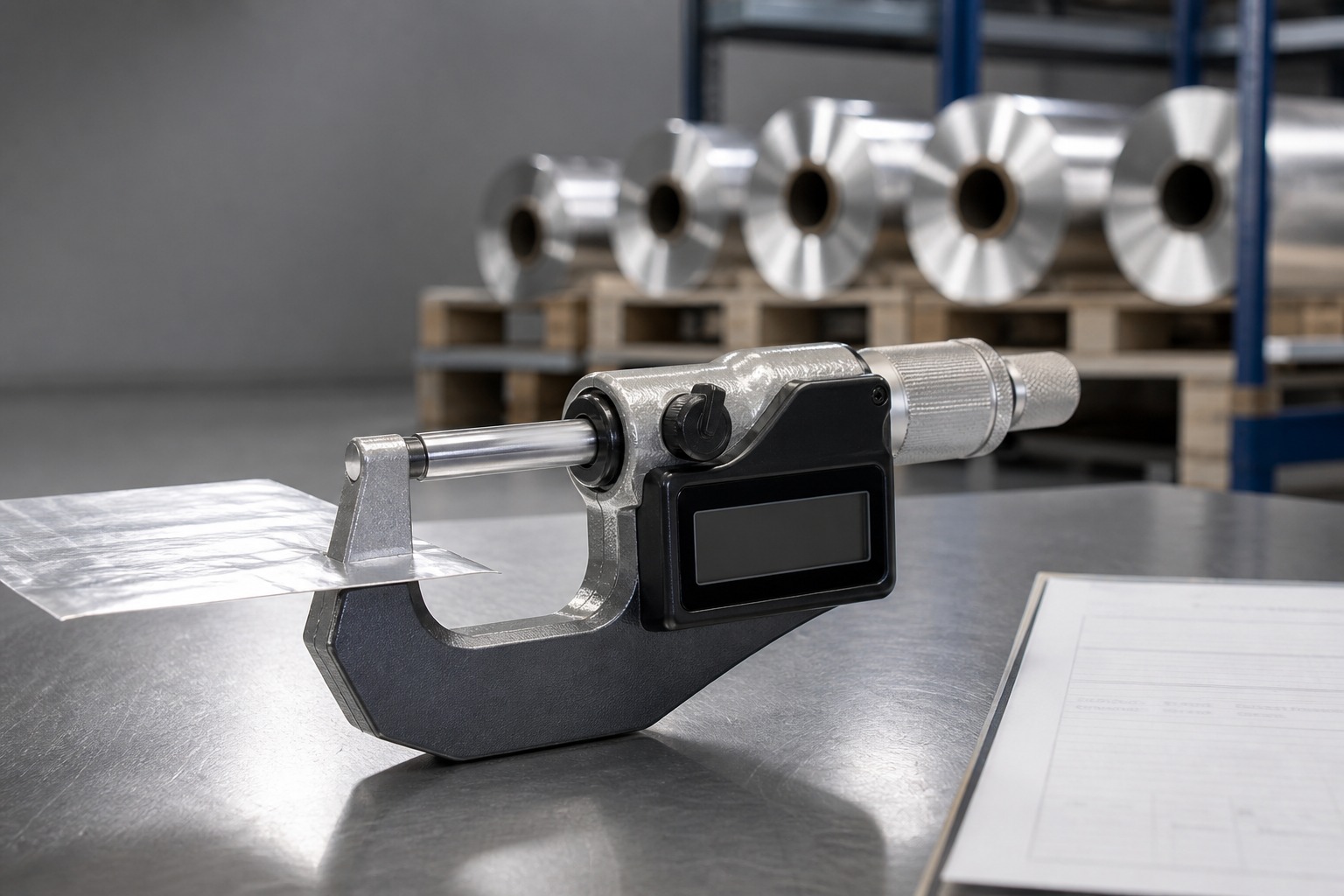
Dive deeper: the goods-in routine that protects the whole batch. Foil is the one purchase that cannot be sorted later, because once a roll is on the line every metre converted from it inherits the problem. Match the mill certificate line by line against the purchase order – alloy designation, temper, nominal gauge with its tolerance, width, core diameter, coil number and the tensile values from tension testing – and file it against the batch. Then measure. A micrometer read at five points across the width of the outer wraps, repeated at two further stations along the roll, will show whether gauge sits inside tolerance or drifts; a consistent shortfall at one edge points to a rolling problem, random scatter points to a quality problem, and either is worth a conversation before the roll is loaded. On the thin gauges, where barrier is the entire point, add a light-box pinhole check. Inspect for burred or nicked edges, the most common cause of web breaks downstream, together with telescoping, dents, crushed edges, water staining and loose winding. Finally, store correctly: indoors, dry and ventilated, off the floor and away from doorways where condensation forms, handled on the core rather than the edge, and consumed first-in-first-out so the oldest material is not left to oxidise at the back of a rack. Before a delivery reaches that point, compare it against our 8011 foil listing, which shows how a harder-temper household and container grade is specified alongside its gauge window, and remember that The Aluminum Association publishes the technical references most North American buyers cite when a specification is disputed.
Want the incoming-inspection checklist and a gauge recommendation for your application? Request a quotation from our export team – we return the specification sheet, the tolerance the gauge is supplied to and the current price together.
Conclusion: Thickness is a specification, not a detail. State the gauge with its tolerance and verify it on arrival, and the foil you ordered is the foil you run.