
Stainless Steel Pipe Grades: How Do 304L and 316L Compare for Process Lines?
The wrong stainless pipe grade for a process line rarely fails at commissioning — it fails years later, as chloride pitting or intergranular corrosion. 304L and 316L are not interchangeable.
304L and 316L pipe are both low-carbon austenitic stainless steels. 304L carries about 18% chromium and 8% nickel; 316L adds 2–3% molybdenum. Choose 316L for chloride-bearing, acidic or high-purity process lines, and 304L where the fluid is benign and cost matters.
Chemistry is only the starting point. The two grades are ordered against different chemistry ranges, they diverge in welding behaviour, in resistance to localised corrosion, in surface finishing and in delivered cost, and most plants run both in the same building. The sections below work through each question a specifier actually asks — what the L suffix changes, what molybdenum buys, how the grades compare side by side, where each belongs, when 304L is the smarter purchase, and how the delivered pipe is verified before it leaves the mill.
What Does the “L” in 304L and 316L Pipe Actually Change?
The L suffix is not a marketing label. It is a carbon ceiling, and that ceiling decides whether a welded line keeps its corrosion resistance in service.
The L stands for low carbon: 304L and 316L are capped near 0.030% carbon, against 0.08% for standard 304 and 316. Lower carbon blocks chromium carbide precipitation during welding, so the heat-affected zone keeps the passive film that makes stainless steel stainless.
The L designation is a carbon restriction, and everything else follows from it. Austenitic stainless steel that is welded passes through a temperature band of roughly 500 to 800 degrees Celsius, and inside that band chromium and carbon combine and precipitate as chromium carbides along the grain boundaries. Those carbides consume chromium locally, so the metal immediately beside each grain boundary can fall below the roughly 10.5% chromium that sustains the passive film described in the general account of stainless steel. The consequence is a narrow, continuous, chromium-depleted path through the weld heat-affected zone that corrodes preferentially wherever moisture and chlorides are present — even though the pipe passes every dimensional and tensile check on the inspection report. Removing carbon from the specification removes the ingredient the reaction needs, and that is the entire purpose of the L grade.
What the lower carbon costs
The trade-off is mechanical rather than metallurgical. ASTM A312/A312M publishes minimum tensile requirements of about 515 MPa tensile and 205 MPa yield for TP304 and TP316, while the low-carbon versions of both grades are quoted at approximately 485 MPa and 170 MPa. A designer working close to the allowable stress may therefore need a marginally heavier wall in 304L than in 304 for the same pressure rating, and that difference is far cheaper to find at the calculation stage than during fabrication. In exchange, the heat-affected zone retains its corrosion resistance as welded, which means long process lines can be fabricated, erected and hydrotested without a full solution anneal afterwards. For a fabrication shop welding spools in a yard, that single advantage normally decides the grade. The carbon limits are also written slightly differently between product forms — around 0.035% maximum for pipe under the pipe specification, and 0.030% for plate — so the standard number on the order matters as much as the grade name.
Where the two low-carbon grades still differ
304L and 316L solve the sensitisation problem in exactly the same way, so that part of the comparison is a tie. Both are austenitic, both are essentially non-magnetic in the annealed condition, both are ordered against the same specification families for seamless and welded pipe. What separates them is molybdenum, and molybdenum is worth a section of its own. When the line is built from pierced rather than welded product, the relevant sizes, walls and standards are collected on the page covering 304L and 316L seamless stainless steel pipe.
What Does 316L Add That 304L Cannot Match?
Molybdenum is the reason 316L costs more, and it is also the reason 316L survives fluids that would pit a 304L line within a few years of service.
316L adds roughly 2% to 3% molybdenum to an 18% chromium and 8% nickel base, with nickel generally a little higher than in 304L. Molybdenum stabilises the passive film against chloride attack, which is why 316L is specified for acids, brines, cleaning chemicals and high-purity process service.
The mechanism is well described in the entry on molybdenum, but the practical consequence is narrower than most enquiries assume. Stainless steel resists corrosion because chromium forms a self-healing oxide film, and that film is attacked locally by chloride ions. Chloride attack concentrates at a weak point in the film, the pit that opens becomes anodic while the surrounding surface stays cathodic, and the small anodic area drives rapid penetration while the rest of the pipe still looks new. Molybdenum interferes with this localised breakdown, which is why it raises resistance specifically to pitting and crevice corrosion rather than to general uniform corrosion.
Reading corrosion resistance as a number rather than a feeling
Buyers comparing grades benefit from a single number, and the industry uses the pitting resistance equivalent number, commonly calculated as chromium percentage plus 3.3 times molybdenum percentage plus 16 times nitrogen percentage. On typical chemistry, 304L lands near 18 and 316L near 24 to 25. That gap is real but bounded, and it explains a limitation that is worth stating plainly to anyone who treats 316L as a marine grade. In chlorinated or stagnant seawater, 316L can still suffer crevice corrosion under gaskets, deposits and supports; the pitting process is documented in detail in the discussion of pitting corrosion, where chloride concentration, oxygen availability and stagnant conditions are all shown to matter. When a genuine seawater service is proposed, the honest answer is a duplex or super-austenitic grade rather than a heavier wall of 316L.
Why the high-purity argument usually lands on 316L
In pharmaceutical, biotech and dairy process lines the decision is often made on cleanability rather than on corrosion alone. Both grades can be supplied with an internal surface that is pickled, passivated, bright annealed or electropolished, and both are non-reactive towards product contact. 316L nonetheless tends to be the default because molybdenum widens the tolerance to the aggressive cleaning agents used in clean-in-place cycles and to the chloride traces those cycles can leave behind in a poorly drained line. Where a specification already calls for the grade in a common size, the dimensions and test documents are listed on the product page for 304 stainless steel pipe in 4 inch Sch 40, which shows the level of specification detail a quotation should carry.
How Do 304L and 316L Compare on Chemistry and Strength?
Chemistry tables settle arguments quickly. The values below are the ones that actually move a specification decision on a process line, not a complete extract of either standard.
304L and 316L share an austenitic base and the same low-carbon ceiling, but they differ in molybdenum, nickel and localised corrosion resistance. The table compares chemistry, mechanical minimums, pitting resistance, process duty and relative cost.
| Item | 304L pipe (TP304L) | 316L pipe (TP316L) |
|---|---|---|
| UNS designation | S30403 | S31603 |
| Chromium, % | About 18.0 to 20.0 | About 16.0 to 18.0 |
| Nickel, % | About 8.0 to 12.0 | About 10.0 to 14.0 |
| Molybdenum, % | Not specified | About 2.00 to 3.00 |
| Carbon, % max | About 0.030 | About 0.030 |
| Minimum tensile strength | About 485 MPa | About 485 MPa |
| Minimum yield strength | About 170 MPa | About 170 MPa |
| Typical PREN | About 18 | About 24 to 25 |
| Chloride pitting resistance | Moderate | Good |
| Typical process duty | Water, food, nitric acid, pulp | Acids, brines, CIP chemicals, pharmaceutical |
| Delivered cost | Baseline | Higher, driven by nickel and molybdenum |
How to read this table as a decision rather than a scorecard
The table is a screening tool, and reading it correctly means treating the two grades as different risk profiles rather than as a good and a better option. Strength is effectively identical, so no pressure calculation will choose between them; the decision is made by the fluid. A designer who starts from the fluid analysis, then checks the pitting resistance margin, then confirms availability and welding, will almost always land on the lower-cost grade that meets the duty rather than the highest grade on the shelf. What the table cannot supply is the chloride level, the temperature and the oxygen content of the actual process stream, and those three inputs change the answer more than anything in the comparison itself. Where the wider question is which of the two austenitic families suits a given plant, our earlier comparison of how 304 and 316 stainless steel behave in corrosive service covers the same chemistry from the corrosion-engineering side.
Where the numbers need a second opinion
Two situations deserve a deliberate check rather than a rule of thumb. The first is any line that will be shut down wet, because stagnant chloride-bearing liquid held against a 316L surface for weeks is a more aggressive condition than the same fluid flowing. The second is a line that will be repeatedly welded and repaired in the field, where the extra alloy content of 316L helps the base metal but does nothing for a poor weld procedure. In both cases the grade label is not the controlling variable — drainage, welding procedure and post-weld cleaning are.
Where Does Each Grade Belong on a Process Line?
Grade selection is a fluid question, not a preference. The chemistry of what flows through the pipe decides which alloy survives a full maintenance cycle without a shutdown.
Use 304L for benign service such as potable and process water, dairy and food contact, nitric acid and pulp handling. Use 316L where chlorides, sulphuric or phosphoric acid, cleaning chemicals or high-purity pharmaceutical requirements appear in the process description.
The pattern behind those two lists is the same everywhere. 304L is chosen where the fluid is oxidising rather than aggressive and where chloride content is low, because in that environment the base passive film is stable and molybdenum would add cost without adding service life. 316L is chosen where the fluid can break the film down, because that is precisely the failure mode molybdenum addresses. Process lines are also the application where the governing code matters as much as the material, since ASME B31.3 Process Piping sets out the requirements for materials, design, fabrication, examination and testing that apply to piping in refineries, chemical, pharmaceutical, paper and similar plants — the code is what turns a grade choice into a specified, inspectable line.
The 304L service map
Typical 304L duties include raw and treated water headers, cooling water circuits with low chloride content, food and beverage transfer lines where product contact and cleanability matter more than chemical resistance, nitric acid service, and pulp and paper liquors in the less aggressive stages. In these applications the metal is protected by its own oxide film and the operating risk is mechanical — vibration, thermal cycling, erosion — rather than chemical. Because 304L fabricates easily, accepts a bright annealed or pickled finish, and is available in the widest range of diameters and schedules, it is also the grade most often stocked for general utility lines on a plant.
The 316L service map
Typical 316L duties include phosphoric and sulphuric acid circuits at moderate concentration and temperature, chloride-bearing process streams, clean-in-place chemical lines, pharmaceutical and biotech product contact piping, desalination pre-treatment upstream of the membrane, and instrument and sampling lines where stagnant liquid cannot be avoided. The last of those is worth emphasising: a small dead-leg that never drains is a much harder service than its nominal fluid suggests, and it is where a grade substitution from 316L to 304L is most reliably punished.
Where neither grade is the answer
Some duties sit outside both grades, and saying so is part of giving an honest specification. Seawater and chlorinated brine at temperature, high-chloride pulp bleach stages, and processes with strong reducing acids typically move to duplex stainless steel such as 2205, or to a super-austenitic grade with a much higher molybdenum content. The correct move there is not a thicker 316L wall but a different alloy family, and the enquiry should say so at the material selection stage rather than after the first inspection.
When Is 304L the Better Commercial Choice?
Quoting 316L everywhere feels safe, and it is often the most expensive decision on the enquiry. The premium only buys something if the fluid demands it.
304L is the better commercial choice when the process fluid carries no chloride load, the line will be welded rather than frequently repaired, and the wall is not stress-critical. It lowers material cost and improves lead time; 316L belongs where the fluid analysis says chlorides, acids or purity control.
The commercial argument is straightforward once the technical one is settled. 316L contains more nickel and adds molybdenum, and both elements carry their own alloying cost, so the delivered price of 316L moves with the nickel and molybdenum markets independently of the steel market — which is why a quotation taken six weeks ago is not a reliable basis for today’s budget. Beyond price, availability matters: 304L is stocked in more diameters, schedules and lengths, so a project on a tight programme can often hold its installation date with 304L where a 316L order would need longer rolling and finishing time. Weldability is the third factor. Both grades weld well, but 304L is the more forgiving of the two in field conditions, and a repair weld executed on a badly cleaned 304L joint is a less costly mistake than the same repair on 316L in a chlorinated service.
Substitution risk cuts in both directions
The expensive error is not choosing 304L for a benign duty — it is choosing 304L for a chloride duty to save a fraction of the material budget, then paying for it in premature failures at the welds and under supports. The opposite error is quieter: specifying 316L everywhere produces unnecessary cost and, more subtly, encourages the belief that grade alone guarantees performance, when surface finish, welding procedure, drainage and passivation do at least as much work. A useful discipline is to write the fluid conditions into the specification next to the grade, so that any later substitution has to argue against the chemistry rather than against a habit.
Specifying the grade without quoting a price you cannot hold
Because stainless prices move with alloy markets, a grade specification should be written to stand on its own. State the standard and edition, the grade, the product form — seamless or welded — the outside diameter and wall convention, the length and end finish, the surface condition, and the test documents required. That package is what makes quotations comparable between suppliers, and it is what allows a buyer to accept the lowest compliant offer without reopening the technical negotiation. When those details are settled and the fluid conditions are on the table, the fastest route from enquiry to quotation is to send the line specification to our team and let the material, finish and documentation be confirmed in writing.
How Are 304L and 316L Pipe Grades Verified Before Shipment?
A certificate that does not match the heat number is a stop-work signal, not paperwork. Verification is the last chance to catch a grade substitution before installation.
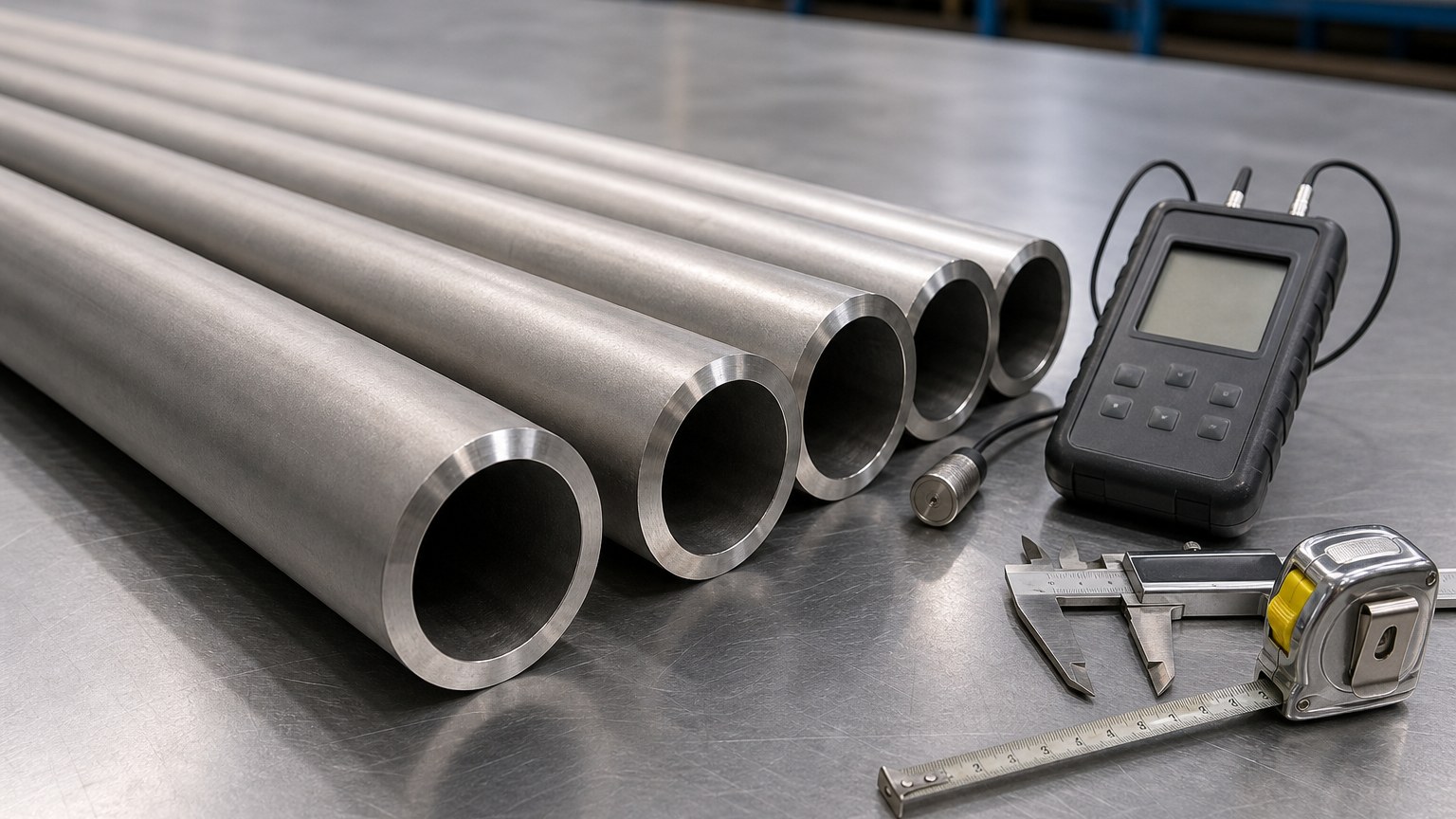
304L and 316L pipe is verified by reconciling the mill certificate with the purchase order, then confirming chemistry, tensile properties, dimensions and non-destructive test results on the tubes themselves. Positive material identification is the fastest way to expose a substitution.
Verification follows the material rather than the drawing, and on an austenitic line the first test is the one that matters most. Positive material identification distinguishes 316L from 304L decisively, because molybdenum is either present or it is not, and that single reading catches the substitution that visual inspection and dimensional checks cannot. Chemistry from the heat analysis is then reconciled against the grade limits on the order, including the carbon ceiling that defines the L grade, since a pipe supplied as 304 in place of 304L would satisfy every strength requirement while reintroducing the sensitisation risk the grade was chosen to avoid. Mechanical testing follows, with tension tests confirming tensile strength, yield strength and elongation against the published minimums, along with the flattening and hardness checks that the pipe specifications require. The chemistry ranges and mechanical minimums a certificate is checked against come from the product specification itself; for austenitic pipe the usual reference is the ASTM specification for seamless, welded and heavily cold worked austenitic stainless steel pipes, so the standard number printed on the certificate has to match the one written on the order.
The tests that actually discriminate between the two grades
Dimensionally, outside diameter and wall are measured with the minimum wall recorded rather than an average, and length is checked against the ordered cut. Non-destructive examination is normally a hydrostatic test or an eddy current test on each tube, and the buyer should specify which, because the two do not detect the same defect populations. For the low-carbon grades, an intergranular corrosion test — the practice in ASTM A262 is the usual reference — is the test that speaks directly to the reason 304L and 316L were specified in the first place, and it is worth requesting on any line that will be welded in a chloride-bearing or high-purity service. Surface condition is checked at the same time: pickled and passivated or bright annealed finish, free of embedded iron, heat tint and contamination, because a mechanically sound pipe with a contaminated surface will still pit.
The document package to request with the order
- Mill test certificate with heat number, chemistry and mechanical results, issued to the standard cited on the purchase order.
- Positive material identification or spectrochemical analysis report confirming chromium, nickel and molybdenum.
- Hydrostatic or eddy current test report identifying the method applied and the tubes covered.
- Dimensional record for outside diameter, minimum wall and length, including the measurement method.
- Intergranular corrosion test result where the order or the end user’s specification requires it.
- Surface condition statement, covering finish, cleaning and any pickling or passivation applied.
- Marking schedule and packing list matching the tube markings to the certificate and to the shipping documents.
Conclusion: 304L is the low-cost low-carbon grade for benign, chloride-free process service; 316L adds molybdenum for chlorides and acids. Choose from the fluid, not from the price list.