
Global Steel Price Trends: What Drives Steel Prices?
Steel quotes moved again this quarter and your tender was priced on last month’s number. Missing the direction of prices costs margin on every tonne you buy.
Steel prices are driven by four layers: input costs such as iron ore, coking coal and scrap; energy and conversion cost; supply discipline measured by mill capacity utilisation; and trade friction from tariffs, freight and currency. Demand sets the direction; supply decides the speed.
Transition: the sections below work backwards from a quotation — the layers that build a price, the raw materials and energy that set its floor, the capacity picture that decides whether a mill can pass costs on, the trade measures that separate an ex-works figure from a landed cost, and the checks a buyer can run before signing. Read them as one chain, because movement in any single link reaches your next purchase order.
What Actually Drives Steel Prices?
Strip away the headlines and a steel price resolves into three stacked costs: a raw material floor, a conversion cost and a trade premium.
A quoted steel price is built from raw material cost, conversion cost, capacity utilisation and the cost of moving material across borders. Each layer reacts to a different market, which is why prices can rise while demand looks flat.
The layers inside one quoted tonne
The first layer is metallurgy. Steel is an alloy of iron and carbon in which the carbon content stays below roughly two percent, and the elements added afterwards — chromium, nickel, molybdenum, manganese or niobium — are chosen for properties rather than for price. Britannica’s reference article on steel describes the same sequence every mill runs: raw materials melted and refined at about 1,600 °C, alloyed to a target chemistry, then cast and rolled into the form the buyer ordered. Every step consumes something traded on a world market, so a quotation is really a bundle of commodity exposures wrapped in one number.
The second layer is conversion cost: the gas and electricity that heat and reheat the steel, the rolls and refractories that wear out, the acids and water treatment used to clean the surface, and the labour that runs the line. These costs are local, which is why two mills quoting the same grade on the same day can carry very different cost bases, and why energy policy is a steel price factor in its own right rather than background noise.
The third layer is market structure: how much capacity is chasing how much demand, how full the order books are, how much stock traders and service centres are carrying, and how aggressively exporters are willing to price into each other’s markets. That layer has nothing to do with metallurgy and everything to do with the number in your inbox.
Why the layers move on different clocks
Iron ore and coking coal settle on contract cycles that can run quarterly, scrap is priced in weekly yard transactions, power is bought daily, freight responds to vessel supply within weeks, and trade measures arrive on political calendars. Because the clocks differ, a cost increase does not translate into a quotation increase at a fixed rate. It appears first in the grades most exposed to the input that moved, spreads as mills re-price their order books, and can be delayed or cancelled entirely by a rise in import competition. That delay is the buyer’s opportunity: the gap between a cost move and a price move is where a purchase decision still changes the outcome.
How Do Iron Ore, Coking Coal and Scrap Set the Cost Floor?
Two thirds of the cost of a hot-rolled tonne is bought in as ore, coal, scrap, alloy and energy before the mill adds any value.
Iron ore and coking coal dominate the blast furnace route, while scrap dominates the electric arc route. Which feedstock a mill depends on decides how quickly an input cost increase reaches your quotation.
Two routes, two cost curves
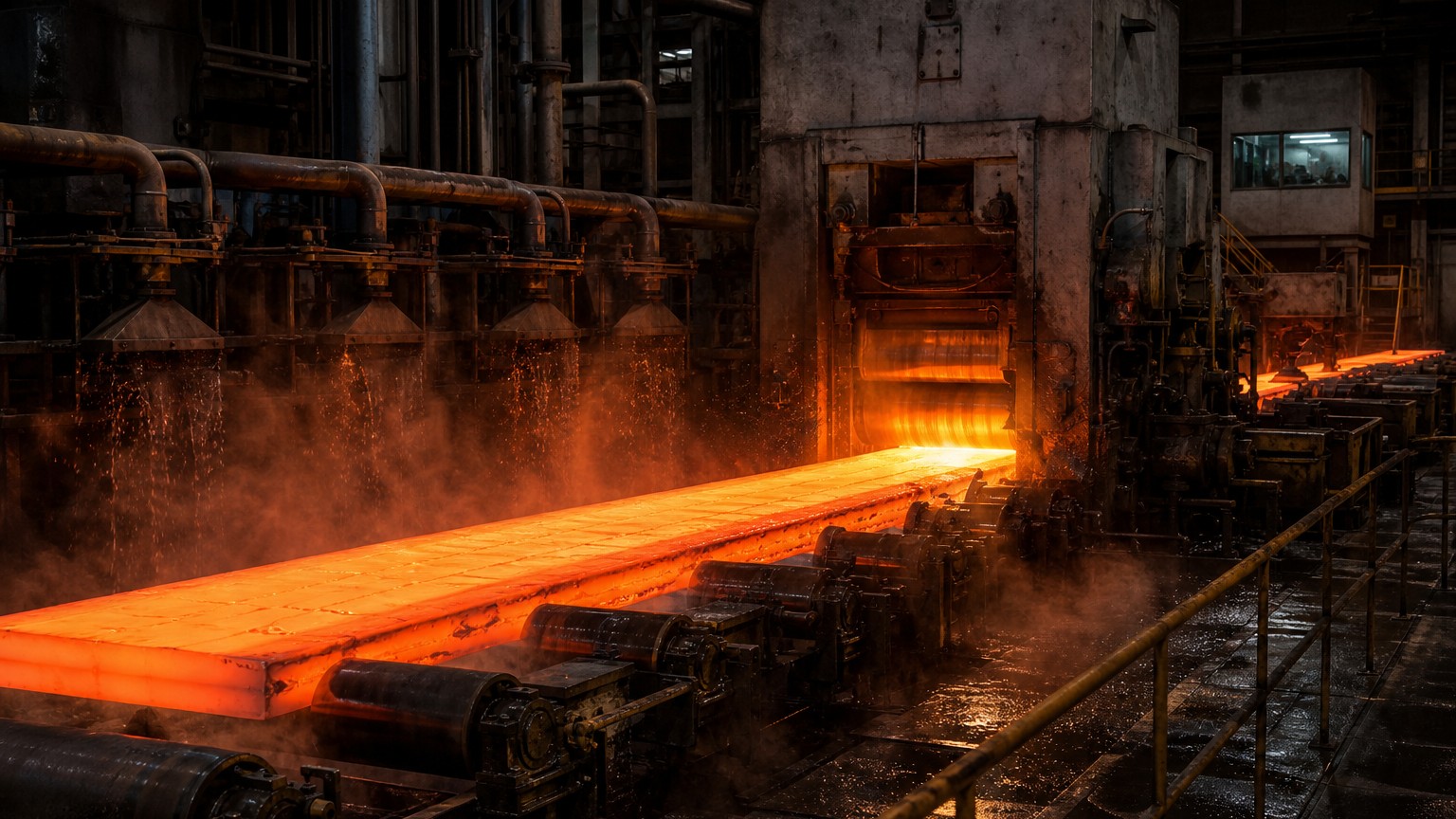
A blast furnace and basic oxygen furnace plant converts iron ore into liquid steel, and its cost base is dominated by ore, coking coal and the coke and sinter plants that feed the furnace. An electric arc furnace melts scrap, and its cost base is dominated by scrap, electricity and graphite electrodes. The two routes therefore behave like different commodities during a price shock. When ore and coal rise, integrated producers feel it first, because the ore and coking coal they buy are the same seaborne cargoes every other buyer bids for. When scrap rises, electric furnace mills feel it first, and their response is usually faster because scrap can be re-priced weekly rather than quarterly.
Commodity indices make that asymmetry visible. The World Bank’s monthly Commodity Markets data recorded a 4.0 percent rise in its metals price index in August 2026, alongside an 8.8 percent rise in the energy index, while its April 2026 outlook projected overall commodity prices to rise 16 percent across 2026 on the back of energy and fertilizer costs. A buyer reading only the steel headline would miss the point: what moved first was the input side, and steel quotations follow with a lag that depends on how easily each mill can pass cost through to its customers.
Alloys, coatings and the extras that scale with grade
The floor also rises with the grade, not only with the market. Austenitic stainless steels carry nickel, chromium and often molybdenum, so their cost floor tracks ferroalloy prices as well as iron; that is why the spread between a plain carbon product and a corrosion-resistant one widens and narrows over the cycle instead of staying fixed. Coated products add a second cost layer through the treatment applied to the surface, whether that is a zinc coating or an organic paint system, and the comparison buyers most often get wrong is between materials that solve different problems rather than materials that differ only in price — a distinction covered in our guide to stainless steel vs galvanized steel. The practical consequence for a purchaser is that a grade decision is also a price-exposure decision, and specifying marginal corrosion resistance costs more than the delta in the mill price alone suggests.
Why Does Capacity Utilisation Matter More Than Demand Headlines?
Steel demand is slow-moving, but the ratio of production to installed capacity is what forces mills to compete on price.
Capacity utilisation decides pricing power. When utilisation falls, mills chase volume and prices weaken even with steady demand; when it tightens, mills regain the ability to pass costs through to buyers.
What the published capacity picture shows
The OECD’s steel work is the clearest public source on this, and its numbers are uncomfortable. Global steelmaking capacity continues to expand while demand prospects stay dim, with excess capacity projected to reach 745 million tonnes by 2028 — 319 million tonnes more than OECD member countries currently produce. Planned additions of up to 138.8 million tonnes through 2028 represent a 5.7 percent increase over 2025 levels, while demand growth is projected to remain sluggish at around 0.9 percent per year through 2030. On that arithmetic, utilisation rates may slide from 76 percent in 2025 to 74 percent or less by 2028, intensifying financial pressure across the industry. The same source records a sector that accounts for roughly 8 percent of global CO2 emissions, and a project pipeline split roughly between basic oxygen furnace capacity at 46 percent and electric arc furnace capacity at 51 percent — a mix that will shape both future energy demand and the global scrap balance. Production-side statistics that let a buyer track actual output month by month are published by the World Steel Association.
Reading utilisation as a negotiation input
Utilisation changes what a mill is willing to do long before it changes the published price. When order books are thin, mills accept smaller quantities, unusual lengths, mixed-grade bundles and shorter lead times, and they quote faster; when the books tighten, minimum order quantities rise, delivery moves out, and allocation replaces negotiation. A buyer who tracks that behaviour has a second price signal that arrives earlier than the quotation itself. It is also worth watching which capacity is being added, because a new electric furnace competes for scrap while a new integrated plant competes for ore, and the two have opposite effects on a buyer’s exposure. The most useful internal record is a simple one: the lead time and minimum quantity you were offered this month compared with last quarter, beside the grades you actually buy from the stainless steel plate range and the carbon products that sit next to them. When lead times extend while indices are flat, the market has usually turned before the price list admits it.
How Do Tariffs, Trade Measures and Exports Change the Price You Pay?
A tonne of steel can change price by crossing a border without changing grade, so trade policy belongs beside cost in any price analysis.
Tariffs, anti-dumping duties, tariff-rate quotas and carbon border mechanisms raise the landed cost of imported steel, while export-side support in producing countries pushes prices down at origin.
The measures that reach your invoice
Anti-dumping and countervailing duties, safeguard measures, tariff-rate quotas that split a volume into a duty-free tranche and a taxed tranche, import licensing and registration requirements, and the newer generation of carbon border mechanisms that require an importer to report the embedded emissions of the material it brings in. Each works differently. A tariff is a percentage of the customs value; an anti-dumping duty is calculated per exporter and per product and can be suspended, amended or extended at every review; a quota taxes only the volume above a threshold. Their shared characteristic is that none of them appears in a mill’s ex-works price, and all of them appear in what you pay at your own gate. That is why two suppliers can quote the same grade at differences that look irrational until the duty treatment of each origin is placed side by side.
Excess capacity, export pressure and the trade response
The OECD describes the mechanism plainly: heavy subsidisation and state influence in some economies have produced excess capacity, low steel prices and unfair trade practices such as dumping on international markets. When domestic demand cannot absorb that capacity, the surplus is exported, and importing countries answer with the measures described above. For a buyer the cycle has two phases with opposite effects. While surplus flows freely, landed prices stay soft and delivery is quick; once measures bite, supply shifts to origins outside the measure, lead times extend and premiums appear on the grades that were previously cheapest. Planning an annual requirement on the assumption that the soft phase continues is the same mistake as planning on the assumption that it ends — both are bets on policy, and policy moves faster than most procurement cycles. The defensive move is to keep more than one origin qualified so that a duty decision does not force a re-sourcing project into a live order book. Our guide to steel pipe procurement quantity estimation sets out how to size that requirement so that splitting an order between origins stays economic.
How Do Freight, Currency and Payment Terms Change Your Landed Cost?
Freight, insurance, port charges, currency and payment terms are the part of a landed cost that moves fastest and is quoted least often.
Landed cost adds ocean freight, inland haulage, insurance, port charges, duties and financing to the mill price. On stainless grades, freight and currency together can move more in one quarter than the steel price itself.
What sits between ex-works and your warehouse
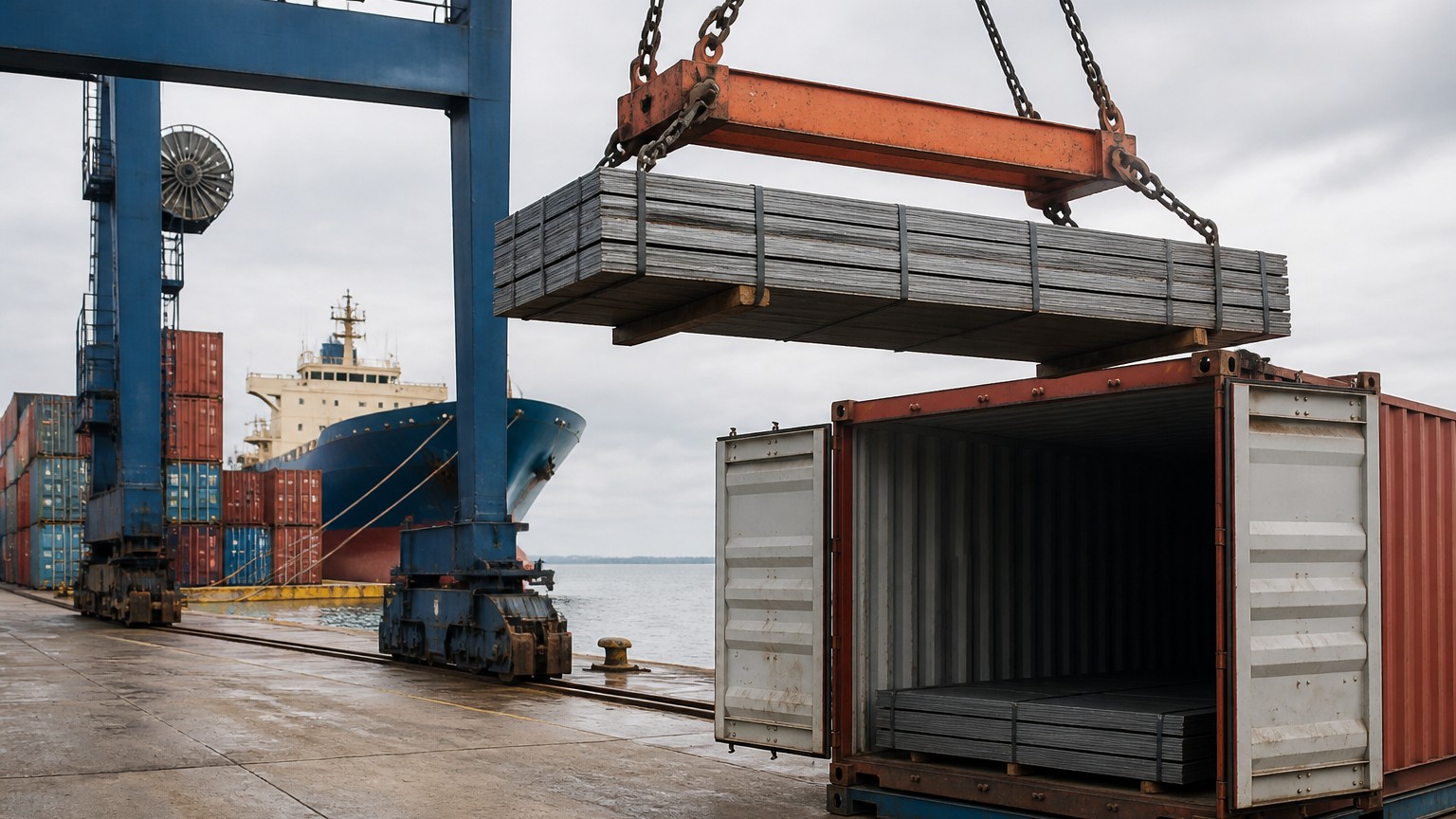
The Incoterm decides how much of the journey the mill price actually covers. An ex-works or FOB quotation leaves ocean freight, insurance, discharge, port charges, customs clearance and inland haulage to the buyer; a CFR or CIF quotation bundles the sea leg; a delivered term pushes responsibility to the seller’s door-to-door arrangements. Between those points sit real, variable costs: container versus breakbulk stowage for heavy plate, lift weight and crane capacity at both terminals, dunnage, edge protection and strapping that decide whether the bundle arrives with clean edges, demurrage and detention charges when a vessel or a box is held beyond free time, and inspection or survey fees when the buyer appoints a third party. None of these is a steel cost, yet together they often explain why the cheapest mill price produces the most expensive delivered tonne.
Currency, financing and the cost of waiting
Steel is traded largely in US dollars, so a buyer whose revenue is in another currency carries an exposure that has nothing to do with the mill. A move of a few percent in the exchange rate can consume the entire margin on a container of plate, and the exposure is usually unhedged because it is treated as an accounting detail rather than a price factor. Financing follows the same pattern: letter of credit charges, payment terms, and the interest cost of holding stock all belong in the comparison. The carry decision is the hardest of the three. Buying early locks the price but converts a price risk into a storage, interest and damage risk; buying late preserves flexibility but accepts lead time and index movement. Most buyers resolve it by treating the specification as the fixed element — a grade such as 316L stainless steel plate in 5 mm 2B finish, for example — and then treating price as the only variable, which inverts the real order of risk, because an unavailable specification costs more than a two percent price move.
How Should an Importer Read Steel Price Trends Before Ordering?
Price forecasts are unreliable; exposure tracking is not, so the practical answer is to measure what your own order is exposed to.
Track the inputs of your grade, watch published capacity and output data, and price freight and duty before comparing suppliers. Then fix quantity, tolerance and payment terms so that a price move cannot change the deal.
A short monthly routine
Four checks cover most of the exposure. First, the input indices that matter for your grade: scrap and iron ore for carbon products, ferroalloys and nickel for austenitic stainless. Second, the supply data: monthly crude steel output from the World Steel Association and the capacity figures published by the OECD, which together show whether the market is tightening or loosening. Third, freight on your own route, quoted rather than remembered, because published averages rarely match the lanes a single buyer uses. Fourth, the trade status of each origin you buy from, including the review dates of any measure that affects it. Keeping those four lines in one page of notes is enough to compare a new quotation with the market it came from instead of comparing it with the last quotation, which is how buyers end up negotiating against their own history rather than against the market.

What protects you when prices move
Contracts protect a buyer in three places, and none of them is the headline price. Quantity planning protects the freight and the schedule: sizing an order to a full container or a full bundle, and splitting deliveries across two shipments, keeps the landed cost stable even when the index moves between them. Price-adjustment clauses protect the value: a formula linked to a published index, with a defined base date, converts a dispute about price into a calculation both sides can verify. Verification protects the material: third-party inspection before shipment, with dimensional and grade checks recorded and the heat number matched to the mill certificate, means that a price argument never turns into a quality argument as well. Buyers who put those three in place find they can accept a price they cannot control, because they control everything around it. If your next requirement involves plate, pipe or tube in a specific grade and tolerance, send your specification and target quantity to our export team and we will confirm the grade, the applicable standard, packing and lead time before the order is placed.
Conclusion: What Should You Watch Next Quarter?
Steel prices follow input costs, capacity discipline and trade friction rather than demand alone. Track those three, price freight and duty properly, and confirm quantity and terms in writing.