
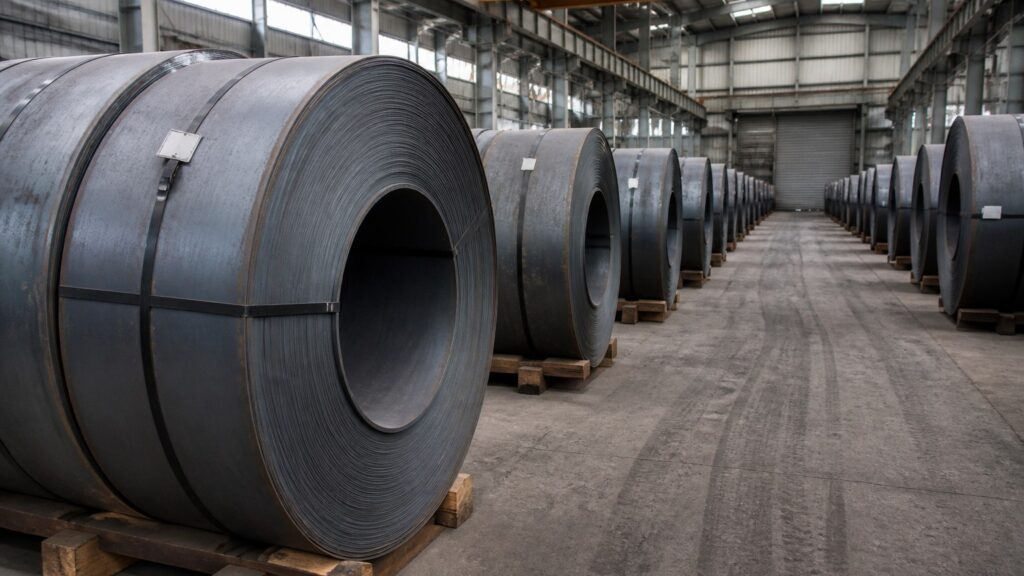
What Is Pickled and Oiled Steel (SPHC)? When Do You Need It?
Scale-covered hot-rolled coil ruins dies, welds and paint adhesion. Pickled and oiled steel strips that scale away and holds the surface rust-free until it reaches your line.
Short answer: Pickled and oiled steel is hot-rolled carbon steel sheet or coil that has been acid-pickled to remove mill scale and then coated with a thin rust-preventive oil. SPHC is the common JIS commercial-quality grade behind it. Specify it when a scale-free, formable surface matters more than cold-rolled tolerances.
Everything that separates a coil which runs cleanly from one that generates a claim is decided in three places: the pickling line, the oiler and the packing line. The sections below follow the material from hot rolling through descaling, oiling, forming and storage, and close with the checks worth writing into a purchase order.
What Is Pickled and Oiled Steel and How Is It Made?
Hot rolling always leaves an oxide skin on the strip, and that skin is the root cause of most weld porosity and premature die wear.
Short answer: Hot-rolled coil is uncoiled, scale-broken, passed through heated acid to dissolve the iron oxides, rinsed, dried and oiled, producing a uniform matte-grey, scale-free surface supplied as coil, cut sheet or slit strip.
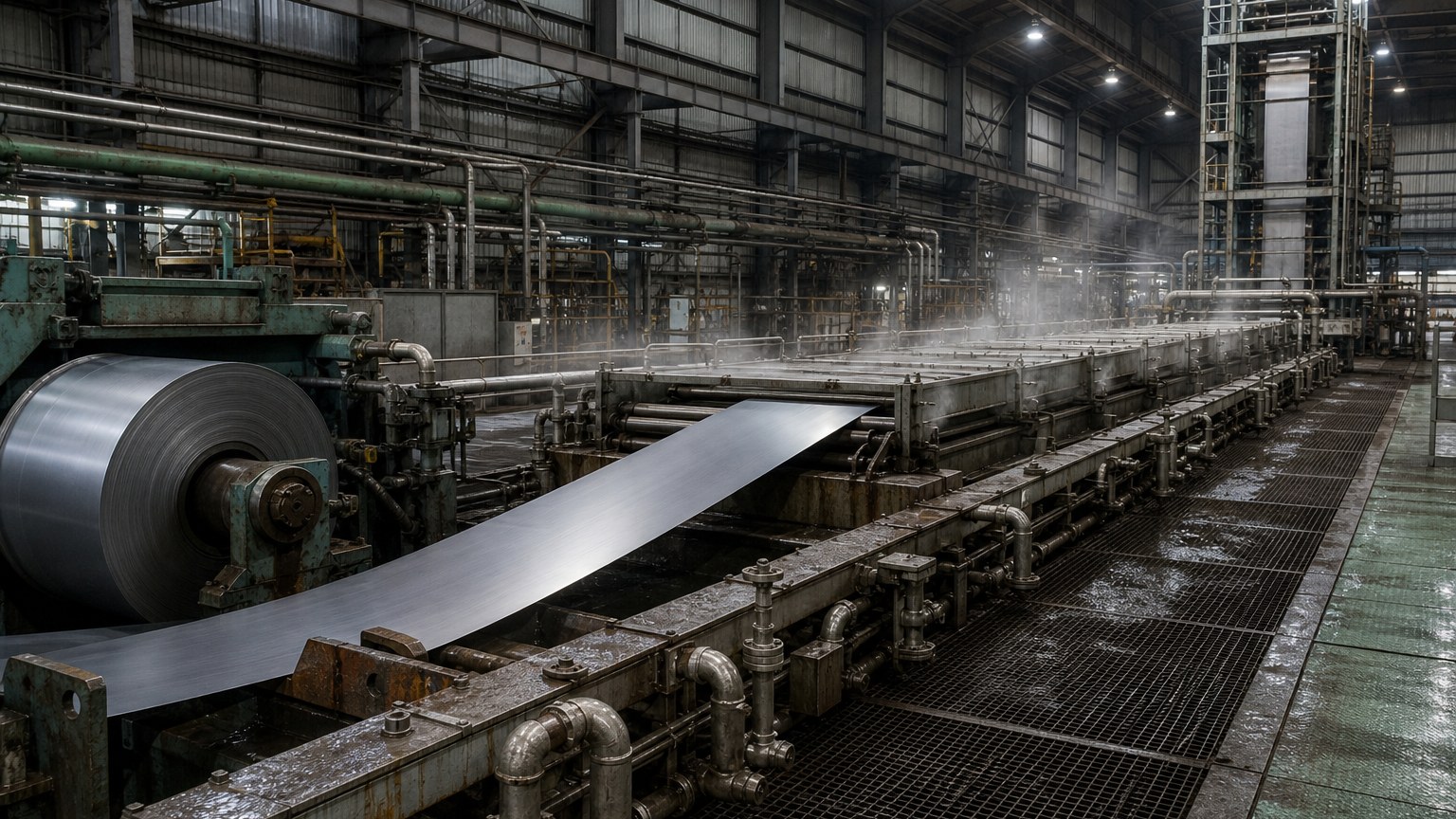
Dive deeper: The sequence starts with hot rolling. When a slab is rolled at high temperature its surface oxidises, and the oxide that survives cooling is mill scale — a brittle, bluish-black layer of mixed iron oxides (wüstite FeO, magnetite Fe3O4 and hematite Fe2O3) that clings only weakly to the steel and flakes away under the first real forming load. On a modern line the coil is uncoiled and passed through a scale breaker and leveller that crack that layer, because acid penetrates cracked scale far faster than an intact film. The strip then travels through a series of heated tanks where hydrochloric acid dissolves the oxides, followed by rinse sections, a dryer and an oiler. Because the scale is dissolved rather than blasted off, the finished surface is chemically clean and uniformly matte grey instead of mottled blue-black — the mechanism behind acid pickling of steel. Three variables decide whether the result is saleable. Acid concentration, temperature and line speed must be matched to the grade and to the incoming scale thickness: run too slowly and residual scale survives in streaks that only appear after painting, run too aggressively and the base metal is over-pickled into a rough, pitted surface that no primer can hide. Drying has to be complete before oiling, because water trapped beneath an oil film is a rust cell from the moment the coil is wound. And the oiler must lay down an even film, since a dry patch is where the first rust bloom shows up in transit. What leaves the line is the product the market calls pickled and oiled steel, or HRPO for short — normally supplied from about 1.0 mm up to roughly 6.0 mm, in coil, cut lengths and slit strip. The line is continuous, not batch: an entry looper lets the strip keep moving while the tail of one coil is welded to the head of the next, which is why surface quality stays consistent from coil to coil rather than drifting through a campaign.
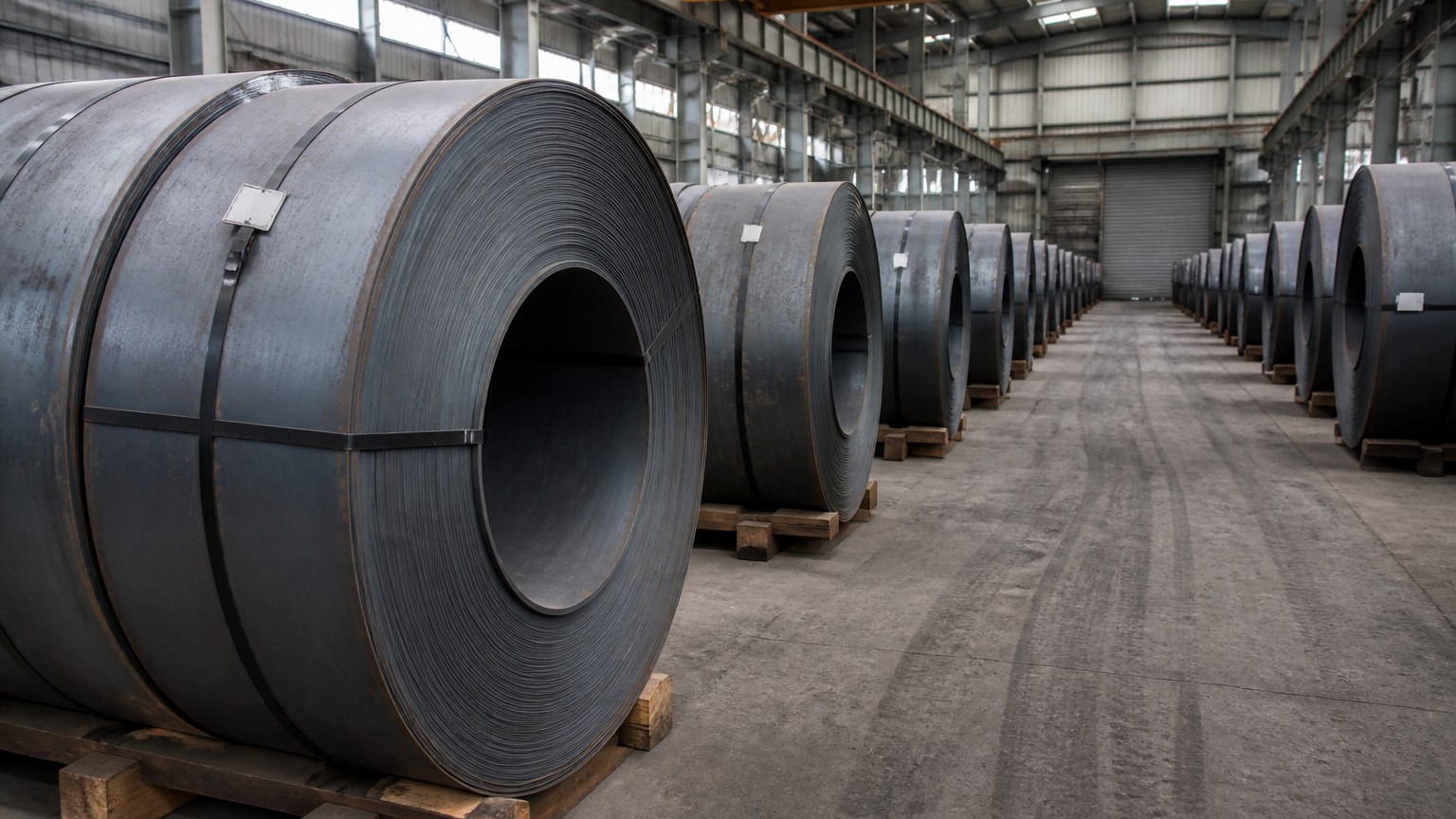
What Does SPHC Mean in a Steel Specification?
Buyers quote SPHC in almost every enquiry and rarely say what it obliges the mill to deliver, which is how a cheap coil ends up in a deep-drawn part.
Short answer: SPHC is a grade in JIS G3131. The letters read steel, plate, hot-rolled, commercial quality — a general forming grade. SPHD and SPHE denote drawing and deep-drawing quality, so the letter after H is the one that matters for formability.
Dive deeper: SPHC is best understood as a designation inside a standard rather than a type of steel. In JIS G3131 the code is built letter by letter: S for steel, P for plate, H for hot rolled, and then a quality letter — C for commercial, D for drawing, E for deep drawing. Each step up the ladder narrows the acceptable chemistry and mechanical range so that the material can survive progressively more severe deformation without cracking. That is why the same nominal thickness and the same supplier can quote two very different prices under two codes that look almost identical on a one-line enquiry: SPHD and SPHE cost more because the mill has to hold tighter control over composition and properties, not because the metal is heavier. The trap is that because SPHC sits at the bottom of the ladder it tends to be treated as a default. If the part is a simple bend, a roll-formed profile or a shallow stamping, commercial quality is usually sufficient and paying for drawing quality is waste. If the part is a drawn housing, a deep shell or anything with a tight bend radius across the rolling direction, commercial quality is the wrong purchase. Standards also do not travel intact between regions. JIS G3131 is a Japanese standard; in the United States the equivalent territory is covered by ASTM A1011/A1011M for hot-rolled carbon sheet and strip, which addresses commercial, drawing and structural qualities with its own designation system, while ISO 3573:2012 defines commercial and drawing qualities for hot-rolled carbon steel sheet internationally. A supplier quoting “SPHC equivalent” is telling you that the material is his interpretation of a Japanese grade, not that a JIS certificate exists. So put the burden of precision on the written order: name the standard, name the quality letter, and state whether a mill certificate is required. Grades are a shorthand; the standard is the contract.
How Does Pickled and Oiled Steel Compare with Hot Rolled and Cold Rolled Steel?
Most over-specification and most field failures come from choosing the wrong one of these three, and the difference is not only surface finish — it is thickness range and forming behaviour.
Short answer: Black hot-rolled coil is cheapest and carries its scale; pickled and oiled steel is the same substrate with a clean, oiled surface in roughly the 1.0 to 6.0 mm band; cold-rolled sheet is thinner, brighter and more formable, and costs more.
Dive deeper: It helps to separate the three families by what each one is for rather than by price alone. Black hot-rolled coil exists to be strong and cheap: it is the material of structural profiles, heavy fabrication and any part that will be shot-blasted or machined before it is finished. Its scale is a nuisance the moment you want to weld, form or coat it, and removing that scale at your own plant — by blasting, grinding or setting up your own acid line — carries labour, waste and environmental cost. Pickled and oiled steel is the answer to that cost: the descaling work has already been done at the mill, on a continuous line that is far more efficient at it than any general fabrication shop, and the oil film buys you weeks of protection instead of hours. Cold-reduced steel is a different proposition again. In place of descaling it substitutes cold rolling — rolling the strip near ambient temperature — which is how the industry produces the thin, smooth, dimensionally tight material that ISO 3574:2012 describes for cold-reduced carbon steel sheet, and it is that extra processing that drives the price. Thickness is the practical dividing line. Above roughly 1.5 to 2.0 mm, cold rolling becomes uneconomic for most buyers and pickled and oiled material is the sensible choice for formed and welded parts. Below about 1.2 mm, black hot-rolled is generally unavailable and the contest is between pickled and cold-reduced. Where a part needs both a cosmetic surface and severe drawing, cold-reduced wins even at a price premium. Where the part will be hidden, galvanized, painted or welded, pickled and oiled usually wins on landed cost.
| Factor | Black hot rolled | Pickled and oiled (HRPO) | Cold reduced |
|---|---|---|---|
| Surface | Blue-black mill scale, brittle | Matte grey, scale-free, oil film | Smooth, bright, tight surface |
| Typical thickness | From about 1.2 mm upward | About 1.0 to 6.0 mm | Below about 2.0 mm |
| Forming | Scale cracks and flakes | Good; clean dies, longer tool life | Best for severe drawing |
| Welding | Scale must be removed first | Weldable after degreasing | Weldable after degreasing |
| Painting | Requires blasting or pickling | Good after degreasing | Best with pretreatment |
| Relative price | Lowest | Middle | Highest |
| Typical use | Structures, profiles, heavy fabrication | Stamping, tube, drums, coating line feedstock | Appliance panels, precision parts |
Why Does Oiling Matter After Pickling?
A freshly pickled surface rusts faster than a scaled one, so the oiler is not a cosmetic step — it is the part of the process that decides whether the coil arrives usable.
Short answer: Pickling leaves bare, chemically active steel that oxidises within hours in humid air. A rust-preventive oil film blocks moisture and buys transport and storage time; it must then be removed before welding, painting or galvanizing.
Dive deeper: Understanding the oiler means understanding that pickling removes protection as well as contamination. Mill scale is not only dirt; an intact scale film actually slows atmospheric corrosion, and the failure mode is a broken scale film, which corrodes the exposed steel faster because the oxide is cathodic to the base metal. Remove the scale entirely and you are left with clean, high-energy steel with no barrier at all. In a humid climate that surface will start to show rust staining within days, and in a container crossing the equator it can happen faster. The oil film is therefore a moisture barrier, applied at the exit end of the line so that it reaches the surface before condensation does. Film weight is normally agreed in grams per square metre rather than as a visual thickness, because what matters is continuity and coverage, not how greasy the coil feels. Two decisions follow from that. The first is which oil, which depends on what happens next: a light rust-preventive oil that welds and paints reasonably after a simple alkaline degrease is the usual choice, while a heavy, waxy protective oil gives better outdoor protection but costs more to strip. The second is whether you want oil at all. Dry-pickled or oil-free pickled material is available, and it suits buyers who will immediately laser-cut or weld and do not want to degrease. The trade is straightforward: no oil means no cleaning step but also a much shorter window. Whichever you choose, the oil is temporary protection, not a treatment. It has to come off before welding, because oil burns into porosity and fume; before painting, because it causes pinholing and adhesion loss; and before hot-dip galvanizing, because the pre-treatment line expects a clean surface. Treat the oil as a bridge between the mill and your first process — and plan the degreasing operation that ends it.
When Should You Specify Pickled and Oiled Steel Instead of Black Hot Rolled or Cold Rolled?
The decision usually comes down to what the scale would cost you if it stayed on the coil: die life, weld quality, coating adhesion or cutting speed.
Short answer: Choose pickled and oiled steel when the part is stamped, roll-formed, welded, laser-cut or fed to a coating line, and when the thickness sits between roughly 1.5 mm and 6 mm. Choose cold-reduced when the surface is visible or the drawing is severe.
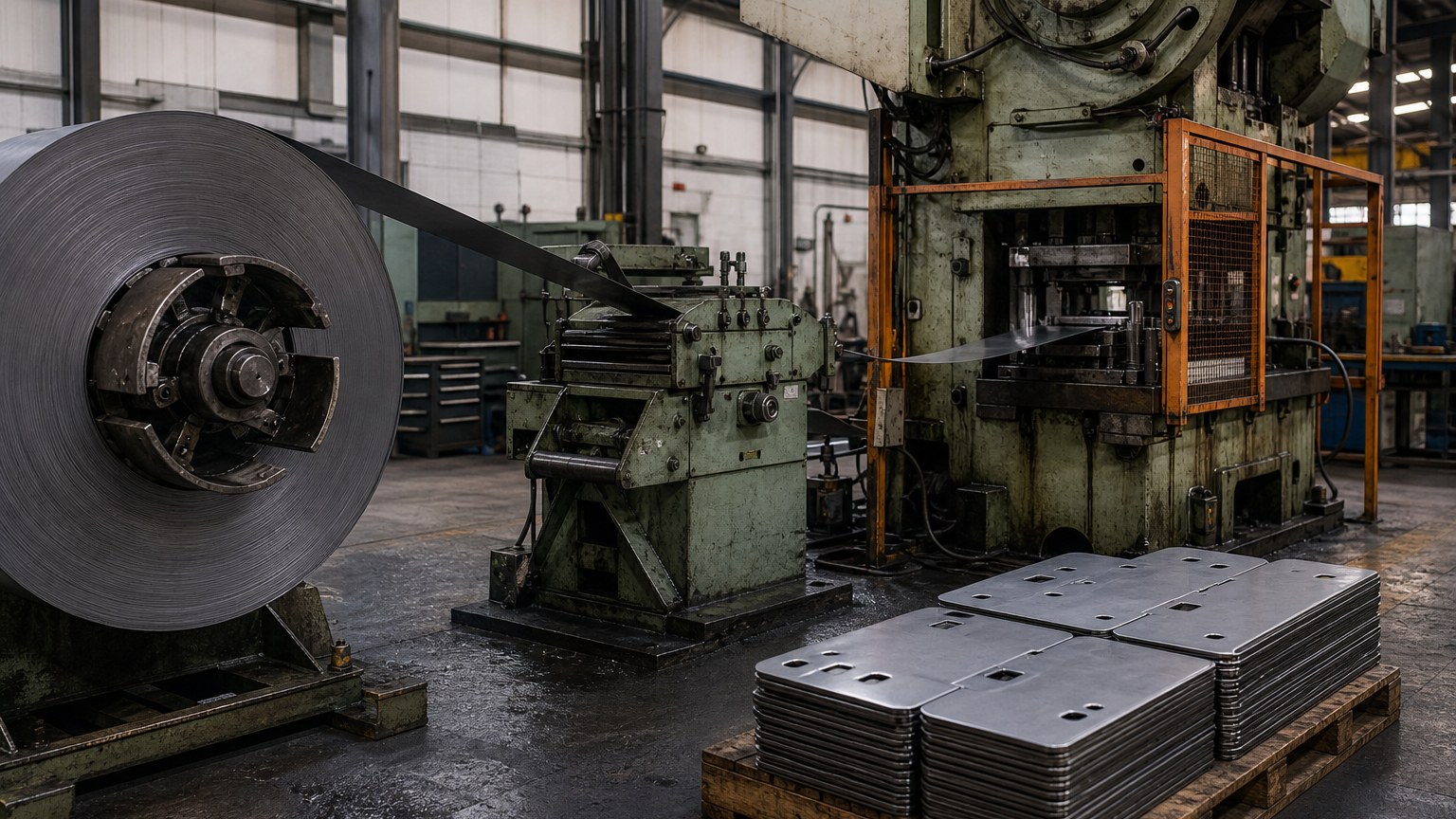
Dive deeper: Start with stamping and press work. Mill scale is abrasive and hard; every scale fragment that passes through a die acts like grit in a bearing, polishing clearance and marking the part, and the cost shows up later as tool refurbishment rather than as an obvious defect. Clean, oiled strip removes that abrasion and, because the oil also lubricates the first forming pass, it usually improves part finish as well. That is why a pickled and oiled steel sheet ordered for press work is often the cheapest way to buy die life. Welding is the second driver. Scale is not weldable in any useful sense: it has to be ground, blasted or pickled off, and in a shop welding drums, pails, tanks, silos, electrical enclosures or shelving, that labour is often more expensive than the material premium. Clean strip lets the welder work directly after a degrease. Third, coating lines. A continuous hot-dip galvanizing or paint line is built on the assumption that it receives scale-free feedstock, because the pre-treatment section is designed to clean light oil and surface soil, not to strip oxide. Feeding it black hot-rolled coil simply shifts the problem downstream. Fourth, tube and roll forming: an ERW tube mill welds the strip edge it has just formed, so scale at the edge converts directly into weld defects, and the same logic applies to cold-formed profiles and sections. Fifth, laser cutting: scale varies in composition across the coil, so the beam absorbs energy inconsistently, producing dross, slower cutting and inconsistent edges on parts that then go straight to a press brake. Add the applications where the finished appearance matters but the thickness is too heavy for cold-reduced material — drums and barrels, furniture and shelving frames, appliance and switchgear enclosures, agricultural equipment, and general fabrication that will be painted. The counter-case is equally clear: if the part will be visible on a consumer product with a bright or decorative finish, or the drawing ratio is deep, cold-reduced sheet in a grade such as the ones covered by cold rolled steel coil grades, remains the correct answer. And when the specification simply calls for a clean, oiled, weldable pickled and oiled steel sheet in coil form, our standard Q355B carbon steel coil in 6.0 mm sits squarely in that band — a structural-grade example of how heavier pickled and oiled material is normally ordered.
How Do You Inspect, Store and Order Pickled and Oiled Steel Correctly?
Almost every pickled and oiled dispute is traceable to a detail that was never written into the order or never checked on arrival.
Short answer: Verify the certificate and coil stencil, measure thickness and width, look for scale streaks, rust staining and dry patches, store indoors on dunnage with the oldest coil used first, and put grade, standard, edge, oil and packing into the written order.
Dive deeper: Inspection starts before the coil is opened. The mill certificate should identify the standard the material was produced to, the grade, the heat number, thickness, width, coil weight and the mechanical results, and the stencil or tag on the coil should match it. Any mismatch between certificate and coil is a stop sign, not a filing question. Then measure rather than assume: thickness with a calibrated micrometer at several points across the width, because a coil that is nominal at the centre and thin at the edge will disappoint a press or a roll former, and width with a tape at both ends of the coil. Look at the surface under raking light. What you are looking for is residual scale streaks, which appear as darker bands parallel to the rolling direction and are a pickling fault rather than transit damage; rust staining, which tells you the oil film failed or water entered the pack; and dry patches, where the oiler missed. Edge condition matters as much as face condition, particularly on slit strip: a burred edge is a handling hazard and a coating defect generator. Storage is where most of the value is saved or lost. Pickled and oiled coil should live indoors, off the concrete on timber or steel dunnage, with airflow around it and away from roof drips and doorways where humid air enters. Large day-to-night temperature swings are the real enemy, because they condense moisture on cold steel; that is why an unheated shed in a coastal climate is harder on this material than a ventilated warehouse inland. Operate first-in, first-out, and re-oil or re-pack coils that will sit for months rather than assuming the original film lasts indefinitely. Finally, put precision into the enquiry: state grade and standard, thickness and tolerance, width, coil weight and inside diameter, mill edge or slit edge, oil type or oil-free, packing for sea freight, and the documents you require. If your process cannot tolerate oil, say so at the enquiry stage rather than discovering it at the degreaser. Send your specification and monthly tonnage to our team at contact Shuncheng Steel for coil, sheet and strip supply, and if you are still weighing substrates, our explanation of how hot rolled and cold rolled steel coil differ picks up where this article leaves off.
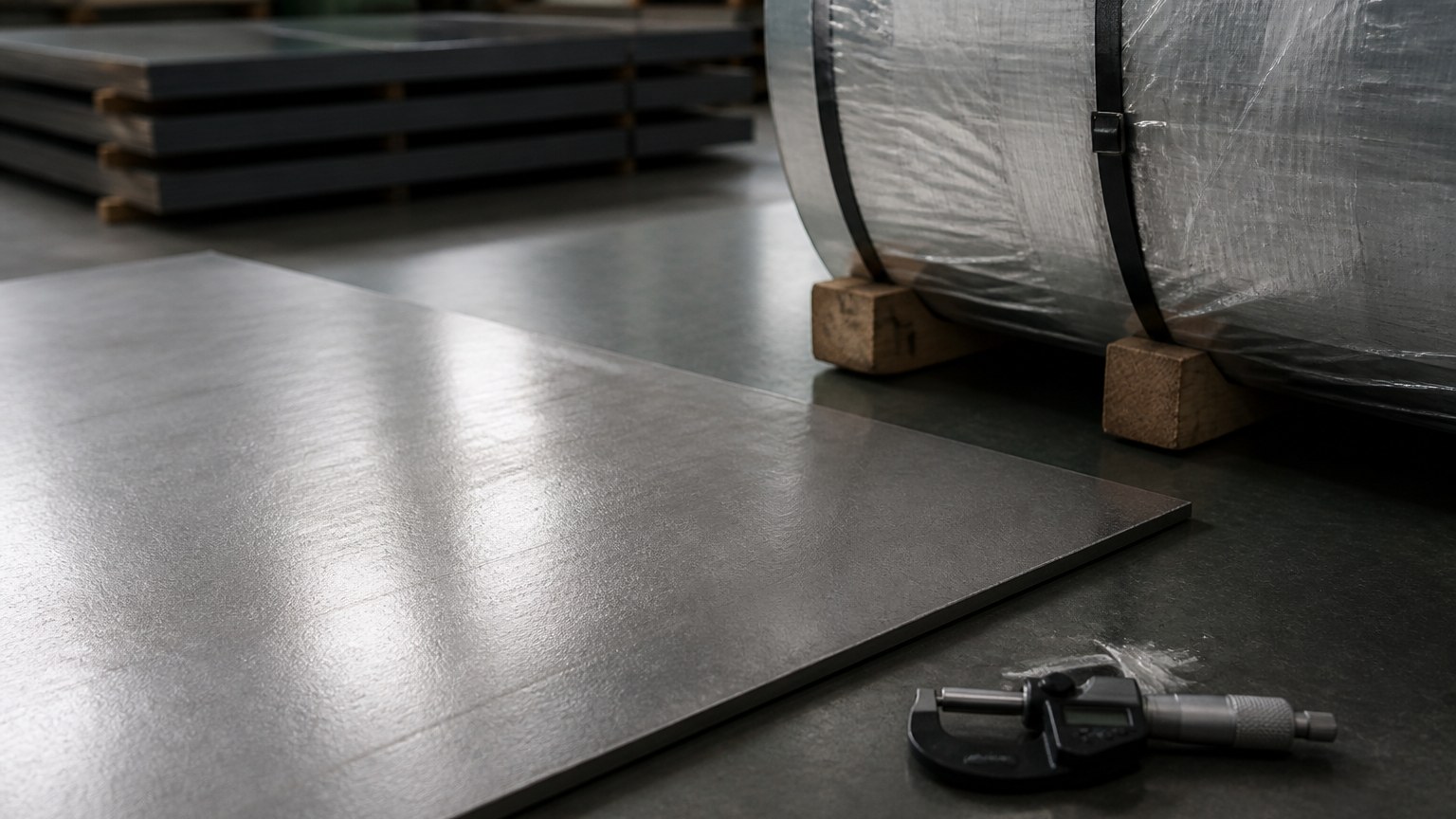
Conclusion: Pickled and oiled steel removes the scale that shortens die life, spoils welds and defeats coatings, at less cost than cold-reduced sheet. Specify standard, oil and tolerances, then verify.